Search

Showing posts with label Slavery and Freedom. Show all posts

20 January 2020

BOOK: Alejandro DE LA FUENTE and Ariela J. GROSS, Becoming Free, Becoming Black Race, Freedom, and the Law in Cuba, Virginia, and Louisiana [Studies in Legal History] (Cambridge: Cambridge University Press, 2020). ISBN 9781108480642, $ 24.95


(Source: CUP)

Cambridge University Press is publishing a new book on Race, Freedom, and the Law in Cuba, Virginia, and Louisiana.

ABOUT THE BOOK

How did Africans become 'blacks' in the Americas? Becoming Free, Becoming Black tells the story of enslaved and free people of color who used the law to claim freedom and citizenship for themselves and their loved ones. Their communities challenged slaveholders' efforts to make blackness synonymous with slavery. Looking closely at three slave societies - Cuba, Virginia, and Louisiana - Alejandro de la Fuente and Ariela J. Gross demonstrate that the law of freedom - not slavery - established the meaning of blackness in law. Contests over freedom determined whether and how it was possible to move from slave to free status, and whether claims to citizenship would be tied to racial identity. Laws regulating the lives and institutions of free people of color created the boundaries between black and white, the rights reserved to white people, and the degradations imposed only on black people.

ABOUT THE AUTHORS

Alejandro de la FuenteHarvard University, Massachusetts

Alejandro de la Fuente is the Robert Woods Bliss Professor of Latin American History and Economics, Professor of African and African American Studies, and the Director of the Afro-Latin American Research Institute at Harvard University, Massachusetts. He is the author of Diago: The Pasts of this Afro-Cuban Present (2018); Havana and the Atlantic in the Sixteenth Century (2008); and A Nation for All: Race, Inequality, and Politics in Twentieth-Century Cuba (2001).
Ariela J. GrossUniversity of Southern California

Ariela J. Gross is the John B. and Alice R. Sharp Professor of Law and History and the Co-Director of the Center for Law, History, and Culture at the University of Southern California Gould School of Law. She is the author of What Blood Won't Tell: A History of Race on Trial in America (2008) and Double Character: Slavery and Mastery in the Antebellum Southern Courtroom (2000).

TABLE OF CONTENTS

Introduction
1. 'A Negro and by consequence an alien': local regulations and the making of race, 1500s–1700s
2. The 'inconvenience” of black freedom: manumission, 1500s–1700s
3. 'The natural right of all mankind': claiming freedom in the age of revolution, 1760s–1830
4. 'Rules … for their expulsion': foreclosing freedom, 1830s–1860
5. 'Not of the same blood': policing racial boundaries, 1830s–1860
Conclusion: 'Home-born citizens: the significance of free people of color.


More info here

28 November 2019

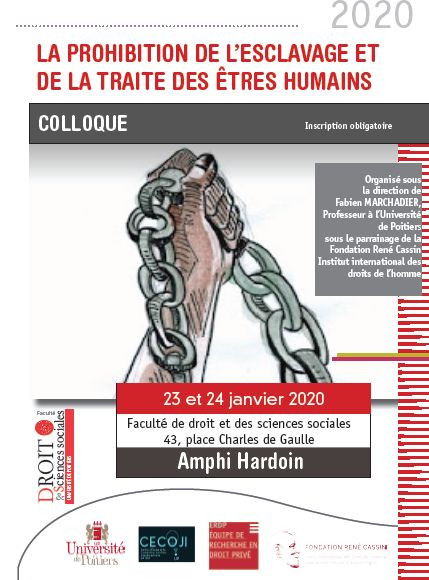
COLLOQUIUM: La prohibition de l’esclavage et de la traite des êtres humains (23-24 January 2020, Paris)


We learned of an international colloquium on the abolition of slavery and the slave trade in Paris coming January.

Particulièrement attentatoire à la dignité de l’homme, au même titre que la torture, l’esclavage fait l’objet d’une prohibition relativement ancienne et d’une grande fermeté. Énoncée dans la convention de Genève relative à l’esclavage du 25 septembre 1926, la prohibition absolue de l’esclavage, quelles que soient les circonstances, est reprise dans l’ensemble des déclarations et conventions protectrices des droits de l’homme. Au sein des États, l’abolition est progressive.

Le Pakistan clôt, en 1992, un processus engagé deux siècles auparavant en 1777 (abolition de l’esclavage dans le Vermont). La réduction en esclavage, autrefois rouage de l’économie (traite négrière), est devenue un crime contre l’humanité (art. 7 Statut CPI).

L’esclavage institutionnel n’existe plus, mais il doit désormais être saisi dans sa réalité factuelle afin de lutter efficacement contre tous les trafics et toutes les formes d’exploitation ayant pour objet des êtres humains, hommes, femmes et enfants. Il perdure dans toutes les régions du monde y compris dans ses manifestations les plus archaïques comme en attestent les marchés aux esclaves en Libye et le traitement réservé aux femmes Yézidies par l’État islamique.

L’esclavage est non seulement une réalité contemporaine, mais il est également un amer souvenir de la conquête du monde et de la colonisation par les européens.

Quelles réponses juridiques, quels recours offrir aux victimes de cette pratique odieuse ? Quelle signification revêt ou devrait revêtir l’esclavage sans pour autant diluer la notion en l’appliquant à des situations licites dans certains États (notamment la gestation pour autrui) ? Quelle distinction opérer entre esclavage, servitude, travail forcé et traite ? Quelle valeur possède le consentement de la victime à son exploitation ? Comment affronter l’esclavage dans ses multiples modalités ainsi que dans ses dimensions spatiales et temporelles ?

L’esclavage est une pratique d’hier et d’aujourd’hui. Les plaies du passé peinent à cicatriser ; le ressentiment des descendants d’esclaves demeure vivace. Entre devoir de mémoire et réparation, comment assumer le passé ? Au présent, la lutte contre l’esclavage associe tant les États que les opérateurs privés, en particulier à travers le devoir de vigilance imposé à certaines entreprises multinationales afin d’éviter qu’elles n’entretiennent indirectement le phénomène par leurs filiales ou sous-traitants établis à l’étranger. Le colloque a pour ambition de réfléchir à ces différentes questions et aux réponses qu’elles sont susceptibles de recevoir.

The full conference program can be found here

25 September 2019

COLLOQIUM: La mémoire du droit dans la lutte contre les formes d’esclavage (Paris, 11 October 2019)


We learned of a colloquium organized by the Association française pour l’histoire de la justice on the theme of “La justice et la mémoire de l’esclavage ancient et moderne”.

Cette journée d’étude représente le 3e temps d’un colloque plurisite organisé sous l’égide de l’Association française pour l’histoire de la justice (AFHJ), sur le thème : La justice et la mémoire de l’esclavage ancien et moderne.

Les deux premiers actes se sont déroulés aux Antilles de la manière suivante :
I. Mémoire passée et réparations, Laboratoire CREDDI (Faculté des Sciences juridiques et économiques de la Guadeloupe, Université des Antilles), 7 novembre 2018 ;
II. Mémoire à travers la littérature et regard sur l’esclavage moderne, Cour d’appel de la Martinique, 9 novembre 2018.

L’esclavage stricto sensu et les autres formes d’exploitation des êtres humains qui lui sont associées (servitude, servage, travail forcé, traite,…) constituent un phénomène présent dans la grande majorité des sociétés à travers le monde depuis l’Antiquité. Or, si les phases des « sociétés esclavagistes », jusqu’au XVe siècle environ, et des « traites légales », jusqu’au XIXe siècle, ont laissé place, au niveau international et à celui d’une partie des États, à celles d’abolitionnisme puis de répression des formes d’esclavage officielles ou généralisées, ce fléau a échoué à être éradiqué. Prenant un aspect souvent plus diffus, d’anciennes formes se sont maintenues et de nouvelles sont apparues, la fondation australienne Walk Free faisant état de 40 millions de victimes à l’échelle de la planète dans la dernière édition de son Global Slavery Index (GSI 2018).

La France, progressivement présentée comme le pays du « sol franc » à partir de la fin de l’époque médiévale, n’est pas demeurée en marge de cette histoire mondiale. Notamment restée une terre de servage jusqu’à la fin de l’Ancien Régime et devenue entre le XVIIe et le XIXe siècle un acteur majeur de la traite négrière en vue du recours à une main d’œuvre d’esclaves dans les « anciennes » colonies, elle enregistrait, cent-soixante-cinq ans après la seconde abolition de l’esclavage en 1848, 8 500 victimes de l’esclavage moderne (GSI 2013)…, 129 000 cinq ans plus tard (GSI 2018).
Comme l’a souligné avec raison l’actuelle présidente du Comité contre l’esclavage moderne (CCEM), association à l’origine de la première condamnation de la France par la Cour européenne des droits de l’homme en raison de l’insuffisance de son dispositif de lutte contre ce phénomène en 2005, cette situation appelle à « lutter contre l’indifférence [des gens] ». Tel est l’un des objectifs poursuivi par le Comité national pour la mémoire et l’histoire de l’esclavage (CNMHE) depuis 2004 et par le projet de Fondation pour la mémoire de l’esclavage, à partir d’un travail d’éclairage sur le passé. Or, parce qu’il se construit dans le temps et laisse une trace tangible, le droit constitue également un utile instrument de la mémoire des formes d’esclavage et de leur évolution, ainsi qu’un important vecteur du « Plus jamais ça ! »

L’objet de la présente journée d’étude est ainsi de rendre compte de ce rôle de mémoire du droit tourné vers l’action contre les formes d’esclavage depuis le début du XIXe siècle, même si son effectivité et son amélioration se heurtent encore (ou surtout) aujourd’hui à une difficile « prise de conscience » de la réalité et de l’ampleur du phénomène.

More info, as well as the full programme, can be found here

28 August 2019

CONFERENCE: Status and Justice in Law, Religion, and Society (Washington and Lee University, 1-3 November 2019)


We learned of a conference “Status and Justice in Law, Religion, and Society” at Washington and Lee University which includes several presentations with a legal-historical angle.

List of presenters:

With topics or titles; more titles to come.

  • Kameliya Atanasova (W&L), on status in Ottoman Turkey
  • David Baluarte (W&L Law): “Family in the Balance: The Human Right to Family Life as a Limit on U.S. Immigration Authority”
  • Carolyn Baugh (Gannon U.), on marriage and unfree status in Islamic legal opinions
  • Linda Bosniak (Rutgers Law): “Who Is a Constitutional Subject?  Citizenship, Personhood, Territoriality”
  • Kristin Collins  (Boston University Law), on personal status, domestic relations, and citizenship
  • Robert Cottrol (George Washington U.), on race, ethnicity, slavery, and discrimination
  • Kevin Crotty (W&L), “Citizenship as Status in Ancient Athens: the Case of Solon”
  • Deepa Das Acevedo (U. Alabama Law): “Just Hindus: The Indian Supreme Court’s Sabarimala Decision”
  • Donald R. Davis (U. Texas, Austin): “Master and Servant Law in Medieval India: What Slavery Might Teach Us about the Nature of Work”
  • Mark Drumbl (W&L Law), on child v. adult status
  • Katharine Gerbner (UMN), on Caribbean slavery, religion/conversion, and racism
  • Sora Han (UC Irvine Law), on slavery, critical race theory, gender, criminality
  • Tim Lubin (W&L): “Personal Status: A Typology in Historical Perspective”
  • Elizabeth Meyer (U. Virginia), on civic statuses in ancient Greece
  • Mona Oraby (Amherst): “Status Conversions: Administering Inequality and Freedom”
  • Michael Satlow (Brown University): “Status or Contract?  The Case of Jewish Marriage”
  • Melissa Vise (W&L): “Legal and Religious Concepts of Medieval persona: Blasphemy at the Limits”
  • Adnan Zulfiqar (Rutgers Law), on status under codified Shariah

More information about the conference can be found here

14 August 2019

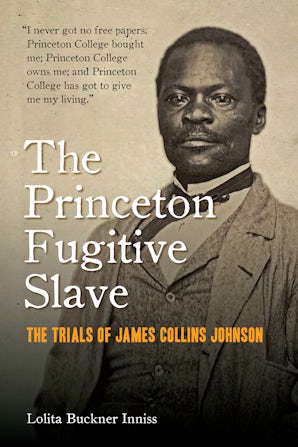
BOOK: Lolita Buckner INNISS, The Princeton Fugitive Slave - The Trials of James Collins Johnson (New York: Fordham University Press, 2019). ISBN 9780823285341, $29.95


Princeton University Press has published a new microhistory of the case of an enslaved person in 19th century America.

ABOUT THE BOOK

James Collins Johnson made his name by escaping slavery in Maryland and fleeing to Princeton, New Jersey, where he built a life in a bustling community of African Americans working at what is now Princeton University. After only four years, he was recognized by a student from Maryland, arrested, and subjected to a trial for extradition under the 1793 Fugitive Slave Act. On the eve of his rendition, after attempts to free Johnson by force had failed, a local aristocratic white woman purchased Johnson’s freedom, allowing him to avoid re-enslavement. The Princeton Fugitive Slave reconstructs James Collins Johnson’s life, from birth and enslaved life in Maryland to his daring escape, sensational trial for re-enslavement, and last-minute change of fortune, and through to the end of his life in Princeton, where he remained a figure of local fascination.

Stories of Johnson’s life in Princeton often describe him as a contented, jovial soul, beloved on campus and memorialized on his gravestone as “The Students Friend.” But these familiar accounts come from student writings and sentimental recollections in alumni reports—stories from elite, predominantly white, often southern sources whose relationships with Johnson were hopelessly distorted by differences in race and social standing. In interrogating these stories against archival records, newspaper accounts, courtroom narratives, photographs, and family histories, author Lolita Buckner Inniss builds a picture of Johnson on his own terms, piecing together the sparse evidence and disaggregating him from the other black vendors with whom he was sometimes confused.

By telling Johnson’s story and examining the relationship between antebellum Princeton’s black residents and the economic engine that supported their community, the book questions the distinction between employment and servitude that shrinks and threatens to disappear when an individual’s freedom is circumscribed by immobility, lack of opportunity, and contingency on local interpretations of a hotly contested body of law.

ABOUT THE AUTHOR

By (author) Lolita Buckner Inniss

Lolita Buckner Inniss, J.D., LL.M., Ph.D., is a professor at Southern Methodist University Dedman School of Law, where she is a Robert G. Storey Distinguished Faculty Fellow. Her research addresses historic, geographic, metaphoric, and visual norms of law, especially in the context of race, gender, and comparative constitutionalism.

More info here

07 January 2019

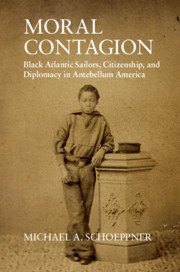
BOOK: Michael A. SCHOEPPNER, Moral Contagion : Black Atlantic Sailors, Citizenship, and Diplomacy in Antebellum America (Cambridge: Cambridge University Press, 2018). ISBN 9781108469999, £ 42.99


(Source: CUP)

Cambridge University Press is publishing a book dealing i.a. with the 19th century “Negro Seamen Acts”.  

ABOUT THE BOOK

Between 1822 and 1857, eight Southern states barred the ingress of all free black maritime workers. According to lawmakers, they carried a 'moral contagion' of abolitionism and black autonomy that could be transmitted to local slaves. Those seamen who arrived in Southern ports in violation of the laws faced incarceration, corporal punishment, an incipient form of convict leasing, and even punitive enslavement. The sailors, their captains, abolitionists, and British diplomatic agents protested this treatment. They wrote letters, published tracts, cajoled elected officials, pleaded with Southern officials, and litigated in state and federal courts. By deploying a progressive and sweeping notion of national citizenship - one that guaranteed a number of rights against state regulation - they exposed the ambiguity and potential power of national citizenship as a legal category. Ultimately, the Fourteenth Amendment recognized the robust understanding of citizenship championed by Antebellum free people of color, by people afflicted with 'moral contagion'.

ABOUT THE AUTHOR

Michael A. Schoeppner, University of Maine, Farmington
Michael A. Schoeppner is Assistant Professor of History at the University of Maine, Farmington.

TABLE OF CONTENTS

Introduction
1. The Atlantic's dangerous undercurrents
2. Containing a moral contagion, 1822–9
3. The contagion spreads, 1829–33
4. Confronting a pandemic, 1834–42
5. 'Foreign' emissaries and rights discourse, 1842–7
6. Sacrificing black citizenship, 1848–59
7. From the decks to the jails to assembly halls: black sailors, their communities, and the fight for black citizenship
Epilogue.

More information here

29 November 2018

CALL FOR PAPERS: White Slavery in Transnational and International Context, 21 June 2019 (University of Warwick, Deadline: 31 January 2019)


Via Legal History Blog, we learned of a CFP on “White Slavery in Transnational and International Context”.

White Slavery in Transnational and International Context, 1880-1950.  June 21, 2019, University of Warwick (UK).  Keynote: Brian Donovan ((University of Kansas)

This is a call for abstracts for paper, poster and creative presentations for a one day interdisciplinary conference on white slavery, as trafficking in women was historically called. The conference seeks to question how white slavery manifested in transnational and international contexts but welcomes papers on any localities.

We welcome papers exploring different aspects of white slavery from nationalism to visual representations, and their impact on anti-white slavery legislation. The conference seeks to investigate white slavery and its legacies from conceptual, legal, popular culture perspectives. It also seeks to place it in relation to wider themes of nationalism, race, gender, and labour, and question how white slavery relates to critiques of modernity.

We invite paper and poster presentations from range of disciplines that explore how white slavery manifested in these different contexts, in different localities, during the years 1880- 1950. The conference is particularly interested in exploring white slavery through the following themes:

* Race, nationality and nationalism
* Regulation / criminalisation of white slavery in domestic and international sphere
* Rhetoric of slavery and neo-abolitionism
* Age, innocence and purity
* Agency, autonomy and free will
* Gender; trafficking in boys / men
* Migration and gendered labour
* Critique of modernity
* White slavery in popular culture / media

We also welcome creative responses to the subject, and in particular poster presentations that engage the audience and foster debate on the conference themes. PG students at any stage of their studies are particularly encouraged to submit proposals for posters or other visual presentations. Poster presentations must be printed in advance of the conference and be size A1, either portrait or landscape (H: 84.1cm x W: 59.4cm); and you have to present in person. Poster session participants populate boards with pictures, data, graphs, diagrams, narrative text, and more - and will informally discuss their presentations with conference attendees during an assigned session.

Please send 300-word abstract for papers and 200-word abstracts for posters with a short bio to the organisers. Deadline is 31 January 2019. PG bursaries may be available.

Dr Catherine Armstrong (Loughborough University) C.M.Armstrong@lboro.ac.uk  and Dr Laura Lammasniemi (University of Warwick) laura.lammasniemi@warwick.ac.uk


12 October 2018

BOOK: Edward Bartlett RUGEMER, Slave Law and the Politics of Resistance in the Early Atlantic World (Cambridge: Harvard University Press, 2018). ISBN 9780674982994, €36.00

(Source: HUP)

Harvard University Press is publishing a book of comparative history on two-hundred years of slave law and resistance in the Early Atlantic World.

ABOUT THE BOOK

The success of the English colony of Barbados in the seventeenth century, with its lucrative sugar plantations and enslaved African labor, spawned the slave societies of Jamaica in the western Caribbean and South Carolina on the American mainland. These became the most prosperous slave economies in the Anglo-American Atlantic, despite the rise of enlightened ideas of liberty and human dignity. Slave Law and the Politics of Resistance in the Early Atlantic World reveals the political dynamic between slave resistance and slaveholders’ power that marked the evolution of these societies. Edward Rugemer shows how this struggle led to the abolition of slavery through a law of British Parliament in one case and through violent civil war in the other.

In both Jamaica and South Carolina, a draconian system of laws and enforcement allowed slave masters to maintain control over the people they enslaved, despite resistance and recurrent slave revolts. Brutal punishments, patrols, imprisonment, and state-sponsored slave catchers formed an almost impenetrable net of power. Yet slave resistance persisted, aided and abetted by rising abolitionist sentiment and activity in the Anglo-American world. In South Carolina, slaveholders exploited newly formed levers of federal power to deflect calls for abolition and to expand slavery in the young republic. In Jamaica, by contrast, whites fought a losing political battle against Caribbean rebels and British abolitionists who acted through Parliament.

Rugemer’s comparative history spanning two hundred years of slave law and political resistance illuminates the evolution and ultimate collapse of slave societies in the Atlantic World.

ABOUT THE AUTHOR

Edward B. Rugemer is Associate Professor of History and African American Studies at Yale University.

TABLE OF CONTENTS

Prologue: At the Heart of Slavery
1. England’s First Slave Society, Barbados
2. Animate Capital
3. The Domestication of Slavery in South Carolina
4. The Militarization of Slavery in Jamaica
5. The Transformation of Slavery’s Politics
6. The Slaveholders Retrench
7. The Political Significance of Slave Resistance
Notes
Acknowledgments
Index

More information here

03 September 2018

BOOK: Loren SCHWENINGER, Appealing for Liberty : Freedom Suits in the South (Oxford: Oxford University Press, 2018). ISBN 9780190664282, $39.95


(Source: OUP)

Oxford University Press is publishing a book on freedom suits in the American South between Independence and the Civil War.

ABOUT THE BOOK

Dred Scott and his landmark Supreme Court case are ingrained in the national memory, but he was just one of multitudes who appealed for their freedom in courtrooms across the country. Appealing for Liberty is the most comprehensive study to give voice to these African Americans, drawing from more than 2,000 suits and from the testimony of more than 4,000 plaintiffs from the Revolutionary era to the Civil War. Through the petitions, evidence, and testimony introduced in these court proceedings, the lives of the enslaved come sharply and poignantly into focus, as do many other aspects of southern society such as the efforts to preserve and re-unite black families. This book depicts in graphic terms, the pain, suffering, fears, and trepidations of the plaintiffs while discussing the legal system—lawyers, judges, juries, and testimony—that made judgments on their "causes," as the suits were often called.

Arguments for freedom were diverse: slaves brought suits claiming they had been freed in wills and deeds, were born of free mothers, were descendants of free white women or Indian women; they charged that they were illegally imported to some states or were residents of the free states and territories. Those who testified on their behalf, usually against leaders of their communities, were generally white. So too were the lawyers who took these cases, many of them men of prominence, such as Francis Scott Key. More often than not, these men were slave owners themselves-- complicating our understanding of race relations in the antebellum period.

A majority of the cases examined here were not appealed, nor did they create important judicial precedent. Indeed, most of the cases ended at the county, circuit, or district court level of various southern states. Yet the narratives of both those who gained their freedom and those who failed to do so, and the issues their suits raised, shed a bold and timely light on the history of race and liberty in the "land of the free."

ABOUT THE AUTHOR

Loren Schweninger is Professor Emeritus of History at the University of North Carolina, Greensboro, where he taught for forty years. He was Director of the Race and Slavery Petitions Project from 1991-2009, creating the Digital Library on American Slavery during his tenure, and is the author of numerous books, including the Lincoln-Prize winning Runaway Slaves: Rebels in the Plantations (2010), co-authored with John Hope Franklin.

More information here

17 July 2018

BOOK: Vanessa HOLLOWAY, Black Rights in the Reconstruction Era (Lanham: Hamilton Books, 2018). ISBN 978-0-7618-7035-7, $70.00


Hamilton Books has published a book on black rights during the reconstruction era.

ABOUT THE BOOK

Most observers and historians rarely acknowledge the history of civil rights predating the twentieth-century. The book Black Rights in the Reconstruction Era pays significant scholarly attention to the intellectual ferment—legal and political—of the nineteenth-century by tracing the history of black Americans’ civil rights to the postbellum era. By revisiting its faulty foundational history, this book lends itself to show that, after emancipation, national and local struggles for racial equality had led to the encoding of racism in the political order in the American South and the proliferation of racism as an American institution.Vanessa Holloway draws upon a host of historical, legal, and philosophical studies as well as legislative histories to construct a coherent theory of the law’s relevance to the era, questioning how the nexus of race and politics should be interpreted during Reconstruction. Anchored in the Reconstruction Amendments, Supreme Court decisions and landmark statutes of the 1860s and 1870s—the Black Codes, the Freedmen’s Bureau, the Civil Rights Act of 1866, the Reconstruction Acts, the Enforcement Acts, and the Civil Rights Act of 1875—Black Rights in the Reconstruction Era offers a new perspective on the political history of law between the years 1865 and 1877. It is predominant in the ongoing debates on social justice and racial inequality.

ABOUT THE AUTHOR

Vanessa Holloway is a historian and philosopher of political theory, legal history, law and policy, and race and rights. She is also the author of Getting Away With Murder: The Twentieth-Century Struggle for Civil Rights in the U.S. Senate (2014) and In Search of Federal Enforcement: The Moral Authority of the Fifteenth Amendment and the Integrity of the Black Ballot (2015).

TABLE OF CONTENTS

Preface
Acknowledgments
Introduction. Unwelcome Changes
Part I. Initial Legal Barriers to Racial Equality, 1865-1868
Chapter 1: Thirteenth Amendment
Chapter 2: Black Codes
Chapter 3: Freedmen’s Bureau
Chapter 4: Civil Rights Act of 1866
Chapter 5: Reconstruction Acts of 1867
Chapter 6: Fourteenth Amendment
Part II. Other Legislative and Constitutional Issues, 1870-1876
Chapter 7: Fifteenth Amendment
Chapter 8: Enforcement Acts of 1870-71
Chapter 9: Civil Rights Act of 1875
Appendix I. Reconstruction Era Congresses and U.S. Presidents
Appendix II. Federal Constitutional Amendments, Acts and Cases
Selected Bibliography

More information here

03 July 2018

BOOK: Bharat MALKANI, Slavery and the Death Penalty: A Study in Abolition. (London: Routledge, 2018). ISBN 9781472452740, £92.00

(Source: Routledge)

Routledge has just published a book on the relationship between the abolitionist movement for slavery and the death penalty.

ABOUT THE BOOK

It has long been acknowledged that the death penalty in the United States of America has been shaped by the country’s history of slavery and racial violence, but this book considers the lesser-explored relationship between the two practices’ respective abolitionist movements. The book explains how the historical and conceptual links between slavery and capital punishment have both helped and hindered efforts to end capital punishment. The comparative study also sheds light on the nature of such efforts, and offers lessons for how death penalty abolitionism should proceed in future. Using the history of slavery and abolition, it is argued that anti-death penalty efforts should be premised on the ideologies of the radical slavery abolitionists.

ABOUT THE AUTHOR

Dr Bharat Malkani researches and teaches in the field of capital punishment, and human rights and criminal justice more broadly. He is a member of the International Academic Network for the Abolition of Capital Punishment, and prior to joining academia he helped co-ordinate efforts to abolish the death penalty for persons under the age of 18 in America.

TABLE OF CONTENTS

Introduction
Chapter 1: The death penalty in the era of slavery
Chapter 2: Capital punishment and the legacy of slavery: 1865–1976
Chapter 3: The legacy of slavery in capital punishment since 1976
Chapter 4: Abolitionism defined
Chapter 5: Radical abolitionist constitutionalism
Chapter 6: The experiential abolitionist
Chapter 7: Abolitionism and "alternatives"
Chapter 8: Non-complicity and abolitionism: from fugitive slaves to lethal injections
Chapter 9: A peculiar abolition


More information here


22 June 2018

BOOK: Martha S. JONES, Birthright Citizens : A History of Race and Rights in Antebellum America (Cambridge: Cambridge University Press, 2018). ISBN 9781107150348, £ 79.99


Later this month, Cambridge University Press will publish the E-Book of “Birthright Citizens - A History of Race and Rights in Antebellum America”. The paperback/hardback (due August 2018) can be pre-ordered here.

ABOUT THE BOOK

Before the Civil War, colonization schemes and black laws threatened to deport former slaves born in the United States. Birthright Citizens recovers the story of how African American activists remade national belonging through battles in legislatures, conventions, and courthouses. They faced formidable opposition, most notoriously from the US Supreme Court decision in Dred Scott. Still, Martha S. Jones explains, no single case defined their status. Former slaves studied law, secured allies, and conducted themselves like citizens, establishing their status through local, everyday claims. All along they argued that birth guaranteed their rights. With fresh archival sources and an ambitious reframing of constitutional law-making before the Civil War, Jones shows how the Fourteenth Amendment constitutionalized the birthright principle, and black Americans' aspirations were realized. Birthright Citizens tells how African American activists radically transformed the terms of citizenship for all Americans.

ABOUT THE AUTHOR

Martha S. Jones, The Johns Hopkins University
Martha S. Jones is the Society of Black Alumni Presidential Professor and Professor of History at The Johns Hopkins University. She was formerly a Presidential Bicentennial Professor at the University of Michigan, and was a founding director of the Michigan Law School Program in Race, Law and History. She is the author of All Bound Up Together: The Woman Question in African American Public Culture, 1830-1900 (2007) and co-editor of Toward an Intellectual History of Black Women (2015).

TABLE OF CONTENTS

Introduction: rights of colored men: debating citizenship in antebellum America
1. Being a native, and free born: race and rights in Baltimore
2. Threats of removal: colonization, emigration, and the borders of belonging
3. Aboard the constitution: black sailors and citizenship at sea
4. The city courthouse: everyday scenes of race and law
5. Between the constitution and the discipline of the church: making congregants citizens
6. By virtue of unjust laws: black laws and the reluctant performance of rights
7. To sue and be sued: courthouse claims and the contours of citizenship
8. Confronting Dred Scott: seeing citizenship from Baltimore city
9. Rehearsals for reconstruction: new citizens in a new era
Epilogue: monuments to men.

More information here

10 May 2015

BOOK: "La Démocratie contre les experts. Les esclaves publics en Grèce ancienne" by Paulin Ismard (Paris, March 2015)


La Démocratie contre les experts. Les esclaves publics en Grèce ancienne, by Paulin Ismard


Paris, Le Seuil (L'Univers historique),  mars 2015, 288 p., 20€
all information here

Supposons un instant que le dirigeant de la Banque de France, le directeur de la police et celui des Archives nationales soient des esclaves, propriétés à titre collectif du peuple français. Imaginons, en somme, une République dans laquelle certains des plus grands serviteurs de l’État seraient des esclaves.

Ils étaient archivistes, policiers ou vérificateurs de la monnaie: tous esclaves, quoique jouissant d’une condition privilégiée, ils furent les premiers fonctionnaires des cités grecques. En confiant à des esclaves de telles fonctions, qui requéraient une expertise dont les citoyens étaient bien souvent dénués, il s’agissait pour la cité de placer hors du champ politique un certain nombre de savoirs spécialisés, dont la maîtrise ne devait légitimer la détention d’aucun pouvoir. Surtout, la démocratie directe, telle que la concevaient les Grecs, impliquait que l’ensemble des prérogatives politiques soit entre les mains des citoyens. Le recours aux esclaves assurait ainsi que nul appareil administratif ne pouvait faire obstacle à la volonté du peuple. En rendant invisibles ceux qui avaient la charge de son administration, la cité conjurait l’apparition d’un État qui puisse se constituer en instance autonome et, le cas échéant, se retourner contre elle.

Que la démocratie se soit construite en son origine contre la figure de l’expert gouvernant, mais aussi selon une conception de l’État qui nous est radicalement étrangère, voilà qui devrait nous intriguer.

Author
Paulin Ismard est maître de conférences en histoire grecque à l’université Paris 1 Panthéon-Sorbonne. Il a récemment publiéL’Événement Socrate (Flammarion, 2013, prix du livre d’histoire du Sénat 2014)

15 April 2015

WORKSHOP: "Between slavery and freedom: aspects of manumission in the ancient world. The ancient Near East, Greece, and Rome" (Edinburgh, 1 May 2015)


WHAT Between slavery and freedom: aspects of manumission in the ancient world. The ancient Near East, Greece, and Rome, one-day Workshop

WHEN Friday 1 May 2015, 9:30 am - 6:00 pm 

WHERE Sydney Smith Lecture Theatre, doorway 1, Old Medical Quad, Teviot Place

all information here

Hosted by the School of History, Classics and Archaeology, this workshop will bring together scholars working on manumission and slavery in both the classical world (Greece and Rome), and the Near East to debate specific aspects of the manumission process and the lives of freed slaves.

Transition from slavery to freedom

Recent monographic work on ancient slavery has included a number of significant studies of manumission and freedmen. But despite these monographic treatments, it has become ever clearer that seminal aspects of the processes involved in slave manumission are understudied (including the workings and the place of peculium, the slave’s ability to amass possessions that enables him or her to purchase their freedom, the role played by the slave’s gender in the manumission process and prospects, etc.).
Moreover, the status of freed slaves remains subject to debate. In light of the prominence of evidence for manumission and the importance of status in ancient societies, the transition from slavery to freedom is central to our understanding of the peculiar institution in the ancient world.

Workshop programme

There will be three formal sessions: one on Rome, one on Greece, and one on Near Eastern slavery and manumission.
Each speaker is allocated one full hour for paper delivery and ensuing discussion, followed by a plenary discussion session at the end of the day chaired by the workshop organisers.