Search

Showing posts with label Slave trade. Show all posts

12 March 2024

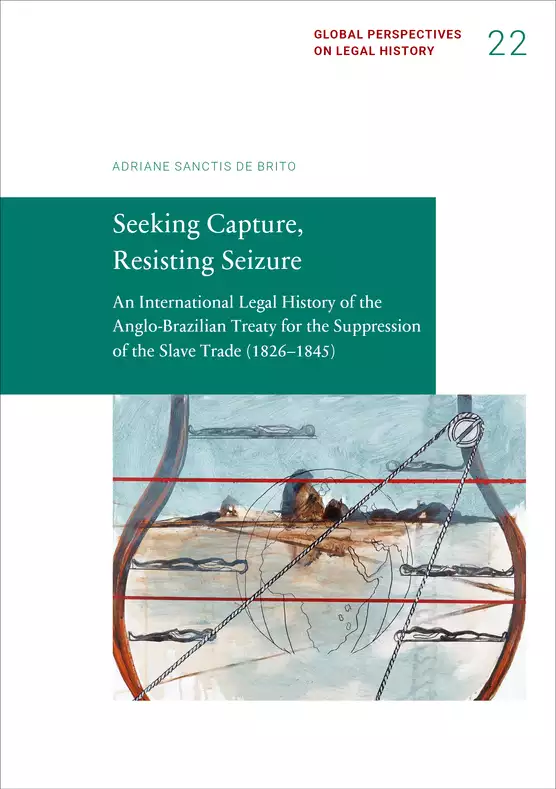
BOOK: Adriane SANCTIS DE BRITO, Seeking Capture, Resisting Seizure. An International Legal History of the Anglo-Brazilian Treaty for the Suppression of the Slave Trade (1826–1845) (Frankfurt am Main: Max-Planck-Institut für Rechtsgeschichte und Rechtstheorie, 2023). ISBN: 9783944773421 [OPEN ACCESS]

(Image source: Max-Planck-Institut)


ABOUT THE BOOK

The treaties to suppress the slave trade were the subject of intense legal battles and debates in the first half of the 19th century. By delving into the legal disputes that took place within the context of the Anglo-Brazilian treaty, this book highlights the political importance of what might at first glance be perceived as little more than argumentative hurdles over the rules and proceedings regarding the search and capture of ships. Some of these legal battles were carried out in the correspondence between the Foreign Offices, sometimes between diplomatic representatives or within mixed commissions, while still others involved the process of interpretation and the resignification that took place over the course of years and involved a multiplicity of exchanges between various actors and institutions.

Britain constantly pushed to expand the legal use of force and possibilities of capture within the spaces outlined by the treaty regime. Brazil actively engaged in the legal interpretation, and in so doing created an argumentative onus that would later continue to transform British legal approaches and the very expectations about the content of the law the two parties were applying.

By constantly challenging the scope and limits of the treaty, Brazilian representatives slowed down the process of abolishing the slave trade, thus preserving the perverse practice, while at the same time protecting Brazil’s independence against the expansion of British interference. Whether reading the bilateral treaty clauses as analogous to or differently from prize law or general international law, the day-to-day interpretation forged anti-slave trade rules that kept ships, instead on enslaved people, protagonists of slave trade suppression mechanisms.

This history of the Anglo-Brazilian treaty provides more detail about the mechanisms created by international law to combat the slave trade. It also reveals the complex legal translations of state inequality, humanitarianism, violence, and the fine line between war and peace.


ABOUT THE AUTHOR

Adriane Sanctis de Brito’s research focuses on the international histories of legal imagination related to peace, humanitarianism, and the suppression of the slave trade. Currently, she is a visiting scholar at the Institute for Global Law and Policy at Harvard Law School. She received her PhD from the University of São Paulo and previously served as an adjunct professor at the university’s International Relations Institute. As a co-founder of the Brazilian think tank LAUT, she leads projects examining how contemporary reactionary movements reimagine and reconfigure legal language and human rights. The research for this book was made possible by scholarships that supported research stays at the University of São Paulo, the University of Melbourne, the Max Planck Institute Luxembourg for Procedural Law, and the University of Helsinki.


More information and the entire publication can be found here.

10 May 2021

BOOK: Claudia STORTI. Economia e politica vs libertà Questioni di diritto sulla tratta atlantica degli schiavi nel XIX secolo. (Torino: Giappichelli, 2020). ISBN 9788892129726. EUR 20.


(Source: https://www.giappichelli.it/economia-e-politica-vs-liberta)

We have learned of the new book of Claudia Storti on international law and slave traffic in the Atlantic.

Prologo 
QUALE DIRITTO PER L’ABOLIZIONE DELLA TRATTA E DEL COMMERCIO DI ESSERI UMANI? 

Capitolo 1 LA TRATTA ‘ATLANTICA’ DEGLI SCHIAVI TRA XVI E XIX SECOLO 

Capitolo 2 IL DIRITTO DELLE GENTI NEL MEDIOEVO

Capitolo 3 LA SCHIAVITÙ NEL DIBATTITO SUL TRATTAMENTO E SULLA DEPORTAZIONE DEGLI INDIGENI AGLI INIZI DELL’ETÀ MODERNA

Capitolo 4 SCHIAVITÙ DEI CORPI E LIBERTÀ DELLE MENTI. LA SCHIAVITÙ TRA DIRITTO DELLE GENTI E DIRITTO NATURALE 


Parte II TRATTA ATLANTICA E SCHIAVITÙ NELLA LEGISLAZIONE E NELLA PRASSI DI ETÀ MODERNA  

Capitolo 5 UOMINI O COSE? LA CONDIZIONE GIURIDICA DEGLI UOMINI AFRICANI NELLA TRATTA ATLANTICA E NELLA SCHIAVITÙ DEL NUOVO MONDO

Capitolo 6 TRATTA E SCHIAVITÙ NELLA LEGISLAZIONE E NELLA PRASSI DELL’EUROPA TRA SEI E SETTECENTO 

Capitolo 7 PROPOSTE E TENTATIVI DI ABOLIZIONE DELLA TRATTA DEGLI SCHIAVI 


Parte III POLITICA, GIUSTIZIA, DIPLOMAZIA E DIRITTO INTERNAZIONALE TRA OTTOCENTO E NOVECENTO  

Capitolo 8 GLI EFFETTI DELLE LEGGI ABOLITIVE STATUNITENSE E INGLESE DEL 1807 NEL CONTESTO INTERNAZIONALE

Capitolo 9 FONTI E RUOLO DEL DIRITTO INTERNAZIONALE IN CONTROVERSIE SULLE NAVI NEGRIERE NELLE CORTI DEGLI STATI UNITI 

Capitolo 10 GIUSTIZIA, UMANITÀ E CONFLITTO TRA LEGGI: JOSEPH STORY E IL CASO DELLA JEUNE EUGÉNIE

Capitolo 11 LIBERTÀ DELLE NAZIONI E SCHIAVITÙ DEGLI UOMINI: IL CASO ANTELOPE 

Capitolo 12 GIUSTIZIA, POLITICA E DIPLOMAZIA. L’ULTIMA FATICA DI JOHN QUINCY ADAMS SUL CASO AMISTAD

Capitolo 13 IL RUOLO DELLA DIPLOMAZIA TRA 1842 E 1888

Capitolo 14 IL COMMERCIO DI ESSERI UMANI TRA DIRITTO CONVENZIONALE E AFFERMAZIONE DEI DIRITTI UMANI


Claudia Storti is full professor of History of Medieval and Modern Law at the Università degli Studi di Milano. 


More information: https://www.giappichelli.it/economia-e-politica-vs-liberta  

04 December 2020

DATABASE : Enslaved – People of the Historical Slave Trade

(Source: Enslaved)

We learned of the online launch of the database Enslaved – Peoples of the Historical Slave Trade.

Enslaved: Peoples of the Historical Slave Trade has a long history with digital collections about enslavement. In 2011, the project originated from an earlier digital humanities project Slave Biographies: The Atlantic Database Network funded by the National Endowment of the Humanities. This project initiated six years of work to develop the needed partnerships as well as plans for possible infrastructure, controlled vocabularies, and data models to do a larger project that would bring together datasets on enslaved people from around the world. A larger project offered many challenges given the disparate, dispersed, and idiosyncratic structure of much of the data.

In 2017, the opportunity to move Enslaved.org project forward came with a planning grant from The Andrew W. Mellon Foundation. After a successful planning stage, in 2018, the Foundation funded Phase 1 of Enslaved.org, to build a proof of concept. The idea was simple: given the complex nature of the plans and the many problems with the data and the innovative nature of the technologies, we needed to prove the project could be done. After successfully doing so, in 2019, Mellon funded an implementation grant to begin populating Enslaved.org with data and begin publishing the Journal of Slavery and Data Preservation as a gateway for including new datasets through peer review into Enslaved.org.

[…]”

More info about the project can be found on Enslaved.org

25 August 2020

SEMINAR: Slaveryarchive Book Club


(Source: Slavery Archive)

The Slavery Archive has created a book club that organizes a session of Zoom meetings focusing on new books on slavery and the Afro-Atlantic world.

The #Slaveryarchive book club is an online initiative put together by scholars Ana Lucia Araujo (Howard University), Jessica Johnson (Johns Hopkins University), Vanessa Holden (University of Kentucky), and Alex Gil (Columbia University) to discuss newly published books on slavery and the Afro-Atlantic world. These hard times force us to stay physically apart but encourage us to create digital connections. In many ways digital meetings are more inclusive as readers and authors across the globe can connect without the usual financial and time barriers that separate us.


How can I attend? Get the book prior to each session, read it, register to attend the meeting on Zoom (check below each meeting for registration links) or watch the sessions live or whenever you want on the #Slaveryarchive book club channel on Youtube. Please note that if you choose to attend on Zoom, each meeting requires a new registration.


How do the meetings work? Authors or editors make a short presentation of their respective books. Attendants can ask questions and provide comments if they wish. If you attend on Zoom you will ask questions orally by first raising your hand (tool of the bottom of the Zoom screen). Please note that you are being broadcast on Youtube and the video will remain there. If you attend on Youtube live, you can type your questions in the chat box and we will read the questions to the author.


Meetings are held on Wednesdays once or twice a month from 5:00 PM to 7:00 PM. Authors based in Europe or Africa present on Saturdays from 1:00 PM to 3:00 PM. All meetings are held at EST time United States and Canada.


All upcoming meetings and book titles can be found here

28 November 2019

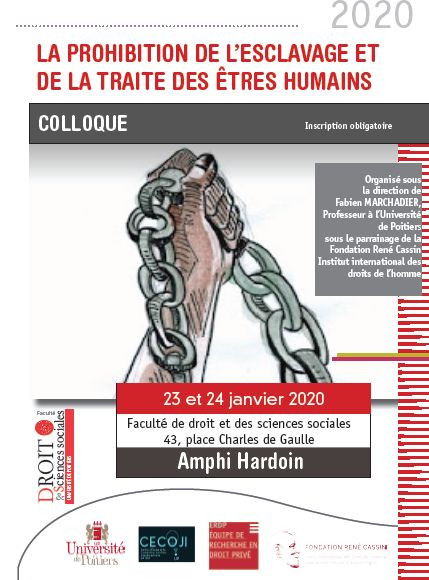
COLLOQUIUM: La prohibition de l’esclavage et de la traite des êtres humains (23-24 January 2020, Paris)


We learned of an international colloquium on the abolition of slavery and the slave trade in Paris coming January.

Particulièrement attentatoire à la dignité de l’homme, au même titre que la torture, l’esclavage fait l’objet d’une prohibition relativement ancienne et d’une grande fermeté. Énoncée dans la convention de Genève relative à l’esclavage du 25 septembre 1926, la prohibition absolue de l’esclavage, quelles que soient les circonstances, est reprise dans l’ensemble des déclarations et conventions protectrices des droits de l’homme. Au sein des États, l’abolition est progressive.

Le Pakistan clôt, en 1992, un processus engagé deux siècles auparavant en 1777 (abolition de l’esclavage dans le Vermont). La réduction en esclavage, autrefois rouage de l’économie (traite négrière), est devenue un crime contre l’humanité (art. 7 Statut CPI).

L’esclavage institutionnel n’existe plus, mais il doit désormais être saisi dans sa réalité factuelle afin de lutter efficacement contre tous les trafics et toutes les formes d’exploitation ayant pour objet des êtres humains, hommes, femmes et enfants. Il perdure dans toutes les régions du monde y compris dans ses manifestations les plus archaïques comme en attestent les marchés aux esclaves en Libye et le traitement réservé aux femmes Yézidies par l’État islamique.

L’esclavage est non seulement une réalité contemporaine, mais il est également un amer souvenir de la conquête du monde et de la colonisation par les européens.

Quelles réponses juridiques, quels recours offrir aux victimes de cette pratique odieuse ? Quelle signification revêt ou devrait revêtir l’esclavage sans pour autant diluer la notion en l’appliquant à des situations licites dans certains États (notamment la gestation pour autrui) ? Quelle distinction opérer entre esclavage, servitude, travail forcé et traite ? Quelle valeur possède le consentement de la victime à son exploitation ? Comment affronter l’esclavage dans ses multiples modalités ainsi que dans ses dimensions spatiales et temporelles ?

L’esclavage est une pratique d’hier et d’aujourd’hui. Les plaies du passé peinent à cicatriser ; le ressentiment des descendants d’esclaves demeure vivace. Entre devoir de mémoire et réparation, comment assumer le passé ? Au présent, la lutte contre l’esclavage associe tant les États que les opérateurs privés, en particulier à travers le devoir de vigilance imposé à certaines entreprises multinationales afin d’éviter qu’elles n’entretiennent indirectement le phénomène par leurs filiales ou sous-traitants établis à l’étranger. Le colloque a pour ambition de réfléchir à ces différentes questions et aux réponses qu’elles sont susceptibles de recevoir.

The full conference program can be found here

14 October 2019

BOOK: Emily HASLAM, The Slave Trade, Abolition and the Long History of International Criminal Law The Recaptive and the Victim (London: Routledge, 2019). ISBN 9781138348899, £92.00


(Source: Routledge)

Routledge is publishing a new book on the slave trade, abolition, and the link with the history of international criminal law.

ABOUT THE BOOK

Modern international criminal law typically traces its origins to the
 20th century Nuremberg and Tokyo trials, excluding the slave trade and abolition.  Yet, as this book shows, the slave trade and abolition resound in international criminal law in multiple ways. Its central focus lies in a close examination of the often-controversial litigation, in the first part of the nineteenth century, arising from British efforts to capture slave ships, much of it before Mixed Commissions.  With archival-based research into this litigation, it explores the legal construction of so-called ‘recaptives’ (slaves found on board captured slave ships). The book argues that, notwithstanding its promise of freedom, the law actually constructed recaptives restrictively. In particular, it focused on questions of intervention rather than recaptives’ rights.  At the same time it shows how a critical reading of the archive reveals that recaptives contributed to litigation in important, but hitherto largely unrecognized, ways. The book is, however, not simply a contribution to the history of international law. Efforts to deliver justice through international criminal law continue to face considerable challenges and raise testing questions about the construction – and alternative construction – of victims. 

By inscribing the recaptive in international criminal legal history, the book offers an original contribution to these contentious issues and a reflection on critical international criminal legal history writing and its accompanying methodological and political choices.

ABOUT THE AUTHOR

Dr Emily Haslam is Senior Lecturer in International Law at Kent Law School. Her research interests lie in the field of international criminal law, international legal history and civil society. She has extensive experience teaching international law, international criminal law and transnational criminal law.

TABLE OF CONTENTS

1 Rethinking International Criminal Legal History;
2 Where It All Began: Prize;
3 The Piracy Analogy and the Slave Trade;
4 Mixed Commissions and the Expansion of Intervention;
5 After Seizure: The Hazards of Recaptivity;
6 Prize, Property and the Economies of Slave Trade Repression;
7 Back to the Present: Recaptives, Victims and Creditors;
8 Conclusion;

More info here

02 October 2018

CFP: Zulueta 360: ‘The Trial of Pedro De Zulueta on a Charge of Slave Trading’ (1844) in Context (DEADLINE: 12 October 2018)


We learned of a Call for Delegates for a workshop on various aspects of the 19th century Zulueta slave trade case. Here the call:

The workshop will take place at The Wallace Collection in London

20 November 2018

The Zulueta family name is not very well known outside of Basque and some slave trade historiography. However, one of the family members, Pedro José de Zulueta (1809-82) is unique for two reasons. Pedro José de Zulueta was put on trial at the Old Bailey for the crime of slave trading in 1843 and, after he was acquitted, he published a monumental tome about his trial in order to exonerate himself further in the eyes of the London merchant community. It is this publication, The Trial of Pedro de Zulueta, Jun. On a Charge of Slave Trading, that is at the centre of the workshop.

Running to almost 500 pages and covering topics from parliamentary inquiries into the slave trade on the West African coast to the Spanish merchant community of London, the book is an unwieldy source. It is difficult to get a sense of it as whole because it is such a convoluted product of its time but it offers a valuable window on Spanish involvement in the trans-Atlantic slave trade and British attempts at its suppression. However, to penetrate the source and make it accessible requires contextualization and a variety of expertise that can draw out its value. This interdisciplinary workshop will bring together members of the academic community from diverse fields of expertise to explore the wider legal, social and cultural context for Zulueta’s book. This is the link to the book:


 Workshop Format
Each delegate will be chosen for their expertise in an area that is central to the Zulueta book. We ask delegates to prepare a talk of no more than 15 minutes, exploring the text and/or its context from the perspective of their own field of interest. We’re interested above all in making sense of the society that gave rise to Zulueta’s trial, and to which his self-defence was addressed. Suggested areas for discussion include:

Royal Navy
African Coast
History of London
Catholicism in London
Slave-trade in London
London Shipping Industry
London Business History
The Legal aspects of Slave-trade Suppression
The Spanish Community in London
Cuban Slave-trade
The Basque dimension
The Old Bailey experience

 Future Digital Publication of the Zulueta Book

The goal of this workshop is to make Zulueta’s book accessible to a wide audience within and beyond the academy. To this end, the Imperial Entanglements project plans to produce an annotated digital version of parts of the Zulueta book with accompanying contextual studies based on the contributions to this workshop.

We particularly encourage PhD students to participate in the workshop. If you are interested in presenting please email Dr. Anna Brinkman at:
a.brinkman@warwick.ac.uk

We are not asking for an abstract at this stage but please email us with your preferred area of discussion along with a paragraph on how your research can contribute to the workshop by Friday 12 October 2018.