Search

26 February 2011

CALL FOR PAPERS: The Language of Law: Classical Perspectives

I just received the following:

The Language of Law: Classical Perspectives

Special Workshop at the XXV. World Congress of Philosophy of Law and Social Philosophy (Frankfurt am Main, 15–20 August 2011)

entwurf3c_verkleinertWhile in recent scholarship there are some signs that 20th-century boundaries between disciplines as Legal Theory, Classics, Legal History and Linguistics become penetrable, interdisciplinary discourse among exponents of these fields is at best sporadic. The aim of the workshop is to bring together scholars working on linguistic aspects of (ancient and contemporary) law from different backgrounds and to facilitate the exchange of ideas through the discussion of their research papers.

The rationale for exploring classical perspectives on the language of law is that encounters of this kind have proven to be mutually enriching: contemporary insights may help to make sense of ancient theories and indeed practices, while the analysis of ancient sources continues to provide useful frameworks for contemporary legal thought.

Papers for the workshop would be both theoretically informed and based on a thorough reading of relevant sources from Classical Antiquity. Possible topics include but are not limited to: legal interpretation, judicial rhetoric, the semiotics of law, law as literature, philosophical approaches (ancient or contemporary) to law. Papers addressing theoretical or methodological questions as well as ‘case studies’ focusing on a single text may be considered. The pre-circulation of the papers is hoped to contribute to a discussion-led style of workshop.

Abstracts for consideration should be sent by e-mail to

Miklós Könczöl (miklos.konczol@dur.ac.uk)
Durham University, Department of Classics and Ancient History
Pázmány Péter Catholic University, Department of Legal Philosophy

The deadlines are: 31 March, 2011 for abstracts and 31 May, 2011 for full papers.

Participants have to be registered for the conference. For further details see the conference website: http://www.ivr2011.org/

25 February 2011

CALL FOR PAPERS: Roman Legal Tradition

I just received the following:

Call for papers: Roman Legal Tradition

The editors and board of Roman Legal Tradition welcome manuscripts in English for the 2011 issue.

 Roman Legal Tradition is a peer-reviewed journal dedicated to the civilian tradition in ancient, medieval, and modern law. It is published by the Ames Foundation at the Harvard Law School and the University of Glasgow School of Law. It seeks to promote the study of the civilian legal tradition in English.

Roman Legal Tradition is an open access periodical. Contents are available free of charge for all non-commercial purposes, and contributors are encouraged to reproduce and distribute their work freely, as well as upload their work to public and institutional repositories.

Contents are distributed by HeinOnline, and available for download from the journal website.

Editor

Ernest Metzger, University of Glasgow School of Law

President of the Board of Editors

Charles Donahue, Jr., Harvard Law School

ISSN 1943-6483
www.romanlegaltradition.org

22 February 2011

CALL FOR PAPERS: Australia and New Zealand Law and History Society Conference (Brisbane, Australia - 12-13 December 2011)

I just received the following:

The 30th annual conference of the Australia and New Zealand Law and History Society will be held in Brisbane, Australia, 12-13 December 2011. The 2011 conference theme – “Private Law, Public Lives” - examines the social dimensions of private law in history. What has been the historical role of private law in the creation of core social values? How did private law in areas such as the laws of marriage, property, succession, labour or contract, for example, shape colonial and postcolonial societies? What are the wider social implications of family law as well as commercial, corporations, competition or insurance law in the common law world and beyond? Proposals are invited from scholars in the fields of law, history and related disciplines. Proposals from all jurisdictions are welcome.

Paper proposals, including paper title, abstract (300 words max.) and brief author bio, should be sent by email to:

Conference committee
"Private Law, Public Lives"
30th annual conference of the ANZLHS
Brisbane, Australia

at lawhistconf@uq.edu.au by 14 May 2011.

The conference is hosted by the University of Queensland, and will be held at the historic Customs House, located on the shores of the Brisbane River.

NOTICE: New American Journal of Legal History Website

The American Journal of Legal History now has a website.

As the website states,

The American Journal of Legal History was founded in 1957 and was the first English-language periodical in the field. Today, the Journal continues to serve as a showcase for outstanding scholarship on all facets of legal history.

11 February 2011

NOTICE: Workshop on Louisiana Legal History

A workshop on “Louisiana: The Legal History of Europe in a Single US State” will take place in Edinburgh on 20-21 May, 2011. The notice on the Edinburgh Legal History Blog reads:

The programme is not finalised but currently appears as follows: George Dargo, “Louisiana in the Early American Republic”; John W. Cairns, “Planning and Printing a Code/Digest?”; John Lovett and Markus Puder, “Possession, Prescription and Uncertain Land Titles in Louisiana: 1808-1825”; Asya Ostroukh, “The Significance of Quebec Sources for Understanding the Origin and Nature of Louisiana’s Civil Law Codification”; Vernon V. Palmer, "Slavery and Louisiana Civil Law 1825-1870"; Agustín Parise, “Influence of the Louisiana Civil Code of 1825 in Latin-American Codification Movements: The References to Louisiana Provisions in the Argentine Civil Code of 1871.”

More information will be available in due course about, place, cost and so on.

This Louisianian recommends it.

NOTICE: Rogoff on French Constitutional Law

Martin A Rogoff has just published a text on French constitutional law: cases and materials (2011) with the Carolina Academic Press.

The description reads:

French Constitutional Law includes extracts from decisions of the Constitutional Council and Council of State, significant laws, important reports, and a variety of French legal writings (many translated into English for the first time). These materials are accompanied by commentary, notes, and readings from secondary sources, including a generous sampling of extracts from historical and philosophical texts, to permit an understanding of the French constitutional system in context. The aim of the book is to present French constitutional law from a French perspective—to understand how the French think about constitutional law and its practice. Dynamics of constitutional evolution in France are stressed, and special attention is devoted to the extensive and significant constitutional amendments of July 2008. The book deals in depth with the following matters: separation of powers and the structure and functioning of government, the evolution and practice of judicial review by the Constitutional Council, the role of the Council of State in the French constitutional system, sources of French constitutional law and their interpretation, the Republican tradition (liberty and human rights, democracy and national sovereignty, secularism, equality, social solidarity, and the indivisibility of the Republic), and the application of supranational law (international law, European Union law, and European human rights law) in the French constitutional system. This book is well suited for use in law school, as the materials are structured to provide the basis for class discussion of legal issues. It is also well suited for use in undergraduate and graduate courses in French, European, or comparative politics or history.

The book approaches French constitutional law from a historical perspective and should be of interest to many of our members.

08 February 2011

NOTICE: Symposium on Comparative Early Modern Legal History (8 April 2011)

The 2011 Symposium on Comparative Early Modern Legal History will be held on Friday, 8 April 2011 at Chicago's Newberry Library.


Organized by Tamar Herzog (Stanford University) and Richard J Ross (University of Illinois at Urbana-Champaign), the Symposium's theme is 'The Struggle for Land: Property, Territory, and Jurisdiction in Early Modern Europe and the Americas':

The struggle to possess and control land, both as property and as jurisdictional territory, was central to the formation of early modern European societies as well as their colonial domains. This conference will look at how Europeans and indigenous peoples defined the right to land. We will examine how so-called European expansion influenced the conceptualization of property and territorial jurisdiction and the relationship between them. Conference participants may explore how notions of property and territoriality changed over time; and how colonial needs and the encounter with new cultures reshaped these notions. In what ways did “international competition” and the emergence of an “international law” (to use an anachronism) modify property and jurisdiction? How did economic, social, and political developments influence new ideas and experiences regarding the land? In what ways did these ideas and experiences shape practical strategies for claiming land and asserting rights to govern it and profit from it? We are particularly eager to know whether these encounters encouraged, consciously or not, borrowing between different European legal systems as well as between settlers and indigenous peoples. How was the movement and refashioning of legal knowledge bound up with the movement of peoples and refashioning of modes of control over land? We would like to encourage an interdisciplinary conversation among lawyers, historians, sociologists, geographers, and literary scholars.

Tamar Herzog (Stanford History) and Richard Ross (Illinois at Urbana-Champaign Law and History) organized “The Struggle for Land.” The conference is an offering of the Symposium on Comparative Early Modern Legal History, which gathers yearly under the auspices of the Center for Renaissance Studies at the Newberry Library in Chicago in order to explore a particular topic in the comparative legal history of the Atlantic world in the period c.1492-1815. Funding has been provided by the University of Illinois College of Law.

Attendance at the Symposium is free and open to the public. Participants and attendees should preregister by contacting the Center for Renaissance Studies at the Newberry Library at renaissance@newberry.org or at 312-255-3514. For information about the conference, please consult our website at http://www.newberry.org/renaissance/seminars/legal.html or contact Prof. Richard Ross at Rjross@illinois.edu or at 217-244-7890.

Here is the program and schedule:

9:00 Welcome: Tamar Herzog (Stanford History) and Richard Ross (University of Illinois, Urbana-Champaign, Law and History)

9:05 to 10:40: Panel: Religion, Civility, and Debates over Property Regimes

Paper 1: Tamar Herzog (Stanford History): “How the Indios Lost their Land: Spanish Debates and Practices of Dispossession”
Paper 2: Dominique Deslandres (Montreal History): “Conversion and French Imperialism: A New Hypothesis on Territorial Expansion in Early Modern France and New France”
Paper 3: Rafe Blaufarb (Florida State History): “The Nation as Lord: The French Revolution and the Creation of National Feudal Dues”

Commentator 1: Frederick Hoxie (University of Illinois, Urbana-Champaign, History)
Commentator 2: Richard Helmholz (University of Chicago Law)

Chair: James Palmitessa (Western Michigan History)

10:40 to 10:55: Refreshment Break

10:55 to 12:30: Panel: Strategies for Claiming Land

Paper 1: Antonio Stopani (Turin, Italy, Faculty of Archeology, Anthropology and Historical Geography): “What Territory Is Made Of: On Property, Jurisdiction and their Reciprocal Relationship in Italy, 15th to 18th Centuries”
Paper 2: Hal Langfur (SUNY Buffalo History): “Lawlessness and Land Grants: Gold Prospecting, Runaway Slave Communities, and the Acquisition of Private Property on a Brazilian Frontier”
Paper 3: Alan Taylor (California, Davis, History): “Remaking Americans: Louisiana, Upper Canada, and Texas”

Commentator 1: Emilio Kourí (University of Chicago History)
Commentator 2: Christopher Schmidt-Nowara (Fordham History)

Chair: Bianca Premo (Florida International History)

12:30 to 1:50: Lunch: Participants and audience members are invited to try the restaurants in the neighborhood around the Newberry.

1:50 to 3:05: Author-Meets-Readers Session on Christopher Tomlins’ Freedom Bound: Law, Labor, and Civic Identity in Colonizing English America, 1580–1865 (2010).

Reader 1: Julia Adams (Yale Sociology)
Reader 2: Stuart Banner (UCLA Law)
Reader 3: Paul Eiss (Carnegie Mellon History)
Reader 4: Tamar Herzog (Stanford History) and Richard Ross (Illinois, Urbana-Champaign, Law and History)
Reader 5: Richard White (Stanford History)

Reply: Christopher Tomlins (California, Irvine, Law)

3:05 to 3:20: Refreshment Break

3:20 to 4:55 Panel: Property as a Foundation of Political Order and Political Economy

Paper 1: Govind Sreenivasan (Brandeis History): “Peasant Property Rights and the Public Order in the Early Modern World: The Holy Roman, Ottoman and Qing Empires Compared”
Paper 2: Allan Greer (McGill History): “Property Formation and State Formation: New Spain, New France, New England”
Paper 3: Claire Priest (Yale Law): “Creating an American Property Law”

Commentator 1 and Chair: Daniel Hamilton (University of Illinois, Urbana-Champaign, Law)
Commentator 2: Alison LaCroix (University of Chicago Law)

5:00 Adjourn

07 February 2011

LAUNCH: Law, Crime and History journal

SOLON has relaunched its journal, formerly Crimes and Misdemeanours, as Law, Crime and History. The first issue contains, among other things, a conference report on the ESCLH's inaugural conference last summer. The full contents include:

Editorial

Debate Forum

•Anna Grear, ‘Mind The Gap’: One Dilemma Concerning The Expansion of Legal Subjectivity in the Age of Globalisation 1-8
•Sascha–Dominik Bachmann and Ulf Haeussler, Targeted Killing as a Means of Asymmetric Warfare: A Provocative View and Invitation to Debate 9-15
Articles

•G H Bennett, The 1942 Laconia Order, The Murder of Shipwrecked Survivors and the Allied Pursuit of Justice 1945-46 16-34
•Yann Philippe, Community Mothers or Impromptu Actresses? The Multifaceted Experience of Women in the New York Police Department (1900-1941) 35-61
•Fran Wright, The More Things Change, The More They Stay The Same: Criminal Law, Down Syndrome, and a Life Worth Living 62-85
Discussion Papers

•Vaughan Jones, Human Rights and the Use of Law in the Modern State 86-94
•Henry Yeomans, Providentialism, The Pledge and Victorian Hangovers: Investigating Moderate Alcohol Policy in Britain, 1914-1918 95-107
Conference Reports

•David Cox, Courtrooms, The Public Sphere and Convicts: An International Symposium, (27-29 September 2010, University of Keele) 108-113
•Iain Channing, Personal Reflections on From School Exclusion Orders To Anti Terror Laws: Human Rights And The Use Of Law In The Modern State (SOLON Experiencing The Law Conference, 22 October 2010, Institute of Advanced Legal Studies) 114-120
•Henry Yeomans, Law and Historical Development from a Comparative Perspective (European Society for Comparative Legal History Inaugural Conference: 5-6 July 2010, University of Valencia) 121-124
SOLON Members' Research Interests and Current Projects 125-133

•Sascha Auerbach, ‘Lurid Dramas’: Race and the Legal Campaigns Against Vice in Britain, 1916-1930
•Mark Galeotti, Digging Out a History of Organised Crime
•Kelly Hignett, Crime in Communist and Post-Communist Eastern Europe

Note that this change is part of wider changes at SOLON. Watch this space.

NOTICE: Law and Marriage in Medieval and Early Modern Times

'Law and Marriage in Medieval and Early Modern Times', the Eighth Carlsberg Academy Conference on Medieval Legal History, will be held at the Carlsberg Academy, Copenhagen from 4-6 May 2011.

Additional information, gathered from the University of Edinburgh's Legal History Blog, includes:

Keynote Speakers

Prof. Charles Donahue, Jr. (Harvard Law School)
Prof. Philip L. Reynolds (Emory University, Candler School of Theology)

The upcoming eighth Carlsberg Academy conference in an interdisciplinary series on medieval legal history aims at discussing new approaches to the study of medieval law and legal practice. The eighth conference concentrates on the topic of law and marriage in the Middle Ages and Early Modern times. The sessions will address the following aspects of marriage: Marriage and Canon Law, Practicing Marital Law, the Concept of Marriage, Marital Impediments, Marriage in Late Medieval Cities, Economical Aspects of marriage and Strategies of Marriage, Family and Kin.

The conference programme is available here: http://jura.ku.dk/crs/english/calendar/eighth-carlsberg-academy/

The conference will take place at Carlsberg Academy, formerly the family residence of the founder of the Carlsberg Breweries, J. C. Jacobsen, close to the centre of Copenhagen (for more information, see: http://www.carlsbergfondet.dk).

For any practical inquiries, please contact:

Helle I. M. Sigh (Institute for History and Area Studies, University of Aarhus)
Kirsi Salonen (Department of History and Philosophy, University of Tampere)
Helle Vogt (Faculty of Law, University of Copenhagen)

Please use this link to register: https://webshop.dpu.dk/default.aspx?id=4992

NOTE: I strongly encourage you to visit the Edinburgh Blog. Note, however, that our link redirects individuals to the Edinburgh Centre for Commercial Law Blog. I don't know what and I've tried, without success, to fix this problem.

02 February 2011

CALL FOR PAPERS: Société Internationale de l’Histoire des Droits de l’Antiquité

The 65th Session of the Société Internationale de l’Histoire des Droits de l’Antiquité (SIDHA) will be held from 19-24 September in Liège, Belgium.

The theme is ‘Obligation in the laws of antiquity, from its source to its execution’:

As always, everybody will be free to offer a paper on any subject, even if it is not directly related to this general theme. The presentation shall not exceed 20 minutes.

The official language of the congress is French, but presentations can also be made in German, Italian, English or Spanish ….

For more information, see http://www.sihda.org/.

01 February 2011

NOTICE: Twentieth British Legal History Conference

F W MaitlandInformation on the Twentieth British Legal History Conference is now available on the conference website.

The conference will held from 13-16 July 2011 in Cambridge. Its theme is 'Law and legal process':

The conference addresses the intersection between law and legal process, the ways in which the processes of courts and other tribunals, the practices of judges and lawyers, and the needs of litigants, have influenced each other and shaped the development of the law; and the influences in turn of legal doctrine upon the practices of those coming into contact with the law.

Note that the 'legal history' discussed at conference isn't only British, but includes American, Commonwealth, and European papers as well!

NOTICE: H-Law seeks Book Review Editor

H-LAW seeks an engaged, interested and energetic scholar for high-visibility appointment as an H-LAW book review editor.


Applicants should be willing to assume responsibility for a wide range of subjects in the fields of legal and constitutional history, both American and non-American. H-LAW book review editors have the full support of the H-LAW editorial board, including the contribution of reviews.

Junior scholars are encouraged to apply. Interested applicants, whether experienced book review editors or not, should send a short letter of interest and a copy of their CV to Charles L. Zelden, Chair of the Book Review Editor Search Committee [zelden@nova.edu]. Review of applications will begin immediately and the search will continue until the position is filled.

28 January 2011

CALL FOR PAPERS: Conference on the Legal Histories of the British Empire

CONFERENCE ON THE LEGAL HISTORIES OF THE BRITISH EMPIRE

National University of Singapore, July 5-7, 2012

PRELIMINARY CALL FOR PAPERS

The First International Conference on the Legal Histories of the British Empire will be held in Singapore from July 5-7, 2012. The Faculty of Law at the National University of Singapore is the local host.

The Conference is supported by the American Society of Legal History, the Australian and New Zealand Legal History Association, the Forbes Society for Australian Legal History and the Osgoode Society for Canadian Legal History.

The Conference is designed to provide a vehicle for a wide ranging sample of current scholarship on imperial and colonial legal history – cultural, institutional, social, biographical, doctrinal, prosopographical and theoretical. The objectives are:

(1) to bring together scholars (senior, junior and graduate students) working in the fields of imperial and comparative colonial legal history, to share the work that is already underway, and
(2) to encourage those with an incipient interest in these fields and others to join in this scholarly endeavour and expand the field.

Without in any way limiting the range of topics considered at the Conference, the following are just some areas of contemporary and comparative research interest:

the treatment of Aboriginal and Indigenous populations; property rights; the treatment of the unfree - slaves and convicts; the administration of justice and the rule of law; constitutional evolution; the colonial judiciary; the legal professions; the transference of legal culture and ideology within the Empire; master and servant law; regulation of labour, labour movement and indenture; crime and criminal justice; formal and informal resolution of private disputes; law and economic development; the law and gender; women’s rights; the law of libel and press freedom; discrimination against ethnic majorities and minorities; martial law in colonial settings; internal security of the colonial state.

This Call for Papers invites submissions for both papers and panels. Submissions of papers should be accompanied by an abstract of 300 words maximum in length and sent to Dr. David Williams, Faculty of Law, University of Auckland (dv.williams@auckland.ac.nz),  cc. Professor John McLaren, Faculty of Law University of Victoria, British Columbia (jmclaren@uvic.ca). The deadline for submissions is June 30, 2011. General inquiries about the Conference should be addressed to Professor McLaren.

The Organizing Committee for the Conference is: Shaunnagh Dorsett (University of Technology, Sydney, New South Wales); Andrew Harding (University of Victoria, British Columbia), Renisa Mawani (University of British Columbia); John McLaren (University of Victoria, British Columbia); Jothie Rajah (Berkeley, University of California); Wes Pue, (University of British Columbia); Carol Tan (School of Oriental and African Studies, University of London); Kevin Tan (National University of Singapore and heritage consultant); David Williams (University of Auckland).

12 January 2011

NOTICE: Irish Legal History Society Bursary

REMINDER: The deadline for the Irish Legal History Society's bursary is 30 January 2011.


The bursary was 'established to subvent the travelling expenses of postgraduate students undertaking research into any aspect to Irish legal history.' It's worth €1000 annually.

10 December 2010

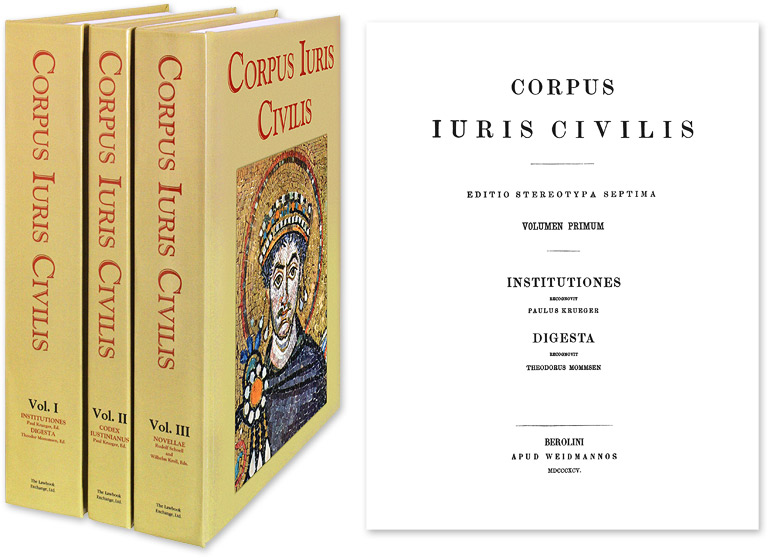
NOTICE: The Lawbook Exchange and the Corpus Iuris Civilis

The Lawbook Exchange has published the Standard Critical Edition of the Corpus Iuris Civilis in three volumes.

Their entry reads:

Reprint of the standard edition of the Corpus Juris Civilis and the basis for all modern English translations. Originally published from 1872 to 1895, this is one of the finest examples of German philology and legal scholarship. In this edition, sometimes called the "Berlin Edition," Krueger edited the Institutes, Mommsen edited the Digest; the Code and Novels were edited by Schoell and Kroll.

Commissioned by the Emperor Justinian in 530 CE, the body of writings known collectively as the Corpus Juris Civilis reformed, restated and preserved Roman law. Its subsequent influence on European and international jurisprudence is difficult to overestimate. It has four components. The Code is the reformed legal system. The Institutes is an elementary textbook about it. The Digest is a collection of commentary by leading jurisconsults. The Novels is a compilation of laws and amendments subsequent to the Code.

07 December 2010

FIRST ANNIVERSARY OF THE ESCLH

The European Society for Comparative Legal History, founded on 5 December 2009 (St Nicholas' Eve) in The Hague, recently celebrated its first anniversary.


Over the past twelve months, we established this blog, held a very successful inaugural conference, and launched a collective project on Western legal traditions with the Ius Commune Casebook Series and Hart Publishing.

It's been a good year.

We want to thank all of those who have helped with our work and invite anyone who hasn't already become a member to do so now.

06 December 2010

OFFER: Hart Publishing Discount for Comparative Law Blog Readers


Members should know about the following generous standing offer from Hart Publishing for Comparative Law Blog readers:
Hart Publishing is delighted to offer readers of the comparativelawblog 20% discount on their comparative law titles. To receive the discount on any comparative law book please quote reference ‘CLB’ when placing your order. If you are ordering online then please quote the reference in the special instructions field. Please note that the discount will not show up on your order confirmation but will be applied when your order is processed.

23 November 2010

Call for Papers: 2011 Meeting of the American Society for Legal History

Call for Papers: 2011 Meeting of the American Society for Legal History

The 2011 meeting of the American Society for Legal History will be in Atlanta, Georgia, November 10-13, 2011. The ASLH invites proposals on any facet or period of legal history, anywhere in the world. In selecting presenters, the Program Committee will give preference to those who did not present at last year’s meeting. Among the people selected to present, limited financial assistance will be available for those in need—with special priority given to graduate students and post-docs, as well as scholars traveling from abroad.


Proposals for both panels and individual papers are welcome. As concerns panels, the Program Committee encourages the submission of a variety of different types of proposals, including:

• classical 3-paper panels (with a separate commentator and chair)
• incomplete 2-paper panels (with a separate commentator and chair), which the Committee will complete with at least 1 more paper
• panels of 4 or more papers (with a separate commentator and chair)
• author-meets-reader panels
• roundtable discussions

Panel proposals should include the following:

• A 300-word description of the panel
• A c.v. for each presenter (including complete contact info)
• In the case of paper-based panels only, a 300-word abstract of each paper (as well as a draft of the paper, if possible)

Individual paper proposals should include:

• A c.v. for each presenter (including complete contact info)
• A 300-word abstract of each paper (as well as a draft of the paper, if possible)

The deadline for submitting proposals is February 28, 2011. Proposals should be sent as email attachments to Amalia Kessler, at akessler@law.stanford.edu.

Those unable to send proposals as email attachments may mail hard copies to:

2011 ASLH Program Committee
c/o Amalia Kessler
Stanford Law School
559 Nathan Abbott Way
Stanford, CA 94305-8610
U.S.A.

09 November 2010

NOTICE: Leiter Poll on the Best US Law Faculties in Legal History

Professor Thomas P Gallanis has brought an interesting online poll to our attention. The poll is being conducted by law professor Brian Leiter on the best US law faculties in the area of legal history.

Perhaps we should organise a similar poll here ...

05 November 2010

NOTICE: SOLON's Crimes and Misdemeanours becomes Law, Crime and History

I received the following message today from SOLON:

Link to UOP
Dear All

when we launched the SOLON e-journal, Crimes and Misdemeanours, back in 2007, we had wanted to indicate through the title that this was a journal which was not just about crime - but even though we have always published material (think of some of the debate pieces!) that are more general law and history, it has become plain in the last year that the title has stood in the way of people offering us work, because some have not picked up (as we had hoped) on the 'Misdemeanours' element - after all, it does have a rather mixed meaning especially for an American audience, and we are an international network, especially now.

So after a great deal of agonising (especially over the new title), we have decided that the time has come to retitle the e-journal, laying Crimes and Misdemeanours gratefully to rest, and replacing it with a more straightforward, more inclusive title. So, the SOLON e-journal now becomes:

LAW, CRIME AND HISTORY

Having made that decision, we also debated again over whether there should be a final issue of Crimes and Misdemeanours, but it seemed more sensible, especially as several of the pieces in hand for it fitted better with the new title, to bury the old title immediately, and start 2011 afresh, publishing the first issue of Law, Crime and History in January 2011, so that it will be out in good time in advance of our next big confence, the 2nd Biennial War Crimes Conference (Justice - Whose Justice) in March at our usual London venue, IALS; permitting the conference report on that to come out in the summer. The second issue will be in good time for our next big conference of next year - Crime, Violence and the Modern State III (Law, Order and Individual Rights - Theory, Intent and Practice): in September at the Universite Lyon Lumiere, again permitting that conference report to feature in the next issue....

So LAW, CRIME AND HISTORY will appear for the first time in January 2011, with articles, debate piece, conference report and also, we hope some contributions from members of the network discussing what they are working on, as one of the things that SOLON wishes to do is to promote international as well as local interdisciplinary collaboration.

The broad intent of the e-journal remains the same: it will still be free to access and download, it remains a peer reviewed journal, and we are happy to publish both short pieces (including work in progress) and long pieces, as with Rob Falconer's article in what will now be the final issue under the old title. We look to publishing interesting and interdisciplinary papers, particularly welcoming those with a historical perspective (which is not the same as a historical chronology - a historical perspective or methodology is one which looks at even current and ongoing developments from the point of questioning why its happening this way, and not another....). We do hope that you will all consider submitting work to us, and that you will continue to read and support SOLON's e-journal under this new title!

Best

The Directors

(Kim Stevenson, Judith Rowbotham, Zoe James, Richard Williams, Lorie Charlesworth, George Mair, David Nash, Ann-Marie Kilday, Cassie Watson, Sarah Wilson, Samantha Pegg)