Search

10 December 2025

VACANCIES: Turku Institute for Advanced Studies opens up to 10 postdoctoral positions [Marie Skłodowska-Curie COFUND] (Turku: University of Turku, DEADLINE 6 JAN 2026)

(image: Autumn in Turku; Source: Wikimedia Commons)

Turku Institute for Advanced Studies (TIAS) has opened a call for up to ten research fellows to join its new Turku Intersectoral Excellence Scheme 2 (TIES2) programme. The programme offers excellent, internationally mobile researchers the opportunity to undertake a three-year research project of their own design.

TIES2 builds on the success of the original TIES, and it has a 2.7M € funding from the European Commission’s Marie Skłodowska-Curie (MSCA) COFUND programme.

A launch and information event for TIES2 will be held online on Tuesday 9 December 2026 between 14.00 and 16.00 (EET). TIAS Director Martin Cloonan will be joined by Professor of Practice Patrik Anckar and TIES Fellow Dr Ranjana Saha.

TIES2 requires its Fellows to undertake a secondment outside of higher education for period of between three and twelve months. TIAS has developed a range of new partnerships, including:

TIES2 will see up to ten Fellows join TIAS in September 2026. As the MSCA programme is designed to increase worker mobility, applicants must not have lived in the host country, Finland, for more than 12 months in the previous 36 at the time of call deadline 9 January 2026.

– I am delighted that the MSCA has seen the merits of the TIES programme and awarded us extra funding. We have very much enjoyed having the TIES Fellows with us and are looking forward to welcoming more in September next year, TIAS Director Professor Martin Cloonan said.

The TIES programme been specifically designed to meet a number of demands from a range of policy bodies, including The Finnish Ministry of Education and Culture’s National Roadmap for Research, Development and Innovation, as it promotes intersectoral working, aims to attract international talent and to help to solidify a fragmented research sector; and the EU’s Innovation Union flagship, which aims to increase competitiveness, provide jobs and stimulate growth.

More information here.

JOURNAL: Justices manifestes. Écrits, rituels et procédures judiciaires au Moyen Âge et à l'époque moderne, dir. Elisabeth SCHMIT & Aurélien PETER (Clio@Thémis 29 (2025) [OPEN ACCESS]

(image source: openedition)

Introduction (Élisabeth Schmit & Aurélien Peter)
DOI 10.4000/156ok
First paragraph:

Ce dossier se situe au croisement de deux manières d’aborder et d’écrire l’histoire de la justice1 : celle, d’une part, qui s’intéresse aux manifestations rituelles du processus judiciaire ; et celle, d’autre part, qui traite des enjeux et des pouvoirs de l’écrit dans l’action de la justice. En repartant de la métaphore théâtrale, c’est-à-dire en envisageant la scène judiciaire comme cadre spatio-temporel du déploiement du rituel, il s’agit d’en étudier précisément les modalités d’enregistrement, pour mieux comprendre comment l’écrit participe du caractère manifeste des justices médiévales et modernes – dans leur diversité. À l’intersection entre rituel et écrit judiciaires, il y a bien sûr la procédure, entendue à la fois comme la succession des étapes conduisant à l’exécution d’une décision de justice, et comme l’ensemble des règles qui encadrent chacune de ces étapes. Faire l’histoire des modalités d’enregistrement du rituel judiciaire implique dès lors d’expliciter à la fois les rapports entre rituel et procédure, et entre procédure et écrit. Les contributions qui suivent témoignent de l’intérêt, pour les historiennes et historiens de la justice, d’articuler ces deux approches, chacune ayant fait l’objet d’une historiographie féconde.

Ad arbitrium dicte nostre curie. Les équilibres de la jurisprudence du Parlement criminel au travers de l’enregistrement des peines infamantes (xive siècle) (Isabelle d'Artagnan) 
DOI 10.4000/156ol
Abstract:

This article analyzes recording strategies shaping parliamentary judicial precedents through seventy 14th century rulings involving the pillory or honorable amend. Clerks selected cases, merged uses of degrading punishments, and erased discrepancies to portray a moderately balanced justice. Three principles guided sentencing: the extent of the harm caused, the status of the parties involved, and the course of the judicial process. The criminal registers appear as a selective memory which guides the magistrates’ practice more than it records it.

 (D)écrire la procédure judiciaire criminelle à Dijon à la fin du Moyen Âge (Rudi Beaulant)
DOI 10.4000/156oo
Abstract:

The excellent preservation of sources relating to Dijon’s municipal justice system provides insight into the various stages of criminal proceedings in the late Middle Ages. Thanks to the diversity of the documents, it is possible to trace the rationalization of the content of the registers and notebooks from the second half of the 14th century to the beginning of the 16th century, which became ordinary judicial writings used in particular to facilitate the work of judges and prosecutors and, above all, to attest to the good judicial governance of the municipality, which also involved the political ritual of the inauguration of officers.

Pratiques de l’écrit et procédures de la justice ordinaire dans les villes allemandes à la fin du Moyen Âge (Dominique Adrian)
DOI 10.4000/156om
Abstract:

A trial before the council of Kempten (now in Bavaria) in 1486 offers a firsthand insight into the procedure followed in the urban courts of the late Middle Ages, for which the normative texts give only a limited account. The considerable weight of witness testimony and the complexity of the procedures used to gather it show the concern to establish an objective truth, without resorting to irrational evidence (purgatory oaths, etc.). By drafting this lengthy charter at the request of the litigants, the council aimed to guarantee the legal solidity of its decision, even in the face of the imperial courts then in full expansion.

Rendre des comptes au xvie siècle : les pratiques juridictionnelles de la Chambre des comptes de Paris dans les comptabilités urbaines de Touraine (Rémi Demoen)
DOI 10.4000/156on
Abstract:

During the Ancient Regime, the chambre des Comtes de Paris was a sovereign court whose task was to audit the accounts of all the agents who had to manage the king's funds. The ritualised practice of this exercise of control is based on a jurisdictional power that, while well researched for the late Middle Ages, remains dependent on documentary losses for the 16th century. Municipal accounts from this period offer a valuable alternative. Because they preserve traces of the judicial ritual in the Chamber as much as they are an integral part of it, these documents make it possible to propose a renewed study.

De petits bois de justice Les bandeaux gravés de Jean-Michel Papillon dans le rituel judiciaire à la fin de l’Ancien Régime (Mathias Boussemart)
DOI 10.4000/156op
Abstract:

Among the engravers producing illustrated headpieces at the end of the Ancien Régime, the renowned Jean-Michel Papillon (1698-1776) worked regularly for the judicial world, notably creating numerous headpieces related to parliamentary activity. The study of his Recueil des Papillons, held at the BNF, makes it possible to analyze in detail these seemingly innocuous images, which reveal the wide diffusion of an iconographic language shared by the judicial world of the Ancien Régime, through the miniature staging of its ritual.

Varia

De la difficulté de devenir fonctionnaire de l’État français dans un protectorat : l’exemple des contrôleurs civils au Maroc (Quentin Lohou)
DOI 10.4000/156oq
Abstract:

By establishing a “protector” state and a “protected” state, the French protectorate in Morocco recognizes the exercise of two sovereignties over the Cherifian Empire. This regime gave rise to some original legal situations, as illustrated by the hybrid status of civil controllers: these civil servants of French nationality embodied French sovereignty in Morocco, but were denied the status of civil servants of the French State until 1955. Gathered in an amicale, they strove to obtain this status until 1930.

Un fondement canonique du pouvoir constituant médiéval : « exercitus imperatorem faciat » (Decretum I, D. 93, c. 24 Legimus)
DOI 10.4000/156or
Abstract:

The Legimus canon (Decretum I, D. 93, c. 24), derived from a letter by Saint Jerome around the year 400, incidentally mentions : « exercitus imperatorem faciat ». However, the lex regia was already intended to provide, since the doctrine of Irnerius († 1130), the foundation of imperial power. Yet, by the late 12th century, the canonist Huguccio established the Legimus canon as a new foundation of imperial power within a dualist perspective. From then on, the doctrine appropriates this canonical foundation, leading to the conception of a constituent power now based on common law, or even the law of nations.

Point de vue

The many territories of Roman law (Dario Mantovani)
DOI 10.4000/156ot
Abstract:

From the 11th century onward, the study of ancient Roman law has been marked by contrasting impulses. One the one hand, Justinian’s Corpus Iuris Civilis was reinterpreted as a body of law detached from historical and geographical specificity, revitalized through academic teaching and functioning as positive law in numerous European contexts (and beyond) from the Middle Ages to the Modern era. On the other hand, when examined in its original context, it remains the law of a specific region – however vast the Roman Empire may have been. Although traditionally tied to the education of jurists in law schools, its study has also demanded a philological and historical approach to enable accurate reconstruction. Roman legal history thus stands as a telling example of the complex relationship between a geographically anchored perspective and a deterritorialized one, and between specialization and interdisciplinarity. Though often regarded as a traditional field, Roman legal history – by virtue of its layered and ambivalent legacy – has also, in key ways, prefigured contemporary methodological innovations in the social sciences and humanities.

 Read the full issue in open access here.


09 December 2025

VIDEO: Le juge d’instruction (19e-20e) (Les Lois de L'histoire, Université Sorbonne Paris Nord)


Presentation:
Vous connaissez sans doute le nom et le visage d’un juge d’instruction : les médias ont en effet mis en avant plusieurs figures de cette institution judiciaire qui s’occupe de nombreuses affaires sensibles. Mais vous ignorez peut-être son histoire multiséculaire en raison, paradoxalement, de la surmédiatisation de ce juge présenté, à tort, comme incontrôlable et omnipotent. La réalité est bien différente : si le juge d’instruction peut faire beaucoup de choses, il ne peut faire n’importe quoi et encore moins le faire seul. Ses pouvoirs sont encadrés par des devoirs et contre-pouvoirs importants depuis le début du 19e siècle. Quels furent ses devoirs ? Qui furent les autres acteurs du monde judiciaire avec lesquels le juge d’instruction travaillait ? Comment était-il nommé ? Était-il vraiment indépendant ? Pouvait-il emprisonner discrétionnairement les suspects ? Voilà quelques-unes des questions posées à l’historienne du droit Blandine CARON que j’ai eu le plaisir de recevoir le lundi 24 novembre 2025 dans les studios des Lois de l’Histoire. 

VIDEO: Alain PAPAUX, "Droit et peinture : la cause animale, de l’escargot (del Cossa) à l’hermine (da Vinci)" (Collège de France, 14 NOV 2025)

(Video source: Youtube)

Abstract:

Alain Papaux est invité par l'assemblée du Collège de France sur proposition de la Pr Samantha Besson. La conférence se tiendra dans le cadre d'une convention signée avec l'Université de Lausanne.

08 December 2025

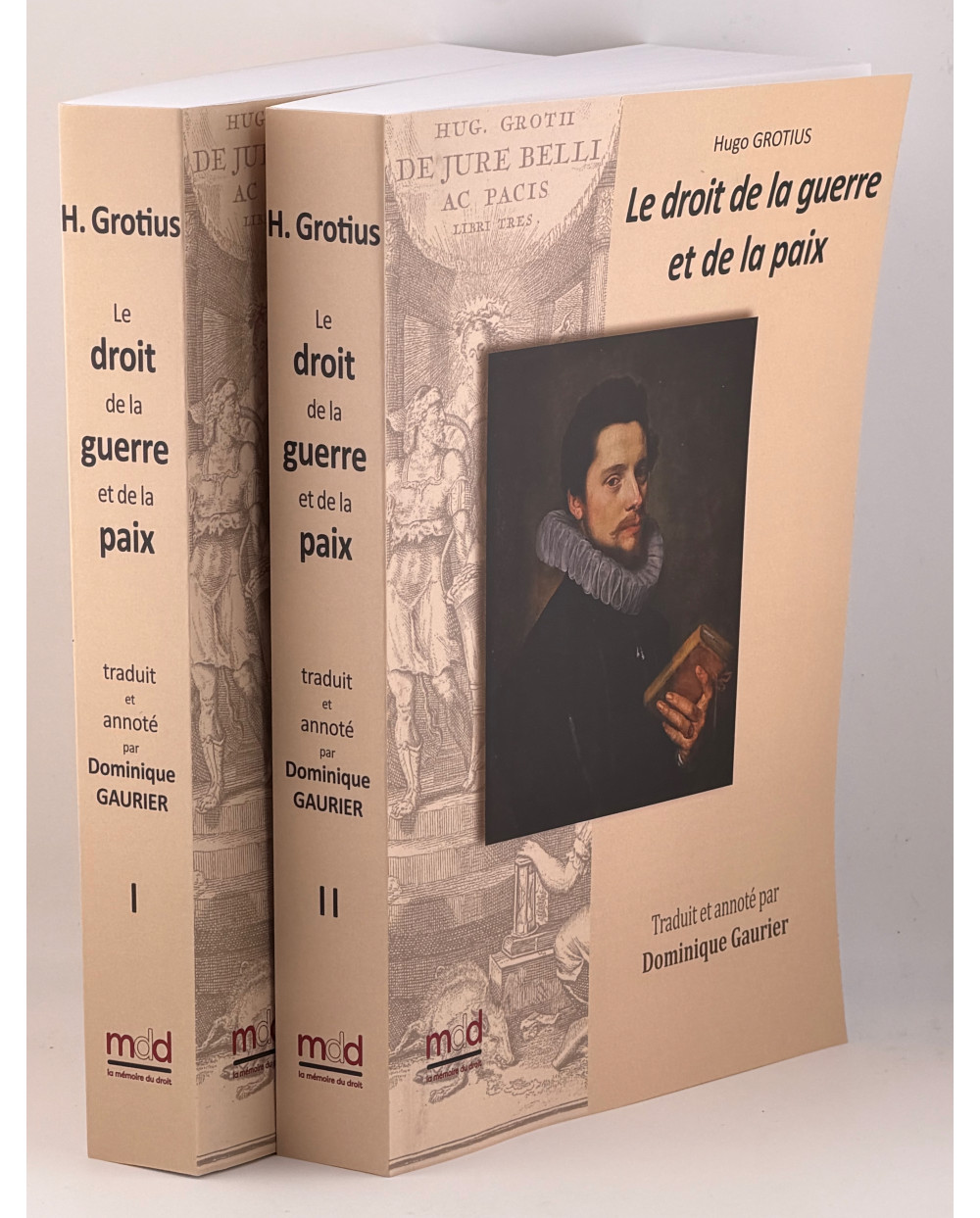
PRE-ORDER: Hugo GROTIUS, De Jure Belli Ac Pacis Libri Tres. Avec les notes de Grotius, de Gronovius, de Barbeyrac et du traducteur (transl. Dominique GAURIER) (Paris: La Mémoire du Droit, 2026), 2 vol., 1350 p. € 480


(image source: MDD)

Abstract:
En 1625, paraissaient à Paris, dédiés à Louis XIII, les De jure belli ac pacis Libri tres d’Hugo Grotius. Pour ce quatrième centenaire, après les trois précédentes traditions en langue française de cet ouvrage, Dominique Gaurier a jugé bon de le retraduire totalement pour permettre aux personnes intéressées d'avoir enfin accès au contenu même de l’ouvrage sans le réécrire ou lui faire dire ce qu'il ne disait pas. De fait, les précédents traducteurs semblent avoir plus fait passer leurs propres idées dans leurs traductions que celles de l’auteur, notamment en modernisant trop le texte et ses concepts.Ce dernier traducteur, qui a beaucoup traduit tant du latin que du néerlandais d'autres ouvrages de Grotius, espère ainsi avoir contribué à une connaissance plus exacte de la place tenue par Grotius qui est loin d’être l'auteur moderne, trop souvent présenté comme le fondateur du droit international moderne, que l’on croit et qui reste très ancré dans la tradition des écrivains de la seconde moitié du XVIe siècle.Le lecteur percevra mieux à travers cette dernière et quatrième traduction, on l’espère, la véracité de cette affirmation.
Read more here.

CONFERENCE: L’industrie des assurances terrestres, un secteur nouveau confronté à des réticences XVIIIe-XXe siècle (Paris: Paris 1 Panthéon-Sorbonne (salle 6), 10 DEC 2025)

(image source: Wikimedia Commons)


10h00 Accueil des participants
10h15 Jonas Knetsch, professeur des universités, Université Paris 1 Panthéon-Sorbonne, directeur de l’Institut des Assurances de Paris, Allocution d’ouverture 

I. La difficile implantation d’une industrie innovante au début du XIXe siècle
Sous la présidence de Marta Peguera-Poch, Professeur des universités, Université Paris 1 Panthéon-Sorbonne 
10h30-11h00 Charlotte Broussy, maître de conférences en Histoire du droit, l’Université de Montpellier, Les compagnies royales d’assurance de 1786 et 1787 : l’émergence ratée de l’assurance terrestre en France à la fin de l’Ancien Régime
11h00-11h30 Alix Profit, maître de conférences en Histoire du droit à l’Université de Caen, Les difficultés de la compagnie d’assurance mutuelle contre l’Incendie de Seine-Inférieure et de l’Eure face aux compagnies à prime fixe (XIXe siècle)
11h30-12h00 Annamaria Monti, professeur d’Histoire du droit, Università degli Studi di Milano, L’industrie des assurances en Italie au XIXe siècle 
12h00-12h30 Discussions
12h30-14h30 Pause méridienne

II. Une industrie en plein développement face à des réticences subsistantes
Sous la présidence de Raymond Dartevelle, Président du Conseil scientifique de la Chaire « Assurance et Société »
14h30-15h00 Marc Thérage, professeur d’Histoire du droit, Université de Limoges, L'essor du droit pénal des assurances terrestres devant la cour d'appel du Nord : disparition ou intensification des réticences face aux assurances ? (XIXe-XXe siècle)
15h00-15h30 Victor Le Breton-Blon, docteur en Histoire du droit, Université Paris Nanterre, Compter, mesurer, évaluer. Le développement de la rationalisation assurantielle contre l’incendie (fin XIXe siècle)
15h30-16h00 Nelly Hissung-Convert, maître de conférences en Histoire du droit, Université Paris 1 Panthéon-Sorbonne, La promotion de l’assurance face aux réticences, l’exemple de L’Argus, Journal international des assurances, depuis 1877
16h00-16h30 Discussions 

Practicalities:

Salle 6, université Paris 1 Panthéon-Sorbonne (2ème étage, aile Soufflot, 12 place du Panthéon, 75005 Paris)


CALL FOR PAPERS: Heraldry and Symbolism of the Hanseatic World – The XIVth Nordic Heraldic Conference (Bergen: Det Hanseatiske Museum and Schøtstuene, Bryggen, 7-8 MAY 2027; DEADLINE 31 MAR 2026)


The conference will be held 7-8 May 2027 at Det Hanseatiske Museum and Schøtstuene, Bryggen, Bergen. The Conference Committee for the XIVth Nordic Heraldic Conference hereby invites interested speakers to submit their name and lecture topic for the conference by 31 March 2026. Contributions may be sent to nhk27@heraldik.org. The theme of the conference is Heraldry and Symbolism of the Hanseatic World. Please see the Call for Papers below for additional details.

Call for papers:

The Hanseatic League started to develop in Lübeck and other towns in northern Germany in the 12th century and expanded in the following centuries around the Baltic Sea and the North Sea. The league as such was not a legal entity and did not have its own seal. It was a cooperation between towns, guilds and tradesmen. Throughout the more than four hundred years of its activities approximately two hundred towns have been part of the Hanse network. The type of ship primarily used, the cog, was used as a symbol on seals and coats of arms. A “kontor” was established in London, Bruges, Bergen and Novgorod. They had their own coats of arms, with eagles as a frequent charge. On the ships, flags and pennants were used, often with the colours red and white.


We welcome papers concerning the theme “Heraldry and Symbolism of the Hanseatic World”. Papers can deal with, for example:

  • the design and symbolism of seals and coats of arms used by merchants, towns and the different ”kontor”, 
  • the usage and function of the seals and coats of arms
  • the design and usage of the flags and pennants on the ships, and
  • how Hanseatic symbols have been used throughout the centuries and are still used in today’s heraldry.
Organising committee: Martin Sunnqvist (convener), Gaute Risholt (secretary), Embla Aae, Jan Oskar Engene, Sören Koch, Kaare Seeberg Sidselrud.

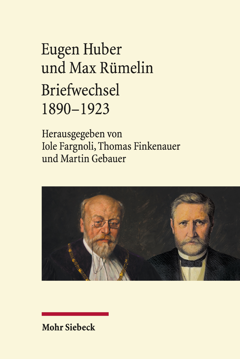
BOOK: Eugen Huber und Max Rümelin Briefwechsel 1890-1923 (ed. Iole FAGNOLI, Thomas FINKENAUER & Martin GEBAUER, with Jutta SCHUMACHER) (Tübingen: Mohr Siebeck, 2026), 817 p. ISBN 978-3-16-164866-3, € 99


(image source: Mohr Siebeck)

Abstract:
Der Briefwechsel zwischen Eugen Huber und Max von Rümelin gibt Einblicke in den juristischen Methodendiskurs am Ausgang des 19. und zu Beginn des 20. Jahrhunderts. Er verbindet den privaten Austausch unter Freunden mit der Kodifikationsgeschichte Deutschlands und der Schweiz in vergleichender Perspektive.

On the editors:

Iole Fargnoli ist Ordentliche Professorin für Römisches Recht an der Universität Bern und an der Università degli Studi di Milano (Italien); seit 2025 Direktorin des 'Istituto di italiano giuridico' an der Universität Bern. https://orcid.org/0000000300765604 Thomas Finkenauer ist Inhaber des Lehrstuhls für Bürgerliches Recht, Römisches Recht und Europäisches Privatrecht an der Universität Tübingen. https://orcid.org/0009000611029222 Martin Gebauer ist Inhaber des Lehrstuhls für Bürgerliches Recht, Internationales Privatrecht und Rechtsvergleichung an der Universität Tübingen und im Nebenamt Richter am Oberlandesgericht Stuttgart. https://orcid.org/0000000324428047 Jutta Schumacher ist promovierte Sprachwissenschaftlerin mit Schwerpunkt auf Texteditionen. 

Read more here. 

05 December 2025

VACANCIES: 3 PHD students and 1 POSTDOC [Centre for Legal History of India] (Frankfurt: Max Planck Institute for Legal History and Legal Theory, DEADLINE 3 FEB 2026)

(image source: MPILHLT)

Presentation:

The Centre for Legal History of India (CLHI) in the Department European and Comparative Legal History at the Max Planck Institute for Legal History and Legal Theory (mpilhlt) is dedicated to advancing research and academic collaboration in the field of Indian legal history. Its primary objective is to strengthen and professionalize the discipline by providing training, mentorship, and resources to doctoral and postdoctoral researchers, equipping them to produce high-quality scholarship. The Centre seeks to foster a collaborative environment where scholars can engage in critical dialogue about both the current state and future scope of research and pedagogy in this diverse field. Building on a multilateral network connecting institutions and researchers within India and internationally, the Centre showcases the richness and breadth of Indian legal history, identifying areas of common ground while highlighting the diversity of legal traditions and interdisciplinary perspectives. Indian legal history has long been a significant focus in the Department of European and Comparative Legal History, especially in the context of the study of legal transfers within the common law world. Given the central role of the Indian subcontinent in the history of the British Empire and the deep and varied legal traditions therein, the Centre aims to contribute towards developing legal history in India as a distinct and valuable field of study that merits dedicated resources and sustained scholarly attention. The Centre maintains formal collaborations with leading Indian law schools NLSIU Bangalore and NALSAR. It is supported by a Centre Advisory Council and has a dedicated visitors’ programme.

Vacancies here (postdoc), here (PhD candidates).

More information on the centre here.

VIDEO: Quentin VERREYCKEN (FRS-FNRS/UCLouvain) on the history of war crimes (RTL, Les Visages de la Recherche)

Dr. Quentin Verrecyken (permanent researcher of the FRS-FNRS at UCLouvain has been interviewed on Belgian commercial television (RTL) on his research on the history of war crimes. See video above.

BOOK: Aniceto MASFERRER DOMINGO (ed.), The Making of Criminal Law. The Role of Case Law in the 19th and 20th Centuries (London: Routledge, 2025), 380 p. ISBN 9781003633082

(image source: Taylor & Francis)

Abstract:
The separation of powers produced by the Enlightenment period reinforced the myth of the “perfection of the law”, with criminal law being dependent on the principle of legality. Demonstrating that this principle has not fundamentally altered judges' methods of interpretation and decision-making, this collective volume explores the role of case law in the making of modern criminal law from the late 19th century to the end of the 20th century. It enables us to gauge the influence of case law developed and to assess the extent to which it contributed to major criminal law decisions and the emergence of model criminal codes. The book takes a comparative view across various European and American jurisdictions and offers an overview of European civil law traditions along with comparisons from the Americas. The focus is on Western legal historiography, which has hitherto been notably under-researched. The chronological point of departure is marked by the creation of the Supreme Court and the cassation in each jurisdiction. Each chapter contains a short introduction to the role of jurisprudence in the making of criminal law from the 19th century onwards in that jurisdiction, followed by an exploration of the contribution of the legal doctrine of the Supreme Court in the making or development of a particular criminal offence or institution. The book will be of interest to scholars and historians working or teaching in the areas of legal history, comparative legal history, criminal law and comparative law. It will also be of use to scholars interested in the study of law in different socio-cultural contexts.

Table of contents

The contribution of case law to the making of Western criminal law (Aniceto Masferrer)
Abstract:

Criminal case law has been scarcely studied for various reasons. In fact, until a few years ago, no legal historian had set out to study it as an element shaping the criminal-legal system. However, in the last decade some of them began this task and have achieved surprising results, both in terms of the volume and quality of their scientific production. In Spain, for example, scholars have practically completed the study of the entire doctrine of the Supreme Court with respect to the Special Part of criminal codes and are now working on the General Part. This chapter analyzes the importance of case law as a source of law and as an object of legal and historical-legal study and includes an exhaustive description of the results obtained in recent years. In addition, it gives – as an introductory chapter of the whole collective book – a brief overview of the the role of case law in the making of modern criminal law in some European and American countries (France, Spain, Portugal, Holland, Austria, Hungary, Denmark, Sweden, Finland, Russia, Georgia-USA, and Chile), all belonging to the civil law tradition.

Case law in the court of cassation. Interpreting codification, production, and physiology of judgments (1811–1863) (Claire Bouglé-Le Roux)
Abstract:

The criminal case law of the first half of the French 19th century offers a particularly rich field of observation for those wishing to measure the role of the judge, and particularly the judge of cassation. This was a strategic period: it saw the introduction of the codification of criminal law by judges, whose interpretation was in principle constrained by the principle of the legality of offences and penalties. However, in cassation, the judges developed interpretation techniques and a method for giving reasons for their decisions, which enabled them to free themselves from the text where necessary, but also to acquire full authority over the trial judges, who were in principle the sole holders of the sovereignty of the trial judges. This study highlights the dual power of the judges of cassation in both legal and jurisdictional terms.

French case law about the age of minority. A historical study about the relationships between jurisprudence and juvenile delinquency (Jean-Louis Halpérin)
Abstract:

France is reputed to be one of the first countries in the world to have adopted a penal code, first in 1791 and then in 1810 with the Napoleonic Code, which remained in force until 1992. However, these codes should not overshadow the role of case law, which developed in parallel with the creation of the Tribunal (later the Court) of cassation in 1790. This chapter deals with criminal minority and the application of articles of the Penal Code providing for two distinct regimes depending on the discernment of minors under the age of 16. In doing so, it shows how the Court of cassation ensured that this question of discernment was always asked and has gradually taken an interest in the choice of reformatories. It gives evidence that, after the 1912 law and a 1945 ordinance closing the houses of correction, the Court of cassation reintroduced the criterion of discernment, and demonstrates that, in the longue durée, French higher judges first acted in the interest of the law, then in the interest of children, with a relative influence of social and doctrinal movements in favor of a more lenient treatment of juvenile delinquency.

The burden of proof in the crime of adultery in Spain. The contribution of the Supreme Court (1870–1978) (Aniceto Masferrer)
Abstract:

This chapter shows that, although the criminal provisions contained in the Codes regulating adultery and de facto union established the essential elements of the criminal type, case law complemented the legal regime by applying these precepts ad mentem legislatorem in specific cases, some of which were difficult – if not impossible – for the criminal legislator to foresee. In this sense, the Supreme Court’s magistrates highly contributed to the legal configuration of a crime, the application of which required going beyond what was established by the legal precept. “Going beyond” does not mean contravening or ignoring the precept, but clarifying, developing, and completing certain aspects that required a correct application of the criminal offense described in the legal precept. Although adultery is a crime that has been in force for centuries, the legislator was never fully aware of the complexity involved in proving it. The evidentiary complexity of the expression “yacimiento” (lying/having sexual relations) used in the legal precept to succinctly describe the type of crime (“A married woman who lies with a man who is not her husband commits adultery”) provoked numerous appeals and a large body of legal doctrine on the different ways of proving the existence or not of sexual intercourse, of its imperfect forms, or of sexual relations outside the scope of this particular type of crime or even of criminal law in general. In short, the chapter gives evidence of the relevance of the Supreme Court, whose doctrine greatly contributed to the adultery’s normative configuration.

Diving into Spanish legal dissonance. Honour as a 19th-century two-sided normative reality (José Franco-Chasán)
Abstract:

Law encompasses society’s values, morals, and ways of acting. Those unwritten values can explain why the legal orders of so many countries enormously differ. The rather wide value of ‘honour’ leads us to a manifold outcome. Particularly, caselaw played a very important role in the configuration of honour due to the main contradiction that characterised the duel: a de iure condemnation (through Criminal Codes), and a de facto promotion (through the Code of Honour and social conceptions). Far from acting in a very dogmatic manner, the judges understood the reality of the moment and knew how to read between the lines of what was happening.

Neither one nor the other. Gender, sex, and marriage on trial in Portugal during the 19th and 20th centuries (Maria Clara Calheiros)
Abstract:

This article uses the legal treatment of adultery in Portugal under the 1886 Penal Code (in force until 1982) as a lens to explore broader European shifts in family law, gender norms, and the relationship between law and religion. Despite early 20th-century legislative reforms aiming for gender equality, Portuguese courts continued to punish female adultery more harshly, reflecting persistent traditional and religious influences. Drawing on legal texts, case law, and scholarly literature, the study reveals the tension between progressive legal ideals and conservative judicial practices. It contributes to wider debates on how legal systems mediate social change, gender relations, and secularization processes in modern Europe.

The Dutch Supreme Court on rape and sexual assault between 1886 and 1991 (Janwillem Oosterhuis)
Abstract:

In the Netherlands, sexual morality changed profoundly between the end of the 19th century and the 1970s. To a considerable degree, this changing morality is reflected in criminal legislation, particularly when it comes to adultery, homosexuality, and pornography. In the same period, however, certain articles on sexual morality stayed the same. Between 1886 and 1991, the articles on rape and sexual assault remained unchanged. Only in 1991, when a revision of the Wetboek van van Strafregt (Criminal Code) took place, were these articles revised. This chapter investigates whether the changing public morality is reflected in the decisions of the Hoge Raad, the Dutch Supreme Court, on sexual morality, focussing on rape and sexual assault. Decisions of the Hoge Raad on adultery are almost completely absent, due to the de facto decriminalisation of adultery by the Hoge Raad through a civil law decision of 1883. Apart from this early decriminalisation of adultery via civil law, it appears that the Hoge Raad did not take the lead in adapting the content of criminal law concepts to changing views on sexual morals and marital relations. In view of its function as court of cassation, that is maybe for the better.

Homosexuality in Austrian penal law and the role of the Supreme Court (Martin P. Schennach)
Abstract:

The contribution explores the impact of the Austrian Supreme Court on the interpretation and application of § 129 (1) lit. b of the Criminal Code of 1852. The law criminalized homosexual relations from the latter half of the 19th century until 1971, when it was repealed during the “minor reform of criminal law.” Pivotal judicial rulings of the Supreme Court were forged in the decades around 1900, intricately intertwined with medical and psychiatric discussions. Renowned psychiatrist Krafft-Ebing emerged as a key figure, actively contributing to debates in the field of legal policy. Despite Krafft-Ebing’s influence and that of other medical experts, the Supreme Court diverged from their views. Instead, it adopted an expansive interpretation of prohibited acts, extending beyond mere male-male intercourse or similar acts. The Supreme court stipulated that criminal liability encompassed all interactions between individuals of the same sex aimed at arousing or fulfilling sexual desires. Moreover, the Supreme Court dismissed defense strategies proposed by psychiatric experts, contending that offenders’ mental health conditions did not absolve them of criminal responsibility. Even if the Supreme Court thus deviated from the line of psychiatric science, the Supreme Court aligned itself with the prevailing consensus of the legal academic community. The landmark rulings of around 1900 retained significant influence for subsequent decades. Even as late as 1969, just two years prior to the repeal of criminal liability, the Supreme Court remained steadfast in its established approach, adhering to its prior decisions despite evolving social dynamics and ongoing discussions.

Judicial decisions shaping criminal law. Eight decades of sedition cases in Hungary (Emőd Veress, Bence Zsolt Kovács)
Abstract:

Sedition typically involves actions or speech that incite rebellion against the authority of a state or monarch, or that seek to undermine the lawful authority of the government. This chapter examines the evolution and implications of judicial decision-making on the consistency of criminal law, with a focus on Hungary’s legal history, through significant political changes from the 19th to the 20th centuries. The research highlights the foundational role of Hungary’s highest courts in maintaining legal consistency amidst these transformations, especially in the interpretation of the sedition offence. By delving into Hungary’s transition to a codified criminal framework, exemplified by the Csemegi Code of 1878, to a more politicized judicial approach influenced by Soviet doctrines post-1948, the analysis demonstrates how judicial practices adapted to shifting political landscapes, impacting the uniform application of criminal law. This evolution underscores the difficult interplay between law and changing societal contexts. Through detailed examinations of precedent and the role of high courts, the study provides insights into the broader implications of judicial decisions in shaping legal and societal norms.

Dolus Eventualis in Danish criminal law The introduction of a legal concept by the Supreme Court (Per Andersen)
Abstract:

In 1918, the Danish Supreme Court confirmed a sentence passed by a lower court in  criminal case. Through its arguments for the confirmation, the Supreme Court introduced the concept of dolus eventualis, a form of intent, for the first time in Danish law. The chapter argues that the Supreme Court judges in 1918 were likely inspired by jurisprudential considerations of the period within the small Danish jurisprudential milieu, which again was particularly inspired by German jurisprudence. By introducing the not explicitly declared idea of dolus eventualis, the Supreme Court foresaw a change to forms of intent that would be made in the coming Criminal Act of 1930. The concept may very well have been known during the following decades, but it was nevertheless debated within jurisprudence and among criminal law experts and not used again before the late 1970s. What makes the concept of dolus eventualis in the 1918 judgment remarkable is the fact that this concept is the only criminal concept introduced by the Danish Supreme Court in recent times. The chapter explains why this may be the case, due to a Danish legal tradition characterized by a very cautious and conservative court in terms of introducing new concepts or legal ideas in order not to act as a legislative power.

Case law between the adoption of two criminal codes, Sweden 1864–1962 The definition of rape and aspects of criminal intent (Martin Sunnqvist)
Abstract:

This chapter discusses the development of criminal law through case law during the time of the Swedish 1864 Criminal Code. The main example is how rules relating to rape were interpreted by the Supreme Court. The first fully reported Supreme Court case about rape is from 1925. In this case and another from 1927, a heavy burden was placed on a woman to clearly resist the perpetrator, otherwise the crime would not be defined as rape. In 1937, the types of violence relevant for rape were widened. There was at first a hesitation within the courts how to draw the line between more or less lenient violence, but in two cases in 1937 and 1942, the Supreme Court marked a stricter view on rape than had dominated before. The chapter also discusses some types of cases where Supreme Court decisions from the 19th and early 20th centuries are still important.

Supreme Court of Finland's theft rulings in the context of crises and modernization (Esko Häkkinen)
Abstract:

The chapter examines the evolution of the Supreme Court of Finland’s approach to theft cases from the end of the 19th century to the 1970s, a period of rapid economic modernization and significant social change in Finland. General development of criminal justice and penal policy and the special role of theft in it as well as the history of the supreme administration of justice in Finland and previous research on its criminal justice role is depicted. An analysis of Supreme Court theft cases shows that the court actively updated and expanded the definition of theft in response to emerging forms of property crime. This was facilitated by the absence of a clear statutory definition of theft in the Finnish Criminal Code. In contrast to its activity in modernizing the interpretation of the meaning of theft, the court was passive in responding to the major shifts Finnish penal policy went through during the period. Despite the penal policy’s importance of theft as a high-volume crime treated severely by the Criminal Code, the court’s approach to theft cases remained largely unaffected by broader changes in penal policy.

Evolution of slander and libel in the Russian Empire and Soviet Russia (1870–1970) (Tatiana Alekseeva)
Abstract:

This chapter is devoted to the general problem of judicial influence on criminal law modification. The lack of legislative changes may not be directly related to the application of law. From a historical perspective, in Russia, it can be exemplified with slander and libel ("kleveta"). High courts interpreted all elements of this crime, specified details, and even changed their positions on the same matters. Although actus reus was not very far from the legislative wording of kleveta, the interpretation of mens rea finally became imprecise and unclear without bearing high courts’ decisions in mind.

Infidelity, legality, and Southern jurisprudence Title The newly established Georgia state Supreme Court and its contribution to adultery as a criminal offense (Julie Rocheton)
Abstract:

This chapter examines the jurisprudence of the Georgia Supreme Court regarding adultery as a criminal offense during its formative years (1846–1900). It explores how the court navigated societal values, legal codification, and the enforcement of morality while utilizing cases to assert its authority and legitimacy within Georgia’s evolving judicial landscape. Through an analysis of rulings, legislative developments, and contemporary newspapers, it highlights the tensions between codified law and community standards in defining personal behavior as a matter of public concern. By situating adultery laws within broader concerns of public order, gender norms, and racial dynamics, the chapter emphasizes the interplay between legality and cultural values. It reveals how the court’s reasoning aligned with legislative frameworks to crystallize adultery as a distinct criminal offense while negotiating the boundaries between legality and morality. This analysis positions the newly established Georgia Supreme Court as a vital site for reinforcing societal norms and shaping its institutional identity. This chapter provides new insights into Southern legal history, the intersection of private and public spheres, and the enduring influence of moral regulation on the development of American criminal law and jurisprudence.

Deterrence and criminal law. A first panorama on the application of Article 483 of the criminal law in Chilean Courts (1878–1887) (Macarena Cordero Fernández, Loris De Nardi)
Abstract:

The investigation explores the application of Article 483 of the Chilean Criminal Code between 1878 and 1887 that presupposed the guilt of a merchant if his premises were destroyed by fire. The historic context that motivated the inclusion of this regulation is examined, enhancing its deterrent function on frauds in fire insurances. In this regard, the expansion of the insurance industry and the increase in intentional fires at the time made it necessary to introduce a measure that would discourage the fraudulent practices. It should be added that the detection of fires, provoked or intentional, was complex mainly due to the lack of adequate appraisals. Despite the presumption of guilt established by the article, the analysis of the jurisprudence reveals that in practice the presumption of innocence prevailed. The judges only applied this article in very exceptional cases, which makes its ineffectiveness evident. The regulation, instead of being an effective punitive instrument, served to dissuade the merchants from using fire as a solution to their economic issues, demanding that they prove their innocence instead of the authorities proving their guilt. The study offers a vision that on one side reflects that this ruling constituted a legal innovation at the time and on the other, that its introduction in the XIX century codes reinforced the interests of the bourgeoisie, adapting the laws to new liberal ideas, in this case by means of a legal fiction to facilitate the resolution of difficult cases.

Read more here: DOI 10.4324/9781003633082.


BOOK REVIEW: William BARBEY on Elgar encyclopedia of comparative law edited by Jan M. Smits, Jaakko Husa, Catherine Valcke and Madalena Narciso (Comparative Legal History, XIII (2025), nr. 2)

(Image source: Taylor&Francis)

Reviewing a collective work, an encyclopaedia no less, is not an easy task. How do you start your reading? Is one supposed to read it from cover to cover, from the first to the last entry in the order of print? Or is one to focus on the most important entries (and in that case how does one select them)? Put in another way: how can a single reviewer do justice to the work of more than 200 eminent scholars?
I once read that in order to criticise a book, you do not have to read all of it: like the cooking of a steak, one bite is all it takes to tell if the chef was off his game. Nonetheless if the dish is properly made, and if you enjoy even your greens, you will probably be more than tempted to order a pudding.
Not entirely sure of the merit of such a method, I narrowed down a few entries (as if selecting from a menu) according to my own fields of interests (eg ‘comparative jurisprudence’, ‘legal families’, ‘legal history and comparative law’, ‘codification’, ‘estoppel’, ‘trust law’, ‘subjective right(s)’) and out of curiosity (eg ‘Islamic law’, ‘gift’, ‘Iceland’). And so, I dived right into it – just to see if it would satisfy my appetite.
After a while, the many cross-references guided me towards more and more new entries I had at first neglected. And being in the habit to look up words in a (printed) dictionary only to forget the one word I was looking for in the first place (having encountered numerous more interesting definitions in the meantime), I ended being quite astray from my original path, transported to other times and other places: ‘Constitutional Court (Germany)’, ‘lex mercatoria’, ‘Europe small jurisdictions (Andorra, Liechtenstein, Monaco)’, ‘supervening events and force majeure’.
For a scholar, to be lost in the material is not a curse but a gift. It is the very essence of comparative research: discovering and revealing connections between per se unrelated themes or jurisdictions. One has to be curious and willing to confront oneself to unknown territories (‘it is simply impossible to master all methods that are needed in order to explore all the law at all times and places’, writes Agustín Parise, vol 1, 359). Above all it demands to go beyond one’s comfort zone.

To read the full review, please click here. Online access is free for members of the European Society for Comparative Legal History.

DOI: 10.1080/2049677X.2025.2580119


04 December 2025

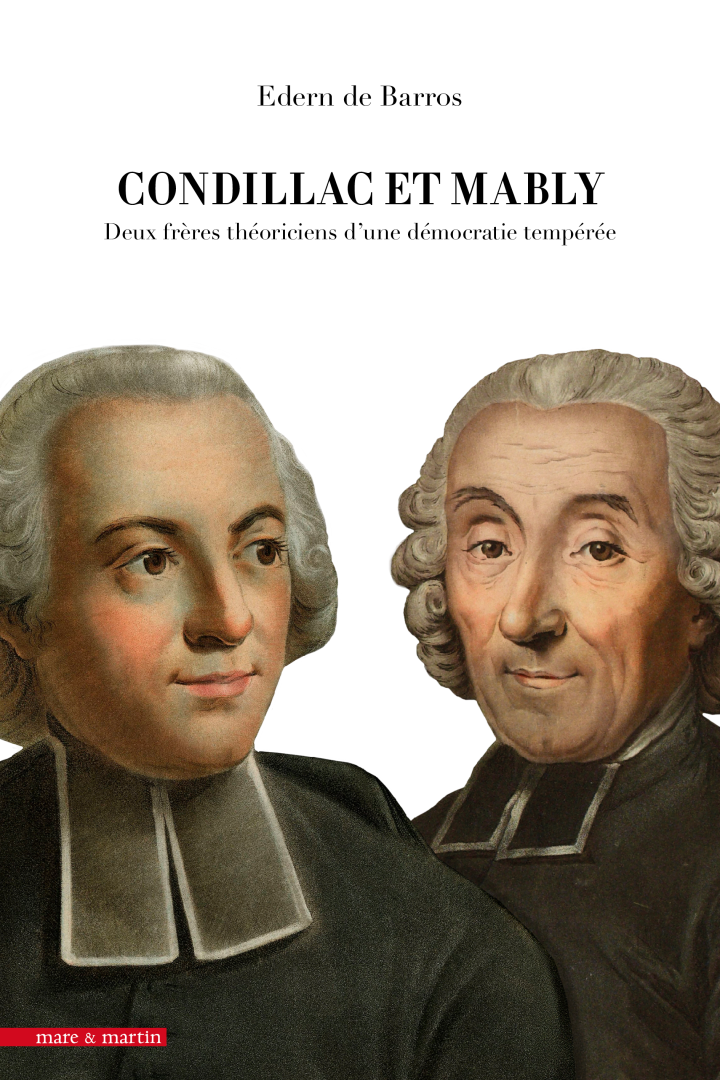
BOOK: Edern DE BARROS, Condillac et Mably. Deux frères théoriciens d'une démocratie tempérée [Politique de l'Esprit] (Paris: Mare & Martin, 2025), 510 p. ISBN 978-2-36222-137-8, € 45


(image source: Mare & Martin)

Abstract:
Condillac (1714-1780) et Mably (1709-1785) sont deux frères dont l’influence sur la Révolution française fut considérable. Figures majeures des Lumières, ils furent durablement séparés par l’historiographie depuis 1789. Condillac, associé aux Idéologues, serait le père du libéralisme français ; Mably, figure de la démocratie égalitaire, un précurseur du communisme. Cette étude déconstruit cette opposition et révèle leur républicanisme libéral commun. À la croisée du droit, de l’histoire et de la philosophie, l’ouvrage articule trois volets : une méthode empiriste fondée sur le lien entre droit naturel et histoire ; une théorie politique de la « démocratie tempérée » fondée sur la souveraineté populaire ; et une critique du « despotisme légal » des physiocrates, au nom d’une liberté économique républicaine. Appuyé sur une lecture comparée de leurs oeuvres complètes, ce livre renouvelle en profondeur notre compréhension des Lumières.

Read more with the publisher. 


03 December 2025

VACANCIES (1 POSTDOC, 1 PHD): "History of Ethics and Law of Responding to Suffering" (Virpi MÄKINEN) University of Helsinki/Faculty of Theology (DEADLINE 17 DEC 2025)

(image source: Helsinki University)

The Research Council of Finland funded centre of excellence in Meliorist Philosophy of Suffering (leader: Sami Pihlström) announces fixed-term employment (doctoral researcher and postdoctoral researcher) in legal history/history of ethics.

The positions are placed in the work package "History of Ethics and Law of Responding to Suffering", lead by Virpi Mäkinen (University of Helsinki).

For more information, please see:

Doctoral researcher: https://jobs.helsinki.fi/job-invite/4561/

Postdoctoral researcher: https://jobs.helsinki.fi/job-invite/4565/

BOOK: Mark Philip BRADLEY (eds.), The Cambridge History of America and the world (Cambridge: CUP, 2022 [paperback 2025]), ISBN 9781108419208

(image source: CUP)

Abstract:

The Cambridge History of America and the World offers a transformative account of American engagement in the world from 1500 to the present. Representing a new scholarship informed by the transnational turn in the writing of US history and American foreign relations, the four-volume reference work gives sustained attention to key moments in US diplomacy, from the Revolutionary War and the Monroe Doctrine to the US rise as a world power in World War I, World War II and the Cold War. The volumes also cast a more inclusive scholarly net to include transnational histories of Native America, the Atlantic world, slavery, political economy, borderlands, empire, the family, gender and sexuality, race, technology, and the environment. Collectively, they offer essential starting points for readers coming to the field for the first time and serve as a critical vehicle for moving this scholarship forward in innovative new directions. 

Contents:

Table of Contents Volume I. 1500–1820 Edited by Eliga Gould, Paul Mapp and Carla Gardina Pestana Volume II. 1820–1900 Edited by Kristin Hoganson and Jay Sexton Volume III. 1900–1945 Edited by Brooke L. Blower and Andrew Preston Volume IV. 1945 to the Present Edited by David Engerman and Max Paul Friedman. 

On the editors:

Mark Philip Bradley is the Bernadotte E. Schmitt Distinguished Service Professor of History at the University of Chicago. He is the author of The World Reimagined: Americans and Human Rights in the Twentieth Century, Vietnam at War, and Imagining Vietnam and America: The Making of Postcolonial Vietnam. He is recipient of fellowships from the John Simon Guggenheim Memorial Foundation, the American Council of Learned Societies, and the National Endowment for the Humanities. 

Read more here. 

02 December 2025

BOOK: Marjoleine KARS, Michael A. MCDONNEL & Andrew M. SCHOCKET (eds.), The Cambridge History of the American Revolution (Cambridge: CUP, 2025), 3 vol. ISBN 9781108496629, 400 USD


(image source: CUP)

Abstract:

Those interested in the American Revolution-whether it be history buffs, undergraduates, teachers, or specialists-will find this collection provocative, informative and educational. Featuring almost ninety chapters by renowned and upcoming scholars, this three-volume collection considers the astonishing diversity of Revolutionary experiences: from silk-wearing legislators to starving Senecas, enslaved tobacco pickers to enraged tenant farmers, free black soldiers to struggling white seamstresses, mobile Tuscarora families to ambivalent sailors, and radical scribblers to reactionary preachers. It will cover the Revolution's earliest roots to its full fruit. In addition to important broad, topical essays, the volumes spotlight shorter yet innovative “viewpoints” that reveal the Revolution's drama on a human scale, telling the compelling stories of individuals, families, events, and objects. Accessible and authoritative, The Cambridge History of the American Revolution will be the chief reference text on the American Revolution for years to come.

 Table of contents:

Volume I. Revolutionary Contexts Volume II. Revolution Volume III. Continuities, Changes, and Legacies.

 On the editors:

Marjoleine Kars , Massachusetts Institute of Technology Marjoleine Kars is a Senior Scholar at the Massachusetts Institute of Technology (MIT), and Professor Emerita at the University of Maryland, Baltimore County. She is the author of Breaking Loose Together: The Regulator Rebellion in Pre-Revolutionary North Carolina (2003) and Blood on the River: A Chronicle of Mutiny and Freedom on the Wild Coast (2022). Her work has won numerous prizes, including the Cundill History Prize and the Frederick Douglass Book Prize. Michael A. McDonnell , University of Sydney Michael A. McDonnell is Professor of History at the University of Sydney. He is the author of two prize-winning books, Masters of Empire: Great Lakes Indians and the Making of America (2024) and The Politics of War: Race, Class, and Conflict in Revolutionary Virginia (2012). He has served as a Distinguished Lecturer for the Organization of American Historians (OAH). Andrew M. Schocket , Bowling Green State University Andrew M. Schocket is Professor of History and American Culture Studies at Bowling Green State University. He is the author of Founding Corporate Power in Early National Philadelphia (2007) and Fighting over Founders: How We Remember the American Revolution (2015). He is co-director of the Magazine of Early American Datasets.

Read more here. 

01 December 2025

CALL: Positions on the Editorial Board (Comparative Legal History; DEADLINE 15 JAN 2026) [REMINDER]


Journal Comparative Legal History


Call for Positions on the Editorial Board


Deadline: 15 January 2026


The European Society for Comparative Legal History (ESCLH) is seeking applications for positions on the editorial board of its flagship journal, Comparative Legal History, including at least an articles editor and a reviews editor.


Evidence of scholarly ability, experience in editing or a willingness to learn quickly, willingness to contribute to journal projects beyond the narrow scope of the job title, and membership (or a commitment to become a member if appointed) of the ESCLH are requirements. Full training in the journal’s processes will be provided as needed.


You would contribute to the advancement of comparative legal history as part of a warm, supportive, and dedicated team.


The journal is an official academic forum of the ESCLH. It was first published in 2013 and aims to offer a space for the development of comparative legal history. The journal welcomes contributions that explore law in different times and jurisdictions from across the globe.


Applications, indicating to which position/s is being applied, with a brief cover letter and short CV (no more than 4 pages) should be sent to Luisa Brunori (Vice-President of the ESCLH), at luisa.brunori@ens.psl.eu, by 15 January 2026.


The ESCLH particularly welcomes applications from people underrepresented in academia generally, and in the ESCLH and the journal particularly.


These positions are not paid.


SEMINAR: Catherine VOLPILHAC-AUGER, "Montesquieu et les "exilés"" (Séminaire Parlement(s) et cours souveraines, 12 DEC) [HYBRID]


Séminaire Parlement(s) et cours souveraines

La prochaine séance du séminaire “Parlement(s) et cours souveraines”  aura lieu :

                                      Vendredi 12 décembre 2025 (16h30-18h30)

Catherine VOLPILHAC-AUGER (ENS Lyon, IHRIM, UMR 5317), « La grande crise de 1753 : Montesquieu et les parlementaires exilés à Bourges  ».

Répondant : Thibault BARBIEUX ( Université Versailles -Saint Quentin)

Le séminaire se tiendra dans les locaux de l’Institut d’Histoire du Droit-Jean Gaudemet (salle Administration ou salle Collinet, selon la disponibilité), 4 rue Valette, 75005 Paris, esc. de gauche sous le hall, 3e étage.

Voici le lien de connexion ZOOM pour toutes les personnes qui ne pourraient pas se déplacer à l’Institut, sachant que nous vous remercions, lorsque vous le pouvez bien sûr, de privilégier la présence dans nos locaux.

Participer à la réunion Zoom

https://us02web.zoom.us/j/83968347357?pwd=z1uP60q7oK5ekpzbYAEmqnF8M5Wtzk.1

ID de réunion: 839 6834 7357

Code secret: 35560

(source: Parlementdeparis)

SERIES: Émigrés européens - des récits oubliés/Auswandern! Deutsche Schicksale aus drei Jahrhunderten (arte.tv)


(image source: arte)

Arte devotes a series of three episodes to migration, including the legal aspects.

Abstract (French):

C’est l’histoire de l’une des plus grandes migrations européennes. Celle de gens fuyant la misère ou les persécutions et espérant une vie meilleure. Ils vont descendre les fleuves du Rhin et du Danube, du XVIIe siècle jusqu'au lendemain de la première guerre mondiale, et vont peupler des contrées en Amérique, dans l’Est de l’Europe, en Russie et sur le continent africain.

Abstract (German):

Deutsche Auswanderer haben – im Guten wie im Schlechten – die Welt geprägt. Was 1618, zu Beginn des 30-jährigen Krieges am Rhein begann, wird zur Geschichte einer Migration über drei Jahrhunderte und vier Kontinente. Millionen Deutschsprachige flohen vor Verfolgung, Hunger und Kälte, suchten in der Ferne ein besseres Leben – und wurden dabei oft zu Spielbällen im Machtkampf um neue Territorien. Eine Geschichte von Hoffnung, Flucht und Neuanfang.

Watch all episodes for free here. 


INTERVIEW: François WAQUET, "Le droit romain à l’origine de la légitimité politique occidentale" (Paris: Collège de France)


(image source: Collège de France)

Introduction:

Comment les monarques européens ont-ils légitimé leur pouvoir pendant des siècles ? Au cœur de cette question se trouve un héritage souvent méconnu, mais décisif, celui du droit romain. Bien après la chute de l’Empire romain, cette tradition juridique a servi de socle intellectuel et institutionnel aux monarchies européennes. Elle a fourni des outils de gouvernement et une rhétorique de légitimation qui ont traversé les âges jusqu’à constituer les fondements de notre système politique contemporain. Rencontre avec François Waquet*, historien du droit romain au Collège de France.

On the interviewee:

François Waquet est chercheur en histoire du droit romain sur la chaire Droit, culture et société de la Rome antique du Pr Dario Mantovani.

Read the full interview here.