Search

14 February 2020

BOOK: Vincent K.L. CHANG, Forgotten Diplomacy, The Modern Remaking of Dutch-Chinese Relations, 1927–1950. Series: Studies on Modern East Asian History, Vol. 2 (Leiden/Boston: Nijhoff/Brill, 2019). ISBN: 9789004410701, € 149.00

Cover Forgotten Diplomacy
(Source Brill)


ABOUT THE BOOK

In this meticulously researched volume, Vincent Chang resurrects a near forgotten yet pivotal chapter of Dutch-Chinese ties to narrate how World War II, the civil war in China, and Indonesia’s decolonization redefined and remade this age-old bilateral relationship. 
Drawing on a unique range of hitherto unexplored archives, the book explains how China’s nascent rise on the global scene and the Netherlands’ simultaneous decline as a colonial power shaped events in Dutch-controlled Indonesia (and vice versa) and prompted a re-calibration of their mutual ties, culminating in the Netherlands’ recognition of the People’s Republic and laying the foundations for Dutch and Chinese policies through to the present. 
Offering insightful analyses of power dynamics and international law at the close of empire, this book is a critical resource for historians and China specialists as well as scholars of international relations.

ABOUT THE AUTHOR

Vincent K.L. Chang, PhD (2016), a Dutch lawyer and historian, is Associate Professor of History at Southwest University (China) specializing in modern Chinese history and diplomacy. He also teaches at Leiden University and serves as a fellow of the LeidenAsiaCentre.

TABLE OF CONTENTS

Contents
Acknowledgments
List of Tables
List of Plates
Note
Introduction
 1 Dutch Diplomatic History
 2 Chinese Diplomatic History
 3 Merging Histories
 4 Traits of Modern Dutch-Chinese Relations
 5 Aims, Arguments, and Organization of the Book

Part 1: Readjustment
1 Diplomatic Relations During the Prewar Years: 1927–1936
 1 International Context
 2 Development of Bilateral Ties
 3 Dutch Official Representation in China
 4 Chinese Official Representation in the Netherlands
 5 Conclusion
2 Remission of the Dutch Share in China’s Boxer Indemnity
 1 A Watershed Moment
 2 The Central Hydraulic Research Institute at Nanjing
 3 Life, Loss, and Lasting Friendship
 4 Effects and Significance
Plates 1–24

Part 2: Realignment
3 Diplomatic Relations during the War Years: 1937–1945
 1 International Context
 2 Development of Bilateral Ties
 3 Dutch Official Representation in China
 4 Chinese Official Representation in the Netherlands
 5 Conclusion
4 Abrogation of Dutch Extraterritorial Rights in China
 1 The System of Extraterritoriality in China
 2 Extraterritoriality and Dutch-Chinese Treaty Relations
 3 The Dutch-Chinese Treaty of
 4 Effects and Significance
Plates 25–45

Part 3: Reset
5 Diplomatic Relations during the Postwar Years: 1946–1950
 1 International Context
 2 Development of Bilateral Ties
 3 Dutch Official Representation in China
 4 Chinese Official Representation in the Netherlands
 5 Conclusion
6 Recognition of the People’s Republic of China
 1 Early Encounters
 2 The Path to Recognition
 3 Rationales, Response, Result
 4 Effects and Significance

Conclusion
 1 Change and Continuity
 2 Policies and People
 3 Power Dynamics
 4 Past and Present
 5 The Future Past
Appendix 1: Chronology of Major Events
Appendix 2: Overview of Senior Envoys, 1927–1950
Appendix 3: Exchange of Notes Dated 4 April 1933
Appendix 4: Joint Announcement Dated 15 February 1943
Appendix 5: Dutch-Chinese Treaty of 29 May 1945
Appendix 6: Notes on Recognition, March/April 1950
Bibliography
Index

More information here

LECTURE: La Cour de cassation italienne: histoire, rôle et perspectives - Nantes 18 févr. 2020


Foto


ABOUT THE SPEAKER

Paolo Alvazzi del Frate è professore ordinario di "Storia del diritto medievale e moderno" presso il dipartimento di giurisprudenza dell'Università Roma Tre.


13 February 2020

JOB: Fixed-Term Lecturership in international law, three years (Cambridge, DEADLINE 2 MAR 2020)

(image source: Cambridge University)

The Faculty of Law is seeking to appoint an appropriately qualified person to a fixed-term Lectureship in International Law commencing 1 September 2020. The funds for the post are available for three years in the first instance, but a further two years of funding may be possible, depending on the return of the substantive post holder. The person appointed will teach on international law papers at undergraduate and postgraduate level, conduct and assist in the supervision of research, and participate in the general work of the Faculty.
The appointee will demonstrate potential to lecture effectively and to carry out and publish research of the highest calibre. The person appointed will normally hold a PhD or equivalent qualification. The Lecturer will be based in central Cambridge.
If you have any questions about this vacancy or the application process, please contact Julie Boucher by email jb234@cam.ac.uk. Please quote reference JK22281 on your application and in any correspondence about this vacancy.
Further particulars and details of the application procedure are available at the University Job Opportunities site.  Online application is available via that site.
Closing date: 2 March 2020
Vacancy Reference No: JK22281
Salary: £41,526-£52,559
The University values diversity and is committed to equality of opportunity.
The University has a responsibility to ensure that all employees are eligible to live and work in the UK.

BOOK: Mathieu SOULA, Martine CHARAGEAT, Bernard RIBEMONT & Mathieu VIVAS (dir.), Résister à la justice XIIe-XVIIIe siècles [POLEN - Pouvoirs, lettres, normes , Vol. 17] (Paris: Classiques Garnier, 2020), 351 p. ISBN 978-2-4060-9713-6, € 25

(image source: Classiques Garnier)

Book abstract:
À la lumière de l’historiographie récente et de l’analyse résistancielle issue des sciences sociales, il s’agit de considérer l’histoire judiciaire non pas seulement des résistances à la manière foucaldienne mais par les résistances, en termes de pratiques et en dépassant l’alternative obéissance/résistance.
Table of contents:
Martine Charageat et Mathieu Soula, Introduction. L’affrontement des légitimités, p. 7

Première partie. Se dresser contre la justice
Bernard Ribémont, Résister à la justice dans la littérature narrative de fiction du Moyen Âge. L’efficace de l’ambiguïté, p. 27
Luca Fois, L’inquisiteur mis en échec. Savoir juridique et contrôle des informations, l’exemple d’un procès pour hérésie dans la Lombardie du xiiie siècle, p. 45
Laure Verdon, Refus de justice et identité nobiliaire. L’affaire Hugues de Baux contre Pelet de Mimet, Roquevaire (1298-1303), p. 59
María Asenjo González, Resistencia a la justicia y desacato en las ciudades castellanas (1450-1520), p. 75
María Luisa Pedrós Ciurana, Otro género de resistencia. La magia apresada, p. 107
Giovanni Romeo, Résister à l’inquisition, résister à la justice de l’Église. Le cas de l’Italie de la Contre-Réforme, p. 121

Deuxième partie. Jouer avec les règles de la justice
Pascal Texier, Résistance, contournement ou instrumentalisation ? Usage de la justice dans la France du bas Moyen Âge, p. 139
Ricardo Córdoba de la Llave, Factores de prevaricación judicial en la Castilla medieval, p. 153
Sandrine Lavaud, En lutte contre les privilèges du vin. Marchands du Haut-Pays contre jurade de Bordeaux sous arbitrage du parlement (fin xve-début xvie siècle), p. 169
Roberto Tufano, Resistenze di parte e di ceto alla giustizia regia nelle Sicilie durante il Settecento. La ricusazione del giudice come strumento di lotta politica tra élites durante il viceregno austriaco, p. 187
Mathieu Soula, Mettre à nue la violence judiciaire. Faire face au pouvoir de mort à Toulouse au xviiie siècle, p. 207
Sébastien Annen, Résister par la grâce aux « poursuites non-méritées du Ministère public ». La grâce, la fuite et l’innocence dans la France des années 1780, p. 225

Troisième partie. Résistances et construction de la souveraineté
Julien Briand, Justiciables, échevins et officiers seigneuriaux face aux évolutions de la procédure rémoise (xive-xve siècles), p. 243
Véronique Beaulande-Barraud, La juridiction du chapitre de Reims, un moyen de résister à la justice archiépiscopale, p. 263
Bernard Dauven, Contester la grâce. Les rapports de pouvoir entretenus entre le prince et la partie intéressée dans les rémissions (Brabant, xvie et xviie siècles), p. 279
Olivier Caporossi, Résister aux abus du corregidor de Plasencia en 1622, un triomphe pour la justice du roi ?, p. 293
Rachel Renault, Résistance à la justice et construction du politique. Les territoires immédiats d’Empire de Saxe et Thuringe face aux justices impériales et territoriales (xviie-xviiie siècles), p. 311
Sophie Delbrel, Quand l’administration résiste à la justice. L’accord en matière de fiscalité indirecte aux xviiie et xixe siècles, p. 325 
(source: Univ-droit)

BOOK: Thomas OLECHOWSKI, Brigitte MAZOHL, Karin SCHNEIDER & Reinhard STAUBER (Hrsg.), Der Wiener Kongress 1814/15 [Denkschriften der philosophisch-historischen Klasse, Band: 517]. (Wien: Österreichische Akademie der Wissenschaften, 2019), 2 v. ISBN 978-3-7001-8182-8, € 99

(image source: OAW)
Abstract:
The Vienna Congress of 1814/15 was a major event, attended by monarchs, diplomats and lobbyists, but also by adventure seekers, dancers and actors to represent their interests, to do business or to enjoy themselves. It provided the opportunity to compose pieces of music and to create many works of fine art, so that it has remained alive in the collective memory until today. The reorganization of Europe agreed at the congress had lasted for half a century. The 34 authors from ten countries analyse the Vienna Congress and its consequences. Both the internationality and the interdisciplinary nature of the research offer new perspectives on the event that changed Europe and the world forever.
See table of contents here.

(source: Austrian Academy of Sciences)

(source: ESILHIL Blog)

LECTURE: Verso il Corpus iuris canonici - lezione di Lorenzo Sinisi, Bergamo 18 febbraio 2020

Foto


12 February 2020

BOOK REVIEW: Ann THOMSON on Jürgen OSTERHAMMEL, Unfabling the East: The Enlightenment’s Encounter with Asia (American Historical Review 2020)

(image source: OUP)

First paragraph:
Jürgen Osterhammel’s Die Entzauberung Asiens, published in 1998, with a second edition in 2013, has acquired the status of something of a classic in the German-speaking world. Its translation into English after twenty years is therefore long overdue and very welcome. This translation, Unfabling the East: The Enlightenment’s Encounter with Asia, by Robert Savage, is a revised and updated version of the original, which has thus allowed Osterhammel to take account of a certain amount of more recent literature; he indicates that it should be seen as the “standard edition” of the work. The choice of “unfabling” in the title rather than the more common translation of Entzauberung as “disenchantment” was made, as Osterhammel explains on pages 30–31, in order to avoid discussions of its meaning for Max Weber and to draw the reader’s attention to what he sees as eighteenth-century travelers’ deliberate undermining of “the fabled East.” It is also interesting that “Asia” in the original German title has been replaced by “the East,” with Asia relegated to the subtitle. In addition, the German subtitle referred to Europe in the eighteenth century rather than the Enlightenment; it might perhaps have been preferable to follow the German original here, as the period under study is the long eighteenth century, from around 1680 to around 1830.
(read more with OUP)

BOOK: Caroline DERRY, Lesbianism and the Criminal Law - Three Centuries of Legal Regulation in England and Wales (London: Palgrave Macmillan, 2020). ISBN 978-3-030-35300-1, 92,64 €


(Source: Routledge)

Routledge is publishing a new book on lesbianism and criminal law in English and Welsh legal history.

ABOUT THE BOOK

This book offers a comprehensive examination of the ways in which the criminal justice system of England and Wales has regulated, and failed or refused to regulate, lesbianism. It identifies the overarching approach as one of silencing: lesbianism has not only been ignored or regarded as unimaginable, but was deliberately excluded from legal discourses. A series of case studies ranging from 1746 to 2013 from parliamentary debates to individual prosecutions shed light on the complex process of regulation through silencing. They illuminate its evolution over three centuries and explore when and why it has been breached. The answers Derry uncovers can be fully understood only in the context of surrounding social and legal developments which are also considered. Lesbianism and the Criminal Law makes an important contribution to the growing bodies of literature on feminism, sexuality and the law and the legal history of sexual offences.

ABOUT THE AUTHOR

Caroline Derry is Lecturer in Law at the Open University, UK. She taught for fifteen years at London Metropolitan University where she was a senior lecturer in Criminal and Evidence Law and Gender and Law, and LLB course leader. She has been a visiting lecturer in Criminal Law at SOAS and at Paris Descartes. She is a co-author of Complete Criminal Law (OUP, 2018) and Gender and Law (Routledge, 2018).

TABLE OF CONTENTS

Introduction
Mary/Charles Hamilton: Eighteenth-Century Female Husband Prosecutions
Louise Mourey and the ‘Maiden Tribute of Modern Babylon’
‘Gross Indecency Between Females’: The 1921 Parliamentary Debates
Victor/Valerie Barker: Sexology and Challenges to Silencing
The Wolfenden Report: A Shift in Silencing
Allen: Sexual Offences Prosecutions in the Late Twentieth Century
McNally: After the Sexual Offences Act 2003
Conclusion

More info here

11 February 2020

CALL FOR PAPERS: Law, Theology, and the Moral Regulation of “Economy” in the Early-Modern Atlantic World (Chicago, 23 April 2021) (DEADLINE: 15 March 2020)


We learned of a call for papers for a conference on “Law, Theology, and the Moral Regulation of “Economy” in the Early-Modern Atlantic World” in Chicago.

This is a call for papers in anticipation of a one-day conference to be organized by Brian Owensby (University of Virginia) and Richard Ross (University of Illinois) through the Symposium on Comparative Early Modern Legal History [https://law.illinois.edu/faculty-research/specialty-programs/legal-history/].  The conference, to be held at the Newberry Library in Chicago on Friday, April 23, 2021 is entitled, “Law, Theology, and the Moral Regulation of ‘Economy’ in the Early-Modern Atlantic World.”  The time is long past when the Western world’s emergent commercial culture could be understood solely in terms of a Protestant ethos or the division between commerce and social morality occasioned by the Protestant Reformation. Scholarship has shown that “modern” ideas regarding commerce and “economics” had their roots in late-medieval Catholic thought and in neo-scholastic ideas that blended theology, justice, and law. It is clear as well that the rise of commercial thinking was not a linear intellectual development. Protestants and Catholics alike, facing the moral and social implications of novel “economic” relations, undertook deep theological and legal reflections regarding unbridled, competitive, exchange-oriented gain seeking. Many of these concerns were raised in the context of Europe’s westward expansion to the New World. Usury, just price, interest, legal personality, slavery, reciprocity, property, cases of conscience, doubts regarding self-regulating mechanisms, concerns for the poor—all figured in a vibrant legal discourse that simultaneously elaborated and critiqued a set of ideas regarding human economy that became dominant between the sixteenth and nineteenth centuries. This conference will bring together historians, legal scholars, and social scientists to investigate law’s historical role in enabling and regulating behaviors now recognized as foundational to modern economies.

Interested presenters should submit an abstract of between 200 and 500 words and a c.v. by March 15, 2020.  Please send submissions and inquiries to Richard Ross [rjross@illinois.edu]; 217-244-7890.  No previously published work will be accepted. Applicants will be notified by email shortly after the submission deadline.  Accepted participants will be required to submit a full paper of no more than 10,000 words by the end of February 2021. Papers will be pre-circulated and read by all participants.  The conference will pay for travel and hotel expenses.

CALL FOR PAPERS: International Days of the Society for Legal and Institutional History of Flanders, Picardy and Wallonia (Middelburg, 22-23 MAY 2020)

Société d'histoire du droit et des institutions des pays flamands, picards et wallons


----------------------------------- 


Les journées internationales d'histoire du droit et des institutions 2020 auront lieu à Middelbourg (Middelburg), les 22 et 23 mai 2020 et seront consacrées au thème de L’Art et le Droit.

 
(Source: Wikipedia)

L’Art et le Droit, un thème universel à travers les âges. Différentes approches peuvent être distinguées. Tout d’abord, le droit lui-même est un art : ars aequi et boni. Ainsi, les notions du droit peuvent ressembler à la poésie : `en fait de meubles, la possession vaut titre’, `we hold these truths to be self-evident’. De plus, l’art peut être une représentation du droit. Les effigies de la justice et des juges vertueux (Zaleucos, Cambyse, Brutus) ornent nos lieux publics. Troisièmement, le plus important, l’art lui-même est l’objet du droit, et bien loin d'être clair et précis. L’artiste, les objets d’art, les obligations concernant l’art sont tous l’objet d'intérêts individuels et communs, privés et publics, locaux et universels, des temps révolus et des temps futurs.


Il va de soi qu’il y a tant d’autres aspects, compte tenu des réalités de la vie quotidienne dans ce domaine. Notre thème couvre maints sujets, qui peuvent aborder de nombreuses perspectives. Tous candidats à faire une communication sont cordialement invités. L'art, par nature, nous concerne en effet tous.


Ce thème général n’exclut pas, par ailleurs, la possibilité de communiquer sur d’autres sujets d’histoire du droit, de la justice et des institutions.


Les interventions peuvent être faites en français, en anglais ou en néerlandais. Les orateurs sont priés d’envoyer un résumé à l’avance aux organisateurs (de préférence en français).


Les personnes désireuses de communiquer sont priées de faire parvenir leur proposition de communication avant le 20 avril 2020 à J.M. MILO et E.K.E. von BONE par courriel: j.m.milo@uu.nl, vonbone21@gmail.com).

-------------------------------------

De internationale dagen 2020 van de Société d'histoire du droit et des institutions des pays flamands, picards et wallons zullen op 22 en 23 mei 2020 in Middelburg plaatsvinden.

Het thema is: “L’Art et le Droit” (“Kunst en Recht”).

Kunst en Recht – het is een tijdloos en universeel thema. Een grote verscheidenheid aan benaderingen zijn mogelijk, zoals de volgende. Recht op zichzelf is een kunst – ars aequi et boni. Welgekozen woorden kunnen een norm verdichten (zoals `we hold these truths to be self-evident’; or `en fait des meubles la possession vaut titre’). Ten tweede kan kunst het recht verbeelden. Zo zijn onze publieke plaatsen van bestuur en rechtspraak van oudsher met exemplarische deugden (en ondeugden) verlucht – Zaleukos, Cambyses en Brutus zijn slechts drie voorbeelden. Ten derde, en niet het minst belangrijk, kunst zelf is een object van recht. Kunstenaar, kunstwerken, verhoudingen en verbintenissen aangaande kunst vertonen zich steeds op ons schouwtoneel, in gecompliceerd en ragfijn spel tussen individuele en gemeenschappelijke, private en publieke belangen, locaal en universeel, in verleden en toekomende tijden.

Vanzelfsprekend is er veel en veel meer, in de klare lijn en het pointillisme van de werkelijke wereld. Ons thema laat zich vanuit meer perspectieven benaderen, die alle vrij zijn om als insteek voor een bijdrage te dienen. Van harte uitgenodigd. Kunst, van nature, raakt ons allen.

Dit hoofdthema sluit overigens lezingen over andere onderwerpen van rechtsgeschiedenis of van de geschiedenis der instellingen niet uit.

De lezingen kunnen in het Frans, het Engels of het Nederlands doorgaan. De sprekers worden verzocht vooraf een samenvatting aan de organisatoren te bezorgen (bij voorkeur in het Frans).

Kandidaat-sprekers kunnen hun voorgenomen onderwerp met titel vóór 20 april 2020 meedelen aan J.M. MILO en E.K.E von BONE (per e-mail: j.m.milo@uu.nl, vonbone21@gmail.com).

(source: Standen & Landen/Anciens Pays & Assemblées d'États)

SPECIAL ISSUE: Trop, c’est trop ! Justice, religion et société devant l’inacceptable (Sources, 2019)


(image source: AHMUF)

The AHMUF anounced the publication of a theme issue of Sources: Arts, Civilisation et Histoire de l'Europe on Religion, justice and society against the inacceptable.
Trop, c’est trop !
Avec le numéro double 14-15 de la revue SOURCE(S) s’achève l’édition du séminaire « Trop c’est trop » organisé par le professeur Antoine Follain, axe « Autorité » dirigé par Antoine Follain, UR 3400 ARCHE, Université de Strasbourg. Le séminaire d’axe a été mis au point pour partager des recherches diverses qui avaient en commun de partir de situations extrêmes. Son titre, employé au départ par commodité, afin de nommer rapidement l’entreprise, a finalement été adopté par tous, comme le montre sa présence dans plusieurs contributions. Il s’agissait d’explorer, en histoire et en histoire de l’art, les faits, discours et représentations intolérables, inacceptables, insupportables. Où sont les limites et pourquoi ? Que se passe-t-il concrètement quand elles sont atteintes et dépassées ? Que nous apprennent les cas extrêmes et comment l’historien peut-il les utiliser pour autre chose que présenter un cas singulier ? En histoire, l’insupportable s’inscrit dans le temps et quantité de choses réprouvées à une époque ont fini par être tolérées plus tard, alors que d’autres ignorées ou sues et tolérées sont devenues interdites et éventuellement punies de plus en plus durement. Il n’est pas facile de faire la balance, mais à notre époque il semble que les cas intolérables dans l’espace public ont été multipliés jusqu’à susciter une impression de saturation, tant il y a de faits socialement réprouvés et/ou sanctionnés par le droit. Ce que l’on dit intolérable est vu et qualifié de mal absolu alors que se retourner vers le passé montre que la limite est toujours historiquement constituée et donc relative. Bien souvent les choses ne sont pas énoncées au préalable et c’est l’étude même des cas qui est révélatrice de l’acceptabilité d’une situation et de ce qui, au contraire, est complètement inacceptable – ou en tout cas l’est à un moment donné. Une analyse fine devait aussi permettre de distinguer entre des transgressions qui sont évaluées plus ou moins gravement par l’ensemble de la société ou celles qui sont socialement diversifiées – intolérables pour les uns et acceptables par d’autres. Observer les actions est probablement plus pertinent que les discours, qui sont soit dépassés par les faits, soit trop avancés par rapport aux crispations anciennes. C’est ainsi la sanction des faits qui exprime au cas par cas ce qu’il est tolérable de faire ou de dire dans l’espace public et dans la sphère privée. Le judiciaire se prête particulièrement à une telle approche.

SOURCE(S) 2019 – n° 14-15

DOSSIER : « Trop, c’est trop ! Justice, religion et société devant l’inacceptable » rassemblé et édité par Antoine Follain

Antoine Follain « Présentation » p. 7-18

Anne Brogini « Le Saint-Office de Malte et les irréductibles de l’apostasie (XVIe-XVIIe siècles) » p. 19-38

Laurent Ropp « Des tueries horribles ? Les violences religieuses dans la France du XVIe siècle selon les mémorialistes » p. 39-58

Pierre-Benoît Roumagnou « Qui trop embrasse mal étreint. Le maillage judiciaire dans les environs de Paris mis en échec au XVIIIe siècle » p. 59-74

Fabrice Mauclair « Une justice mise en échec ? Les crimes impunis de deux « méchants nobles » en Touraine au XVIIIe siècle » p. 75-92

Adèle Delaporte « Du noble incestueux à l’honneur bafoué de toute une famille : les rebondissements des crimes de Claude de Tance au XVIIIe siècle » p. 93-114

Gwénael Murphy « Justice, société et violences conjugales aux XVIIe et XVIIIe siècles : les seuils de tolérance » p. 115-134

Élodie Lemaire, « Dans la tête du curé Bennenot. Le suicide du curé de Pompierre en Franche-Comté en 1689 » p. 135-162

DOSSIER AUTOUR D’UNE SOURCE

Antoine Follain « Cinquante nuances (criminelles) de Gray au XVIIIe siècle. Comprendre un fonds d’archives et trouver comment l’étudier » et « Les jugements définitifs pour homicide dans le « registre des sentences » du bailliage de Gray de 1738 à 1751. Édition annotée » p. 171-220

COMPTES RENDUS, ANNONCES, CHANTIERS EN COURS

Camille Dagot (position de thèse dir. Antoine Follain) « Le voleur face à ses juges. Criminels d’habitude et délinquants d’occasion dans les Vosges lorraines des XVIe et XVIIe siècles » p. 222-230

http://ea3400.unistra.fr/fileadmin/upload/DUN/ea_3400/Revue_sources/Sources_14-15_web_complet.pdf
SOURCE(S) 2017 – n° 11

DOSSIER : : « Trop, c’est trop ! » rassemblé et édité par Antoine Follain

Antoine Follain « Présentation » p. 7-14

Adrien Dubois « Abdication face à l’intolérable ou désir de vengeance posthume : suicide et genre à la fin du Moyen Âge » p. 15-34

Emmanuel Gerardin « Réflexions sur les limites du pardonnable dans les lettres de rémission en Lorraine au XVIe siècle » p. 35-54

Christophe Regina « Toutes les femmes sont perfides, artificieuses, vaniteuses, curieuses et dépravées : toutes les femmes, non, mais… la soeur Marie-Thérèse de la Croix, si ! » p. 55-68

Myriam Deniel-Ternant « Effets de sources et effets de seuil de la sexualité cléricale. Mise en regard des ecclésiastiques à la Bastille et à l’officialité de Paris au XVIIIe siècle » p. 69-88

Hervé Piant « Un mauvais sujet dont la commune seroit fort aise d’être débarrassée » : justice, crimes et relations sociales en Lorraine à l’époque révolutionnaire (1799) » p. 89-106

Sarah Dumortier « Il est impossible de souffrir plu lontems les ordures qui se font au presbitaire. La paroisse entre tolérance et condamnation de la sexualité des gens d’Église (XVIe-XVIIIe siècle) » p. 107-124

AUTOUR D’UNE SOURCE

Antoine Follain « Un crime capital en voie de disparition. La bestialité et l’exemple du procès fait à Léonard Forrest en 1783 » et « Procédure commencée dans le marquisat de l’Isle-Jourdain en 1783. Édition annotée » p. 127-154

TRAVAUX DES DOCTORANTS, CHANTIERS EN COURS

Antoine Fersing (position de thèse dir. Antoine Follain) « Idoines et suffisants. Les officiers d’État et l’extension des droits du prince en Lorraine ducale (début du XVIe siècle – 1633) » p. 155-165

Antoine Follain « L’axe « Autorité Contrainte Liberté » : bilan et perspectives (2011-2018) » p. 175-180
(source: AHMUF)

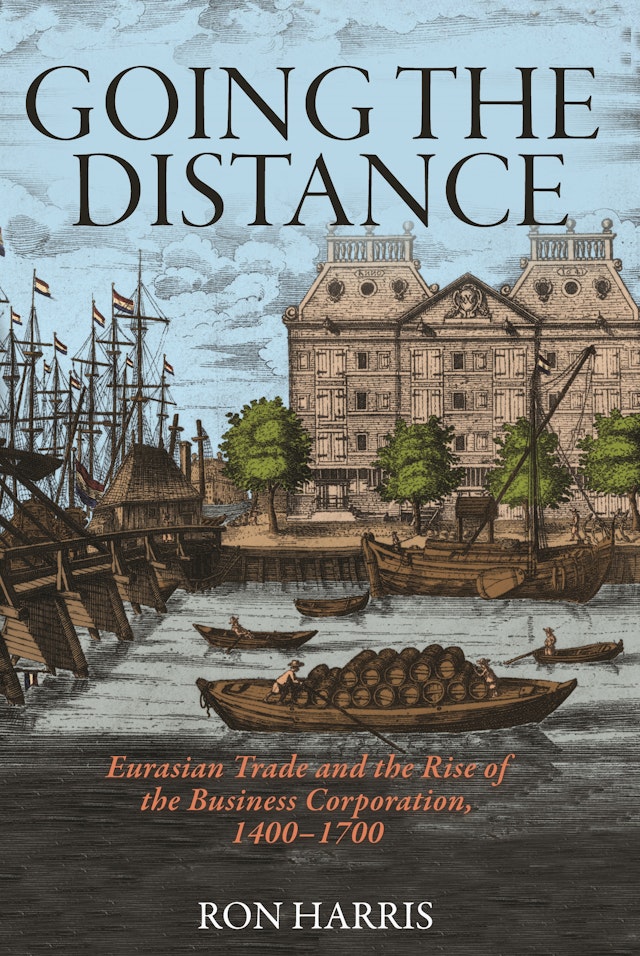
BOOK: Ron HARRIS, Going the Distance: Eurasian Trade and the Rise of the Business Corporation, 1400-1700 (Princeton: Princeton University Press, 2020). ISBN 9780691150772, £34.00


Princeton University Press is publishing a new book on Eurasian trade and the rise of the business corporation (1400-1700).

ABOUT THE BOOK

Before the seventeenth century, trade across Eurasia was mostly conducted in short segments along the Silk Route and Indian Ocean. Business was organized in family firms, merchant networks, and state-owned enterprises, and dominated by Chinese, Indian, and Arabic traders. However, around 1600 the first two joint-stock corporations, the English and Dutch East India Companies, were established. Going the Distance tells the story of overland and maritime trade without Europeans, of European Cape Route trade without corporations, and of how new, large-scale, and impersonal organizations arose in Europe to control long-distance trade for more than three centuries.

Ron Harris shows that by 1700, the scene and methods for global trade had dramatically changed: Dutch and English merchants shepherded goods directly from China and India to northwestern Europe. To understand this transformation, Harris compares the organizational forms used in four major regions: China, India, the Middle East, and Western Europe. The English and Dutch were the last to leap into Eurasian trade, and they innovated in order to compete. They raised capital from passive investors through impersonal stock markets and their joint-stock corporations deployed more capital, ships, and agents to deliver goods from their origins to consumers.

Going the Distance explores the history behind a cornerstone of the modern economy, and how this organizational revolution contributed to the formation of global trade and the creation of the business corporation as a key factor in Europe’s economic rise.

ABOUT THE AUTHOR

Ron Harris is professor of legal history and former dean of law at Tel Aviv University. He is the author of Industrializing English Law.

More info here


BOOK: Gregor ALBERS et al., Causa Contractus: Auf der Suche nach den Bedingungen der Wirksamkeit des Vertraglichen Willens (Tübingen: Mohr Siebeck, 2020).


(Source: Mohr Siebeck)

Mohr Siebeck is publishing a book on historical and comparative approaches to the “causa contractus” in different European legal traditions.

ABOUT THE BOOK

European legal tradition uses the notion of causa or la cause both to identify a contract's underlying purpose and to address the reasons for its enforcement. By combining a historical analysis of the causa doctrine with comparative studies of various national systems, this volume seeks to promote a common understanding of Europe's legal heritage and to present proposals for its further development. Contributions are in German, French, Italian and English, summarized by introductory chapters in English.

ABOUT THE EDITORS

Gregor Albers ist Akademischer Rat auf Zeit am Institut für Römisches Recht und Vergleichende Rechtsgeschichte an der Universität Bonn.

Francesco Paolo Patti ist Professore associato der Universität Bocconi in Mailand.

Dorothé Perrouin-Verbe ist Wissenschaftliche Assistentin am Max-Planck-Institut für ausländisches und internationales Privatrecht in Hamburg und Doktorandin an der Universität Paris II-Panthéon-Assas.

TABLE OF CONTENTS

Teil 1: Dogmengeschichte / The History of an Idea
Gregor Albers: Introduction – Tommaso dalla Massara: Die causa des Vertrages im Denken des Aristo: zu den Ursprüngen einer Idee – Arnaud Paturet: Réflexions sur des archétypes socio-anthropologique de la cause contractuelle – Martin Schermaier: Die Rolle der causa bei der Überwindung des Typenzwangs durch die mittelalterlichen Juristen – Klaus Kowalski: Die causa des Vertrags im frühen Naturrecht – Céline Combette: La cause de Grotius au Code Napoléon – Emmanuelle Chevreau: La cause du Code civil de 1804 à la réforme du droit des obligations de 2016 – Andrea Maria Garofalo: Il ruolo della causa del contratto in Italia tra il 1865 e il 1942 – Francesca Bartolini: La causa dal codice del 1942 ai giorni nostri – Gregor Albers: Deutschland und die causa des Vertrages: vom Code Civil bis zum BGB – Birke Häcker: Causa und Consideration – ein historischer Dialog

Teil 2: Vergleich / Comparison
1. Wirksamkeitsvoraussetzungen / Requirements of Valid Contracts
Dorothée Perrouin-Verbe: Introduction – Elena Giannozzi: Le caractère contraignant des contrats en droit romain classique – Samuel Fulli-Lemaire: Le rôle de la cause au sein des conditions d'efficacité de la volonté contractuelle – Ralf Treibmann: Wirksamkeitsvoraussetzungen des Vertrags im deutschen Recht – Andrea Maria Garofalo/Francesco Paolo Patti: La causa come requisito essenziale del contratto – Kristin Boosfeld: Äquivalente der causa beim Vertragsschluss im englischen Recht

2. Unerwartete Umstände / Unexpected Circumstances
Francesco Paolo Patti: Introduction – Manuel Grasso: Accordo, causa e sopravvenienze: contratto e realtà nel diritto romano – Dorothée Perrouin-Verbe, L'evenement imprévu et le bouleversement de l'équilibre contractuel en droit francais – Gregor Albers: Der Einfluss unerwarteter Ereignisse auf den Vertrag nach deutschem Recht – Francesco Paolo Patti: Causa e sopravvenienze nel diritto italiano – Francesco Mezzanotte: Scopo del contratto e doctrine of frustration

Teil 3: Europäisches Vertragsrecht der Zukunft / Future European Contract Law
1. Nationale Aussichten / National Prospects
Gregor Albers/Francesco Paolo Patti/Dorothée Perrouin-Verbe: Introduction – Thomas Genicon, L'avenir de la cause - Elena Bargelli, Il futuro della causa. Prospettiva italiana – Horst Ehmann, Eine deutsche causa -Lehre – Simon Whittaker, Purpose of contract

2. Proposals
Gregor Albers/Francesco Patti/Dorothée Perrouin-Verbe: Introduction – Samuel Fulli-Lemaire: La cause comme raison d'être du contrat, entre finalité et équilibre – Andrea Maria Garofalo: Speech acts e causa concreta – Ralf Treibmann, Assumer les causae – pour une analyse vectorielle en droit comparé
Close 

More info here

10 February 2020

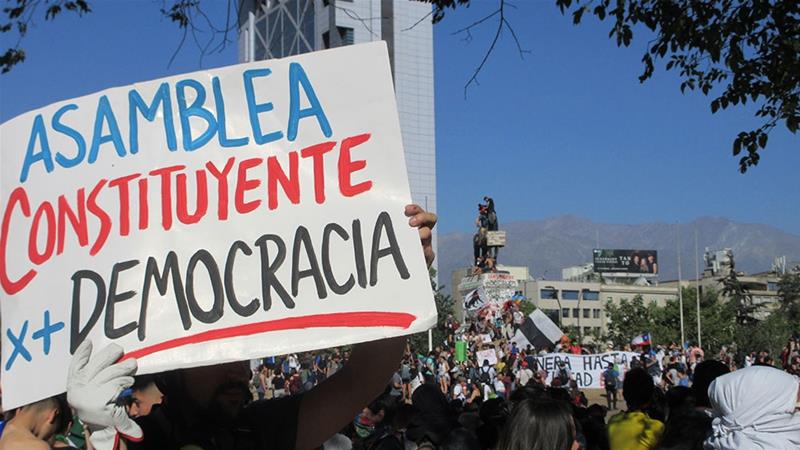
BOOK: Xenophon CONTIADES & Alkmene FOTIADOU (eds.), Routledge Handbook of Comparative Constitutional Change (London: Routledge, JUL 2020), ISBN 9781138496644, 190 GBP

(image source: Aljazeera)

Abstract:
Comparative constitutional change has recently emerged as a distinct field in the study of constitutional law. It is the study of the way constitutions change through formal and informal mechanisms, including amendment, replacement, total and partial revision, adaptation, interpretation, disuse, and revolution. The shift of focus from constitution-making to constitutional change makes sense, since amendment power is the means used to refurbish constitutions in established democracies, enhance their adaptation capacity and boost their efficacy. Adversely, constitutional change is also the basic apparatus used to orchestrate constitutional backslide as the erosion of liberal democracies and democratic regression is increasingly affected through legal channels of constitutional change. The Routledge Handbook of Comparative Constitutional Change provides a comprehensive reference tool for all those working in the field and a thorough landscape of all theoretical and practical aspects of the topic. Coherence from this aspect does not suggest a common view, as the chapters address different topics, but reinforces the establishment of Comparative Constitutional Change as a distinct field. The book brings together the most respected scholars working in the field, and presents a genuine contribution to comparative constitutional studies, comparative public law, political science and constitutional history.
Table of contents:
1. Xenophon Contiades & Alkmene Fotiadou - Comparative Constitutional Change: A New Academic Field;
Part I The study of comparative constitutional change: theoretical and methodological aspects;2. Jaakko Husa - Comparative methodology and constitutional change;
3. Oran Doyle - Order from chaos? Typologies and models of constitutional change;
4. Tom Ginsburg - Constitutional endurance;
5. David Law & Ryan Whalen - Constitutional amendment versus constitutional replacement: An empirical comparison;
6. Mark Tushnet - Varieties of liberal constitutionalism;
Part II Formal constitutional change;7. Richard Albert - Formal amendment rules: Functions and design;
8. Manfred Stelzer - Constitutional design through amendment;
9. Yaniv Roznai - The uses and abuses of constitutional unamendability;
10. Nathalie Behnke & Arthur Benz - Federalism and constitutional change;
11. Eoin Carolan - Participatory constitutional change: constitutional referendums;
Part III Informal constitutional change;12. David Feldman - Political practice and constitutional change;
13. Joel I. Colón-Ríos - Judge-made constitutional change;
14. Helle Krunke - Global values, international organizations and constitutional change;
15. Giacomo Delledonne - Crises, emergencies and constitutional change;
16. Marco Goldoni & Olcay Tarik - The material study of constitutional change;
Part IV Contemporary challenges in the theory and practice of comparative constitutional change;17. Chris Thornhill - Constituent power and european constitutionalism;
18. Paul Blokker - Populism and constitutional change;
19. Tomasz Tadeusz Koncewicz - The democratic backsliding in the European Union and the challenge of constitutional design;
20. Zoran Oklopcic - Constitution and self-determination;
21. Silvia Suteu - Gender in comparative constitutional change;
Part V Case studies. Distinct profiles of constitutional change;22. Robert Blackburn - The future of UK constitutional law;
23. Elisa Arcioni & Adrienne Stone - Constitutional change in Australia: The paradox of the frozen continent;
24. Juliano Zaiden Benvindo - Preservationist constitutional change in Latin America: The cases of Chile and Brazil;
25. James Fowkes - Informal constitutional change in unlikely places: The case of South Africa;
26. Yasuo Hasebe - Constitutional changes in Japan; 
(more information with the publisher)

CALL: Legal History on the Web

(image source: Wikimedia Commons)

The Legal History Blog issued a call from Duke University for further links in its Legal History on the Web Directory:
Second Call for Information about Legal History Websites/Multimedia Projects for “Legal History on the Web”Many of you may have had occasion to use “Legal History on the Web,” a gateway to online resources related to legal history that we started at Duke University in 2006.  This year we are undertaking a long-overdue update of the site, building on the platform first created by Mitch Fraas and revised by Ashton Merck, both working with and under the direction of Ed Balleisen.
We particularly invite suggestions for websites to include in a couple of new categories, as well as sites that engage with legal history outside the United States and the UK.
We are already well into the process of fixing broken links by updating URLs and revising annotations for existing websites where advisable.  If you know of any websites that require updates or that you think merit inclusion on “Legal History on the Web,” please send along the relevant information to Siobhan Barco, at siobhan.barco@duke.edu.
Please feel free to send along suggested text for annotations to any new links that you nominate for inclusion.  That suggested text needs to be short – just a few lines that encapsulate what the site has to offer legal historians (see current annotations for examples).Existing Categories:
Other Web Gateways to Legal HistoryLibrary Research Guides/General Reference ResourcesPrimary Source Databases/Web Archives (likely to be renamed in some way to convey expansive digital legal history projects that include GIS mapping or other kinds of digital analysis in addition to primary sources).Law & Popular Culture  (possibly to be discontinued unless we locate a sufficient number of relevant sites)ChronologiesJournalsPublishers with Legal History ListsBlogsWorkshops, Seminars, and Working GroupsScholarly Associations and NetworksGraduate Programs in Legal History/Law and SocietyReading ListsSyllabi  (sorely in need of updating – syllabi disappear more frequently than perhaps any other category on the site)FellowshipsGrantsPrizesJob Market for Legal History
New Categories:
  •   Companion Websites to Legal History Books
(See for example, Ed Balleisen’s Suckers & Swindlers in American History, a companion site to his Fraud: An American History from Barnum to Madoff, which includes an extensive bibliography, essay about sources and methods, essay about avenues for future research, compilations of fraud-related slang, and much else besides.)
  • Legal History Multimedia (e.g.) podcasts / documentaries)
Thanks for your crowd-sourcing help as we seek to refresh this resource for the legal history community.
(source: Legal History Blog)

BOOK: Vincenzo FERRONE, The Enlightenment and the Rights of Man (Oxford: Oxford University Press, 2020), ISBN 9781789620368, $99.99.


(Source: OUP)

Oxford University Press is publishing a new book on the enlightenment and the rights of man.

ABOUT THE BOOK

The Enlightenment redefined the ethics of the rights of man as part of an outlook that was based on reason, the equality of all nations and races, and man's self-determination. This led to the rise of a new language: the political language of the moderns, which spread throughout the world its message of the universality and inalienability of the rights of man, transforming previous references to subjective rights in the state of nature into an actual programme for the emancipation of man.

Ranging from the Italy of Filangieri and Beccaria to the France of Voltaire, Rousseau and Diderot, from the Scotland of Hume, Ferguson and Smith to the Germany of Lessing, Goethe and Schiller, and as far as the America of Franklin and Jefferson, Vincenzo Ferrone deals with a crucial theme of modern historiography: one that addresses the great contemporary debate on the problematic relationship between human rights and the economy, politics and justice, the rights of the individual and the rights of the community, state and religious despotism and freedom of conscience.

ABOUT THE AUTHOR

Vincenzo Ferrone has written extensively on the Enlightenment and Ancien régime Europe. He has taught and held fellowships at the Princeton Institute for Advanced Study, Ca' Foscari University in Venice, and the Collège de France in Paris. He is currently Professor of Modern History at the University of Turin.

More info here

07 February 2020

BOOK : Barbara J. SHAPIRO, Law Reform in Early Modern England, (Hart publishing), ISBN : 9781509934218, £63.18

(Source : Hart publishing) 


ABOUT THE BOOK : Law Reform in Early Modern England, Crown, Parliament and the Press.

This book provides an illuminating commentary of law reform in the early modern era (1500–1740) and views the moves to improve law and legal institutions in the context of changing political and governmental environments.
Although lawyers have often been seen as the chief obstacles to law reform, this book emphasises their contributions – particularly their role in legislation and in reforming the corpus of legal materials – and highlights the previously ignored reform efforts of Lord Chancellors.

ABOUT THE AUTHOR : Barbara J Shapiro is Professor Emerita and Professor in the Graduate School at the University of California, Berkeley.

TABLE OF CONTENTS :

1. Introduction
2. The Early Tudors and Law Reform 1509–58
3. The Elizabethan Era 1558–1603
4. The Early Stuarts 1603–40
5. The Civil War and Parliamentary Rule 1640–49
6. Commonwealth and Protectorate 1649–60
7. The Restoration Era 1660–88
8. Revolution and Beyond 1688–1740
9. Conclusion


BOOK: Boris BERNABÉ, Cyrille DOUNOT & Nicolas WAREMBOURG, La déposition du pape hérétique. Lieux théologiques, modèles canoniques, enjeux constitutionnels (Paris: Mare & Martin, 2019), pp. 224. ISBN: 978-2-84934-426-2, € 28.00

(Source: Mare & Martin)

ABOUT THE BOOK

Le pape hérétique peut-il être déposé ? Cette question provocatrice met en jeu l’histoire et la foi, le droit et la théologie, et reçoit des réponses diverses sur la possibilité de déposer le souverain pontife dans le cas spécifique de l’hérésie, seule dérogation admise au principe selon lequel le premier siège n’est jugé par personne. C’est autour de ce thème qu’eut lieu une rencontre internationale à l’université Paris-Saclay, en mars 2017, pour aborder la question agitée par la thèse de Laurent Fonbaustier, La déposition du pape hérétique. Une origine du constitutionnalisme ? (Mare & Martin, 2016).
À la suite de ce travail novateur, les congressistes ont abordé la question sous un angle chronologique, depuis la conceptualisation de la déposition pour cause d’hérésie chez les canonistes médiévaux jusqu’aux supputations des traditionalistes contemporains relatives à Paul VI, en passant par les pratiques conciliaires du temps du Grand Schisme qui voient plusieurs papes ou antipapes déposés par ces assemblées. Ces contributions éclairent d’un nouveau jour l’inextricable souveraineté pontificale, et les difficultés pratiques de la déposition.

ABOUT THE AUTHORS

Cyrille Dounot est professeur d’histoire du droit à l’université Clermont-Auvergne.
Nicolas Warembourg  est professeur d’histoire du droit à l’université Paris I Panthéon-Sorbonne.
Boris Bernabé  est professeur d’histoire du droit à l’université Paris-Saclay. Il est doyen de la faculté Jean-Monnet (université Paris-Sud).

TABLE OF CONTENTS

Avant-Propos 
Boris Bernabé
Introduction
Position du problème 
Laurent Fonbaustiere
Les temps Médiévaux
Nisi deprehendatur a fide devius : les décrétistes face à l’hypothèse d’un pape hérétique 
P. Thierry Sol
La chute du pape : entre renonciation et déposition. Quelques réflexions sur les sources du droit canonique médiéval
Valerio Gigliotti
Le rôle des instances de l’Église dans un cas voisin de la déposition: autour de l’abdication de Célestin V (1294)
Benoît Fleury
La déposition de Jean XXIII et de Benoît XIII par le concile de Constance, 1415-1417
Philippe Pichot
Constitutionnaliser la monarchie pontificale en actes. Le procès conciliaire d’Eugène IV: procédure et modèle 
Émilie Rosenblieh
L’époque contemporaine
De la chambre des larmes à la renonciation. Figures de la fragilité de l’institution pontificale au temps de la Question romaine
François Jankowiak
Paul VI hérétique ? La déposition du pape dans le discours traditionaliste 
Cyrille Dounot
Les modèles concurrents
«Iconodule et chalcédonien»: la déposition de Vahan Ier, catholicos de l’Église arménienne, en 968
Aram Mardirossian
«Des crimes qui sont du tout intolérables en un ministre». La déposition d’office genevoise au temps de Calvin
Guerric Meylan
La déposition du prince ou l’impossible ministérialité
Édouard Martin
Conclusion
Pontife et Souverain. L’inextricable souveraineté pontificale
Nicolas Warembourg et Cyrille Dounot


More information here

06 February 2020

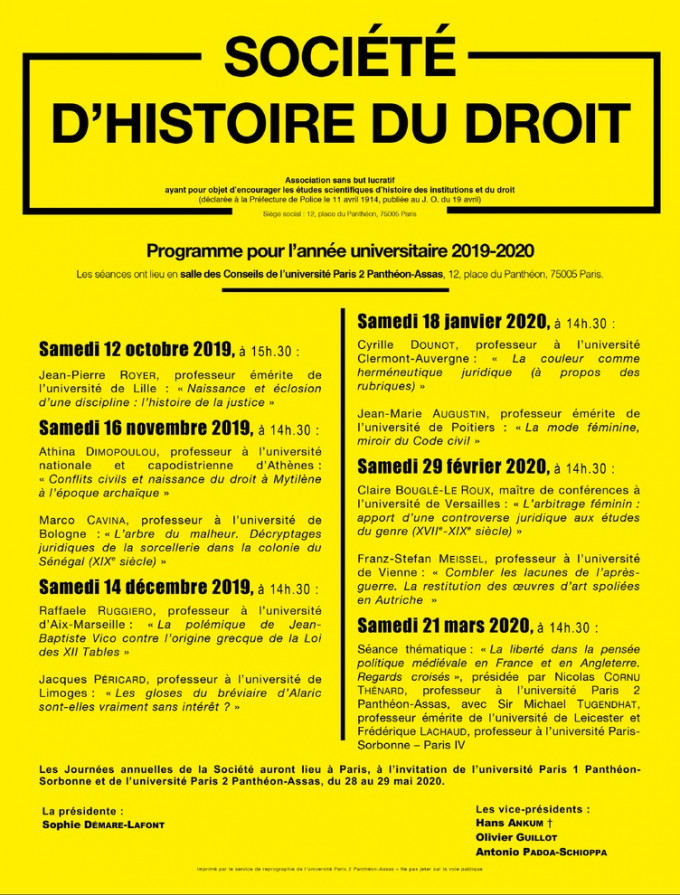
REMINDER, LECTURE SERIES: Conférences de la Société d’histoire du droit 2019-2020 (Paris)

(Source: Hi-D)


The last lectures organised by the Société d’histoire du droit (for the academic year 2019-2020) are going to take place in February and March:

Samedi 29 février 2020
14h30: L’arbitrage féminin : apport d’une controverse juridique aux études du genre (XVIIe-XIXe siècle)
Claire Bouglé-Le Roux, Maître de conférences à l’Université de Versailles

Combler les lacunes de l’après-guerre. La restitution des œuvres d’art spoliées en Autriche 
Franz-Stefan Meissel, Professeur à l’Université de Vienne

Samedi 21 mars 2020
14h30: Séance thématique – «La liberté dans la pensée politique médiévale en France et en Angleterre. Regards croisés», Présidée par Nicolas Cornu Thénard, Professeur à l’Université Paris 2 Panthéon-Assas
Avec: Sir Michael Tugendhat, Professeur émérite de l’université de Leicester 
Frédérique Lachaud, Professeur à l’Université Paris-Sorbonne - Paris IV


Venue: Salle des Conseils, Université Paris 2 Panthéon-Assas 12, place du Panthéon, 75005 Paris

For the original post in the ESCLH blog, see here
More information here


BOOK: Christine LEHNE-GSTREINTHALER, Iurisperiti et Oratores : Eine Studie zu den römischen Juristen der Republik (Göttingen: Vandenhoeck & Ruprecht, 2020). ISBN 978-3-412-50899-9, 110.00 EUR


Vandenhoeck & Ruprecht has published a new book on legal scholars in the Roman republic.

ABOUT THE BOOK

In der Studie gibt die Verfasserin in einem ersten Teil zunächst einen prosopographischen Überblick über die Juristen der römischen Republik, welche mit einer Zusammenschau ihrer responsa nebst weiterführenden Literaturangaben verbunden sind. Der zweite Teil enthält einen Überblick über die Disziplin „Rechtswissenschaft“ während dieser Epoche: Geschildert wird u.a., wie sich die Ausbildung eines Juristen gestaltete, was genau der Aufgabenbereich eines Juristen war und welche soziale Stellung diese in Rom innehatten.

Die Monographie bietet aufgrund des erweiterten Personenkreises nicht nur einen breiteren Überblick über die während der Republik tätigen römischen Juristen als die bisher zu diesem Themenbereich publizierten Werke, sondern zeigt auch neue, bisher unbekannte Aspekte aus dem Leben und Wirken der römischen Juristen auf.

Das Buch zeigt, dass für die römischen Juristen der Republik Recht und Rechtsfortbildung nicht nur eine "Privatangelegenheit" war, vielmehr prägten sie durch ihr Mitwirken an Gesetzesvorhaben, ihre responsa zum ius sacrum und ius publicum und ihre Beratung der politischen Führungspersönlichkeiten auch die Politik ihrer Epoche.

ABOUT THE AUTHOR

Christine Lehne-Gstreinthaler ist Assistenzprofessorin am Institut für Römisches Recht und Rechtsgeschichte der Universität Innsbruck.

TABLE OF CONTENTS

Can be found here

More info here