Search

Showing posts with label social history of law. Show all posts

17 September 2024

CONFERENCE: Learning about the law: Historical perspectives on public legal education for laypersons and underprivileged groups (Helsinki: University of Helsinki, 20-21 MAY 2025; DEADLINE 30 NOV 2024)

(image: Helsinki; source: Wikimedia Commons)
 

Abstract:

This conference focuses on public legal education in a historical perspective. It aims to discuss the various ways in which legal information has been disseminated to groups of laypersons or underprivileged people in order to enhance their legal literacy. Such groups can include e.g. women and children, workers, people with disabilities, immigrants and refugees. 

In the wake of industrialisation and the growth of the working class, many countries implemented legislation regarding workers’ protection in the late 19th and early 20th centuries. This in turn caused the need to educate workers on their rights. The early 20th century also witnessed the growth of women’s rights regarding e.g. education, occupation, property and marriage – all of which women needed information on. Throughout history, there have been waves of immigration around the world for various reasons. Those leaving their homes and moving to another country have also needed knowledge on their rights and the laws they need to follow. Moreover, besides underprivileged groups, educating laypersons in general on legal matters has also been part of building liberal, democratic nation states in which citizens are aware of the legal system and know how to navigate it. This kind of public legal education can take various forms. Legal knowledge has been distributed e.g. through handbooks, magazine articles, popular lectures and courses. 

The conference aims to bring together historical research on the topic from different countries or regions to form a comparative understanding on the reasons for such activities, the forms they take and the consequences these practices had for each group of people and even society as a whole. 

Papers could discuss e.g.: the motives for distributing legal knowledge to laypersons and underprivileged groups; the different actors involved (providers and recipients of public legal education); whether the activities are initiated from within the specific group or from the outside; what kind of legal information was seen as relevant for each group; the role of professional lawyers in these activities; the role of various interest groups in promoting these activities (associations, political parties etc.); the role of the state in these activities; the different media used to disseminate legal education (courses, lectures, handbooks, magazines, radio and tv programmes etc.); the role of publishers or media outlets; public legal education as part of developing a civil society; how has the increasing legal awareness impacted each group; the topic from a broader comparative perspective; a longue durée view on the phenomenon.

Keynote presentations will be given by: Dr. Kate Bradley (University of Kent) Dr. Elsa Trolle Önnerfors (Lund University) Prof. Felice Batlan (Chicago-Kent College of Law, Illinois Institute of Technology). Deadline for paper proposals with abstracts (max. 400 words) and a short description of the presenter is 30 November 2024. 

More information:

For further information, as well as sending paper proposals, please contact Marianne Vasara-Aaltonen (marianne.vasara-aaltonen@helsinki.fi), University Lecturer in Legal History at the University of Helsinki.

 Read more here.

15 January 2024

VACANCY: Two fully-funded PhD-positions: Communicating the Law in Europe, 1500-1750 (St Andrews: University of St Andrews/ERC, DEADLINE 15 MARCH 2024)

(image source: Wikimedia Commons)


Two fully funded PhD studentships are available at the University of St Andrews to work as part of the ERC-selected/UKRI-funded project ‘Communicating the Law in Europe, 1500-1750’, under the supervision of the Principal Investigator, Dr Arthur der Weduwen. The project investigates how law was communicated in early modern Europe (c. 1500-1750), and what impact this had on European society.

The PhD studentships will begin in September 2024, will be based in the School of History at the University of St Andrews (with significant periods to be spent on research abroad), and will last for four years. 

These PhD studentships offer the successful applicants the exciting prospect of combining the pursuit of an independently researched thesis exploring a particular dimension of legal and political communication in early modern Europe with the opportunity to work collaboratively within a research team and to contribute to co-authored publications and the organisation of scholarly conferences.

The ‘Communicating the Law in Europe, 1500-1750’ project has been awarded a grant of €1.4 million by the European Research Council and is funded as part of the UKRI’s Frontier Research Guarantee scheme.  It will run for five years, from 1 January 2024 to 31 December 2028, and is led by the Principal Investigator, Dr Arthur der Weduwen.

The COMLAWEU project is the first to investigate comparatively how law was communicated to citizens and subjects by the authorities in early modern Europe (1500-1750). It pursues an original comparative study of the publication and circulation of municipal, regional and national law, encompassing oral communication, ceremonial proclamations and the employment of criers, as well as the affixing, distribution and sale of law texts, in manuscript and printed form.

Based on extensive archival research, this project will seek to establish for the first time to what extent the increasing body of law that was issued in early modern Europe was made publicly available, and in what forms.

The project seeks to add a new and much-needed perspective to the study of European politics in a critical era of state formation, framing the communication of law as an essential stabilising factor in an era of highly participatory but undemocratic politics.

This project will offer multiple comparative frameworks through which the communication of law will be studied, including Protestant and Catholic states, urban and rural areas, and empires, national kingdoms and city-states.

With the aid of such a comparative lens, it is an overarching aim of the project to analyse how the public dissemination of law shaped early modern civic society and influenced political participation and accountability.

The project team, led by the PI and comprising two postdoctoral research assistants and two PhD students, will work collaboratively, using a series of comparative case studies based on European regions to explore and reveal the complex ways in which European authorities communicated with their citizens and subjects.

Further details about this opportunity can be found on the School of History postgraduate funding page.

03 July 2023

BOOK: H. B. CALLAWAY, The House in the Rue Saint-Fiacre: A Social History of Property in Revolutionary Paris (Cambridge, MA: Harvard University Press, 2023), 304 pp, ISBN 9780674279346, $45


(image courtesy: Harvard University Press)

Book description: 

Property reform was at the heart of the French Revolution. As lawmakers proclaimed at the time, and as historians have long echoed, the Revolution created modern property rights. Under the new regime, property was redefined as an individual right to which all citizens were entitled. Yet as the state seized assets and prepared them for sale, administrators quickly found that realizing the dream of democratic property rights was far more complicated than simply rewriting laws.

H. B. Callaway sifts through records on Parisian émigrés who fled the country during the Revolution, leaving behind property that the state tried to confiscate. Immediately, officials faced difficult questions about what constituted property, how to prove ownership, and how to navigate the complexities of credit arrangements and family lineage. Mothers fought to protect the inheritances of their children, tenants angled to avoid rent payments, and creditors sought their dues. In attempting to execute policy, administrators regularly exercised their own judgment on the validity of claims. Their records reveal far more continuity between the Old Regime and revolutionary practices than the law proclaimed. Property ownership continued to depend on webs of connections beyond the citizen–state relationship, reinforced by customary law and inheritance traditions. The resulting property system was a product of contingent, on-the-ground negotiations as much as revolutionary law.

The House in the Rue Saint-Fiacre takes stock of the contradictions on which modern property rights were founded. As Callaway shows, the property confiscations of Parisian émigrés are a powerful, clarifying lens on the idea of ownership even as it exists today.

Table of contents: 

  • Map of Paris Showing Approximate Locations of Key Addresses in the Text
  • Introduction
  • 1. Property Law in Revolutionary Society
  • 2. The Émigrés and the Politics of Property
  • 3. The Hands of the Nation
  • 4. Césarine’s Inheritance
  • 5. Property, Family, and Patrimony
  • 6. By Iron or Nail
  • Conclusion
  • Notes
  • Acknowledgments
  • Index

About the author: 
H. B. Callaway is Research Associate at the Centre Roland Mousnier of the Université Paris-Sorbonne.
More information can be found here. 

31 January 2023

VIDEO: Michelle PERROT on the Social History of Justice (Les entretiens de Criminocorpus)


The French research site Criminocorpus released an interview with the esteemed French historian Michelle Perrot on her career and the social history of justice. Watch it above or on Youtube.

29 May 2021

BOOK : Marc BONINCHI (dir) , Jean-Pierre LE CROM (dir) , La chicotte et le pécule, les travailleurs à l’épreuve du droit colonial français (XIXe-XXe siècles), (Presses universitaires de Rennes, 2021). ISBN : 978-2-7535-8066-4, pp. 336, € 25,00.


About the book : 

Collection : Histoire 

Résumé de l'éditeur : Entre l'abolition de l'esclavage et les indépendances, une réglementation du travail s'est progressivement et très diversement implantée dans les colonies. Ce sujet méconnu a fait l'objet d'une recherche collective de plusieurs années ayant mobilisé de nombreux chercheurs et dont ce livre est issu. Il repose sur l'exploitation de milliers de documents d'archives, en très grande partie inédits. Du Maroc à l'Indochine, du Cameroun aux Antilles, ce livre apporte une pierre inédite à l'histoire du colonialisme et à celle du droit social et il lève un coin de voile sur le « mauvais sort » fait aux travailleurs de l'outre-mer qui n'et pas sans lien avec l'aspiration des peuples à l'indépendance. 


Editor's summary : Between the abolition of slavery and independence, labor regulations gradually and very differently took hold in the colonies. This little-known subject has been the subject of collective research over several years that has mobilized many researchers and from which this book is based. It is based on the exploitation of thousands of archival documents most of them unpublished. From Morocco to Indochina; from Cameroon to the West Indies, this book brings an unprecedented stone to the history of colonialism and of social law. It lifts a corner of the veil on the "wrongdoings" done on the workers of the other side-sea which is not unrelated to the peoples' aspiration for independance. 


Les contributeurs sont : Farid LEKEAL, Bruno DUBOIS, Philippe AUVERGNON, Delphine CONNES, Dominique TAURISSON-MOURET, Stéphanie COUDERC-MORANDEAU, Dominique BLONZ-COLOMBO, Florence RENUCCI, Katia BARRAGAN. 


The contributors are :  Farid LEKEAL, Bruno DUBOIS, Philippe AUVERGNON, Delphine CONNES, Dominique TAURISSON-MOURET, Stéphanie COUDERC-MORANDEAU, Dominique BLONZ-COLOMBO, Florence RENUCCI, Katia BARRAGAN. 


A propos des directeurs de l'ouvrage :  


Marc Boninchi, est actuellement maître de conférence en histoire du droit à l'université de Lyon. Marc Boninchi a soutenu en 2005 la thèse suivante : " La répression des infractions à l'ordre moral sous le régime de Vichy, 1940-1944." 


Jean-Pierre Le Crom, est actuellement directeur de recherche au CNRS au sein de l'université de Nantes. Jean-pierre Le Crom a soutenu en 1992 la thèse suivante : "L'organisation des relations professionnelles en France (1940-1944) : corporatisme et charte du travail. " 


Concerning the directors of the book :  


Marc Boninchi, is currently a lecturer in the history of law at the University of Lyon. Marc Boninchi defended in 2005 the following thesis: "The repression of offenses against the moral order under the Vichy regime, 1940-1944."


Jean-Pierre Le Crom, is currently a research director at the CNRS at the University of Nantes. Jean-pierre Le Crom defended the following thesis in 1992: "The organization of industrial relations in France (1940-1944): corporatism and the labor charter."


Table des matières : 


Sommaire : 


Jean-Pierre LE CROM, Introduction, p. 7-20


Marc BONINCHI, La genèse des règles de protection. Les dynamiques de la réforme sociale aux colonies. p. 21-70

Farid LEKEAL, Indemniser les accidents du travail survenus aux colonies ? Quelques questions posées sur l’application de la loi du 9 avril 1898 concernant les responsabilités des accidents dont les ouvriers sont victimes dans leur travail . p. 71-90

Bruno DUBOIS, Entre conflit de souveraineté, crispations coloniales et antagonismes professionnels, la difficile implantation des conseils de prud’hommes en Tunisie (1897-1957). p. 91-124

Philippe AUVERGNON, Delphine CONNES, L’encadrement juridique du travail dans les « vieilles colonies » au XIXe siècle ou comment sortir de l’esclavagisme. p. 125-146


Dominique TAURISSON-MOURET, Le recrutement colonial en Indochine. Hyperréglementation et dérèglement durable. p. 147-174


Marc BONINCHI, Un Code pour l’Inde. Le travail indigène et sa protection durant l’entre-deux-guerres. p. 175-204


Stéphanie COUDERC-MORANDEAU, La législation du travail des pays sous mandat français. Syrie-Liban (1920-1941). p. 205-226


Jean-Pierre LE CROM, Travail libre, travail forcé. Les catégories du travail « indigène » au Cameroun sous le mandat français de la Société des Nations (1922-1945). p. 227-254


Dominique BLONZ-COLOMBO, Le droit syndical au Maroc au temps du Protectorat (1912-1956). p. 255-274


Florence RENUCCI, Les voltigeurs d’outre-mer. L’inspection générale du travail de la Seconde Guerre mondiale aux Indépendances. p. 275-296


Katia BARRAGAN, Le droit du travail des Européens dans les colonies françaises d’exploitation, entre différenciation et assimilation. p. 297-316


Marc BONINCHI, Conclusion – Le sort des travailleurs dans les colonies françaises. Une révolution à refaire ? p. 317-328


Les auteurs. p. 329


07 May 2021

PODCAST: Yves-Marie BERCÉ (Académie des Inscriptions et des Belles-Lettres), 'The Old Regime has never existed' (30 APR 2021)


(image source: canalacadémie)

Abstract:

“L’Ancien Régime n’a pas existé, ou du moins n’a-t-il existé qu’après coup, aux yeux des Constituants de 1790.” C’est par cette assertion à rebrousse-poil du catéchisme républicain que commence le dernier livre de l’historien Yves-Marie Bercé, membre de l’Académie des inscriptions et belles-lettres, dans la collection Que sais-je ? Pour faire comprendre la France d’avant la Révolution, le moderniste explique les rites de la monarchie, la diversité des institutions, les préoccupations de la vie quotidienne. Il prend soin de montrer les évolutions au fil des siècles mais aussi la continuité de mouvements qui se poursuivront après la grande césure de 1789. Voici un livre dense et passionnant qui revisite bien des idées reçues.

Listen here. 

12 February 2021

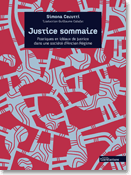
BOOK: Simona CERUTTI, Justice sommaire Pratiques et idéaux de justice dans une société d’Ancien Régime (translated by Guillaume CALAFAT) (Paris: Éditions de l'ÉHESS, 2021), ISBN 978-2-7132-2881-0, €26


(image source: EHESS)

Abstract:

Sous l’Ancien Régime, la procédure sommaire était une procédure rapide et à bas coût que les pauvres pouvaient mobiliser devant différentes magistratures civiles. À partir d’une étude minutieuse des affaires traitées par le tribunal du Consulat de commerce de Turin, Simona Cerutti explore les idéaux et les débats sur les définitions concurrentes d’une « justice bonne et véritable ». Durant la première moitié du XVIIIe siècle, le Consulat de commerce de Turin connaît une série d’inflexions radicales, qui contribuent à la disparation de la procédure sommaire. Cette transformation met en jeu le concept même de responsabilité en justice : certains la veulent pleine et entière, résolument individuelle et liée aux actions des individus ; d’autres, en revanche, la corrèlent à la réputation, aux privilèges associés au statut et aux hiérarchies sociales.Pour cette raison, le débat sur la justice au début du XVIIIe siècle fut bien loin de n’impliquer que les seuls professionnels du droit, les réformateurs et les intellectuels. Il concernait un public plus vaste de marchands, d’artisans, mais aussi d’hommes et de femmes qui se rendaient au tribunal pour des affaires portant sur de petites sommes. En s’intéressant aussi bien aux plaideurs « misérables » qu’aux réformateurs des Lumières, cette traduction inédite met au jour les demandes de justice formulées par les hommes et les femmes des sociétés du passé.

(source: EHESS) 

04 February 2021

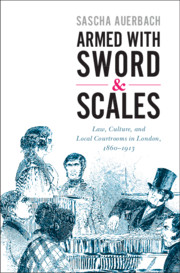
BOOK: Sascha AUERBACH, Armed with Sword and Scales - Law, Culture, and Local Courtrooms in London, 1860–1913 (Cambridge: CUP, 2021). ISBN 9781108491556, 75.00 GBP


(Source: CUP)

CUP is publishing a social history of the London courtroom during the period 1860-1913.

ABOUT THE BOOK

In the mid-eighteenth century, author and magistrate Henry Fielding adjudicated cases of theft, assault, and public disorder from his London home on Bow Street. By the middle of the nineteenth century, Fielding's modest 'police office' had expanded to become the most prolific court system in Britain and the cornerstone of criminal and civil justice in the metropolis. Sascha Auerbach examines the fascinating history of this institution through the lens of 'courtroom culture' – the combination of formal statute and informal custom that guided everyday practice in the London Police Courts. He offers a new model for understanding the relationship between law, culture, and society in modern Britain and illuminates how the local courtroom became a crucial part of everyday life and thoroughly entangled with popular representations of justice and morality.

ABOUT THE AUTHOR

Sascha Auerbach, University of Nottingham

Sascha Auerbach is a Lecturer in Modern British and Colonial History at the University of Nottingham. A former Fulbright Scholar, he is the author of Race, Law and 'The Chinese Puzzle' in Imperial Britain (2009).

TABLE OF CONTENTS

Introduction: Courtroom Culture

1. 'Many-Coloured Scenes of Life': The Police Courts in Metropolitan Culture and Society, 1758–1860

2. 'A Ruffian Rightly Punished': Morality and Local Courtrooms in Practice and Portrayal, 1860–1880

3. 'An Evil Quarter of an Hour About the Precincts': Urban Reform and Municipal Authority in the Courtroom, 1870–1902

4. 'Two Shillings' Worth of Revenge in the Form of a Summons': The Integration of Courtrooms and Communities in London, 1882–1902

5. A Poor Woman's Court of Justice, 1882–1910

6. 'The Very Centre of Observation and Information': Constables, Magistrates, and Changing Patterns of Prosecution and Punishment, 1880–1913

Conclusion: The Historical and Cultural Legacies of the London Magistrates Courts.


More info here

08 September 2020

BOOK: Yves-Marie BERCÉ, Archives des gens simples (Rennes: Presses universitaires de Rennes, 2020), 254 p. ISBN 9782753580220, € 32


(image source: PUR)

Abstract:
L’histoire sociale doit souvent inventer des cheminements à la découverte de vies disparues. Des pièces d’archives méprisées à l’ordinaire recèlent peut-être des bribes du passé de personnes nées et mortes obscurément, ayant vécu aux frontières de la misère et de l’illettrisme, condamnées au silence de l’histoire. La Société des amis des archives de France, dans ses rôles d’auxiliaire des institutions de conservation et d’alliée des historiens, se doit d’attirer l’attention sur des sources et des fonds d’archives que leur insignifiance apparente pourrait faire négliger.

See table of contents here. 

(source: Presses universitaires de Rennes)

13 February 2020

BOOK: Mathieu SOULA, Martine CHARAGEAT, Bernard RIBEMONT & Mathieu VIVAS (dir.), Résister à la justice XIIe-XVIIIe siècles [POLEN - Pouvoirs, lettres, normes , Vol. 17] (Paris: Classiques Garnier, 2020), 351 p. ISBN 978-2-4060-9713-6, € 25

(image source: Classiques Garnier)

Book abstract:
À la lumière de l’historiographie récente et de l’analyse résistancielle issue des sciences sociales, il s’agit de considérer l’histoire judiciaire non pas seulement des résistances à la manière foucaldienne mais par les résistances, en termes de pratiques et en dépassant l’alternative obéissance/résistance.
Table of contents:
Martine Charageat et Mathieu Soula, Introduction. L’affrontement des légitimités, p. 7

Première partie. Se dresser contre la justice
Bernard Ribémont, Résister à la justice dans la littérature narrative de fiction du Moyen Âge. L’efficace de l’ambiguïté, p. 27
Luca Fois, L’inquisiteur mis en échec. Savoir juridique et contrôle des informations, l’exemple d’un procès pour hérésie dans la Lombardie du xiiie siècle, p. 45
Laure Verdon, Refus de justice et identité nobiliaire. L’affaire Hugues de Baux contre Pelet de Mimet, Roquevaire (1298-1303), p. 59
María Asenjo González, Resistencia a la justicia y desacato en las ciudades castellanas (1450-1520), p. 75
María Luisa Pedrós Ciurana, Otro género de resistencia. La magia apresada, p. 107
Giovanni Romeo, Résister à l’inquisition, résister à la justice de l’Église. Le cas de l’Italie de la Contre-Réforme, p. 121

Deuxième partie. Jouer avec les règles de la justice
Pascal Texier, Résistance, contournement ou instrumentalisation ? Usage de la justice dans la France du bas Moyen Âge, p. 139
Ricardo Córdoba de la Llave, Factores de prevaricación judicial en la Castilla medieval, p. 153
Sandrine Lavaud, En lutte contre les privilèges du vin. Marchands du Haut-Pays contre jurade de Bordeaux sous arbitrage du parlement (fin xve-début xvie siècle), p. 169
Roberto Tufano, Resistenze di parte e di ceto alla giustizia regia nelle Sicilie durante il Settecento. La ricusazione del giudice come strumento di lotta politica tra élites durante il viceregno austriaco, p. 187
Mathieu Soula, Mettre à nue la violence judiciaire. Faire face au pouvoir de mort à Toulouse au xviiie siècle, p. 207
Sébastien Annen, Résister par la grâce aux « poursuites non-méritées du Ministère public ». La grâce, la fuite et l’innocence dans la France des années 1780, p. 225

Troisième partie. Résistances et construction de la souveraineté
Julien Briand, Justiciables, échevins et officiers seigneuriaux face aux évolutions de la procédure rémoise (xive-xve siècles), p. 243
Véronique Beaulande-Barraud, La juridiction du chapitre de Reims, un moyen de résister à la justice archiépiscopale, p. 263
Bernard Dauven, Contester la grâce. Les rapports de pouvoir entretenus entre le prince et la partie intéressée dans les rémissions (Brabant, xvie et xviie siècles), p. 279
Olivier Caporossi, Résister aux abus du corregidor de Plasencia en 1622, un triomphe pour la justice du roi ?, p. 293
Rachel Renault, Résistance à la justice et construction du politique. Les territoires immédiats d’Empire de Saxe et Thuringe face aux justices impériales et territoriales (xviie-xviiie siècles), p. 311
Sophie Delbrel, Quand l’administration résiste à la justice. L’accord en matière de fiscalité indirecte aux xviiie et xixe siècles, p. 325 
(source: Univ-droit)

14 January 2020

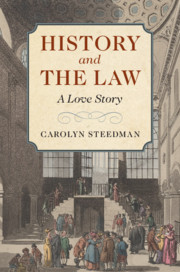
BOOK: Carolyn STEEDMAN, History and the Law - A Love Story (Cambridge: Cambridge University Press, 2020). ISBN 9781108736985, £ 22.99


(Source: CUP)

Cambridge University Press is publishing a new book on everyday legal encounters with the law in English law between the 18th-20th century.

ABOUT THE BOOK

Focusing on everyday legal experiences, from that of magistrates, novelists and political philosophers, to maidservants, pauper men and women, down-at-heel attorneys and middling-sort wives in their coverture, History and the Law reveals how people thought about, used, manipulated and resisted the law between the eighteenth and the twentieth centuries. Supported by clear, engaging examples taken from the historical record, and from the writing of historians including Laurence Sterne, William Godwin, and E. P. Thompson, who each had troubled love affairs with the law, Carolyn Steedman puts the emphasis on English poor laws, copyright law, and laws regarding women. Evocatively written and highly original, History and the Law accounts for historians' strange ambivalent love affair with the law and with legal records that appear to promise access to so many lives in the past.

ABOUT THE AUTHOR

Carolyn Steedman, University of Warwick

Carolyn Steedman is Emeritus Professor of History at the University of Warwick. Her previous books include Landscape for a Good Woman (1986), Dust (2001), Master and Servant (Cambridge, 2007), Labours Lost (Cambridge, 2009), An Everyday Life of the English Working Class (Cambridge, 2013) and Poetry for Historians (2018).

TABLE OF CONTENTS

A beginning: 'history' Stephen Dunn
1. Its ziggy shape
2. Law troubles: two historians and some threatening letters
3. Letters of the law: everyday uses of the law at the turn of the English nineteenth-century
4. The worst of it: Blackstone and women
5. Who owns Maria
6. Sisters in laws
7. Hating the law: Caleb Williams
8. The kind of law a historian loved
An ending: not a story
Bibliography
Index.

More info here

20 December 2019

CALL FOR PAPERS: Kinship and Business. Law, Gender and Generational Perspectives (16th-20th centuries) (Bolzano, 17-19 September 2020) (DEADLINE: 28 February 2020)


(Source: UniVie)

The University of Vienna has a CFP for a conference on “Kinship and Business. Law, Gender and Generational Perspectives (16th–20th Centuries)” (conference languages: German, English, Italian). Here the call:

Organisationsteam:
Margareth Lanzinger (Institut für Wirtschafts- und Sozialgeschichte, Universität Wien)
Siglinde Clementi (Kompetenzzentrum für Regionalgeschichte, Freie Universität Bozen)
Andrea Bonoldi (Dipartimento di Economia e Management, Università di Trento)

Keynote: Martha Howell (Columbia University)

Wirtschaften gestaltet sich in und über soziale Beziehungen. In der wirtschafts- und sozialhistorischen Forschung stehen dabei je nach Perspektive ganz unterschiedliche Formen und Qualitäten sozialer Beziehungen im Fokus. Unternehmen als Form sozialer Organisation des Wirtschaftens gehören zu den etablierten Themenfeldern. In den letzten Jahrzehnten hat sich die historische Verwandtschaftsforschung konstituiert, die sich sowohl den kulturell und rechtlich geprägten Konzepten von Verwandtschaft widmet als auch spezifischen Beziehungsnetzen und Organisationsformen und damit verbundenen Praktiken des Wirtschaftens.

Ziel der Tagung ist es, Unternehmen im weitesten Sinn und Verwandtschaft – in Verbindung mit Recht, Geschlecht und Generation – in Beziehung zueinander zu setzen.

Tagungssprachen sind Deutsch, Englisch und Italienisch mit Simultanübersetzung ins Englische.
Bitte senden Sie einen Themenvorschlag (1 Seite/300 Wörter) und einen KurzCV in der gewählten Tagungssprache bis 28. Februar 2020 an:

Siglinde Clementi (Freie Universität Bozen), siglinde.clementi@unibz.it

Weiterführende Informationen in deutscher Sprache finden Sie hier.
Weiterführende Informationen in englischer Sprache finden Sie hier.

More info with the Universität Wien

25 March 2019

LECTURE: Prof. dr. Jean-Louis HALPERIN, "L'état des juristes en Allemagne, XIXe-XXe siècles. Une réflexion sur la sociologie historique des juristes" (Brussels: Royal Flemish Academy for the Arts and Sciences/Committee for Legal History - VUB/French Embassy, 3 April 2019)

(image source: Prof. Halpérin at the Sarton Medal for Legal History, UGent)

On Wednesday 3 April, prof. dr. Jean-Louis Halpérin (Ecole Normale Supérieure, Paris) will hold a lecture at the Royal Flemish Academy for the Arts and Sciences, at the joint invitation of the Commitee for Legal History (President prof. dr. D. Heirbaut) and the Vrije Universiteit Brussel (Prof. dr. F. Dhondt/CORE), in the framework of the Année de la France à la VUB, a joint initiative between the French Embassy in Brussels and the Rector of the VUB.

Topic: L'état des juristes en Allemagne, XIXe-XXe siècles. Une réflexion sur la sociologie historique des juristes.

The lecture will start at 17:00 in the Rubens Room, with an introduction of the speaker (Prof. dr. D. Heirbaut).

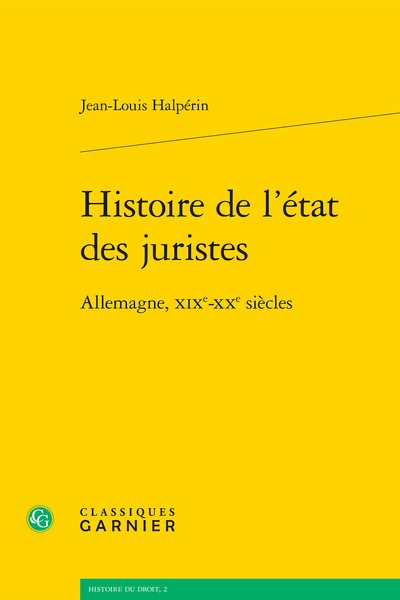
Those interested can prepare the lecture with Prof. Halpérin's monography on the topic (Histoire de l'Etat des juristes. Allemagne, XIXe-XXe siècles [Histoire du Droit], Paris: Classiques Garnier, 2015).
(image source: Classiques Garnier)

RSVP with drs. Wouter De Rycke (academic assistant, VUB/CORE).

The Academy Palace (Hertogstraat - Rue Ducale 1, 1000 BRUSSELS) is easily accessible by metro, bus, or on foot from the Central Station.

12 July 2018

BOOK: Claire DOLAN (dir.), Les pratiques politiques dans les villes françaises d’Ancien Régime. Communauté, citoyenneté et localité (Rennes: PURennes, 2018), 236 p. ISBN 9782753574755, €28

(image source: PURennes)

Book abstract:
Même sous la monarchie absolue, les urbains utilisaient leur droit de parole pour contribuer à la vie politique. La citoyenneté d’avant la Révolution était un phénomène local, urbain, qui a très peu à voir avec la démocratie, même si les décisions collectives faisaient partie du système citadin. Cet ouvrage observe les pratiques politiques d’Ancien Régime dans trois villes (Marseille, Toulouse et Paris) en s’interrogeant sur comment les citadins conjuguaient la participation politique et l’organisation en communautés qui structurait une bonne partie de leurs activités.
On the editor:
Claire Dolan est professeur associé à l’université Laval (Québec). Ses trois plus récents ouvrages sont Le Notaire, la famille et la ville : Aix en Provence à la fin du XVIe siècle (Presses universitaires du Mirail, 1998) ; Les Procureurs du Midi sous l’Ancien Régime (Presses universitaires de Rennes, 2012) ; Délibérer à Toulouse au XVIIIe siècle. Les procureurs au parlement (Éditions du CTHS, 2013).
Free blurbs:


More information here.

25 November 2016

WORKSHOP: Labour Accidents, 19th-20th Century, France/Belgium (Lille, Lille II University/CNRS, 9 Dec 2016)


The Centre d'Histoire Judiciaire (Lille II/CNRS) organizes a workshop on labour accidents, with the support of the Belgian Scientific Policy IAP Justice & Populations.

All persons interested should register on nathalie.flament@univ-lille2.fr.

The full program can be consulted here.


01 October 2016

BOOK: Paul J. DU PLESSIS, Clifford ANDO & Kaius TUORI (eds.), The Oxford Handbook of Roman Law and Society [Oxford Handbooks]. Oxford: OUP, 2016, 752 p. ISBN 9780198728689, £ 110


(image source: OUP)


Dr. Paul du Plessis announced the publication of the Oxford Handbook of Roman Law and Society (eds. P. du Plessis, C. Ando & K. Tuori).

Table of contents:
Part I: Introduction
1: A Word from the Editors, Paul J. du Plessis, Clifford Ando and Kaius Tuori
2: Framing "Law and Society" in the Roman World, Janne Pölönen
Part II: Reading Roman Law
3: More than Codes: Roman Ways of Organising and Giving Access to Legal Information, Dario Mantovani
4: Epigraphy, Tommaso Begio
5: Juristic Papyrology and Roman Law, José Luis Alonso Rodríguez
6: Roman Law and Latin Literature, Michèle Lowrie
Part III: The Constitutional Structure of the Roman State
7: SPQR: Institutions and Popular Participation in the Roman Republic, Francisco Pina Polo
8: The Emperor, the Law and Imperial Administration, Werner Eck
9: Provincial Administration, John Richardson
10: Local Administration, Saskia T. Roselaar
11: Collegia and Their Impact on the Constitutional Structure of the Roman State, Jonathan S. Perry
Part IV: Legal Professionals and Legal Culture
12: Legal Education and Training of Lawyers, Jill Harries
13: Lawyers in Administration, Michael Peachin
14: Legal Writing and Legal Reasoning, Ulrike Babusiaux
15: Greek Philosophy and Classical Roman Law, Jacob Giltaij
16: Rhetoric and Roman Law, Agnieszka Kacprzak
Part V: Settling Disputes
Civil Actions and Civil Procedure
17: Magistrates that Made and Applied the Law, Frederik Vervaet
18: Roman Courts and Private Arbitration, Leanne Bablitz
19: Republican Civil Procedure: Sanctioning Reluctant Defendants, Ernest Metzger
20: Imperial Cognitio Process, Thomas Rüfner
21: Evidence and Argument: The Truth of Prestige and its Performance, Elizabeth A. Meyer
22: Legal Pluralism in Practice, Clifford Ando
Criminal Law and Social Order
23: Police Functions and Public Order, Christopher Fuhrmann
24: Public and Private Criminal Law, Andrew Riggsby
25: Crimes against the Individual: Violence and Sexual Crimes, Ari Z. Bryen
26: Crimes Against the State, Callie Williamson
Part VI Persons Before the Law
Status
27: Social Status, Legal Status, and Legal Privilege, Tristan S. Taylor
28: Legally Marginalised Groups-The Empire, Robert Knapp
29: Repression, Resistance and Rebellion, Benjamin Kelly
30: Slavery: Social Position and Legal Capacity, Richard Gamauf
31: Emancipation, Henrik Mouritsen
Gender
32: Defining Gender, Matthew J. Perry
33: Woman and Patriarchy in Roman Law, Eva Cantarella
34: Women as Legal Actors, Verena Halbwachs
Part VII Legal Relations
Persons and Family
35: Family, Suzanne Dixon
36: Husband and Wife, Jakub Urbanik
37: Child and Parent in Roman Law, Ville Vuolanto
38: Inheritance, Éva Jakab
Property
39: The Economic Structure of Roman Property Law, Richard A. Epstein
40: Ownership and Power in Roman Law, Luigi Capogrossi Colognesi
41: Possession, Christian Baldus
42: Possession and Provincial Practice, Andrea Jördens
Obligations
43: Obligatio in Roman Law and Society, David Ibbetson
44: Contracts, Commerce and Roman Society, Roberto Fiori
45: The Scope and Function of Civil Wrongs in Roman Society, Floriana Cursi
Economics
46: Price Setting and Other Attempts to Control the Economy, Egbert Koops
47: Law, Business Ventures and Trade, Jean-Jacques Aubert
48: Urban Landlords and Tenants, Paul J. du Plessis
49: Tenure of Land and Agricultural Regulation, Dennis P. Kehoe
50: Roman Law, Markets and Market Prices, Luuk de Ligt
This work can be acquired for £ 110.

More information at OUP.  See also preview on Google Books.

01 September 2016

BOOK: Carole AVIGNON (ed.), Bastards and Bastardy in Medieval and Early Modern Europe. Rennes: PURennes, 2016, 562 p. ISBN 9782753549487, € 26

 (image source: PUR)

The Presses universitaires de Rennes published Bâtards et bâtardises dans l’Europe médiévale et moderne, a collective work edited by Carole Avignon.

Book abstract:
Ce livre pose les jalons d’une histoire sociale et culturelle de la bâtardise dans les sociétés européennes du Moyen Âge et de l’époque moderne. La diversité des disciplines mobilisées (histoire, histoire du droit, linguistique, littérature, démographie historique) permet de mettre en valeur la pluralité des approches d’un statut intrinsèquement complexe dont l’appréciation par l’Église, la société ou la parenté oscille entre exclusion et intégration, stigmatisation et réhabilitation.

On the editor:
Carole Avignon, agrégée d’histoire, maître de conférences en histoire médiévale à l’université d’Angers, membre de l’UMR 6258-CERHIO, consacre ses recherches aux questions relatives au mariage et à la filiation dans la France médiévale.

Table of contents:

Ce que la bâtardise nous révèle des sociétés passées : un objet d’étude à (re)construire

Les régimes juridiques de la bâtardise et leurs enjeux disciplinaires et politiques

  • La définition d’une condition juridique au service de la défense de la norme (grégorienne, monarchique) du mariage
  • Déclinaisons canoniques, coutumières et jurisprudentielles des incapacités liées au « défaut de naissance », et leurs tempéraments

La place des bâtards dans les sociétés d’Ancien Régime : stigmatisation, discrimination, intégration

  • Naturel, adultérin ou sacrilège. Naître bâtard dans une société chrétienne
  • Les bâtard(e)s de la noblesse : des acteurs du jeu politique et dynastique ?

Au-delà de la stigmatisation. Un observatoire de la parentalité et des expressions de la filiation

  • « Père », « mère » et « fil(le)s »
  • Bâtardise et honneur familial
  • Aux marges de la filiation ?

Dire, Penser, Représenter l’écart à la norme

  • Langages et discours : ce qu’être « bâtard » veut dire
  • Figures de bâtards : l’ambivalence valorisée ?

More information here.
An introduction can be consulted here.
Information on contributors here.
Abstracts here.
All books published by the PUR are avalaible as e-books on openedition.org.

25 January 2016

BOOK PRESENTATION: "L'exercice de la pensée. Machiavel Leopardi Foucault" by Alessandro Fontana (Paris, February 4 2016)


WHAT Alessandro Fontana, L'exercise de la pensée. Machiavel, Leopardi, Foucault, publications Sorbonne 2015, book presentation

WHEN February 4, 2016, 18:00

WHERE Maison d'Italie, Cité internationale universitaire, 7A Boulevard Jourdan, 75014 Paris

all information here 

04 December 2015

SEMINAR: "L'institution juridique du social. L'homme qui allaite. L'institution juridique de la nourriture première" (Paris, December 8 2015)


WHAT L'institution juridique du social, L'homme qui allaite. L'institution juridique de la nourriture première, Séminaire de casuistique et de théorie « Droit et sciences humaines et sociales » , Seminar

WHEN December 8 2015, 6:00-9:00 pm

WHERE CNRS – CENJ « Yan Thomas », EHESS, 105 bd Raspail, salle 3, Paris

L'homme qui allaite. L'institution juridique de la nourriture première
speaker Mathilde Cohen, (CNRS – CENJ « Yan Thomas » )
Le lait animal et le lait humain sont rarement pensés ensemble et pourtant ils représentent tous deux la nourriture première des mammifères. Quand on y regarde de plus près, les similitudes abondent entre la façon dont le droit appréhende les productrices de lait, qu’il s’agisse d’animaux humains ou non-humains, ainsi que la substance « lait » elle-même, tantôt célébrée comme une source de nutrition supérieure, tantôt vilipendée comme excrétion abjecte, voire mortifère. Le droit contribue aussi à fabriquer le genre du lait en reconnaissant, ou non, que non seulement les femmes allaitent, mais aussi peut-être les hommes, ou en tout cas que l’allaitement n’est pas l’apanage d’un genre particulier.

28 September 2015

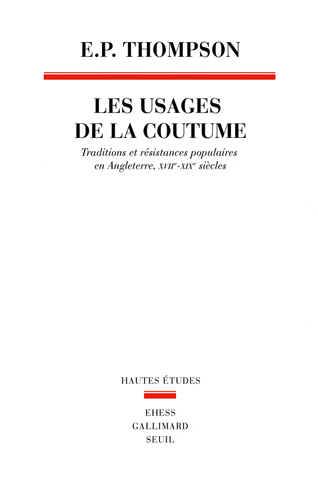
BOOK: Edward P. THOMPSON, The Uses of Custom. Tradition and Popular Resistance in England, 17th-18th Centuries [Hautes Etudes; French translation by Jean BOUTIER and Arundhati VIRMANI]. Paris: EHESS/Gallimard/Seuil, 2015. ISBN 978-2-02-118078-7, € 30.


(image source: EHESS.fr)

Nomôdos announced the translation in French (by Jean Boutier & Arundhati Virmani) of the famous historian Edward P. Thompson's work on custom and popular resistance.

Abstract:
Intellectuel peu conventionnel, E. P. Thompson n’a jamais séparé la rigueur et l’inventivité de ses recherches de son engagement militant pour un socialisme humaniste. Cette anthologie de textes majeurs, pour la première fois traduits en français, analyse à partir du cas anglais les transformations des sociétés européennes.
Les usages de la coutume propose la traduction en français de Customs in Common, ouvrage dans lequel l’historien britannique Edward P. Thompson avait rassemblé en 1991 ses articles majeurs. Tous ont marqué la réflexion historiographique depuis près de cinq décennies. 
À l’aide de notions comme l’histoire vue d’en bas, l’agency, l’économie morale ou la discipline du travail industriel, Thompson, à partir du cas anglais, y analyse les transformations des sociétés européennes entre le XVIIe et le XIXe siècle. Dans une société travaillée par le paternalisme de la noblesse, les tensions sur le marché des subsistances, la privatisation des biens communs ou l’impossibilité du divorce, l’auteur scrute les luttes des hommes et des femmes du peuple pour conserver leur place et leurs droits, batailles dont il n’a cessé de rappeler l’actualité. La défense de la coutume y apparaît alors comme le principal moyen pour s’opposer aux réformes qui ouvrent la voie à la société libérale.

Table of contents:
Présentation
Jean Boutier, Arundhati Virmani
Préface et remerciements
Abréviations
Chapitre premier. Coutume et culture
Chapitre II Les patriciens et la plèbe
Chapitre III. Coutume, droit et droits collectifs
Chapitre IV. L’économie morale de la foule anglaise au xviiie siècle
Chapitre V. L’économie morale revisitée
Chapitre VI. Temps, discipline du travail et capitalisme industriel
Chapitre VII. La vente des épouses
Chapitre VIII. Rough Music
Index
Bibliographie des travaux d’Edward P. Thompson
Crédits

More information on the publisher's website.