Search

Showing posts with label Chinese legal history. Show all posts

18 September 2026

BOOK: Fupeng LI, Translating Weimar. The Cultural Translation of the Weimar Constitution in China (1919-1949) [Global Perspectives on Legal History; 28] (Frankfurt: MPI für Rechtsgeschichte und Rechtstheorie, 2025), XIV + 192 p. ISBN 9783944773544, €17,33 [OPEN ACCESS]

(image source: MPI LH LT)


Abstract:

Wie kann eine Verfassung sich eine soziale Revolution vorstellen? Das Buch beantwortet diese Frage, indem es am Beispiel der sozialen Rechte die lange Reise der Weimarer Verfassung nach China verfolgt. Diese globale Rechtsgeschichte erzählt, wie Juristen und Gesetzgeber die Sprache der Verfassung nutzten, um Projekte sozialen Wandels im 20. Jahrhundert zu konzipieren. Das Buch, das sich zwischen Deutschland und China bewegt, untersucht, wie die Weimarer Reichsverfassung von chinesischen Akteuren gelesen, übersetzt und umgeschrieben wurde. Anstatt den Einfluss der Weimarer Verfassung als einfache „Rezeption“ ausländischer Ideen zu behandeln, rekonstruiert es, wie chinesische Juristen Debatten über Arbeit, Sozialwesen und Wirtschaftsordnung nutzten, um zu überdenken, was eine soziale Verfassung sein könnte – und welche Art von sozialer Revolution sie legitimerweise leiten könnte. Im Zentrum der Analyse steht ein struktureller Wandel: vom rechtebasierten Modell der sozialen Ordnung der Weimarer Verfassung hin zum politikorientierten Konstitutionalismus, der das moderne China prägen sollte. Unter Rückgriff auf mehrsprachige Archivquellen und Verfassungsentwürfe zeichnet die Studie nach, wie der Katalog der sozialen Grundrechte der Weimarer Verfassung schrittweise in „Grundlegende nationale politische Leitlinien“ umformuliert wurde, wodurch soziale Rechte in staatliche Programme, Planungsziele und ideologische Verpflichtungen umgewandelt wurden. Ausgehend von der Trias aus Raum, Zeit und Tradition zeichnet das Buch die Wege nach, auf denen die deutsche Staatsrechtslehre und das Konzept der sozialen Rechte aus der Weimarer Verfassung in chinesischen Debatten aufgenommen wurden. Es zeigt auf, wie sie sich in wechselnden Narrativen von Krise und Revolution verorteten, und untersucht, wie sie im Zusammentreffen mit konfuzianischer Staatskunst, revolutionärem Nationalismus und sozialistischer Planwirtschaft verhandelt wurden. Damit bietet das Werk einen neuen Erklärungsansatz für die Frage, wie Verfassungen soziale Revolutionen durch die kulturelle Übersetzung von Rechten in Politik vermitteln. Das Buch richtet sich an Wissenschaftler*innen und Studierende des Verfassungsrechts, der globalen Rechtsgeschichte und der modernen chinesischen Geschichte, die verstehen wollen, wie soziale Rechte Grenzen überschritten – und wie sie dabei im 20. Jahrhundert still und leise die Bedeutung sowohl von „Verfassung“ als auch von „Revolution“ neu prägten.

Table of contents:

XI        Preface

1          Introduction: Perspectives, Questions, and Structure

7          Chapter 1: Reclassifying Legal Knowledge: German Staatsrechtslehre as Intellectual Prelude to the
            Chinese Translation of the WRV

39        Chapter 2: Mapping Each Other: The Embedded Worlds in Compilations of World Constitutions

69        Chapter 3: The Rights-based Model of Weimar

91        Chapter 4: From Translators to Legislators

115      Chapter 5: The Policy-Oriented Model of China: Two Translation Frameworks

153      Conclusion: Translating Weimar through Space, Time, and Tradition

157      Bibliography

171      About the Author

Read the full book here: DOI 10.12946/gplh28.

17 January 2024

PODCAST: Tristan G. BROWN, Laws of the Land. Fengshui and the State in Qing Dynasty China (Princeton: Princeton University Press, 2023) [New Books Network, 11 DEC 2023]

(image source: New Books Network)
 

First paragraph:

Welcome to another episode of New Books in Chinese Studies. I am your host, Julia Keblinska, and I am speaking today to Prof. Tristan Brown about his book, Laws of the Land: Fengshui and the State in Qing Dynasty China (Princeton UP, 2023). Brown’s book considers fengshui, that is, the knowledge of orienting structures, such as graves and houses, in accordance with well-established cosmological principles, as an administrative technology and language of power that was intrinsic to governance through the Qing legal code.

Listen to the podcast here. 

13 July 2022

BOOK: Zhaoyang ZHANG, A History of Civil Law in Early China: Cases, Statutes, Concepts and Beyond [Legal History Library, eds. C.H. (Remco) VAN RHEE, Dirk HEIRBAUT & Mathew C. MIROW; 60] (Leiden/Boston: Martinus Nijhoff/Brill, 2022), ISBN 9789004513907, € 118


(image source: Brill)


On the book:

How did people solve their disputes over debt, compensation, inheritance and other civil matters in early China? Did they go to court? How did the authorities view those problems? Using recently excavated early Chinese legal materials, Zhang Zhaoyang makes the compelling argument that civil law was not only developed, but also acquired a certain degree of sophistication during the Qin and Han dynasties. The state promulgated detailed regulations to deal with economic and personal relationships between individuals. The authorities formed an integral part of the formal justice system, and heard civil cases on a regular basis.

On the author:

Zhaoyang Zhang, Ph.D. (2010), University of California at Berkeley, is Professor of History at the School of Humanities, Shanghai Jiao Tong University. He has published monographs and many articles on China, including Zhongguo zaoqi minfa de jiangou (Zhongguo zhengfa daxue, 2014).

Read more on Brill's website. 

01 February 2021

BOOK: Hailin ZHENG, The Diaoyu Dao Islands (Beijing: Elsevier, 2021). ISBN 9780128140154, 125.00 USD


(Source: Elsevier)

Elsevier is publishing a new book on the legal history of the Diaoyu islands from a Chinese perspective.

ABOUT THE BOOK

The Diaoyu Islands: A Historical and Legal Study from a Chinese Perspective examines the issue of the Islands in the context of Chinese and Western maritime history, including knowledge and research methods from a wide variety of fields, including linguistics, geography, textual criticism of historical sources, tectonics and the principles of international law that are applied for a holistic and in-depth analysis. In particular, the rigorous analysis of a large number of historical maps is especially valuable as a supplement to the textual sources examined.

ABOUT THE AUTHOR

Hailin Zheng is Director and Research Fellow, Hong Kong Research Center of Asia-Pacific Studies and President, China Maritime Boundary Research Foundation. Zheng received a Bachelor’s degree from Sun Yat-sen University in 1982 and a doctorate in History from Jinan University in 1987. Since 1988, he has held various teaching and research positions at Tokyo University, Kyoto University, Toyo Bunko, The University of Sydney, The University of British Columbia, and The Chinese University of Hong Kong, specializing in the history of Sino-Japanese relations and modern Chinese history. He has collected a large volume of literature relating to the Diaoyu Islands, published a number of books and presented over a hundred papers in North America and the greater China area.


More info here

01 December 2020

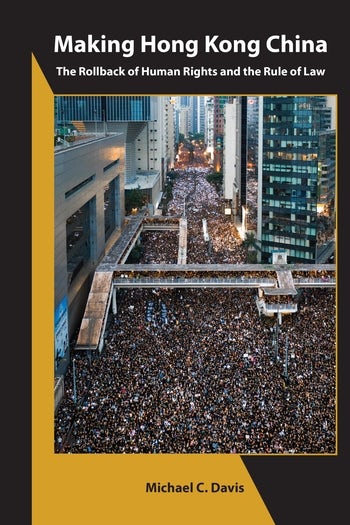
BOOK: Michael C. DAVIS, Making Hong Kong China - The Rollback of Human Rights and the Rule of Law (New York: Columbia University Press, 2020). ISBN 9781952636134, 16.00 USD


Columbia University Press has published a new book on the legal history of Hong Kong since 1997.

ABOUT THE BOOK

How can one of the world’s most free-wheeling cities transition from a vibrant global center of culture and finance into a subject of authoritarian control? As Beijing's anxious interference has grown, the “one country, two systems” model China promised Hong Kong has slowly drained away in the years since the 1997 handover. As “one country” seemed set to gobble up “two systems," the people of Hong Kong riveted the world’s attention in 2019 by defiantly demanding the autonomy, rule of law and basic freedoms they were promised. In 2020, the new National Security Law imposed by Beijing aimed to snuff out such resistance. Will the Hong Kong so deeply held in the people’s identity and the world’s imagination be lost? Professor Michael Davis, who has taught human rights and constitutional law in this city for over three decades, and has been one of its closest observers, takes us on this constitutional journey.

ABOUT THE AUTHOR

Professor Michael C. Davis is in the Fall of 2020 a Visiting Professor in the Faculty of Law at the University of Hong Kong where he teaches core courses on international human rights. He is also currently a Global Fellow at the Woodrow Wilson International Center for Scholars in Washington DC, a Senior Research Scholar at the Weatherhead East Asia Institute at Columbia University and a Professor of Law and International Affairs at O.P. Jindal Global University in India (where he is in residence each spring). A professor in the Law Faculty at the University of Hong Kong until late 2016, he has held a number of distinguished visiting professorships, including the J. Landis Martin Visiting Professor of Human Rights Law at Northwestern University (2005-6), the Robert and Marion Short Visiting Professor of Human Rights at the University of Notre Dame (2004-5) and the Frederick K. Cox Visiting Professor of Law at Case Western Reserve University (2000).


More info here

12 November 2020

BOOK: Xiaoqun XU, Heaven Has Eyes – A History of Chinese Law (Oxford: Oxford University Press, 2020). ISBN 9780190060046, USD 39.95.


(Source: OUP)

Oxford University Press is publishing a new book offering a general overview of Chinese legal history.

ABOUT THE BOOK

Heaven Has Eyes is a comprehensive but concise history of Chinese law and justice from the imperial era to the post-Mao era. Never before has a single book treated the traditional Chinese law and judicial practices and their modern counterparts as a coherent history, addressing both criminal and civil justice. This book fills this void.

Xiaoqun Xu addresses the evolution and function of law codes and judicial practices throughout China's long history, and examines the transition from traditional laws and practices to modern ones in the twentieth century. To the Chinese of the imperial era, justice was an alignment of heavenly reason (tianli), state law (guofa), and human relations (renqing). Such a conception did not change until the turn of the twentieth century, when Western-derived notions-natural rights, legal equality, the rule of law, judicial independence, and due process--came to replace the Confucian moral code of right and wrong. The legal-judicial reform agendas that emerged in the beginning of the twentieth century (and are still ongoing today) stemmed from this change in Chinese moral and legal thinking, but to materialize the said principles in everyday practices is a very different order of things, and the past century was fraught with legal dramas and tragedies. Heaven Has Eyes lays out how and why that is the case.

ABOUT THE AUTHOR

Xiaoqun Xu is Professor of History at Christopher Newport University.

TABLE OF CONTENTS

Introduction: Law and Justice in Chinese History


Part One: Law and Justice in Imperial China, 221 BEC-1911 CE

Chapter 1: Five Punishments and Beyond: The Evolution of Penal Codes in Imperial China

Chapter 2: From the Imperial Capital to the Magistrate's Court: Judicial Practices in Imperial China

Chapter 3: The Emperor, the Family, and the Land: Law and Order in Imperial China


Part Two: Law and Justice in Late Qing and Republican China, 1901-1949

Chapter 4: The Best of the Chinese and of the Western: Legal-Judicial Reform in the Late Qing, 1901-1911

Chapter 5: The Rule of Law, Judicial Independence, and Due Process: Ideals and Realities in the Republican Era, 1912-1949

Chapter 6: Bandits, Collaborators, and Wives/Concubines: Criminal and Civil Justice in the Republican Era, 1912-1949


Part Three: Law and Justice in Maoist China, 1949-1976

Chapter 7: "Contradictions between the People and the Enemy": Criminal Justice as the "Proletarian Dictatorship"

Chapter 8: "Contradictions among the People": Mediation and Adjudication of Civil Disputes


Part Four: Law and Justice in Post-Mao China, 1977-2018

Chapter 9: The Legal System and the Rule of Law: Changes in Criminal Justice, 1977-1996

Chapter 10: "Naked Officials" and "Heavenly Net": Changes in Criminal Justice, 1997-2018

Chapter 11: "Look toward Money": Civil Justice in Post-Mao China, 1977-2018


Conclusion: Heaven Has Eyes


Chronology of Chinese History

Chinese Character List

Notes

Selected Bibliography

Index


More info here

05 October 2020

BOOK: Ka-Chai TAM, Justice in Print: Discovering Prefectural Judges and Their Judicial Consistency in Late-Ming Casebooks (Leiden-New York: Brill, 2020). ISBN 978-90-04-44276-4, 116.00 EUR


(Source: Brill)

Brill is publishing a new book on prefectural judges in the judiciary of the Ming Dynasty.

ABOUT THE BOOK

In Justice in Print: Discovering Prefectural Judges and Their Judicial Consistency in Late-Ming Casebooks, Ka-chai Tam argues that the prefectural judge in the judiciary of the Ming dynasty (1368–1644) became crucial to upholding justice in Chinese society.


In light of two late Ming casebooks, namely the Mengshui zhai cundu (盟水齋存牘) by Yan Junyan and the Zheyu xinyu (折獄新語) by Li Qing, Ka-chai Tam demonstrates that the late Ming judges handled their cases with a high level of consistency in judicial reasoning and practice in every type of case, despite their differing regions and literary styles. Equipped with relative institutional independence and growing professionalism, they played an indispensable role in checking and guaranteeing the legal performance of their subordinate magistrates.

ABOUT THE AUTHOR

Ka-chai Tam, D.Phil. (2009), University of Oxford, is Assistant Professor in History at the Hong Kong Baptist University. He has published several dozen articles on the social and maritime history of late imperial China and Chinese legal history.


TABLE OF CONTENTS


Acknowledgement 

List of Tables 

1 Introduction 


2 Prefectural Judges in the Late-Ming Judicial System 


3 Favorable Institutional Circumstances for the Development of Judicial Professionalism 


4 The Emergence of the Late-Ming Casebooks and Their Importance to Our Understanding of the Ming Judiciary 

5 Two Exemplary Samples of Late-Ming Casebooks by Prefectural Judges: Mengshui zhai cundu and Zheyu xinyu 

6 The High Degree of Consistency of Judicial Rulings as Reflected in the Case Reports from Mengshui zhai cundu and Zheyu xinyu 

Conclusion 

Appendix 

Bibliography 
Index 


More info here

02 September 2020

BOOK: Yunsheng LIU, The History of the Contractual Thoughts in Ancient China (Cham: Springer, 2020). ISBN 978-981-15-5767-5, EUR 106.99


(Source: Springer)

Springer is publishing a history of contractual thought in ancient China.

ABOUT THE BOOK

This book explores the intellectual history of contract law in ancient China by employing archaeological and empirical methodologies. Divided into five chapters, it begins by reviewing the origin of the contract in ancient China, and analyzing its name, primary form, historical premise and functions. The second chapter discusses free will and lawfulness in the establishment of a contract, offering insights into the impact of contracts on social justice. In turn, the third chapter addresses the inner core of the contract: validity and liability. This allows readers at all levels to identify the similarities and differences between contracts from different eras and different parts of the world, which will also benefit those pursuing comparative research in related fields. Chapters four and five offer a philosophical exploration of contract history in ancient China, and analyze key aspects including human nature and ethical justice.

More info here

08 June 2020

BOOK: Jinfan ZHANG, The History of Chinese Legal Civilization, Modern and Contemporary China (Cham: Springer, 2020). ISBN: 9789811010309

Image result for springer publishing
(Source: Springer)


ABOUT THE BOOK

This book, based on the theory of Marxism-Leninism, aims to study the essence, content and features of various legal systems in China in different historical periods, as well as the rules of the development of Chinese legal systems. It effectively combines classic analysis and historical analysis to probe historical facts and elaborate the historical role of the legal system, revealing both the general and the specific rules of the development of China s legal system on the basis of the existing relevant research. The subject matter is of abundant theoretical and practical significance, as it enriches Marxist legal studies, deepens readers' understanding of China s legal civilization and offers guiding principles for the creation of socialist legal systems with Chinese characteristics. It discusses the trends in thinking on the reconstruction of the legal system; changing laws; western legal culture; the legal system in the period of westernization, constitution and reform; preparation for constitutionalism; modification of the law during the late Qing Dynasty; criminal, civil and commercial legislation; and judicial reforms in the modern era as well as the various ups and downs and cases of malconduct after the founding of the People's Republic of China.

TABLE OF CONTENTS

Introduction.- The Rise of the Ideological Trend of Updating the Legal System and Laws before and after the Opium War.- The Input of the Western Legal Culture and the Updating of Chinese Settled Legal Ideas (1840-1870s).- "Chinese-style Westernization ": the Legal System during the Period of the Westernization Movement.- The Sprouting of the Constitutional Thoughts and the Constitutional Reform and Modernization (the second half of the 1800s - the late 1800s).- The preparation for Constitutionalism in the Late Qing Dynasty and the Constitution.- The Emergence of the Contemporary Chinese Legal Civilization: the Modification of the Law during the Late Qing Dynasty.- A New Chapter in Chinese Criminal Law Civilization-- Criminal Law of the Great Qing Dynasty.- The Draft Civil Law of the Great Qing Dynasty Integrating with the Western Civil Law.- The Commercial Legislation Changing from restraining Business to Protecting Business.- The Reforms Ushering in the Judicial Civilization.- The National Program of Building a Democratic Republic and the New Epoch of Chinese Legal Civilization.- The Development and Devastation of Modern Chinese Legal Civilization during the Beijing Government Period (1912-1928).- The Book of the Six Laws of Nanjing national government (1928-1949).- Facilitating Chinese Legal Civilization during the New Democracy Period: building the Legal System of the Base Areas.- Contemporary Chinese Civilization (1949 - present).- Introduction.- The Groundwork for the New Chinese Legal Civilization.- Constructing the Socialist Legal Civilization with Chinese Characteristics (1st).- Constructing the Socialist Legal Civilization with Chinese Characteristics (2nd).- The Historical Experience in Building the Socialist Legal System with Chinese Characteristics.


More information here

24 April 2020

BOOK: Jinfan ZHANG, The History of Chinese Legal Civilization Ancient China. (Cham: Springer, 2020). ISBN 978-981-10-1027-9, EUR 145,59


(Source: Springer)

Springer is publishing a new book on the history of Chinese legal civilization from a Marxist-leninist perspective.

ABOUT THE BOOK

This book, based on the theory of Marxism-Leninism, aims to study the essence, content and features of various legal systems in China in different historical periods, as well as the rules of the development of Chinese legal system. It effectively combines classic and historical analysis to probe the historical facts and elaborate the historical role of the legal system, revealing both the general and the specific rules of the development of the Chinese legal system on the basis of the existing relevant researches. The subject matter is of abundant theoretical and practical significance, as it enriches Marxist legal studies, deepens the readers’ understanding of Chinese legal civilization and offers guiding principles for the creation of socialist legal systems with Chinese characteristics. The chapters are structured chronologically, ranging from the Xia and Shang Dynasties, the Western Zhou Dynasty, the Spring and Autumn Period, the Han Dynasty, the South and North Dynasties, the Sui and Tang Dynasties, the Song Dynasty to the Ming and Qing Dynasties when Chinese legal system took on its final form. The chapters are compiled according to legislation, administrative law, criminal law and judicial system. Besides, the Chinese legal civilization after the Revolution of 1911 led by Sun Yat-sen is also addressed.

More info here

07 April 2020

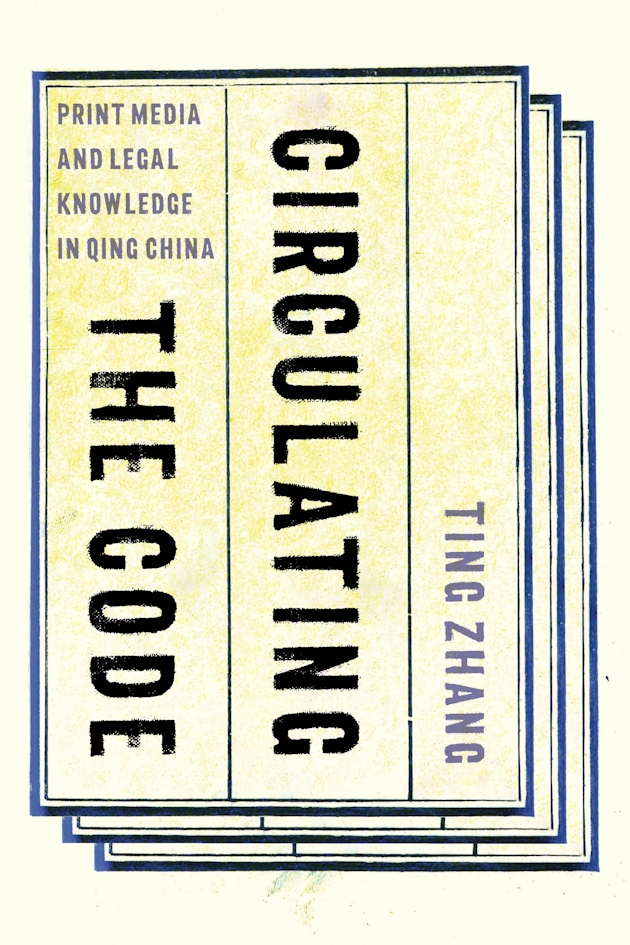
BOOK: Ting ZHANG, Circulating the Code : Print Media and Legal Knowledge in Qing China (Seattle: University of Washington Press, 2020). ISBN 9780295747156, $30.00


The University of Washington Press is publishing a book on the diffusion of legal knowledge in Qing China.

ABOUT THE BOOK

Contrary to longtime assumptions about the insular nature of imperial China’s legal system, Circulating the Code demonstrates that in the Qing dynasty (1644–1911) most legal books were commercially published and available to anyone who could afford to buy them. Publishers not only extended circulation of the dynastic code and other legal texts but also enhanced the judicial authority of case precedents and unofficial legal commentaries by making them more broadly available in convenient formats. As a result, the laws no longer represented privileged knowledge monopolized by the imperial state and elites. Trade in commercial legal imprints contributed to the formation of a new legal culture that included the free flow of accurate information, the rise of nonofficial legal experts, a large law-savvy population, and a high litigation rate.

Comparing different official and commercial editions of the Qing Code, popular handbooks for amateur legal practitioners, and manuals for community legal lectures, Ting Zhang demonstrates how the dissemination of legal information transformed Chinese law, judicial authority, and popular legal consciousness.

ABOUT THE AUTHOR

Ting Zhang is assistant professor of history at the University of Maryland.

More info here

03 April 2020

ARTICLE: Yue DU, "Legal Justice in Eighteenth-Century Mongolia: Gender, Ethnicity, and Politics in the Manchu-Mongol Marriage Alliance" (Late Imperial China XXXVII (2016), no. 2 (Dec); OPEN ACCESS

(image source: ProjectMuse)

First paragraph:
The rule of the Qing Empire (1644–1911) over its “outer territories” in East and Inner Asia (Mongolia, Manchuria, Xinjiang, and Tibet) has received considerable scholarly attention since the 1990s. Historians have suggested that in Mongolia, as well as in Xinjiang and Tibet, the Qing managed to establish and maintain an efficient administration that played a more crucial role than military power, at least since the second half of the eighteenth century. The Qing eventually transformed the jimi, or “loose reign” system, an indirect form of central control over “barbarian” client states along the imperial borders in the traditional Chinese tributary system, to a more direct administrative structure accompanied by military occupation.1 With regard to legal order in Mongolia under Qing rule, previous scholarship has proposed that, unlike their counterparts in colonies controlled by European powers, Mongolian local banner princes (jasags) held a recognized position in the official hierarchy of Qing judicial-administration in Mongolia.
(read further on ProjectMuse)

27 March 2020

BOOK: Max Wai Lun WONG, Chinese Marriage and Social Change - The Legal Abolition of Concubinage in Hong Kong (Cham: Springer, 2020). ISBN 978-981-15-1643-6, EUR 83,19


(Source: Springer)

Springer is publishing a new book on the legal history of the abolition of concubinage in Hong Kong.
 
ABOUT THE BOOK

This book provides a comparative account of the abolition of concubinage in East Asia, offering a new perspective and revised analysis of the factors leading to – and the debates surrounding  – the introduction of a new Marriage Reform Ordinance in Hong Kong in 1971. It uses this law as a platform to examine how the existence of concubinage – long preserved in the name of protecting Chinese traditions and customs — crucially influenced family law reforms, which were in response to a perceived need to create a ‘modern’ marriage system within Hong Kong’s Chinese community after the Second World War. This was, by and large, the result of continued pressure from within Hong Kong and from Britain to bring Hong Kong’s marriage system in line with international marriage treaties. It represented one of the last significant intrusions of colonial law into the private sphere of Hong Kong social life, eliminating Chinese customs which had been previously recognised by the colonial legal system’s family law. This book contextualizes the Hong Kong situation by examining judicial cases interpreting Chinese customs and the Great Qing Code, offering a comprehensive understanding of the Hong Kong situation in relation to the status of concubines in Republican China and other East Asian jurisdictions. It will be of particular interest to teachers and students of law, as well as researchers in gender studies, post-colonialism, sociology and cultural studies.

ABOUT THE AUTHOR

Dr. Max Wai Lun Wong is an Assistant Professor at the School of Modern Languages and Cultures at the University of Hong Kong. He holds a PhD from SOAS, University of London. He is an associate member of the Chartered Institute of Arbitrators in the UK. His research interests include Law and Public Administration, Chinese Customary Law and Practice in South East Asia, Law and Creative Industries and Traditional Cultural Expression and Law in South East Asia.

More info here

BOOK: Martin HOFMAN, Joachim KURTZ & Ari Daniel LEVINE (eds.), Powerful Arguments. Standards of Validity in Late Imperial China [Sinica Leidensa; 146] (Leiden/Boston: Martinus Nijhoff/Brill, 2020), ISBN 978-90-04-42362-6, € 149

(image source: Brill)

Book abstract:
The essays in Powerful Arguments reconstruct the standards of validity underlying argumentative practices in a wide array of late imperial Chinese discourses, from the Song through the Qing dynasties. The fourteen case studies analyze concrete arguments defended or contested in areas ranging from historiography, philosophy, law, and religion to natural studies, literature, and the civil examination system. By examining uses of evidence, habits of inference, and the criteria by which some arguments were judged to be more persuasive than others, the contributions recreate distinct cultures of reasoning. Together, they lay the foundations for a history of argumentative practice in one of the richest scholarly traditions outside of Europe and add a chapter to the as yet elusive global history of rationality.

On the editors:
Martin Hofmann, Ph.D. (2007) is Assistant Professor for East Asian Intellectual History at Heidelberg University’s Centre for Asian and Transcultural Studies. He has mainly published on historical cartography, practices of argumentation, and the text-image relation in late imperial China. Joachim Kurtz, Ph.D. (2003), is Professor of Intellectual History at Heidelberg University. He is the author of The Discovery of Chinese Logic (Brill, 2011), and has published widely on circulations of knowledge between China and Europe. Ari Daniel Levine, Ph.D (2002) is Associate Professor of History at the University of Georgia. The author of Divided by a Common Language (University of Hawai'i Press, 2008), he is currently the Editor of the Journal of Song-Yuan Studies.

21 February 2020

BOOK: Richard CULLEN, Hong Kong Constitutionalism : The British Legacy and the Chinese Future (London: Routledge, 2019). ISBN 9781138320130, £96.00


(Source: Routledge)

Routledge is publishing a new book on the history of Hong Kong constitutionalism.

ABOUT THE BOOK

Hong Kong is widely regarded as an exemplar of authoritarian jurisdictions with a positive history of adhering to Rule of Law shaped governance systems. British Hong Kong provides a remarkable story of the effective development and consolidation of such a system, which has continued to apply since 1997 when it became the Hong Kong Special Administrative Region (HKSAR) within the People’s Republic of China (PRC).

This book adopts a fresh approach in examining the evolution of Hong Kong’s political-legal experience. It establishes that these prominent governance achievements were built on particular British constitutional foundations forged over many centuries. The work shows how the analysis of the British theorist Albert Dicey and, in particular, `Diceyan Constitutionalism’ was fundamental, within the pivotal context of `Chinese Familism’, in shaping the development of governance institutions and operational procedures within the new British Colony.

It discusses how Hong Kong’s system of Authoritarian Legality has come to pass. Exploring the essence of that system, the study probes how thoroughly it has been stress-tested, not least in 2019, and how well it may be placed to cope with tests yet to come. It also analyzes Hong Kong–Beijing relations and the long-term prospects for the HKSAR within the PRC based on a balanced contemporary assessment of China’s exceptional One Party State.

ABOUT THE AUTHOR

Richard Cullen is a Visiting Professor in the Faculty of Law, University of Hong Kong. He first began working in Hong Kong in 1991. His research interests are in Public Law, Taxation Law, Comparative Law, Fundamentals of the Common Law, and Media Law. He has published extensively on these and related areas.

More info here

14 February 2020

BOOK: Vincent K.L. CHANG, Forgotten Diplomacy, The Modern Remaking of Dutch-Chinese Relations, 1927–1950. Series: Studies on Modern East Asian History, Vol. 2 (Leiden/Boston: Nijhoff/Brill, 2019). ISBN: 9789004410701, € 149.00

Cover Forgotten Diplomacy
(Source Brill)


ABOUT THE BOOK

In this meticulously researched volume, Vincent Chang resurrects a near forgotten yet pivotal chapter of Dutch-Chinese ties to narrate how World War II, the civil war in China, and Indonesia’s decolonization redefined and remade this age-old bilateral relationship. 
Drawing on a unique range of hitherto unexplored archives, the book explains how China’s nascent rise on the global scene and the Netherlands’ simultaneous decline as a colonial power shaped events in Dutch-controlled Indonesia (and vice versa) and prompted a re-calibration of their mutual ties, culminating in the Netherlands’ recognition of the People’s Republic and laying the foundations for Dutch and Chinese policies through to the present. 
Offering insightful analyses of power dynamics and international law at the close of empire, this book is a critical resource for historians and China specialists as well as scholars of international relations.

ABOUT THE AUTHOR

Vincent K.L. Chang, PhD (2016), a Dutch lawyer and historian, is Associate Professor of History at Southwest University (China) specializing in modern Chinese history and diplomacy. He also teaches at Leiden University and serves as a fellow of the LeidenAsiaCentre.

TABLE OF CONTENTS

Contents
Acknowledgments
List of Tables
List of Plates
Note
Introduction
 1 Dutch Diplomatic History
 2 Chinese Diplomatic History
 3 Merging Histories
 4 Traits of Modern Dutch-Chinese Relations
 5 Aims, Arguments, and Organization of the Book

Part 1: Readjustment
1 Diplomatic Relations During the Prewar Years: 1927–1936
 1 International Context
 2 Development of Bilateral Ties
 3 Dutch Official Representation in China
 4 Chinese Official Representation in the Netherlands
 5 Conclusion
2 Remission of the Dutch Share in China’s Boxer Indemnity
 1 A Watershed Moment
 2 The Central Hydraulic Research Institute at Nanjing
 3 Life, Loss, and Lasting Friendship
 4 Effects and Significance
Plates 1–24

Part 2: Realignment
3 Diplomatic Relations during the War Years: 1937–1945
 1 International Context
 2 Development of Bilateral Ties
 3 Dutch Official Representation in China
 4 Chinese Official Representation in the Netherlands
 5 Conclusion
4 Abrogation of Dutch Extraterritorial Rights in China
 1 The System of Extraterritoriality in China
 2 Extraterritoriality and Dutch-Chinese Treaty Relations
 3 The Dutch-Chinese Treaty of
 4 Effects and Significance
Plates 25–45

Part 3: Reset
5 Diplomatic Relations during the Postwar Years: 1946–1950
 1 International Context
 2 Development of Bilateral Ties
 3 Dutch Official Representation in China
 4 Chinese Official Representation in the Netherlands
 5 Conclusion
6 Recognition of the People’s Republic of China
 1 Early Encounters
 2 The Path to Recognition
 3 Rationales, Response, Result
 4 Effects and Significance

Conclusion
 1 Change and Continuity
 2 Policies and People
 3 Power Dynamics
 4 Past and Present
 5 The Future Past
Appendix 1: Chronology of Major Events
Appendix 2: Overview of Senior Envoys, 1927–1950
Appendix 3: Exchange of Notes Dated 4 April 1933
Appendix 4: Joint Announcement Dated 15 February 1943
Appendix 5: Dutch-Chinese Treaty of 29 May 1945
Appendix 6: Notes on Recognition, March/April 1950
Bibliography
Index

More information here

22 January 2020

BOOK: Pierre-Étienne WILL, Handbooks and Anthologies for Officials in Imperial China (Leiden-New York: Brill, 2020). ISBN 978-90-04-41611-6, EUR 250.00


(Source: Brill)

Brill is publishing a new book on sources of Song, Ming, and Qing administrative Chinese law.

ABOUT THE BOOK

The 1,165 entries of Handbooks and Anthologies for Officials in Imperial China by Pierre-Étienne Will and collaborators provide a descriptive list of extant manuscript and printed works—mainly from the Song, Ming, and Qing dynasties—created with the aim to instruct officials and other administrators of imperial China about the technical and ethical aspects of government, and to provide tools and guides to help with the relevant procedures. Both generalist and specialized texts are considered. Among the latter, such disciplines as the administration of justice, famine relief, and the military receive particular attention. Each entry includes the publishing history of the work considered (including modern editions), an analysis of contents, and a biographical sketch of the author.

ABOUT THE AUTHOR

Pierre-Étienne Will, Ph.D. (1975), EHESS, is Professor Emeritus of modern Chinese history at Collège de France. He has published extensively on the socio-economic history of late-imperial and early-Republican China, including Bureaucracy and Famine in Eighteenth- Century China (Stanford, 1990).

More info here

11 October 2019

BOOK: Jean-Pierre DIENY, Le Droit Mongol dans l’État Sino-Mandchou (1644-1911) (Paris: Editions de Boccard, 2019). ISBN 978-2-85757-079-0, 35,00 €


Editions De Boccard has published a new book on Chinese Ming dynasty laws in the Mongol sphere.

ABOUT THE BOOK

Partant d’une description complète de la législation impériale promulguée par le gouvernement des Qing pour la Mongolie, l’auteur examine dans ce livre les problèmes nés de l’introduction de cette législation aux Mongols et de l’application de celle-ci. L’étude d’un large éventail de documents juridiques — incluant les codes mongols antérieurs aux Qing, la législation impériale, les règlements administratifs et les jugements rendus à la fois aux niveaux local et central — lui permet d’analyser les interactions entre le droit et diverses questions relatives à l’autonomie locale, au pluralisme juridique, à l’assimilation politique et aux relations entre le centre et la périphérie. L’auteur défend l’idée que les Qing tendirent à mettre en valeur l’approche et les principes du droit chinois lors de l’élaboration de la législation propre aux Mongols. Ils transférèrent progressivement une grande partie de concepts étrangers à la tradition juridique mongole, sinon leur totalité. Malgré les efforts importants mis en œuvre pour contrôler et normaliser l’administration des régions périphé-riques jusqu’à en faire une extension de la Chine intérieure plutôt qu’un protectorat gouverné par l’aristocratie locale, et malgré les effets de l’immigration Han en Mongolie, les principes du droit mongol ne disparurent cependant pas complètement, ainsi qu’en témoignent les jugements rendus par les juges des niveaux inférieurs de l’administration Qing en Mongolie.

More info here

11 September 2019

LECTURE: Leuven Legal History Talks – Dr. Carrai on “China, Sovereignty and International Law” (Leuven, 19 November 2019)


(Source: KU Leuven)


The department of Roman law and legal history at the KU Leuven is hosting its next speaker in the Leuven Legal History Talks coming November.

NEXT LECTURE

CHINA, SOVEREIGNTY AND INTERNATIONAL LAW


When?
19th November 2019
4PM-5PM
Where?
DE VALK-03, room 01.25

More info here

30 May 2019

BOOK: Maria Adele CARRAI, Sovereignty in China - A Genealogy of a Concept since 1840 [Cambridge Studies in International and Comparative Law] (Cambridge: Cambridge University Press, 2019). ISBN 9781108474191, £ 85.00


(Source: CUP)

Cambridge University Press is publishing a new book on the concept of sovereignty in China during the period 1840 to the present.

ABOUT THE BOOK

This book provides a comprehensive history of the emergence and the formation of the concept of sovereignty in China from the year 1840 to the present. It contributes to broadening the history of modern China by looking at the way the notion of sovereignty was gradually articulated by key Chinese intellectuals, diplomats and political figures in the unfolding of the history of international law in China, rehabilitates Chinese agency, and shows how China challenged Western Eurocentric assumptions about the progress of international law. It puts the history of international law in a global perspective, interrogating the widely-held belief of international law as universal order and exploring the ways in which its history is closely anchored to a European experience that fails to take into account how the encounter with other non-European realities has influenced its formation.

ABOUT THE AUTHOR

Maria Adele Carrai, Katholieke Universiteit Leuven, Belgium

Maria Adele Carrai is currently a Marie Curie Postdoctoral Fellow at the Katholieke Universiteit Leuven and a Fellow at Harvard University Asia Center. She completed a Ph.D. in Law at the University of Hong Kong in 2016, where she received the Award for Outstanding Postgraduate Research Student for 2015–16, the Hong Kong Ph.D. Fellowship and the Swire Scholarship. Since she completed her Ph.D., she has been Princeton-Harvard China and the World Fellow (2017–18), New York University Global Hauser Fellow (2016–17), Max Weber Postdoctoral Fellow at the European University Institute, Florence (2015–17). Her research has appeared in various peer-review journals and she has spoken in a variety of fora.

TABLE OF CONTENT

Introduction
1. International law and the sinocentric ritual system: a nineteenth-century clash of normative orders
2. Secularizing a sacred empire: early translations and uses of international law
3. China's struggle for survival and the new Darwinist conception of international society (1895–1911)
4. China rejoining the world and its fictional sovereignty, 1912–1949
5. From Proletarian revolution to peaceful coexistence: sovereignty in the PRC, 1949–1989
Conclusion.

More info here