Search

27 August 2020

LIST: Comprehensive List of Legal History Journals (David Berg Foundation Institute for Law and History)


Presentation:

The list includes current periodicals, in all languages, that have legal history as their main focus. Many other legal and history journals also publish important work on legal history but are not listed here. We would be happy to add to the list. Please send corrections, broken links, and suggestions for additional journals to berg@tauex.tau.ac.il.

This list was compiled by Ron Harris and Assaf Likhovsky. 

Consult the list here. 

(source: David Schorr)

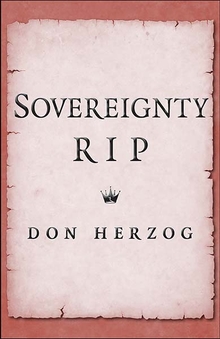
BOOK: Don HERZOG, Sovereignty, RIP (New Haven: Yale University Press, 2020). ISBN 9780300247725, 40.00 USD

(Source: Yale University Press)


Yale University Press is publishing a book on the past, present and future of the concept of sovereignty.

ABOUT THE BOOK

Has the concept of sovereignty outlived its usefulness?

Social order requires a sovereign: an actor with unlimited, undivided, and unaccountable authority. Or so the classic theory says. But without noticing, we’ve gutted the theory. Constitutionalism limits state authority. Federalism divides it. The rule of law holds it accountable. In vivid historical detail—with millions tortured and slaughtered in Europe, a king put on trial for his life, journalists groaning at idiotic complaints about the League of Nations, and much more—Don Herzog charts both the political struggles that forged sovereignty and the ones that undid it. He argues that it’s no longer a helpful guide to our legal and political problems, but a pernicious bit of confusion. It’s time, past time, to retire sovereignty.

ABOUT THE AUTHOR

Don Herzog is the Edson R. Sunderland Professor of Law at the University of Michigan. His many books include Defaming the Dead, Household Politics, and Cunning.


More info here


26 August 2020

CONFERENCE: Monarchy & Money: Interdisciplinary Approaches to Economics and Finances of Monarchical Rule (Online, 16-18 September 2020)

 
(Source: HSozKult)

We learned of an online conference organized by the University of Göttingen on monarchy & money.

“In monarchies, power, law, finances, and economy were and are intertwined aspects of the royal household. Recent legal disputes between royal and formerly royal houses and governments show the continued relevance of economic aspects of monarchical rule. Historically, monarchies were often not only states ruled by a closely related, small elite group, i.e. the dynasty, but also encompassed the private properties of these families. Separating ownership between the institution (crown) and the family (dynasty) has been a difficult problem which is yet to be solved entirely. Analysing the economic and financial resources of a monarchy, a dynasty or a court therefore also has implications of how scholars assess the economic development of a realm or a state. Although historical research has addressed many questions of monarchical rule, there is still a need to analyse the administration of money and resources at court, the decision making behind patterns of expenditure and resource utilisation, and the strategies of royal investments. Regarding the political and historical context, economic and financial prosperity also contributes to the international reputation and influence of a court and/or a monarchy. Economic aspects of monarchical rule are still mostly lacunae in historical research, and also directly relevant for current affairs.

The e-conference “Monarchy & Money” will address the interdependences of monarchical rule on past and present economies and finances.”

The program of the conference can be found on HSozKult

25 August 2020

SEMINAR: Slaveryarchive Book Club


(Source: Slavery Archive)

The Slavery Archive has created a book club that organizes a session of Zoom meetings focusing on new books on slavery and the Afro-Atlantic world.

The #Slaveryarchive book club is an online initiative put together by scholars Ana Lucia Araujo (Howard University), Jessica Johnson (Johns Hopkins University), Vanessa Holden (University of Kentucky), and Alex Gil (Columbia University) to discuss newly published books on slavery and the Afro-Atlantic world. These hard times force us to stay physically apart but encourage us to create digital connections. In many ways digital meetings are more inclusive as readers and authors across the globe can connect without the usual financial and time barriers that separate us.


How can I attend? Get the book prior to each session, read it, register to attend the meeting on Zoom (check below each meeting for registration links) or watch the sessions live or whenever you want on the #Slaveryarchive book club channel on Youtube. Please note that if you choose to attend on Zoom, each meeting requires a new registration.


How do the meetings work? Authors or editors make a short presentation of their respective books. Attendants can ask questions and provide comments if they wish. If you attend on Zoom you will ask questions orally by first raising your hand (tool of the bottom of the Zoom screen). Please note that you are being broadcast on Youtube and the video will remain there. If you attend on Youtube live, you can type your questions in the chat box and we will read the questions to the author.


Meetings are held on Wednesdays once or twice a month from 5:00 PM to 7:00 PM. Authors based in Europe or Africa present on Saturdays from 1:00 PM to 3:00 PM. All meetings are held at EST time United States and Canada.


All upcoming meetings and book titles can be found here

CD-ROM: Entscheidungen Des Bundesverfassungsgerichts (BVerfGE) - CD-ROM (Tübingen: Mohr Siebeck, 2020). EUR 7226.00


(Source: Mohr Siebeck)

Mohr Siebeck has made a CD-ROM containing all decisions of the Bundesverfassungsgericht.

ABOUT THE CD-ROM

Published in German.

The official compilation of the decisions made by the Federal Constitutional Court of Germany presently consists of 147 volumes containing a total of approx. 3300 decisions. The CD-ROM contains all these decisions, has exactly the same page make-up as the printed version and a user-friendly program interface. It is possible to browse through all the decisions and also to access individual decisions or passages directly. The decisions are linked, can be highlighted partially and notes can be appended to them.


More info here

24 August 2020

JOURNAL: Unbound – A Review of Legal History and Rare Books (Vol. 12, Issue 1)

 
(Source: HeinOnline)

We learned of the open access summer issue of “Unbound-A Review of Legal History and Rare Books”. Here the table of contents:

ARTICLES

Sir William Gooch and Law Books in Colonial Virginia

Warren M. Billings 5

Reflections on the monographs of David Yale QC, FBA

Lesley Dingle 17

Like Sand from the Pyramids*: Using Rare Books and

Manuscripts to Facilitate Object-Based Learning in the Law

School Classroom

Melissa M. Hyland 28

Creating a Biographical Dictionary of the Justices of

the Supreme Court of Pennsylvania: A Bibliographical Essay

Joel Fishman 55

The Mystery of Missing Marvin: Determining the

Alumni Status of a Century-Old Student

Marcus Walker 80

BOOK REVIEWS 91


The full issue can be found here

21 August 2020

PODCAST: New Books in Law


(Source: New Books Network)

We had not yet reported on the New Books in Law podcast hosted by the New Books Network, and which includes several episodes discussing new books in the field of legal history. The podcast can be found here

20 August 2020

ADVANCE ARTICLE: Merve FEJZULA, 'The Cosmopolitan Historiography of Twentieth-Century Federalism' (Historical Journal, 14 JUL 2020)

(image source: CUP)

Abstract:

This article examines the historiographical debate over federalism between the 1930s and 1960s. In their most sweeping iterations, revisionists have sought to unravel the history of the nation-state, by using the history of anti-colonial federalist demands for equal incorporation into imperial states as evidence against a teleology of nationalist independence. In perceiving the democratic potentialities embedded within imperial state forms, revisionists argue that anti-colonial federalists therefore belong within a cosmopolitan tradition of seeking democratic supra-national governance beyond empire and nation. Some iterations of ‘post-colonial cosmopolitanism’ have unfortunately channelled debate into an opposition between federalism and nationalism, while also generating methodological republicanism, the tendency to view proto-republics within imperial formations. This review challenges these interpretive shortcomings and argues instead that federalism ought to be understood as part of a contest about the state as such. By integrating scholarship on French and British imperial federalism with recent work on regional federalisms in European and African contexts, this essay centres a whole range of ideological variations of ‘cosmopolitanism’ that adapted federalism to their critiques of the state. Ultimately, this reframing of federalist historiography enables new insights into contests about, and not just over, twentieth-century states.

Read here: DOI 10.1017/S0018246X20000254.

BOOK: Leonardo PIERDOMINICI, The Mimetic Evolution of the Court of Justice of the EU A Comparative Law Perspective (London: Springer, 2020). ISBN 978-3-030-47863-6, 90.09 EUR


(Source: Springer)

Palgrave is publishing a new book on the institutional development of the CJEU.

ABOUT THE BOOK

This book provides fresh perspectives in the legal study of the Court of Justice of the European Union. In the context of European studies, the Court has mainly been analysed in light of its central role in the process of continental integration. Moreover, the Court has traditionally been studied by specialists for its important role as an agent of comparative law. This book studies the evolution of the Court itself, rather than that of the EU legal order in its judge-made dimension, and addresses several institutional aspects of its structure and organization, selected and constructed as a complete range of symptomatic figures of judicial institutionalisation. In doing so, the author seeks to showcase how the development and the institutional evolution of the CJEU happened through a selective internalization of comparative influences.

ABOUT THE AUTHOR

Leonardo Pierdominici is a researcher at the School of Law of the Alma Mater Studiorum – University of Bologna, Italy. He previously worked as a research associate at the Robert Schuman Center for Advanced Studies of the European University Institute.

More info here

BOOK: Virpi MÄKINEN et al., eds., Rights at the Margins - Historical, Legal and Philosophical Perspectives (Leiden-New York: Brill, 2020). ISBN 978-90-04-43153-9, $119.00


(Source: Brill)

Brill is publishing a new essay collection on the history of rights.

ABOUT THE BOOK

The essays in this volume explore the ways rights were available to those in the margins of society. By tracing pivotal judicial concepts such as ‘right of necessity’ and ‘subjective rights’ back to their medieval versions, and by situating them in unexpected contexts such as the Franciscans’ theory of poverty and colonization or today’s immigration and border control, this volume invites its readers to consider whether individual rights were in fact, or at least in theory, available to the marginalized. By focusing not only on the economically impoverished but also those who were disenfranchised because of disability, gender, race, religion or infidelity, this book also sheds light on the relationship between the early history of individual rights and social justice at the margins. 

Contributors are: Wim Decock, Heikki Haara, Virpi Mäkinen, Alejandra Mancilla, Julia McClure, Ilse Paakkinen, Mikko Posti, Jonathan Robinson, John Salter, Pamela Slotte, and Jussi Varkemaa.

ABOUT THE EDITORS

Virpi Mäkinen is Senior Lecturer in Theological and Social Ethics at the University of Helsinki, Finland. She has published monographs and many articles on medieval and early modern intellectual history, including Property Rights in the Late Medieval Discussion on Franciscan Poverty (Peeters, 2001), and co-edited Transformations in Late Medieval and Early-Modern Rights Discourse (Springer, 2006). 

Jonathan Robinson, Ph.D. (2010) in Medieval Studies at the University of Toronto, Canada. He currently acts as a lawyer and is the author of William of Ockham’s Theory of Property Rights in Context (Brill, 2012).

Pamela Slotte is Associate Professor of Minority Studies at the Åbo Akademi University, Finland. She is the co-author of The Juridification of Religion (Brill, 2017) and co-editor of Revisiting the Origins of Human Rights (Cambridge University Press, 2015). 
Heikki Haara is Senior Lecturer of Political History at the University of Helsinki. He is the author of Pufendorf’s Theory of Sociability: Passions, Habits and Social Order (Springer, 2018).

TABLE OF CONTENTS

Acknowledgements
About the Authors
Abbreviations

Introduction: Rights and Justice towards the Margins
  Virpi Mäkinen, Jonathan Robinson and Pamela Slotte


PART 1: Rights and the Poor Law

1 Poverty and Need in the Fourteenth Century: Johannes Andreae, Bartolus of Saxoferrato, and Baldus de Ubaldis
  Jonathan Robinson

2 Poor and Insolvent: Debtor Relief in Alvarez de Velasco’s De privilegiis pauperum (1630)
  Wim Decock


PART 2: Rights, Duties and Justice

3 Inclination to Self-Preservation and Rights to Life and Body in Samuel Pufendorf’s Natural Law Theory
  Heikki Haara

4 The Right of Necessity: From Hugo Grotius to Adam Smith
  John Salter


PART 3: Rights Beyond the Margins

5 Rights and Needs: Widows as a Protected Group in Christine de Pizan’s Thought
  Ilse Paakkinen

6 Can Animals Have Rights? Conrad Summenhart and Francisco de Vitoria at the Margins of Rights Language
  Jussi Varkemaa

7 Whether Heretics and Infidels Can Possess Dominion Rights? Late Medieval and Early Modern Debates
  Virpi Mäkinen and Mikko Posti


PART 4: Geopolitical, Global, and Contemporary Perspectives at the Margins

8 The Darker Side of Rights in Global Intellectual History: an Ambivalent Case of Franciscan Poverty
  Julia McClure

9 Necessity Knows No Borders: the Right of Necessity and Illegalized Migration
  Alejandra Mancilla

10 “Rights, Not Charity!” On Vocabularies for Conceptualizing the Case of Persons with Disabilities
  Pamela Slotte 

More info here

19 August 2020

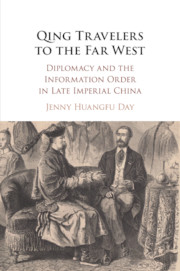
BOOK: Jenny HUANGFU DAY, Qing Travelers to the Far West. Diplomacy and the Information Order in Late Imperial China (Cambridge: University Press, 2020). ISBN: 9781108457729, £ 23.99

Qing Travelers to the Far West
(Source: CUP)

ABOUT THE BOOK

Prior to the nineteenth century, the West occupied an anomalous space in the Chinese imagination, populated by untamable barbarians and unearthly immortals. First-hand accounts and correspondence from Qing envoys and diplomats to Europe unraveled that perception. In this path-breaking study, Jenny Huangfu Day interweaves the history of Qing legation-building with the personal stories of China's first official travelers, envoys and diplomats to Europe. She explores how diplomat-travelers navigated the conceptual and physical space of a land virtually unmapped in the Chinese intellectual tradition and created a new information order. This study reveals the fluidity, heterogeneity, and ambivalence of their experience, and the layers of tension between thinking, writing, and publishing about the West. By integrating diplomatic and intellectual history with literary analysis and communication studies, Day offers a fundamentally new interpretation of the Qing's engagement with the West.

ABOUT THE AUTHOR

Jenny Huangfu Day is Assistant Professor of History at Skidmore College, New York.

TABLE OF CONTENTS

List of figures
Acknowledgments
Introduction
1. The traveler
2. The envoy
3. The student
4. The scholar
5. The diplomat
6. The strategist
Epilogue
Appendix 1. Zhigang's passage on the White House visit in the 1877 and 1890 editions
Appendix 2. Selected passages that appeared in the Chushi taixi jiyao (1890) but not in the Chushi taixi ji (1877)
Glossary
Bibliography
Index.


More information with the publisher.

18 August 2020

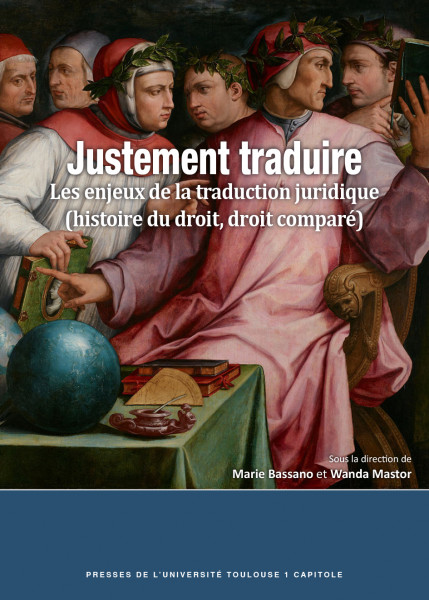
BOOK: Wanda MASTOR & Marie BASSANO (eds), Justement traduire [Colloques de l'IFR, vol. 42] (Toulouse: IFRD, 2020), 316 p. ISBN 978-2-3617-0197-0, € 42

(image source: Nomôdos)

Abstract:
Le droit a son propre langage, et même plusieurs. La circulation des droits d'un pays à un autre, d'une époque à l'autre, suppose la possibilité de pouvoir saisir ce droit voyageur. Pour traverser les frontières et les âges, il doit être traduit. Mais que traduit-on lorsqu'on traduit le droit ? La différence fondamentale formulée par Ferdinand de Saussure - entre sens (contenu intrinsèque du terme) et valeur (contenu du terme tel qu'il résulte des relations qu'il entretient avec d'autres termes relevant d'un même système linguistique) d'un mot - prend une dimension toute particulière dans le domaine juridique : ce qui y distingue le sens de la valeur n'est pas seulement l'intégration du mot dans un système linguistique donné, mais aussi et surtout dans un système juridique spécifique. La question de la traduction juridique s'entend donc en réalité à plusieurs niveaux. Il n'y est pas seulement question de traduire les mots du droit ; s'y mêlent aussi la question de la possibilité de traduire la distance qu'entretient la langue juridique avec la langue commune au sein de chaque système linguistique, et celle de la capacité à transcrire les réalités juridiques inhérentes à un système juridique dans des langues par lesquelles se pensent et se formulent des règles auxquels ces réalités sont étrangères. Historiens du droit et comparatistes sont sans cesse confrontés à cette passionnante mais redoutable difficulté. L'ambition du colloque était de questionner les pratiques multiples de la traduction juridique, à la fois dans leur épaisseur historique et dans leur amplitude transfrontalière. Asseoir l'autorité, établir le dialogue et diffuser le savoir ont été les trois temps autour desquels se sont articulés les interventions académiques et retours d'expérience multiples.

 (source: Nomôdos)


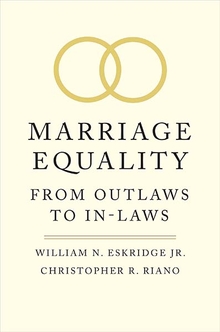
BOOK: William N. ESKRIDGE, Marriage Equality From Outlaws to In-Laws (New Haven: Yale University Press, 2020). ISBN 9780300221817, 40.00 USD


Yale University Press has published a new book on the history of the marriage equality debate in the United States.

ABOUT THE BOOK

As a legal scholar who first argued in the early 1990s for a right to gay marriage, William N. Eskridge Jr. has been on the front lines of the debate over same-sex marriage for decades. In this book, Eskridge and his coauthor, Christopher R. Riano, offer a panoramic and definitive history of America’s marriage equality debate. The authors explore the deeply religious, rabidly political, frequently administrative, and pervasively constitutional features of the debate and consider all angles of its dramatic history. While giving a full account of the legal and political issues, the authors never lose sight of the personal stories of the people involved, or of the central place the right to marry holds in a person’s ability to enjoy the dignity of full citizenship. This is not a triumphalist or one-sided book but a thoughtful history of how the nation wrestled with an important question of moral and legal equality.

ABOUT THE AUTHOR

William N. Eskridge Jr. is the John A. Garver Professor of Jurisprudence at Yale Law School. 
Christopher R. Riano is the executive director of the Center for Civic Education and a lecturer in constitutional law and government at Columbia University.

More info here

BOOK: Aislinn MULLER, The Excommunication of Elizabeth I. Faith, Politics, and Resistance in Post-Reformation England, 1570-1603 (Leiden: Brill, 2020). ISBN: 9789004425996, €125.00

Cover The Excommunication of Elizabeth I
(Source: Brill)

ABOUT THE BOOK

Series: St Andrews Studies in Reformation History

In The Excommunication of Elizabeth I, Aislinn Muller examines the excommunication and deposition of Queen Elizabeth I of England by the Roman Catholic Church, and its political afterlife during her reign. Muller shows that Elizabeth’s excommunication was a crucial turning point for both Catholics and Protestants, one that irrevocably changed attitudes towards the queen, widened political participation and resistance, and posed a destabilising threat to her regime. The Excommunication of Elizabeth I demonstrates how this event exacerbated religious tensions in England’s foreign and domestic politics, and how Elizabeth’s conflict with the papacy shaped the development of anti-Catholicism in post-Reformation England.

ABOUT THE AUTHOR

Aislinn Muller obtained her Ph.D. in History at the University of Cambridge (2017). Her work on religious politics in post-Reformation England has appeared in publications such as British Catholic History and Studies in Church History. This is her first book.

TABLE OF CONTENTS

A Acknowledgements 
List of Figures 
Abbreviations 
Note on the Text 

  Introduction 
 1 Queen Elizabeth’s Excommunication in Post-Reformation Politics 
 2 Elizabeth’s Excommunication in Surviving Records 

1. The Excommunication of Elizabeth I in International Politics 
 1 Making the Case for Elizabeth's Illegitimacy, 1558–1569 
 2 Interpreting and Executing Regnans in Excelsis 

2. Transmitting the Excommunication of Elizabeth I 
 1 Distribution and Reception in the 1570s 
 2 Catholic Missions and the Circulation of Regnans in Excelsis, ca. 1580–1603 
 3 Debating the Excommunication’s Legitimacy 

3. Spreading the Word? Regnans in Excelsis in Protestant Discourse 
 1 Humour, History, and Anxiety in Printed Responses to Regnans in Excelsis 
 2 Protestant Translations of Regnans in Excelsis 

4. The Excommunication in Foreign and Domestic Policy 
 1 Threats from Spain and Scotland, ca. 1570–1579 
 2  Regnans in Excelsis and the Coming of War, ca. 1580–1588 
 3 Wars with Spain, France, and Ireland, ca. 1589–1603 

5. Political Engagement, Subversion, and Resistance in England and Ireland 
 1 Sedition as Resistance: Perceptions of Elizabeth after 1570 
 2 Alternatives to Violence: Prohibited Objects, Recusancy, and Public Disobedience 
 3  Regnans in Excelsis and Resistance in Ireland 

Conclusion 
Bibliography 
Index 


More information with the publisher.

17 August 2020

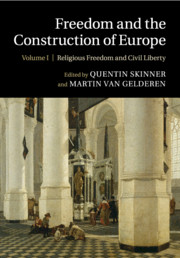
BOOK: Quentin SKINNER & Martin VAN GELDEREN (eds) Freedom and the Construction of Europe - Volume 1. Religious Freedom and Civil Liberty (Cambridge: CUP, 2020), ISBN 9781108817776, 24,99 GBP

(image source: CUP)

Abstract:
Freedom, today perceived simply as a human right, was a continually contested idea in the early modern period. In Freedom and the Construction of Europe an international group of scholars explore the richness, diversity and complexity of thinking about freedom in the shaping of modernity. Volume 1 examines debates about religious and constitutional liberties, as well as exploring the tensions between free will and divine omnipotence across a continent of proliferating religious denominations. Debates about freedom have been fundamental to the construction of modern Europe, but represent a part of our intellectual heritage that is rarely examined in depth. These volumes provide materials for thinking in fresh ways not merely about the concept of freedom, but how it has come to be understood in our own time.

Read more here. 


BOOK: Gian Paolo TRIFONE, La scienza dell’amministrazione di Federico Persico. Scritti scelti (Napoli: Editoriale Scientifica, 2020). ISBN: 9788893917315, pp. 178, € 15,00


ABOUT THE BOOK

Collana: IusRegni. Collana di Storia del diritto medievale, moderno e contemporaneo.

Federico Persico (1829-1919), letterato, avvocato, docente universitario impegnato attivamente nelle vicende politiche e culturali napoletane a cavallo dell’Unità d’Italia, è stato l’ultimo esponente della scuola partenopea del diritto pubblico ad affermarne il primato di un indirizzo culturale autoctono. Il giurista concepisce la scienza dell’amministrazione come disciplina atta a fornire le ragioni stesse del diritto positivo. Il modello ordinamentale da lui teorizzato, di un self-government rispettoso del vertice istituzionale, risente dell’influenza vichiana e nondimeno delle dottrine hegeliane, pur filtrate da una salda coscienza religiosa. Per la denuncia di un’amministrazione accentrata senza adeguato riguardo delle specificità “naturali” di comunità e territori; ed in base alle sue originalissime proposte di una rappresentanza organica degli interessi in Parlamento, Federico Persico sarebbe stato considerato un anticipatore del sindacalismo “istituzionalizzato”, contro il sindacalismo rivoluzionario. La selezione dei suoi scritti, che attraversano un lungo periodo della storia italiana e in particolare di quella del Mezzogiorno, offre di tutto ciò sensibile testimonianza.

ABOUT THE AUTHOR

Gian Paolo Trifone è attualmente professore associato di Storia del diritto medievale e moderno presso il dipartimento di Giurisprudenza dell’Università degli Studi di Salerno.


More information with the publisher.


14 August 2020

INTERVIEW: Mark TUSHNET on "How to do Comparative Constitutional Law?" (Harvard Law Today, 21 JUL 2020)

(image source: HLS)

First paragaph:

Harvard Law School Professor Mark Tushnet is the rare scholar who has made huge contributions to a number of different fields. He was an active participant in the Critical Legal Studies movement of the 1980s; he has been a leading contributor to both academic and public debates on the U.S. Constitution; and he is one of the founders—along with HLS colleague Vicki Jackson, the Laurence H. Tribe Professor of Constitutional Law—of the modern field of comparative constitutional law. And inevitably, he has been able to connect these fields and ways of thinking about law and constitutional government, as few other scholars have been willing or able to do.

Read more here. 

BOOK: Antonio TRAMPUS, Emer de Vattel and the Politics of Good Government - Constitutionalism, Small States and the International System (Cham: Springer, 2020). ISBN 978-3-030-48023-3, EUR 64,19


(Source: Springer)

Springer is publishing a book on the significance of Emer de Vattel’s Droit des gens in political debate and the conception of good government.

ABOUT THE BOOK

This book explores the history of the international order in the eighteenth and nineteenth century through a new study of Emer de Vattel’s Droit des gens (1758). Drawing on unpublished sources from European archives and libraries, the book offers an in-depth account of the reception of Vattel’s chief work. Vattel’s focus on the myth of good government became a strong argument for republicanism, the survival of small states, drafting constitutions and reform projects and fighting everyday battles for freedom in different geographical, linguistic and social contexts. The book complicates the picture of Vattel’s enduring success and usefulness, showing too how the work was published and translated to criticize and denounce the dangerousness of these ideas. In doing so, it opens up new avenues of research beyond histories of international law, political and economic thought.

ABOUT THE AUTHOR

Antonio Trampus is Professor of Modern History at Ca’ Foscari University Venice, Italy. His research focuses on cultural history and constitutionalism. His books include the critical edition of Benjamin Constant’s commentary on Filangieri (2012) and the edited volume, with K. Stapelbroek, of The Legacy of Vattel’s Droit des gens (2019).

More info here

13 August 2020

BOOK: Wanda MASTOR, Julie BENETTI, Pierre EGEA & Xavier MAGNON, Les grands discours de la culture juridique (Paris: Dalloz, 2020), 868 p. ISBN 9782247197163, € 45


(image source: Dalloz)

Abstract:

Quels sont les discours (politiques ou juridiques) qui ont construit la culture juridique des juristes ou ont été décisifs pour le droit ? Du discours de Montesquieu dans l’Esprit des lois à celui de Christine Taubira sur la défense du mariage entre personne du même sexe en passant par ceux de Thiers à l’Assemblée, leurs auteurs ont influencé la formation du droit positif. Abordés autour de quatre grandes thématiques (la culture républicaine, la justice, les libertés et les normes et rapport entre normes), chacun de ces « grands » discours commentés par des chercheurs spécialistes a été sélectionné pour sa portée juridique. Cette deuxième édition intègre une 15ne de nouveaux discours: de Voltaire, Grévy, Zola, Renan, Caillaux, Louise Michel, Charles Péguy à Michel Rocard en passant par Gambetta, Léon Blum, Giraudoux, Simone de Beauvoir, etc.

More information with the publisher. 

12 August 2020

BOOK: Julie HARDWICK, Sex in an Old Regime City - Young People, Production, and Reproduction in France, 1660-1789 (Oxford: Oxford University Press, 2020). ISBN 9780190945183, $35.00


(Source: OUP)

OUP is publishing a book on the history of young people's intimacy, based on legal records from the city of Lyon during the Ancien Régime.

ABOUT THE BOOK

Our ideas about the long histories of young couples' relationships and women's efforts to manage their reproductive health are often premised on the notion of a powerful sexual double standard.

In Sex in an Old Regime City, Julie Hardwick offers a major reframing of the history of young people's intimacy. Based on legal records from the city of Lyon, Hardwick uncovers the relationships of young workers before marriage and after pregnancy occurred, even if marriage did not follow, and finds that communities treated these occurrences without stigmatizing or moralizing. She finds a hidden world of strategies young couples enacted when they faced an untimely pregnancy. If they could not or would not marry, they sometimes tried to terminate pregnancies, to make the newborn go away by a variety of measures, or to charge the infant to local welfare institutions. Far from being isolated, couples drew on the resources of local communities and networks. Clerics, midwives, wet nurses, landladies, lawyers, parents, and male partners in and outside the city offered pragmatic, sympathetic ways to help young, unmarried pregnant women deal with their situations and hold young men responsible for the reproductive consequences of their sexual activity. This was not merely emotional work; those involved were financially compensated. These support systems ensured that the women could resume their jobs and usually marry later, without long-term costs. In doing so, communities managed and minimized the disruptions and consequences even of cases of abandonment and unprosecuted infanticide.

This richly textured study re-thinks the ways in which fundamental issues of intimacy and gendered power were entwined with families, communities, and religious and secular institutions at all levels from households to neighborhoods to the state.

ABOUT THE AUTHOR

Julie Hardwick is the John E. Green Professor of History at the University of Texas at Austin. She is the author of Family Business: Litigation and the Political Economies of Daily Life in Seventeenth-Century France (OUP, 2009) and The Practice of Patriarchy: Gender and the Politics of Household Authority in Early Modern France.

TABLE OF CONTENTS

Acknowledgments
Introduction A Foundling's Garter and the World of Young People's Intimacy
Ch.. 1. Sourcing Intimate Histories: The Social World of Young Workers
Ch. 2. Peril Stories: Licit Intimacy, Space, and Community Safeguarding
Ch. 3. Holding Men Responsible: Fertility, Community, and Court
Ch. 4. "Remedies" and Remedies: Managing Out-of-Wedlock Pregnancy
Ch. 5. Intimate Labor: Paid Work and an Intimate Economy of Reproduction
Ch. 6. Foundlings and Makeshift Coffins: Community Complicity and Dead Babies
Conclusion: The End of the Old Regime?
Notes
Bibliography
Index

More info here