Search

Showing posts with label federalism. Show all posts

10 December 2025

PRIZE: American Society for Legal History Article Prize to Grace MALLON (co-winner), "Negotiated Federalism: Intergovernmental Relations on the Maritime Frontier, 1789-1815"


(image source: Rothermere American Institute, Oxford)

On the article:

Grace Mallon’s “Negotiated Federalism” examines the federal government’s efforts to enforce its new authority after the Founding. Federal officials quickly realized that they required the participation and consent of state governments, as federal laws could not take effect without the legislation, investment, and manpower of state governments. The piece showcases how Atlantic port cities presented a crucial test case for negotiated federalism, where the federal government sought to exercise power in spaces where states had already entrenched their authority. As early federal officials set up customs and lighthouse services, rebuilt coastal fortifications, and enforced regulations, they had to negotiate with states to determine “which powers each level of government could exercise.” As a result, federal power depended on a state’s willingness to negotiate its authority. The crisply written article tackles big questions of federalism through granular details of practical problems and personality conflicts. Based in impressive primary source research in state and federal official records and correspondence, Mallon brings multiple areas of scholarship together to describe how power was worked out ‘in the course of ordinary government administration instead of in high theory. “Negotiated Federalism” takes something that we feel is well-understood (federalism at the founding) and through a creative path through the archive mines new and provocative ways of seeing the past that help us see the present more clearly.

Link to the article here: 10.1353/wmq.2024.a941486 

(source: RAI - Oxford University) 

23 September 2024

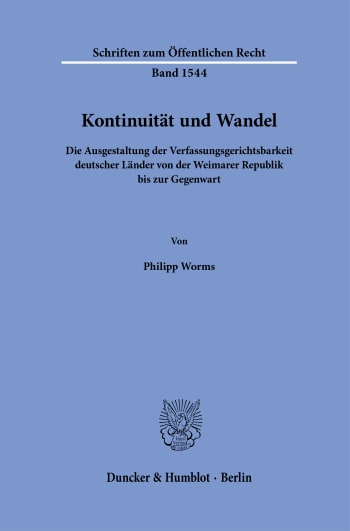
BOOK: Philipp WORMS, Kontinuität und Wandel. Die Ausgestaltung der Verfassungsgerichtsbarkeit deutscher Länder von der Weimarer Republik bis zur Gegenwart [Schriften zum Öffentlichen Recht; 1544] (Berlin: Duncker & Humblot, 2024), 310 p., ISBN 978-3-428-19237-3

 Cover: Kontinuität und Wandel

ABOUT THE BOOK:

Die Abhandlung widmet sich der geschichtlichen Entwicklung der Verfassungsgerichte der Länder, um auf diese Weise einen Beitrag zur näheren Bestimmung des Verhältnisses zwischen der gegenwärtigen Landesverfassungsgerichtsbarkeit und ihren historischen Vorbildern zu leisten. Dabei untersucht der Autor in einem ersten Schritt, inwieweit die Weimarer Landesstaatsgerichtshöfe prägend waren für die Entwicklung und die Ausgestaltung der Landesverfassungsgerichte wie wir sie heute kennen. Anhand der Länder Baden-Württemberg, Bayern, Hessen und Thüringen zeigt der Autor auf, dass die Weimarer Landesstaatsgerichtshöfe trotz ihrer vergleichsweise schmalen Kompetenzkataloge den Vätern und Müttern der westdeutschen Landesverfassungen nach 1945 als Anknüpfungspunkt für die Konzeption der Landesverfassungsgerichte dienten. Dass die Weimarer Landesstaatsgerichtshöfe gleichwohl nicht den einzigen Traditionsstrang darstellten, wird ebenso deutlich. Daher beleuchtet der Autor in einem zweiten Schritt, welchen übrigen Einflussfaktoren die Ausgestaltung der Verfassungsgerichtsbarkeit nach 1945 ausgesetzt war und wie unterschiedlich stark sich diese Faktoren in den jeweiligen Ländern auswirkten.

TABLE OF CONTENTS:

A. Einleitung

B. Methodik

Zur Auswahl der betrachteten Länder – Vorgehensweise – Maßstabsbestimmung

C. Historische Wurzeln der Verfassungsgerichtsbarkeit seit 1815
Auf Ebene des Bundes und des Reiches – Auf Ebene der Gliedstaaten

D. Staatsgerichtsbarkeit in der Weimarer Republik
Der Staatsgerichtshof für das Deutsche Reich – Allgemeine Situation der Staatsgerichtsbarkeit in den Ländern

E. Entwicklung und Ausgestaltung ausgewählter Landesverfassungsgerichte
Baden-Württemberg – Bayern – Hessen – Thüringen

F. Landesübergreifende Parallelen
Landesverfassungsgerichte als solitäre Institutionen – Parallele Entwicklungslinien

G. Landesspezifische Aspekte
Baden-Württemberg – Bayern – Hessen – Thüringen

H. Maßgebliche Einflussfaktoren
Grundgesetz und Bundesverfassungsgericht – Eigene historische Landesverfassungen – Weimarer Reichsverfassung – Andere Landesverfassungen – Ausländische Vorbilder – Besatzungsmächte – Persönlichkeiten – Gesamtwürdigung der Einflussfaktoren

I. Schlussbetrachtung

Anlage: Relevante Vorschriften zur Verfassungsgerichtsbarkeit seit 1919

Read more here.


17 March 2023

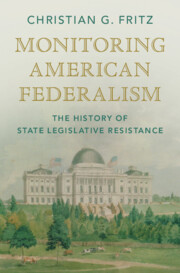
BOOK: Christian G. FRITZ, Monitoring American Federalism. The History of State Legislative Resistance [Studies in Legal History, ed. Lisa FORD, Thomas MCSWEENEY, Reuel SCHILLER & Taisu ZHANG] (Cambridge: CUP, 2023), ISBN 9781009325578, 39,99 USD


(image source: CUP)

Abstract:
Monitoring American Federalism examines some of the nation's most significant controversies in which state legislatures have attempted to be active partners in the process of constitutional decision-making. Christian G. Fritz looks at interposition, which is the practice of states opposing federal government decisions that were deemed unconstitutional. Interposition became a much-used constitutional tool to monitor the federal government and organize resistance, beginning with the Constitution's ratification and continuing through the present affecting issues including gun control, immigration and health care. Though the use of interposition was largely abandoned because of its association with nullification and the Civil War, recent interest reminds us that the federal government cannot run roughshod over states, and that states lack any legitimate power to nullify federal laws. Insightful and comprehensive, this appraisal of interposition breaks new ground in American political and constitutional history, and can help us preserve our constitutional system and democracy.

 On the author:

Christian G. Fritz is Emeritus Professor of Law at the University of New Mexico School of Law. He is the author of American Sovereigns: The People and America's Constitutional Tradition Before the Civil War (2008).

Table of contents;:

Introduction 1. The riddle of federalism and the genesis of interposition 2. Early state use of interposition: testing the powers of the new national government 3. State interposition and debates over the meaning of the Constitution 4. The Virginia and Kentucky Resolutions and Madison's report of 1800 5. State interposition during the Jefferson and Madison presidencies 6. State challenges to the Supreme Court's control over constitutional interpretation 7. The transformation of interposition: the theory of nullification emerges 8. State interposition and nullification on the path to secession 9. State interposition during and after the Civil War 10. Modern interposition by states and 'nullification' Epilogue. 

(Source: Law & Humanities Blog) 

Read more on the CUP site.


30 January 2023

BOOK: Christian G. FRITZ, Monitoring American Federalism: The History of State Legislative Resistance (Cambridge: Cambridge University Press, 2023), 410 pp., ISBN 9781009325578, £29.99


(image credit: Cambridge University Press)

Book description: 
Monitoring American Federalism examines some of the nation's most significant controversies in which state legislatures have attempted to be active partners in the process of constitutional decision-making. Christian G. Fritz looks at interposition, which is the practice of states opposing federal government decisions that were deemed unconstitutional. Interposition became a much-used constitutional tool to monitor the federal government and organize resistance, beginning with the Constitution's ratification and continuing through the present affecting issues including gun control, immigration and health care. Though the use of interposition was largely abandoned because of its association with nullification and the Civil War, recent interest reminds us that the federal government cannot run roughshod over states, and that states lack any legitimate power to nullify federal laws. Insightful and comprehensive, this appraisal of interposition breaks new ground in American political and constitutional history, and can help us preserve our constitutional system and democracy.
Table of contents: 
Introduction
1. The riddle of federalism and the genesis of interposition
2. Early state use of interposition: testing the powers of the new national government
3. State interposition and debates over the meaning of the Constitution
4. The Virginia and Kentucky Resolutions and Madison's report of 1800
5. State interposition during the Jefferson and Madison presidencies
6. State challenges to the Supreme Court's control over constitutional interpretation
7. The transformation of interposition: the theory of nullification emerges
8. State interposition and nullification on the path to secession
9. State interposition during and after the Civil War
10. Modern interposition by states and 'nullification'
Epilogue.
About the author: 
Christian G. Fritz is Emeritus Professor of Law at the University of New Mexico School of Law. He is the author of American Sovereigns: The People and America's Constitutional Tradition Before the Civil War (2008).
More information can be found here. 

20 August 2020

ADVANCE ARTICLE: Merve FEJZULA, 'The Cosmopolitan Historiography of Twentieth-Century Federalism' (Historical Journal, 14 JUL 2020)

(image source: CUP)

Abstract:

This article examines the historiographical debate over federalism between the 1930s and 1960s. In their most sweeping iterations, revisionists have sought to unravel the history of the nation-state, by using the history of anti-colonial federalist demands for equal incorporation into imperial states as evidence against a teleology of nationalist independence. In perceiving the democratic potentialities embedded within imperial state forms, revisionists argue that anti-colonial federalists therefore belong within a cosmopolitan tradition of seeking democratic supra-national governance beyond empire and nation. Some iterations of ‘post-colonial cosmopolitanism’ have unfortunately channelled debate into an opposition between federalism and nationalism, while also generating methodological republicanism, the tendency to view proto-republics within imperial formations. This review challenges these interpretive shortcomings and argues instead that federalism ought to be understood as part of a contest about the state as such. By integrating scholarship on French and British imperial federalism with recent work on regional federalisms in European and African contexts, this essay centres a whole range of ideological variations of ‘cosmopolitanism’ that adapted federalism to their critiques of the state. Ultimately, this reframing of federalist historiography enables new insights into contests about, and not just over, twentieth-century states.

Read here: DOI 10.1017/S0018246X20000254.