Search

11 February 2026

JOURNAL: Pro Memorie. Bijdragen tot de Rechtsgeschiedenis der Nederlanden XXVII (2025), nr. 2 (Dec)


Redactioneel (Kaat Cappelle & Joke Verfaillie)

Heerlijkheden van graafschap naar gewest. Ontwikkelingen in de spreiding van heerlijkheden en heerlijke rechten in Holland 1433-1795 (Maarten J. Prins)
DOI: 10.5117/PM2025.2.002.PRIN
Abstract: 
Early modern Holland consisted of hundreds of lordships, most of them owned by nobles. This article argues that the most extensive developments regarding the formation and distribution of lordship occurred before the acquisition of the county by the Duke of Burgundy (1433). By the mid-fifteenth century, an administrative and legal landscape had emerged that would change little in the centuries that followed. As a successor to the counts, the States of Holland did not implement any major reorganization of the feudal system and refrained from altering the framework of local government controlled by lords. The provincial authorities did not actively strengthen the position of the lords but certainly did not undermine their authority. As some benchmark court rulings indicate, bodies such as the Hoge Raad (Supreme Court), Hof van Holland (Court of Appeal), and the States of Holland upheld and confirmed the rights of lords vis-à-vis regional bailiffs and towns.
Data collected about 2,000 rights found throughout the county between the years 1300 and 1795 shows that significant differences existed between the various regions. Holland’s lordships can be characterized by the clustering of rights around the appointment of a shout (sheriff); rights with a dominial origin were rarely found. Holland’s lords typically appointed a schout, secretary and beadle, held tithes, and levied taxes (cijns and thijns).
The rights of lords differed considerably between the Northern and the Southern parts, particularly pertaining to land ownership, ferry rights, wind rights, and rights to nominate priests or pastors, as well as the appointment of lower officials and officials of waterboards. Lords in the Southern parts more often held these rights, though the difference is less pronounced than suggested by earlier research.
Heerlijke reacties in het graafschap Vlaanderen na de hoge middeleeuwen (circa 1350 – circa 1795) (Tom De Waele)
DOI: 10.5117/PM2025.2.003.WAEL
Abstract:
‘The seigneurial reaction’ is a concept originally conceived as one of the major causes for the French Revolution: lords who fiercely reimposed long forgotten dues from the 1750s onward. Historians of old regime lordships throughout Western Europe however discern similar ‘seigneurial reactions’ as early as the fourteenth century. The county of Flanders saw such reactions by lords from 1350 onward. The incentive for such measures was however oftenmost not financial gain, but the protection or reinstatement of social status and symbolic capital.

Heren zonder grenzen. De heerlijkheid Edingen tussen Brabant en Henegouwen (twaalfde–zestiende eeuw) (Margreet Brandsma & Sieben Feys)
DOI: 10.5117/PM2025.2.004.BRAN
Abstract:
In this article we explore the complex feudal status and territorial scope of the prominent lordship of Enghien (Dutch: Edingen) in the border region between the Duchy of Brabant and the County of Hainaut. From the High Middle Ages onwards, Enghien’s lords and ladies cultivated their dual status by actively maintaining feudal and political ties with both Count and Duke. By combining source material from both principalities and creating GIS-maps we were able to visualise the impressive scope of the territory that the successive lords were able to acquire on both sides of the border. Taken together, Enghien had the size of a small principality. Due to strategic importance of the border region and its relative distance from princely administrative centres, both princes mostly supported the creation and perpetuation of this enormous power base, thus effectively recognizing the essential role of the lords of Enghien in maintaining the territorial status quo in the Hainaut-Brabant border region.
Heerlijke karweien in het graafschap Vlaanderen tijdens de zeventiende en achttiende eeuw (Thijs Lambrecht & Joke Verfaillie)
DOI: 10.5117/PM2025.2.005.LAMB
Abstract:
This article examines practical aspects associated with the enforcement and execution of servile works in the County of Flanders during the seventeenth and eighteenth centuries, a feudal right that required peasants to perform labour for their lord. Although this ‘corvée’ labour largely fell into disuse from the late Middle Ages onwards, archival sources from Poeke and Boelare show that the system was still actively applied locally. Analysis of corvée records reveals remarkable flexibility in implementation, differentiation according to socio-economic status and a gradual transition to optional redemption systems – all of which mainly benefited the peasantries. The administration of servile works was therefore complex and reflected demographic changes within the seigneuries. The downside was a particularly high administrative burden for the lord, raising the question of whether this indirect cost was not one of the causes of the system’s decline. Finally, this study nuances the image of early modern corvée labour as inherently conflictual as most subjects of the lords executed their labour duties without clear signs of protest or contention.
De voorgeboden en keuren van Sint-Annaland uit 1569: een inkijk in het zestiende-eeuwse dorpsleven in het graafschap Zeeland (Kaat Cappelle)
DOI: 10.5117/PM2025.2.006.CAPP
Abstract:
From the late Middle Ages onwards, many seigneuries in the Low Countries began compiling local law. One notable example is the compilation (Dutch: voorgeboden en keuren) of Sint-Annaland from 1569, a small village in the county of Zeeland. This contribution provides an edition and an analysis of these rules, preserved in three manuscripts. These rules offer valuable insights into the socio-economic daily life of this village in Zeeland. When integrated into a broader corpus from several seigneuries, such texts can illustrate aspects of late medieval and early modern village life in the Low Countries, an area of research that remains relatively underexplored by both legal scholars and historians.
Herzele (1444-1502): de heerlijkheid als ruimte van onderhandeling (Erwin Van der Hoeven)
DOI: 10.5117/PM2025.2.007.HOEV
Abstract:
This paper contributes to the ongoing debate on the role of seigneuries by examining the nature of social relations within the lay seigneurie of Herzele between 1444 and 1502. Drawing on a quantitative and qualitative analysis of domain and bailiff accounts, the research is structured around four case studies: the ‘beste kateil’, the ‘wandelkoop’, a financial assessment, and criminal justice. Across all these domains, a consistent pattern emerges: while the rules were applied uniformly, they were interpreted with a sensitivity to context. A structural space for negotiation was typically embedded in the system, allowing compromises to be reached between those who were entitled to receive—the lord and his officials—and those who were expected to give—the local inhabitants. When punishments were imposed, it was ensured they were enforceable. After all, all parties had a shared interest in the smooth functioning of the seigneurie.
Heerlijke rechtspraak en de plattelandsbevolking in Oost-Nederland (circa 1480-1570) (Reinder Klinkhamer)
DOI: 10.5117/PM2025.2.008.KLIN
Abstract:
This article studies the impact of seigneurial lordship on rural communities through an analysis of the litigants active in a seigneurial court of the lords of Bergh (van Bergh) in the eastern Netherlands. The results show that the rural population barely made use of the court but was often charged before it. Meanwhile, inhabitants of the small town of ‘s-Heerenberg figure prominently among the plaintiffs. This finding fits within the development of the court, being both permanently located within the town and dominated by its inhabitants. Given the wide variety of options for conflict resolution mechanisms open to the rural inhabitants of premodern Europe, these results suggest that the seigneurial court in this case did not serve the interests of the rural population, but rather those of the citizens of ‘s-Heerenberg. This conclusion is surprising in light of recent research and testifies to the widely different effects seigneurial lordship could have on rural societies within the Netherlands.
Slotbeschouwing (Frederik Buylaert)
DOI: 10.5117/PM2025.2.009.BUYL

Book reviews
  • Heerlijkheden in Vlaanderen (Wim Blockmans)
  • Heerlijkheid Ruinen (Paul Brood)

More information can be found here.


10 February 2026

LECTURE SERIES: Figures/Visages de l'administration dans l'Europe des crises politiques (XVIe-XXIe siècles) (Brussels: UCLouvain, St-Louis Bruxelles, 17 FEB 2026)


(click on image to enlarge)

Abstract:

Ce séminaire, intitulé Figures/Visages de l'administration dans l'Europe des crises politiques (XVIe-XXIe siècles), est conçu sur le mode de l'atelier de discussion méthodologique et épistémologique. Après une introduction conduite par Nicolas Simon (ARB), Quentin Verreycken (FNRS/UCLouvain) et Jérémie Ferrer-Bartomeu, nous donnerons la parole à nos trois orateurs : Catherine Thomas (Musée du Verre de Charleroi), Christian Ingrao (CNRS, ancien directeur de l'Institut du Temps Présent) et Xavier Rousseaux (FNRS/UCLouvain). La discussion sera animée par John Pitseys (député au parlement bruxellois, docteur de l'UCLouvain).

Registration (mandatory for logistical purposes) with jeremie dot ferrer at uclouvain dot be. 

BOOK: Diederik BURGERSDIJK, Henk J.M. NELLEN & Marc DE WILDE (eds.), Hugo Grotius’s On Public Partnership with Unbelievers (De societate publica cum infidelibus). Introduction, Transcription and English Translation [Mini-monographs in Medieval and Early Modern Studies; 5] (Leiden/Boston: Brill, 2025), viii + 146 p. ISBN 9789004744592, € 102,85


(image source: Brill)

Abstract:

In this hitherto unpublished treatise, Hugo Grotius examines what kinds of partnerships between Christians and non-Christians are legally permissible. These include public partnerships, such as treaties and alliances, but also private associations, such as commercial contracts, marriages, and relations of servitude. Grotius’s treatise is indispensable for understanding his ideas about legal relations between Christians and non-Christians, both in international and domestic contexts. This is the first edition of the annotated Latin text with an English translation and introduction.

 On the editors:

Diederik Burgersdijk, Ph.D. (2010), University of Amsterdam, is a lecturer in classics and ancient history at Utrecht University. His research focuses on the rhetoric and historiography of the later Roman empire, with a special interest in the reception of antiquity in later eras. His most recent co-edited volume is Constantinople Through the Ages: The Visible City from its Foundation to Contemporary Istanbul (Brill, 2025). Henk Nellen, Ph.D. (1980), Catholic University of Nijmegen, is a guest researcher at the Huygens Institute in Amsterdam. He co-edited the final five of the seventeen volumes in the series of Hugo Grotius’s correspondence. In 2007, he completed a biography of Grotius (English translation published by Brill, 2014). In 2021, he published a second biographical study: Geen vredestichter is zonder tegensprekers. Hugo de Groot, geleerde, staatsman, verguisd verzoener (Athenaeum, 2021). Marc de Wilde, Ph.D. (2008), University of Amsterdam, is a professor of jurisprudence at the University of Amsterdam with a focus on the history of legal thought. He has published several articles on Grotius, including on his letters to East-Indian rulers and his draft regulations for Jews.

Read more here: DOI  10.1163/9789004744592.

09 February 2026

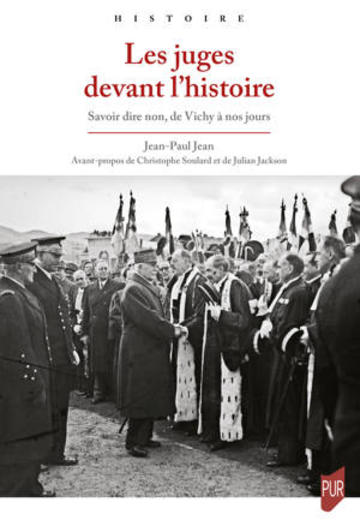
BOOK PRESENTATION: Jean-Paul JEAN, "Judges before history/Les juges devant l’histoire’" (Oxford: Maison française d'Oxford, 18 FEB 2026) [HYBRID]


(image source: MFO)

Presentation:

Jean-Paul Jean will present his book, which examines the role of judges under Vichy and during the Purge, drawing on previously unpublished archives to reassess their responsibilities, choices, and the enduring challenges facing justice and the rule of law. With Lise Jaulin (Liaison Judge, French Embassy in London) I Chair: Anne Simonin (EHESS-CESPRA). How could judges who had sworn an oath of loyalty to Marshal Pétain and served the Vichy regime later go on to preside over the courts of the Purge? What was the justice system’s actual role in enforcing the laws during the Occupation, in the persecution of Jews, and in the repression of members of the Resistance? By presenting the careers of prosecutors and judges throughout the dark years—ranging from wait-and-see attitudes to collaboration, resistance, or the ambiguous position of “Vichy-resisters”—this work places in context the concrete situations magistrates faced and the choices they made in conscience. Why was Paul Didier the only one to refuse to swear an oath to Pétain? What did resistance-minded magistrates actually do? How did the judiciary contribute to the exclusion of Jews? What is the reality behind the controversial career of André Mornet, the “Vichy-resister” and prosecutor general who called for the death penalty against Pétain? How were the judges of the special sections tried after the war? Why were the trials of the Purge able to rely only on very partial evidence? Drawing on numerous previously unpublished documents from public and private archives, the book sheds new light on this period. By placing this dark chapter of history in perspective—also illuminated by post-war reforms, including women’s access to the judiciary and the early foundations of international criminal justice—it opens a broader debate on the contemporary challenges facing justice, a cornerstone of the rule of law now widely threatened by populist and authoritarian drift.

Venue: 

More information here. 

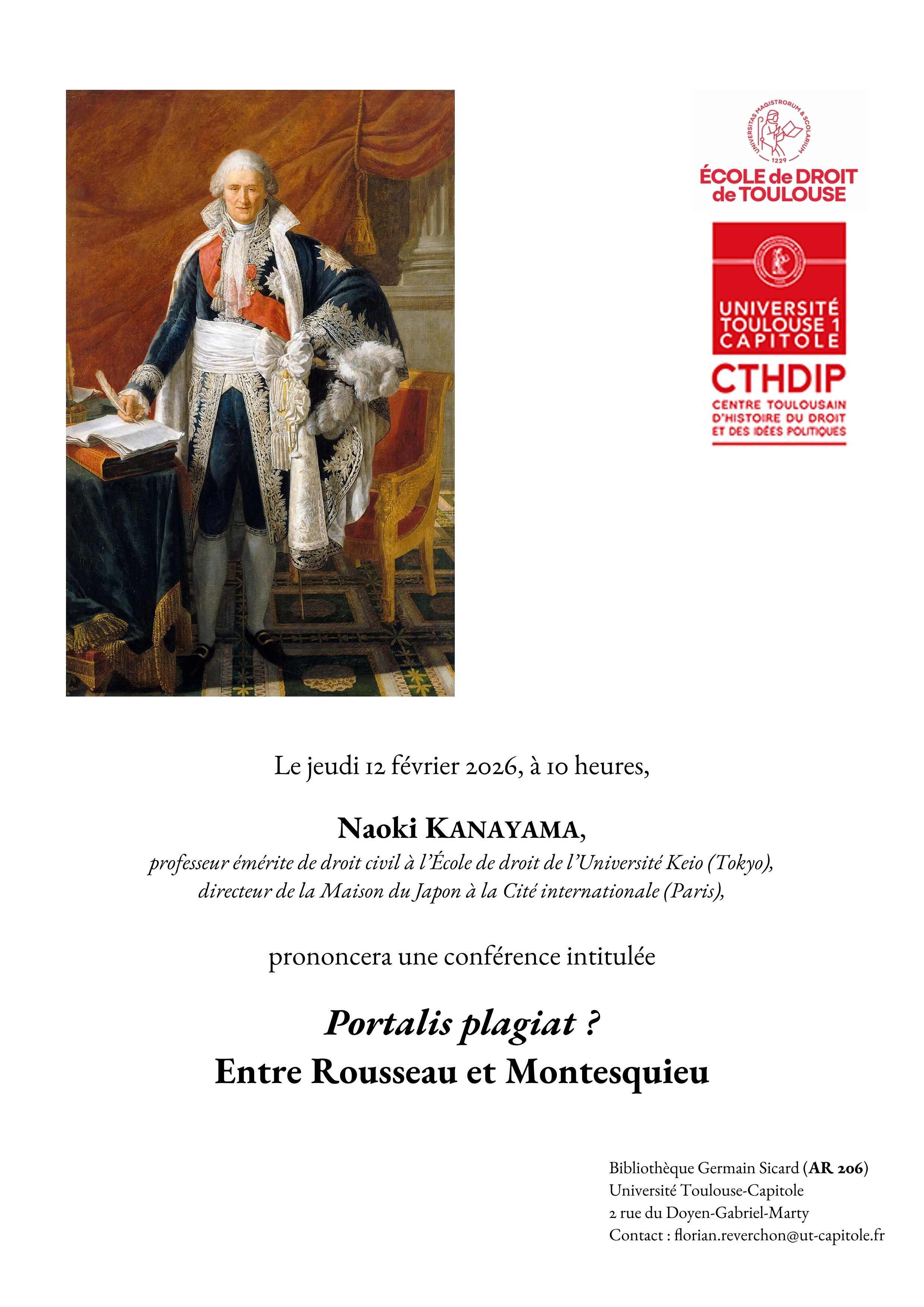
LECTURE: Naoki KANAYAMA, "Portalis plagiat ? Entre Rousseau et Montesquieu" (Toulouse: Université Toulouse 1 Capitole/CTHDIP, 12 FEB 2026)


On the speaker:

Naoki Kanayama est professeur émérite de droit civil à l’École de droit de l’Université Keio (Tokyo) et directeur de la Maison du Japon à la Cité internationale (Paris).

Convened by prof. Florian Reverchon (Toulouse).

Click here for more information. 

BOOK: Peter COLLIN & Leonard WOLCKENHAAR (eds.), Plurale Rechtsverständnisse ? Begriff und Grundlagen des Rechts in den juristischen Teildisziplinen im späten 19. und frühen 20. Jahrhundert [Moderne Regulierungsregime; 6] (Frankfurt am Main: Vittorio Klostermann, 2025), VI + 456 p. € 89


(image source: Klostermann)

Abstract:
From the end of the 19th century onwards, German jurisprudence became increasingly differentiated, as evidenced by the establishment of new institutes and new chair titles, textbooks and journals. A number of legal sub-disciplines developed and became independent, while established disciplines also re-examined their self-image. At the same time, there was lively activity in the fundamental subjects. Not only did legal philosophy, legal theory and, later, legal sociology stated to diverge from one another, but an impressive plurality of opinions can generally be observed here. This raises the question of whether and in what way specific understandings of law also developed within disciplines, e.g. with regard to the nature of legal norms, their scope of application, norm-setters and norm structure. The authors of this volume shed light on fundamental debates in the respective sub-disciplines, thereby revealing the conditions under which a differentiated jurisprudence emerged.

 Read more here.


06 February 2026

SOURCE: Official version of the Travaux Préparatoires of the European Convention on Human Rights (Strasburg: Council of Europe, 2026)


(image: Strasburg city centre; source: Wikimedia Commons)

The European Court of Human Rights has released the 8 volumes of the official Travaux Préparatoires of the European Convention on Human Rights on the internet, with the kind cooperation of Brill/Martinus Nijhoff. This work originally appeared between 1975 and 1985.

Read the eight volumes here.

BOOK REVIEW: Emily KADENS on La dynamique juridique des réseaux marchands: Hanses, nations, agences, filiales et comptoirs, edited by Luisa Brunori (Comparative Legal History, XIII (2025), nr. 2 (December), pp. 318-323)

(Image source: Taylor&Francis)

This collection of essays, as Luisa Brunori’s introduction explains, explores the legal landscape of merchant institutions from the medieval to the modern periods. The book, which is the third component of the PHEDRA project (‘Pour une Histoire Européenne du DRoit des Affaires’), originates from a colloquium held in Lille (France) in November 2021. A central thesis of the project is that commercial law is inherently supra-national and supra-legal. Commercial law, the volume argues, cannot be understood through analysing national systems alone, nor by merely comparing those systems. Instead, one must look to transnational merchant networks, such as Hanses, nations, trading posts, and factors, to study how business norms influenced and were influenced by formal commercial law.


To read the full review, please click here. Online access is free for members of the European Society for Comparative Legal History. For further information about the volume on our blog, please visit here

DOI: 10.1080/2049677X.2025.2580114

05 February 2026

CALL FOR PAPERS: Dirigeants et dirigés [Journées de la Société d’histoire du droit et institutions des pays flamands, picards et wallons] (Versailles, 15-16 MAY 2026) [DEADLINE 15 APR 2026]


Les journées de la Société d’histoire du droit et des institutions des pays flamands, picards et wallons se tiendront cette année à Versailles les 15 et 16 mai 2026, à l’invitation de Madame Catherine Lecomte, professeur émérite à l’université de Versailles-Saint Quentin et présidente honoraire de la société, sur le thème « Dirigeants et dirigés ».

Si la notion de gouvernance a été, ces dernières années, souvent questionnée dans ses structures, ses moyens et ses fins, celle de gouvernant et plus largement de dirigeant mérite à nouveau une particulière attention. L’actualité contemporaine montre en effet qu’en matière de gouvernance publique, les structures institutionnelles ne suffisent pas à déterminer à elles seules les politiques qui demeurent influencées par la personnalité des dirigeants. Renouant avec une problématique classique de l’Histoire des idées politiques, un tel sujet propose une réflexion sur les gouvernements à travers la personne de ses dirigeants, ses qualités attendues, ses modes de désignation, ses réseaux, ses limites personnelles et les garde-fous institutionnels. 

Le thème des « Journées » de la Société n’est pas en outre limité à une réflexion sur les seuls dirigeants politiques mais s’étend à l’étude des dirigeants d’autres organisations juridiquement constituées et productrices elles-mêmes d’une réglementation, comme les dirigeants militaires, municipaux, provinciaux, mais aussi les dirigeants spirituels (la direction de l’Eglise) ou économiques (les directions de sociétés). Enfin, le thème de la rencontre comprend aussi l’étude des dirigés, de leur adhésion à leurs dirigeants ou à l’inverse la manière dont ils s’expriment et s’organisent pour limiter leurs dérives. S’il n’est pas fixé de limite temporelle au thème proposé, les communications se concentreront sur le plan géographique sur les régions linguistiques des Pays, flamands, picards et wallons.

Les propositions de communications sont à envoyer à Monsieur Tanguy Le Marc’hadour tanguylemar@yahoo.fr, président de la Société et à Madame Catherine Lecomte catherine.lecomte@uvsq.fr, présidente honoraire, avant le 15 avril 2026. Celles-ci seront accompagnées d’une brève présentation en français. 

Les communications pourront être présentées dans une des langues de la Société, le français, le néerlandais ou l’anglais, avec, compte tenu du lieu des « « Journées », une préférence pour le français.

 Pour le bureau,

Tanguy Le Marc’hadour, président de la Société.


SEMINAR: 'In dialogo sulla storia costituzionale italiana: Augusto Antonio Barbera, testimone e protagonista' (Rome: Lumsa Università, 20 FEB 2026)


Il Convegno “In dialogo sulla storia costituzionale italiana - Augusto Antonio Barbera, testimone e protagonista” – in programma nella sala Pia dell’Università LUMSA (via di Porta Castello 44, Roma) il 20 febbraio 2026, dalle ore 11.00 – è organizzato dall’Università LUMSA e dal Centro di Ricerca "Leopoldo Elia" (CREL).


Il Convegno costituisce la tappa di avvio dell’attività dell’Associazione per la storia costituzionale, una società scientifica che coinvolge studiosi di varie materie storiche e giuridiche, fondata il 7 ottobre 2025 a Roma e che ha tra i suoi soci fondatori alcuni professori dell’Università LUMSA (Francesco Bonini, Angelo Rinella, Marco Olivetti, Gian Marco Sperelli, Filippo Benedetti).


Il Convegno intende affrontare il senso degli studi di storia costituzionale in Italia attraverso il contributo di uno dei principali costituzionalisti italiani, il prof. Augusto Antonio Barbera, a lungo ordinario di diritto costituzionale nell’Università di Bologna e testimone-protagonista della storia istituzionale repubblicana nell’ultimo mezzo secolo (come parlamentare, ministro, giudice costituzionale, membro di commissioni sulle riforme costituzionali).


Le attività inizieranno con i saluti ai presenti e con una presentazione a cura del prof. Francesco Bonini (rettore dell’Università LUMSA) e del prof. Luigi Lacché (presidente dell’Associazione per la storia costituzionale).


Il contributo del prof. Barbera assumerà la forma di una intervista, condotta dai membri del direttivo dell’Associazione per la storia costituzionale. Seguirà un dibattito.


L’evento sarà trasmesso da Radio radicale

BOOK: Aldo Andrea CASSI and Cinzia CREMONINI (eds.), Lombardia veneziana. Contributi per nuove prospettive (Torino: Giappichelli Editore, 2025). ISBN: 9791221116830, pp. 256, € 37,00


Abstract:

Il volume raccoglie una serie di contributi in prospettiva storica (ricorrendo anche ad un ricco corredo di fonti inedite) dedicati a diversi profili (istituzionali, giuridici, economici, sociali, culturali) della "Lombardia veneziana" (Brescia, Bergamo, Crema) considerati nella loro tensione tra il moto centripeto della Serenissima e la specificità delle singole tradizioni locali tra XV e XVIII secolo. Il libro si rivolge non solo agli "addetti ai lavori" (storici, docenti, archivisti, studiosi) ma al Lettore colto interessato a questo ricco laboratorio culturale. Le strutture e le dinamiche economiche, sia del contado che delle civitates, le istituzioni cittadine con i loro corpi normativi (statuta) e apparati giudiziari, le compagini sociali e cetuali, il rapporto dialettico dei territori, e dei loro attori, con Venezia sono analizzati con rigore storiografico, acribia documentale e non di rado con verve stilistica.

Autori: Amighetti Paolo Maria, Berardi Francesca, Carotti Giampiero, Castelli Marco, Colombo Emanuele Camillo, Cremonini Cinzia, Edigati Daniele, Gregorini Giovanni, Maione Luigi, Paletti Federica, Pellegrini Marco, Sandona' Alan, Sulli Maria Antonietta, Venturelli Alberto.

About the editors:

Aldo Andrea Cassi è professore ordinario di storia del diritto presso l'Università di Brescia. Cinzia Cremonini è professoressa ordinaria di storia moderna presso presso l'Università Cattolica del Sacro Cuore, sede di Milano.

Table of contents: available here.

More information with the publisher.

BOOK: Nicolas MICHEL & Romain WAROQUIER (dir.), Pensée politique et Gouvernement dans l'Occident médiéval (XIe-début XIIIe siècle) [Rencontres, vol. 691; Civilisation médiévale, vol. 66] (Paris: Classiques Garnier, 2026), 288 p.


(image source: Classiques Garnier)

Abstract:

Comment s’opèrent le dialogue et les conditions de la négociation permanente entre norme et pratique du politique au sein des différents niveaux de pouvoir qui structurent la société occidentale du « long xiie siècle » ? Les contributions réunies dans ce volume offrent un éclairage important à cette question.

Read more here: DOI 10.48611/isbn.978-2-406-18979-4.

04 February 2026

ENCYCLOPEDIA: Sylvie CROGIEZ-PETREQUIN "Le Code Théodosien (438-439) : un jalon du droit romain" (EHNE) [OPEN ACCESS]


 (image source: EHNE)

Introduction:

Le Code Théodosien est un recueil de règlements et de décisions impériales des ive et ve siècles, écrit en latin, et compilé à partir de 429. Les textes rassemblés ne sont pas des lois au sens moderne du terme : il s’agit d’un ensemble de décisions à propos de questions qui intéressent directement l’État romain impérial, comme les impôts ou l’administration de l’Empire. S’il est impossible d’en résumer le contenu, tant celui-ci touche à des sujets divers, il permet néanmoins d’approcher la société romaine de son époque.

Read the full entry here. 

03 February 2026

BOOK: Filippo ROSSI (ed.), Soggetti, diritto e disuguaglianze tra passato e presente. Un’analisi interdisciplinare [Collana del Dipartimento di Scienze Giuridiche Cesare Beccaria | serie: Corso di dottorato] (Torino: Giappichelli, 2026), 240 p. ISBN 9791221117608 € 34


 (image source: Giappichelli)

Introduction:

I saggi che compongono questo volume raccolgono gli atti del corso dottorale Soggetti, diritto e disuguaglianze tra passato e presente. Un’analisi interdisciplinare, organizzato, tra aprile e maggio 2025, allo scopo di mettere a fuoco alcuni macro-contesti di trattamento differenziato nei confronti di individui, categorie e gruppi, approfondendo – in modo particolare – l’analisi diacronica e multi-prospettica dei fattori e delle tecniche giuridiche di disparità.

Read a free excerpt here.

More information with the publisher.

02 February 2026

BOOK: Pierre-Anne FORCADET & Corinne LEVELEUX-TEIXEIRA (dir.), La Nature et le Droit médiéval. Entre savoirs et normes [POLEN - Pouvoirs, lettres, normes; 38] (Paris: Classiques Garnier, 2025), 332 p.


(image source: Classiques Garnier)

Abstract:

Dans un article de 1967, Lynn White attribuait au christianisme médiéval une vision prédatrice du monde. Ce débat, relancé par la crise écologique, reste peu exploré par les juristes. Le présent ouvrage comble ce vide en étudiant les liens entre droit et nature au Moyen Âge.

Read more here: DOI 10.48611/isbn.978-2-406-18777-6.

30 January 2026

BOOK: Michael KLOEPFER, Laura BADER, Posterioritätsgrundsatz und Verfassungsrecht [Wissenschaftliche Abhandlungen und Reden zur Philosophie, Politik und Geistesgeschichte; 114] (Berlin: Duncker & Humblot, 2025), 95 p., ISBN 978-3-428-19519-0

 Cover: Posterioritätsgrundsatz und Verfassungsrecht

ABOUT THE BOOK:
 
Späteres Recht geht vor, bestimmt der Posterioritätsgrundsatz (lex posterior derogat legi priori) zur Lösung von Normenkollisionen nach dem Kriterium der Zeit. Dieser Derogationsgrundsatz, dessen Wurzeln bereits im römischen Recht zu finden sind, prägte und prägt nicht nur die deutsche Rechtsordnung über Zeiten hinweg und offenbart sich in vielfältigen Erscheinungsformen. Eine Beschränkung allein auf methodische Aspekte greift bei der Betrachtung des Posterioritätsgrundsatzes zu kurz und wird seiner nahezu universellen Dimension nicht gerecht.
Die Arbeit fragt – den Posterioritätsgrundsatz als ungeschriebenes Verfassungsrecht ausweisend –, auch nach seiner grundgesetzlichen Verortung. Die Änderungsoffenheit der Rechtsordnung erweist sich dabei als die entscheidende demokratische Legitimation im dialektischen Spannungsfeld von Kontinuität und Flexibilität staatlichen Handelns.
 
TABLE OF CONTENTS:
 
I. Zum Posterioritätsgrundsatz
Einführung – Posterioritätsgrundsatz in der Rechtsgeschichte – Posterioritätsgrundsatz in der Rechtstheorie – Posterioritätsgrundsatz und verschiedene (Teil-)Rechtsordnungen – Posterioritätsgrundsatz in verschiedenen ausländischen Rechtskreisen – Posterioritätsgrundsatz und die Vielgestaltigkeit der Derogationsgrundsätze – Posterioritätsgrundsatz und Staatsgewalten – Instrumente der formellen Derogation

II. Posterioritätsgrundsatz und Verfassungsrecht
Demokratische Legitimation des Posterioritätsgrundsatzes – Posterioritätsgrundsatz und Grundgesetz – Folgen der Einordnung des Posterioritätsgrundsatzes als materielles Verfassungsrecht – Zur Dialektik des Posterioritätsgrundsatzes – Ausblick
 
ABOUT THE AUTHORS:
 
Prof. em. Dr. Michael Kloepfer war von 1974–1976 Professor an der Freien Universität Berlin, von 1976–1992 Professor an der Universität Trier, dort Direktor des Instituts für Umwelt- und Technikrecht. Von 1992–2011 war er Professor für Staats- und Verwaltungsrecht, Europarecht, Umweltrecht, Finanzrecht und Wirtschaftsrecht an der Humboldt-Universität zu Berlin und Direktor am Walter Hallstein-Institut für Europäisches Verfassungsrecht. Seit 2011 ist er Emeritus. Von 1992–1998 war er Stellvertretender Vorsitzender der unabhängigen Sachverständigenkommission »Umweltgesetzbuch« und von 1999–2001 und 2005–2007 Vorsitzender der Berliner Wissenschaftlichen Gesellschaft e.V. Von 2008–2016 war er Mitglied der Schutzkommission beim Bundesministerium des Innern. Er absolvierte zahlreiche Forschungsaufenthalte im Ausland (u.a. Kobe/Japan; Lausanne/Schweiz; Stanford/USA). Er ist zudem Präsident der Forschungszentren Umweltrecht (FZU), Technikrecht (FZT), Katastrophenrecht (FZK) sowie des Instituts für Gesetzgebung und Verfassung (IGV) und ist seit 2011 Leiter des Forschungszentrums Recht an der Humboldt-Universität zu Berlin. Seit 2017 ist er als Rechtsanwalt bei der Kanzlei Köhler & Klett tätig. 
 
Laura Bader studierte Rechtswissenschaften in Potsdam und Paris X – Nanterre (Licence de droit). Nach dem ersten Staatsexamen Tätigkeit als geprüfte Rechtskandidatin im Deutschen Bundestag, nach dem zweiten Staatsexamen Referentin am Bundesverfassungsgericht in Karlsruhe, derzeit Promotionsstipendiatin und Wissenschaftliche Mitarbeiterin an der Humboldt-Universität zu Berlin. 
 
Find more here. 


BOOK REVIEW: Emanuel VAN DONGEN on Codifications of Late Antiquity: exclusive and universal, by JHA Lokin, edited by Tom Von Bochove, Frits Brandsma, Anne-Marie Drummond and Pia Lokin-Sassen (Comparative Legal History, XIII (2025), nr. 2 (December), pp. 318-323)

(Image source: Taylor&Francis)


This work represents the final project of the late Jan Lokin, professor of Roman law and its history at the University of Groningen, which he had nearly completed just before his passing. Lokin was a well-known Dutch law professor who taught Roman law and legal history to around 25,000 students through his lifetime, and a legal historian with broad interests and knowledge. He wrote numerous works on Greek-Roman or Byzantine law, Justinian as a codifier, legal education in the sixth century, and the phenomenon of codification (nb, a bibliography of Lokin can be found at the end of the book that motivates this review). Throughout his long career, Lokin frequently wrote about the codification of law. Fittingly, the present book on codifications in Late Antiquity has been published in a period in which there seems to be a renewed interest in codifications.


To read the full review, please click here. Online access is free for members of the European Society for Comparative Legal History. 

DOI: 10.1080/2049677X.2025.2580107


29 January 2026

BOOK: Malte BRIX, Maritime Schiedsgerichtsbarkeit in New York City. Rechtshistorische Betrachtung der Entwicklung einer eigenständigen maritimen Schiedsgerichtsbarkeit [Schriften zur Rechtsgeschichte; 228] (Berlin: Duncker & Humblot, 2025), 223 p., ISBN 978-3-428-19344-8

 Cover: Maritime Schiedsgerichtsbarkeit in New York City 

ABOUT THE BOOK:
 
Die private Seehandelsschiedsgerichtsbarkeit hat eine enorme praktische Bedeutung im internationalen Seehandel. Die 1963 gegründete Society of Maritime Arbitrators (SMA) mit Sitz in New York City ist eine bedeutsame Institution in diesem Bereich. Die Arbeit untersucht die Entstehung der eigenständigen maritimen Schiedsgerichtsbarkeit in New York City seit der Kolonialzeit bis heute anhand von bislang noch nicht erforschten Originalquellen und ausgewählten Schiedssprüchen verschiedener Institutionen. Durch die Auswertung des hauptsächlich in den Archiven der New York Historical Society und des New Netherland Institute in Albany aufgefundenen Materials gelingt es, die Zusammenschlüsse von Kaufleuten und die vielfältigen maritimen Handelsbräuche als Ausgangspunkt dieser Entwicklung zu identifizieren. So waren die Arbitration Committees der New York Chamber of Commerce und der New York Produce Exchange die Wegbereiter der Gründung der SMA als eigenständiger Seehandelsschiedsgerichtsbarkeit in New York City.
 
TABLE OF CONTENTS:
 
A. Einführung
Einleitung und Forschungsgegenstand – Quellenlage

B. Die Geschichte des Seehandelsrechts
Erste Überlieferungen des Seerechts und des Seehandels – Das Seehandelsrecht im antiken Griechenland – Das Seehandelsrecht im antiken Rom – Das Seehandelsrecht im Frühmittelalter – Das Seehandelsrecht nach dem Zerfall des Römischen Reiches

C. Die Geschichte der Schiedsgerichtsbarkeit
Das Schiedsgericht im antiken Griechenland – Die Schiedsgerichtsbarkeit und der Zivilprozess im römischen Recht – Die Entwicklung der Schiedsgerichtsbarkeit seit dem Mittelalter

D. Die Entwicklung einer maritimen Schiedsgerichtsbarkeit in New York City
Die niederländische Kolonialzeit – Die englische Kolonialzeit – Die New York Chamber of Commerce – Die New York Produce Exchange – Die Society of Maritime Arbitrators

E. Die gegenwärtige Bedeutung der maritimen Schiedsgerichtsbarkeit
Die gegenwärtige Bedeutung der Schiedsgerichtsbarkeit für den internationalen Seehandel – Die gegenwärtige Bedeutung der SMA im Seehandel

F. Gesamtergebnis
Die Entstehung einer maritimen Schiedsgerichtsbarkeit in New York City – Die Handelsplätze als Ausgangspunkt – Die Bedeutung der Handelsbräuche und die lex mercatoria – Ausblick
 
Find more here. 

28 January 2026

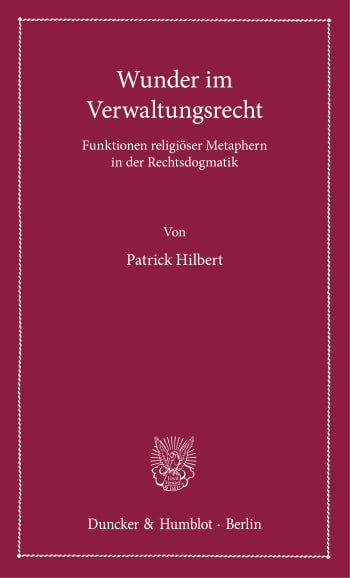
BOOK: Patrick HILBERT, Wunder im Verwaltungs. Funktionen religiöser Metaphern in der Rechtsdogmatik [Lectiones Inaugurales; 20] (Berlin: Duncker & Humblot, 2025), 59 p., ISBN 978-3-428-19085-0

 Cover: Wunder im Verwaltungsrecht 

ABOUT THE BOOK:
 
Wunder gibt es im Verwaltungsrecht immer wieder. Sie begegnen uns als religiöse Metaphern in dogmatischen Argumentationen. Wenn sich etwa der gebundene Anspruch auf Nutzung einer öffentlichen Einrichtung in einen Anspruch auf ermessensfehlerfreie Auswahlentscheidung wandelt, wird hierfür zwar keine klassische dogmatische Begründung gegeben, mit der Bezeichnung als »Wandlung« aber eine Formulierung gebraucht, die nicht nur entfernt an die Transsubstantiation erinnert.
Anhand von drei Beispielen spürt Patrick Hilbert den religiösen Metaphern im Verwaltungsrecht nach, untersucht, ob ihre Verwendung methodisch zulässig ist und welche Funktionen (religiöse) Metaphern in der juristischen Dogmatik erfüllen können.
 
TABLE OF CONTENTS:
 
I. Wunder als Metapher in der verwaltungsrechtlichen Dogmatik
Die Wandlung – Die Auferstehung – Die Heilung

II. Warum Metaphern?

III. Warum religiöse Metaphern?

IV. Funktionen von (religiösen) Metaphern in der Dogmatik

Methodische Zulässigkeit – Name für ein dogmatisches Argument – Vorstufe zu einem dogmatischen Argument – Stilmittel – Multifunktionalität von Metaphern
 
ABOUT THE AUTHOR:
 
Patrick Hilbert, Studium in Bayreuth, Promotion und Habilitation in Heidelberg. Seit 2022 Inhaber des Lehrstuhls für Öffentliches Recht, insbesondere Verwaltungsrecht der Universität Münster, Direktor des Instituts für Umwelt- und Planungsrecht sowie des Zentralinstituts für Raumplanung. Er forscht und lehrt zum deutschen und europäischen Öffentlichen Recht. Seine aktuellen Arbeitsschwerpunkte liegen im Allgemeinen Verwaltungsrecht, den Strukturfragen des Umweltrechts sowie dem Parlamentsrecht.
 
Find more here. 


27 January 2026

SYMPOSIUM: Between State Power and the Supremacy of Law – (Legal-)Historical Perspectives on Administrative Jurisdiction in Germany and Europe (Regensburg: Institute for East European Law, University of Regensburg, 19-20MAR 2026)


(Source: University of Regensburg)


Organisator: Michael Reichenthaler

For organizational reasons, participants are requested to register by email

(michael.reichenthaler@jura.uni-regensburg.de) by 28 February 2026.


Final Program


Day 1 – March 19, 2026


12.00 – 12.30 Arrival

13.45 – 14.30 Welcome and opening remarks


Panel 1: Constitutional and Administrative Jurisdiction

13.00 – 13.45 Sarah Dersarkissina (Heinrich-Heine-Universität Düsseldorf)

Qui iudicat? Entwicklungsgeschichtliche Perspektiven auf die Abgrenzung

von Verwaltungs- und Verfassungsgerichtsbarkeit

13.45 – 14.30 Max Hopp, David Neuhoff (Ludwig-Maximilians-Universität München)

"Das Politische vor Gericht" - Zur Geschichte des Verhältnisses von

Verwaltungs- und Verfassungsgerichtsbarkeit


Panel 2: Institutional and Personnel (Dis)Continuities in the German Administrative Judiciary

14.45 – 15.30 Paul Schüller (Universität Regensburg)

Das Sächsische Oberverwaltungsgericht - Rechtstaatskontinuitäten und -

brüche zwischen Königreich, Republik und Diktatur

15.30 – 16.15 Philip Bockelmann (Leibniz Institut für jüdische Geschichte und Kultur Leipzig)

„Durchgängiger Rechtsschutz“. Walter Jellinek und die Neubegründung der

Verwaltungsgerichtsbarkeit nach 1945


Panel 3: The Establishment of a West German Administrative Legal Order and the Influence of EU Law

16.30 – 17.15 Julia Nebel (Universität Leipzig)

(Un)politische Richter(wahl): die Erstbesetzung des Bundesverwaltungsgerichts

17.15 – 18.00 Lennat Kokott (Bucerius Law School Hamburg)

Die Rolle der Verwaltungsgerichtsbarkeit bei der Entwicklung der Raumordnung in der Bundesrepublik

18.00 – 18.45 Philip Ermacora (Universität Augsburg)

Unionsrechtliche Einflüsse auf den Vorrang des Gesetzes


19.00

Public evening lecture by Prof. Dr. Hans-Christof Kraus (Universität Passau)


Day 2, March 20, 2026

Panel 4: German and French Administrative Jurisdiction

9.00 – 9.45 Lucya Jakobi (Hellriegel Rechtsanwälte)

Der verwaltungsgerichtliche Untersuchungsgrundsatz im deutsch-französischen Vergleich sowie vor dem EuGH

9.45 – 10.30 Leana Clerc (Jean Moulin Lyon 3 University)

The influence of supreme administrative jurisprudence on lower courts: a Franco-German comparative analysis

10.30 – 11.15 Paul-David Chouinard (University of Ottawa)

The influence of French and English Law on Administrative Justice: Reforms in the province of Quebec


Panel 5: Administrative Jurisdiction in Italy and South Tyrol

11.30 – 12.15 Federico Margheri Biagi (University of Rome Tor Vergata / LUISS Gudio Carli)

Unbestimmte Rechtsbegriffe and the Theory of Administrative Discretion: The Influence of German Theory on the Italien Doctrine of Technical Assessments

12.15 – 13.00 Philipp Rossi (vormals Universität Innsbruck)

Verwaltungsgerichtsbarkeit und Minderheitenschutz am Beispiel Südtirols


Panel 6: The (Non-)Emergence of administrative courts in Russia, Ukraine and Hungary 

14.00 – 14.45 Dr. Alexander Gorskiy (Eberhard-Karls-Universität Tübingen)

Staat, der Allmächtige? Zur Problematik der fehlenden eigenständigen Verwaltungsgerichtsbarkeit in Russland

14.45 – 15.30 Dr. Yuliaa Tsurkalenko (Institut für Ostrecht)

Die historische Entwicklung der Verwaltungsgerichtsbarkeit in der Ukraine im europäischen Kontext

15.30 – 16.15 Prof. Attila Barna (Széchenyi Universität Győr)

Streitigkeiten und Mustern – Die Gründung des Verwaltungsgerichts in Ungarn - Versuche zur Etablierung einer Verwaltungsgerichtsbarkeit in Ungarn, in der zweiten Hälfte des 19. Jahrhunderts


Panel 7: Influences and Developments of Administrative Jurisdiction in Central and Eastern Europe

16.30 – 17.15 Dr. Weronika Szafrańska (Uniwersytet Śląski w Katowicach)

Ist die polnische Verwaltungsgerichtsbarkeit „österreichisch“ geblieben? – Auf der Suche nach Kontinuität und Wandel

17.15 – 18.00 Michał Szudrowicz, Andrzej Paduch (Adam Mickiewicz University Poznan)

The role of the head of administrative court of the highest instance in ensuring the effectiveness and stability of administrative justice

18.00 – 18.45 Prof. Tomáš Gábriš (Trnava University) Institutional Unification of Administrative Justice in Czechoslovakia in the 


Interwar Period (Problems, Challenges, Solutions)

End of the conference

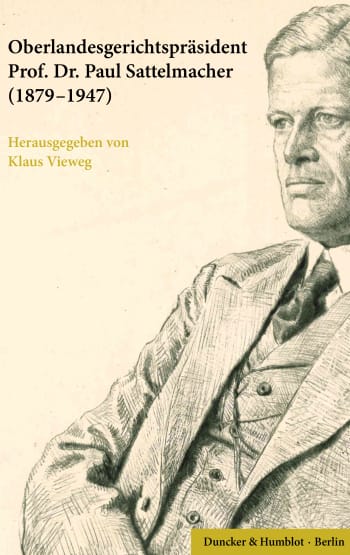
BOOK: Klaus VIEWEG (ed.), Oberlandesgerichtspräsident Prof. Dr. Paul Sattelmacher (1879–1947) Seine persönlichen Aufzeichnungen mit einer Würdigung von Heiner Lück (Berlin: Duncker & Humblot, 2025), 224 p., ISBN 978-3-428-19435-3


Cover: Oberlandesgerichtspräsident Prof. Dr. Paul Sattelmacher (1879–1947) 

ABOUT THE BOOK:
 
Paul Sattelmacher (1879–1947) hat mit dem Werk »Bericht, Gutachten und Urteil« Juristengenerationen in ihrer Referendarausbildung begleitet. Seine persönlichen Aufzeichnungen sind ein wertvolles Zeitdokument. Sie spiegeln die eigenen beruflichen Positionen wider: Landrichter im Königreich Preußen, Feldkriegsgerichtsrat im Ersten Weltkrieg, stellvertretender Leiter des preußischen Justizprüfungsamts, Oberlandesgerichtspräsident in Naumburg und Honorarprofessor in Halle. Seine Tagebuchnotizen aus dem Jahr 1945 schildern eindrucksvoll das Ende des Zweiten Weltkriegs in Naumburg und die US-amerikanische Besatzung. Die sich anschließende sowjetische Besatzung führte zu seiner Verhaftung und schließlich zu seinem Tod in Buchenwald.
Als das OLG Naumburg 1992 wiedererrichtet wurde, war das unklare Verhältnis zur staatlichen Verwaltung und zur NSDAP, in die Sattelmacher 1937 eintrat, Anlass, seiner Person mit Vorbehalten zu begegnen. Die wissenschaftliche Würdigung durch Prof. Dr. Heiner Lück aus dem Jahr 2003, die hier mitveröffentlicht wird, dokumentiert Forschungsstand und -bedarf.
 
TABLE OF CONTENTS:
 
Persönliche Aufzeichnungen von Oberlandesgerichtspräsident Prof. Dr. Paul Sattelmacher (13.4.1879 bis 19.7.1947)
Frühe Kindheit und Volksschulzeit – Die Gymnasialzeit – Studienzeit – Die Referendarzeit – Assessoren-Zeit – Landrichter in Halle a. d. S. – Kriegszeit (1914–1918) – Vortrag als Feldkriegsgerichtsrat über Straffälle – Beispiele – Im Ministerium 1919 – Oberlandesgerichtspräsident und Honorarprofessor der Rechte an der Universität Halle – Stellung zur NSDAP – Das Kollegium – Als Unterrichtsleiter – Erinnerungen an die große Staatsprüfung – Kursiosa – Tagebuch 11.4.–18.6.1945 – Brief an seinen Sohn (Mai 1944)

Von Barop nach Buchenwald: Der Naumburger OLG-Präsident Dr. Paul Sattelmacher (1879–1947). Von Heiner Lück
Vorbemerkung – Geburt bis Ende der Assessorenzeit (1879–1909) – Juristenkarriere vom Landrichter in Halle bis zum OLG-Präsidenten in Naumburg (1909–1945) – Von der Amtsentsetzung in Naumburg bis zum Tod in Buchenwald (April 1945–Juli 1947) – Standortbestimmung im NS-System – Schluss
 
Find more here. 


26 January 2026

REMINDER: CALL FOR NOMINATIONS: 2025 ESIL IG History of International Law Article Prize (DEADLINE 6 FEB 2026)


(image source: ESILHIL)

The ESIL IG History of International Law invites its members to nominate an article that they believe has had or will have a major impact on the field of international legal history (sensu stricto).

Members may nominate any article on the history of international law published in any academic journal in 2023, 2024, or 2025 (the range is deliberately broad to avoid restricted access due to publisher embargoes). The prize winner will be invited to present the paper at an online ESIL event and participate in an interview with the IG Coordinating Committee, with the intention of publishing the interview in a peer-reviewed scientific venue. It is our intention to award this prize annually, with the following year’s award covering 2024, 2025, and 2026.

Nominations should adhere to the following rules (eligibility):

-          While the IG does not wish to define the history of international law, we prefer articles that, in substance, deal with history and international law, for example, by relying on archival materials. Articles whose primary focus is present-day international law (theory or practice), with an incidental historical excursion, will not be eligible for the award. Articles whose primary focus is history, with an incidental account of international law, will also not be eligible. In case of doubt, members are welcome to nominate the article. The evaluation committee will make the final decision based on the abovementioned criteria.

-          Self-nominations are not allowed.

-          The official year of publication of the article needs to be 2023, 2024, or 2025.

-          Only papers published in the Society’s official languages, English or French, are eligible.

-          Nominations should be sent to esil.ighilprize@gmail.com by the 6th of February 2026 with the subject line following the format: [FirstName_SURNAME_Paper title], with the paper attached in PDF. Nominations that do not adhere to this format will be excluded from evaluation.

Evaluation procedure:

-          Members of the IG Coordinating Committee and invited evaluators cannot express an opinion on or score papers submitted by colleagues currently or formerly affiliated with the same university to avoid a conflict of interest. The evaluators will assess any further conflicts of interest in accordance with the Canadian guidelines for federal research funding.

-          Threshold for consideration: The Coordinating Committee does not award this prize; the members of the IG do. To draw on the “wisdom of the crowd,” the Coordinating Committee will evaluate only the ten most nominated papers.

-          Each IG member can nominate only one paper. If a nominated paper does not receive the award, IG members can renominate it in a subsequent year, if they believe the impact of the paper has endured.

-          Nominations must be submitted through an institutional email address; IG members without an institutional email address can ask for a motivated exception.

-          In deciding the award, the Coordinating Committee will invite one or several highly-regarded, senior historians of international law to join the evaluation committee.

-          The Coordinating Committee calls upon its members to make an individual evaluation of a paper, in line with the four Mertonian norms underpinning the scientific ethos: communality, universalism, disinterestedness, and organized scepticism. Social media campaigns or other types of advertising, recruiting, or intimidation to increase a paper’s nominations are considered unethical.

The evaluation committee will assess papers based on the following criteria (1-5 scale):

-          The paper addresses longstanding and emergent questions regarding the history of international law from an innovative methodological and/or theoretical point of view.

-          The paper expands the history of international law by examining overlooked/understudied social contexts.

-          The paper bridges the history of international law with other disciplines in ways that result in new and original knowledge, advancing the state of the art of our field.

-          The paper soundly and rigorously explores the topic at hand, and offers significant or impactful insights, beyond increasing our knowledge of the field in question.

-          Clarity: The paper lays out the main argument unambiguously without unnecessarily reducing complexity or nuance.

Questions regarding the prize can be addressed to Dr. Florenz Volkaert (florenz.volkaert@uclouvain.be).


Appel à candidatures : Prix d’Article 2025 de groupe d’intérêt pour l’histoire du droit international de la SEDI

Le GI Histoire du droit international de la SEDI invite ses membres à proposer un article qui, selon eux, a eu ou aura un impact majeur sur le domaine de l’histoire du droit international (au sens strict).

Les membres peuvent proposer tout article portant sur l’histoire du droit international, publié dans n’importe quelle revue académique en 2023, 2024 ou 2025 (la plage d’années est délibérément large afin d’éviter les restrictions d’accès liées aux embargos des éditeurs). Nous avons l’intention de décerner ce prix chaque année, la remise de l’année suivante couvrant les années 2024, 2025 et 2026.

Les candidatures doivent respecter les règles suivantes (éligibilité) :

  • Bien que l’IG ne souhaite pas définir l’histoire du droit international, nous privilégions les articles qui traitent, en substance, d’histoire et de droit international, par exemple en s’appuyant sur des sources archivistiques. Sont exclus du prix les articles dont l’objet principal est le droit international actuel (théorie ou pratique), se contentant d’une incursion historique accessoire. De même, sont exclus les articles principalement historiques se limitant à un volet accessoire de droit international. En cas de doute, les membres peuvent proposer l’article. Le comité d’évaluation prendra la décision finale sur la base des critères susmentionnés.
  • Les auto-candidatures ne sont pas autorisées.
  • L’année officielle de publication de l’article doit être 2023, 2024 ou 2025.
  • Seuls les articles publiés dans l’une des langues officielles de la Société, l’anglais ou le français, sont éligibles.
  • Les candidatures doivent être envoyées à esil.ighilprize@gmail.com avant le 6 février 2026 avec, dans l’objet, le format suivant : [Prénom_NOM_Titre de l’article], et inclure l’article au format PDF. Les candidatures ne respectant pas ce format seront exclues de l’évaluation.

Procédure d’évaluation :

  • Les membres du comité de coordination de l’IG et les évaluateurs invités ne peuvent pas donner d’avis ni noter les articles soumis par des collègues actuellement ou anciennement affiliés à la même université, afin d’éviter tout conflit d’intérêts. Les évaluateurs examineront tout autre conflit d’intérêts conformément aux directives canadiennes relatives au financement fédéral de la recherche.
  • Seuil de considération : Le comité de coordination n’attribue pas ce prix ; ce sont les membres du GI qui en décident. Pour exploiter la « sagesse des foules », le comité de coordination n’évaluera que les dix articles ayant reçu le plus de propositions.
  • Chaque membre du GI ne peut proposer qu’un seul article. Si un article proposé n’est pas primé, les membres du GI peuvent le proposer de nouveau lors de l’année suivante, s’ils estiment que son impact perdure.
  • Les candidatures doivent être soumises depuis une adresse email institutionnelle ; les membres de l’IG sans adresse email institutionnelle peuvent demander une dérogation motivée.
  • Pour fixer le prix, le comité de coordination invitera un ou plusieurs historiens confirmés et renommés en droit international à rejoindre le comité d’évaluation.
  • Le comité de coordination invite ses membres à procéder à une évaluation individuelle d’un article, conformément aux quatre normes mertoniennes qui sous-tendent l’éthique scientifique : communauté, universalité, désintéressement et scepticisme organisé. Les campagnes sur les réseaux sociaux ou toute autre forme de publicité, de recrutement ou d’intimidation visant à augmenter le nombre de propositions pour un article sont considérées comme contraires à l’éthique.

Le comité d’évaluation évaluera les articles selon les critères suivants (échelle de 1 à 5) :

  • L’article aborde des questions anciennes ou émergentes relatives à l’histoire du droit international dans une perspective méthodologique et/ou théorique innovante.
  • L’article élargit l’histoire du droit international en examinant des contextes sociaux négligés ou peu étudiés.
  • L’article crée des liens entre l’histoire du droit international et d’autres disciplines, aboutissant à de nouvelles connaissances originales et faisant progresser l’état de l’art de notre domaine.
  • L’article explore solidement et rigoureusement le sujet traité, et apporte des perspectives significatives ou marquantes, allant au-delà de l’accroissement de nos connaissances dans le domaine concerné.
  • Clarté : L’article expose l’argument principal de manière non ambiguë, sans réduire inutilement la complexité ou les nuances.

Toute question concernant le prix peut être adressée au Dr Florenz Volkaert (florenz.volkaert@uclouvain.be).


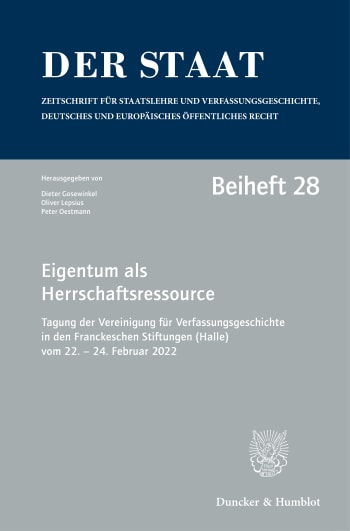
JOURNAL: Dieter GOSEWINKEL, Oliver LEPSIUS, Peter OESTMANN (eds.), Eigentum als Herrschaftsressource. Tagung der Vereinigung für Verfassungsgeschichte in den Franckeschen Stiftungen (Halle) vom 22.–24. Februar 2022 [Beihefte zu "Der Staat"; 28] (Berlin: Duncker & Humblot, 2025), 292 p., ISBN 978-3-428-19212-0

Cover: Eigentum als Herrschaftsressource

ABOUT THE JOURNAL:
 
Das Beiheft dokumentiert eine Tagung der Vereinigung für Verfassungsgeschichte. Eigentum als Herrschaftsressource scheint auf den ersten Blick einen zivilrechtlichen und einen öffentlichrechtlichen Aspekt zu verknüpfen. Aber in der Tat stützten sich frühmittelalterliche Könige auf eigene Ländereien und Domänen, um ihre Macht zu finanzieren und damit zu festigen. Später erschien dominium als Inbegriff von Herrschaft und Eigentum zugleich, sehr handfest auch in der Geschichte des Kolonialismus. Erst das 19. Jahrhundert versuchte, Amt und Privatperson wieder zu trennen. Bis in die Zeitgeschichte mit ihren neuen Nationalstaaten, totalitären Regimen, der Daseinsvorsorge und dem geistigen Eigentum erstreckt sich die thematische Spannweite der Beiträge. Die Plenumsdiskussionen sind umfassend dokumentiert und zeigen, wie Rechtshistoriker, Öffentlichrechtler und Archivare über eine Grundfrage der Verfassungsgeschichte epochenübergreifend ins Gespräch kommen. 
 
OVERVIEW OF CONTRIBUTIONS:
 
David Bachrach
Allodium und Eigentum im frühen Mittelalter. Die Basis der königlichen Macht?

Stefan Hammer
Eigentum, Vertrag und politische Herrschaft im Vernunftrecht

Benedikt Stuchtey
Mit John Locke argumentieren. Eigentumsfragen als Herrschaftsressource in der Geschichte des Kolonialismus

Reinhard Mußgnug
Das Eigentum des Monarchen im Wandel der Verfassungen

Dirk van Laak
Experimentierfelder des Gemeinwohls? Infrastrukturen und die Logik des Eigentums

Margrit Seckelmann
Die Internationalisierung »geistiger Eigentumsrechte«

Marju Luts-Sootak und Karin Visnapuu
Eigentum im Nationalstaat und Sozialismus – der Fall Estland als unabhängige Republik 1918−1940 und unter der Sowjetherrschaft

Thorsten Keiser
Eigentum als Herrschaftsressource in totalitären Regimen

Simon Kempny
Die Konstruktion des Eigentumsrechts durch Gesetzgebung
 
Find more here. 

23 January 2026

NEWS: Wim DECOCK appointed as new Regius Professor of Civil Law (Oxford University)


(image source: Oxford University)

Start of the press release:

His Majesty The King has approved the appointment of Professor Wim Decock, of the Universities of Louvain and Liège, as the new Regius Professor of Civil Law at the University of Oxford. He will take up the post on 1 October 2026 and succeeds Professor Wolfgang Ernst.

 Read the full press release here.

BOOK: Dirk ERDELKAMP, Nemo pro parte testatus pro parte intestatus decedere potest [Schriten zur Europäischen Rechts- und Verfassungsgeschichte; 64] (Berlin: Duncker & Humblot, 2025), 321 p., ISBN 978-3-428-19350-9

 Cover: Nemo pro parte testatus pro parte intestatus decedere potest

ABOUT THE BOOK:

Die Arbeit setzt sich als erste deutschsprachige Monographie seit dem Ende des 19. Jahrhunderts mit dem »[großen] Rätsel des römischen Erbrechts« (Lenel), dem sog. Nemo-pro-parte-Prinzip, auseinander, das eine Kombination von testamentarischer und Intestaterbfolge verbot. Geltungsanspruch und Anwendung des Prinzips werden von dessen römisch-rechtlichen Anfängen über seine gemeinrechtliche Rezeption bis in die Neuzeit hinein verfolgt. Inhaltliche Schwerpunkte liegen dabei zum einen auf der Rezeptionsgeschichte des Prinzips in den verschiedenen Entwicklungsstufen des gemeinen Rechts sowie auf der bislang umfangreichsten Sammlung von Theorien, die im Laufe der Zeit zu seiner Erklärung entwickelt worden sind. Die Arbeit schließt mit dem Vergleich zwischen einer Anwendung des Nemo-pro-parte-Prinzips und der Regeln des heutigen deutschen Erbrechts. Hierbei erweist es sich, dass der Vorwurf der Interessenwidrigkeit, der häufig gegen das Prinzip erhoben wird, nicht ohne weiteres haltbar ist.
 
TABLE OF CONTENTS:
 
1. Grundzüge des römischen Erbrechts
Die römische familia – Stellung des Erben und Intestaterbfolge – Testamentarische Erbfolge – Das Anwachsungsprinzip – Das ius praetorium – Nachklassische Entwicklungen

2. Das Nemo-pro-parte-Prinzip im römischen Recht
Ursprünge des Prinzips – Quellen – Anwendungsbereich

3. Die Rezeption des Nemo-pro-parte-Prinzips
Ius commune – Jüngere Kodifikationen

4. Begründungsansätze für das Nemo-pro-parte-Prinzip
Einleitende Bemerkungen – Die Begründungsansätze im Überblick

5. Das Nemo-pro-parte-Prinzip im Lichte des BGB
Die Systematik der §§ 2088, 2089, 2094 BGB – Grundlagen der Testamentsauslegung – Fallgruppen im Vergleich
 
Find more here.