Search

Showing posts with label normativity. Show all posts

09 March 2026

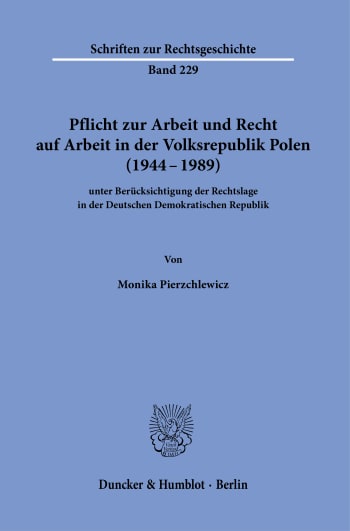
BOOK: Monika PIERZCHLEWICZ, Pflicht zur Arbeit und Recht auf Arbeit in der Volksrepublik Polen (1944-1989) [Schriften zur Rechtsgeschichte; 229] (Berlin: Duncker & Humblot, 2025), 372 p., ISBN 978-3-428-19472-8

Cover: Pflicht zur Arbeit und Recht auf Arbeit in der Volksrepublik Polen (1944–1989)

ABOUT THE BOOK:
 
Die Dissertation untersucht die Arbeitspflicht und das Recht auf Arbeit im sozialistischen Polen und nimmt Bezug auf die Rechtslage in der DDR. Im Sozialismus galt Arbeit als Recht, Pflicht und Ehrensache eines jeden Bürgers, was in den Verfassungen beider Länder verankert war. Neben Verfassungsbestimmungen analysiert die Arbeit Rechtsakte des einfachen Rechts, die strafrechtliche und administrative Sanktionen für die Nichterfüllung der Arbeitspflicht vorsahen. Die Untersuchung zeigt, dass die sozialistische Idealvorstellung von Arbeit als Lebensbedürfnis des Werktätigen und Sache der Ehre, das Ideal der nach sozialistischem Verständnis freiwillig nachgegangenen Pflicht zur Arbeit sowie des Rechts auf eine »ausbeutungsfreie« und »schöpferische« Arbeit in der Realität scheiterten. Die Arbeitspflicht sollte primär wirtschaftlichen Zielen dienen, wobei Zwang im Sozialismus als Mittel zur Erreichung von Freiheit betrachtet wurde.
 
TABLE OF CONTENT:
 
Einleitung
Zum Thema der Arbeit – Forschungsstand – Methodik und Leitfragen – Quellen – Thematischer und zeitlicher Rahmen der Arbeit – Aufbau

1. Einführende Bemerkungen und Begriffserklärungen
Zwangsbegriff – Sozialistischer Freiheitsbegriff – Sozialistischer Staat – Sozialistisches Recht – Wirtschaftliche und politische Hintergründe in der Volksrepublik Polen – Das gesellschaftlich-politische System der DDR und ökonomische Rahmenbedingungen

2. Arbeit im Sozialismus
Arbeitsbegriff – Sozialistische Arbeitsmoral – Sozialistische Berufsfreiheit

3. Pflicht zur Arbeit und Recht auf Arbeit auf Verfassungsebene
Charakter der VRP-Verfassung – Sozialistische Grundrechtskonzeption – Recht auf Arbeit auf Verfassungsebene – Pflicht zur Arbeit auf Verfassungsebene – Das Prinzip der »Einheit von Rechten und Pflichten«

4. Pflicht zur Arbeit und Recht auf Arbeit auf Gesetzesebene
Wiederaufbau des Staates nach dem Zweiten Weltkrieg – Absolventenlenkung – Die Bekämpfung des sog. »sozialen Parasitismus« – Pflicht zur Arbeit in dem Dekret vom 12. Dezember 1981 über das Kriegsrecht (Kriegsrechtsdekret) – Schlussbetrachtung: Recht oder Pflicht?
 
Find more here


09 February 2026

BOOK: Peter COLLIN & Leonard WOLCKENHAAR (eds.), Plurale Rechtsverständnisse ? Begriff und Grundlagen des Rechts in den juristischen Teildisziplinen im späten 19. und frühen 20. Jahrhundert [Moderne Regulierungsregime; 6] (Frankfurt am Main: Vittorio Klostermann, 2025), VI + 456 p. € 89


(image source: Klostermann)

Abstract:
From the end of the 19th century onwards, German jurisprudence became increasingly differentiated, as evidenced by the establishment of new institutes and new chair titles, textbooks and journals. A number of legal sub-disciplines developed and became independent, while established disciplines also re-examined their self-image. At the same time, there was lively activity in the fundamental subjects. Not only did legal philosophy, legal theory and, later, legal sociology stated to diverge from one another, but an impressive plurality of opinions can generally be observed here. This raises the question of whether and in what way specific understandings of law also developed within disciplines, e.g. with regard to the nature of legal norms, their scope of application, norm-setters and norm structure. The authors of this volume shed light on fundamental debates in the respective sub-disciplines, thereby revealing the conditions under which a differentiated jurisprudence emerged.

 Read more here.


14 November 2024

BOOK: Lyndsay CAMPBELL & Shaunnagh DORSETT (eds.), Legal Histories of Empire. Navigating Legalities (London: Routledge, 2025), 324 p. ISBN 9781032616179, 140 GBP


(image source: Routledge)

Abstract:
This collection brings together an international group of scholars in order to provide new insights into the diversity of imperial legalities.

Across empires, legalities were produced not just – or even – through the imperial imposition of laws and legal forms, but through local processes of negotiation and contestation. Far from the metropoles, local actors found ways to creatively navigate and subvert imperial frameworks and laws and to create space in which to shape new legalities, responsive to local circumstance and need. Covering topics as diverse as smuggling in eighteenth century Jersey, the criminalisation of female market women in World War II-era southern Nigeria, and whiteness and race in ‘sexual perversion’ cases in twentieth-century Malaya, the collection elaborates new legal histories of empire. Drawing from Britain, Ireland, Australia, Canada, the USA, India, Sri Lanka, Africa and Malaysia, the collection brings together chapters that examine the stories of the peoples of empires and shows how they constituted, experienced, navigated and subverted the legal complexities of living under empire.

This book will be of interest to scholars and researchers in law and history, but also to those with relevant interests in post-colonial and cultural studies, as well as in criminology and sociology.
Table of contents:

1. Navigating Legalities: Legal Histories of Empires 

Lyndsay Campbell and Shaunnagh Dorsett 

Part 1: Legalities 

2. Gerald of Wales, John Davies, and the Laws of the Irish in an English Colonial Perspective 

Craig Lyons 

3. Constituting a Colonial Crisis: Kielley v. Carson, St. John’s, 1838-43 

Lyndsay Campbell 

4. Recrafting Subjecthood through Exceptional Laws in the Nineteenth-Century British Empire 

Amanda Nettelbeck 

5. Making Empire: Writing the 1833 Ceylon Charter of Justice and Curial Reform in the British Empire 

Shaunnagh Dorsett 

Part 2: Negotiating Legalities 

6. Resisting and Extending Empire: How the Acadian People Shaped British and French Imperial Rule Through the Strategic Use of Law 

Robert Hamilton 

7. Arbitration and Empire: The Anti-Adjudicatory State in Bengal and British America, 1763–1775 

Christian R. Burset 

8. Legally Interconnecting Empires in the Americas: The Circulation of ‘Foreign’ Law Books in Québec and Louisiana from the 17th to the Early 19th Century 

Serge Dauchy 

9. Protestant State, Catholic Subjects: Religion, Law and Caste in Early Colonial Madras 

Aparna Balachandran 

10. Goomany Naik: Fragments of A ‘Non-Traditional’ Legal Biography 

Nishant Gokhale 

Part 3: Subverting Empire: Legalities and Illegalities 

11. Creative Friction, Legal Pluralism and the Eighteenth-Century Smuggling Economy in the Channel Islands 

David Chan Smith 

12. The ‘Price’ of War: The Criminalization and Punishment of Profiteers in Southern Nigeria during World War II 

Yolanda Chinelo Osondu 

13. Anxieties of Whiteness: Evidence, Race, and Emotions in the (Non-)Prosecution of the “Malayan ‘Sexual Perversion’ Cases,” 1938-1940 

Jack Jin Gary Lee 

14. Merchant Seafarers on British Ships: Lascars, Labour, Law and Empire in the Early 20th Century 

Diane Kirkby

On the editors:

Lyndsay Campbell is Professor in the Faculty of Law and Department of History, University of Calgary, Canada.

Read more here