Search

14 January 2021

ONLINE CONFERENCE: English Law and Colonial Connections Histories, Parallels, and Influences (Lodz: University of Lodz, 26-27 JAN 2021)


English Law and Colonial Connections

Histories, Parallels, and Influences

26th-27th January 2021

(All times are GMT)

Tuesday, 26th January 2021


3.00-3.15 PM – Introduction


Panel 1

3.15-3.35 PM

Richard Ireland (Aberystwyth University)

“It seems history is to blame”: Imagination and the Colonial Challenge to English Legal History.

3.35-3.55 PM

                Matilde Cazzola (Max Planck Institute for European Legal History)

To Remake Britain in the Image of the Raj: James Fitzjames Stephen and India as a Legal Model.

3.55-4.15 PM

                Justine K. Collins (Max Planck Institute for European Legal History)

The Role of Legislation in Racial Identities within the English Atlantic 1640s-1700s

4.15-4.45 PM

Discussion


Panel 2

5.15-5.35 PM

Sally Hadden (Western Michigan University)

London’s Middle Temple and Law Students from the New World

5.35-5.55 PM

Łukasz J. Korporowicz (University of Lodz)

Sir James Mackintosh – Barrister, Judge, Law Professor

5.55-6.15 PM

Discussion


Wednesday, 27th January 2021


Panel 3

3.00-3.20 PM

Cerian Griffiths (Northumbria University)

Fraud and the City of London: Global Opportunities in the Eighteenth-Century                      

3.20-3.40 PM

                Michael Lobban (London School of Economics and Political Science)

Authority and Subjecthood at the Margins of Empire: the Case of Sekgoma Letsholathibe

3.40-4.00 PM

Discussion


Panel 4

4.30-4.50 PM

Julia Rudolph (North Carolina State University)

The Last Will and Testament of John Gardner Kemeys: Jamaican Mortgages and English   Inheritance Disputes

4.50-5.10 PM

                Stefan Vogenauer (Max Planck Institute for European Legal History)

Influences of English Law on Asian Contract Laws: Contractual Interpretation

5.10-5.30 PM

Jan Halberda, Jagiellonian University

The Principle of Good Faith and Fair Dealing in Anglo-American Contract Law                       

5.30-6.00 PM

Discussion


6.00-6.20 PM – Closing Remarks

More infomation on the conference website.


BOOK: Erik DE BOM, Randall LESAFFER and Werner THOMAS (Eds.), Early Modern Sovereignties - Theory and Practice of a Burgeoning Concept in the Netherlands (Leiden-New York: Brill, 2021). ISBN 978-90-04-44604-5, 141.00 EUR


(Source: Brill)

Brill is publishing a new edited collection on early modern sovereignties.

ABOUT THE BOOK

The essays in this volume explore the theories and practices of sovereignty in the context of state-building in the early modern Northern and Southern Low Countries. The Dutch Revolt, the secession of the northern provinces from the Spanish empire, the formation of the Dutch Republic and the reconstitution of Habsburg authority in the south, fostered tense debates among scholars and political leaders about the legitimacy, organisation and processes of law and governance. This made the Low Countries a prime battlefield for theoretical and political contestations about the nature of public authority and the relations between different layers of government in early-modern Europe. The book approaches this historical debate from three angles: (1) political theoretical, (2) legal, and (3) politico-historical.

ABOUT THE EDITORS

Erik De Bom, Ph.D. (2009), KU Leuven, is Research Fellow at that university. He has published on the history of political thought in the sixteenth and seventeenth century, early-modern intellectual history and Renaissance humanism. 


Randall Lesaffer is Professor of legal history at KU Leuven as well as Tilburg University. His research focuses on the historical development of the law of nations in Europa since the sixteenth century. He is general editor of Oxford Historical Treaties and The Cambridge History of International Law. 


Werner Thomas is professor of Spanish and Spanish American History at KU Leuven. He publishes on the Low Countries and the Spanish monarchy, the repression of Protestantism in Spain, and the government of Archdukes Albert and Isabella in the Southern Netherlands.

TABLE OF CONTENTS

List of Tables

Notes on Contributors


Introduction

   Werner Thomas


PART 1

The Construction of Sovereignty


1 Sovereignty in Grotius

   Hans Blom


2 Ideas on Sovereignty

  Soto, Vázquez and Grotius

   Gustaaf van Nifterik


3 Conform to the Government and Acknowledge the Sovereignty

  Simon Stevin and François Vranck, a Practical Approach to Contested Sovereignty

   Lies van Aelst


PART 2

The Use and Limits of Sovereignty


4 Sovereignty as Argument

  The Habsburg-Dutch Struggle for Territory before and after Westphalia, 1576–1664

   Bram De Ridder


5 Sovereignty and Early Modern Private Property Rights

   Shavana Musa


6 The ‘Perfect Principality’ of the Archdukes Albert and Isabella

  Project and Reality of a ‘Separate Sovereignty’ of the Spanish Crown, 1529–1621

   Alicia Esteban Estríngana


PART 3

Sovereigns and Sovereignty in Practice


7 ‘The King is the Real Sovereign of this Countries’

  Politics of Justice and Order from the Duke of Alba in the Netherlands, 1567–1571

   Gustaaf Janssens


8 Electing a Prince

  the Popular Transfer of Sovereignty at the End of the Sixteenth Century

   José Javier Ruiz Ibáñez


9 North-Netherlandish Sovereigns at Work in the First Half of the Seventeenth Century

   Simon Groenveld


10 Early Seventeenth-Century Representative Institutions and Law Making in the Habsburg Netherlands

   René Vermeir


Index


More info here

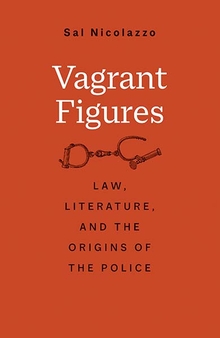
BOOK: Sal NICOLAZZO, Vagrant Figures - Law, Literature, and the Origins of the Police (New Haven: Yale University Press, 2021). ISBN 9780300241310, 65.00 USD


Yale University Press is publishing a new book on how vagrancy has shaped the role of policing in colonialism, racial formation and resource distribution

ABOUT THE BOOK

In this innovative book demonstrating the important role of eighteenth-century literary treatments of policing and vagrancy, Nicolazzo offers a prehistory of police legitimacy in a period that predates the establishment of the modern police force. She argues that narrative, textual, and rhetorical practices shaped not only police and legal activity of the period, but also public conceptions of police power. Her extensive research delves into law and literature on both sides of the Atlantic, tracking the centrality of vagrancy in establishing police power as a form of sovereignty crucial to settler colonialism, slavery, and racial capitalism. The first book in several generations to address policing and vagrancy in the eighteenth century, and the first in the field to center race and empire in its account of literary vagrancy, Nicolazzo’s work is a significant contribution to the field of eighteenth-century literary and cultural studies.

ABOUT THE AUTHOR

Sal Nicolazzo is assistant professor of Literature at the University of California, San Diego.


More info here

13 January 2021

NEW BOOK SERIES: Routledge Studies in Comparative Legal History (eds. Aniceto MASFERRER DOMINGO & Heikki PIHLAJAMÄKI)


(image source: Routledge)

About the series:

This series covers the general area of comparative legal history, including contributions focusing on both 'internal' legal history, i.e., doctrinal and disciplinary developments in the law, and 'external' legal history, i.e., legal ideas and institutions in wider contexts. Considering the various legal traditions worldwide, the series also welcomes works dealing with other laws and customs from around the globe. Temporal or geographical in approach, the series will consider both legal and similar law-like normative traditions. Works encompassing views from different schools of thought and contributions from comparative and transnational historiography, including interdisciplinary approaches, are encouraged. With a focus on higher level research in the form of monographs and edited collections, proposals for supplementary reading and textbooks are also welcomed.

On the editors:

Aniceto Masferrer is Professor of Legal History and teaches legal history and comparative law at the Faculty of Law, University of Valencia, Spain. He has published extensively on criminal law from an historical and comparative perspective, as well as on the codification movement and fundamental rights in the Western legal tradition. Heikki Tapio Pihlajamäki is Professor of Comparative Legal History, Faculty of Law, University of Helsinki, Finland. He has published widely, in a number of languages, on various aspects of comparative legal history. 

Board:

Tatjana Borisova, Higher School of Economics, St. Petersburg; Luisa Brunori, Lille 2 University; Emanuele Conte, Università degli Studi Roma Tre; Matthew Dyson, University of Oxford; Manuel Gutan, Lucian Blaga University of Sibiu; Dirk Heirbaut, Ghent University; Phillip Hellwege, University of Augsburg; Mia Korpiola, University of Turku; Marju Luts, University of Tartu; Emi Matsumoto, Aoyama Gakuin University; Matthew C. Mirow, Florida International University; Ulrike Müßig, Universität Passau; Jacques du Plessis, Stellenbosch University; Helle Vogt, University of Copenhagen; James Q. Whitman, Yale Law School; Alain Wijffels, Université Catholique de Louvain, Leiden University, CNRS.

µ Read more here.

ZOOM TALK: Thomas SIMON, Christlich", "deutsch", "ständisch": Die sog. "Maiverfassung" 1934 und der "Autoritäre Ständestaat". Versuch einer verfassungsgeschichtlichen Einordnung (Vienna: Universität Wien, 19 JAN 2021)

(image source: Universität Wien)

The Viennese Legal History Society (Wiener Rechtsgeschichtliche Gesellschaft) holds its events online via Zoom during the pandemic and opens the talks now for the wider public.


On 19 January, Prof. Thomas Simon (Vienna) will give a talk in German with the title: "Christlich", "deutsch", "ständisch": Die sog. "Maiverfassung" 1934 und der "Autoritäre Ständestaat". Versuch einer verfassungsgeschichtlichen Einordnung


Everyone is warmly invited to join the event via Zoom. Contact rechtsgeschicht@univie.ac.at to enroll.

BOOK: Geoffrey GRANDJEAN, Histoire de la construction européenne (Brussels : Larcier, 2020). ISBN 9782802739708, 90.00 EUR


(Source: Larcier)

Larcier has published a book on the history of “la construction européenne”.

ABOUT THE BOOK

À l’heure où l’Union européenne donne des signes d’un délitement annoncé, cet ouvrage s’intéresse, dans la perspective du temps long, aux États et aux personnalités politiques ayant joué et jouant encore un rôle majeur dans l’histoire de la construction européenne. En interrogeant l’idée d’Europe, en examinant les conséquences des deux guerres mondiales et en détaillant les étapes de la construction européenne, cet ouvrage tend à démontrer que l’Union européenne ne vit que par ses États et pour ses États.

À travers l’analyse de faits historiques, la présentation de notices biographiques et l’étude de textes fondamentaux, cette Histoire de la construction européenne propose une immersion dans des contextes politiques, sociaux, économiques ou encore culturels à la fois convergents et divergents. Elle est surtout l’occasion de s’interroger sur la possibilité de concrétiser une commune solidarité entre les citoyens et les États européens.

ABOUT THE AUTHOR

Geoffrey Grandjean : Professeur de science politique à la Faculté de Droit, de Science politique et de Criminologie (ULiège)


The table of contents can be found here


More info here

12 January 2021

JOURNAL: Tijdschrift voor Rechtsgeschiedenis/Revue d'Histoire du Droit/The Legal History Review LXXXVIII (2020), no. 3-4 (Dec)


(image source: Brill)

Prijs Robert Feenstra/Prix Robert Feenstra/Robert Feenstra Prize  (De Dagelijkse Redactie/Le Comité de rédaction/The Editorial Committee)

In memoriam Laurent Waelkens (1953-2020) (Alain Wijffels)

Academic bibliography of Laurent Waelkens (Wouter Druwé)

Irnerius and the imperial legislator, between Justinian and Henry V (Luca Loschiavo)

Abstract:

Nowadays both the figure of Irnerius and his role in the revival of legal studies in the Middle Ages are being questioned under different profiles. Returning to examine the manuscript tradition, the author aims in this essay to show how fondamental was the Irnerius’ contribution in giving the subsequent school of Bologna a very specific direction. Philology was only a tool he used to demonstrate to his contemporaries the authority and ‘positive’ validity of the whole imperial legislation against the early medieval use of selecting only what was immediately useful for practice.

Des clercs qui se mesleront de faire lettres et obligations. Public notaries and comital vassals or ‘hommes de fief’ in the organisation of voluntary jurisdiction in late-medieval Hainaut (1345-1467) (Falco Van der Schueren)

Abstract:

During the late Middle Ages, the organisation of voluntary jurisdiction in the customary regions of the Southern Low Countries was strongly determined by local developments. While it thrived in the major bishoprics of Liège and Tournai as well as in the commercial centers of Flanders and Brabant, historiography long assumed that the notary public failed to integrate into society in the rural county of Hainaut. Competition with the more dominant aldermen and comital vassals or hommes de fief supposedly prevented notaries from institutionalising their role as private legal intermediaries. Yet, the long-held top-down perspective disregarded interactions between, and the mutual competition among these different ‘agents’, thus creating a unilateral view that emphasised the importance of existing or indigenous alternatives. This contribution aims to better comprehend the organisation of late-medieval voluntary jurisdiction in Hainaut, taking the co-existence of public notaries and hommes de fief into consideration. From a bottom-up approach, relying on contemporary documentary writing practices, it will demonstrate how they both employed pragmatic literacy to gain authority, claim fides publica, and consolidate their own institutional position as such. This paradigm shift offers a framework that nuances previous insights regarding the reception of and developments within the notarial office in late-medieval Hainaut.

Hugo Grotius’s De societate publica cum infidelibus, Justifying overseas expansionism or religious toleration? (Marc de Wilde) (open access)

Abstract:

This article provides an analysis of an unpublished manuscript of Hugo Grotius, entitled De societate publica cum infidelibus, ‘On public partnership with infidels’. In the text, Grotius examines the legal conditions under which Christians may enter into treaties and alliances with non-Christians. Grotius’s text has been interpreted by Peter Borschberg and Martine van Ittersum as a justification of the Dutch commercial and military policies in the East Indies. However, as this article shows, Grotius probably conceived of De societate as a more general treatise, which related not only to the East Indian context, but also to the domestic debate about the legal position of non-Christians in the Dutch Republic. The same arguments that served as a justification for overseas expansionism could thus serve as a justification for religious toleration in the domestic context.

Why  did Louis XIV establish High Courts of Justice in North America?The Sovereign Council of Québec (1663) and the Superior Council of Louisiana (1712) through the prism of legal transplant theories (Serge Dauchy)

Abstract:

Why did Louis XIV establish high courts in the distant and sparsely populated North-American colonies? The logic of the establishment of the Sovereign Council of Québec in 1663 and the Superior Council of Louisiana in 1712 is indeed in no way similar to the one which led to the creation of high courts in the metropolitan territories previously under foreign sovereignty. In the colonies, there was no need to safeguard the provincial privileges, in particular that to be judged in accordance with the local customs and procedural rules. Historians have emphasized the idea that justice foremost asserted the king’s authority on his overseas territories and France’s position on the international scene. Colonial institutions were thus merely considered as extensions of the metropolitan model. This paper proposes to study the high courts of New France through the prism of legal transplant theories, focusing on the objectives and expectations of the donor rather than on their objects or on the obstacles faced by the receiver. We assert that the overseas high courts were a means to define and orientate the French colonial policy rather than an end in themselves. Their judicial and, above all, regulatory competences made them indeed a particularly suitable instrument for the fulfillment of the monarchy’s political and economic expectations.

French Influences on Germany’s Commercial Courts in the Nineteenth Century (Thomas Vogl)

Abstract:

The present contribution explores the extent of influence which French law had on the development of Germany’s commercial courts in the nineteenth century. Modern literature describes this influence as marginal, yet without further proof. The author takes this state of research as a starting point to compare the Napoleonic legislation on commercial courts with the German commercial court systems of the nineteenth century. However, the present contribution will start with an overview of the German legal situation at the end of the eighteenth century. This is followed by an examination of whether French law was transferred to Germany during the French occupation of large parts of Germany at the beginning of the nineteenth century. Against this background it is possible to fully analyse the influence which French law had on the further development of German commercial courts.

‘The Nation will always prevail’, Representation, participation and contestation in the Belgian Constitution of 1831 (Christophe Maes and Brecht Deseure) (open access)

Abstract:

The exact nature of the concept of sovereignty enshrined by the Belgian Constitution of 1831 has recently become the object of academic debate. This article takes a stand in this debate by analyzing the representative system instated by the constituent National Congress. It is argued that the congressmen attributed primacy to the legislative Chamber because it concentrated in its midst all the individual wills of the people in order to express the general will or the wish of the Nation. Importantly, though, parliament was not the only representative of the national will, neither was it considered completely self-contained. Parliament’s expression of the national will was subject to constant evaluation by public opinion. When the assembly failed to respond to popular grievances, other representatives were qualified to address the issue: the king could disband the Chamber or pronounce his veto when the national interest required it. The jury, assessing press or political related crimes, could correct oppressive governmental action. And if all of this failed – and only then – the nation could ultimately resist and take directly matters in its own hands. Thus, it is argued that the character of sovereignty in the Belgian state system was ultimately popular.

Roman Law in the Curriculum of the First Chinese Students in England, France, and China (Li Chen)

Abstract:

This article retraces the beginnings of Roman law studies by Chinese students during the latter part of the 19th century. It relies on archival research in order to piece together the curricula and careers of three pioneering Chinese law students who first came to study law, including Roman law, in England, France, and China. Wu Tingfang’s legal training at an Inn of Court in London, Ma Kié-Tchong’s legal education at the University of Paris and Wang Chung Hui’s study at Peiyang University in Tianjin, all included a more or less in-depth exposure to Roman law. Ma Kié-Tchong’s wrote a thesis on Roman law in Latin. As the first surviving specimen of legal Latin written by a Chinese jurist, his work not only reflects Roman law studies in France in the 19th century, it also sheds light on the level of proficiency in legal Latin which a Chinese scholar could attain.

Les minorités dans la Déclaration Universelle des Droits de l’Homme, une absence délibérée (Fernando Arlettaz)

Abstract:

The League of Nations established, in the interwar period, a legal regime for the protection of minorities which considered them as intermeditate groups between the State and the individuals. On the contrary, the Universal Declaration on Human Rights, adopted in 1948 by the United Nations, assumed a radically individualistic point of view and did not include any mention to minority rights. The travaux préparatoires of the Universal Declaration suggest that the question of minorities caused strong tension among States and that, for this reason, they avoided its inclusion in the 1948 document.

The Navel, Reflections on the composition of the Quarta pars Digestorum (W.J. Zwalve and Th. de Vries)

Abstract:

In an earlier edition of Tijdschrift voor Rechtsgeschiedenis we have contended that Justinian’s Digest was composed on the basis of Ulpian’s Libri ad Edictum and the peculiarities and special exigencies of the legal curriculum. It was also contended that the distribution of the fifty books over the seven partes of the Digest was based on a mathematical formula, complicated by the fact that Justinian (Tribonian) had decided to assign four books to the first pars (Ta prota) and 36 to the first five partes together according to ‘the nature and science of numbers’ (natura et ars numerorum). This article offers some additional arguments supporting our thesis and concentrates on the composition of the quarta pars Digestorum, designated by Justinian himself as ‘The Navel’ (Umbilicus) of the entire composition. The hypothesis is that Tribonian composed the quarta pars Digestorum as a microcosm of the Digest as a whole and that he has been ‘juggling with numbers’ within the composition of ‘The Navel’ as he has ostensibly done in the composition of the Digest as a whole.

Lauro Chiazzese, lo studio delle interpolazioni e i confronti ‘ritrovati’ (Mario Varvaro)

Abstract:

A first draft of the Parte speciale of Chiazzese’s Confronti Testuali, projected as complement of the Parte generale published in 1933, was known for quite some time, but was only recently published by Falcone. Although this is an important transcription work of the manuscript, the reconstruction provided about the historical background – partially based on two different versions of an anecdote – should be read taking into account some clarifications.

 Book reviews:

  • Die Akten des Kaiserlichen Reichshofrats, Serie II: Antiqua, Band 5: Karton 425-516, edited by W. Sellert, 2019 (P.L. Nève)
  • Latent defect or excessive price? Exploring early modern legal approach to remedying defects in goods exchanged for money, written by C.J. de Bruijn, 2018 (Wim Decock)
  • Ernst Kantorowicz, a Life. written by R.E. Lerner,  2017 (Alain Wijffels)
  • Juristen die schreven en bleven, Nederlandstalige rechtsgeleerde klassiekers, edited by G. Martyn e.a., 2020 (Jan Hallebeek)
  • The Oxford handbook of European legal history, edited by H. Pihlajamäkki, M.D. Dubber and M. Godfrey, 2018 (A.J.B. Sirks)
  • Handwörterbuch zur deutschen Rechtsgeschichte HRG, 2., edited by A. Cordes, H. Lück, D. Werkmüller und C. Bertelsmeier-Kierst, 2016 (Alain Wijffels)

(source: Standen & Landen/Anciens Pays et Assemblées d'États)

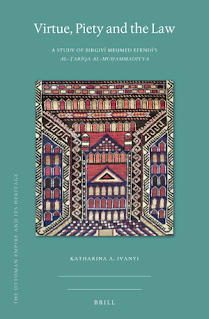
BOOK: Katharina Anna IVANYI, Virtue, Piety and the Law. A Study of Birgivī Meḥmed Efendī’s al-Ṭarīqa al-muḥammadiyya (Leiden: Brill, 2020). ISBN: 9789004419865, € 105.00

(Source: Brill)

ABOUT THE BOOK

Series: The Ottoman Empire and its Heritage, Volume: 72

In Virtue, Piety and the Law Katharina Ivanyi examines Birgivī Meḥmed Efendī’s (d. 981/1573) al-Ṭarīqa al-muḥammadiyya, a major work of pietist exhortation and advice, composed by the sixteenth-century Ottoman jurist, Ḥadīth scholar and grammarian, who would articulate a style of religiosity that had considerable reformist appeal into modern times. Linking the cultivation of individual virtue to questions of wider political, social and economic concern, Birgivī played a significant role in the negotiation and articulation of early modern Ottoman Ḥanafī piety. Birgivī’s deep mistrust of the passions of the human soul led him to prescribe a regime of self-surveillance and control that was only matched in rigor by his likewise exacting interpretation of the law in matters of everyday life, as much as in state practices, such as the cash waqf, Ottoman land tenure and taxation.

ABOUT THE AUTHOR

Katharina A. Ivanyi, Ph.D. (2012), Princeton University, is External Lecturer at the Department of Near Eastern Studies at the University of Vienna.

TABLE OF CONTENTS

Acknowledgements 

Abbreviations and Frequently Cited Sources 

Note on Transliteration and Transcription 

Introduction 

1 Please Provide Chapter Title 

 1 Context I: Birgivī’s Life 

 2 Context II: Birgivī’s oeuvre 

 3 Context III: the Bigger Picture—Early Modern Sunnitization, the Negotiation of Orthodoxy and the Pietist Turn 

2 The Intellectual Framework 

 1 The Ḥanafī Tradition—Law and Ethics 

 2 Post-Classical fatāwā Handbooks 

 3 Abū al-Layth al-Samarqandī 

 4 Other Ḥanafī Literature 

 5 The Corruption of Times 

 6 Legal Sources beyond the Ḥanafī School 

 7 Birgivī and the Ḥanbalīs 

 8 Birgivī and Ḥadīth 

 9 Sufism 

 10 Science of the Hearts 

 11 Ghazālī 

 12 Emulation of the Prophet 

 13 Birgivī in Contemporary Comparison: Shāhzāde Ḳorḳud 

 14 Birgivī and the Ottoman naṣīḥat-nāme: Muṣṭafā ʿĀlī 

 15 Birgivī and Ottoman Jurisprudence: Ebūʾs-Suʿūd 

3 The Fundamentals of Piety: an Overview of the Structure and Contents of al-Ṭarīqa al-muḥammadiyya 

 1 Introduction 

 2 A Note on the Textual History of al-Ṭarīqa al-muḥammadiyya 

 3 General Structure of TM and Overview of Contents 

 4 Detailed Summary of Contents—Introduction 

 5 Innovation 

 6 Bidʿa and Sufism 

 7 Moderation 

 8 Part Two—Chapter One—Doctrine 

 9 The Legal Status of the various sciences 

 10 Part Two, Chapter Three: Piety 

 11 The Practical Manifestations of Piety—the Core of TM 

 12 The Vices of the Heart 

 13 Birgivī’s Conception of the Soul 

 14 The Vices of the Tongue 

 15 The Vices of the Ear 

 16 The Vices of the Eye 

 17 The Vices of the Hand 

 18 The Vices of the Belly 

 19 The Vices of the Private Parts 

 20 The Vices of the Leg 

 21 Vices Unspecified by Any One Part of the Body 

 22 Part Three of TM—Ritual Purity 

 23 Part Three—Chapter Two—Finance, Land Tenure and Taxation 

 24 What Holds It All Together 

4 The Slippery Slope of Piety: Birgivī on Sincerity, Sanctimony and How to Determine Right Intention 

 1 Introduction 

 2 Vocabulary and Semantics, Definitions and Classifications 

 3 Riyāʾ as Lesser Shirk 

 4 Other Types of Dissimulation 

 5 Sincerity (ikhlāṣ and iḥsān) 

 6 Truthfulness (ṣidq) 

 7 Various Taxonomies of riyāʾ 

 8 Legal Categorization 

 9 The Why(s) and How(s) of riyāʾ 

 10 The “People of Religion” 

 11 When Things Are Not That Clear-Cut 

 12 Embarrassment 

 13 How to Cure the Evil of riyāʾ 

 14 Display in Order to Guide, but How Can You Be Sure 

 15 Conclusion 

5 The Economics of Piety: Birgivī on Wastefulness, the Cash waqf and Ottoman Land Tenure and Taxation 

 1 Introduction 

 2 Basic Concepts—the Good and Bad Qualities of Wealth 

 3 Stinginess, Generosity and Waste 

 4 The Causes, Manifestations and Antidotes of Wastefulness 

 5 Charity, Poverty and Begging 

 6 Payment for Religious Services 

 7 The Cash waqf 

 8 Land Tenure and Taxation 

 9 Conclusion 

Conclusion 

Bibliography 

 Reference Works, Library Catalogues, Bibliographies 

 Primary Sources 

 Secondary Sources 

Index 


More information with the publisher.

BOOK: Charlotte EPSTEIN, Birth of the State - The Place of the Body in Crafting Modern Politics (Oxford: Oxford University Press, 2020). ISBN 9780190917623, 99.00 USD


(Source: OUP)

OUP has published a new book on the place of the body in crafting modern politics.

ABOUT THE BOOK

This book uses the body to peel back the layers of time and taken-for-granted ideas about the two defining political forms of modernity, the state and the subject of rights. It traces, under the lens of the body, how the state and the subject mutually constituted each other all the way down, by going all the way back, to their original crafting in the seventeenth century. It considers two revolutions. The first, scientific, threw humanity out of the centre of the universe, and transformed the very meanings of matter, space, and the body; while the second, legal and political, re-established humans as the centre-point of the framework of modern rights.

The book analyses the fundamental rights to security, liberty, and property respectively as the initial knots where the state-subject relation was first sealed. It develops three arguments, that the body served to naturalise security; to individualise liberty; and to privatise property. Covering a wide range of materials--from early modern Dutch painting, to the canon of English political thought, the Anglo-Scottish legal struggles of naturalization, and medical and religious practices--it shows both how the body has operated as history's great naturaliser, and how it can be mobilised instead as a critical tool that lays bare the deeply racialised and gendered constructions that made the state and the subject of rights. The book returns to the origins of constructivist and constitutive theorising to reclaim their radical and critical potential.

ABOUT THE AUTHOR

Charlotte Epstein is Associate Professor of International Relations at the University of Sydney.

TABLE OF CONTENTS

Acknowledgements

A Note on References

Chapter 1: Introduction

I. Security

Chapter 2: The Corporeal Ontology of Modern Security

Chapter 3: Denaturalising Security

II. Liberty

Chapter 4: From Liberties to Liberty: Crafting Territory and the Law with the Body

Chapter 5: Externalising and Internalising Liberty via Discipline

III. Property

Chapter 6: Privatising Property

Chapter 7: The Public Anatomy Lesson

Chapter 8: Conclusion

Bibliography


More info here

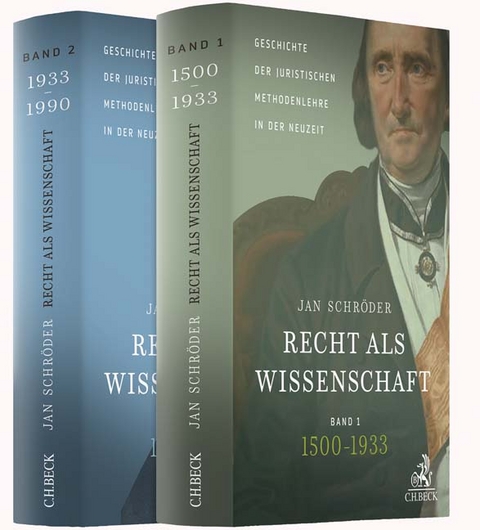
BOOK: Jan SCHRÖDER, Recht als Wissenschaft - Geschichte der juristischen Methodenlehre in der Neuzeit (1500-1990), 2 Bänden (Munich: C.H. Beck, 2020). ISBN 978-3-406-76089-1, 149.00 EUR


(Source: Lehmanns)

C.H. Beck has published “Recht als Wissenschaft - Geschichte der juristischen Methodenlehre in der Neuzeit (1500-1990)“

ABOUT THE BOOK

Wie ist vorzugehen, um das geltende Recht zu ermitteln? Wie gehen wir mit Regelungslücken um? Wie verhält sich die Interpretation der Rechtssätze zum logisch richtigen Arbeiten mit ihnen?

Das Buch stellt Grundfragen und zeigt, wie sich die Antworten bis heute entwickelt haben. Die Ergebnisse sind auf überraschende Weise aktuell. Wer als Jurist die historischen, geistesgeschichtlichen und aktuellen Grundlagen der juristischen Methode verstehen und sie im modernen Sinne weiterentwickeln will, kommt an diesem Buch nicht vorbei.

Vorteile auf einen Blickin seiner Art einzigartig, ein vergleichbares Werk zur Rechtsquellen- und Methodenlehre gibt es nicht.gleichermaßen bedeutend für den historischen Blick zurück wie auch für die aktuelle Rechtsquellen- und Methodendiskussion.ein faszinierendes Panorama der Geistesgeschichte und damit eine spannende Lektüre. Schon die unvollendete 1. A. wurde 2001 als eines von vier juristischen "Büchern des Jahres" ausgezeichnet.

Zur Neuauflage

Das opus maximum nun vollendet! Der gesamte Zeitraum von 1500 bis 1990 jetzt abgedeckt. Über dreißig Jahre hat den Autor dieses Werk beschäftigt. Vom göttlich-menschlichen Recht der frühesten Neuzeit über die Entdeckung der konstruktiven Vernunft führt er uns zur Begründung der positiven Rechtswissenschaft, zum Rechtspositivismus im späten 19. Jahrhundert, zu den deutschen Diktaturen (NS-Staat, DDR) und schließlich zur Methodenlehre des bürgerlich-liberalen Verfassungsstaats.


More info here

11 January 2021

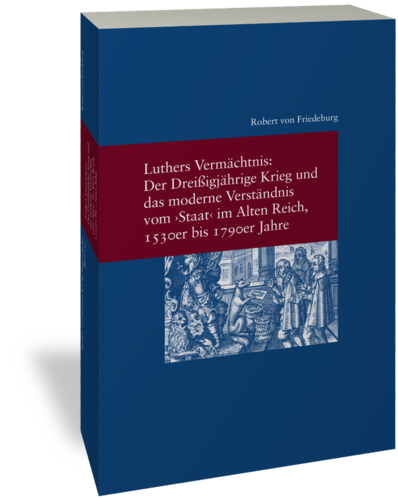
BOOK: Robert VON FRIEDEBURG, Luthers Vermächtnis: Der Dreißigjährige Krieg und das moderne Verständnis vom ›Staat‹ im Alten Reich, 1530er bis 1790er Jahre (Frankfurt: Klostermann Verlag, 2021). ISBN 978-3-465-04369-0, 98.00 EUR


(Source: Klostermann)

Klostermann published „Luthers Vermächtnis: Der Dreißigjährige Krieg und das moderne Verständnis vom ›Staat‹ im Alten Reich, 1530er bis 1790er Jahre“, the 320th title in its Studien zur europäischen Rechtsgeschichte series.

ABOUT THE BOOK

In the German-speaking Reich, the term "state" in its modern understanding was not coined with reference to the early modern Old Reich as a whole and certainly not with the consolidation of princely power over land and people as its aim. Rather, its genesis was related to the bitter conflicts between emerging estates and princes in the face of the devastations of the Thirty Years' War. Taking up the contemporary polemics against criminal princes dating back to Luther, Seckendorff's "Teutscher Fürstenstaat" (1656) was supposed to protect its inhabitants from the incompetence and wickedness of the princes by means of their own legal system and lawful administration (Policey) as a unit of land, people and laws that allegedly reached far back into the Middle Ages. Since the last third of the 17th century these ideas, the development of which the book traces on a broad source basis, have increasingly found favour with many princes and their advisors in Protestant and Catholic German countries.

The table of contents can be found here


More info here

BOOK: Martin P. SCHENNACH, Austria inventa? Zu den Anfängen der österreichischen Staatsrechtslehre (Frankfurt: Klostermann Verlag, 2020). ISBN 978-3-465-04414-7, 98.00 EUR


(Source: Klostermann)

Klostermann Verlag published “Austria inventa? Zu den Anfängen der österreichischen Staatsrechtslehre” at the end of last year.

ABOUT THE BOOK

This is the first work of its kind devoted to Austrian constitutional law, which has so far received little attention in (legal) historical research. It examines its origins, its authors, its connection with the “Reichspublizistik”, its sources and methods as well as its contents and, last but not least, its role in university teaching. Of all the particular state rights in the Holy Roman Empire, its subject was probably the one most intensively discussed. In the second half of the 18th century, Austrian constitutional law was a flourishing genre of literature promoted by the Habsburg dynasty. This is accounted for by its main themes: It flanked the process of internal integration of the heterogeneous Habsburg ruling complex and aimed at the discursive and legal construction of an Austrian state as a whole and the legitimation of absolutism.


The table of contents can be found here


More info here

Book: Maurits EBBEN & Louis SICKING (Eds.), Beyond Ambassadors. Consuls, Missionaries, and Spies in Premodern Diplomacy (Leiden: Brill, 2021). ISBN: 9789004438842, pp. 223, € 99.00

 (Source: Brill)

ABOUT THE BOOK

Series: Rulers & Elites, Volume: 19. Contributors are: Maurits Ebben, Dante Fedele, Alan Marshall, Jacques Paviot, Felicia Roșu, Jean-Baptiste Santamaria, Louis Sicking, and John Watkins.

Because of the overarching shadow of ‘the state’ in all things diplomatic, traditional diplomatic history has neglected the study of any actors in foreign relations other than state diplomats, such as ambassadors. This volume focuses on the question of how and why consuls, missionaries, and spies not formally tied to the state or a prince could play a role in premodern diplomatic relations. It highlights their multiple loyalties, their volatility, and the porous boundaries of diplomatic activity. Historical research on non-state actors – in the context of the so-called new diplomatic history – is all the more urgent as it demonstrates their undeniably significant contributions to the formation of Europe’s international relations. 

ABOUT THE EDITORS

Maurits Ebben (1955) is a lecturer at Leiden University, Ph.D. Leiden University 1996. He is currently working on a new volume entitled Ambassadors, Consuls and Commerce: The Dutch Diplomatic Service in the Later Seventeenth Century, 1648-1700. 

Louis Sicking is the Aemilius Papinianus professor of history of public international law at VU University and lecturer in history at the University of Leiden. He is presently working on a book on conflict management in pre-modern Atlantic Europe.


TABLE OF CONTENTS

List of Maps and Table 
Notes on Contributors 
Introduction 
  Maurits Ebben and Louis Sicking 
Part I
Theoretical Challenges 
1. Premodern Non-State Agency: the Theoretical, Historical, and Legal Challenge 
  John Watkins 
2. Plurality of Diplomatic Agents in Premodern Literature on the Ambassador 
  Dante Fedele 
Part II
Consuls 
3. Space, Agency, and Conflict Management in the Late Medieval Baltic: Urban Colonies and Representatives of Hanse Towns at Scania 
Louis Sicking 
4. Your High and Mighty Lordships’ Most Humble Servants: Dutch Consuls and the States General’s Diplomacy in Spain, 1648–1661 
Maurits Ebben 
Part 3 
Missionaries 
5. The Mendicant Friars: Actors in Diplomatic Encounters with the Mongols 
  Jacques Paviot 
6. The New Indies, the Desired Indies: Antonio Possevino and the Jesuits between Diplomacy and Missionarism in Northeastern Europe, 1577–1587 
  Felicia Roșu 
Part IV
Spies 
7. Secrets, Diplomatics, and Spies in Late Medieval France and in the Burgundian State: Parallel Practices and Undercover Operations 
  Jean-Baptiste Santamaria 
8. ‘Secret Wheeles’: Clandestine Information, Espionage, and European Intelligence 
  Alan Marshall 
Index of Names 


More information with the publisher.

08 January 2021

BOOK: Gregory J. DURSTON, Jacks, Knaves and Vagabonds: Crime, Law, and Order in Tudor England (Sherfield on London: Waterside Press, 2020). ISBN 9781909976764, pp. 736, £39.95


(Source: Waterside Press)

ABOUT THE BOOK

In this welcome addition to his Crime History Series, Gregory Durston points to the lack of design and short-term expediency that typified Tudor law and order. But he also detects an emergent criminal justice system amidst royal patronage, protection, and the influence of wealthy magnates. Students of English history will have heard how benefit of clergy and the ‘neck verse’ might avoid a hanging, but what of other stratagems such as down-valuing stolen goods, cruentation, chance medley, pious perjury or John at Death (a non-existent culprit blamed by the accused and treated by juries as real); all devices used to mitigate the all-pervading death-for-felony rule. Together with other artifices deployed by courts to circumvent black-letter law the author also describes how poor, marginalised and illiterate citizens were those most likely to suffer unfairness, injustice and draconian punishment. He also describes the political intrigue and widescale corruption that were symptomatic of the era, alongside such diverse aspects as forfeiture of property, evidential ploys, the rise of the highwayman, religious persecution, witchcraft and infanticide crazes. At a time of shifting allegiances — and as Crown, church, judges, magistrates and officials wrestled over jurisdiction, central or local control, ‘ungodly customs’, laws of convenience or malleable definitions — never perhaps were facts or law so expertly engineered to justify or defend often curious outcomes.

ABOUT THE AUTHOR

Gregory J Durston is a barrister-at-law who has taught in law schools in England and Japan. He was for many years Reader in Law at Kingston University, Surrey and is currently an adjunct professor at Southern Cross University School of Law and Justice, New South Wales, Australia. He is the author of Fields, Fens and Felonies and Whores and Highwaymen (both Waterside Press).


More information with the publisher.


DATABASE: Directory of History Dissertations (American Historical Association)


(image source: AHA)

Description:
Welcome to the Directory of History Dissertations. The Directory contains 57,267 dissertations that were completed or are currently in progress at 204 history departments in the United States and Canada.

Consult the database here


07 January 2021

BOOK: John CHRISTOPOULOS, Abortion in Early Modern Italy (Cambridge: Harvard University Press, 2021). ISBN 9780674248090, EUR 45.00.


(Source: HUP)

Harvard University Press is publishing a history of abortion in Renaissance Italy.

ABOUT THE BOOK

In this authoritative history, John Christopoulos provides a provocative and far-reaching account of abortion in sixteenth- and seventeenth-century Italy. His poignant portraits of women who terminated or were forced to terminate pregnancies offer a corrective to longstanding views: he finds that Italians maintained a fundamental ambivalence about abortion. Italians from all levels of society sought, had, and participated in abortions. Early modern Italy was not an absolute anti-abortion culture, an exemplary Catholic society centered on the “traditional family.” Rather, Christopoulos shows, Italians held many views on abortion, and their responses to its practice varied.

Bringing together medical, religious, and legal perspectives alongside a social and cultural history of sexuality, reproduction, and the family, Christopoulos offers a nuanced and convincing account of the meanings Italians ascribed to abortion and shows how prevailing ideas about the practice were spread, modified, and challenged. Christopoulos begins by introducing readers to prevailing ideas about abortion and women’s bodies, describing the widely available purgative medicines and surgeries that various healers and women themselves employed to terminate pregnancies. He then explores how these ideas and practices ran up against and shaped theology, medicine, and law. Catholic understanding of abortion was changing amid religious, legal, and scientific debates concerning the nature of human life, women’s bodies, and sexual politics. Christopoulos examines how ecclesiastical, secular, and medical authorities sought to regulate abortion, and how tribunals investigated and punished its procurers—or did not, even when they could have. Abortion in Early Modern Italy offers a compelling and sensitive study of abortion in a time of dramatic religious, scientific, and social change.


ABOUT THE AUTHOR

John Christopoulos is Assistant Professor of History at the University of British Columbia.

TABLE OF CONTENTS

Introduction: The Meanings of Abortion

1. Abortion and Women’s Bodies

(Rosana and Giovanni)

2. Abortion and the Church

(Femia and Antino)

3. Abortion and the Law

(Maria and Superio)

Conclusion

Notes

Bibliography

Acknowledgments

Index


More info here

06 January 2021

BLOG SERIES: Prune DECOUX, Legal History and Digital Humanities (ConDÉ Project, University of Caen)

(image source: Hypothèses)

First paragraph of the first post by dr. Prune Decoux:

« L’historien de demain » — devenu celui d’aujourd’hui— existe toujours. Est-ce grâce, comme le dit cette prophétie, au développement de nouvelles habiletés technologiques ? Si elles ne sont pas seules en cause, force est de constater que ce scientifique s’est emparé, depuis le milieu du XXe siècle, de l’informatique et a opéré un véritable tournant numérique, à l’instar des linguistes et des sociologues. Alors que les sciences humaines et sociales se sont saisies de ces nouvelles technologies, une discipline parmi elles semble encore résister aux sirènes des digital humanities : l’histoire du droit. L’historien du droit, déjà mi-juriste, mi-historien, doit-il lui aussi, pour survivre, devenir informaticien — le « programmeur » d’hier?

Read further here. Second blog herehere

JOURNAL: Special Issue Regards croisés histoire du droit – science politique (Cahiers Jean Moulin 6 (2020)) (OPEN ACCESS)


(image source: Prairial)

« S'il plaist à la coustume » Introduction au dossier (Xavier Prévost)

Articles:

Norme et insuffisance de pouvoir La tentative de François Ier de prescrire la rescision pour lésion par l’ordonnance de Villers‑Cotterêts (Floriane Masséna)

Modérer les passions, censurer l’élection Étudier la validité sociale d’un dispositif de contrôle de l’élection en l’an VIII (1799) (Franck Duchesne)

De la recommandation à l’imposition normative Le rôle du Conseil constitutionnel dans la construction du candidat idéal à l’élection présidentielle (1958-2017) (Clémentine Belle Grenier)

La colonisation et la transposition des concepts juridiques L’exemple du droit coutumier au Punjab (Inde) (Amanjit Kaur Sharanjit)

La collision des normes : régime international de contrôle des drogues et droits des peuples indigènes (Julián Andrés Fernández López)

Discussions:

La normativité au prisme de l’analyse historique : point de jonction entre l’histoire du droit et la science politique ? (Victor Le Breton-Blon)

Histoire du droit, science politique : La fin du mythe des méthodologies distinctes ? (Alexandre Frambéry-Iacobone)

Questionner la norme à travers le religieux : le dialogue entre l’histoire du droit et la science politique (Badr Karkbi)

Méthodes de recherche relatives à l’étude de la circulation et de la transposition des normes Liens et dissensions entre historiens du droit et politistes (Alizée Miranda)

La norme en voyage : le point de vue du politiste (Pierre Bourgois & Clément Rodier)

Des normes et du pouvoir politique : quelques réflexions de base (Patrick Castenet)

Interview

De l’esprit des droits de l’homme Entretien entre Dan Edelstein et Thérence Carvalho

Comptes rendus de lecture

R. Repole, Église synodale et démocratie. Quelles institutions ecclésiales pour aujourd’hui ? (Maxime Blachon)

Oscar Ferreira, Le constitutionnalisme octroyé. Itinéraire d’un constitutionnalisme au xixe siècle (France, Portugal, Brésil) (Hugo Beuvant)

Frédéric Audren, Anne-Sophie Chambost & Jean-Louis Halpérin, Histoires contemporaines du droit (Dominique Messineo)

(read all articles here

05 January 2021

BOOK: Oliver F.R. HAARDT, Bismarcks ewiger Bund. Eine neue Geschichte des Deutschen Kaiserreichs (Darmstadt: WGB Theiss, 2020), 944 p. ISBN 978-3-8062-4179-2, € 40


(image source: WBG/Theiss)

Book abstract:

Neue Perspektive auf das deutsche Kaiserreich: Wie prägte es die Geschichte Deutschlands? Es war kein festgefügtes Machtgebilde, sondern ein »ewiger Bund von Fürsten«: Oliver Haardt stellt die Geschichte des deutschen Reichs von 1871 bis 1918 unter einem völlig neuen Blickwinkel dar. Ein loser Bund von 22 Fürstenstaaten und drei Hansestädten bildete einen Staatenbund unter preußischer Führerschaft und ohne Zentralregierung. Wie konnte sich aus diesem heterogenen Konglomerat ein straff zentralisierter Staat entwickeln, der wirtschaftlich und militärisch so schlagkräftig wie keine andere europäische Macht war? Oliver Haardt schlägt in dieser umfassenden Studie erstmals einen Bogen zwischen den Teildisziplinen der Rechts- und Politikgeschichte. Die Reichsverfassung als Kulturartefakt aus der Zeit der Reichsgründung: Verfassungsgeschichte als Kulturgeschichte Die Rolle von Kaiser Wilhelm II. im Regierungssystem und ihr Wandel im Laufe der Jahre Weswegen und wie bildete sich die Reichsregierung um Kanzler Otto von Bismarck aus? Wie entwickelte sich das Verhältnis zwischen Bund und Ländern, insbesondere Preußen? Die Auswirkungen der Reichspolitik auf die Entwicklung Deutschlands im 20. Jahrhundert Vom Fürstenbund zur Reichsmonarchie: Was machte Bismarcks Bündnissystem so einzigartig? Stark nach außen, instabil nach innen: Innenpolitische Machtkämpfe hielten das Regierungssystem ständig im Fluss. Trotz aller internen Spannungen konnte sich das Kaiserreich jedoch zum ersten deutschen Nationalstaat entwickeln, aus dem die Weimarer Republik hervorging. Die politische Kultur des Kaiserreichs hinterlässt bis heute Spuren in der europäischen Politik. Zum Beispiel ähneln die Föderalstrukturen der Europäischen Union denen des Kaiserreiches in einigen wichtigen Punkten in bemerkenswerter Weise. Oliver Haardt gelingt ein interdisziplinärer Überblick zum aktuellen Forschungsstand. Seine kenntnisreiche Analyse fasst in klarem Stil Gründung, Zerfall und Auswirkungen des Deutschen Kaiserreichs zusammen!
(source: WBG)

BOOK: Amnon LEV, Souveraineté et liberté: Étude sur les fondements du pouvoir (trad. Gabriel BIBEAU-PICARD) [Bibliothèque de la pensée juridique, 13] (Paris: Classiques Garnier, 2020), 264 p. ISBN 978-2-406-09739-6, € 32


(image source: Classiques Garnier)

Book abstract:

Ce livre propose une généalogie de la souveraineté qui met au jour ses sources, ses ressorts et la tension qui agit en son sein. Il dresse ainsi un portrait intime de notre modernité politique.

(more information here


04 January 2021

BOOK: Guido ROSSI (ed.), Authorities in Early Modern Courts in Europe [Edinburgh Studies in Law] (Edinburgh: Edinburgh niversity Press, 2021), ISBN 978-1-4744-5100-0


(image source: Edinburgh University Press

Abstract:

The first comparative study of the relationship between law courts and substantive law in the early modern period. Bringing together some of the most distinguished scholars in the field including John Ford, David Ibbetson, Javier García Martín, Annamaria Monti, Peter Oestmann, Heikki Pihlajamäki and Alain Wijffels, this volume looks at the comparative development of legal practice in the early modern period across Europe. Focusing deliberately on the impact of law courts on substantive law - and not on its systematisation by learned jurists - it studies similarities and differences in the development of the law across different jurisdictions. In doing so it evaluates whether and to what extent it is possible to consider this development as a unitary and truly European phenomenon. This collection re-evaluates current debates surrounding the development of civil law in the early modern period in the context of the grand narratives of European legal history and sets out to challenge current orthodox views about early modern civil law.

Key Features:

A comparative study on the passage from late medieval to early modern civil law from a practical viewpoint. Assesses the influence of law courts on the development of substantive law. Re-evaluates and challenges current orthodox views about early modern civil law

On the editor:

Guido Rossi is Reader in European Legal History at the University of Edinburgh.

(source: Edinburgh UP)

BOOK: Lisa COLLINSON, Torgeir LANDRO and Bertil NILSSON (Eds.), The Borgarthing Law and the Eidsivathing Law - The Laws of Eastern Norway (London: Routledge, 2020). ISBN 9780367646424, GBP 120.00


(Source: Routledge)

Routledge is publishing a new book on two medieval Norwegian laws.

ABOUT THE BOOK

The Borgarthing Law and the Eidsivathing Law is dedicated to two closely linked medieval laws which were intended to cover adjacent legal provinces in eastern Norway, around and beyond the modern capital, Oslo.


The core of this book consists of new translations of the two laws, based on the recent editions and translations into modern Norwegian by Eyvind Fjeld Halvorsen and Magnus Rindal. Individual rules cover subjects such as Church rites, prohibitions, property and payments, and shed light on medieval ideas relating to matters as diverse as disability, sexual relations, witchcraft, and forbidden foods. The volume contains a general introduction by Torgeir Landro and Bertil Nilsson, in addition to a translator’s introduction by Lisa Collinson, summarizing in English some of the information on manuscripts and relevant linguistic studies outlined by Halvorsen and Rindal. The translated texts in English are also supplemented by footnotes, supplying key readings from the original, in some cases with significant variants from relevant manuscripts.


With a commentary on the individual chapters after each translation, drawing on recent scholarship on medieval law, Church history, and other relevant historical fields, this book is an ideal resource for students and scholars of medieval Norwegian legal history.

ABOUT THE EDITORS

Lisa Collinson is Research Lead for Museums and Special Collections, University of Aberdeen. Her previous work has examined the legal and literary history of medieval Scandinavia and the British Isles.

Torgeir Landro is Associate Professor at NLA University College, Norway. His previous publications deal with the reception of canon law in medieval Norway.

Bertil Nilsson is Professor Emeritus of History of Christianity at the University of Gothenburg, Sweden. His previous publications deal with medieval canon law as well as the way in which the encounter between religions developed during the process of Christianization in the Scandinavian kingdoms.


TABLE OF CONTENTS

A general introduction to the Medieval Nordic Laws translations

Foreword

Part I: General Introduction

Part II: Translator’s Introduction

Part III: The Borgarthing Law

Part IV: Notes on the Text

Part V: The Eidsivathing Law

Part VI: Notes on the Text

Part VII: Sources, literature, and abbreviations

Glossary

Index


More info here

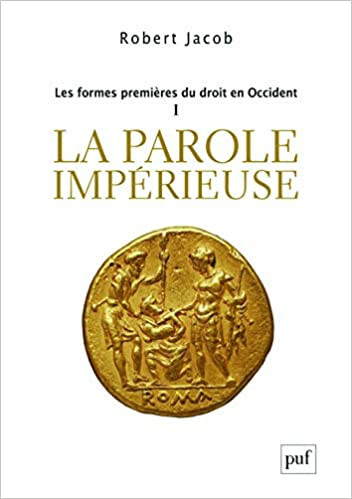
BOOK: Robert JACOB, Les formes premières du droit en Occident. La parole impérieuse (Paris: PUF, 2020), 576 p. ISBN 978-2-1308-2451-0, €32


(image source: univ-droit)

Book presentation:

Cinq siècles avant notre ère, les Romains ont dessiné les traits d'une forme première du droit nommée ius. Fondatrice, des siècles d'histoire n'altèreront pas ses particularités : autonomie à l'égard du religieux, du sacré et dans une certaine mesure, du pouvoir politique. De même, le temps n'altèrera pas sa capacité à créer pour elle-même de nombreuses figures institutionnelles ― la filiation, la paternité, la propriété, le contrat ― distinctes des réalités sociales auxquelles elles correspondent. Mais on est encore très loin du développement d'un droit écrit. Longtemps, le ius ne s'est référé qu'à la loi des Douze Tables, premier corpus de lois romaines écrites qui prenait la forme d'une collection de brèves phrases proverbiales, ou à des recueils de formules rituelles. Aussi a-t-on cherché, en quête d'une anthropologie universelle de la parole comme fondatrice de la norme, une voie d'accès à la naissance du droit dans l'étude des sociétés sans écriture. Cette démarche redonne tout son sens à une évidence longtemps négligée et incomprise par l'historiographie : le ius fut d'abord une parole jurée, une parole de paix. Autour de cette parole première en gravitent d'autres : celles de la loi, de l'interprète, du magistrat, du titulaire d'offices sacerdotaux ou encore du citoyen. Robert Jacob reconstitue par là un ensemble rituel cohérent, dont l'analyse permet de poser un regard neuf sur les commencements de la culture juridique occidentale.

On the author:

Robert Jacob est directeur de recherche honoraire du CNRS, professeur émérite d’histoire du droit à l’Université de Liège, et auteur notamment de La Grâce des juges. L’institution judiciaire et le sacré en Occident (Puf, 2014). 

 (source: univ-droit)