Search

Showing posts with label courts. Show all posts

04 April 2025

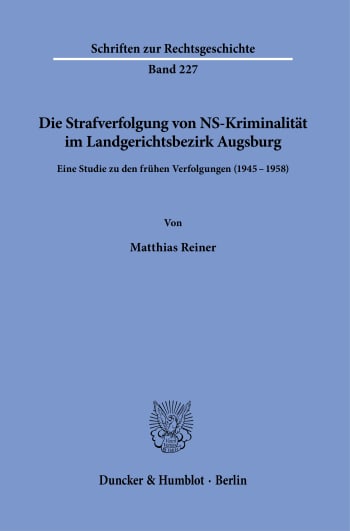
BOOK: Matthias REINER, Die Strafverfolgung von NS-Kriminalität im Landgerichtsbezirk Augsburg [Schriften zur Rechtsgeschichte; 227] (Berlin: Duncker & Humblot, 2025), 374 p., ISBN: 978-3-428-19359-2

Cover: Die Strafverfolgung von NS-Kriminalität im Landgerichtsbezirk Augsburg
About the book:

Denkt man an die Verfolgung und Bestrafung von nationalsozialistischen Gewaltverbrechern nach dem Zweiten Weltkrieg, so kommen dem historisch Interessierten womöglich zunächst die von den alliierten Siegermächten durchgeführten »Nürnberger Prozesse« oder die maßgeblich von Generalstaatsanwalt Fritz Bauer initiierten »Auschwitz-Prozesse« in den Sinn. Weniger im Zentrum der Aufmerksamkeit stehen dagegen die Strafverfahren, die die deutsche Justiz bereits 1945, wenige Wochen nach dem Zusammenbruch, »unter Aufsicht« der Besatzungsmächte gegen mutmaßliche NS-Täter durchführte. In der vorliegenden Arbeit werden diese Strafverfahren für den geografisch abgegrenzten Bereich des Landgerichtsbezirks Augsburg untersucht und in die gesamtdeutsche Aufarbeitung eingeordnet. Der Autor zieht das Fazit, dass bei der Strafjustiz in Augsburg durchaus ein Wille zur Strafverfolgung erkennbar ist, wobei einzelne Justizjuristen besonders hervorzuheben sind. Auf der anderen Seite konnten jedoch auch etliche Fälle zutage gebracht werden, bei denen auf die von der höheren und obersten Rechtsprechung entwickelten Auslegungen und dogmatischen Figuren zurückgegriffen wurde.

Table of contents:

Einleitung
Thema und Problemstellung – Forschungsdesiderat – Quellenlage – Struktur der Studie

1. Rahmenbedingungen für die Verfolgung von NS-Verbrechen durch die nachkriegsdeutsche Justiz
Einführung – Stillstand und Neuorganisation der Rechtspflege – Überblick über die frühe Verfolgung von NS-Kriminalität – Materiellrechtliche Grundlagen der Ahndung von NS-Kriminalität durch die westdeutsche Justiz – Tatsächliche Herausforderungen bei der Wiedereröffnung der Gerichte

2. Quantitativer Überblick
Anzahl der geführten NS-Verfahren – Deliktskategorien – Tatorte und Zuständigkeit

3. Verfahren im Einzelnen
Delikte im Zusammenhang mit der nationalsozialistischen Machtergreifung – Antisemitische Straftaten – Endphaseverbrechen – Lagerverbrechen und Verbrechen zulasten von Zwangsarbeitern – Denunziationen – Kriegsverbrechen – Heil- und Pflegeanstalt Kaufbeuren-Irsee

4. Synthese
Anlass für die Verfahrenseinleitung – Verfahrensgang – Emigration jüdischer Tatzeugen und der Umgang seitens der Justiz hiermit – Schwurgerichtspraxis – Auslegungsfragen – Strafzumessung

Schlussbetrachtung

Anhang
Tabellarische Übersicht über NS-Verfahren im LG-Bezirk Augsburg 1945–1958

Find more here.

27 March 2025

BOOK: Felix MÜLLER, Die sog. Generalklauseln des BGB in der Rechtsprechung des Reichsarbeitsgerichts (1927-1945) [Schriften zur Rechtsgeschichte; 226] (Berlin: Duncker & Humblot, 2025), 518 p., ISBN 978-3-428-19238-0, € 109,9

Cover: Die sog. Generalklauseln des BGB in der Rechtsprechung des Reichsarbeitsgerichts (1927–1945)

Book abstract:

Die Arbeit untersucht die Rechtsprechung des Reichsarbeitsgerichts anhand der sog. Generalklauseln des BGB. Im Vordergrund steht hierbei die Frage, welchen gesellschaftlichen und politischen Einfluss das damals höchste deutsche Arbeitsgericht während der Zeit seines Bestehens (1927–1945) hatte, oder ob es selbst solchen Einflüssen unterworfen war. Für die umfassende Analyse boten sich die in den Generalklauseln enthaltenen unbestimmten Rechtsbegriffe wie »Treu und Glauben« oder die »guten Sitten« an, da gerade sie der Auslegung durch die Rechtsprechung bedürfen und grundsätzlich wertungsoffen sind. Die Arbeit zeigt auf, dass die Rechtsprechung des Reichsarbeitsgerichts ein soziales Ideal verwirklichte. Ferner legt sie dar, ob und in welchem Umfang die Begriffe wie Treu und Glauben, gute Sitten, etc. Einfallstore für die NS-Ideologie in die Rechtsprechung des Reichsarbeitsgerichts nach der sog. Machtergreifung durch die Nationalsozialisten im Jahr 1933 waren.

Table of contents:

A. Einleitung

B. Entstehung der Arbeitsgerichtsbarkeit

C. Die Rechtsprechung des Reichsarbeitsgerichts zu § 826 BGB

D. Die Rechtsprechung des Reichsarbeitsgerichts zu § 134 BGB

E. Die Rechtsprechung des Reichsarbeitsgerichts zu § 138 BGB

F. Die Rechtsprechung des Reichsarbeitsgerichts zu § 133 BGB

G. Die Rechtsprechung des Reichsarbeitsgerichts zu § 157 BGB

Read more here.

09 July 2024

BOOK: Theodor BAUMS, Luxemburg und das Reichskammergericht [Quellen und Forschungen zur höchsten Gerichtsbarkeit im Alten Reich; 81] (Köln: Böhlau, 2024), 143 p., ISBN 978-3-412-53052-5


ABOUT THE BOOK:


1548 schloss Kaiser Karl V. mit den Ständen des Heiligen Römischen Reichs den Burgundischen Vertrag. Dieser Vertrag und die nachfolgende Entwicklung führten zur weitgehenden Lösung der burgundischen Erblande der Habsburger, darunter das Herzogtum Luxemburg, vom Reich. Theodor Baums behandelt zunächst die Stellung des Herzogtums Luxemburgs als Reichslehen, die Zuständigkeit des Reichskammergerichts auch für die burgundischen Erblande und sodann Inhalt und Bedeutung des Burgundischen Vertrags. Die durch den Vertrag bewirkte Abspaltung der Erblande vom Reich machte neben anderem die Entwicklung von Normen für die „internationale“ Gerichtszuständigkeit erforderlich. Im zweiten Teil befasst sich die Untersuchung mit der durch den Burgundischen Vertrag ausgelösten Entfaltung dieser frühen Form zwischenstaatlicher Kooperation bei grenzüberschreitenden Konflikten. Hierfür werden die Akten des Reichskammergerichts zu einschlägigen Streitigkeiten mit Bezug zum Herzogtum Luxemburg ausgewertet.

ABOUT THE AUTHOR:

Theodor Baums ist emeritierter Ordinarius für Bürgerliches Recht, Handels- und Wirtschaftsrecht und Gründungs- und Vorstandsmitglied des Instituts for Law and Finance (ILF) der Johann Wolfgang Goethe-Universität, Frankfurt am Main.

Find more here.

04 January 2021

BOOK: Guido ROSSI (ed.), Authorities in Early Modern Courts in Europe [Edinburgh Studies in Law] (Edinburgh: Edinburgh niversity Press, 2021), ISBN 978-1-4744-5100-0


(image source: Edinburgh University Press

Abstract:

The first comparative study of the relationship between law courts and substantive law in the early modern period. Bringing together some of the most distinguished scholars in the field including John Ford, David Ibbetson, Javier García Martín, Annamaria Monti, Peter Oestmann, Heikki Pihlajamäki and Alain Wijffels, this volume looks at the comparative development of legal practice in the early modern period across Europe. Focusing deliberately on the impact of law courts on substantive law - and not on its systematisation by learned jurists - it studies similarities and differences in the development of the law across different jurisdictions. In doing so it evaluates whether and to what extent it is possible to consider this development as a unitary and truly European phenomenon. This collection re-evaluates current debates surrounding the development of civil law in the early modern period in the context of the grand narratives of European legal history and sets out to challenge current orthodox views about early modern civil law.

Key Features:

A comparative study on the passage from late medieval to early modern civil law from a practical viewpoint. Assesses the influence of law courts on the development of substantive law. Re-evaluates and challenges current orthodox views about early modern civil law

On the editor:

Guido Rossi is Reader in European Legal History at the University of Edinburgh.

(source: Edinburgh UP)

21 October 2016

SEMINAR: The Parliament of Paris in the 17th and 18th Centuries (Archives Nationales, Paris, 15 Nov 2016)

(image source: Nouvelobs)

The French National Archives announce, in the framework of their cycle "Retour aux sources" (Back to Sources) a special session on the Parliament of Paris, the highest court in the realm under the Old Regime. The event takes place on 15 November 2016, 14-17:45

Three books will be presented and discussed:
Le Parlement en sa Cour. Études en l'honneur du Professeur Jean Hilaire, textes réunis par Olivier DESCAMPS, Françoise HILDESHEIMER et MoniqueMORGAT-BONNET (Paris, Champion, 2012)


Le  Parlement  de  Paris.  Logiques  politiques  et  pratiques  documentaires,XVIIe-XVIIIesiècles sous  la  direction  de  Françoise  HILDESHEIMER (Paris, Champion, 2016) (see publisher website)


Autour des États généraux de 1614. Parlement de Paris et États généraux ou les liaisons dangereuses sous la direction de Françoise HILDESHEIMER et Louis DE CARBONNIÈRES(Paris, Champion, 2016) (see publisher website)

 (image source: H. Champion)

More information can be found in this leaflet.

The event will be made available on Dailymotion. More information here.

06 June 2016

BOOK: Mario CAJAS, The History of the Supreme Court of Colombia, 1886-1991 [La Historia de la Corte Suprema deJusticia de Colombia, 1886-1991]. Bogotá: University of the Andes/Icesi University, 2015. ISBN 9789587740929 and 9789587740943, $25

(image source: Libreria Uniandes)

Mario Cajas-Sarria (Icesi University, Cali) published The History of the Supreme Court of Colombia, 1886-1991.

Abstract and table of contents:
The book tells for the first time a history of the Supreme Court of Colombia and places the tribunal in the broader context of Colombian politics.
This history evolves in eight periods and chapters: (1) From the Court of the Regeneration to Constitutional Court: Between the Defense of Legality to Constitutional Supremacy, 1886-1910; (2) The Supreme Court in its Inaugural Stage as a Constitutional Court, 1910-1915; (3) The Court Between Conservative and Liberal Hegemony: Between Politics and Law, 1915-1945; (4) The Supreme Court, 1945-1952: Toward the Crisis of the Political Regime; (5) The Court under the Military Rule, from 1953 to 1958; (6) The Transition to Civilian Rule: The Court at the beginning of the National Front; (7) The Consolidation and Crisis of the National Front and the Struggle for Power of Judicial Review, 1968 to 1980; and (8)The Court in the Midst of War: Rise and Decline of Judicial Review of the Supreme Court, 1981-1991.
The narrative is constructed through the mutual interdependence between legal doctrine and political contexts and environments, so that it serves to outline the development of the Court within the Colombian political realm. The book analyzes the constitutional decisions of the Court, and recognizing a partial autonomy of legal doctrine, discusses his relationship with political events.
In each period different interventions of the court reveal their political complex, the relationships with other political actors in the political regime, and also the strategic behavior of the Court and its justices. Thus, it captures the changes, ruptures and continuity in the institutional trajectory of the Supreme Court, the constitutional justice and even the building of the Colombian judiciary. In this history, the Court appears as a "special" political actor, who made decisions although constrained by legal doctrines and the interpretive community. In doing so, this narrative seeks to contribute to the knowledge of a field that, in general, has arguably been unexplored in Latin America and especially in Colombia.
Capítulo Primero: Cómo construir una narrativa de la Corte Suprema de Justicia de Colombia
Capítulo Segundo De juez de la Regeneración a juez constitucional: entre la defensa de la legalidad y la supremacía constitucional, 1886-1910.
Capítulo Tercero: La Corte Suprema de Justicia en su etapa inaugural como juez constitucional, 1910-1915;.
Capítulo Cuarto: La Corte entre las hegemonías conservadora y liberal: entre la política y el .derecho, 1915-1945.
Capítulo Quinto: La Corte Suprema de justicia, 1945-1952: hacia la crisis del régimen político.
Capítulo Sexto: La Corte bajo el régimen militar, 1953-1958.
Capítulo Séptimo: La transición al régimen civil: La Corte en los inicios del Frente Nacional.
Capítulo  Octavo: La consolidación y crisis del Frente Nacional y la lucha por el poder del control constitucional,-1968-1980.
Capítulo Noveno: La Corte en medio de la guerra: ascenso y declive del control constitucional de la Corte Suprema de Justicia, 1981-1991.  
 The book can be acquired on amazon or at the University of the Andes.

10 November 2014

ARTICLE: "How Do Things Get Started? Legal Transplants and Domestication: An Example from Colonial New Zealand", by S. Dorsett


SHAUNNAGH DORSETTUniversity of Technology Sydney, Faculty of Law on "How Do Things Get Started? Legal Transplants and Domestication: An Example from Colonial New Zealand"

full text here


Abstract
‘Unearthing’ is a problematic task for historians. To some extent it assumes continuity between the past and the present, and that matters identified by whatever means as ‘traditions’ in the present were understood that way in the past. It is a backward looking task, rather than an exploration of understandings at a moment in time. Rather than ‘unearthing’, this article seeks to start at the beginning and to think about how things get going in colonies. It pays attention to foundations and to questions of institutional design. This article draws on literature on legal transplants, and examines one example of a legal transplant in New Zealand: the Resident Magistrates’ Court, focusing in particular on its civil jurisdiction. If not the ‘number eight wire’ approach, it is a recognition of pragmatism - the ways in which legal forms, both discursive and institutional, circulated Empire and are made and remade in new times and places in response to local circumstance.