Search

Showing posts with label vagrancy. Show all posts

14 January 2021

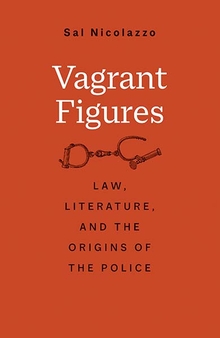
BOOK: Sal NICOLAZZO, Vagrant Figures - Law, Literature, and the Origins of the Police (New Haven: Yale University Press, 2021). ISBN 9780300241310, 65.00 USD


Yale University Press is publishing a new book on how vagrancy has shaped the role of policing in colonialism, racial formation and resource distribution

ABOUT THE BOOK

In this innovative book demonstrating the important role of eighteenth-century literary treatments of policing and vagrancy, Nicolazzo offers a prehistory of police legitimacy in a period that predates the establishment of the modern police force. She argues that narrative, textual, and rhetorical practices shaped not only police and legal activity of the period, but also public conceptions of police power. Her extensive research delves into law and literature on both sides of the Atlantic, tracking the centrality of vagrancy in establishing police power as a form of sovereignty crucial to settler colonialism, slavery, and racial capitalism. The first book in several generations to address policing and vagrancy in the eighteenth century, and the first in the field to center race and empire in its account of literary vagrancy, Nicolazzo’s work is a significant contribution to the field of eighteenth-century literary and cultural studies.

ABOUT THE AUTHOR

Sal Nicolazzo is assistant professor of Literature at the University of California, San Diego.


More info here

07 August 2019

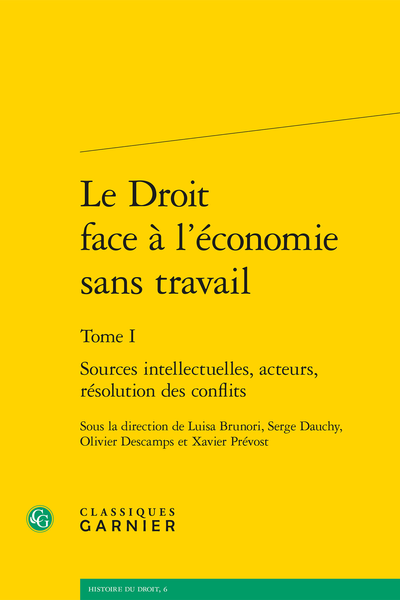
BOOK: Luisa BRUNORI et al., eds., Le Droit face à l’économie sans travail. Tome I Sources intellectuelles, acteurs, résolution des conflits (Paris: Classiques Garnier, 2019). ISBN 978-2-406-08407-5


Classiques Garnier has published a new co-edited collection that contains several contributions that deal with the “dynamics of the jobless economy” from a legal-historical angle (the book is only available in digital version).

ABOUT THE BOOK

Ten years after the beginning of the subprime crisis, the situation in the early years of the third millennium requires a broad look at the dynamics of the jobless economy, understood as the set of financial operations that do not directly compensate human labor or the exchange of goods.

The table of contents can be found here

All info here

07 February 2019

BOOK: Kristin O’BRASSILL-KULFAN, Vagrants and Vagabonds : Poverty and Mobility in the Early American Republic (New York: NYU Press, 2019). ISBN 9781479845255, $35


(Source: NYU Press)

NYU Press has published a new book on vagrancy in the Early American Republic

ABOUT THE BOOK

The riveting story of control over the mobility of poor migrants, and how their movements shaped current perceptions of class and status in the United States 

Vagrants. Vagabonds. Hoboes. Identified by myriad names, the homeless and geographically mobile have been with us since the earliest periods of recorded history. In the early days of the United States, these poor migrants – consisting of everyone from work-seekers to runaway slaves – populated the roads and streets of major cities and towns. These individuals were a part of a social class whose geographical movements broke settlement laws, penal codes, and welfare policies. This book documents their travels and experiences across the Atlantic world, excavating their life stories from the records of criminal justice systems and relief organizations. 

Vagrants and Vagabonds examines the subsistence activities of the mobile poor, from migration to wage labor to petty theft, and how local and state municipal authorities criminalized these activities, prompting extensive punishment. Kristin O’Brassill-Kulfan examines the intertwined legal constructions, experiences, and responses to these so-called “vagrants,” arguing that we can glean important insights about poverty and class in this period by paying careful attention to mobility. This book charts why and how the itinerant poor were subject to imprisonment and forced migration, and considers the relationship between race and the right to movement and residence in the antebellum US.  Ultimately, Vagrants and Vagabonds argues that poor migrants, the laws designed to curtail their movements, and the people charged with managing them, were central to shaping everything from the role of the state to contemporary conceptions of community to class and labor status, the spread of disease, and punishment in the early American republic.

ABOUT THE AUTHOR

Kristin O’Brassill-Kulfan is Instructor in the Department of History at Rutgers University.

More information here