Search

Showing posts with label methodology. Show all posts

07 May 2026

CONFERENCE: Faire référence: penser le droit au prisme de l'autorité [XVIIIe Congrès de l'Association Internationale de Méthodologie Juridique] (Liège: Université de Liège, 25-26 JUN 2026)


(image source: ULiège)

Description:

Le XVIIIᵉ Congrès de l’Association internationale de méthodologie juridique (AIMJ) se tiendra à Liège les 25 et 26 juin 2026 et sera consacré au thème : « Faire référence : Penser le droit au prisme de l’autorité ». Le congrès examinera la manière dont l’autorité structure le droit, ses institutions, ses discours et ses pratiques. L’autorité y est entendue comme un pouvoir légitime, reconnu par une communauté, et distinct de toute forme d’autoritarisme. Cette notion, pourtant centrale au fonctionnement du droit, reste étonnamment peu explorée par la théorie juridique.

Axes:

(1)Comment le droit institue des autorités ? Cet axe interroge la manière dont les concepts juridiques (propriété, famille, contrat, autorité parentale, lien de subordination, etc.) structurent des rapports de domination légitimés par le discours juridique. Il s’intéresse aussi à l’émergence des autorités administratives indépendantes, à leur légitimité fondée sur l’expertise, et aux effets de la soft law sur la production normative. Les contributions sont invitées à examiner ces institutions, leur histoire, leurs fondements et les critiques adressent différentes écoles de pensée.
(2) Comment le droit s’appuie-t-il sur l’autorité ? Le second axe analyse le fonctionnement interne du droit : sa structure hiérarchique, ses mécanismes de référence, la normativité des décisions juridictionnelles, la valeur des motifs jurisprudentiels ou encore le dialogue des juges. Il explore aussi les transformations contemporaines — modes alternatifs de règlement des différends, contractualisation, négociation — qui tendent à horizontaliser les rapports entre la justice et le justiciable. 
(3) Comment se construit l’autorité des auteurs et de la doctrine ? Cet axe examine la place de la doctrine et son pouvoir de structuration du droit. Il s’intéresse aux mécanismes sociaux qui produisent l’autorité épistémique de certains auteurs, aux dynamiques de consécration, aux hiérarchies internes du champ doctrinal et aux tensions entre neutralité affichée et engagement des chercheurs. Il interroge ce qui fait qu’une opinion doctrinale devient « autorisée ».

More details here. 

02 June 2025

BOOK: Luca von BOGDANDY, Christoph RESCH, Julius SCHUMANN (eds.), Konflikte um Wahrheit. 1. Tagung des Jungen Netzwerks Rechtsgeschichte [Junges Netzwerk Rechtsgeschichte; 1] (Baden-Baden: Nomos, 2024), 348 p. ISBN 978-3-7560-1361-6

 Konflikte um Wahrheit
 
Abstract:
Der Tagungsband „Konflikte um Wahrheit“ vereint Beiträge der ersten Tagung des jungen Netzwerks Rechtsgeschichte, die im Juni 2023 in Frankfurt stattfand. Mit Bezug auf das interdisziplinär angelegte Generalthema diskutierten Nachwuchswissenschaftler:innen ihre Forschung zur rechtshistorischen Methodik, Prozessrechtsgeschichte, Wissenschaftsgeschichte und antiken Rechtsgeschichte.
Die Beiträge nähern sich dem in verschiedenen Kontexten erhobenen „Wahrheitsanspruch“ und erörtern dabei Fragen der Gerichtspraxis, des „Wahrheitsgehalts“ rechtshistorischen Quellen und auch Probleme „alternativer Fakten“ in der Antike. Der Band gibt dadurch Einblicke in aktuelle Forschungsvorhaben von Nachwuchswissenschaftler:innen aus Deutschland, Österreich und der Schweiz.

Table of contents:
 
Hubert Rottleuthner - Wahrheit – Perspektiven aus Rechtsgeschichte und Rechtssoziologie 
 
Renato Sedano Onofri - Methode und Wahrheit: Gedanken zum Anspruch auf rechtswissenschaftliche Wahrheit im 19. Jahrhundert am Beispiel der Werke Julius Hermann von Kirchmanns (1802–1884) und Augusto Teixeira de Freitas’ (1816–1883)
 
Sascha Ohlenforst - Expertise als Machtressource. Die Epistemisierung von Rechtskonflikten zwischen Kalibergbau und Gewässerschutz 
 
Raphael Dummermuth - Alternative Fakten in der Spätantike
 
Caterina M. Mitwalsky - Unsittlich gekleidete Römerinnen und andere historische „Wahrheiten“ – ein kritischer Blick auf Interpretationsansätze zum Ehrenschutz der Frau im römischen Recht 
 
Rhonda-Marie Lechner - „Ob diese oder jene umbstände waar sind, kommen auf deß ordentl[ichen] richters untersuchung an“ – Mögliche Erkenntnisse über Wahrheit in den handelsrechtlichen Streitigkeiten der Nürnberger Pareres
 
Nora Bertram - Open Science – Inhaltliche Aspekte und Chancen für die Rechtsgeschichte
 
Tania Ixchel Atilano - The search for truth in the trial against Maximilian of Habsburg (1867)
 
Merle Iffert - Historische Wahrheit und koloniales Wissen zum „Eingeborenenstrafrecht“: Ansätze zum Umgang mit einer asymmetrischen Quellenlage 
 
Magdalena Gebhart - Zwischen Wahrheit und Erinnerung. Die Anwendung des Bundesentschädigungsgesetzes (BEG) auf die Verfolgung der Astrologen
 
Malte Dücker - Glaube, Normen, Tatsachen? Historische Wahrheitsfragen zwischen Theologie, Geschichte und Rechtswissenschaft 
 
Miriam Gassner - „The Oath“. Der Eid als Gegenstand eines Transfers „österreichischen“ Rechtsdenkens?
 
Franziska Niedrist - „Das Eingeständniß ist in SüdTyrol eine Rarität.“ Richterliche Beurteilung und strafrechtliche Praxis im vormärzlichen Österreich 
 
Anne Bittner - Haushaltspflichten und Arbeitsfreude. Die Scheidungspraxis in der SBZ/frühen DDR

Find more here. 


15 July 2024

BOOK: Sebastian SCHWAB, Geschichte und Argument [Grundlagen der Rechtswissenschaft; 59] (Tübingen: Mohr Siebeck, 2024), 517 p., ISBN 978-3-16-163526-7


ABOUT THE BOOK:

Historische Argumente im Recht geben Fragen auf. Warum argumentiert man im Recht unter Bezugnahme auf historisches Wissen, obwohl die Geschichtstheorie doch gezeigt hat, mit welchen Unsicherheiten es belastet ist? Und: Hat historische Argumentation in der deutschen Rechtsordnung Platz? Ist sie nicht viel zu reaktionär? Es bedarf eines Zweischritts: Man muss sich von den Debatten um die »historische Auslegung« lösen und historische Argumente ganz abstrakt als Ausdruck der Grundstruktur positiven Rechts fassen. Positives Recht muss historisch argumentieren, weil sich darin seine Rechtlichkeit erweist und aktualisiert. Daneben aber bedarf es einer Betrachtung, die sich tatsächlich auf die ganz konkrete Rechtsordnung einlässt. Nur dann sind Methodenfragen wirklich Verfassungsfragen. Zentrale Weichenstellungen im Verständnis des grundgesetzlichen Demokratieprinzips geraten so in den Fokus.

Read more here.

24 November 2022

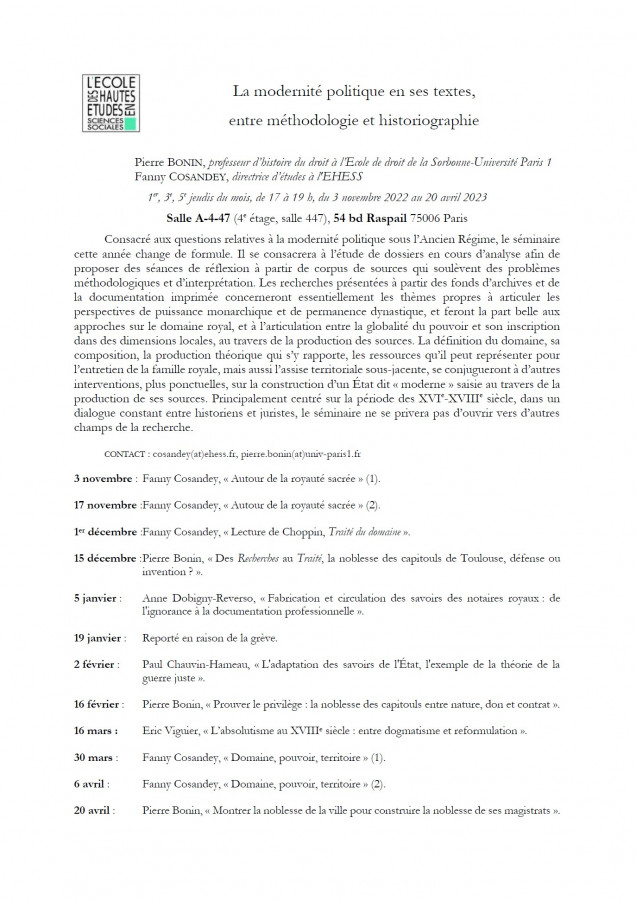
SEMINAR SERIES: La modernité politique en ses textes, entre méthodologie et historiographie (November 2022 - April 2023; Parigi: EHESS)


PRESENTATION

Consacré aux questions relatives à la modernité politique sous l'Ancien Régime, le séminaire cette année change de formule. Il se consacrera à l'étude de dossiers en cours d'analyse afin de proposer des séances de réflexion à partir de corpus de sources qui soulèvent des problèmes méthodologiques et d'interprétation. Les recherches présentées à partir des fonds d'archives et de la documentation imprimée concerneront essentiellement les thèmes propres à articuler les perspectives de puissance monarchique et de permanence dynastique, et feront la part belle aux approches sur le domaine royal, et à l'articulation entre la globalité du pouvoir et son inscription dans des dimensions locales, au travers de la production des sources. La définition du domaine, sa composition, la production théorique qui s'y rapporte, les ressources qu'il peut représenter pour l'entretien de la famille royale, mais aussi l'assise territoriale sous-jacente, se conjugueront à d'autres interventions, plus ponctuelles, sur la construction d'un Etat dit « moderne » saisie au travers de la production de ses sources. Principalement centré sur la période des XVIe-XVIIIe siècle, dans un dialogue constant entre historiens et juristes, le séminaire ne se privera pas d'ouvrir vers d'autres champs de la recherche.

Le séminaire est organisé par Pierre Bonin, professeur d'histoire du droit à l'Ecole de droit de la Sorbonne-Université Paris 1, et Fanny Cosandey, directrice d'études à l'EHESS. Le séminaire se déroule les 1er, 3e, 5e jeudis du mois, de 17 à 19 h, du 3 novembre 2022 au 20 avril 2023 dans les bâtiments de l'EHESS (Salle A-4-47 - 4e étage, salle 447 -, 54 bd Raspail 75006, Paris)


PROGRAMME

  • 3 novembre : Fanny Cosandey, « Autour de la royauté sacrée » (1).
  • 17 novembre : Fanny Cosandey, « Autour de la royauté sacrée » (2).
  • 1er décembre : Fanny Cosandey, « Lecture de Choppin, Traité du domaine ».
  • 15 décembre : Pierre Bonin, « Des Recherches au Traité, la noblesse des capitouls de Toulouse, défense ou invention ? ».
  • 5 janvier : Anne Dobigny-Reverso, « Fabrication et circulation des savoirs des notaires royaux : de l'ignorance à la documentation professionnelle ».
  • 19 janvier : Eric Viguier, « L'absolutisme au XVIIIe siècle : entre dogmatisme et reformulation ».
  • 2 février : Paul Chauvin-Hameau, « L'adaptation des savoirs de l'Etat, l'exemple de la théorie de la guerre juste ».
  • 16 février : Pierre Bonin, « Prouver le privilège : la noblesse des capitouls entre nature, don et contrat ».
  • 16 mars : Pierre Bonin, « Montrer la noblesse de la ville pour construire la noblesse de ses magistrats »
  • 30 mars : Fanny Cosandey, « Domaine, pouvoir, territoire » (1).
  • 6 avril : Fanny Cosandey, « Domaine, pouvoir, territoire » (2).
  • 20 avril : Fanny Cosandey, « Domaine, pouvoir, territoire » (3).


Detailed information can be found here.


14 April 2022

ONLINE LECTURE: I-HILT History of International Law E-Lecture Series 2021-2022 / Tilburg Law School, 19th April 2022 - 13:00 CET


I-HILT History of International Law E-Lecture Series 2021-2022

Date: 19th April 2022  Time: 13:00  Location: Online

Anne Orford: International Law and the Politics of History


Summary

The ongoing I-HILT online e-lecture series at Tilburg Law School is excited to have Professor Anne Orford (University of Melbourne) present in the latest installment to discuss her most recent book International Law and the Politics of History. ‘As the future of international law has become a growing site of struggle within and between powerful states, debates over the history of international law have become increasingly heated. International Law and the Politics of History explores the ideological, political, and material stakes of apparently technical disputes over how the legal past should be studied and understood.’ 

If you are interested please contact Deepak Mawar (d.r.mawar@tilburguniversity.edu) with the email title ‘I-HILT E-Lecture Registration’ and he will provide you with the Zoom link for the e-lecture.

11 April 2022

CALL FOR PAPERS: Clio@Themis on ‘Thinking the methodology of law and legal history with Michael Stolleis’ (DEADLINE: 30 June 2022)


(Source: Clio@Themis)

We learned of a new call for papers by Clio@Themis.

Penser la méthodologie du droit et de l’histoire du droit avec Michael Stolleis

Appel à contribution pour le no 26

Coordination :

  • Aurore Gaillet (Toulouse Capitole)
  • Hans-Peter Haferkamp (Cologne)
  • Nader Hakim (Bordeaux)

Alors que Michael Stolleis (1941-2021) vient de nous quitter et que les hommages se multiplient, juristes et historiens du droit, tant en Europe qu’au-delà, relisent les œuvres qu’il nous a laissées en héritage. Parmi celles-ci, figurent quelques textes d’orientation davantage méthodologique. Or c’est précisément cette réflexion méthodologique qui est au cœur de ce projet de numéro de la revue Clio&Themis.

Deux de ses textes retiendront en particulier notre attention : Rechtsgeschichte als Kunstprodukt. Zur Entbehrlichkeit von “Begriff” und “Tatsache”, Baden-Baden, Nomos, 1997 (30 p.) ; Rechtsgeschichte schreiben. Rekonstruktion, Erzählung, Fiktion ?, Basel, Schwabe Verlag, 2008 (48 p.). Ils constituent le point de départ d’une réflexion à laquelle nous souhaitons associer un large panel de chercheurs, historiens, juristes et historiens du droit, mais aussi linguistes/traducteurs ou d’autres représentant(e)s de sciences sociales qui pourraient être intéressé(e)s par le sujet.

Il s’agira d’explorer une méthodologie, ou peut-être plus précisément une épistémologie, qui n’a cessé de retenir l’attention de l’auteur de la grande Histoire du droit public en Allemagne (4 vol. 1988-2012). Il importera donc, au-delà de l’hommage rendu à l’Homme et à l’œuvre, de prolonger une discussion avec l’auteur. Rien d’ailleurs ne saurait mieux lui rendre hommage que de discuter ses choix, que de poursuivre sa quête d’un chemin qui mène, non à la vérité, mais à la connaissance. Que l’on soit d’accord ou en désaccord avec lui, totalement ou partiellement, il est surtout important de poursuivre son œuvre en ce qu’elle est une invitation au doute constructif, à la créativité et à la persévérance.

La conception d’ensemble de cet appel à contributions se veut originale, tant dans l’ouverture disciplinaire à laquelle il invite (et à laquelle Michael Stolleis était attaché) que dans le point de jonction attendu entre toutes les contributions : toutes partiront des deux textes susmentionnés, d’un ou plusieurs de leurs éléments, pour les alimenter, les prolonger, les discuter ou / et les contredire. Les textes seront réunis dans la revue Clio&Themis, Revue européenne d’histoire du droit. Un séminaire d’échanges pourra être envisagé, en amont ou ultérieurement.

The full call and submission details can be found here.

22 March 2022

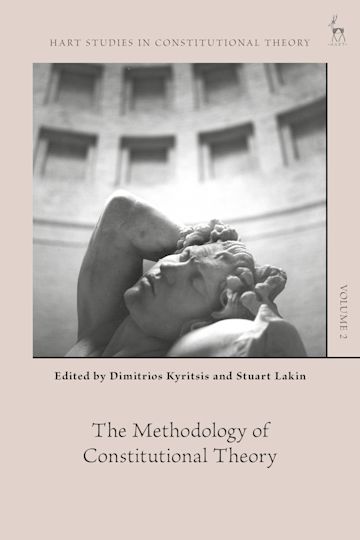
BOOK: Dimitrios KYRITSIS & Stuart LAKIN (eds.), The Methodology of Constitutional Theory [Hart Studies in Constitutional Theory] (London/Oxford: Bloomsbury/Hart, 2022), 464 p. ISBN 9781509933853, 85 GBP


(image source: Bloomsbury)

Abstract:

What sort of methods are best suited to understanding constitutional doctrines and practices? Should we look to lawyers and legal methods alone, or should we draw upon other disciplines such as history, sociology, political theory, and moral philosophy? Should we study constitutions in isolation or in a comparative context? To what extent must constitutional methods be sensitive to empirical data about the functioning of legal practice? Can ideal theory aid our understanding of real constitutions? This volume brings together constitutional experts from around the world to address these types of questions through topical events and challenges such as Brexit, administrative law reforms, and the increasing polarisations in law, politics, and constitutional scholarship. Importantly, it investigates the ways in which we can ensure that constitutional scholars do not talk past each other despite their persistent - and often fierce - disagreements. In so doing, it aims systematically to re-examine the methodology of constitutional theory.

Table of contents:

The Methodology of Constitutional Theory – Introduction
Dimitrios Kyritsis, University of Essex, UK and Stuart Lakin, University of Reading, UK
I. Background
II. The Scope of the Volume
III. The Chapters and Thematic Groupings

SELF-UNDERSTANDINGS
1. The Significance of the Common Understanding in Legal Theory
NW Barber, University of Oxford, UK
I. Adherence to the Common Understanding
II. Paying Attention to the Common Understanding
III. The Limitations of the Common Understanding
IV. Conclusion
2. In Defence of Traditional Methodologies
Jeffrey Goldsworthy, Monash University, The University of Melbourne, and The University of Adelaide, Australia
I. Introduction
II. The Orthodox Understanding
III. Judicial Pragmatism
IV. Confusion between the Common Law and Other Kinds of Law
V. Constitution-making by Judges
VI. Legal Philosophy
VII. Parliamentary Sovereignty Today
3. Constitutional Methodology and Brexit: Adopting a Model-Theoretic Approach
Alison L Young, University of Cambridge, UK
I. Defining Model-Theoretic Approaches
II. What is Distinctive about a Model-Theoretic Approach to Constitutional Theory?
III. Why Adopt a Model-Theoretic Approach to Constitutional Theory?
IV. Brexit and Parliamentary Sovereignty
V. Conclusion

HOW DO FACTS MATTER?
4. Slaying the Misshapen Monster: The Case for Constitutional Heuristics
TT Arvind, University of York, UK and Lindsay Stirton, University of Sussex, UK
I. Introduction 3
II. Facts, Theories and Traditions: Making the Constitutional World
III. A Methodology for Constitutional Theory
IV. Heuristics and the Limits of Rhetoric
V. Conclusion
5. Why Common Law Constitutionalism is Correct (If It Is)
Stuart Lakin, University of Reading, UK
I. Introduction
II. Two Accounts of the British Constitution
III. What Makes GO or CLC Correct?
IV. GO and CLC as Rival Interpretations of British Constitutional Practice
V. Conclusion
6. Methodological Pluralism and Modern Administrative Law
Sarah Nason, Bangor University, UK
I. Subordinating Administrative Law to Constitutional Law
II. New Methods of Administrative Law Theory
III. Challenges and Opportunities of Methodological Pluralism in Administrative Law

MORALITY
7. The Constitution of Legal Authority
David Dyzenhaus, University of Toronto, Canada
I. Hart on the Constitution of Authority
II. Approaching Natural Law? 5
III. The Legal Man vs. the Legal Subject
IV. Acceptance, Legitimacy, and the Social Contract
8. Constitutional Law as Legitimacy-Enhancer
Dimitrios Kyritsis, University of Essex, UK
I. Introduction
II. Moral Force and Settlement
III. Legitimacy vs. Justice
IV. Two Moralised Methodologies for Constitutional Theory
V. Conclusion
9. A Positivist and Political Approach to Public Law
Michael Gordon, University of Liverpool, UK
I. Introduction
II. A Basis for Positivist and Political Public Law
III. The Nature of Positivist and Political Public Law
IV. The Value of a Positivist and Political Approach to Public Law
V. Conclusion

SOCIAL THEORY
10. The Material Study of the Constitutional Order
Marco Goldoni, University of Glasgow, UK
I. The Legal Theory of the Material Study
II. The Political Theory of the Material Study
III. Thematising the Constitutional Order as Legal Organisation
IV. Case Study: Constitutional Change
V. Conclusion
11. The British Constitution as an Improvised Order
David Howarth, University of Cambridge, UK
I. Introduction
II. Spontaneous Order, Improvisation and Design
III. Theoretical Implications
IV. Interaction between Improvisation and Design
V. The Conflictual Side of Improvisation
VI. Assessing Improvisations
VII. Distinguishing Improvisation from Non-improvisation
VIII. Constitutional Improvisations
IX. Good or Bad Improvisations?
X. Improvising Better
XI. Improvisation and Constitutional Theory

COMPARISONS
12. A Proposal for Defining and Classifying Systems of Constitutional Government
Paul Yowell, University of Oxford, UK
I. Introduction
II. On Constitutional Government and its History
III. The Characteristics of Constitutional Government
IV. Types of Constitutional and Non-constitutional Government
V. Conclusion
13. The View from Nowhere in Constitutional Theory: A Methodological Inquiry
Silvia Suteu, University College London, UK
I. Introduction
II. The Comparative Turn in Constitutional Theory
III. Constitutional Theory and Comparative Constitutional Change
IV. Conclusion

ADMINISTRATIVE LAW
14. Common Understandings of Administrative Law
Matthew Lewans, University of Alberta, Canada
I. Introduction
II. The Puzzle of Administrative Law
III. Legality and Constitutional Formalism
IV. Dicey on the Absence of Administrative Law
V. Common Understandings of Administrative Law
VI. Conclusion
15. Methodology in Constitutional Theory: The Case of the Administrative State
Kristen Rundle, University of Melbourne, Australia
I. Introduction
II. Constitutionalising the Administrative State: Delineating the Object of Inquiry
III. Constitutionalising the Administrative State: The 'Status' Intervention
IV. Constitutionalism and the Administrative State: Reflections from Australia
V. Constitutional Theory Revisited? The Provocation of the Administrative State

VI. Conclusion

 Read more with the publisher.

07 October 2021

Revue de la Recherche Juridique 2020-3 [Numéro spécial - Cahiers de Méthodologie Juridique, eds. Frédéric ROUVIÈRE & Clotilde Aubry de MAROMONT]]


See table of contents here. 

Contributions by inter alios Wanda Mastor, Xavier Prévost, Anne-Sophie Chambost, Laetitia Guerlain, Marie-Claire Ponthoreau...

(source: PUAM)

23 February 2021

SEMINAR: Methods of Legal History (Online, 5 March 2021)


Prof. Dr. Thomas Duve at the Max Planck Institute for Legal History and Legal Theory is organizing a seminar on methods of legal history (in German). Registration is possible until 25.02

Research in legal history requires continuous reflection on its methods and goals. This takes place in various forums at the Institute. The seminar 'Methods of Legal History' aims at discussing methodological issues that are especially important for the work in the department 'Historical Normativity'. In principle, the seminar will be held in German.


More info here

12 January 2021

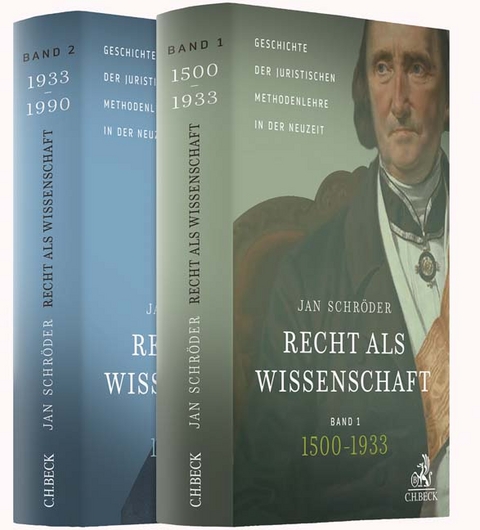
BOOK: Jan SCHRÖDER, Recht als Wissenschaft - Geschichte der juristischen Methodenlehre in der Neuzeit (1500-1990), 2 Bänden (Munich: C.H. Beck, 2020). ISBN 978-3-406-76089-1, 149.00 EUR


(Source: Lehmanns)

C.H. Beck has published “Recht als Wissenschaft - Geschichte der juristischen Methodenlehre in der Neuzeit (1500-1990)“

ABOUT THE BOOK

Wie ist vorzugehen, um das geltende Recht zu ermitteln? Wie gehen wir mit Regelungslücken um? Wie verhält sich die Interpretation der Rechtssätze zum logisch richtigen Arbeiten mit ihnen?

Das Buch stellt Grundfragen und zeigt, wie sich die Antworten bis heute entwickelt haben. Die Ergebnisse sind auf überraschende Weise aktuell. Wer als Jurist die historischen, geistesgeschichtlichen und aktuellen Grundlagen der juristischen Methode verstehen und sie im modernen Sinne weiterentwickeln will, kommt an diesem Buch nicht vorbei.

Vorteile auf einen Blickin seiner Art einzigartig, ein vergleichbares Werk zur Rechtsquellen- und Methodenlehre gibt es nicht.gleichermaßen bedeutend für den historischen Blick zurück wie auch für die aktuelle Rechtsquellen- und Methodendiskussion.ein faszinierendes Panorama der Geistesgeschichte und damit eine spannende Lektüre. Schon die unvollendete 1. A. wurde 2001 als eines von vier juristischen "Büchern des Jahres" ausgezeichnet.

Zur Neuauflage

Das opus maximum nun vollendet! Der gesamte Zeitraum von 1500 bis 1990 jetzt abgedeckt. Über dreißig Jahre hat den Autor dieses Werk beschäftigt. Vom göttlich-menschlichen Recht der frühesten Neuzeit über die Entdeckung der konstruktiven Vernunft führt er uns zur Begründung der positiven Rechtswissenschaft, zum Rechtspositivismus im späten 19. Jahrhundert, zu den deutschen Diktaturen (NS-Staat, DDR) und schließlich zur Methodenlehre des bürgerlich-liberalen Verfassungsstaats.


More info here

30 November 2020

BOOK: M. STOLLEIS, Escrever História do Direito: reconstrução, narrativa ou ficção? (São Paulo: Contracorrente, 2020). R$ 30

(Source: https://loja-editoracontracorrente.com.br/produto/escrever-historia-do-direito-reconstrucao-narrativa-ou-ficcao/)

A Editora Contracorrente tem a satisfação de publicar mais um volume da coleção “Ensaios”, intitulado Escrever História do Direito: reconstrução, narrativa ou ficção?, de autoria do celebrado historiador alemão Michael Stolleis.
Mediante uma bem cuidada tradução, realizada pelo Professor Gustavo César Machado Cabral, o autor discute importantes questões de metodologia da História do Direito, enfrentando múltiplos referenciais e tradições que norteiam as formas de se pensar esse campo de pesquisa. Trata-se de uma reflexão fundamental para a compreensão do lugar e da relevância da metodologia na construção da Ciência do Direito.
Em prefácio à obra, o Professor Titular da USP, Gilberto Bercovici, afirma que “a tradução deste importante livro de Michael Stolleis significa tornar acessíveis vários debates metodológicos aos pesquisadores brasileiros, configurando uma enorme contribuição para a História do Direito no Brasil, que cada vez mais vem se firmando como um campo científico rigoroso, afastando-se das obras laudatórias, meramente narrativas, ou da falsa erudição”.

Table of Contents

PREFÁCIO – Prof. Gilberto Bercovici

CAPÍTULO I – Escrever história do Direito: reconstrução,
narrativa ou ficção?

CAPÍTULO II – Sobre a história da ciência histórica

2.1 Sobre a história da ciência histórica
2.2 Sobre a história da História do Direito
2.3 Impulso da história dos conceitos
2.4 História materialista do direito
2.5 Macro e micro-história
2.6 Reviravolta linguística
2.7 Palavras como fatos
2.8 História do Direito e “conceitos” jurídicos
2.9 Experiência jurídica do presente como fio de Ariadne?
2.10 Palavra e coisas (fatos)
2.11 Fatos e evidências
2.12 Historiador como autor
2.13 Imaginação e memória
2.14 Limites da ética científica

CAPÍTULO III – Compreender e traduzir

3.1 Compreender e traduzir
3.2 Objetivo do conhecimento
3.3 Tarefas de futuro da História do Direito

METODOLOGIA DA HISTÓRIA DO DIREITO

Michael Stolleis is retired director of the Max Planck Institute for European Legal History


03 November 2020

BLOG: Jonathan GIENAPP on constitutional originalism, methodology and historical thinking (AHA Process Blog, MAR 2017)


(image source: Process Blog)

First paragraph:

Thanks to President Donald Trump’s nomination of Justice Neil Gorsuch—a self-identified “originalist”—to the Supreme Court, constitutional originalism is yet again at the forefront of American consciousness. Historians would do well to take special notice. Because while most forms of American constitutional jurisprudence have drawn on the history of the Constitution’s creation, only originalism—the theory that seeks to construe the Constitution today in accordance with its original meaning when it was first enacted—implicates the role of historical study in constitutional interpretation. Moreover, despite several assurances through the years that originalism’s death knell had sounded, the theory enjoys more champions, and more influential champions, than at any point previous.

Read more on the American Historical Association's blog.