Search

Showing posts with label urban history. Show all posts

20 November 2025

BOOK: Maarten PRAK (ed.), The Cambridge Urban History of Europe (Cambridge: CUP, 2026)


(image source: CUP)

Volume I (eds. Penelope J. Davies & Christina G. Williamson):

Volume I offers a broad perspective on urban culture in the ancient European world. It begins with chronological overviews which paint in broad brushstrokes a picture that serves as a frame for the thematic chapters in the rest of the volume. Positioning ancient Europe within its wider context, it touches on Asia and Africa as regions that informed and were later influenced by urban development in Europe, with particular emphasis on the Mediterranean basin. Topics range from formal characteristics (including public space), water provision, waste disposal, urban maintenance, spaces for the dead, and border spaces; to ways of thinking about, visualising, and remembering cities in antiquity; to conflict within and between cities, economics, mobility and globalisation, intersectional urban experiences, slavery, political participation, and religion.

Volume II (eds. Patrick Lantschner & Maarten Prak):

Volume II charts European urbanism between 700–1850, the millennium during which Europe became the world's most urbanised region. Featuring thirty-six chapters from leading scholars working on all the major linguistic areas of Europe, the volume offers a state-of-the-art survey that explores and explains this transformation, how similar or different such processes were across Europe, and how far it is possible to discern traits that characterise European urbanism in this period. The first half of the volume offers overviews on the urban history of Mediterranean Europe, Atlantic and North Sea Europe, Central and Eastern Europe, and European urbanisms around the world. The second half explores major themes, from the conceptualisation of cities and their material fabric to continuities and changes in the social, political, economic, religious, and cultural histories of cities and towns.

Volume III  (eds. Dorothée Brantz & Gábor Sonkoly):

Volume III uncovers the radical transformations of European cities from 1850 until the twenty-first century. The volume explores how modern developments in urban environments, socio-cultural dynamics, the relation between work and leisure, and governance have transformed urban life. It highlights these complex processes across different regions, showcasing the latest scholarship and current challenges in the field. The first half provides an overview on the urban development of European regions in the West, North, Centre, East-South-East, and South, and the interconnectedness of European urbanism with the Americas and Africa. The second half explores major themes in European urban history, from the conceptualisation of cities, their built fabric and environment, and the continuities, rhythms, and changes in their social, political, economic, and cultural histories. Using transborder, transregional, and transdisciplinary approaches to discern traits that characterise modern and contemporary European urbanism, the volume invites readers to reconsider major paradigms of European urban history.

Read more here.

27 August 2025

CALL FOR PAPERS: Between Institutions and Geography: Cities as Hubs of Medieval River Transport and Trade (EAUH 2026 Barcelona, 5-6 SEP 2026); DEADLINE 22 OCT 2025


Call for Papers: Between Institutions and Geography: Cities as Hubs of Medieval River Transport and Trade (EAUH 2026 Barcelona)


(image source: Wikimedia Commons)


17th European Association for Urban History Conference (Barcelona)


Dr. Marco in ‘t Veld (Tilburg University), dr. Bart Holterman (Forschungsstelle für die Geschichte der Hanse und des Ostseeraums), and dr. Maurits den Hollander (Tilburg University) warmly invite all academics interested in medieval river trade in an urban context to submit their paper proposals for our main session (nr. 3) at the EAUH conference in Barcelona, 2-5 September 2026.


Session Abstract


It is commonly acknowledged that waterways are of crucial importance for trade. They allow for relatively efficient transportation of goods. Cities served as hubs in medieval trade, as providers of the necessary institutions and services. While the relation between geography and the early modern economy is well-studied, we know much less about the interaction between geography and these urban institutions. This session will therefore investigate how urban governance was influenced by the geography of rivers. Did cities cooperate to ensure the efficient passage of ships? Were they developing common trade policies, or rather competing? To what extent did they copy legislation or exchange professionals?


In general, cities kept a close eye on legislation and institutions in other cities. Historians, particularly in the tradition of the New Institutional Economics, have underlined the importance of these social and legal norms for facilitating economic growth. Others, like Fernand Braudel, have focused on the more stable preconditions of economic prosperity, such as the position of a city in geographically determined commercial systems. This session draws on both academic traditions. For example, the city of Dordrecht possessed important staple rights in the wine trades along the Rhine river. These privileges were opposed by other cities and would have hindered commercial activity, but on the other hand cities also cooperated to divide the river into spheres of exclusive economic influence, such as Hamburg and Magdeburg on the Elbe or Wroclaw, Frankfurt and Szczecin on the Oder river. As such, they can be considered both as pillars in the economic system as well as crucial institutions in the economic organisation of trade.


However, our focus on cities also raises additional questions. How were privileges concretely enforced and how was infrastructure maintained? Staple rights, as well as toll rights, for example, were mostly privileges of the sovereign. On the other hand, it was often up to the guilds or merchant associations to prevent harbours and canals from freezing up in winter. As such rivers, while crossing several jurisdictions, seem to have necessitated cities to participate in special forms of multi-level governance, both external (inter-city communications, relations with princely authorities) and internal (urban professionals, guilds).


Although these examples are derived from the context of the northern European lowlands, the organisers believe that these questions are relevant in relation to many river systems. It is worthwhile to compare the specific dynamics of rivers from an economic, geographic, and legal point of view. Therefore, we would like to invite scholars from all over the world to contribute, preferably based on original archival research, to the analysis of the role of cities in transport and trade along rivers.


Paper Submissions


We encourage interested scholars with a diverse, global range of perspectives on this topic to submit abstracts for our session according to the general conference guidelines. Presentations should aim to be between 10 – 15 minutes, with additional space for discussion. Abstracts of max. 2500 characters can be submitted through this link ultimately Wednesday 22 October 2025. Please note that you will have to register on the website first, before being able to submit. Select ‘session 3’ when submitting your abstract.

18 April 2025

BOOK: Esther LIBERMAN CUENCA, The Making of Urban Customary Law in Medieval and Reformation England (Oxford: Oxford University Press, 2025), 288 p. ISBN : 978-0-19891-677-2, GBP 99,00.

(Image source: Oxford University Press)


Abstract:

Drawing on a quantitative analysis of hundreds of printed and archival sources from 77 towns, The Making of Urban Customary Law in Medieval England is the first cross-regional investigation into the history of urban customs since Mary Bateson’s seminal, two-volume work Borough Customs (1904-1906). In contrast to English common law and church law, which both had long institutional and academic traditions devoted to training men in their legal philosophies, customary law constituted local practices that acquired the force of law over time. Urban customary law regulated political officeholding, trade, property holding, and even moral behaviour in English towns.

The Making of Urban Customary Law argues that urban customs, which governed the lives of people in English towns, were crucial to the development of a distinct, bourgeois identity in England-an evolution that this new study tracks from the early twelfth to the late sixteenth centuries. In the years following the Black Death, and especially during the Reformation period, this law became more concerned with defining political authority, maintaining morality, and articulating a consensus about the “common good” for townspeople.

This book makes two principal claims: First, customary law advanced the business interests of an urban oligarchy. These were urban (male) elites who drafted laws and obtained privileges to enhance their wealth and assert their political independence from local lords, and often made claims about the legitimacy of their privileges or laws by rooted them in history or some kind of ancestral past. These lawmakers also made considerable efforts to establish their identities as morally upright and even-handed patriarchs. In so doing, urban customary law played a central role in the development of a distinct bourgeois identity in medieval and Reformation England. Second, this law lent particular meanings to the “common good” in towns, as it helped these lawmakers articulate policies that cohered to their vision of an ideal civic community.


On the author

Esther Liberman Cuenca received her PhD in History from Fordham University and is Assistant Professor of History at the University of Houston-Victoria in Victoria, Texas. She is an editor of the undergraduate textbook, Law, Justice, and Society in the Medieval World: An Introduction through Film (Fordham Press, 2025), and her essays have appeared in Urban History, The Paris Review, Continuity and Change, and Historical Reflections/Réflexions Historiques. She has received fellowships and awards from the Mellon Foundation, Medieval Academy of America, and American Philosophical Society. In 2022/23, she was a Member at the Institute for Advanced Study in Princeton.


Table of Contents

Introduction
1: The Making of Urban Charters and Custumals
2: The Authorship and Transmission of Urban Custumals
3: Customary Time and Urban Memory
4: Custom, Community, and the Common Good
5: Unenfranchisement: The Gendered and Classed Boundaries of Custom
6: Oath-Taking and the Performance of Urban Customary Law

More information can be found here.


03 February 2025

WEBSITE: Urban Legal History (Tilburg University)


(image source: Urban Legal History)

Introduction:

Kings, princes, or states have often been the primary focus of legal historians. In late medieval and early modern Europe, however, seminal developments in the creation and use of law and legal institutions took place at the urban level. Join us to explore and write an urban legal history! On this website you will find tools and leads to study the legal history of cities, as well as get to know our research.

Read more here. 

21 December 2023

BOOK: Jonas ROELENS, Citizens and Sodomites: Persecution and Perception of Sodomy in the Southern Low Countries (1400–1700) [Crime and City in History, eds. Margo DE KOSTER & Manon VAN DER HEIJDEN]; 6] (Leiden/Boston: Brill, 2023), ISBN 9789004685956, € 130,38


(image source: Brill)

Abstract:
The Southern Low Countries were among Europe’s core regions for the repression of sodomy during the late medieval period. As the first comprehensive study on sodomy in the Southern Low Countries, this book charts the prosecution of sodomy in some of the region’s leading cities, such as Bruges, Ghent and Antwerp, from 1400 to 1700 and explains the reasons behind local differences and variations in the intensity of prosecution over time. Through a critical examination of a range of sources, this study also considers how the urban fabric perceived sodomy and provides a broader interpretive framework for its meaning within the local culture.

On the author:

Jonas Roelens, Ph.D. (2018), Ghent University, is postdoctoral researcher at that university, where he teaches gender history. His Ph.D. thesis received the Erik Duverger Award. He is co-author of Verzwegen verlangen. Een geschiedenis van homoseksualiteit in België (2017). 

Table of contents:

List of Figures and Tables
List of Abbreviations

PART I: Methodological and Discursive Framework


1 Introduction
 1 Sodomy: a Contested Historiography
 2 Sodomy: an Urban Vice? Geographical and Chronological Demarcation
 3 Sources and Methodology
 4 Structure
 5 Terminology

2 Sodomy in Religion, Law, and Popular Culture
 1 Introduction
 2 Religious Views on Sodomy
 3 Legal Views on Sodomy
 4 Cultural Views on Sodomy
 5 Conclusion

PART II: Urban Prosecutions


3 Cycles in the Urban Prosecution Policy
 1 Introduction
 2 Cycles in Early Modern Europe
 3 Sodomy in the Southern Netherlands: Facts and Figures
 4 The Sodomite as Scapegoat
 5 Bruges: Sodom of the North
 6 Bruges and Its Reputation: Some Possible Explanations
 7 Conclusion

4 Social Profiles
 1 Introduction
 2 The Young Sodomite
 3 The Bourgeois Sodomite
 4 The Noble Sodomite
 5 Conclusion

5 Clerical Sodomy
 1 Introduction
 2 Clerical Sodomy in Context
 3 Clerical Sodomites in the Southern Netherlands
 4 Sodomy and the Reformation
 5 The Sodomy Trials of 1578
 6 Tridentine Reforms and Same-Sex Desires
 7 Conclusion

6 Foreign Sodomy
 1 Introduction
 2 Discursive Constructions of Sodomy
 3 Migration in the Southern Netherlands
 4 Migrant Sodomites in the Southern Netherlands
 5 Conclusion

7 Female Sodomy
 1 Introduction
 2 Female Sodomy in Theological and Legal Traditions
 3 Female Sodomy Prosecution in the Southern Netherlands
 4 Female Visibility as an Explanation?
 5 Conclusion

PART III: Urban Discourses


8 Gossip, Defamation, and Sodomy
 1 Introduction
 2 Rumors and Gossip in the Early Modern City
 3 Gossiping about Sodomy
 4 Suspicious Communities or Severe Authorities?
 5 Conclusion

9 Sodomy, Religious Conflict, and Urban Memory
 1 Introduction
 2 Anti-Monasticism and the Ghent Sodomy Trial of 1578
 3 Catholic Rehabilitation in City-Chronicles
 4 Sodomy and Urban Memory
 5 Conclusion

10 Sodomy, Witchcraft, and Public Discourse
 1 Introduction
 2 The Remarkable Romance of Mayken and Magdaleene
 3 Female Sodomy in Seventeenth-Century Europe
 4 Female Sodomy and Hermaphrodites
 5 Sodomy and Witchcraft
 6 Conclusion

Conclusion

Bibliography
Appendix Chronological Overview per City

Index

 Read more here: DOI 10.1163/9789004686175


13 July 2023

CFP: Workshop 'Sovereignty and Commercial Cities (c. 1400 - c. 1650)' - Tilburg University, 14-15 December 2023 [DEADLINE 1 OCTOBER 2023]


On the 14th and 15th of December a two day workshop will be held at Tilburg University in order to bring together scholars working on urban history, legal history and economic history of the later medieval and early modern period.

The focus of this workshop is the sovereignty of cities of trade. If interested, please send in an abstract of 500 words to d.deruysscher@Tilburguniversity.edu before 1 October 2023. 

25 May 2023

ARTICLE: Sandro NOTARI, "Statuta Urbis, 1469. La prima riforma pontificia dello statuto comunale di Roma.Profili storico-giuridici" (Historia et Ius 15 APR 2023) (OPEN ACCESS)


Abstract:

In 1469 Pope Paul II, as lord of the city, issued the municipal statutes of Rome (statuta Urbis). The essay examines these statutes, which represent the first reform of the Roman municipal law issued by a pope after the end of municipal autonomy and the establishment of the papal signoria in 1398. The papal statutes of 1469 are compared to the popular regime’s statutes of 1363, which remained in effect until then. The papal reform conforms the statutes to the new system of seignorial government by removing officials and organs elective of the commune. However, Paul II left intact the structure of the statutes of 1363 and introduced few changes to civil and criminal law. Thanks to this reform, many vestiges of medieval legal romanitas were transmitted to later ages: the statuta Urbis, after being revised and modified, remained in effect until the 19th century.

Read the article on Historia et Ius (an open access peer reviewed journal). 

19 May 2023

ARTICLE: Roman CUTTAT, "La constitution de l'Edit de 1570 à Genève" (Forum Historiae Iuris, OCT 2022) (OPEN ACCESS)


(image source: FHI)

Abstract:

Despite the independence gained from the Duke of Savoy, Geneva, which took on the name Republic in the first half of the XVIth century, is no less, in its new constitutional form as in the exercise of power, dependent on an oligarchic political arrangement of which the "Eidguenots" are partly the instigators. Thus, there is less of an abrupt turnaround in the genesis of the Civil and Political Edicts of 1543 than an aristocratic model. Evidence of this is the Edict of 1570, which illustrates the unstoppable and explicit dispossession of the people in legislative matters. Although originally authorized by the Franchises of Adhémar Fabri to decide the weight of taxation, in 1570 the General Council ceded the permission to the patriciate for the right to levy taxes, but such delegation is part of singular circumstances. Indeed, this concession makes sense according to the bourgeoisie and citizens only because of imperative conditions, which are essentially due to external threats and to the situation of an economically cornered Geneva. In addition to appearing politically characteristic of an oligarchic inflection, the 1570 Edict was the subject of an ambivalent reception during the constitutional crises of the first half of the XVIIIth century, under the emergence, among others, of Natural Law, which served as a real political reason both for the bourgeoisie and citizens, as well as the patriciate. If, in many respects, the 1570 Edict reveals the oligarchic conditioning characteristic of the Geneva of the Ancien Régime, the whole issue will involve measuring the exact scope of this delegation, the ultimate purpose of which lies in this synthetic question: Whom does the power belong to?

Read the full article in open access here: DOI  10.26032/fhi-2022-13.

28 March 2022

CALL FOR PAPERS: Towards urban constitutionalism? Exploring constitutional and rule of law challenges in the urban age (Hague Journal on the Rule of Law); DEADLINE 30 APRIL 2022

(Image source: Springer) 

The Department of Public Law and Governance (PLG), the Tilburg Center for Regional Law and Governance (TiREG), at Tilburg University are pleased to announce a call for papers for a special issue of the Hague Journal on the Rule of Law exploring the constitutional and rule of law challenges those contemporary urban dynamics bring. 


Background and introduction to the theme of the special issue

By the year 2007 over 50% of the world’s population lived in urban areas and by the year 2050 almost 70% will live in cities. Already, large cities, metropolitan areas and city-regions have become major actors in global governance and economics: they are at the forefront in taking on the world’s wicked challenges, such as climate change, mass migration, health care, energy and water, crime and security, technological innovation (smart cities), and transport and mobility. They are the world’s major economic hubs, home to banks, financial institutions, and large multinational companies. Many of them are also the centers of government. They are global cities, as Saskia Sassen framed them.

The term ‘city’ or urban region may have multiple meanings: it encompasses metropolitan cities or regions such as New York, Mumbai, Lagos or London, but also somewhat smaller cities like Amsterdam, Antwerp or Milan that experience typical urban challenges. Also highly urbanized regions like the German Ruhrgebiet, which consists of several larger and mid-sized urban communities, may be of interest. The city or urban region is thus not just a continuously built environment with ‘high impact’ challenges where many people live ('high density'). It is also a place that attracts people from  exceptionally diverse cultures (‘high diversity’) and which has a complex economy (‘high complexity’).

Whilst the role of global cities and the urban region has been increasing, the political and legal domain of the states, of which these cities or regions constitutionally form part, is continuously shrinking. This is caused by at least two simultaneously occurring trends: the transfer of tasks and responsibilities upwards, to the international and supranational level, through processes of globalization, and a development downwards to the local and regional level (or even the neighborhood or district), through processes of decentralization, and regionalization. These combined trends have been called localization, a process exemplary for the complexity of modern society, in which authority often shifts from hierarchy to networks, and where the central and sovereign state is under pressure. This differentiation and asymmetry might for example give rise to questions about urban representation and involvement at the national, supra-, and international level, the protection of fundamental rights in an urban context, and urban citizenship and urban democracy.

With this special issue we want to explore several constitutional and rule of law challenges posed by contemporary urban dynamics. To what extent can or should existing constitutional norms and the rule of law be revised or adapted in view of the current questions and challenges confronting the modern megacity?


Contributions

We welcome contributions of a theoretical, historical and/or normative nature, addressing one or more of the following general questions: 

  • To what extent can or should the existing constitutional and rule of law orientation be revised in view of the current questions and challenges facing the modern city?
  • Where do the current frameworks and arrangements pinch or falter with cities’ needs for greater power and the desire to shape and enshrine this constitutionally of with an eye to the rule of law?
  • Which constitutional and rule of law frameworks arrangements can we find specifically for cities, and how can these be explained historically, politically, and socially?
  • How, and to what extent, do these arrangements reflect both the global and local dimensions of urban governance?
  • What kind of new frameworks and arrangements would be desirable or necessary to allow cities to tackle their challenges effectively and legitimately?

Within this general theme, more specific questions may be addressed, such as:

  • How exactly do we determine the boundaries of a city or urban region, which is often internally diverse (international hub versus marginalized neighborhood)?
  • When is a representation structure adequate (who or what belongs to the city or urban region)?
  • How can we find the balance between on the one hand a city that performs and solves urban challenges, and for that purpose is both a locally and globally networking city, and on the other hand a legitimate (i.e., in line with constitutional and rule of law guarantees) and responsive city (open to and supported by the different ‘voices’)?
  • How is the notion of rights – e.g. in relation to participation, citizenship, public and private spaces, living conditions – incorporated in the constitutional arrangements for cities or urban regions?

The special issue takes a combined law and governance perspective, including a distinct historical point of view. It is therefore not limited to contemporary studies, but also welcomes historical analyses. Contributions studying urban constitutionalism beyond the western world and well-known and frequently studied cases of global cities and metropolitan regions are particularly welcomed.


Deadline for paper proposals

30 April 2022


More information regarding the Journal and the submission process can be found here

09 February 2022

ARTICLE: Jamie PAGE, "No Way to Run a Brothel? Prostitution and Policey in the Late Medieval Holy Roman Empire" (German History, XL (2022), Nr. 1, 1-21)


(image source: OUP)

Abstract:

This article addresses the relationship between civic prostitution and the concept of ‘gute Policey’ in the late fifteenth and early sixteenth centuries. It takes as its object of discussion a series of so-called Frauenhausordnungen (brothel ordinances or brothel rules) from the cities of Nuremberg, Nördlingen, Strasbourg, Constance and Ulm. Previous discussions have characterized Frauenhausordnungen from these cities as members of a coherent genre of regulations, a grouping which this article contests. By placing the creation of new brothel regulations in these cities in the larger context of the emergence of ‘gute Policey’ as a crucial category within domestic administration, the article seeks to expose civic authorities’ moral ambiguities about the role of prostitution in society, which originated well before the Reformation, often seen as the key factor in the vanishing of public prostitution from the urban landscape in the early modern era.

Read further here (DOI 10.1093/gerhis/ghab082) 

25 November 2020

BOOK: Jackson W. ARMSTRONG & Edda FRANKOT (Eds.), Cultures of Law in Urban Northern Europe: Scotland and its Neighbours c.1350–c.1650 (London: Routledge, 2020). ISBN 9780367206796, 34.99 GBP

(Source: Routledge)


Routledge is publishing a book on cultures of law in urban Northern Europe during the period 1350-1650.

ABOUT THE BOOK

Drawing together an international team of historians, lawyers and historical sociolinguists, this volume investigates urban cultures of law in Scotland, with a special focus on Aberdeen and its rich civic archive, the Low Countries, Norway, Germany and Poland from c. 1350 to c. 1650.


In these essays, the contributors seek to understand how law works in its cultural and social contexts by focusing specifically on the urban experience and, to a great extent, on urban records. The contributions are concerned with understanding late medieval and early modern legal experts as well as the users of courts and legal services, the languages and records of law, and legal activities occurring inside and outside of official legal fora. This volume considers what the expectations of people at different status levels were for the use of the law, what perceptions of justice and authority existed among different groups, and what their knowledge was of law and legal procedure. By examining how different aspects of legal culture came to be recorded in writing, the contributors reveal how that writing itself then became part of a culture of law.


Cultures of Law in Urban Northern Europe: Scotland and its Neighbours c.1350–c.1650 combines the historical study of law, towns, language, and politics in a way that will be accessible and compelling for advanced level undergraduates and postgraduate to postdoctoral researchers and academics in medieval and early modern, urban, legal, political, and linguistic history.

ABOUT THE EDITORS

 Jackson W. Armstrong is a Senior Lecturer in History at the University of Aberdeen, Scotland. He is the author of England’s Northern Frontier: Conflict and Local Society in the Fifteenth-Century Scottish Marches (2020).

Edda Frankot is Associate Professor in History at Nord University in Bodø, Norway. She specialises in late medieval urban, maritime and legal history. She is the author of ‘Of Laws of Ships and Shipmen’. Medieval Maritime Law and its Practice in Urban Northern Europe (2012).


TABLE OF CONTENTS


Investigating Cultures of Law in Urban Northern Europe

Jackson W. Armstrong and Edda Frankot

PART I: TELLING TALES

Chapter 1: Telling Tales: Maritime Law in Aberdeen in the Early Sixteenth Century

J.D. Ford

PART II: COMMUNICATION OF LAW

Chapter 2: Common Books in Aberdeen, c. 1398 - c. 1511

William Hepburn and Graeme Small

Chapter 3: The Language of Medieval Legal Record as a Complex Multilingual Code

Joanna Kopaczyk

Chapter 4: The Vernacularisation of the Aberdeen Council Registers (1398–1511)

Anna D. Havinga

PART III: JURISDICTION AND CONFLICT

Chapter 5: Urban law in Norwegian market towns: Legal culture in a long fourteenth century

Miriam Tveit

Chapter 6: The Burgh and the Forest: Burgesses and Officers in Fifteenth-Century Scotland

Michael H. Brown

Chapter 7: Pax Urbana. The Use of Law for the Achievement of Political Goals

Jörg Rogge

Chapter 8: Recalcitrant Brides and Grooms. Jurisdiction, Marriage, and Conflicts with Parents in Fifteenth-Century Ghent

Chanelle Delameillieure and Jelle Haemers

PART IV: LAW IN PRACTICE, IN AND OUT OF COURT

Chapter 9: Legal Business Outside the Courts: Private and Public Houses as Spaces of Law in the Fifteenth Century

Edda Frankot

Chapter 10: Conflicts about Property: Ships and Inheritances in Danzig and in the Hanse Area (Fifteenth to Sixteenth Centuries)

Justyna Wubs-Mrozewicz

Chapter 11: ‘Malice’ and Motivation for Hostility in the Burgh Courts of Late Medieval Aberdeen

Jackson W. Armstrong

PART V: MEN OF LAW IN SCOTLAND

Chapter 12: Bells, Clocks and the Beginnings of ‘Lawyer Time’ in Late Medieval Scotland

David Ditchburn

Chapter 13: Andrew Alanson: Man of Law in the Aberdeen Council Register, c. 1440 - c. 1475?

Andrew R.C. Simpson

Chapter 14: Notaries and Advocates in Early Modern Aberdeen

Adelyn L.M. Wilson


More info here

20 March 2020

BOOK: Vincent DENIS, Isabelle FOUCHER, Vincent MILLIOT (éds.): La police des Lumières. Ordre et désordre dans les villes au XVIIIᵉ siècle (1830-1850) (Paris: Gallimard, 2020), 256 p. ISBN 978-2-0728-8629-4, € 35,-

(Source: univ-droit.fr)

Book abstract:
Lorsque la Bastille tombe le 14 juillet 1789, c'en est fini du despotisme de la police. Lettres de cachet, mouches, espions sont devenus insupportables à un peuple en quête de liberté et d'égalité. Pourtant, l'histoire de la police de l'Ancien Régime ne peut se résumer à ce sombre portrait. Présentés pour la première fois, deux cents documents exceptionnels conservés aux Archives nationales nous plongent dans le quotidien du travail policier. On y voit Rousseau déclarer un vol de chemises, Sade protester contre son enfermement, Diderot et d'Alembert fichés, des prostituées sous contrôle. Mais l'on découvre aussi des lettres, des rapports, des projets qui dessinent une autre police, fille du siècle des Lumières. Prétendant vouloir «faire le bonheur des hommes en société», elle approvisionne les villes en blés, organise le travail ou veille à l'hygiène des populations. Cet ouvrage richement illustré offre un nouvel éclairage sur la naissance de la police moderne à la veille de la Révolution française. 

09 July 2019

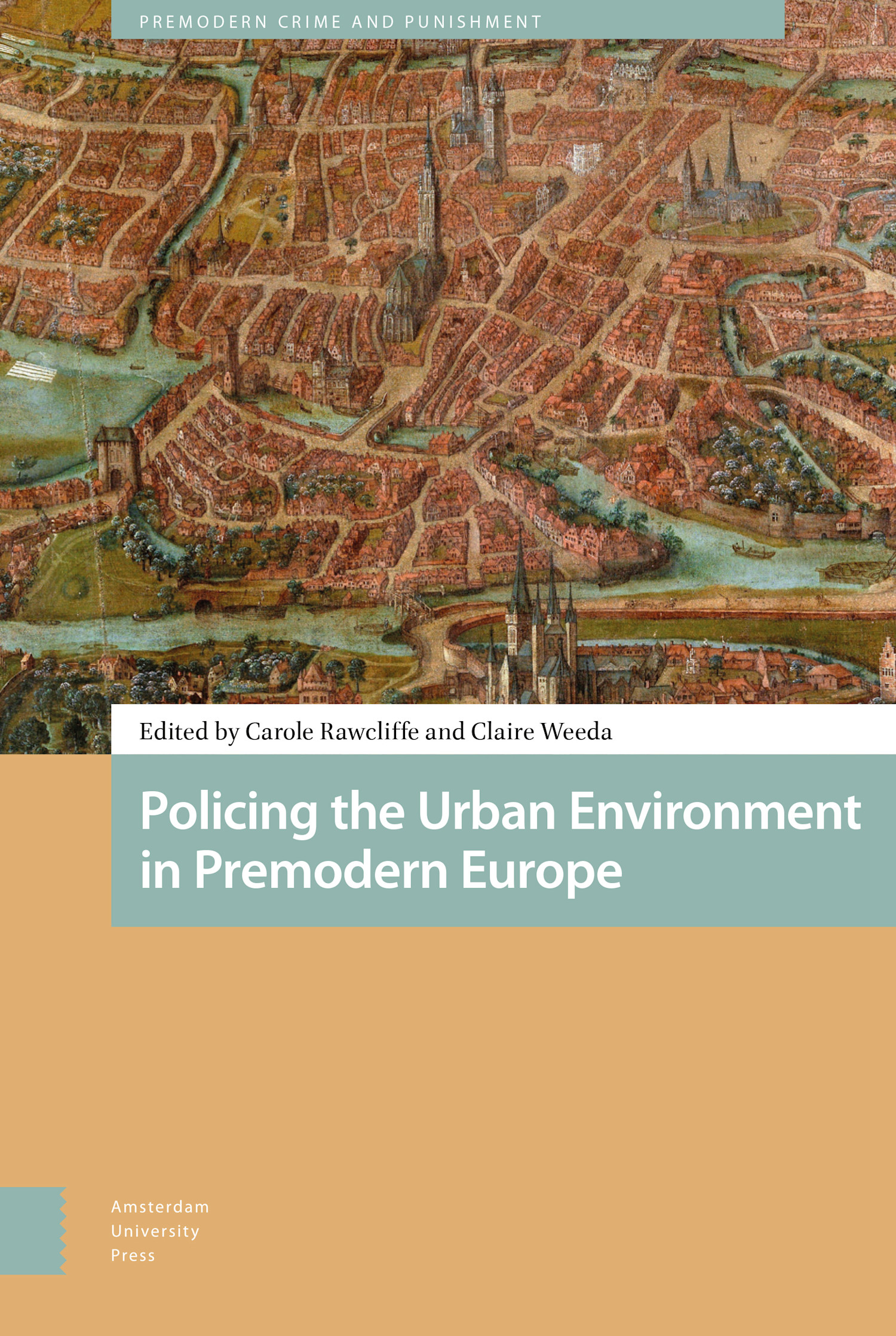
BOOK: Carole RAWCLIFFE and Claire WEEDA, eds., Policing the Urban Environment in Premodern Europe (Amsterdam: Amsterdam University Press, 2019). ISBN 9789462985193, € 109,00


Amsterdam University Press has published a new book on the attempts by public authorities in premodern Europe to create a clean, healthy environment.

ABOUT THE BOOK

Tapping into a combination of court documents, urban statutes, material artefacts, health guides and treatises, Policing the Urban Environment in Premodern Europe offers a unique perspective on how premodern public authorities tried to create a clean, healthy environment. Overturning many preconceptions about medieval dirt and squalor, it presents the most outstanding recent scholarship on how public health norms were enforced in the judicial, religious and socio-cultural sphere before the advent of modern medicine and the nation-state, crossing geographical and linguistic boundaries and engaging with factors such as spiritual purity, civic pride and good neighbourliness.

ABOUT THE EDITORS:  

Carole Rawcliffe

Carole Rawcliffe is Professor Emerita of Medieval History at the University of East Anglia, and is the author of many books and articles on health, medicine and disease in the Middle Ages, especially in an urban context.

Claire Weeda

Claire Weeda works as an assistant professor at the History Department of Leiden University. She is specialized in ethnic identity, medicine, and community formation in the period 1100-1500.

The introduction and table of contents can be found here

More information here

08 July 2019

CALL FOR PAPERS: Law and Governance of a Global City: 17th-century Amsterdam (Amsterdam, June 2020) (DEADLINE EXTENDED: 1 SEP 2019)


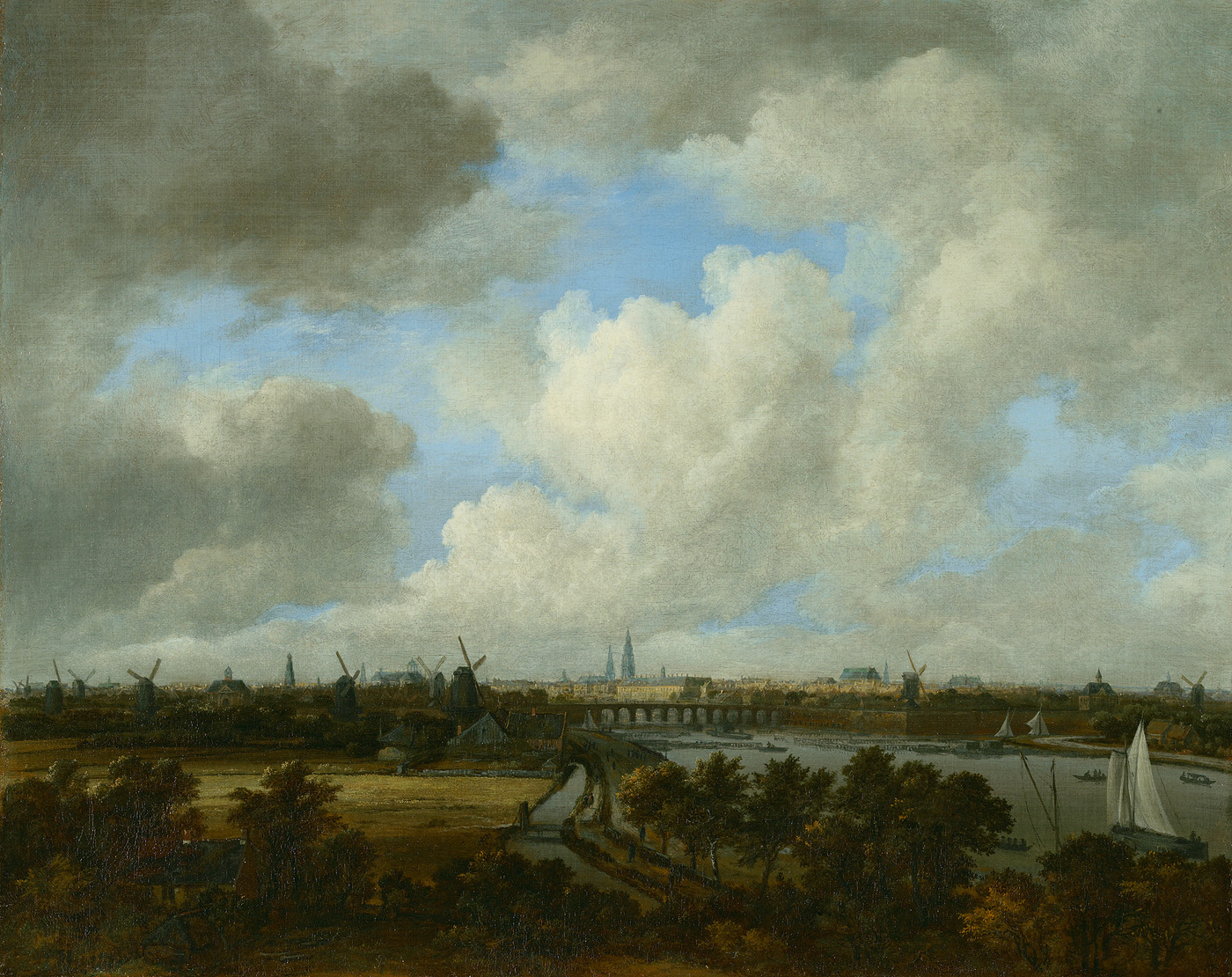
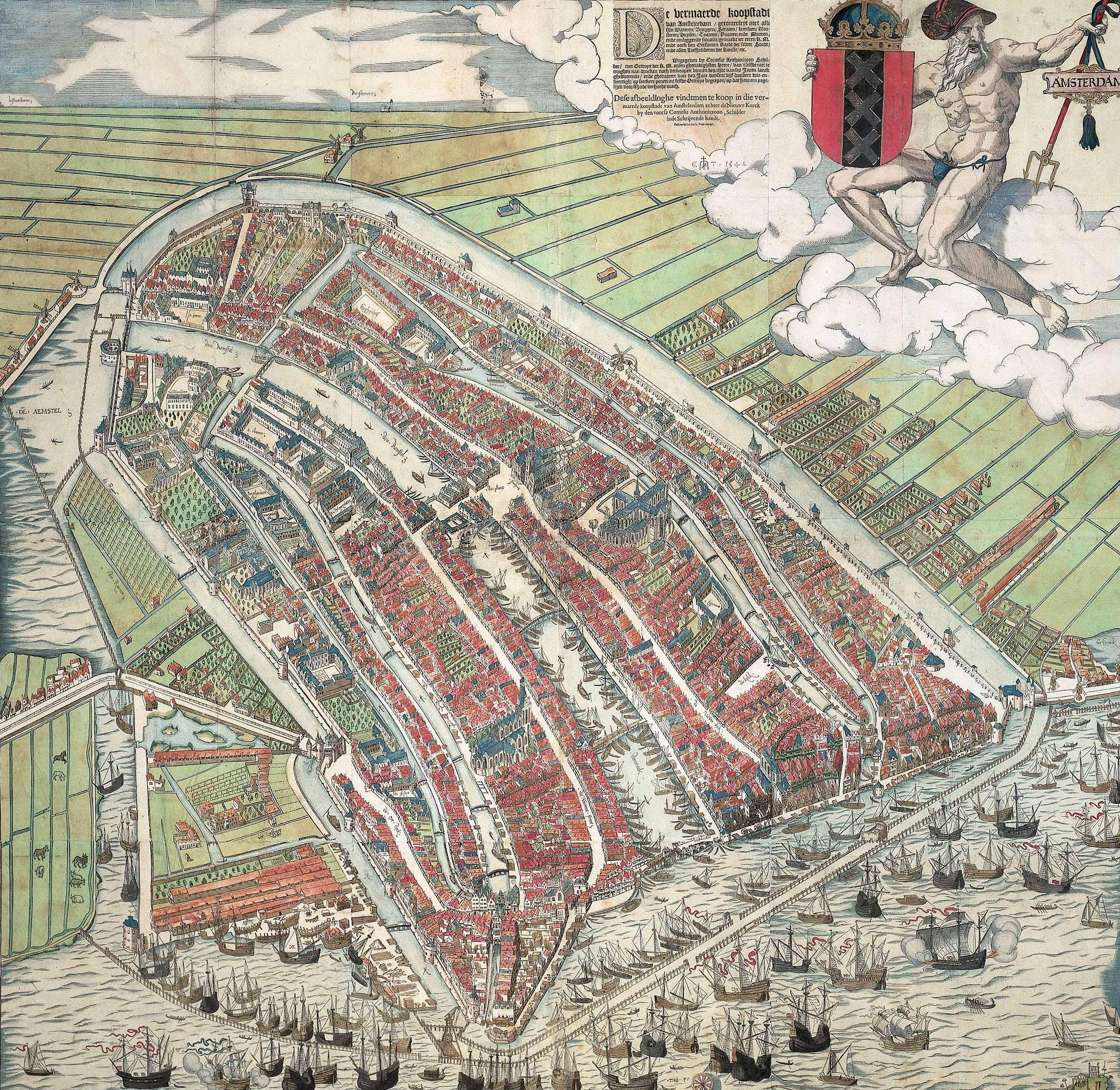
(Source: Wikipedia)

We learned of a call for papers for a symposium on law and governance in 17th century Amsterdam. Here the call:

Four hundred years ago, like today, globalisation and urbanisation impacted the world’s cities. In seventeenth-century Amsterdam, the afflux of trade and migrants prompted rapid economic and demographic growth, resulting in dynamic multicultural urban life and leading to complex questions of governance. The foreign merchants and newcomers were governed by the city administrators, who pursued policies of commercial and religious freedom. The governance of the city was both local and global. The Amsterdam Chamber of the Dutch East India Company was the most affluent and had a large say in the Company’s policies.

The communities of foreign merchants and often well-skilled newcomers were very well connected to their home regions and cities contributing to the constitution of Amsterdam at the center of global trade networks. It was the city where the first ‘modern’ stock exchange was established and the availability of capital pushed the Amsterdam and Dutch economy into a new phase of capitalism. The Dutch hegemony in the global slave trade soon made a significant contribution to the wealth of the city. The Burgerzaal of the seventeenth-century City Hall visualised the city’s bold ambition: Amsterdam as the center of a global (commercial)empire – the center of the universe.  From 1500 to 1700 Amsterdam grew from 12.000 to 200.000 inhabitants, mostly due to massive immigration. The city’s relatively tolerant intellectual climate contributed to an influx of – sometimes very wealthy – religious refugees as well as progressive/radical thinkers.Economics and politics were highly intertwinned. Economic interests and ambitions went hand in hand with political interests and ambitions. The public and the private were very much intertwined. How to govern such a rapidly expanding and very diverse city well? How did this impact existing local government practices? How to approach global trade and commercial activities stemming from and coming through Amsterdam? How did law and government support and contribute to the Amsterdam economy, and vice versa? How did the city governors deal with the risks, tensions and complications of a city and its people catapulted into a global existence? How did the city government approach Amsterdam’s immigration and diversity? What were the legal and institutional responses to the local and global challenges that came with globalisation and urbanisation in this 17th century city? The revolt against Spain ended ultimately in a quest for independence. But how to organise and govern a leading city of this emerging state? Where should sovereignty be vested? How did Amsterdam contribute to the position of The Dutch Republic on the international stage? The Dutch Republic developed into a (con)federalised state with powerful towns and Holland as the most urbanised province. Amsterdam – the rising metropolis of a rapidly expanding colonial Empire - was a city in need of new ideas, policies and institutions to govern at home and abroad. The global role of cities and city-based companies contributed to a normative discourse, which drew on different bodies of law, including (Dutch-)Roman law and the emerging law of nations and nature, ius gentium et naturale.   Slavery, trade, war, as well as discussions of religious toleration, justice and good government triggered legal questions and debates.

Against this background, this Call for Papers invites submissions engaging with the aforementioned questions and issues related to three themes:  I.  City of commerce and tradeII. City of immigration and diversity III. City of Innovative governance and law

Call for papers:

We call on scholars from legal history, history and theory of international law, urban history, as well as scholars from related disciplines, such as political philosophy, economic history, social history, history of ideas and intellectual history, history of slavery and empire, and migration studies, to send an abstract of circa 500-700 words setting out the prospective paper they would like to submit for inclusion in the symposium dealing with one of thethemes identified within the overarching topic of law and governance of Amsterdam in the 17th-century. 

PLEASE SUBMIT PAPER PROPOSALS TO LGAMSTERDAM@ASSER.NLDeadline
Abstracts July1st, 2019
On the basis of the Abstracts we will select authors by September 1st, 2019.
Deadline First Draft March1st, 2020 Selected Authors’deadline for first draft.
Symposium June2020

In June 2020, a symposium will take place in Amsterdam to bring together the selected authors.
Co-donors / co-organisers: ERC-Project led by Dave De ruysscher (Tilburg University), ‘Coherence in Law Through Legal Scholarship’ (http://www.clls.eu/ ).Gieskes Strijbis-project led by Janne Nijman (Asser Institute/University of Amsterdam), ‘The Global City: Trust, Challenges, and the Role of Law’ ( http://www.asser.nl/Global-City ). VIDI-Project led by Bram van Hofstraeten (Maastricht University), ‘What's in a Name? Challenging Early Modern Ideal-Types of Private Partnerships in the Low Countries (17th-18th Centuries)’ (http://www.maastrichtuniversity.nl/privatepartnerships )

All info can be found here

17 June 2019

CALL FOR PAPERS: Law and Governance of a Global City: 17th-century Amsterdam (Amsterdam, June 2020) (DEADLINE: 1 July 2019)


(Source: Wikipedia)

We learned of a call for papers for a symposium on law and governance in 17th century Amsterdam. Here the call:

Four hundred years ago, like today, globalisation and urbanisation impacted the world’s cities. In seventeenth-century Amsterdam, the afflux of trade and migrants prompted rapid economic and demographic growth, resulting in dynamic multicultural urban life and leading to complex questions of governance. The foreign merchants and newcomers were governed by the city administrators, who pursued policies of commercial and religious freedom. The governance of the city was both local and global. The Amsterdam Chamber of the Dutch East India Company was the most affluent and had a large say in the Company’s policies.

The communities of foreign merchants and often well-skilled newcomers were very well connected to their home regions and cities contributing to the constitution of Amsterdam at the center of global trade networks. It was the city where the first ‘modern’ stock exchange was established and the availability of capital pushed the Amsterdam and Dutch economy into a new phase of capitalism. The Dutch hegemony in the global slave trade soon made a significant contribution to the wealth of the city. The Burgerzaal of the seventeenth-century City Hall visualised the city’s bold ambition: Amsterdam as the center of a global (commercial)empire – the center of the universe.  From 1500 to 1700 Amsterdam grew from 12.000 to 200.000 inhabitants, mostly due to massive immigration. The city’s relatively tolerant intellectual climate contributed to an influx of – sometimes very wealthy – religious refugees as well as progressive/radical thinkers.Economics and politics were highly intertwinned. Economic interests and ambitions went hand in hand with political interests and ambitions. The public and the private were very much intertwined. How to govern such a rapidly expanding and very diverse city well? How did this impact existing local government practices? How to approach global trade and commercial activities stemming from and coming through Amsterdam? How did law and government support and contribute to the Amsterdam economy, and vice versa? How did the city governors deal with the risks, tensions and complications of a city and its people catapulted into a global existence? How did the city government approach Amsterdam’s immigration and diversity? What were the legal and institutional responses to the local and global challenges that came with globalisation and urbanisation in this 17th century city? The revolt against Spain ended ultimately in a quest for independence. But how to organise and govern a leading city of this emerging state? Where should sovereignty be vested? How did Amsterdam contribute to the position of The Dutch Republic on the international stage? The Dutch Republic developed into a (con)federalised state with powerful towns and Holland as the most urbanised province. Amsterdam – the rising metropolis of a rapidly expanding colonial Empire - was a city in need of new ideas, policies and institutions to govern at home and abroad. The global role of cities and city-based companies contributed to a normative discourse, which drew on different bodies of law, including (Dutch-)Roman law and the emerging law of nations and nature, ius gentium et naturale.   Slavery, trade, war, as well as discussions of religious toleration, justice and good government triggered legal questions and debates.

Against this background, this Call for Papers invites submissions engaging with the aforementioned questions and issues related to three themes:  I.  City of commerce and tradeII. City of immigration and diversity III. City of Innovative governance and law

Call for papers:

We call on scholars from legal history, history and theory of international law, urban history, as well as scholars from related disciplines, such as political philosophy, economic history, social history, history of ideas and intellectual history, history of slavery and empire, and migration studies, to send an abstract of circa 500-700 words setting out the prospective paper they would like to submit for inclusion in the symposium dealing with one of thethemes identified within the overarching topic of law and governance of Amsterdam in the 17th-century. 

PLEASE SUBMIT PAPER PROPOSALS TO LGAMSTERDAM@ASSER.NLDeadline
Abstracts July1st, 2019
On the basis of the Abstracts we will select authors by September 1st, 2019.
Deadline First Draft March1st, 2020 Selected Authors’deadline for first draft.
Symposium June2020

In June 2020, a symposium will take place in Amsterdam to bring together the selected authors.
Co-donors / co-organisers: ERC-Project led by Dave De ruysscher (Tilburg University), ‘Coherence in Law Through Legal Scholarship’ (http://www.clls.eu/ ).Gieskes Strijbis-project led by Janne Nijman (Asser Institute/University of Amsterdam), ‘The Global City: Trust, Challenges, and the Role of Law’ ( http://www.asser.nl/Global-City ). VIDI-Project led by Bram van Hofstraeten (Maastricht University), ‘What's in a Name? Challenging Early Modern Ideal-Types of Private Partnerships in the Low Countries (17th-18th Centuries)’ (http://www.maastrichtuniversity.nl/privatepartnerships )

All info can be found here

20 July 2018

CALL FOR PAPERS: Congrès - Archives urbaines. Congrès de la Société Française d’Histoire Urbaine (Créteil), DEADLINE 15 OCTOBER 2018


Via Portail universitaire du droit, we learned of a call for papers for a conference on urban archives. Here the call:

Archives urbaines. Congrès de la Société Française d’Histoire Urbaine
Archives départementales du Val-de-Marne, 24-25 janvier 2019
Date limite le lundi 15 octobre 2018

Convaincue de l’importance de l’approche historienne de la ville pour répondre aux défis du XXIe siècle, la SFHU souhaite se pencher sur les « archives urbaines ». Formant les sources de l’histoire des villes, celles-ci peuvent être également considérées comme objets d’histoire. Qu’elles soient publiques, municipales, d’État ou privées, de cabinets d’urbanistes ou d’architectes, de syndicats techniques, d’associations de locataires ou de résidents, de défenseurs du patrimoine ou de l’environnement ou tout simplement de citadins, la diversité de leurs supports et de leurs contenus mais aussi des conditions de leur production, de leur conservation et de leurs usages mérite que l’on s’y arrête. Plus largement, la ville, dans sa matérialité, est parfois assimilée à une archive à travers le bâti, la rue, les espaces publics et privés, la toponymie ou les mémoires individuelles de ceux qui l’habitent ou l’administrent. Aussi paraît-il indispensable de cerner l’ensemble complexe et diversifié des archives urbaines, de faire l’histoire de leur production, de leur conservation et de leur circulation, afin de les replacer dans leur historicité et rétablir les strates de leur composition. Mises à la disposition des décideurs et des citadins, elles participent de la gouvernance et du changement urbain.

Un premier objectif de ces journées concerne la constitution des archives urbaines. Tous les documents produits sur la ville, dans la ville, par la ville ne sont pas nécessairement archivés : s’opère une sélection qui résulte de choix individuels et collectifs, scientifiques et pratiques, sociaux et politiques. Les vifs débats actuels à propos des archives soulignent à quel point il importe de réfléchir aux critères qui président à la conservation et l’archivage de certains documents et à l’oubli d’autres, et de penser les pratiques qui en résultent. Il convient de s’interroger aussi sur les personnes et les institutions qui produisent ces archives et sur la diversité des configurations administratives et politiques qu’elles recouvrent. Au-delà des situations habituelles, les moments de grandes ruptures de l’histoire des villes (catastrophes naturelles, incendies, bouleversements géopolitiques, guerres, révolutions, etc.) mettent souvent en péril les archives et cristallisent les discussions à leur sujet : la réflexion gagnera à ce qu’ils soient évoqués.

Un second objet d’analyse touche les enjeux de leurs usages. Lors des grandes phases de transformation ou de reconstruction des villes, les archives sont régulièrement mobilisées. On en produit certaines (campagnes photographiques, enquêtes foncières ou sociales), on en mobilise d’autres, qu’au besoin on reconstitue. L’accès aux archives n’est pas le même pour tous et ne l’a pas toujours été. Que ce soit d’un point de vue légal ou pratique, celui-ci peut constituer en lui-même un enjeu. Comment faire l’histoire de ces usages et que nous apprend-elle sur le caractère politique des archives ? Comment les différents types de corpus, archives publiques ou privées, archives nationales ou locales, archives écrites ou orales, archives des événements ou longues séries relatives par exemple au fonctionnement des institutions locales, constituent-ils la base d’une compréhension complexe du fait urbain ?

En troisième lieu, signalons que la notion d’archives urbaines s'avère polysémique. Sans revenir sur leur diversité typologique, on constate que l’expression est parfois utilisée dans un sens restreint, comme synonyme d’ « archives des villes », c’est-à-dire « produites par les autorités urbaines », et parfois dans une acception beaucoup plus large, comme équivalent de « documents relatifs au phénomène urbain ». Voire, la ville elle-même est parfois présentée comme sa propre archive. Est-ce seulement l’effet de l’avènement de la notion de patrimoine urbain au cours du XXe siècle ? Jusqu’où peut-on donner suite à cette métaphore ? La ville n’a en effet pas vocation à être systématiquement inventoriée, conservée et fixée comme le sont les fonds d’archives. Certains historiens d’art, géographes, archéologues préfèrent d’ailleurs utiliser d’autres images : les strates, le palimpseste, la ville comme « livre de pierre » ou même comme texte etc., finalement tout aussi discutables. Par une approche réflexive sur les spécificités des archives « de ville », il peut être intéressant de revenir sur ce type d’homologie.

La SFHU, soutenue par l’UPEC (CRHEC et Lab’URBA), le collectif « Archival City », le GT Usages de l’histoire et devenirs urbains du labex Futurs Urbains, et les Archives départementales lancent cet appel à communications dans une approche essentiellement pluridisciplinaire et ouverte à toutes les périodes historiques et à tous les champs géographiques pour un congrès qui se tiendra les 24 et 25 janvier prochains aux Archives départementales du Val-de-Marne, 10, rue des Archives 94000 Créteil. Les interventions dureront 20 mn.

Les propositions de communication, en français ou en anglais, comporteront un titre et un résumé d’environ 1500 signes, ainsi que les coordonnées de l’intervenant (nom, prénom, fonction et rattachement institutionnel, courriel, adresse postale). Elles devront être adressées avant le 15 octobre 2018 à bourillon@u-pec.fr et à laurent.coudroydelille@wanadoo.fr .

Comité d’organisation :
Jérôme Bazin, Florence Bourillon, Marie-Andrée Corcuff, Laurent Coudroy de Lille, Vincent Lemire, Giuliano Milani, Virginie Mathé, Denis Menjot, Clément Orillard, Loïc Vadelorge.

Comité scientifique :
Outre les membres du comité d’organisation, Laurence Buchholzer, Natacha Coquery, Jean-Pierre Guilhembet, Judith Rainhorn, Thibault Tellier, Mélanie Traversier, Boris Bove, Youri Carbonnier, Catherine Denys, Stéphane Frioux, Laurence Jean-Marie, Frédéric Moret, Jean-Luc Pinol, Dominique Poulot, Olivier Ratouis, Charlotte Vorms.

More information here