Search

16 October 2026

WORKSHOP: Language, Sources and Land Law (Lodz: University of Lodz, 22 OCT 2026, 10:30) [ONLINE]


(click on images to enlarge)

On behalf of Stanisław Gozdz-Roszkowski and myself, I am delighted to invite you to participate in the "Language, Sources and Land Law Workshop", which will take place on Thursday, 22 October 2026. We will begin at 10:30 (Polish time) / 9:30 (UK time). The event will be held entirely online.
The workshop is, in some respects, a culmination of the research we have been conducting over the past eighteen months on the language of English land law in eighteenth-century legal sources and treatises, thanks to funding received through the IDUB Interdisciplinary Research Grant scheme at the University of Lodz.
In addition to a presentation of the projects aims, dataset, and linguistic analysis, there will be much more to discuss. We would like to share our plans for further research at the intersection of language and law, particularly within a historical context.
We have also invited a group of fabulous guests who will speak on related and equally fascinating topics. Our speakers will be: Joanna McCunn (University of Bristol), Dan Gosling (The UK National Archives) and Dorota Wiśniewska (University of Lodz). 
Everyone is welcome. No registration is required. Simply save the date and click the link: https://teams.microsoft.com/meet/340912218631407?p=huZBJWBuOlDzEMAe3q

(source: Prof. dr. Łukasz Korporowicz).


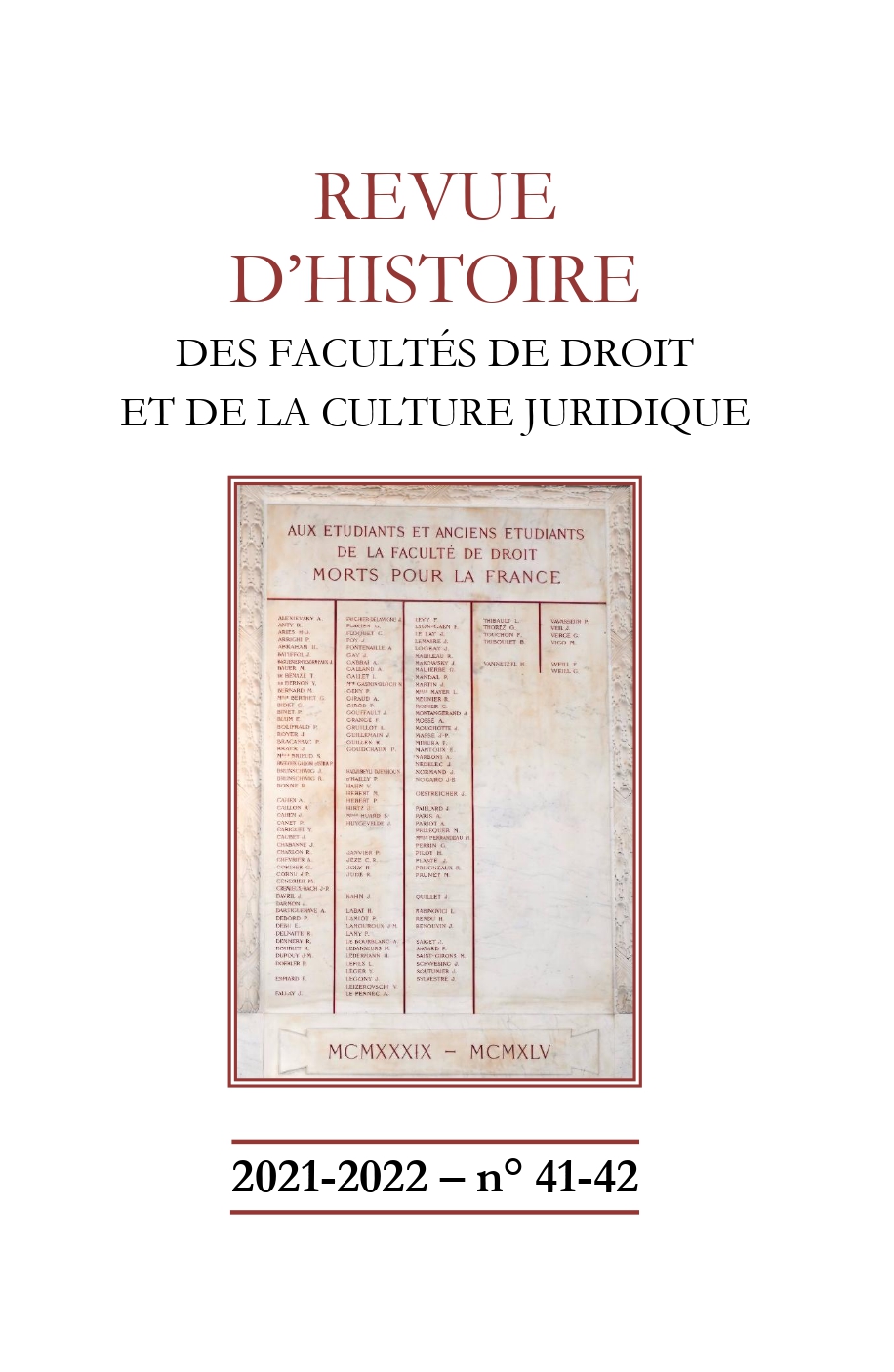
JOURNAL: Revue d’histoire des Facultés de droit et de la culture juridique, n° 41–42 (2021–2022) [Paris: SHFD]

(image source: PUD)

La Société pour l’histoire des Facultés de droit et de la culture juridique (SHFD) annonce la parution du numéro double 41–42 de la Revue d’histoire des Facultés de droit et de la culture juridique.


Ce nouveau volume réunit de nombreuses contributions consacrées à l’histoire de l’enseignement juridique, aux grandes figures de la doctrine et de la magistrature, ainsi qu’à l’évolution de la pensée juridique.


Plusieurs dossiers thématiques structurent ce numéro, notamment autour de Théophile Ducrocq (1829–1913), professeur de droit administratif à la Faculté de droit de Paris, et de Pierre Mimin (1887–1980), magistrat dont les écrits et la conception de la justice font l’objet d’une série d’études.


D’autres contributions examinent l’histoire de l’enseignement des droits de l’homme dans les facultés de droit, les rapports entre l’enseignement juridique et les engagements politiques, ainsi que la place de la philosophie du droit entre juristes et philosophes.


Le volume comprend également des études historiques consacrées à Raymond Saleilles, à l’enseignement du droit au Collège de France et aux facultés catholiques de droit sous la Troisième République.


Le numéro est disponible à la commande, notamment à un tarif préférentiel pour les membres de la SHFD.


Sommaire complet et informations relatives à la commande : Portail universitaire du droit.

PHD Training: Semaine doctorale intensive (Paris: Sciences Po Paris, 14-18 JUN 2027); DEADLINE 15 DEC 2026


(image source: Sciences Po)


INTENSIVE DOCTORAL WEEK - 16TH EDITION

The Sciences Po Law PhD Program will hold its forthcoming Intensive Doctoral Week (IDW) from 14 to 18 June 2027.

What is the IDW?

Since 2011, the Intensive Doctoral Week has been a leading PhD training lab for legal researchers. This unique 5-day experience brings together emerging scholars and renowned professors from all over the world to advance cutting-edge legal research through dynamic collaboration and peer exchange.

Who Can Apply?

We welcome PhD researchers at all stages from any field of law, including legal theory, law & society, democracy, digitalization, climate law, international law, critical theory, domestic law, European law, and all cross-cutting and interdisciplinary areas.

Your Personalized Program

Customize your own adventure from our rich menu of parallel sessions, including writing workshops to sharpen your academic skills, Interactive methodology classes, substantive panels on emerging legal topics, open roundtables for discussing research challenges an networking opportunities with IDW alumni community.

Languages and Format

Sessions run in French and English – present in your preferred language and engage in multilingual discussions. The bilingual format enriches perspectives and broadens your academic network.

Practical Information

Participants cover their own travel and accommodation costs. Lunches and social events are provided, with additional networking opportunities organized by our partners. Detailed logistics will follow for accepted participants.

Application Process

  • Deadline: December 15, 2026
  • Notification: January 31, 2027
  • Program details: Spring 2027

Submit your PhD project description through our online application. An independent expert committee will select participants based on originality, clarity, and potential for interdisciplinary dialogue.

Milan KUHLI, Strafgesetzbücher der Zwischenkriegszeit, eds. Arnd KOCH and Martin LÖHNIG (Tübingen: Mohr Siebeck, 2024) (Comparative Legal History, XIV (2026), nr. 1 (June), pp. 166-168)

(image source: Taylor&Francis)

This compilation, edited by Arnd Koch and Martin Löhnig, deals with criminal law discourses and legislation in the early twentieth century. It refers to the interwar period (Zwischenkriegszeit), the period between the two World Wars (1918- 39). However, it is obvious that this period of legal history can only be comprehended if a broader temporal context is considered. Therefore, some of the case studies comprised in the book reflect issues concerning historical development between the mid-nineteenth century (eg in the article by Marju Luts-Sootak and Marin Sedman on the legal situation in Estonia) and the 1960s (eg in Danuta Janicka's account about Poland). Except for one article written in English (by Luts-Sootak and Sedman), the compilation is in German. 

What is not apparent from the title of the anthology is the fact that the book focuses on legislation and discourse in Central and Eastern Europe. So, apart from an introductory article by Löhnig, the anthology comprises seven studies about the legal situation in individual territories in this European region. Attila Barna's article deals with the Hungarian criminal law, focussing on reform initiatives from 1908 and 1928. The latter reformed inter alia the system of fines and brought in the concept of the so-called serious criminal (Schwerverbrecher) which reflected discourses that could also be found in Germany during this time. Janicka's article deals with Poland, especially with the discussion about legal unification around 1918 and with the international network within which the debate took place. Furthermore, she shows the links to the concepts of the classical school of criminal law and to those of the sociological, 'modern' school. Koch addresses the history of Germany between 1919 and 1933, the so-called Weimar Republic. He notes that the project to comprehensively reform the German criminal code from 1871 (Reichsstrafgesetzbuch) failed during this period, but emphasises that the successes achieved in criminal policy during the Weimar period must not be forgotten. In this regard, Koch refers to the admission of women to the legal profession, the legislative regulation of fines, juvenile criminal law, and the reform of the prison system. 

Luts-Sootak and Sedman focus on the Estonian Penal Code of 1929, which came into force in 1935. According to the authors [...]

To read the full review, please click here. Online access is free for members of the European Society for Comparative Legal History.

DOI: https://www.tandfonline.com/doi/full/10.1080/2049677X.2026.2671636

15 October 2026

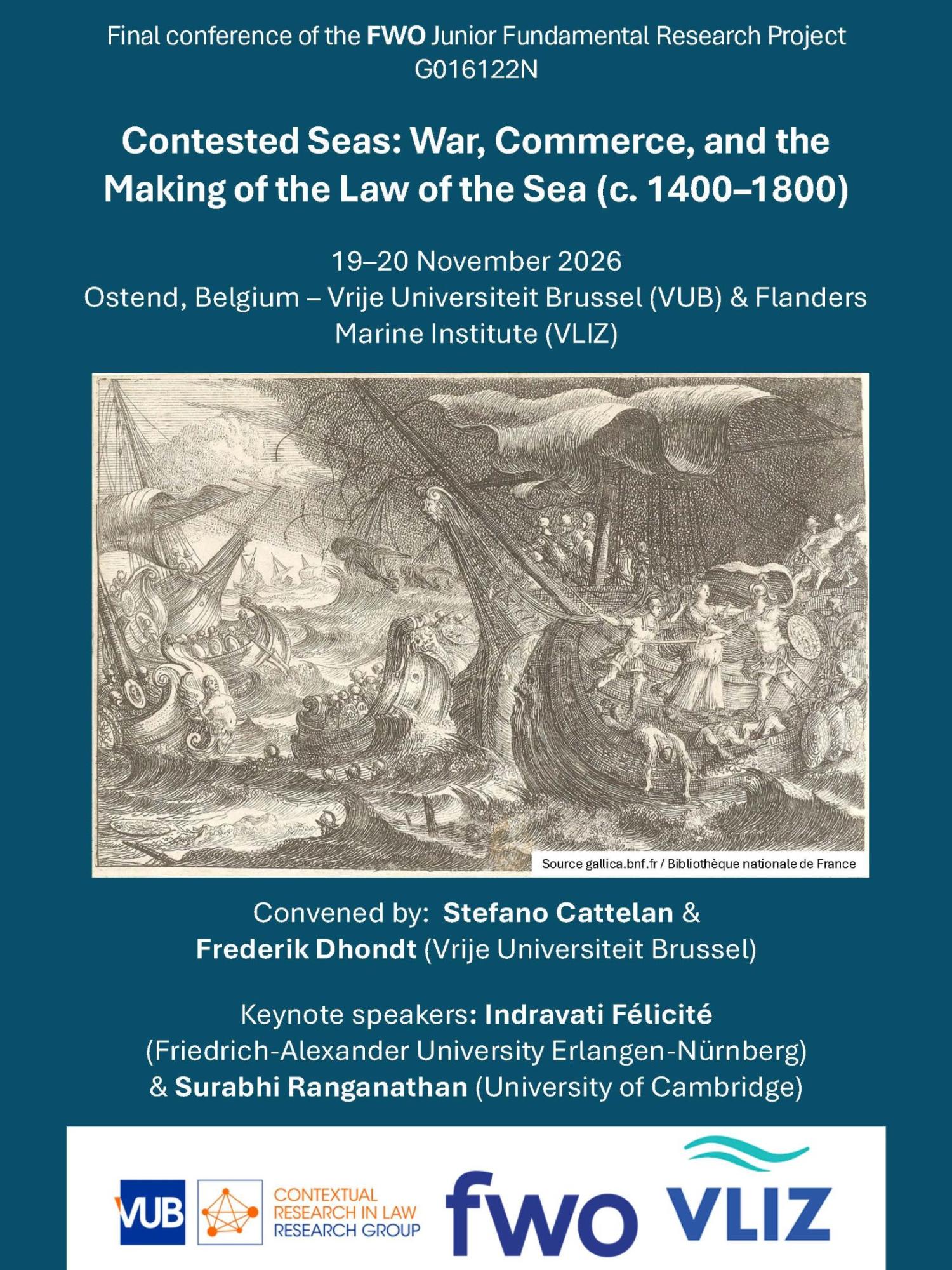
CONFERENCE: Contested Seas: War, Commerce, and the Making of the Law of the Sea (c. 1400–1800) [Ostend: VUB aan Zee / VLIZ, 19–20 November 2026]

(image source: VUB)

The international conference “Contested Seas: War, Commerce, and the Making of the Law of the Sea (c. 1400–1800)” will take place on 19–20 November 2026 in Ostend, Belgium. Organised by Stefano Cattelan (Vrije Universiteit Brussel / Brussels School of Governance) and Frederik Dhondt (Vrije Universiteit Brussel), through the research group CORE in cooperation with the Flanders Marine Institute (VLIZ), the conference will bring together scholars from legal history, international law, maritime history, and related disciplines.


The conference seeks to examine the historical formation of the law of the sea between the fifteenth and eighteenth centuries, approaching it not as a coherent and established body of rules, but as a contested legal order shaped by maritime warfare, commercial rivalry, competing claims to sovereignty, and jurisdictional disputes.


Through plenary and parallel sessions, participants will explore a broad range of themes, including the historical foundations of maritime sovereignty, the principles of mare liberum and mare clausum, neutrality and seapower, maritime capture and prize jurisdiction, and the interaction of different legal traditions and practices across the Mediterranean, Atlantic, and Asian maritime worlds. Further discussions will address the evolution of maritime jurisdiction, the regulation of shipboard activities, and the historical foundations of contemporary ocean governance.


The programme features two keynote lectures:

  • Prof. Indravati Hiltl-Félicité (Friedrich-Alexander-Universität Erlangen-Nürnberg), Beyond Mare Liberum: Empires and the Contest for Maritime Order – 19 November, 17:15–18:45.
  • Prof. Surabhi Ranganathan (University of Cambridge, Lauterpacht Centre for International Law), Seeking Other Oceans – Chokepoints Past and Present – 20 November, 09:30–10:45.

The conference will be held at two venues in Ostend:

Registration is open until 18 November 2026. The registration fee is €70; students are exempt and can register by contacting stefano.cattelan@vub.be.


The registration form and details, as well as further information, are available on the official conference webpage. 

The detailed programme can also be consulted here (PDF).

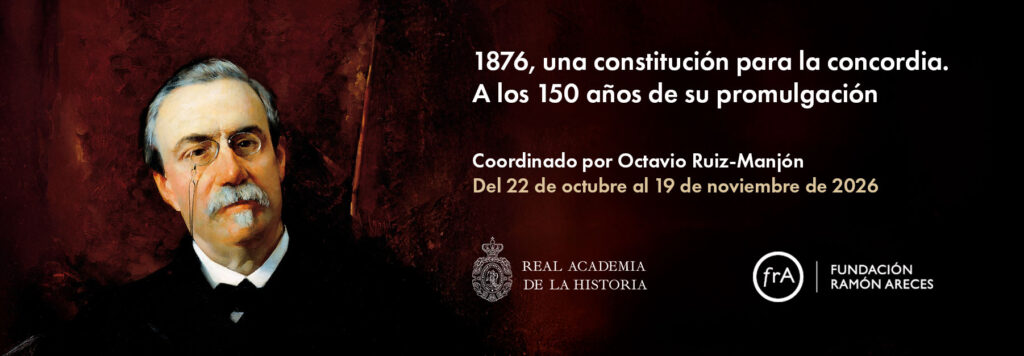
LECTURE: Octavio RUIZ-MANJÓN, "El planteamiento de la Restauración canovista" [Lecture Series 1876, une constitución para la concordia. A los 150 años de su promulgación, coord. Octavio RUIZ-MANJÓN] (Madrid: Real Academia de la Historia, 22 OCT 2026)


(image source: RAH)

Abstract:

El pasado 30 de junio se cumplieron 150 años de la firma de la Constitución de la Monarquía Española que estuvo plenamente vigente hasta 1923. Fue una ley en la que, bajo la influencia de Antonio Cánovas del Castillo, predominó la idea de inclusión de la mayor parte de las fuerzas políticas a partir de los principios de transigencia y de tolerancia, así como por la de flexibilidad en su desarrollo posterior. La prolongada vigencia del texto constitucional facilitó la afirmación de un consistente sistema de predominio civil y la consecución de un elevado nivel de libertades personales. En los días finales de 1874, la situación política española parecía agotada y la situación política internacional parecía apuntar hacia la consolidación de regímenes de autoridad. En Francia se ensayaba un cierto cesarismo militar después de las convulsiones revolucionarias de 1871, mientras que acababa de establecerse el Imperio alemán, de tono conservador. Todo parecía apuntar hacia regímenes de orden.

More information on all lectures in the series here. 


14 October 2026

FELLOWSHIPS: 6-12 month Postdoc (Mainz: IEG Leibniz-Institut für Europäische Geschichte, DEADLINE 15 OCT 2026)

(image source: IEG Mainz)


 The Leibniz Institute of European History (IEG) awards fellowships to postdocs conducting research in European history, the history of religion, and other historical disciplines (including Digital Humanities).

The IEG funds research projects on European history from the early modern period to contemporary history. We are particularly interested in projects

  • with a comparative or cross-border approach,
  • on European history, including its relation to the wider world,
  • on topics of intellectual and religious history,
  • with digital tools and methods, or
  • on environmental history.

WHAT WE OFFER

The IEG Fellowship provides a unique opportunity to pursue your individual research project while living and working for 6–12 months at the Institute in Mainz.
The monthly stipend is €2,100. Additionally, it is possible to apply for a family allowance (partner €250 Euro, first child €400, every further child €100).

REQUIREMENTS

Successful candidates are required to reside at the Institute in Mainz throughout the duration of their fellowship. For family-friendly arrangements, please contact the Fellowship Office. Fellows are expected to be active members of the IEG research community and to participate in the weekly colloquia and scholarly activities. Moreover, they will present their work in progress at least once during their stay. Applicants must have completed their doctorate no more than three years prior to the application. We expect proficiency in English.

APPLICATION

Applications can be submitted in either English or German. We recommend choosing the language you are most proficient in.

The IEG encourages applications from women.

LECTURE: Bethany McNAMARA-DALE, "Frameworks of German Sovereignty and Legal Reform: Pluralism and Contested Jurisdiction, 1770-1866" (London: Institute of Historical Research, 14 OCT 2026)


(image source: IHR)

Abstract:

This paper examines legal reform as a multi-dimensional political, social and legal process across the late eighteenth and nineteenth century. It explores the supranational, state and social interactions with judicial reform, demonstrating the legal pluralism and fundamental arbitration culture at the heart of German law and state building. Focusing on Bavaria and Hessen-Kassel as primary case studies, it examines the experiences of legal reform in two contrasting examples of states which, for better or worse, survived the upheavals of the era. By focusing upon the courses and dynamics of inevitable jurisdictional tensions, this research provides a new lens through which to understand state-building and legal change. In doing so, it contributes to a richer account of multi-dimensional German governance and society, while also providing a critical historical perspective on the challenges of supranational order – demonstrating that state-building and legal reform were inherently contingent and intertwined.

Location:

Read more here.

13 October 2026

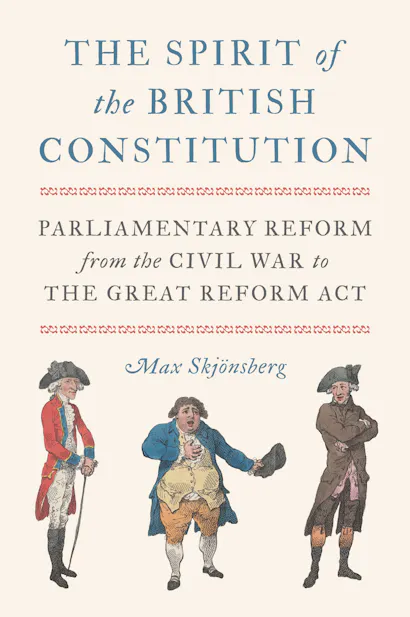
BOOK: Max SKJÖNSBERG, The Spirit of the British Constitution: Parliamentary Reform from the Civil War to the Great Reform Act (Princeton: Princeton University Press, 2026), 488 p. ISBN 9780691245652, 35 GBP


Abstract:

Eighteenth-century Britain was ruled by landed Protestant gentlemen who were united in their embrace of the country’s constitution, common law, and system of rights that had been confirmed by milestones such as Magna Carta in 1215, the Petition of Right in 1628, and the Glorious Revolution in 1688. Yet the British elite and the public at large were divided on fundamental political questions, such as how the constitution should work in practice and what reforms, if any, were needed to make reality cohere with theory. In this panoramic book, Max Skjönsberg provides the most comprehensive study to date of the history of parliamentary reform in Britain from the seventeenth century to the First Reform Act in 1832. At the heart of the book is the idea of the spirit of the British constitution, which was invoked by widely different political actors and thinkers throughout this period to argue for an array of reforms for the security of liberty. What this precisely entailed was deeply contested, with key figures such as Bolingbroke, Edmund Burke, Catharine Macaulay, William Pitt the Younger, and William Cobbett interpreting the spirit of the constitution in diverse ways, all the while seeking to remain within a constitutional framework. A landmark account of the English political and constitutional tradition, The Spirit of the British Constitution challenges us to rethink eighteenth-century history as well as the relationship between tradition, history, and freedom.

Author:

Max Skjönsberg is associate professor of humanities in the Hamilton School at the University of Florida. He is the author of The Persistence of Party: Ideas of Harmonious Discord in Eighteenth-Century Britain and the editor of Catharine Macaulay: Political Writings. 

Read more here. 


10 October 2026

SEMINAR: Family Feud or Family Reunion? Comparative Law and Comparative Legal History as Siblings [Online: Comparative Legal History Dialogues Series, 15 OCT 2026]

The journal Comparative Legal History, published on behalf of the European Society for Comparative Legal History (ESCLH), is organizing an online seminar entitled “Family Feud or Family Reunion? Comparative Law and Comparative Legal History as Siblings”, as part of its Comparative Legal History Dialogues series. The event will take place on 15 October 2026, from 12:00 to 13:00 (CEST), via Zoom.

The seminar will bring together three distinguished scholars:

  • Prof. Thomas Duve – Max Planck Institute for Legal History and Legal Theory;
  • Prof. Ralf Michaels – Max Planck Institute for Comparative and International Private Law;
  • Prof. Jaakko Husa – University of Helsinki.

Comparative law and comparative legal history share a close intellectual relationship. During the nineteenth century, when comparative law emerged as an autonomous discipline, comparative lawyers frequently engaged with legal history. However, following decades of increasing differentiation and specialization within legal scholarship, the relationship between these two fields invites renewed examination.

The discussion will explore whether comparative lawyers continue to engage with comparative legal history, the extent to which both disciplines share methodological approaches and theoretical assumptions, and how comparative legal historians might contribute to contemporary debates within comparative law.

Following brief contributions from the invited speakers, participants will have the opportunity to join an open discussion.

Participation is free and open to the public. Registration is required by email at: clhdialogues@gmail.com.

The organisers warmly invite scholars, researchers, and students interested in comparative law, legal history, and legal methodology to participate in this exchange.

09 October 2026

LECTURE: Anthony PAGDEN, From Empire to Federation: Can the European Union Become the Paradigm for a New World Order ? (Geneva: Graduate Institute, 20 OCT 2026) [HYBRID]


(image source: Graduate Institute)

Anthony Pagden (Distinguished Professor of Political Science and History (UCLA) will hold a talk at the Graduate Institute in Geneva for the Fondation Pierre du Bois pour l'histoire du temps présent on 20 October 2026 from 18:30 to 20:00.

This takes place in the Maison de la Paix, Room A1B or online.


More information and registration here.

BOOK REVIEW: Panikos PANAYI, Legal responses to mass migration: from the nineteenth century to World War II, eds. Luigi NUZZO, Michele PIFFERI, Giuseppe SPECIALE and Cristina VANO (Abingdon: Routledge, 2025) (Comparative Legal History, XIV (2026), nr. 1 (June), pp. 162-165)

(image source: Taylor&Francis)

This long, edited volume containing sixteen essays tries to address the question of legal responses to mass migration from the end of the nineteenth century until the post-Second World War period, an ambitious task. The editors, all Italian legal or legal history scholars, divide the volume into three sections covering 'Discourses', 'Policies and Institutions', and 'Legal Practices’; although the choice of location of the individual pieces is not always clear, especially in the case of those in sections 2 and 3. The chapters come from a 'collaborative research project on Legal History and Mass Migration' (xvi), focusing on the late nineteenth and early twentieth centuries. Although the editors sought to take an interdisciplinary approach, most of the contributions are written by either legal scholars or legal historians. The main focus is Italy and the Italian diaspora, and most of the authors work in Italian universities. 

Section I contains five chapters, beginning with Eliana Augusti's ‘From Vitoria to Kant: A Genealogy of ius migrandi’, an interesting philosophical-legal discussion about the concept of ius migrantis, traced through a series of philosophers down to the present. The author demonstrates command of the evolution of migration policy, and the essay is well conceptualised and clear in its explanation of the various authorities with which it engages, adding an interesting perspective on migration and migration law and rights. Chapter 2, by Giulio Abbate, on 'Emigration and Colonisation: The Debate in Italy at the End of the Nineteenth Century', tackles the issue of legal attitudes towards the relationship between emigration and colonisation, which initially focused upon emigration only taking place as a result of trade but gradually moved towards the idea that it could be linked to conquest because it would bring civilisation. Chapter 3, by Virginia Amorosi, on ‘Leaving Italy: Transoceanic Migration and Legal Discourse in the City of Napoli (1901-1910)’, despite its title and the fact that much of this essay focuses upon Naples, actually covers a wide range of discourse which falls under the broad description of 'legal', focusing not simply on Naples but also more broadly on Italy, including the concern about the loss of people as a result of emigration in the late nineteenth and early twentieth centuries. Chapter 4, by Francesco Rotondo, on 'The "Peculiar Paradox" of the Criminalisation of Italian Immigrants in Argentina in the Late Nineteenth Century' examines this process by focusing upon a series of individuals who concentrated up on perceived criminality and sickness against the background of a significant increase in the movement of people into Argentina at the end of the nineteenth century [...]


To read the full review, please click here. Online access is free for members of the European Society for Comparative Legal History.


DOI: https://www.tandfonline.com/doi/full/10.1080/2049677X.2026.2671635

08 October 2026

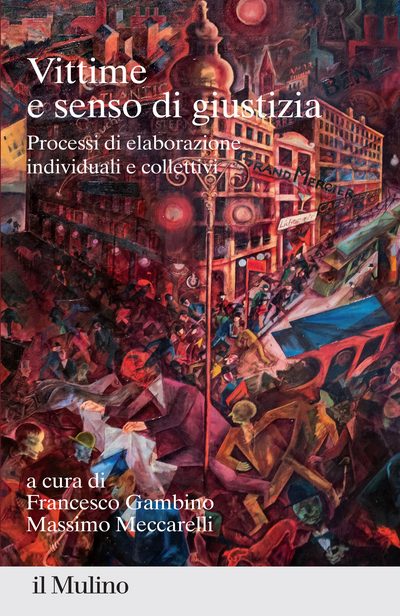
BOOK: Francesco GAMBINO & Massimo MECCARELLI (eds.), Vittime e senso di giustizia. Processi di elaborazione individuali e collettivi (Bologna: il Mulino, 2026), ISBN 9788815395986, € 26


(image source: il Mulino)

Abstract:
Nello scenario attuale, dove i rapporti di forza tra individui, poteri e corpi sociali subiscono in vario modo energiche e repentine distorsioni, irrompendo nelle vite dei singoli, è più che mai necessario riflettere sul tema delle vittime. Questo volume presenta gli esiti di una ricerca interdisciplinare che ha coinvolto giuristi, storici, sociologi e studiosi di letteratura, con lo scopo di distinguere le diverse dimensioni del fenomeno: soggettiva, sociale e istituzionale, storica, filosofica, giuridica e processuale, rappresentativa. Si affacciano molte domande: sul rapporto tra paradigma vittimario e società, sulle forme di riparazione, sulla distorsione dell’immagine della vittima nel processo, sul ruolo delle vittime nella memoria collettiva, sull’oblio, e non da ultima sulla psicologia delle vittime. L’obiettivo è intercettare, dietro la diffusa domanda di giustizia, nuove forme di coesione sociale.
Editors:
Francesco Gambino è professore ordinario di Diritto civile nell’Università di Macerata. Finalista del premio Viareggio Rèpaci, sezione saggistica, con «In sala con il diritto» (La nave di Teseo, 2023). Massimo Meccarelli è professore ordinario di Storia del diritto medievale e moderno nell’Università di Macerata. È condirettore di «LawArt. Rivista di Diritto, Arte, Storia».

Read more here. 


07 October 2026

BOOK: Dante FEDELE & Orazio CONDORELLI (eds.), Droit international et relations interconfessionnelles : étude d'une dynamique historique (XVe-XXe siècle) [Études d’histoire du droit et des idées politiques, vol. 40; dir. Florent GARNIER] (Toulouse: Presses de l'Université Toulouse Capitole, 2026) [OPEN ACCESS]


(image source: openedition)

Abstract:

Issu d’un projet international mené par le Centre d’histoire judiciaire (CNRS-Université de Lille) et le Département de droit de l’Université de Catane, cet ouvrage explore les relations complexes entre droit international et relations interconfessionnelles du XVe au XXe siècle. À rebours d’une vision longtemps dominante qui faisait de la modernité juridique l’aboutissement d’un processus linéaire de sécularisation, les contributions réunies ici interrogent les modalités selon lesquelles les rencontres et les conflits entre groupes de religions différentes ont contribué à façonner des concepts, des principes et des pratiques ayant structuré le droit international. Adoptant une perspective de longue durée, l’ouvrage envisage le droit international non pas comme un simple ordre interétatique, mais comme un cadre normatif pluriel destiné à réguler les interactions entre des acteurs aux statuts variés. À travers une série d’études de cas couvrant les périodes médiévale, moderne et contemporaine, il montre combien les débats théologiques et canoniques ont nourri la recherche de formes de coexistence et de dialogue entre confessions. En proposant une réflexion historique sur un sujet dont l’actualité demeure manifeste, ce volume contribue à une meilleure compréhension des dynamiques religieuses qui continuent de façonner les relations entre les sociétés humaines.

Editors:

Dante Fedele (dir.) Chargé de recherche HDR au Centre d'Histoire Judiciaire (HMR 8025 CNRS-Université de Lille) Orazio Condorelli (dir.) Professeur de Droit et Religion, Université de Catane 

Read the full book on openedition. 

06 October 2026

BOOK: William MAGNUSON, The Just and the Good. How Law made the Western World (Georgetown: Georgetown University Press, 2026), 342 p. ISBN 9781647127428 € 29,28


(image souce: Amazon)

Abstract:
Explore how the pillars of the rule of law―from the courts of ancient Athens to the Constitution of the United States―were built In The Just and the Good, William Magnuson takes readers on a sweeping tour of the history of the law in Western civilization. He explains how foundational institutions like courts, codes, and constitutions magically transform the worlds they govern. And he argues that if we want to understand the foundations of freedom, justice, and democracy, we need to begin by looking at the history of the law. In each chapter, Magnuson explores how the pillars of the rule of law were built. How did the courts of ancient Athens create the world's first democracy? Why did the barons of medieval England insist that King John sign the Magna Carta? What was so revolutionary about the American Constitution? And why did it take so long to abolish slavery? Magnuson shows that the answers to these questions are not always as simple as they seem. Good laws require ingenuity, problem-solving, and compromise. A landmark work, The Just and the Good teaches us where our ideas of justice came from and why they are worth saving.

Read more here. 

05 October 2026

CONFERENCE: Harvard Graduate Student Conference on International History (Con-IH) 2027: 'Transimperial Histories' (26-27 MARCH 2027) [DEADLINE 13 NOV 2026]


(Source: Harvard University)


The 2026-2027 organizing committee for the Harvard Graduate Student Conference on International History (Con-IH) invites graduate students to submit proposals for its annual conference. This year’s theme is Transimperial Histories.

Building on contributions since the 1990s from new imperial history and postcolonial studies, scholars of global and international histories have increasingly looked beyond normative imperial boundaries to incorporate multiple empires within their research. This expansion in scope has allowed for insights into imperial mechanisms otherwise overlooked when empires are studied as singular, contained units or in comparison to other empires. Articulated and popularized most prominently by Daniel Hedinger and Nadin Hée, “Transimperial History” centers on the “3Cs”— connectivity, cooperation, and competition—between and across empires to understand a world in which a multiplicity of imperial powers were, and still are, inextricably linked. A transhistorical approach therefore provides new insights into the production of imperial knowledge, the mobility of anticolonial struggles, and the circulation of people, goods, and ideas across imperial borders. Recent decades have revealed transimperial history to be a timely methodology for contemplating the “crisis of the global” and the resurgence of imperial thinking in our fragmented, multipolar world.

On this theme, Con-IH 2027 seeks to promote cross-disciplinary as well as cross-regional historical approaches. We welcome submissions from individuals at any point in their graduate program, particularly those in the early stages of research, that address one or more of the themes below. It should be considered that this list is only suggestive.

  • Law
  • Religion
  • Textuality
  • Globalization
  • Economic and business history
  • Capitalism
  • Oceanic and maritime history
  • Environmental history
  • Borders and boundaries
  • Decolonization
  • Gender
  • Labor
  • Race
  • Migration and diaspora
  • Culture and identity
  • Media studies

Accepted papers will be grouped for presentation in roundtables, tentatively scheduled for March 26-27, 2027. Each group will receive individual attention from a faculty commentator. Participation in Con-IH presents an unparalleled opportunity to engage in lively and lengthy discussions with an emerging cohort of researchers-in-training from around the world, as well as with faculty from Harvard and elsewhere.
    

Graduate students interested in participating in the conference should submit a 300-word proposal and one-page Curriculum Vitae in a single PDF document to conih@fas.harvard.edu. Please title your submission “Lastname_ShortTitle.” Proposals must be received by November 13, 2026 in order to be considered. Please note that funding for travel and accommodations cannot be guaranteed at this time. As the date approaches, additional information will be posted on this page. 


More information here.

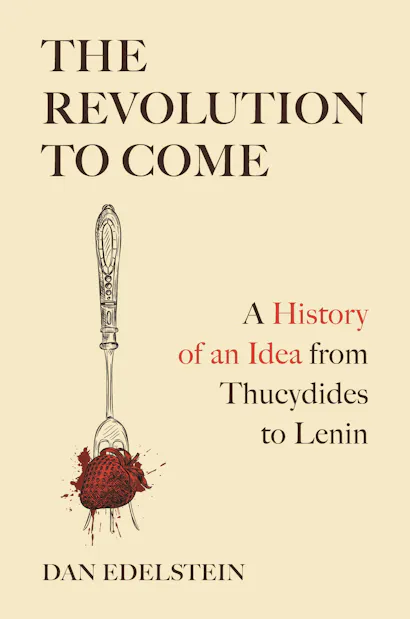
BOOK: Dan EDELSTEIN, The Revolution to Come: A History of an Idea from Thucydides to Lenin (Princeton: Princeton University Press, 2026), 432 p. ISBN 9780691231860, 24,95 USD


(image source: Princeton UP)

Abstract:
Political thinkers from Plato to John Adams saw revolutions as a grave threat to society and advocated for a constitution that prevented them by balancing social interests and forms of government. The Revolution to Come traces how evolving conceptions of history ushered in a faith in the power of revolution to create more just and reasonable societies. Taking readers from Greek antiquity to Leninist Russia, Dan Edelstein describes how classical philosophers viewed history as chaotic and directionless, and sought to keep historical change—especially revolutions—at bay. This conception prevailed until the eighteenth century, when Enlightenment thinkers conceived of history as a form of progress and of revolution as its catalyst. These ideas were put to the test during the French Revolution and came to define revolutions well into the twentieth century. Edelstein demonstrates how the coming of the revolution leaves societies divided over its goals, giving rise to new forms of violence in which rivals are targeted as counterrevolutionaries. A panoramic work of intellectual history, The Revolution to Come challenges us to reflect on the aims and consequences of revolution and to balance the value of stability over the hope for change in our own moment of fear and upheaval.

On the author:

Dan Edelstein is the William H. Bonsall Professor of French and (by courtesy) professor of political science and of history at Stanford University. His many books include On the Spirit of Rights and The Terror of Natural Right: Republicanism, the Cult of Nature, and the French Revolution.

Read more here. 


02 October 2026

VIRTUAL EXHIBITION: Crimes et justices de guerre (1430-1945) (Criminocorpus)


(image souce: Criminocorpus)

Curators:

Bentéboula Maurena,  Chinaud-Robert Effie,  Dubs Marcel,  Dufresne-Taillon Esteban,  Fouquet Julien,  Mazy Vincent,  Rahier Alain,  Renard Maxime,  Richelle Sophie,  Sergent F.,  Stennier Perrine,  Tlili-Bourgeois Guillaume,  Vermeersch Romain,  Wouters Théo

Abstract:

Ce projet est le fruit d’une école doctorale qui s’est tenue en juin 2026, en collaboration entre l’Université catholique de Louvain, l’Université de Liège et l’Université du Québec à Montréal. Il est né de l’association de deux projets de recherche, respectivement portés sur les origines médiévales de la notion de crime de guerre et sur le déploiement de la justice militaire du XIVe au XXe siècle. Les jeunes scientifiques ont construit cette exposition virtuelle comme une rencontre entre leurs propres recherches et le partage au public d’un thème encore méconnu, quoique largement fantasmé par la culture populaire. 

Consult the exhibition here. 

BOOK REVIEW: Elisabetta FUSAR POLI, Law and art in the 19th century. Power in images, eds. Giovanni ROSSI and Pietro SCHIRÒ (Pisa: Pacini, 2024) (Comparative Legal History, XIV (2026), nr. 1 (June), pp. 158-161)

(image source: Taylor&Francis)

The book edited by Giovanni Rossi and Pietro Schirò (opening the 'Immagini, Diritto e Storia' series directed by Rossi himself) is a collaborative effort that owes its overall value first of all to its editors drawing on their long-standing academic background in the Law and Humanities field. Notably, they sought to explore the intertwining of law, power, and images in the nineteenth century, sparking a broad international debate through the conference (held in Verona, 19-21 October 2022) which gave rise to the book and nurtured its truly appreciable diversity of contents and perspectives. 

This plurality has been appropriately structured by the editors into four sections: ‘The Representation of Power', 'Revolutions, Laws, Art', 'The Force of Law and the Tyranny of Power’, and ‘Tangible Forms of Law'. Rossi's introduction ('A proposito di immagini e di diritto. Un percorso tra visual culture e storia legale', 9-31) helps clarify this inner structure and is, at the same time, an integral part of the volume, serving as both a 'map for sailors' and a toolbox for the reader: It is indeed a substantial introduction, which can also be considered partly programmatic. According to Rossi's introduction, the image (artistic or not) takes on an important heuristic value, as a vehicle, a medium of ideas, concepts, and values connected to law and power, if not also an essential part of an affirmative or negative narrative of power itself. The 'gamble' that animates the scientific and editorial project of the conference and book is that of 'guaranteeing depth and historical interpretation to an aspect as pervasive as it is often underestimated, such as that of the translation into images of the values and myths of law and power. In other words, the aim is 'laying bare the colossal operation of […]


To read the full review, please click here. Online access is free for members of the European Society for Comparative Legal History.


DOI: https://www.tandfonline.com/doi/full/10.1080/2049677X.2026.2671634