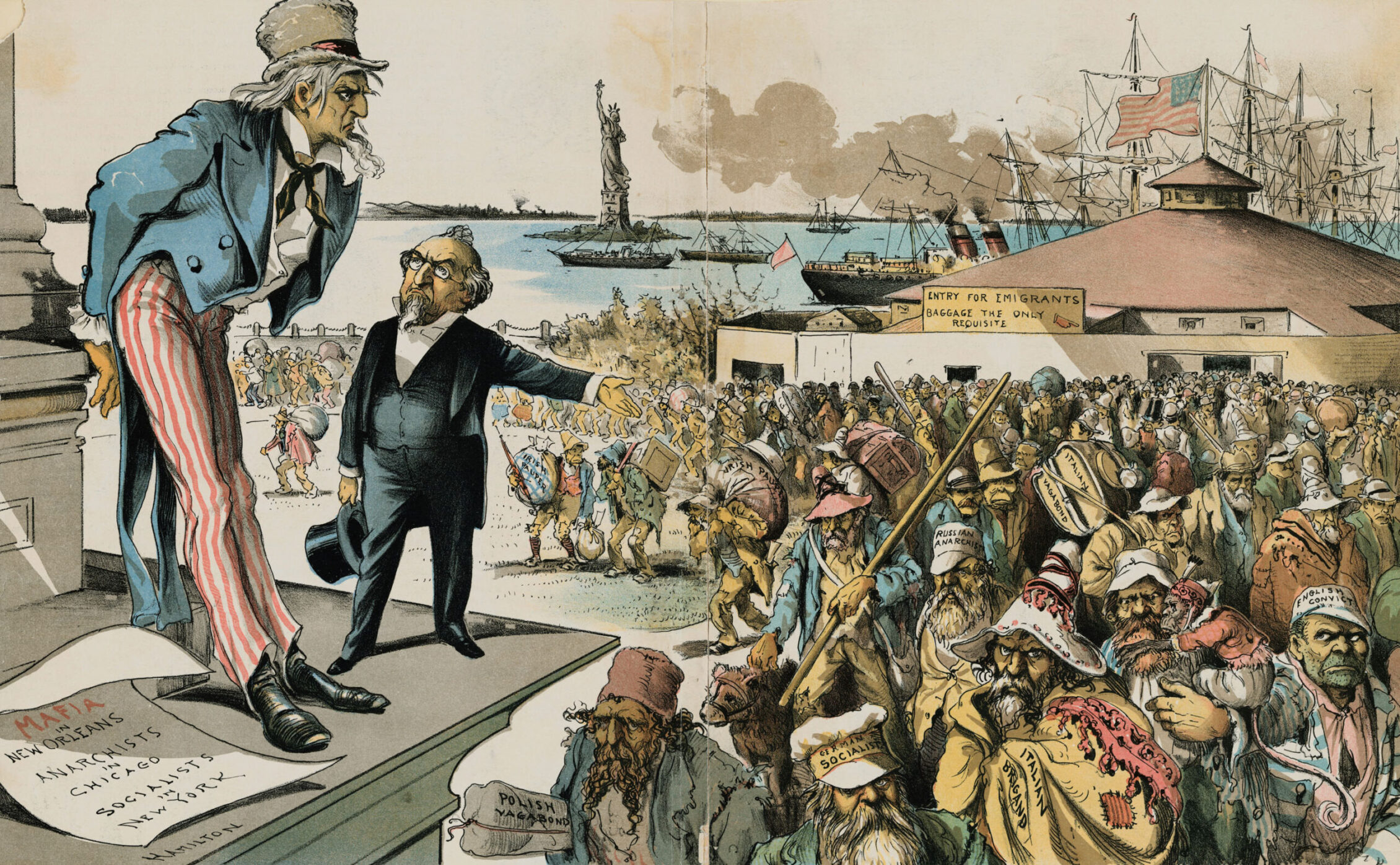
This long, edited volume containing sixteen essays tries to address the question of legal responses to mass migration from the end of the nineteenth century until the post-Second World War period, an ambitious task. The editors, all Italian legal or legal history scholars, divide the volume into three sections covering 'Discourses', 'Policies and Institutions', and 'Legal Practices’; although the choice of location of the individual pieces is not always clear, especially in the case of those in sections 2 and 3. The chapters come from a 'collaborative research project on Legal History and Mass Migration' (xvi), focusing on the late nineteenth and early twentieth centuries. Although the editors sought to take an interdisciplinary approach, most of the contributions are written by either legal scholars or legal historians. The main focus is Italy and the Italian diaspora, and most of the authors work in Italian universities.
Section I contains five chapters, beginning with Eliana Augusti's ‘From Vitoria to Kant: A Genealogy of ius migrandi’, an interesting philosophical-legal discussion about the concept of ius migrantis, traced through a series of philosophers down to the present. The author demonstrates command of the evolution of migration policy, and the essay is well conceptualised and clear in its explanation of the various authorities with which it engages, adding an interesting perspective on migration and migration law and rights. Chapter 2, by Giulio Abbate, on 'Emigration and Colonisation: The Debate in Italy at the End of the Nineteenth Century', tackles the issue of legal attitudes towards the relationship between emigration and colonisation, which initially focused upon emigration only taking place as a result of trade but gradually moved towards the idea that it could be linked to conquest because it would bring civilisation. Chapter 3, by Virginia Amorosi, on ‘Leaving Italy: Transoceanic Migration and Legal Discourse in the City of Napoli (1901-1910)’, despite its title and the fact that much of this essay focuses upon Naples, actually covers a wide range of discourse which falls under the broad description of 'legal', focusing not simply on Naples but also more broadly on Italy, including the concern about the loss of people as a result of emigration in the late nineteenth and early twentieth centuries. Chapter 4, by Francesco Rotondo, on 'The "Peculiar Paradox" of the Criminalisation of Italian Immigrants in Argentina in the Late Nineteenth Century' examines this process by focusing upon a series of individuals who concentrated up on perceived criminality and sickness against the background of a significant increase in the movement of people into Argentina at the end of the nineteenth century [...]
To read the full review, please click here. Online access is free for members of the European Society for Comparative Legal History.
DOI: https://www.tandfonline.com/doi/full/10.1080/2049677X.2026.2671635
Search
09 October 2026
BOOK REVIEW: Panikos PANAYI, Legal responses to mass migration: from the nineteenth century to World War II, eds. Luigi NUZZO, Michele PIFFERI, Giuseppe SPECIALE and Cristina VANO (Abingdon: Routledge, 2025) (Comparative Legal History, XIV (2026), nr. 1 (June), pp. 162-165)
16 December 2020
CALL FOR PAPERS: Legal Response to Mass Migration between the 19th century and the WWII (DEADLINE: 30 March 2021)
We learned of a call for papers
from the research project “Legal History and Mass Migration”.
Confronted with mass migration,
since the mid-19th century Western legal culture was forced to face migrants
not just as a sum of individuals, but as a phenomenon demanding new legal
concepts and mechanisms appropriate to govern and regulate groups and
collective subjects. European migrants moving towards colonies and the East led
to a reconceptualization of traditional international law doctrines on state
sovereignty in order to de-territorialize Western citizens who occurred to be
in the Eastern countries, freeing them from the imperium of the local authority
and entrusting them to their own consular courts. Whereas immigration into Western
countries led to the adoption of protective legal strategies and exclusion
mechanisms to bar the dangerous others, emigration of European citizens towards
colonized regions and Eastern countries prompted the elaboration of exceptional
safeguards and privileges for ‘civilizing’ migrants. The new challenges of
mobility led jurists and legislators to reshape the peculiarity of ius migrandi
through terminological as well as conceptual revisions (e.g. the notions of
citizenship, sovereignty, territorial state, undesirable and dangerous alien),
the elaboration of new disciplines such as international labor law and
international migration law, and the creation of special administrative bodies
or jurisdictions (e.g. immigration officers; board of inspectors; consular
courts; inspectors of emigration; arbitral commissions for emigration).
The Legal History and Mass
Migration project (PRIN 2017) invites proposals for papers relating to the
theme of the juridical response to mass migration between the mid-19th century
and WWII. Papers can be based on different methodologies and may refer to a
broad variety of subjects, including, by way of example:
application of methodologies such
as global legal history, comparative legal history, critical analysis of law to
the study of migration issues;
relationship between local rules
and international migration law;
tensions between human rights’
recognition and border control policies;
non-Western legal approaches to
migration issues;
construction of legal discourses,
theories, justifications to support, contrast, govern, or limit mass migration;
models of citizenship and
integration or exclusion of alien immigrants in different countries;
role of case law and/or resort to
special tribunals with jurisdiction in migration issues as means of departing
from ordinary rules and constitutional protections;
institutional and informal
mechanisms (such as ‘soft law’, role of unions or charitable institutions, nets
of assistance of national citizens abroad etc.) adopted to deal with mass
migration problems in different countries of both departure and destination;
impact of mass migration on
national and international labour law;
racial paradigms and immigration
laws;
local/global economic impact of
migration and its legal regulation;
exploitation of criminal law
concepts, discourses, practices to stir the public conviction about the social
danger of mass migration
Proposals for papers are due by
30 March 2021 and should be submitted by e-mail at
legalhistoryandmassmigration@gmail.com
in Word format, following this order:
a) author(s)
b) affiliation
c) e-mail address
d) title of abstract
e) body of abstract (apx 350
words)
Accepted papers will be presented
at an international conference which will be held at the University of Naples
in December 2021.
Support for selected
participants: funding for travel expenses and accommodation may be available.
Please indicate with your paper proposal if you would like to be considered for
a support, and if so, your expected expenses. All funding decisions will be
made independently of paper acceptance.
Papers and pre-circulation:
Please note that the conference panels will be structured around a short
summary of speakers’ pre-circulated papers, followed by more extended
discussion. It is our intention that accepted speakers will submit papers of no
more than 4,000 words for circulation by Friday 22 October 2021.
For general inquiries, please
email: info@legalhistoryandmassmigration.com
Conference Committee: Luigi Nuzzo
(University of Salento), Michele Pifferi (University of Ferrara), Giuseppe
Speciale (University of Catania), Cristina Vano (University of Naples Federico
II).
More info here