Search

19 March 2020

FREE ACCESS: Cambridge University Press Textbooks (until end of MAY 2020)

(image source: Cambridge UP)

Cambridge University press published the following announcement:
Cambridge University Press is making higher education textbooks in HTML format free to access online during the coronavirus outbreak. Over 700 textbooks, published and currently available, on Cambridge Core are available regardless of whether textbooks were previously purchased. Free access is available until the end of May 2020.
For legal history, Randall Lesaffer's European Legal History (2009, transl. Jan Arriens) has been made accessible in HTML format (see here). The collection of textbooks equally includes the blue series of major texts in the history of political thought (see here).

More information here.

(source: ESILHIL Blog)

BOOK: Eleonora CAPPUCCILLI. La critica imprevista: Politica, teologia e patriarcato in Mary Astell, [Bibblioteca del Giornale di Storia Costituzionale]. Edizioni Università di Macerata, 263 p., 13,60 €

La critica imprevista

Difendere l’assolutismo e la libertà delle donne allo stesso tempo: questa è l'ambizione di Mary Astell. Ben prima della nascita del femminismo, Astell, pensatrice politica originale e innovativa, critica l’individualismo proto-liberale e patriarcale mentre sostiene l’unione di Stato e Chiesa nella figura della regina come risposta al disordine delle Rivoluzioni inglesi. Affermando una radicale eguaglianza degli individui, disuniti e soli davanti a Dio e al sovrano, Astell ripensa l’incontro tra politica e teologia di fronte al consolidarsi di un nuovo ordine costituzionale. Nel farlo, si confronta tanto con i grandi pensatori del Seicento – Hobbes, Locke, Shaftesbury – quanto con le donne e gli uomini che delle Rivoluzioni sono stati i protagonisti. La critica imprevista è un nuovo e inaspettato capitolo della storia costituzionale inglese.

Prefazione di Maurizio Ricciardi, Storia costituzionale e patriarcato

 
Capitolo primo. Nel disordine della costituzione
1. Ribelli in nome di Dio
2. Convulsioni dello Stato
3. L’illegittimità della Gloriosa Rivoluzione
4. L’invenzione del “pubblico”
Capitolo secondo. Frammenti di ordine patriarcale
1. Il diritto differente
2. Eludere la coverture
3. Il patriarcalismo come trama occulta dell’ordine costituzionale
4. Oltre Filmer
Capitolo terzo. Teologia sive politica
1. Il dibattito teologico-politico alle origini della costituzione inglese
2. L’amore di Dio contro l’amore del mondo
3. Contro la tolleranza
4. La sacralità del potere alla prova dell’entusiasmo
5. La religione dell’obbedienza
Capitolo quarto. La costituzione dell’individuo a un solo sesso
1. L’origine della disuguaglianza
2. Individualismo e cristianesimo
3. Il soggetto profetico
4. Una formidabile insurrezione
Capitolo quinto. Dall’equivalenza all’eguaglianza
1. Lo spazio separato dell’educazione
2. Il superamento dell’imago
3. L’ordine e la libertà della conoscenza
4. Il potere della conoscenza

Eleonora Cappuccilli is a post-doctoral fellow in History of Ideas at the University of Oslo.


BOOK: Patrick O. HEINEMANN, Rechtsgeschichte Der Reichswehr 1918–1933 (Brill, 2018). ISBN 978-3-506-78785-9


(Source: Brill)

Brill published a legal history of the Reichswehr during the Weimar Republic back in 2018.

ABOUT THE BOOK

Der Autor zeigt mit der Rechtsgeschichte der Reichswehr 1918–1933 das Spannungsverhältnis auf, in dem die Weimarer Republik zum Militär als Ganzem wie auch dem einzelnen Soldaten stand.
Wie und warum die Integration der Streitkräfte in die erste deutsche Republik aus juristischer Perspektive misslang, belegt diese archivalisch fundierte Rechtsgeschichte der Reichswehr erstmals anhand verschiedenster Themenfelder wie der Militärstrafjustiz, dem Ehren- sowie dem Disziplinar- und Beschwerderecht. Das überlieferte Bild vom »Staat im Staate« bildete sich rechtlich gesehen in einer Tendenz der Reichswehr zur »Paralegalität« ab. Sie hatte ihre Wurzeln vor allem im überkommenen preußisch-deutschen Sonderstatus des Militärs im Staatsaufbau, in exzessiven ausnahmerechtlichen Einsätzen im Innern sowie im fortgesetzten Völkerrechtsbruch der Geheimrüstung. 

ABOUT THE AUTHOR

Patrick Oliver Heinemann hat in Berlin und Freiburg Rechtswissenschaft studiert. Heute ist er Rechtsanwalt in Freiburg.

TABLE OF CONTENTS

Preliminary Material
Pages: 1–7
Vorwort zur Reihe
By: Stig Förster, Bernhard R. Kroener, Bernd Wegner and Michael Werner
Pages: 9–10
Zum Geleit
By: Manfred Messerschmidt
Pages: 11
Dank
By: Patrick O. Heinemann
Pages: 13
Einleitung
Pages: 15–27
Entstehung der Weimarer Wehrverfassung
Pages: 28–112
Grundlagen des Soldatischen Dienstverhältnisses
Pages: 113–173
Politische und Bürgerliche Grundrechte
Pages: 174–234
Militärstrafrecht
Pages: 235–285
Das Disziplinarstrafrecht als Prothese
Pages: 286–309
Ehrenschutz
Pages: 310–336
Rechtsschutz
Pages: 337–352
Spätphase und Untergang der Republik
Pages: 353–388
Fazit
Pages: 389–397
Abkürzungen
Pages: 398–400
Literatur und Veröffentlichte Quellen
Pages: 401–417
Archivalische Quellen
Pages: 418
Personenregister
Pages: 419–424

More info here

BOOK: Sylvie DAUBRESSE: Conjurer la dissension religieuse La justice du roi face à la Réforme (1555-1563) (Ceyzérieu: Champ Vallon, 2020), 464 p. ISBN ISBN 979-10-267-0888-9, € 29

(Source: Champ Vallon)

Book abstract:
Les années de la fin du règne de Henri II jusqu’à la fin de la première guerre de religion en mars 1563 voient s’accélérer la rupture religieuse entre catholiques et protestants. En témoignent les arrêts criminels rendus par le parlement de Paris, cour souveraine qui rend la justice au nom du roi. Ils sont un observatoire privilégié, sorte de caisse de résonance de leur époque. L’activité criminelle d’une haute cour de justice montre qu’en matière de religion, la politique royale est souvent hésitante, parfois volontariste, et qu’elle finit par se heurter à l’opposition des sujets, laquelle entraîne l’inapplication des lois et le développement de la violence. Cette étude révèle à quel point la Réforme protestante a ébranlé le royaume de France ainsi que la monarchie.
On the author:

Archiviste paléographe, Sylvie Daubresse est ingénieur de recherche CNRS au Centre Roland Mousnier (UMR 8596), Sorbonne Université. Ses travaux portent sur l’histoire politique et judiciaire du XVIe siècle. Elle a publié Le parlement de Paris ou la voix de la Raison (Droz, 2005), collaboré à un ouvrage collectif sur Le Parlement en exil (H. Champion, 2007), et édité un recueil de textes sur la période de la Ligue (H. Champion, 2012). Le présent ouvrage est le mémoire inédit de son habilitation à diriger les recherches.
(source: Standen&Landen/Anciens Pays et Assemblées d'États) 

CALL FOR PAPERS: The Institutional Foundations of pre-modern long-distance trade (Oldenburg, 24-25 July 2020) (DEADLINE: 1 May 2020)


(Source: Hsozkult)

Via H-Soz-Kult, we learned of a call for papers for a conference on the institutional foundations of pre-modern long distance trade.

“In pre-industrial societies, long-distance trade constituted the most dynamic sector of the economy. Trade expansion increased the demand for goods, incentivizing growth of the manufacturing and service sectors. It facilitated social mobility and brought prosperity in its wake. For trade to expand, institutions need to develop that enforce contracts and secure property rights. In order to understand why trade flourished in some places, during some periods, and not in others, we need to understand how institutions develop and work” […]

The full call can be found here

ARTICLE: Coleman DENNEHY: 'Parliamentary committees in seventeenth-century Ireland: a brief introduction', Parliaments, Estates and Representation 2019, 39 (3), pp. 316-327 (OPEN ACCESS)

Abstract:
Parliament in early modern Ireland grew in both the size of its membership and its workload, and so as the flow of business put before parliament in the early modern period increased, the parliamentary committee became a more frequent part of the institution. Committees, and the parliamentary conferences conducted by them, were used as a way of dispatching business in an increasingly efficient, targeted, and concentrated manner. The committee allowed for freer debate, concentration of expertise, and timely completion of work. Studying them is useful for our understanding of the development of the institution, but also too for observing the involvement and work-rate of individual parliamentarians, and perhaps political activity too.
Source: Taylor&Francis.

18 March 2020

WEBSITE: Kelsen Online (Digitale Akademie, Mainz)

(image source: Wikimedia Commons)

Project abstract:
Hans Kelsen (1881–1973), im k.u.k.-Österreich-Ungarn geborener und 1933 von den Nationalsozialisten aus Deutschland vertriebener Wissenschaftler jüdischer Herkunft, der im US-amerikanischen Exil seine neue Heimat fand, gehört im globalen Maßstab auch mehr als 40 Jahre nach seinem Tod zu den meistdiskutierten Rechtstheoretikern. Er zählt zu den ganz wenigen Rechtswissenschaftlern, die außerhalb ihres muttersprachlichen, nämlich deutschsprachigen Kreises weltweit Anerkennung gefunden haben und den rechtswissenschaftlichen Diskurs sowohl in Ost- als auch Südeuropa, sowohl in Ostasien als auch in Lateinamerika nachhaltig und selbst in der Anglosphere mehr als nur vernachlässigbar beeinflusst haben.
See project website.

(source: ESILHIL Blog)

BOOK: Violaine GIACOMOTTO-CHARRA, La philosophie naturelle en langue française. Des premiers textes à l'oeuvre de Scipion Dupleix [Travaux d'Humanisme et Renaissance, vol. 605] (Genève: Droz, 2020), 600 p. ISBN 9782600019699, 75 EUR

(image source: Wikimedia Commons)

Abstract:
Surtout connu pour ses ouvrages d’histoire, le juriste condomois Scipion Dupleix fut aussi l’un des tout premiers à écrire en français un corpus complet de philosophie scolastique. Dans les années 1600-1610, il publia un ensemble de textes couvrant la logique, la philosophie naturelle, l’éthique et la métaphysique, qui connut en son temps un immense succès sous le nom de Corps ou de Cours de philosophie. Notre ouvrage analyse le travail de vulgarisateur de Dupleix, en se fondant plus particulièrement sur les textes traitant de philosophie naturelle. Il examine le statut et la place de cette discipline dans les milieux lettrés, l’adaptation de la langue française à la philosophie jusque-là exprimée en latin, les raisons qui ont pu pousser un jeune magistrat de province à entreprendre une vaste entreprise de diffusion philosophique et le détail du travail du texte, pour tenter de cerner les raisons d’écrire la philosophie en langue française à la toute fin de la Renaissance.
(source: Droz)

CALL FOR PAPERS: International Commission for the History of Representative and Parliamentary Institutions – Commission Sessions at the American Historical Association 2021 (Seattle, 7-10 January 2021)


(Source: ICHRPI)

The International Commission for the History of Representative & Parliamentary Institutions scholars in the United States announce the following Call for Papers to be presented at the annual conference of the American Historical Association at Seattle, 7–10 January 2021. The International Commission has been an Affiliated Society of the AHA since May, 2019.

Topic A:

Pacific Rim parliamentary history: 1850-1945
The panel will survey parliamentary institutions from 1850 to 1945 in countries that face the Pacific Ocean: during this interval, what role do technological progress and economic change play in the history of these institutions?

Topic B:

Constitution writing and parliamentary organization in the Atlantic World 1775-1815
In the forty year study interval (1775-1815) 523 constitutional instruments were composed or proposed.  What do they have in common? Given the high failure rate of these constitutions, what were the enduring achievements of this outburst of top-down modelling? If enough proposals are received on the subject of constitutions imposed by force of French arms or on the subject of state constitution-making in the US, we will organize separate panels directed to these topics.

Topic C:

Elements of European political culture from the 11th century
Medievalists have isolated and studied specific elements in statecraft, such as consultation, negotiation, recording of disputes, choreography in ordered discourse, and the composition of procedural treatises.  What is the state of today’s scholarly art in the study of statecraft as an emerging collection of skills and logics? Presenters are invited to center their attention on an author who has made a major contribution to the elements of statecraft from the 11th century or on an interval in which notable progress was made.

The International Commission welcomes submissions from scholars interested in the history of parliamentary institutions. The Commission is an American Historical Association Affiliated Society. Its scholars participated in AHA’s most recent conference (New York City, 3–6 January 2020). The ICHRPI was founded in Lausanne in 1936 and has been continuously active throughout the world since its re-founding in 1950 in Paris. Please see the commission webpage for further information regarding the history of the organization and its purposes, as well as updates on the evolution of this panel. Please note: H-Net does not permit the commission to update its postings on the H-Net webpages.

Contact Dr. Peter J. Aschenbrenner, National Convenor (US) regarding this announcement: aschenbrenner.historian@gmail.com

The Commission is also interested in hearing from scholars wishing to serve as panel chairs and commentators.

The scholarly journal of the Commission is the Parliaments, Estates and Representation and welcomes submissions from academic or independent scholars on all aspects of parliamentary and political history throughout the world. Please refer to www.ichrpi.info/journal/ for further information on the Journal.

More info can be found here

BOOK: Richard J. Butler, Building the Irish Courthouse and Prison: a political history, 1750-1850 (Cork, 2020) ISBN ISBN: 9781782053699 €39,00

This book is the first national history of the building of some of Ireland’s most important historic public buildings. Focusing on the former assize courthouses and county gaols, it tells a political history of how they were built, who paid for them, and the effects they had on urban development in Ireland.


Using extensive archival sources, it delves in unprecedented detail into the politics and personalities of county grand jurors, Protestant landed society, government prison inspectors, charities, architects, and engineers, who together oversaw a wave of courthouse and prison construction in Ireland in an era of turbulent domestic and international change. It investigates the extent to which these buildings can be seen as the legacy of the British or imperial state, especially after the Act of Union, and thus contributes to ongoing debates within post-colonial studies regarding the built environment. Richly illustrated with over 300 historic drawings, photographs and maps, this book analyses how and why these historic buildings came to exist. It discusses crime, violence and political and agrarian unrest in Ireland during the years when Protestant elites commissioned such extensive new public architecture. The book will be of interest to academic and popular audiences curious to learn more about Irish politics, culture, society and especially its rich architectural heritage.


Our Price: €39.00
Authors: Richard Butler
Affiliation: University of Leicester
Publication Year: Hardback April 2020
Pages: 720
Size: 250 x 195mm

ISBN: 9781782053699

POSTPONED: Digital Legal History Conference

Due to the Corona-Virus the Max-Planck Gesellshaft has cancelled this conference. 
It is postponed until 4-5 March, 2021.

BOOK: Francesco PAOLO DE CEGLIA, ed., The Body of Evidence: Corpses and Proofs in Early Modern European Medicine (Leiden-New York: Brill, 2020). ISBN 978-90-04-28481-4, €154.00


(Source: Brill)

Brill is publishing a new book on forensic evidence in early modern Europe.

ABOUT THE BOOK

When, why and how was it first believed that the corpse could reveal ‘signs’ useful for understanding the causes of death and eventually identifying those responsible for it? The Body of Evidence. Corpses and Proofs in Early Modern European Medicine, edited by Francesco Paolo de Ceglia, shows how in the late Middle Ages the dead body, which had previously rarely been questioned, became a specific object of investigation by doctors, philosophers, theologians and jurists. The volume sheds new light on the elements of continuity, but also on the effort made to liberate the semantization of the corpse from what were, broadly speaking, necromantic practices, which would eventually merge into forensic medicine.

ABOUT THE AUTHOR

Francesco Paolo de Ceglia, Ph.D. (2001), is a Professor of History of Science at the University of Bari, where he directs the Interuniversity Research Center, Seminary of the History of Science. He has often been a fellow at the Max Planck Institute for the History of Science in Berlin. He has published monographs and articles on the relationship between the history of science and theology, including The Secret of Saint Januarius. Natural History of a Neapolitan Miracle (Einaudi, 2016).

TABLE OF CONTENTS

List of Figures

Contributing Authors
Introduction: Corpses, Evidence and Medical Knowledge in the Late Middle Ages and the Early Modern Age
Francesco Paolo de Ceglia


SECTION 1. FROM DIVINATION TO AUTOPSY

1. Saving the Phenomenon: Why Corpses Bled in the Presence of their Murderer in Early Modern Science
Francesco Paolo de Ceglia

2. Unfamiliar Faces: The Identification of Corpses In Late Medieval Valencia
Carmel Ferragud

3. Reading the Corpse (Bologna, Mid 13th-Early 16thth Century)
Tommaso Duranti


SECTION 2. THE UNCERTAINTIES OF THE ANATOMICAL GAZE

4. Dissection Techniques, Forensics and Anatomy in the Sixteenth Century
Allen Shotwell

5. Monstrous Exegesis: Opening Up Double Monsters in Early Modern Europe
Alan W.H. Bates 


6. Corpses, Contagion and Courage: Fear and the Inspection of Bodies in Seventeenth-Century London
Kevin Siena

7. Knowledge from and on Bodies and Resistance to Anatomical Discourse (Padua, 16th-18th Centuries)
Massimo Galtarossa


SECTION 3: CORPSES AND EVIDENCES

8. Reading Deeds, Lifestyles and Bodies: The Classification of Suicide in Early Modern Europe
Alexander Kästner

9. Corpses and Confessions: Forensic Investigation and Infanticide in Early Modern Germany
Margaret Brannan Lewis

10. Visum et Repertum: Medical Doctrine and Criminal Procedures in France and Naples (17th-18th Centuries)
Diego Carnevale

11. Frightening Whirlpools: Drowning in France in the Eighteenth Century
Lucia De Frenza and Caterina Tisci

Bibliography
Index

More info here

CANCELLED AND POSTPONED: Journées internationales de la Société d'histoire du droit et des institutions des pays flamands, picards et wallons (Middelburg, new date: 14-15 MAY 2020)

(bron afbeelding: Wikimedia Commons)

Les Journées internationales de la Société d'histoire du droit et des institutions des pays flamands, picards et wallons: histoire du droit et art ont été annulées et reportées à cause de la crise du Coronavirus. Nouvelle date: 14 et 15 mai 2021.

(source: Standen&Landen/Anciens Pays et Assemblées d'États)

17 March 2020

BOOK: Alessandra BASSANI, Angela SANTANGELO CORDANI & Marina BENEDETTI (a cura di ), Tra storia e diritto. Giustizia laica e giustizia ecclesiastica dal Medioevo all'età moderna (Milano: Giuffrè, 2019). ISBN 9788828812371, 35 €, pp. 345

Tra storia e diritto


TABLE OF CONTENTS

Introduzione

Giovanni Minnucci
Diritto e processo penale nel XII secolo fra dottrina e legislazione 

Marina Benedetti
Condanne e riabilitazioni nei processi inquisitoriali medievali. Alcune riflessioni

Igor Salomão Teixeira
Giustizia ecclesiastica e le parole delle persone “giuridiche” nei processi di canonizzazione di Luigi d’Angiò e Tomaso d’Aquino

Alessandro Sala
L’origine dell’Inquisizione nelle lettere papali 

Enrique de León Rey
« La ‘aequitas canonica’: proceso sumario o “brevior” en el derecho canónico matrimonial clásico » 

Roberta Mucciarelli
Storie di debiti e di conflitti tra procedure di giustizia e prassi politica (Siena e il suo territorio, fine XIII-inizio XIV secolo) 

Silvia Bertolin
Publica vox et fama. I testes nei processi inquisitoriali del Quattrocento in Valle d’Aosta 

Alessandra Bassani
La deposizione del testimone nel processo di diritto comune fra dottrina e prassi

Maria Gigliola di Renzo Villata
La ‘crisi’ della vita coniugale tra giustizia civile e ecclesiastica (dal Medioevo alla Milano secentesca)

Andrea Errera
Concorrenza e conflitto tra giurisdizione laica e giurisdizione ecclesiastica nella persecuzione dell’eresia secondo la dottrina processualistica del XVI e XVII secolo

Gianclaudio Civale
L’effimera esistenza della ‘Inquisición de la Mar’. Un tribunale peculiare del Sant’Uffizio spagnolo (1571-1574) 

Angela Santangelo Cordani
Ricerca della verità e garanzie della difesa nel processo inquisitoriale di età moderna

Indice dei nomi


More information here


CALL FOR PAPERS: Grey Eminences in Action - Personal Structures of Informal Decision-Making at Late Medieval Courts (Vienna, 12-14 October 2020) (DEADLINE: 15 April 2020)


(Source: ÖEAW)

We learned of a call for papers for an international conference in Vienna on personal structures of informal decision-making at late medieval courts.

The papers that shall be presented at the conference are expected to either contribute to the working model/definition of Grey Eminences or to present case studies in order to enhance the comparative approach of the GREMIA project. Hence, papers may address the following research topics:

1. Proposing biographies to be compared with the case studies investigated within the GREMIA project: The starting point of the GREMIA project was the idea to trace the careers and biographies of several important decision-makers of the political entourage of late medieval Emperors and King of the Romans: Sigmund Huler (Bohemian vice-chamberlain or royal treasurer to King Wenceslas), Brunoro della Scala (key figure of the Italian party at the court of Emperor Sigismund), Sigmund Prüschenk (counsellor to Emperor Frederick III), Zyprian von Northeim (named Serntein, aulic and Tyrolean chancellor to Maximilian I) and Kaspar Schlick (imperial chancellor and leading diplomat to the Roman Kings and Emperors Sigismund, Albert II and Frederick III). We are keen to confront the chosen sample of people at the Imperial court with comparable and matching figures from other European royal and princely households.

2. Discussing and assessing one or several of the proposed characteristics attributed to Grey eminences: - Social ascent: Grey eminences often (but not always) rise to their position as the result of an advancement from comparably low social milieu (in contrast to courtiers belonging to the higher aristocracy). - Technicians of power (diplomacy, engineering, finance, legal matters, etc.): their specific technical knowledge helped them climbing the ladder and accessing the direct service of the prince, even more so, if they had training in more than just one of these areas of knowledge or retained a good general overview of political concepts and the modes of decision-making at court; - Secundus regi/imperatori, second to the ruler or to a minister in terms of power: it seems, however, that Grey eminences could not only rely on their close cooperation with the king himself; they rather had to work hand in hand with potentially rivalling courtiers; - Powerbroker/gatherer of symbolic capital, or the Grey eminence as a node of a wide-ranging network. Grey eminences often promoted family members or clients from their patronage systems, but they could also function as go-betweens for regional elites, promoting political interests of their countrymen at court and thus ensuring or intensifying interaction between the court as a political centre and its more or less distant peripheries and vice versa; - Founders of a bureaucratic and courtly dynasty: they pursued their own interests and expected to have their share in the redistribution of power and honours at court. Consequently, if the Grey eminence had gained a hold on power, they tried to retain it or to pass it on to their offspring, often seeking to achieve heredity of (formal) court offices or at least of landed property given to them. - Part of a group of Grey eminences: the ruler promoted more than one Grey eminence at a time, as a deliberate strategy to establish a counterbalance between favourites, so that none of them could entirely dominate the court or the counsel. - Rival of the sovereign: Grey eminences entering in a relationship of rivalry with the sovereign, a constellation typically appearing with the succession of a new sovereign when the office of the Grey eminence did not end with the death of the ruler.

3. Grey Eminences belonging to other political bodies/spheres of decision centres: the five reference characters selected for the GREMIA project as well as most of the theoretical material gathered refer to Grey eminences as members of a royal or princely court. However, it is true that other forms of decision centres (ecclesiastic court, city councils, republican institutions, representative assemblies) could have produced other forms of Grey eminences. Papers on such topics will also be highly welcomed.

The conference will take place at the Institut für Mittelalterforschung of the Österreichische Akademie der Wissenschaften (Hollandstraße 11-13, 1st floor, Vienna, Austria), 12-14 October 2020. Conference languages will be English, German and French. Proposals (including an abstract of 1500 characters max. and a short bio-bibliographical presentation) for papers of 25 min should be sent to sonja.duennebeil@oeaw.ac.at and jonathan.dumont@oeaw.ac.at before 15 April.

The full call can be found here

More info here


SYMPOSIUM: AJIL Ubound on Prosper Weil's Analysis of Normativity (OPEN ACCESS)

(image: Prosper Weil; Source: Académie des Sciences Morales et Politiques)

The American Journal of International Law has published a symposium on Prosper Weil's famous article 'Towards Relative Normativity in International Law' ? (1983).

The introduction by Karen Knop can be found here.
The contribution of Pierre-Marie Dupuy is here.
The contribution of José E. Alvarez is here.
The contribution of Paola Gaeta is here.
The contribution of Monica Garcia Salmones-Rovira is here.
The contribution of John Tasioulas is here.
The contribution of Sienhoo Yee is here.

(source: ESILHIL Blog)

16 March 2020

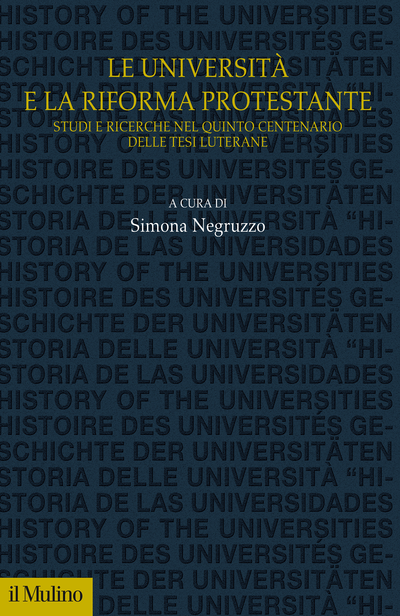
BOOK: Simona NEGRUZZO (a cura di), Le università e la riforma protestante. Studi e ricerche nel quinto centenario delle tesi luterane (Bologna: Il Mulino, 2018). ISBN: 9788815279835, pp. 532, € 29,00

Cover L'università e la Riforma protestante
(Source: Il Mulino)

ABOUT THE BOOK

Nel quinto centenario delle tesi luterane, il Centro interuniversitario per la storia delle università italiane - CISUI ha promosso un'aggiornata riflessione sul rapporto tra Riforma e università, approfondendo, attraverso alcuni esempi indicativi, il significato e le ricadute che i movimenti riformatori ebbero sul sistema d'insegnamento superiore tra medioevo ed età moderna. Come la proposta religiosa di Lutero s'innestò in un clima umanistico-rinascimentale già attraversato da fermenti di rinnovamento, così le riforme provocarono e/o accelerarono un processo di trasformazione dei luoghi d'insegnamento e dei metodi educativi, in parte già in atto. «Universitas semper reformanda»: se fin dalle sue origini, l'istituzione accademica aveva accolto e accompagnato i cambiamenti storici, dal XVI secolo le nuove proposte universitarie s'inserirono nel solco delle riforme religiose e in un contesto culturale, politico, sociale ed economico ormai confessionale. Eredità della Riforma fu la gemmazione, intorno a università «stricto sensu», di istituzioni più o meno deputate a erogare i gradi accademici, ma provviste di insegnamenti «superiori», con finalità esclusivamente professionali non soddisfatte in pieno dagli atenei: le accademie calviniste svizzere e francesi per la formazione dei pastori, i seminari cattolici post-tridentini per la preparazione dei sacerdoti, fino ai «seminaria nobilium» o alle scuole d'ingegneria civile o militare. La Riforma protestante, avviata con Lutero, Zwingli e Calvino, provocò un'autentica rivoluzione dell'ambito educativo che scosse le fondamenta delle comunità accademiche e l'epistemologia di alcune discipline, come l'astronomia o la medicina.

ABOUT THE EDITOR

Simona Negruzzo è professoressa associata presso il Dipartimento di Storia Culture Civiltà dell' Università di Bologna; Settore scientifico disciplinare: M-STO/02 STORIA MODERNA.

TABLE OF CONTENTS

Introduzione, di Simona Negruzzo

Paolo Prodi: dalle «riforme» religiose alle radici del moderno, di Umberto Mazzone

Heidelberg and the Holy See. From the Late Medieval reform councils to the Reformation in the Electoral Palatinate, di Heike Hawicks e Ingo Runde

La réforme des enseignements à l’Université de Wittenberg (1508-1536): une relecture, di Jean-Luc Le Cam Universale Studium Marpurgense. La prima fondazione universitaria della Riforma, di Hans Schneider

Educare la città. Martin Butzer nella Strasburgo d’inizio Cinquecento, di Simona Negruzzo

Between integration and independence: cultural development in 16th century Zurich higher education, di Anja-Silvia Goeing

L’Académie de Calvin à Genève: «Instruire nos enfants afin de les préparer tant au ministère qu’au gouvernement civil», di Béatrice Nicollier

The Lausanne Academy and the origin of the reformed academy model, di Karine Crousaz

Les «petites» académies réformées françaises aux XVIe-XVIIe siècles, di Yves Krumenacker

La lotta dell’università luterana contro spinozismo e pietismo, di Valerio Marchetti

Astronomia e matematica nei primi decenni delle riforme protestante e cattolica, di Luigi Pepe

L’emigrazione religionis causa dall’Italia e gli studi nella Penisola: il caso di uno studente protestante in incognito all’Università di Padova, di Federico Zuliani

La enseñanza del derecho y los Índices de libros prohibidos. Notas para un panorama ibérico, 1583-1640, di Laura Beck Varela

«Un’anatomia dell’anima come esigenza del nuovo individuo». La Scuola di Salamanca e il dibattito teologicogiuridico scaturito dalla Riforma protestante fra XVI e XVII secolo, di Gian Luca D’Errico

A Catholic university fathered by Protestantism? The Jesuits of Vilnius and the Counter-Reformation in the late sixteenth century, di Liudas Jovaiša


More information here

ADVANCE ARTICLE: Warren SWAIN, 'The Great Britain of the South’: the Law of Contract in Early Colonial New Zealand' (American Journal of Legal History)

(image source: Wikimedia Commons)

Abstract:
Some nineteenth century writers like the Scottish born poet William Golder, used the term ‘the Great Britain of the south’ as a description of his new home. He was not alone in this characterisation. There were of course other possible perspectives, not least from the Māori point of view, which these British writers inevitably fail to capture. A third reality was more specific to lawyers or at least to those caught up in the legal system. The phrase ‘the Great Britain of the south’ fails to capture the complexity of the way that English law was applied in the early colony. The law administered throughout the British Empire reflected the common law origins of colonial legal systems but did not mean that the law was identical to that in England. Scholars have emphasised the adaptability of English law in various colonial settings. New Zealand contract law of this time did draw on some English precedents. The early lawyers were steeped in the English legal tradition. At the same time, English authorities were used with a light touch. The legal and social framework within which contract law operated was also quite different. This meant, for example, that mercantile juries were important in adapting the law to local conditions. Early New Zealand contract law provides a good example of both the importance of English law in a colonial setting and its adaptability.
(more information with Oxford Journals)

13 March 2020

CANCELLED AND POSTPONED: Krausisme juridique et politique en Europe (Dijon, 2-3 April)

Due to the COVID19-crisis, the following event has been cancelled and postponed:


(Source : U. Dijon)
When and Where :  -MSH of Dijon, 2 April.
                                  - Amphitéâtre Danube, Campus de Sciences Po Dijon, 3 April.

Programme :
Jeudi 2 avril 2020, Amphi de la MSH :
8h30 : Accueil des participants
9h15-10h30 : Aux origines du krausisme : philosophie du droit et droit naturel
1°) La philosophie du droit de Karl Christian Friedrich Krause et de Heinrich Ahrens
Intervenant : Grégory Lewkowicz (Centre Perelman - Université libre de Bruxelles)
2°) Une réception du droit naturel krausiste en France : Edouard Laboulaye
Intervenant : Tristan Pouthier (CRJ Pothier - Université d’Orléans)
3°) Le droit naturel de Vicente Ferrer Neto Paiva et la réception portugaise du krausisme
Intervenant : Paulo Ferreira da Cunha (Université de Porto)
11h-12h15 : Utilisations et mésusages de la pensée de Krause et d’Ahrens en droits public et civil
4°) A propos de la méconnaissance, du dédain voire du rejet du krausisme par les juristes allemands
du XIX e siècle
Intervenant : Olivier Jouanjan (Institut Villey- Univ. Paris II)
5°) La réforme de l’Etat par les krausistes espagnols au second XIX e siècle
Intervenant : Paul Aubert (TELEMME – Université d’Aix-Marseille)
6°) Krausisme et kantisme dans l’œuvre juridique du Doyen dijonnais Claude-Joseph Tissot
Intervenant : Jean-Jacques Clère (CREDESPO – Université de Bourgogne)
14h15-15h05 : Droit pénal et droit social krausistes
7°) Le droit pénal de Karl Röder
Intervenant : Jean-Louis Halpérin (CTAD – Ecole Normale Supérieure)
8°) Le rôle des krausistes dans l’institution des sciences sociales et la critique du droit libéral
(Espagne, 1880-1910)
Intervenant : Elodie Richard (CNRS)
15h30-16h25 : Concept et réalisations du krausisme politique
9°) Qu’est-ce que le krausisme politique ? Essai de définition à travers l’activité politique d’Ahrens
en tant que député en Allemagne [intervention en anglais]
Intervenant : Wolfgang Forster (Université de Tübingen)
10°) Guillaume Tiberghien et l’Instruction publique
Intervenant : Véronique Dortu (Haute Ecole de Liège)
17h : Fin de la première journée
Vendredi 3 avril 2020, Amphi Danube – campus dijonnais de Sciences Po :
9h00-9h50 : Diffusions d’un message d’espoir
11°) Scruter et répandre « l’époque nouvelle » depuis Prague : la revue Die neue Zeit de Hermann
Karl von Leonhardi
Intervenant : Caroula Argyriadis-Kervégan (CPJP – Université de Cergy-Pontoise)
12°) Le projet européen krausiste
Intervenant : Raphaël Cahen (CORE – Vrije Universiteit de Bruxelles)
Discussion - pause
10h25-12h30 : Réceptions contrastées 1
13°) La réception manquée des krausistes par les proudhoniens et les utopistes français
Intervenante : Aurélie Lahaie (CREDESPO – Université de Bourgogne)
14°) L’actualité de l’idéal krausiste : le programme politique de Ciudadanos dans l’Espagne du
XXI e siècle [visioconférence ou lecture du papier par un tiers ?]
Intervenant : Mathieu Petithomme (CRJFC – Université de Franche-Comté)
15°) Utopies organicistes et régulations corporatistes dans les dissertations doctorales portugaises
du second XIX e siècle : les rêveries krausistes des ministres Mártens Ferrão et Costa Lobo
Intervenant : Oscar Ferreira (CREDESPO – Université de Bourgogne)

JOB OFFERS: City, University of London

The School is seeking to appoint an outstanding academic passionate about providing students with the best possible education and co-curricular experience and enthusiastic about world-leading and internationally excellent research that will advance legal knowledge and practice to the benefit of society.

The School is seeking to appoint up to twelve academic staff at all levels, from new entry positions (including new and emerging academics) through to recognised professorial leaders to work within academic and professional programmes departments. It will consider candidates who have researched, educated or practised in any area of the Law, its theory, processes and practice, although preference will be given to applicants able to contribute to the core subjects of the LLB.

City offers a sector-leading salary, pension scheme and benefits including a comprehensive package of staff training and development.

Closing date for applications: Sunday 5th April 2020

Actively working to promote equal opportunity and diversity.

JOB DESCRIPTIONS/PERSON SPECIFICATIONS:
To view the job description and person specification for Lecturer (Education) positions, please click here: 
https://www.city.ac.uk/__data/assets/pdf_file/0005/520196/CLS-Lecturer-Eduction-JD.pdf

To view the job description and person specification for Lecturer (Education & Research) positions, please click here: 
https://www.city.ac.uk/__data/assets/pdf_file/0019/520192/CLS-Lecturer-Eduction-Research-JD.pdf

To view the job description and person specification for Senior Lecturer / Reader (Education & Research) positions, please click here: 
https://www.city.ac.uk/__data/assets/pdf_file/0003/520194/CLS-SL-R-Eduction-Research-JD.pdf

To view the job description and person specification for Senior Lecturer / Associate Professor (Education) positions, please click here: 
https://www.city.ac.uk/__data/assets/pdf_file/0006/520197/CLS-SL-AP-Eduction-JD.pdf

To view the job description and person specification for Professorial (Education) positions, please click here: 
https://www.city.ac.uk/__data/assets/pdf_file/0004/520195/CLS-Professor-Eduction-JD.pdf

To view the job description and person specification for Professorial (Education & Research) positions, please click here: 
https://www.city.ac.uk/__data/assets/pdf_file/0020/520193/CLS-Professor-Eduction-Research-JD.pdf

APPLICATION PROCEDURE:
To apply for Lecturer (Education) positions, please click here:
https://www2.i-grasp.com/fe/tpl_cityuniversity01.asp?newms=ap&id=115858&aid=18628

To apply for Lecturer (Education & Research) positions, please click here:
https://www2.i-grasp.com/fe/tpl_cityuniversity01.asp?newms=ap&id=115876&aid=18628

To apply for Senior Lecturer / Reader (Education & Research) positions, please click here:
https://www2.i-grasp.com/fe/tpl_cityuniversity01.asp?newms=ap&id=115858&aid=18628

To apply for Senior Lecturer / Associate Professor (Education) positions, please click here:
https://www2.i-grasp.com/fe/tpl_cityuniversity01.asp?newms=ap&id=115878&aid=18628

To apply for Professorial (Education) positions, please click here:
https://www2.i-grasp.com/fe/tpl_cityuniversity01.asp?newms=ap&id=115879&aid=18628

To apply for Professorial (Education & Research) positions, please click here:
https://www2.i-grasp.com/fe/tpl_cityuniversity01.asp?newms=ap&id=115880&aid=18628

GENERAL APPLICATIONS: Please apply via the below url:
https://www2.i-grasp.com/fe/tpl_cityuniversity01.asp?newms=jj&id=115857&aid=18630

Closing date for applications: Sunday 5th April 2020

ABOUT THE ORGANIZATION: Founded in 1894, City, University of London is a global university committed to academic excellence with a focus on business and the professions and an enviable central London location.

City attracts around 20,000 students (over 40% at postgraduate level) from more than 150 countries and staff from over 75 countries.

In the last decade, City has almost tripled the proportion of its total academic staff producing world-leading or internationally excellent research.

Led by President, Professor Sir Paul Curran, City has made significant investments in its academic staff, its estate and its infrastructure and continues to work towards realising its vision of being a leading global university.

The City Law School is unique in attracting significant numbers of students across all stages of legal education. It has a very long history of educating lawyers, judges, policymakers and business leaders dating back to the nineteenth century in the form of the Inns of Court Law School. Alumni include three British Prime Ministers, many of the City of London's most prominent barristers, solicitors and judges; and leaders of a wide variety of business and community organisations.

The School has over 2,500 students enrolled for the Bachelor of Laws, Graduate Diploma in Law (which originated at City), Master of Laws, PhD and on its barrister and solicitor vocational training programmes. It benefits from being a comprehensive law school in the heart of London in close proximity to the courts, leading barristers' chambers and law firms. From 2020/21, City's academic and professional programmes will, for the first time, be housed together in a new building.

A large majority of the School's staff have been practising lawyers and many are leaders in their academic and professional fields. During the next five years the School will increase its academic staff numbers significantly while holding student numbers at current levels. This will allow for improvements in research, education and the student experience; and provides an opportunity for outstanding candidates to join The City Law School at an exciting time in its history.


City, University of London
Legal Academics


The School is seeking to appoint an outstanding academic passionate about providing students with the best possible education and co-curricular experience and enthusiastic about world-leading and internationally excellent research that will advance legal knowledge and practice to the benefit of society.

The School is seeking to appoint up to twelve academic staff at all levels, from new entry positions (including new and emerging academics) through to recognised professorial leaders to work within academic and professional programmes departments. It will consider candidates who have researched, educated or practised in any area of the Law, its theory, processes and practice, although preference will be given to applicants able to contribute to the core subjects of the LLB.

City offers a sector-leading salary, pension scheme and benefits including a comprehensive package of staff training and development.

Closing date for applications: Sunday 5th April 2020

Actively working to promote equal opportunity and diversity.

JOB DESCRIPTIONS/PERSON SPECIFICATIONS:
To view the job description and person specification for Lecturer (Education) positions, please click here: 
https://www.city.ac.uk/__data/assets/pdf_file/0005/520196/CLS-Lecturer-Eduction-JD.pdf

To view the job description and person specification for Lecturer (Education & Research) positions, please click here: 
https://www.city.ac.uk/__data/assets/pdf_file/0019/520192/CLS-Lecturer-Eduction-Research-JD.pdf

To view the job description and person specification for Senior Lecturer / Reader (Education & Research) positions, please click here: 
https://www.city.ac.uk/__data/assets/pdf_file/0003/520194/CLS-SL-R-Eduction-Research-JD.pdf

To view the job description and person specification for Senior Lecturer / Associate Professor (Education) positions, please click here: 
https://www.city.ac.uk/__data/assets/pdf_file/0006/520197/CLS-SL-AP-Eduction-JD.pdf

To view the job description and person specification for Professorial (Education) positions, please click here: 
https://www.city.ac.uk/__data/assets/pdf_file/0004/520195/CLS-Professor-Eduction-JD.pdf

To view the job description and person specification for Professorial (Education & Research) positions, please click here: 
https://www.city.ac.uk/__data/assets/pdf_file/0020/520193/CLS-Professor-Eduction-Research-JD.pdf

APPLICATION PROCEDURE:
To apply for Lecturer (Education) positions, please click here:
https://www2.i-grasp.com/fe/tpl_cityuniversity01.asp?newms=ap&id=115858&aid=18628

To apply for Lecturer (Education & Research) positions, please click here:
https://www2.i-grasp.com/fe/tpl_cityuniversity01.asp?newms=ap&id=115876&aid=18628

To apply for Senior Lecturer / Reader (Education & Research) positions, please click here:
https://www2.i-grasp.com/fe/tpl_cityuniversity01.asp?newms=ap&id=115858&aid=18628

To apply for Senior Lecturer / Associate Professor (Education) positions, please click here:
https://www2.i-grasp.com/fe/tpl_cityuniversity01.asp?newms=ap&id=115878&aid=18628

To apply for Professorial (Education) positions, please click here:
https://www2.i-grasp.com/fe/tpl_cityuniversity01.asp?newms=ap&id=115879&aid=18628

To apply for Professorial (Education & Research) positions, please click here:
https://www2.i-grasp.com/fe/tpl_cityuniversity01.asp?newms=ap&id=115880&aid=18628

GENERAL APPLICATIONS: Please apply via the below url:
https://www2.i-grasp.com/fe/tpl_cityuniversity01.asp?newms=jj&id=115857&aid=18630

Closing date for applications: Sunday 5th April 2020

ABOUT THE ORGANIZATION: Founded in 1894, City, University of London is a global university committed to academic excellence with a focus on business and the professions and an enviable central London location.

City attracts around 20,000 students (over 40% at postgraduate level) from more than 150 countries and staff from over 75 countries.

In the last decade, City has almost tripled the proportion of its total academic staff producing world-leading or internationally excellent research.

Led by President, Professor Sir Paul Curran, City has made significant investments in its academic staff, its estate and its infrastructure and continues to work towards realising its vision of being a leading global university.

The City Law School is unique in attracting significant numbers of students across all stages of legal education. It has a very long history of educating lawyers, judges, policymakers and business leaders dating back to the nineteenth century in the form of the Inns of Court Law School. Alumni include three British Prime Ministers, many of the City of London's most prominent barristers, solicitors and judges; and leaders of a wide variety of business and community organisations.

The School has over 2,500 students enrolled for the Bachelor of Laws, Graduate Diploma in Law (which originated at City), Master of Laws, PhD and on its barrister and solicitor vocational training programmes. It benefits from being a comprehensive law school in the heart of London in close proximity to the courts, leading barristers' chambers and law firms. From 2020/21, City's academic and professional programmes will, for the first time, be housed together in a new building.

A large majority of the School's staff have been practising lawyers and many are leaders in their academic and professional fields. During the next five years the School will increase its academic staff numbers significantly while holding student numbers at current levels. This will allow for improvements in research, education and the student experience; and provides an opportunity for outstanding candidates to join The City Law School at an exciting time in its history.

12 March 2020

BOOK: Drew D. GRAY, Prosecuting Homicide in Eighteenth-Century Law and Practice (London: Routledge, 2020). ISBN 9780367460099, £120.00


(Source: Routledge)

Routledge has published a new book on homicide and the law in 18th century England.

ABOUT THE BOOK

This volume uses four case studies, all with strong London connections, to analyze homicide law and the pardoning process in eighteenth-century England. Each reveals evidence of how attempts were made to negotiate a path through the justice system to avoid conviction, and so avoid a sentence of hanging. This approach allows a deep examination of the workings of the justice system using social and cultural history methodologies. The cases explore wider areas of social and cultural history in the period, such as the role of policing agents, attitudes towards sexuality and prostitution, press reporting, and popular conceptions of "honorable" behavior. They also allow an engagement with what has been identified as the gradual erosion of individual agency within the law, and the concomitant rise of the state. Investigating the nature of the pardoning process shows how important it was to have "friends in high places," and also uncovers ways in which the legal system was susceptible to accusations of corruption. Readers will find an illuminating view of eighteenth-century London through a legal lens.

ABOUT THE AUTHOR

Drew D. Gray is the head of Humanities at the University of Northampton.

TABLE OF CONTENTS 

1. Introduction and Themes
2. "Mercy Without Justice"? Press Criticism of the Pardoning Process in Late Eighteenth-Century London: The Kennedy Case of 1770
3. "There Goes Clarke, That Blood-Selling Rascal": Murder, Revenge and the Crowd in Early 1770s Spitalfields
4. The Royal Duchess and the Apothecary’s Son: Homicide, Communal Prejudice and Pleading for Pardon in Provincial England
5. Sex, Scandal and Strangulation: The Strange Case of Francis Kotzwara and Susannah Hill
6. Conclusions

More info here


BOOK: Intisar A. RABB & Abigail KRASNER BALBALE (eds.), Justice and Leadership in Early Islamic Courts [Harvard Series in Islamic Law, 7] (Cambridge (Mass.): Harvard University Press, 2017), 260 p. ISBN 9780674984219, € 40,5

(image source: Harvard UP)

Abstract:
This book presents an in-depth exploration of the administration of justice during Islam’s founding period, 632–1250 CE. Inspired by the scholarship of Roy Parviz Mottahedeh and composed in his honor, this volume brings together ten leading scholars of Islamic law to examine the history of early Islamic courts. This approach draws attention to both how and why the courts and the people associated with them functioned in early Islamic societies: When a dispute occurred, what happened in the courts? How did judges conceive of justice and their role in it? When and how did they give attention to politics and procedure? Each author draws on diverse sources that illuminate a broader and deeper vision of law and society than traditional legal literature alone can provide, including historical chronicles, biographical dictionaries, legal canons, exegetical works, and mirrors for princes. Altogether, the volume offers both a substantive intervention on early Islamic courts and on methods for studying legal history as social history. It illuminates the varied and dynamic legal landscapes stretching across early Islam, and maps new approaches to interdisciplinary legal history.
(more information with Harvard University Press)

11 March 2020

BOOK: Feisal G. MOHAMED, Sovereignty: Seventeenth-Century England and the Making of the Modern Political Imaginary (Oxford: Oxford University Press, 2020). ISBN 9780198852131, $70.00


(Source: OUP)

Oxford University Press is publishing a new book on 17th century English political thought.

ABOUT THE BOOK

This book argues that sovereignty is the first-order question of political order, and that seventeenth-century England provides an important case study in the roots of its modern iterations. It offers fresh readings of Thomas Hobbes, John Milton, and Andrew Marvell, as well as lesser-known figures and literary texts. In addition to political philosophy and literary studies, it also takes account of the period's legal history, exploring the exercise of the crown's feudal rights in the Court of Wards and Liveries, debates over habeas rights, and contests of various courts over jurisdiction. Theorizing sovereignty in a way that points forward to later modernity, the book also offers a sustained critique of the writings of Carl Schmitt, the twentieth century's most influential, if also most controversial, thinker on this topic.

ABOUT THE AUTHOR

Feisal G. Mohamed, Professor in the PhD Program in English and Coordinator of The Program in Global Early Modern Studies, The Graduate Center, CUNY

Feisal G. Mohamed is Professor of English at The Graduate Center, CUNY, where he also serves as coordinator of The Program in Global Early Modern Studies. His previous books include In the Anteroom of Divinity: The Reformation of the Angels from Colet to Milton (2008) and Milton and the Post-secular Present: Ethics, Politics, Terrorism (2011). He is a past recipient of a Mellon Foundation New Directions Fellowship, which provided second-discipline training in law.

TABLE OF CONTENTS

Introduction
The Crown as Machine: Hobbes and Lord Saye
Provincializing Romance
Milton's Unitary Sovereignty
Marvell's Dread of the Sword
Epilogue: Uzzah and the Protection-Obedience Axiom

More info here

BOOK: Mark D. WEST, Drunk Japan Law and Alcohol in Japanese Society (Oxford: Oxford University Press, 2020). ISBN 9780190070847, $74.00


(Source: OUP)

Oxford University Press is publishing a new book on the history of law and alcohol in Japanese society.

ABOUT THE BOOK

Each society that consumes alcohol has its own unique drinking culture, and each society deals with the drunken products of that culture in particular    ways.

As Mark D. West shows in Drunk Japan, the distinctive features of Japanese drinking culture and its intoxication-related laws are not simply interesting in and of themselves, but offer a unique window into Japanese society more broadly. Drawing upon close readings of over 5,000 published Japanese court opinions on drunkenness-related cases, he provides a rich description of Japanese alcohol consumption, drinking culture, and intoxication. West reveals that the opinions not only show patterns in what, where, and why people drink in Japan, but they also focus to a surprising extent on characteristics (including occupation, wealth, gender, and education) of individual litigants. By examining the consistencies and contradictions that emerge from the cases, West finds that, at its most extreme, the Japanese legal system is hyper-individualized. Focusing on individual people sometimes leads courts to ignore forensic evidence, to rely on post-arrest drinking tests, and to calculate prison sentences based on factors such as a mother's promise to help her adult child abstain.            

Cumulatively, the colorful and often tragic cases West uses not only illuminate the complexity of the culture, but they also reveal an entirely new vision of Japanese law and a comprehensive picture of alcohol use in Japanese society writ large.

ABOUT THE AUTHOR

Mark D. West is the Nippon Life Professor of Law and Dean of the University of Michigan Law School.

TABLE OF CONTENTS

Explanatory Notes
Acknowledgments
Preface
1. Drinker's Paradise?
2. How to Drink in Japan
3. Drunk Crimes
4. Drunk Driving
5. Drunk Others
6. Punishing the Drunk
7. Drunk in Society
8. Conclusion
Notes
Index

More info here