Search

10 May 2022

SEMINAR SERIES: Law, History and Visual Culture Seminar Series - Every Thursday online from 26th May to 23rd June, 3:00-6:30 pm BST (Online)


Law, History and Visual Culture Seminar Series

Every Thursday online from 26th May to 23rd June, 3:00-6:30 pm BST 


This five part seminar series encourages and facilitates the growing interest in the interdisciplinary field of law, history and visual culture. As such, these reflections break away from the traditional view of law as an image-less, a text-based discourse.  Registration for each event can be found in the links below:


Seminar 1: Art, Law and Social Justice (Thursday 26 May 3:00-6:30 pm BST)


Pierangelo Blandino (University of Lapland)

Through a Legal Lens: Law, History, and Visual Culture


Elena Cooper (University of Glasgow)

Art, Copyright and Justice in the Nineteenth Century: Connecting Abraham Solomon’s ‘Waiting for the Verdict’ and ‘Not Guilty’ (1857) to Graves’ Case (1869)


Marcus V. A. B. De Matos (Brunel University London)

The Shadows of Modern State Law: a Visual Genealogy of Dark Knights


Sophie Doherty (Dublin City University)

What does Justice in the Aftermath of Sexual Violence look like?


Benjamin Goh (London School of Economics)

Perceiving Breitkopf Fraktur


Jack Quirk (Brown University)

Animus Possidendi: Nation Building and Settler Colonial Aesthetics


Seminar 2: Reflections of Law and Legal Prisms (Thursday 2 June 3:00-6:30 pm BST)


Agnes Barr-Klouman (University of Ottowa)

Mapping the Free North: Law, Geography, and Cartography in Early Canadian Arctic Sovereignty Claims


Zeynep Devrim Gürsel (Rutgers)

Portraits of Unbelonging: Photography, the Ottoman State and Armenian Expatriation


Matheus Gobbato Leichtweis and Davi Perin Adorn (Federal University of Rio Grande do Sul)

Law, History and Visual Culture: Critical Reflections from Brazil and Ideas for a New Research Agenda


Elizabeth Rajapakshe (University of Peradeniya)

The Images of Japanese Juvenile Law in Television: An Analysis of ‘Reiko to Reiko’ and ‘Hanzai Shokogun’


Joan Torrents Juncà (Universitat Autònoma de Barcelona)

A Weapon to Cut the ‘Plug’: The Visual Discourse on the Law of Incompatibilities During the Second Spanish Republic (1931-1936)


Li Zheng (Ecole des Hautes Etudes en Sciences Sociales/Max Planck Institute for Legal History and Legal Theory)

Seeing Law Through the Legal Costumes in Modern China


Seminar 3: Visual Evidence in Law and Legal Processes (Thursday 9 June 3:00-6:30 pm BST)


Thomas Giddens (University of Dundee)

Touching the Images of Judgment


Johannah Latchem (University of Oxford)

My Bloody Oar: Law’s Materials Reimagined in Contemporary British Art


Craig Newberry-Jones (University of Exeter)

‘The Jolly Young Barrister’: The Visual Representation of the Bar in the Popular Illustrated Press of the Nineteenth Century


Gee Semmalar (University of Kent)

The Evidencing of Difference: Caste, Gender and Ethnographic Photography in 19th c British India


Jennifer Tucker (Wesleyan University)

Moving Beyond the 'Mug Shot': Expanding the Frame for Considering how Photographs were used as Metropolitan and Colonial Evidence in Britain in the 1860s and 1870s


Diana Volonakis (Northumbria University)

Agents of the Law and the Court as Depicted by Press Photography in The New York World, 1922-1927


Seminar 4: Visualising Law in Society (Thursday 16 June 3:00-6:30 pm BST)


Patrick Brian Smith (University of Warwick)

Mediated Forensics: Visual Cultures of Resistance


Anat Rosenberg (Reichman University)

Ways of Seeing Advertising: Law and the Making of Visual Commercial Culture


Chris Ashford (Northumbria University)

Legal Perspectives on Visualising Queer Sex: Case Studies from Queer Theatre 1973-2019


Teresa Sutton (University of Sussex)

Ecclesiastical Exemption, Visual Culture and the Law


Lara Tessaro (University of Kent)

‘No Ban on Romance!’: Materializing Cosmetics through Product Labels, 1947-1960


Giulia Walter (University of Zurich) and Filippo Contarini (University of Lucerne)

Fabrizio De André’s Storia di un Impiegato


Seminar 5: Visual Legal Iconography (Thursday 23 June 3:00-6:30 pm BST)


Valentin Jeutner (Lund University)

The Relation between Law, Aesthetics and Empathy


Amanda Perry-Kessaris (University of Kent)

Will Future Legal Histories be more Visual?


Nicholas Mignanelli (Yale University)

The Lost Swedish-Language Minnesota Practice Rules of John B. West


Daniel Quiroga (Graduate Institute, Geneva)

‘Architects of the Better World’: The Birth of the International Conference Complex (1918-1998)


Katharina Isabel Schmidt (Max Planck Institute for Comparative and International Private Law)

Nazi Law and Visual Culture in the Exhibition ‘Das Recht’ (1936)


Grigorij Tschernjawskyj (Max Planck Institute for Legal History and Legal Theory)

Of Mirrors and Hammers: Women in Law and in Art of the Weimar Republic (1918–1933)


CONFERENCE: Das Juristische Buch im Mittelalter. Paläographische und Philologische Aspekte der Überlieferung der juristischen lateinischen Literatur (Max Planck Institute for Legal History and Legal TheorY, 10-12 MAY 2022)

(Image source: MPI - LHLT)


The symposium aspires to provide an up-to-date overview of the research on juristic literature and on specific groups of manuscripts from various periods from late antiquity to the fifteenth century. Included in this broader objective are methodological essays from the fields of paleography and codicology as well as questions of textual criticism and considerations that draw upon databases and on-line resources. Among the issues to be given special attention are juristic books from the late antique period, Roman and Lombard law in the early Middle Ages, twelfth- and thirteenth-century glossators of Roman and canon law, the transmission of juristic texts in the fourteenth century, and book production for the universities of the fifteenth century. It is also planned to collect the papers and many of the illustrations presented at the symposium in a volume that will also be useful as a reference work on the subject.

The symposium will be held at the Max Planck Institute for Legal History and Legal Theory and it's organized by Antonio Ciaralli, Vincenzo Colli and Gero Dolezalek


***

Dienstag, 10. Mai 2022 (Raum Z01)
14:30 – 15:00 – Ankunft und Registrierung – Kaffee
15:00 – 15:15 – Begrüßung durch Stefan Vogenauer
15:15 – 15:30 – Gero Dolezalek, Antonio Ciaralli, Vincenzo Colli, Einführung 

Abschnitt I: Das juristische Buch von der Spätantike bis ins 12. Jh.
15:30 – 16:15 – Serena Ammirati (Roma): Per una storia del libro antico: osservazioni paleografiche e codicologiche sui manoscritti latini di argomento giuridico dalle origini alla tarda antichità
16.15 – 17:00 – Wolfgang Kaiser (Freiburg i. B.): Überlieferung und Textkritik der Digesten Justinians
17:00 – 17:30 – Kaffeepause
17:30 – 18:15 – Antonio Ciaralli (Perugia): La partecipazione dei pratici del diritto alla trasmissione delle leggi
18.15 – 19:00 – Charles Radding (Chicago): Making the transition from Lombard to Roman law: the Walcausina manuscripts and Köln W 328
19:00 – 20:00 – Abendessen mit Buffet im Institut (in der Lobby)
20:00 – 21:00 Magnus Ryan (Cambridge): Lombarda Glosses and Early Feudal Law

Mittwoch, 11. Mai 2022 (Raum Z01)

Abschnitt II: Schreiber und Studenten im Spätmittelalter
9:30 – 10:15 – Nicoletta Giovè (Padova): I copisti dei manoscritti giuridici: il caso degli studenti (e dei professori) universitari
10:15 – 11:00 – Elisabetta Caldelli (Caserta): Quattro passi tra i manoscritti giuridici di età umanistica
11:00 – 11:30 Kaffeepause

Abschnitt III: Kanonistische und romanistische Literatur des 12. und 13. Jhs.
11:30 – 12:15 – Anders Winroth (Oslo): The many philological problems of editing Gratian’s Decretum
12:15 – 13:00 – Danica Summerlin (Sheffield): Old law, new collections: decretals & old law in canonical collections, 1140-1234
13:00 – 14:00 Mittagspause (Imbiss in der Lobby): 
14:00 – 14:45 – Gero Dolezalek (Leipzig): Frühe Glossierung bei Texten Justinians, als noch nicht die Glossen von Irnerius dominierten
14:45 – 15:30 – Emanuele Conte (Roma): Forma Iuris Medii Aevi. Per una nuova mappa geografica e concettuale della letteratura giuridica tra 1130 e 1234
15:30 – 16:00 Kaffeepause

Abschnitt IV: Die Überliefung von Werken spätmittelalterlicher Juristen
16:00 – 16:45 Susanne Lepsius (München): Bischöfe als Leser von Bartolus von Sassoferrato
16:45 – 17:30 Vincenzo Colli (Frankfurt/M.): L’autore e il suo testo. Giuristi tra Due e Trecento: prassi scrittorie e composizione delle opere
19:00 – Abendessen im Lokal (Restaurant Taboo, Unterlindau 69)

Donnerstag, 12.05.2022 (Raum Z01)

Abschnitt V: Digital Humanities und Datenbanken
9:30 – 10:15 Lucia Pinelli (Firenze): Leggere banche dati on-line. Mirabile nel panorama delle risorse per gli studi medievistici
10:15 – 11:00 Gero Dolezalek (Leipzig): Die Datenbank Manuscripta Juridica
11:00 – 11:30 Kaffeepause
11:30 – 12:30 – Abschliessende Diskussion: Forschungsperspektiven und -projekte

More information can be found here.


09 May 2022

CFP: Natural law and domestic government. Transformative legal theory in Early Modern Europe - Leuven, 27-28 April 2023 (Deadline: 1 June 2022)


(Ambrogio Lorenzetti - Allegory of Good Government. 


Natural law and domestic government

Transformative legal theory in Early Modern Europe

Leuven – 27-28 April 2023

The Early Modern natural law tradition as received from Antiquity and the Middle Ages was in many senses a bridging paradigm. While natural law had been a significant subject of debate among late-medieval theologians, civilians and canonists, it gained a far more central role in legal theory and scholarship from the sixteenth century onwards, in the writings of theologians and jurists alike. As natural law discourse developed over its Early Modern lifespan, it increasingly started to acquire the trappings of a legal theory – underpinning concrete legal notions and offering a paradigm which could be applied to a variety of legal domains and facts. By the early seventeenth century, it had become a major vehicle for conceptions, principles and institutions of law, relating to both private transactions and public governance.

This emergence of natural law as legal theory coincided with the emergence of one legal field to which it would be readily applied; the sphere of the state or the domain of domestic public law. In another sense, it was precisely the growing autonomy and importance of public law and the need for a legal theory underpinning it (as the classic Roman law texts provided insufficient textual support and canon law lost its universality), which fed the rise of legal natural law thinking. This intimate link between natural law and the sphere of domestic governance is made manifest especially in the first modern theories of the polity, where i.a. the articulation of the idea of a state of nature is closely tied together with the Catholic notion of natural rights. It is around this link and its two components that this two-day conference revolves.

We hence especially welcome contributions dealing with the role of natural law in the development of domestic public law in the 16th and 17th centuries (with the possibility to accommodate papers on Early Modern subjects set in the 18th century, before 1789). Subjects of private law with a meaningful link to questions of domestic governance within the outlined period are also welcomed. After all, e.g. the all-important natural law notion of private property was at least in part developed as a premise for theories of the state. Likewise, contributions dealing with the development of domestic public law as a scientific discipline in general will also be considered.

Potential participants are to send in a summary of the proposed paper (200-400 words) to naturallawconference@kuleuven.be by 1 June, 2022, also including their academic affiliation and a brief cv (max. 200 words). A maximum of twenty participants will be chosen from among the applicants by the selection committee. Full manuscripts will be required by the start of the conference. The contributions of the participants will, after a peer-reviewing process, be published as a collection volume at an internationally reputed publishing house. Professors Annabel Brett (University of Cambridge) and Marie Seong-Hak Kim (St. Cloud State University) will deliver the keynote addresses.


The conference organisers,

Wouter Druwé, Randall Lesaffer and Geert Sluijs

REMINDER: Respect the instructions for blog proposals


 This is a kind reminder to respect the instructions for proposed announcements:

(1) Send an MS Word or RTF-version

(2) Join an image


The ESCLH Blog works with volunteers. It is possible that your announcement does not appear within two or three days, but rather within a week. 

06 May 2022

CONFERENCE: Internationale rechtshistorische dagen // Journées internationales d’histoire du droit et des institutions (Middelburg, 28 May 2022)


Les journées internationales d’histoire du droit et des institutions 2022 auront lieu à Middelbourg (Middelburg), 28 mai 2022 et seront consacrées au thème de L’Art et le Droit. Vous pouvez trouver le programme ci-dessous. 

De internationale dagen 2022 van de Société d’histoire du droit et des institutions des pays flamands, picards et wallons zullen op 28 mei 2022 in Middelburg plaatsvinden. Het thema is : « l’Art et le Droit (“Kunst en Recht”). Hieronder vindt u het programma terug. 


***

MIDDELBOURG, le 28 mai 2022
« L’Art et le Droit »


09:15   Emese VON BÓNÉ (Erasmus Universiteit Rotterdam, Présidente de la Société d'histoire du droit et des institutions des pays flamands, picards et wallons) : Accueil et Introduction aux journées internationales d'histoire du droit et des institutions

09:30-10:30 Tanguy Le Marchadour

  • Catherine LECOMTE (Versailles), Le Droit dans les Peintures de la Galerie des Glaces a Versailles
  • Jules FOURNEL (Université Paris Nanterre), Quelques observations sur les possibilités d'une analyse méta-théorique et artistique de la pensée juridique.
  • Ronan BRETEL (Paris II), L'art et les enchères: métonymie et hypermétropie du droit français du marché de l'art - Perspectives historiques
  • Francois-Xavier GERVASONI (Besançon), Le Procès, mise en scène du tragique

10:30-10:45 Discussion

10:45-11:00 Café

11:00-12:00 Paul Nѐve

  • Amber GARDEYN (Gent), Nazi looted art in Belgium: an archival study into the Belgian practice in the postwar era
  • Stefano CATTELAN (VUB Bruxelles), Art, Law and Sea Power in the Early Modern Age
  • Tim LUBBERS (Leyde), Art for the Court: A new interpretation of Gerard de Lairesse’s paintings for the Court of Appeal of Holland (1688-1689)
  • Louise TESTOT-FERRY (Toulouse 1 Capitole), Le souci de l’image ou la réception allégorique des symboles de la Justice. Le legs antique dans les attributs vu au travers de dessins et gravures du XVIe au XVIIIe siècle

12:00-12:15 Discussion

12:15-13:00 Jeroen Chorus

  • Niels FIEREMANS (Gent), The Last Judgement of Portinari. Litigation Strategies in the Case of the Burgundian Galleys
  • Paulien WYMEERSCH (Gent), The Advocate and Death: Rubens’ drawing after Holbein’s woodcut
  • Marco in ‘t VELD (VUB Bruxelles), The Art of Rhetoric in Mercantile Customary Law

13:00-13:15 Discussion

13:15   Assiette froide composée (sur place) – pour les personnes préalablement inscrites

14:15-15:45 Georges Martyn

  • Fred STEVENS (Leuven), De galeislaven van Antwerpen (1880) van Hendrik Shaefels: getuigen van een realiteit?   
  • Jan DE PUTTER, Van den Vos Reynaerde, Straf en Verzoening

15:45-15:00 Discussion

15:00 Emese VON BÓNÉ (Présidente de la Société), Conclusions et clôture des Journées internationales d'histoire du droit et des institutions

Suivies de l’Assemblée générale de la Société et Visite au musée de Zélande.


Further information can be found here.


05 May 2022

BOOK: Scott JACQUES, Philip SCHOFIELD (eds.), Jeremy Bentham on Police. The unknown story and what it means for criminology (London: UCL Press, 2021), ISBN: 9781787356177 OPEN ACCESS

(Image source: UCL Press)


ABOUT THE BOOK

Jeremy Bentham’s ideas on punishment are famous. Every criminology student learns about Bentham, and every criminologist contends with him, as advocate or opponent. This discourse concerns his ideas about punishment, namely with respect to legislation and the panopticon. Yet, scholars and students are generally ignorant of Bentham’s ideas on police. Hitherto, these ideas have been largely unknowable. Now, thanks to UCL’s Bentham Project, these ideas are public. Jeremy Bentham on Police celebrates this achievement by exploring the story of Bentham’s writings on police and considering their relevance to the past, present and future of criminology. After Scott Jacques introduces the book, the Director of the Bentham Project, Philip Schofield, describes and explains how it works. Then Michael Quinn, who brought together Bentham’s writings on police, delves into the personal and socio-historical background in which they were created. An extract follows, representing the most (criminologically-)relevant passages from Bentham’s police writings. Finally, a rich variety of scholars offer their thoughts on what those writings mean for criminology. These contributions come from Anthony A. Braga, Ronald Clarke, David J. Cox, Stephen Douglas, Stephen Engelmann, G. Geltner, Joel F. Harrington, Jonathan Jacobs, Paul Knepper, Gloria Laycock, Gary T. Marx, Daniel S. Nagin, Graeme R. Newman, Pat O’Malley, Eric L. Piza, Kim Rossmo, Lucia Summers and Dean Wilson.


ABOUT THE EDITORS

Scott Jacques is Director of Criminology Open, and Professor of Criminal Justice and Criminology at Georgia State University.

Philip Schofield is Director of the Bentham Project, Faculty of Laws, UCL, and General Editor of the new authoritative edition of The Collected Works of Jeremy Bentham.


TABLE OF CONTENTS

Part I: Chapters

1. The Story of Jeremy Bentham on Police: Bridging the Bentham Project to Criminology (Scott Jacques)
2. Jeremy Bentham, the Bentham Project and The Collected Works of Jeremy Bentham (Philip Schofield)
3. Bentham on Preventive Police: The Calendar of Delinquency in Evaluation of Policy, and the Police Gazette in Manipulation of Opinion (Michael Quinn)

Part II: Extracts

4. Extracts from Jeremy Bentham’s Board-of-Police Bill (Jeremy Bentham, Selected and edited by Philip Schofield and Scott Jacques)

Part III: Comments

  • The Influence of Bentham on the Development of Focused Deterrence (Anthony A. Braga and Stephen Douglas)
  • Regulating Crime and the International Crime Drop (Ronald Clarke)
  • ‘An Attention to Domestic Quiet’: A Comparative Commentary on the Originality or Otherwise of Bentham’s Views and Writings on Preventive Policing and the Police Gazette (David J. Cox)
  • Bentham’s Virtue (Stephen Engelmann)
  • On Policing Before Bentham: Differences in Degree and Differences in Kind (G. Geltner)
  • Bentham’s England and the Longue Durée of Preventive Policing (Joel F. Harrington)
  • Bentham on the Complex Role of Police (Jonathan Jacobs)
  • Bentham and Historical Criminology (Paul Knepper)
  • Bentham: The First Crime Scientist? Gloria Laycock)
  • Bentham on Modern Social Control: Prescient, Clairvoyant, Prescient, and More (Gary T. Marx)
  • Utilitarianism and Policing in the US (Daniel S. Nagin)
  • Bentham in the Weeds (Graeme R. Newman)
  • A Genealogy of Bentham’s Preventive Policing (Pat O’Malley)
  • Bentham on Crime Analysis and Evidence-Based Policing (Eric L. Piza)
  • Bentham and the Philosophical Nature of Preventive Policing (Kim Rossmo and Lucia Summers)
  • Bentham in the Colonies (Dean Wilson)


More information can be found here. The entire publication can be read and downloaded at this link.

04 May 2022

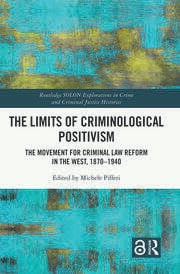
BOOK: Michele PIFFERI (Ed.), The Limits of Criminological Positivism. The Movement for Criminal Law Reform in the West, 1870-1940 (London: Routledge, 2022). ISBN: 9780367340599, pp. 202, £96.00

ABOUT THE BOOK

The Limits of Criminological Positivism: The Movement for Criminal Law Reform in the West, 1870-1940 presents the first major study of the limits of criminological positivism in the West and establishes the subject as a field of interest.

The volume will explore those limits and bring to life the resulting doctrinal, procedural, and institutional compromises of the early twentieth century that might be said to have defined modern criminal justice administration. The book examines the topic not only in North America and western Europe, with essays on Italy, Germany, France, Spain, the United Kingdom, Belgium, and Finland but also the reception and implementation of positivist ideas in Brazil. In doing so, it explores three comparative elements: (1) the differing national experiences within the civil law world; (2) differences and similarities between civil law and common law regimes; and (3) some differences between the two leading common-law countries. It interrogates many key aspects of current penal systems, such as the impact of extra-legal scientific knowledge on criminal law, preventive detention, the ‘dual-track’ system with both traditional punishment and novel measures of security, the assessment of offenders’ dangerousness, juvenile justice, and the indeterminate sentence. As a result, this study contributes to a critical understanding of some inherent contradictions characterizing criminal justice in contemporary western societies. Written in a straight-forward and direct manner, this volume will be of great interest to academics and students researching historical criminology, philosophy, political science, and legal history.

ABOUT THE EDITOR

Michele Pifferi is Professor of Legal History at the University of Ferrara, Law Department. He has been Visiting Researcher at the Max-Planck-Institute for Legal History and Legal Theory in Frankfurt am Main; Emil Noël Fellow at NYU School of Law; Robbins Fellow at Berkeley UC—School of Law; Academic Visitor at the Oxford Centre for Criminology; and Alexander von Humboldt Research Fellow at the University of Hamburg, Faculty of Law. He is currently Alexander von Humboldt Research Fellow at the Humboldt Universität zu Berlin, Faculty of Law as well Principal Investigator of a research project on Legal History and Mass Migration: Integration, Exclusion, and Criminalization of Migrants in the 19th and 20th Century. Member of the Editorial Board of the series Rechtsgeschichte und Rechtsgeschehen —Italien (LIT Verlag), and of Quaderni fiorentini per la storia del pensiero giuridico moderno. His research interests focus on history of late medieval to late modern criminal justice, history of criminology, and history of migration law.

TABLE OF CONTENTS

Introduction. An Historiographical Reassessment of Criminological Positivism

Michele Pifferi


Scientist Utopia and Reactionary Nostalgia: Criminal Procedure and the Early Positivist School

Marco Nicola Miletti


Penal Reform in Imperial Germany: Conflict and Compromise

Richard F. Wetzell


The French Judicial and Political Origins of Raymond Saleilles’ Individualization of Punishment

James M. Donovan


The Influence of Positivism in Belgium: An Eclectic Compromise Between Adhesion and Resistance

Yves Cartuyvels


The Limits of Positivism: Finnish Criminal Law Scholarship and the European Context at the Turn of the Twentieth Century

Heikki Pihlajamäki


From the Sacred Springtime of Criminal Law to the Limits of Criminological Positivism in Spain

Enrique Roldán Cañizares


Fascist Italy’s Juvenile Courts in Their Infancy: First Impressions

Paul Garfinkel


Responding to the Problem of Crime: English Criminal Law and the Limits of Positivism, 1870-1940

Lindsay Farmer


Positivism’s Humbugs: Criminology and its Cranks in Progressive America

Susanna Blumenthal


Limits and displacements in the adoption of criminological positivism in Brazil (1890-1940)

Ana Lucia Sabadell and Dimitri Dimoulis


From Responsibility to Dangerousness? The Failed Promise of Penal Positivism

Michele Pifferi


Index


More information with the publisher.

03 May 2022

SEMINAR: I carteggi come fonte per la storia diplomazia. Seminario del Centro di Ricerca sugli Epistolari del Settecento (C.R.E.S.), IX ciclo, Università degli Studi di Verona - 4 maggio 2022, ore 14.30


(Source: Academia)

PROJECT INFORMATION: Continuity and Discontinuity of Pre-war Legal Systems in the Post-war Successor States (1918–1939)

(Source: Visegrad Fund)

Continuity and Discontinuity of Pre-war Legal Systems in the Post-war Successor States (1918–1939)

Legal historical research with the support of Visegrad Grants. The commitments focus on the support area “Culture and Common Identity” and consist of three elements:

1. English language collection of texts from the most important sources of Czechoslovak, Hungarian and Polish legal systems in the interwar period; 2. online series of webinars about the legal culture and codification movements of Czechoslovakia, Hungary, and Poland in the interwar period; 3. conference and volume of publications with the title of “Difficult heritage: interwar codification movement in Central and Eastern Europe (1918-1939)”.

Visegrad Grant No. 22030159.

The objective of the project is to integrate the Czech, Polish, Slovak, and Hungarian academic community around the issues of the legal heritage of the interwar period and to popularize joint research on this issue. This heritage can be described as difficult, because after the end of World War I, the countries of Central Europe faced the necessity of either building new legal systems or thoroughly rebuilding the existing ones. The axis of these activities was therefore the confrontation of the needs of the interwar period with the legal heritage from before 1918, generating problems regarding the continuity and discontinuity of pre-war legal systems. While research on the legal codifications of individual countries of the V4 is already far advanced, there are still no comparative approaches that would make it possible to identify the similarities and differences in the legal heritage of these countries. The research questions include, in particular, whether there are any similarities and what the differences were in dealing with problems with the codification of law in the countries of the V4 in the interwar period. It is also necessary to undertake efforts to popularize the legal identity of V4 countries through access to English-language open lectures devoted to this subject. In the dynamics of research and the dissemination of knowledge about the legal culture and identity of the V4 countries, an invaluable help will be the action of translating important interwar legal acts into English and ensuring access to them in an open access format (www.iura.uj.edu.pl). 

The project is coordinated by the Faculty of Law and Administration of the Jagiellonian University (Poland). The Faculty of Law of the University of Trnava (Slovakia) and the Faculty of Law and Political Sciences of the University of Szeged (Hungary) also participate. In the project, we have translated several Polish, Czech, Slovak, and Hungarian legislative acts from the interwar period, which can be found on this link. As a part of the project, we have made webinars as well, which represent topics from the legal history of the participant countries. In order to watch them, please follow this link to the website.

More information is available on the project website: 

http://www.wyznaniowe.law.uj.edu.pl/visegrad.

The project is co-financed by the Governments of Czechia, Hungary, Poland and Slovakia through Visegrad Grants from International Visegrad Fund. The mission of the fund is to advance ideas for sustainable regional cooperation in Central Europe.

LECTURE: Renaissance Florence and the Origins of Capitalism: A Business History Perspective (Law and History Workshop, 10 May 2022, Stanford-ONLINE)


We learned that the last seminar of the Law and History Workshop organized by the Stanford Center for Law and History will be held on Tuesday, May 10, from 12:45-2:00PM (Pacific) in Room 320D, Stanford Law School, and via Zoom. 

Francesca Trivellato, Institute for Advanced Study, School of Historical Studies will present, “Renaissance Florence and the Origins of Capitalism: A Business History Perspective.” Professor Trivellato will present in-person but participants will be able to attend either in-person or online. 

Please RSVP by Monday, May 2. To RSVP, click here. Those who confirm their attendance will receive a separate email containing the paper and link to the event after the RSVP deadline.

For those who attend in-person, however, lunch will be provided at 12:25PM, 20 minutes before the workshop at Room 320D. We also ask all those who attend in-person to comply with current Stanford event guidelines which can be found here.


ABSTRACT

From the 1940s to the 1970s, the commercial revolution of the Middle Ages was a historiographical concept with considerable traction. This article revisits the literature that brought about and engaged with that concept, with specific reference to Florence. In so doing, it draws attention to the place once held by business history in the study of Europe’s takeoff. It also discusses the preliminary results of an ongoing project on limited partnerships in early modern Tuscany, which reaffirms the relevance of business history for understanding preindustrial economies but steers away from a teleological search for the origins of modern capitalism.


More information can be found here.


02 May 2022

CFP: Legal orders under pressure: Non-Western experiences of legal transformations in the 19th and early 20th centuries - 7th December-9th December 2022 (virtual) (deadline 25th May 2022)


Call for papers


Legal orders under pressure: 

Non-Western experiences of legal transformations in the 19th and early 20th centuries


7th December-9th December 2022 (virtual)


Symposium Theme


From the mid-19th century onwards, many regions underwent fundamental legal changes by following Western models, driven by both internal and external diplomatic or economic pressures. The most prominent example of this kind of pressure is the extraterritoriality that was applied e.g., to the Ottoman Empire, China, Japan, Siam, and Ethiopia, which deprived these countries of their judicial sovereignty, without abolishing their statehood altogether. Many other non-colonised regions were also subjected to other forms of strong pressure for legal reforms, such as in Eastern Europe, Russia, Iran, Afghanistan, among others. 


The legal reforms initiated in these countries are usually examined with a focus on codifications. However, such a perspective limits the understanding of the complexity of the transformations that took place. Therefore, this symposium invites participants to tackle broader layers of law, and to look at the actors, the agencies, the dynamics of cultural translations, the diplomatic relations, and the interconnectedness between the spaces that were located neither in Western Europe, nor in North America. It will cover a time frame loosely running from ca. 1850 to 1940, according to each region’s own itinerary. 


Thereby, the symposium offers a platform for gaining a better understanding of the characteristics of the legal translations and transformations that took place in spaces that were under the pressure of the Western European Powers. Encompassing a broad scope of different countries and settings will allow us to rethink the alleged universalisation of Western European law in the 19th century and early 20th century. By looking at the different experiences of translation and invention, radical transition and complex continuities, resistance and internal conflicts, the symposium aims at contributing to a broader framework of current research that reassesses what legal ‘modernity’ as well as the ‘West’meant. By connecting legal histories, which have mostly been studied in isolation from one another, and by analysing them against the backdrop of global imperialism and colonialism, the symposium offers the opportunity to reconsider historiographical narratives. Theoretical, empirical and interdisciplinary approaches are equally welcome. Subjects for papers may include, but are by no means limited to:


 The autonomy/heteronomy of the legal transformation processes: multiple agencies and layers, complex positioning towards Europe and European law; negotiating tradition, religion, and identity within the reform processes.

 The connections/disconnections between the countries under pressure: To what extent did they observe, emulate, contest, or hamper each other? What impact did these connections and/or disconnections have on the legal reform processes in the respective countries?

 To what extent did non-state actors play a role in the legal reform processes, not only on the local and national levels, but also on the supra and transnational levels? What role did transnational movements such as Pan-Asianism, Pan-Islamist, Pan-Arabism, Anti-colonialism, or the transnational dimension of nationalism play in the exchange between the countries?

 How did the concept of justice and the understanding of law change? How did such an epistemological shift translate into legal practice?


Submission process and Organisation

The Symposium will be conducted in English. Applicants are invited to submit an abstract of up to 350 words (including a title, full name, email address, and institutional affiliation), and a short biography of up to 100 words to zuelal.muslu@univ.ac.at by 25th May 2022. Successful applicants will be informed by 15th June 2022. Symposium papers are expected by 20th November 2022, and the symposium will take place virtually from 7th to 9th December 2022.

The Symposium is organised by the Max-Planck-Research Group “Translations and Transitions: Legal Practice in 19th Century Japan, China, and the Ottoman Empire”, at the Max-Planck-Institute for Legal History and Legal Theory (Frankfurt), and by the Chair for Globalisation and Legal Pluralism, Department of Legal and Constitutional History, University of Vienna. 

The Organisers are: Egas Bender de Moniz Bandeira, Lena Foljanty, and Zülâl Muslu.

Contact information: zuelal.muslu@univie.ac.at       

CFP: Call for Papers for Volume 3, Issue 2 - Central European Journal of Comparative Law (Deadline 31 August 2022)

(Source: CEJCL)

CALL FOR PAPERS FOR VOLUME 3, ISSUE 2

The Editorial Team of Central European Journal of Comparative Law kindly invites researchers, scholars, and university lecturers to submit their scholarly writings to the forthcoming issue (Volume 3, Issue 2) of our journal in the following sections: 1. Issues related to cultural rights, in particular UNESCO and the protection of cultural landscapes, the impact of the pandemic on culture and cultural rights, cultural rights and diaspora communities, food as cultural right; 2. Cultural property: protection regime, current problems of looted or nationalized art.

These topics are not exclusive. The Editorial Team gladly welcomes manuscripts from all fields of law which are in connection with the journal’s mission. The Central European Journal of Comparative Law (CEJCL) aims at establishing itself as a comparative legal research forum that analyses both private and public law of primarily, but not exclusively, European countries. Manuscripts from the field of political science (e.g. comparative politics) and international relations are also accepted. Both the CEJCL research topics and adopted approach are relevant to the Central European and East Central European region, and hence, it also intends to build its reputation as a major publication within this region. CEJCL prefers thematic issues to advance more straightforward comparability. Ensuring the ‘best practises’ and making different legal solutions available and interpretable to the relevant group of countries is of utmost importance to CEJCL.

Language: CEJCL exclusively accepts manuscripts that are written in English. The manuscripts submitted that are accepted for publication are proofread by English-language experts, the costs of which are covered by the publisher.

Length requirements: CEJCL publishes articles that do not exceed 60.000 characters, including spaces. Generally, the manuscripts should be between 40.000 and 60.000 characters.

Guide for authors, including reference style and citation; peer-review: Please find the detailed guide for authors on the following website: https://ojs3.mtak.hu/index.php/cejcl/guideforauthors. The authors may find more information about the process of peer-review on the following website: https://ojs3.mtak.hu/index.php/cejcl/peerreview.

Deadline: We ask the authors to be so kind as to submit their manuscripts by 31 August 2022 at the latest. The submission should be sent via e-mail to the following address: comparativelaw@mfi.gov.hu. It should also include the author’s personal data (affiliation, academic degree, position, e-mail address, ORCID number), a brief abstract and 5-7 keywords in a separate document.

Publication date: The Editorial Team aims to publish the new issue in the second half of 2022.

BOOK : Jean-Pierre MARGUENAUD (dir), Claire VIAL (dir), Droits des êtres humains et droits des autres entités : une nouvelle frontière ?, (Mare & Martin, 2022), ISBN : 978-2-8493-4510-8, pp. 300, 33€


 (Source : univ-droit)


A propos de l'ouvrage : 


Les droits garantis aux êtres humains ont profondément évolué. Si l'on conçoit désormais que des droits attribués à l'homme puissent également l'être à l'humanité ou aux humains et post-humains à l'ère de l'homme augmenté, il reste difficile d'envisager que d'autres entités, comme la nature, les robots ou les animaux, puissent se voir également reconnaître de tels droits. L'opération n'est pourtant pas juridiquement impossible. La question est alors de savoir s'il est opportun d'attribuer des droits fondamentaux à d'autres que les êtres humains, les rapports entre les uns et les autres pouvant en être profondément bouleversés.


A propos des directeurs de l'ouvrage 


Jean-pierre MARGUENAUD est professeur des universités en Droit privé et sciences criminelles à l'université de Limoges

Claire VIAL est professeure des universités en Droit public à l'université de Montpellier.


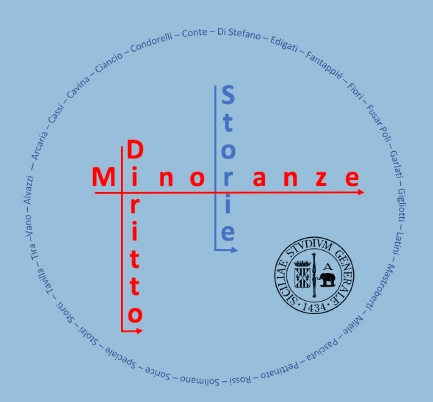
CONFERENCE: Diritto, minoranze. Storie (Catania, 2-4 maggio 2022)


Nei giorni dal 2 al 4 maggio si terrà, presso il Dipartimento di Giurisprudenza dell'Università degli Studi di Catania, il convegno "Diritto, minoranze. Storie", parte del progetto Medita (Minoranza e Diritto. Esclusione, Discriminazione, Tolleranza, Accoglienza).


PRESENTAZIONE

Il termine minoranza si definisce solo in relazione al suo opposto, maggioranza. Ma è un termine di per sé neutro. Una minoranza, infatti, può essere l’oligarchia che detiene il potere o, al contrario, un gruppo marginale che chi detiene il potere vuole ulteriormente marginalizzare, escludere, eliminare.

Ciascuna minoranza è stata definita per ragioni culturali, etniche, religiose, linguistiche, razziali e gli ordinamenti nel corso della storia si sono dotati degli strumenti più diversi per definire, discriminare, combattere, limitare, escludere, eliminare, contenere, proteggere, conservare gruppi che ritenevano ostili, pericolosi, o solo diversi, le minoranze.


PROGRAMMA

2 maggio, ore 15.00, Auditorium della Purità
Introduce Rosalba Sorice e coordina Francesco Arcaria

  • Francesco Priolo, Saluti del Magnifico Rettore dell’Università degli studi di Catania
  • Salvatore Zappalà, Saluti del Direttore del Dipartimento
  • Rosalba Sorice,  Lo spazio giuridico degli esclusi nel Medioevo. Aspetti penali (I)
  • Antonia Fiori,  Lo spazio giuridico degli esclusi nel Medioevo. Aspetti processuali (II)
  • Beatrice Pasciuta,  Diritti e culture nella Sicilia normanna. Cronache e documenti
  • Giovanni Rossi, Privilegia universitatum, collegiorum, scholasticorum: il trattato di Pierre Rebuffi sulle tutele previste per la comunità universitaria 
  • Manlio Miele,  I Greci a Venezia


3 maggio, ore 9.00, Auditorium della Purità
Coordina Carlo Fantappié

  • Aldo Andrea Cassi, La minorità della maggioranza. Gli indios all'alba della 'Conquista' tra schiavitù e tutela
  • Marco Cavina,  Puné Zeruzeru. Gli albini nel diritto tradizionale africano
  • Valerio Gigliotti,  Profili comparati della condizione giuridica di Ebrei e Valdesi in area subalpina
  • Stefano Solimano, Gli ebrei e la prima emancipazione: da Giuseppe Il a Napoleone
  • Orazio Condorelli, La minoranza albanese in Sicilia (secoli XV-XVIII): modi e problemi dell’integrazione civile e religiosa
  • Francesco Mastroberti, La condizione giuridica delle minoranze albanesi nel Regno di Napoli 


3 maggio, ore 15.00, Auditorium della Purità
Coordina Cristina Vano

  • Daniele Edigati, La tolleranza religiosa al crepuscolo dell'Antico Regime
  • Paolo Alvazzi del Frate, Anti-individualismo e compressione delle minoranze: considerazioni sulla crisi dello Stato liberale
  • Loredana Garlati, Dietro le sbarre: escludere per includere? La segregazione carceraria tra Otto  e Novecento 
  • Carlotta Latini,  I devianti e la Scuola positiva. Tra malattia mentale e criminalità
  • Elio Tavilla, La pederastia come devianza penalmente rilevante, tra medicina legale e scuola positiva
  • Cristina Ciancio,  Corpi morti nelle vetrine etnografiche. Profanazioni o strumenti di conoscenza?
  • Alessia Di Stefano, “Una raffica incivile di protezionismo”: gli effetti dell'exclusionist legislation sugli emigranti italiani negli Stati Uniti tra XIX e XX secolo


4 maggio, ore 9.00, Auditorium della Purità
Coordina Emanuele Conte

  • Elisabetta Fusar Poli, Powerful minorities. Gli Europei d'Egitto e il diritto misto
  • Irene Stolzi,  Lo sguardo del giuridico: un itinerario primo-novecentesco
  • Giuseppe Speciale, La legislazione razziale antiebraica: discriminazioni e sistema graziale
  • Alessandro Tira, Le minoranze religiose nella politica ecclesiastica italiana dal Fascismo alla Ricostruzione
  • Ida Nicotra, Le prerogative costituzionali delle minoranze
  • Cristiana Pettinato, Spinte nazional sovraniste e semi di neoconfessionalismo in Lituania. Al vaglio della Corte di Strasburgo le relazioni pericolose tra Chiesa e Stato


Ulteriori informazioni possono essere reperite a questo link.

LECTURE: JHIL Lecture - Lauren Benton: „What is Interpolity Law? Protection and Jurisdiction in the Age of Empires“ - Max Planck Institute for Comparative Public Law and International Law, Heidelberg - 5 May 2022, 18:00 h


JHIL Lecture - Lauren Benton: 

„What is Interpolity Law? Protection and Jurisdiction in the Age of Empires“ 

5 May 2022, 18:00 h, Room 038


 Lauren Benton is the Barton M. Biggs Professor of History and Professor of Law at Yale University. A comparative and global historian, she writes on the legal history of European empires and the history of international law. She received her AB from Harvard University and PhD in anthropology and history from The Johns Hopkins University. Prior to Yale, Benton was the Nelson O. Tyrone Jr. Professor of History and professor of law at Vanderbilt University, where she also served as dean of the College of Arts and Sciences, and Julius Silver Professor of History and affiliate professor of law at New York University, where she served as dean of humanities and dean of the graduate school. In 2019, Benton was awarded the Toynbee Prize for significant contributions to global history. She is a recent recipient of a Guggenheim Foundation Fellowship and immediate past president of the American Society for Legal History. 

Benton is the author of four books, including three on the history of empires and law: Rage for Order: The British Empire and the Origins of International Law, 1800–1850, coauthored with Lisa Ford (Harvard, 2016); A Search for Sovereignty: Law and Geography in European Empires, 1400–1900 (Cambridge, 2010); and Law and Colonial Cultures: Legal Regimes in World History, 1400–1900 (Cambridge, 2002), which was awarded the James Willard Hurst Prize and the WHA Jerry Bentley Book Prize. Her coedited books include (with Bain Attwood and Adam Clulow) Protection and Empire: A Global History (Cambridge, 2017); (with Richard Ross) Legal Pluralism and Empires, 1500–1850 (NYU, 2013); and (with Nathan PerlRosenthal) A World at Sea: Maritime Practices and Global History (UPenn, 2020). She is currently the AnnaMaria Kellen Fellow at the American Academy in Berlin. 

Max Planck Institute for Comparative Public Law and International Law Im Neuenheimer Feld 535, 69120 Heidelberg

29 April 2022

REMINDER: Respect the instructions for blog proposals


(image source: Wikimedia Commons)


 This is a kind reminder to respect the instructions for proposed announcements:

(1) Send an MS Word or RTF-version

(2) Join an image


The ESCLH Blog works with volunteers. It is possible that your announcement does not appear within two or three days, but rather within a week. 

BOOK: Giordano FERRI, Tra romanistica e filosofia. Il carteggio Giovanni Baviera-Benedetto Croce (1906-1951) (Roma: Historia et ius, 2022), ISBN 978-88-946376-4-9, pp. 120 (open access)


(Source: Historia et ius)

The book is available open access here.