Search

16 March 2023

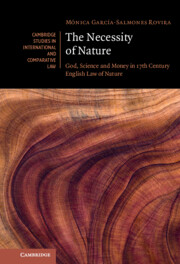
BOOK: Mónica GARCÍA-SALMONES ROVIRA, The Necessity of Nature. God, Science and Money in 17th Century English Law of Nature [Cambridge Studies in International and Comparative Law, ed. Larissa VAN DEN HERIK & Jean d'ASPREMONT; 179] (Cambridge: CUP, 2023); ISBN 9781009332149, 120 GBP

(image source: CUP)


Book description:

To understand our current world crises, it is essential to study the origins of the systems and institutions we now take for granted. This book takes a novel approach to charting intellectual, scientific and philosophical histories alongside the development of the international legal order by studying the philosophy and theology of the Scientific Revolution and its impact on European natural law, political liberalism and political economy. Starting from analysis of the work of Thomas Hobbes, Robert Boyle and John Locke on natural law, the author incorporates a holistic approach that encompasses global legal matters beyond the foundational matters of treaties and diplomacy. The monograph promotes a sustainable transformation of international law in the context of related philosophy, history and theology. Tackling issues such as nature, money, necessities, human nature, secularism and epistemology, which underlie natural lawyers' thinking, Associate Professor García-Salmones explains their enduring relevance for international legal studies today.

On the author:

Mónica García-Salmones Rovira is Global Law Fellow in the Alvaro d'Ors Global Law Chair, ICS, at the University of Navarre, and a Senior Fellow at the Erik Castrén Institute of International Law, University of Helsinki. She is the author of The Project of Positivism in International Law (2013) and co-editor of Cosmopolitanisms in Enlightenment Europe and Beyond (2013) and International Law and Religion (2017). 

Table of contents:

Table of Contents:
Introduction
I Altering the Perception of Nature
II Nature and The Light of Nature
III Needs, Politics and Money
IV Necessity and Liberalism
IV Outline of Chapters
  • 1. A Christian Science: Searching for the Common Good and the Public Good
1.1 Deism, Neoplatonism and the Light of Reason
1.2 Scepticism and Moral Righteousness
1.3 Hobbes and Locke versus Filmer on Political Economy
1.4 The New Oeconomies: Household – State – Nature
  • 2. Hobbes's Doctrine of Necessity
2.1 Hobbes's Doctrine of Necessity and Existence
2.2 Necessitarian Metaphysics and (Human) Body in Avicenna and Hobbes
  • 3. Necessities, Natural Rights and Sovereignty in Leviathan
3.1 Hobbes's Necessity, Theology and Natural Laws
3.2 The Doctrine of Necessity in Leviathan
  • 4. Reformers on the Necessary Knowledge
4.1 Useful Knowledge as the Only Necessary Knowledge: Benjamin Worsley in Context
4.2 All-Encompassing Human Necessities
  • 5. Necessity, Free Will and Conscience: Robert Sanderson
5.1 Logician and Theologian
5.2 The Mechanical Conscience
  • 6. The Grand Business of Nature
6.1 The Oeconomy of Nature
6.2 The Fact of Man
6.3 The Grand Business of Nature
  • 7. Robert Boyle, the Empire over Nature
7.1 Nothing Is Necessary: Benjamin Worsley Revisited
7.2 The Transmutator of Nature
7.3 Undoing Nature
  • 8. Locke's Early Writings
8.1 Independent Judgment of Conscience, Public Order and Public Interest
8.2 Undoing Conscience
  • 9. Medicine, Oeconomy and Needs
9.1 The Oeconomy of Needs
9.2 Physicians and Oeconomia
  • 10. Money and the Doctrine of Necessities
10.1 Locke's Doctrine of Necessities
10.2 Usury, Interest and Science
  • 11. The Scientification of Money
11.1 The Science of Interest
11.2 The Morality of Capital
  • 12. The Doctrine of Necessities and the (Public) Good
12.1 Necessity and Necessities in Knowledge and Morality: An Essay Concerning Human Understanding
12.2 Necessities, Dominion and Money in the Two Treatises of Government
  • Conclusions 

(source: ESIL IGHIL)

More information with CUP.

15 March 2023

PRIVACY LECTURE: Privacy and Concurrence of Norms in the 'Age of Ambiguity' - 17 April 2023, 13:00-15:00, Copenhagen


Abstract by Professor Hillard von Thiessen

The Center for Privacy Studies examines how notions of privacy and the private shape relations between individuals and society in the early modern period. Partially, privacy may be regarded as the place of an individual in the social sphere – not yet (theoretically) secluded from the public world, but already constituting a field of action with particulars values, norms and rules. The lecture will contextualize the notions, the significance and the dynamics of social norms in early modern latin-Christian societies. In those societies, normative demands were aimed at individuals with increasing vigour from a variety of authorites: the church, the secular authorities, and social groups like the family, the neighbourhood, the guild, the peer group and so on. It will be discussed how early modern individuals navigated in such a demanding and complex normative field, in which occasions and with what arguments individuals were in the position to fend off certain normative demands, how social as well as religious and political dynamics were set off and how cultural ambiguity came out as a – wílly-nilly and precarious – result of the concurrence and competition of norms.

Bio

Hillard von Thiessen studied at the Universities of Kiel, Edinburgh and Freiburg, where he was awarded a doctoral degree with a dissertation on the Capuchins between confessionalization and popular culture in the early modern period in two German cities. Since 2000, one of his topics of investigation is the history of foreign relations in the early modern period with particular regard to the approaches of New Diplomatic History. After having obtained the habilitation degree at the University of Berne in 2007 with a study on diplomacy and patronage, he worked as substitute professor for Early modern history at the University of Cologne, until he was appointed professor for Early modern history at the University of Rostock in 2013. Currently, his principle field of research is the history of norms and values in premodern Europe. With regard to this topic, he published the monograph Das Zeitalter der Ambiguität. Vom Umgang mit Werten und Normen in der Frühen Neuzeit (The Age of Ambiguity. On Norms and Values in the Early Modern Period) in 2021.

14 March 2023

CONFERENCE: 'Diplomatie et droit à travers l'histoire' - Cycle de conférences lorraines d'histoire du droit - Nancy, 5 Avril 2023


Dans le cadre du cycle des conférences lorraines d’Histoire du Droit, l'Institut François Gény vous propose une nouvelle conférence sur le thème "Diplomatie et droit à travers l'histoire".


PROGRAMME

Introduction aux rapports entre Diplomatie et Droit aux XIXe et XXe siècles
par Monsieur Hugo STAHL, Maître de conférences à l’Université de Lorraine, Faculté de Droit, Économie et Administration de Metz, Institut François Gény (UR 7301)

La négociation du Traité de Paris du 30 mars 1856
par Monsieur Yves BRULEY, Maître de conférences à l'École Pratique des Hautes Études, (UR 4116 Savoirs et Pratiques du Moyen Âge au XIXe siècle)

De l’action réformatrice de la diplomatie au XIXe siècle. Exemples d’analyse, d’inspiration et de création de la norme étrangère
par Monsieur Jean-Romain FERRAND-HUS, Maître de conférences à l’Université de Lorraine, Faculté de Droit, Sciences économiques et Gestion de Nancy, Institut François Gény (UR 7301)

La diplomatie non officielle : le statut juridique des espions de la fin du XIXe au milieu du XXe siècle
par Madame Claire de BLOIS, Docteure en Droit, ATER à l’Université Paris-Cité, IHD (UR 2515)

Le diplomate et le droit
par Monsieur Jean-Pierre VIDON, Ancien ambassadeur, Ministre plénipotentiaire honoraire

ENTRÉE LIBRE

Cette conférence est organisée avec le soutien de l'Institut François Gény (UR7301) et de la Ville de Nancy.

10 March 2023

JOURNAL: E-legal History Review, 1/2023

(Source: https://www.iustel.com//v2/revistas/detalle_revista.asp?id=15&popup=)


 Seccion Historiografía

Sección Estudios
Necrológica

08 March 2023

SEMINAR SERIES: Seminari di storia del diritto e del pensiero giuridico 2023 - 16 marzo, 19 aprile, 3 maggio - Padova


JOB OFFER: Research Group Leader (m/f/d) (W2 – Associate Professor Level) - Max Planck Institute for Legal History and Legal Theory in Frankfurt/Main (DEADLINE 24 April 2023)

(Source: MPILHLT)

The Institute is looking to recruit, from 1 October 2023, or as soon as possible thereafter, a Max Planck Research Group Leader (m/f/d) (W2 – Associate Professor Level) on the topic "The Hidden Heritage of the European Union: the Legacy of the Law of the League of Nations".

The funding period of the Research Group is restricted to five years. In the event of a positive evaluation it may be extended.

Your tasks
You will conceptualise the Research Group, build it up and coordinate it. Funding for establishing a Group of three to four PhD students is available. You will supervise the PhD theses of the members of the group. You will publish your findings and actively contribute to the research activities of the Institute

Your profile
You have published an outstanding doctoral thesis in law, history or another relevant discipline of the humanities or social sciences. You have published further in the field. You are fully proficient in the French and the English language. Good proficiency in the German language is desirable; you are at least willing to learn German if necessary.

Your CV should demonstrate your capacity to pursue research at the highest international level. You are able to adopt interdisciplinary approaches, work independently and efficiently, have excellent communication skills and the capacity to work in a team.

Our offer
We offer an attractive and international research environment with an unparalleled research infrastructure and a good working atmosphere. The salary is based on the German Civil Service scale (Besoldungsgruppe W2 Bundesbesoldungsgesetz). Depending on your qualification and relevant job experience, the annual salary before tax will be on a scale currently stretching from EUR 75.237,24 (W2 band 1) to EUR 84.088,80 (W2 band 3) for a full time position (41 hours per week), plus a family allowance, if applicable. While you will be based in Frankfurt/Main, there are generous opportunities for mobile working (at present, up to 40 per cent per month). There is no obligation or expectation to teach, although we encourage you to take up limited teaching assignments if you wish to do so.

You will have unlimited access to our world leading library and a multitude of databases. You will be provided with office space and will receive extensive academic and administrative support. There are generous grants for research trips to archives and libraries, as well as for attending conferences. A variety of personal and development opportunities is available, including funding for German language classes.

We are located on Campus Westend, one of the most beautiful university campuses in Europe, right at the heart of the thriving and cosmopolitan city of Frankfurt, the centre of finance, banking and the legal professions of Europe’s biggest economy, with many law firms and job opportunities for lawyers.

The Institute belongs to the Max Planck Society, Germany’s most successful research organization. Since its establishment in 1948, no fewer than 22 Nobel laureates have emerged from the ranks of its researchers, thus outperforming many the most prestigious research institutions worldwide. The mission of the Max Planck Society is to conduct fundamental (i.e., non-applied) research in the natural sciences, life sciences, social sciences and the humanities at the highest possible level. Its 86 Institutes are scattered across Germany and beyond, and they focus on research fields that are particularly innovative and resource-intensive.

The Institute is part of Max Planck Law, the network of ten Max Planck Institutes engaging in advanced legal research. The first of these was established in Berlin in 1924. Today, we cover a broad range of legal studies, from the anthropology of law to tax law, at eight different locations across Germany and Luxembourg.

The Max Planck Society is committed to increasing the number of individuals with disabilities in its workforce and therefore encourages applications from such qualified individuals. Furthermore, the Max Planck Society seeks to increase the number of women in those areas where they are underrepresented and therefore explicitly encourages women to apply. The Max Planck Society strives for gender equality and diversity. We welcome applications from all backgrounds.


Application procedure

Your application should be written in either English or German and contain the following documents, joined together in a single pdf file:

  • Cover letter with reference to your research proposal and an explanation as to how your profile matches the selection criteria;
  • Detailed CV;
  • List of publications;
  • Research proposal (up to ten pages);
  • Transcripts of your achievements at school and university, copies of degree certificates;
  • Two of your publications of some 20 pages length each (journal articles, book chapters etc).


Your application must be submitted online via the link on our homepage (https://www.lhlt.mpg.de/job-offers) by the closing date of 24 April 2023.

Strong applicants will be invited for an interview, probably on 15 June 2023 or 16 June 2023.

Contact
Informal enquiries as to the substance of the research field may be directed to Professor Stefan Vogenauer (vogenauer@lhlt.mpg.de). Questions as to the terms and conditions of employment may be directed to Ms Rita Gommermann (jobs@lhlt.mpg.de).

06 March 2023

CONFERENCE PROGRAMME: "Droit et nature au Moyen Âge" - 16-17 marzo 2023, Orléans

(Source: Calenda)

La rencontre scientifique des 16 et 17 mars prochain est le second volet d’une enquête sur le thème du droit et de la nature au Moyen Âge. Pluridiscplinaire et abordant différentes thématiques (les animaux, l'environnement, le surnaturel...) sous des angles variés, cette manifestation sera aussi l’occasion de faire le point sur les recherches en cours. 

Jeudi 16 mars 2023

8h45: Accueil

Session I: Contrôler le surnaturel

  • 9h00  Jean-Pierre Poly (Université Paris Nanterre), L'origo des Mérovingiens. Chamanisme et pouvoir féminin au Ve siècle
  • 9h45  Julien Véronèse (Université d’Orléans), "[Magi] sanguine utuntur et victimis, et saepe contingunt mortuorum corpora" (Decretum Gratiani, IIa pars, q. 5, c. 14) : nigromancie et usages du corps humain aux derniers siècles du Moyen Âge

10H30 Pause

  • 10h45  Jean-Patrice Boudet (Université d’Orléans), Retour sur une censure : la condamnation de l'astrologie à Paris en 1494
  • 11h30  Sara Menzinger (Université Roma Tre),  Fictions in the 12th century canon law thought

Session II: Naturaliser la domination

  • 14h00  Marco Castelli (Université d'Etat de Milan), Praeter naturam : la Physique d’Aristote et le miracle dans la fondation de la plenitudo potestatis
  • 14h45  Raphaël Eckert (Université de Strasbourg), La naturalité de la société et de l’État au XIIe siècle. Une relecture de Gaines Post
  • 15h30  Clémentine Girault (Université de Paris Cité),  Normes de genre et normes d’espèce dans les traités d’éducation en français (XIVe-XVe siècles)

16h15 Pause

Session III: Penser l’animalité

  • 16h30  Alexandre Mimouni (Université de Paris 2), La nature de l'animal en droit canonique médiéval
  • 17h15. Bruno Laurioux (Université de Tours), Ces animaux qu’on ne mange pas

Vendredi 17 mars 2023

Session IV: Qualifier juridiquement le monde

  • 9h30  Marie Bassano (Université de Toulouse), De quelques problèmes sur les rapports de l’homme et de la nature chez les juristes savants (XIIIe-XVe)
  • 10h15  Dante Fedele (CNRS Lille), Les juristes médiévaux et la mer

11H00 PAUSE

  • 11h15  Claire De Blois (Université Paris Cité), Mythe et réalités de la « frontière naturelle » au Moyen Âge
  • 12h00  Joël Chandelier (Université de Paris 8), Conclusions

SEMINAR: O sacerdote imigrante como desafio de governança durante o Brasil imperial: perspectivas do Conselho de Estado e da Santa Sé (Online). 10 March, 10:30


(Source: https://studiumiurisufmg.wordpress.com/)

On 10 March, 10:30 (Brasília time), Anna Clara Lehmann Martins will discuss about migrating priests in imperial Brazil, and how both the national government and the Holy See managed them. This event is promoted by the Brazilian Society of 19th century studies. Link: https://www.youtube.com/@SociedadedoOitocentos/streams

03 March 2023

CFP: XVII International Scientific Conference from the series "From the History of Law": "The evolution of civil law over the centuries - Volenti non fit iniuria"- 26th-27th May 2023, Cracow [hybrid]

(Source: JU)


We received notice of the invitation to participate in the following conference:

Ladies and Gentlemen,

We would like to kindly invite you to participate in the XVII International Scientific Conference from the series "From the History of Law" entitled "The evolution of civil law over the centuries - Volenti non fit iniuria", which will take place in a hybrid form on 26th-27th of May* (Friday - Saturday). Participation will be possible both in an online form via MS Teams (26th of May ,Friday) and stationary form in Cracow (27th of May, Saturday). We recommend online form especially for those, who will not be able to arrive in Cracow in person. 

The event - held by the Jagiellonian University's Student Society for State and Legal History, the Chair of Polish Legal and State History, the Chair of World Legal and State History at the Faculty of Law and Administration of the Jagiellonian University and by Jagiellonian University's Student Society for Civil Procedure - is aimed at researchers in fields of law and history - in particular at Professors, D.Sc.'s, graduate students, PhD students and PhD graduates.  

It is extremely difficult to overestimate the role of civil law and its meaning for the nations and for individuals. The multitude of functions and tasks, which have been transforming throughout history, have been the subject of numerous scientific studies until present day. In 2023, we celebrate the anniversaries of the legislative enactment of several important legal acts concerning both substantive and procedural civil law. 90 years ago the Polish Obligation Code and Presidential Act on Limited Liability Company were issued (1933). 125 years ago the Japanese Civil Code and French Act on Employer Responsibility in case of Workplace Accident went into effect (1898), 240 years ago there was Austrian Ehepatent also known as Marital Patent of Joseph II (1783), 155 years ago there was Austrian Marriage Act for Galicia Notzivilehe (1868). In 2023 we also commemorate 205 years of Hypothec Law of Kingdom of Poland (1818). Furthermore, 340 years ago the Danish Code of Christian V – Danske Lov (1683) was introduced. 

We also hope that the above events will encourage a comprehensive discussion on the role and importance of civil law in the past, present and future, as well as the presentation of the results of your academic research. 

Suggested topics include the following: 

1. functions and tasks of civil law 

2. the conception of contract 

3. the rules of civil procedure 

4. history of institutions of obligation law 

5.history of institutions of hereditary law 

6. history of institutions of property law 

7.history of institutions of family law 

8.history of the labour law  

9.history of company law 

10.evolution of civil procedure

Any other research topics that are in line with the conference topic will of course also be warmly welcomed. 


If you are interested in participating in the conference, you just need to send us topic of your speech and preferred day of the speech. The length of the speech should not exceed 30 minutes (Professors, D.Sc, PhD) or 20 minutes (students, PhD students). Speech can be presented in English, Polish and German** 

Participating in the conference is free of charge.

*In case of great number of submissions suitable to the topic of the conference we keep the right to extend the conference to Thursday (25th of May). 

**German-speaking panel will be scheduled in case of 3 or more abstracts of speeches submitted in this language.

For more information, please contact us by email: hpip.tbsp@uj.edu.pl or via Historia Państwa i Prawa TBSP UJ page on Facebook.

 Link to the Conference event on Facebook: https://www.facebook.com/events/748298223578312


Yours Faithfully,


In the name of Jagiellonian University's Student Society for State and Law History

Piotr Owsiak

Chairman of Jagiellonian University's Student Society for State and Law History

CONFERENCE: The Silesian Voivodeship: An analysis of a 'legal interspace' , 23./24. 03. 2023, Regensburg


(source: Univ. Regensburg)

The Silesian Voivodeship: An analysis of a 'legal interspace'

The reorganisation of Europe after the First World War – with the re-establishment or formation of states on the former territory of the empires Austria-Hungary, Prussia and Russia – confronted the young republics with challenging difficulties of legal particularism. From a legal point of view, the resurrected Poland in particular disintegrated into several legal systems and was only able to fully unify some areas of law in the short interwar period.

Within the Second Polish Republic, the Silesian Voivodeship held a special position. It was the only autonomous voivodeship in the polish state. The constitutional act of 15th July 1920 (Dziennik Ustaw Rzeczypospolitej Polskiej No. 73, poz. 497) granted autonomy to the Silesian Voivodeship, it provided for the establishment of a separate legislative body (Silesian Sejm) for the Silesian Voivodeship. Consequently, depending on the subject matter, the legislative competences belonged either to the regular polish Parliament or to the Silesian Sejm. Moreover, the act of 15th July 1920 determined the adoption of the previous legal system into the body of law of the Silesian Voivodeship.
Unlike the other voivodships, which were formed from the former territories of a single partitioning power, the Silesian Voivodeship unit consisted of former Prussian and Austrian territories. This circumstance could have presented the voivodeship of Silesia with particular difficulties of legal fragmentation. For in addition to the new Polish legal acts, Prussian law applied in some parts of the Silesian Voivodeship, and Austrian law in other parts. The organisation of the authorities was also inconsistent due to this particularism. During the inter-war period, a gradual unification of the law began.
At this conference we would like to explore the origins and development of the Silesian Voivodeship from a legal-historical perspective in the broadest sense.
 

Programm

23. 03. 2023 - 13.30

- Welcoming/Introduction (Martin Löhnig)
- Autonomie der Woiwodschaft Schlesien und andere Projekte der Regionalautonomien in Polen 1918-1939 (Ryszard Kaczmarek)
- Polish legal thought in relation to the Silesian autonomy in the Second Polish Republic (Adam Krychowski)
- Between Cieszyn and Bielsko. Polish Cieszyn Silesians and the Silesian autonomy (Krzystof Nowak)
- The Autonomous Silesian Voivodship and its Legacy (Anna Mus)

24. 03. 2023 - 09.00

- Silesian Jurisdiction after Versailles (Donata Zehner)
- Courts and courts procedure in Silesian voivodeship and proceedings before the Polish Supreme Court
(Anna Stawarska-Rippel)
- Die Anwendung des Deutsch-Polnischen Abkommens über Oberschlesien 1922-1937 (Konrad Graczyk)
- Closing remarks (Kamila Staudigl-Ciechowicz)
 

Organisers:
Martin Löhnig (Regensburg)
Kamila Staudigl-Ciechowicz (Wien/Regensburg)

Venue:
Café Goldenes Kreuz, Haidplatz, Regensburg

Contact:
rechtskultur@ur.de


02 March 2023

BOOK: Robert P. MERGES, American Patent Law: A Business and Economic History (Cambridge: Cambridge University Press, 2023), 450pp., ISBN 9781009123419, £105


(image courtesy: Cambridge University Press)

Book description: 
Students and established scholars of intellectual property law often look for historical context when trying to understand the development and present-day contours of IP rules and systems. American Patent Law supplies this context, offering readers a comprehensive account of the evolution of the US patent system and patent doctrine beginning in 1790. From the technologies for harvesting wood and shoemaking in the earliest periods to computer software and biotechnology of the present, each chapter of the book covers the characteristic technologies of each historical era. The book also describes how businesspeople in each era acquired and enforced patents and used patents as the foundation of various business arrangements. This book is a landmark in the history of technologies, the US patent system, and the way private actors have deployed patents across American history.
Table of contents: 
1. Introduction: Overview and themes
2. Founding era patent law, 1790-1820
3. The Jacksonian era and early industrialization, 1820-1880
4. Corporatization, 1880-1920
5. 1921-1982: Patents in and out of the headlines
6. The federal circuit era
7. In conclusion: The private (law) life of patents.
About the author: 
Robert Merges is a professor of law at Berkeley Law (University of California), where he co-directs the Berkeley Center for Law & Technology. He has been writing about patents and patent law for over thirty years.
More information can be found here