Search

11 February 2019

BOOK: Jean-Michel DAVID, Au service de l’honneur - Les appariteurs de magistrats romains (Paris: Les Belles Lettres, 2019). ISBN 9782251448947, €33.00


Les belles letters has published a book on the magistrate’s assistants in Roman law.

ABOUT THE BOOK

À Rome, sous la République et au début de l’Empire, un magistrat ne pouvait pas exercer ses responsabilités sans ses appariteurs. Ils étaient sa voix (hérauts ou praecones), ses huissiers (viatores), ses gardes du corps (licteurs), ses mains et sa mémoire (scribes). Ils entouraient le magistrat et effectuaient les multiples tâches qu’exigeait l’exercice du pouvoir. Ils étaient des hommes libres et des citoyens, au service de la cité qui les rémunérait et les mettait à la disposition des magistrats le temps de leurs fonctions.

La plupart d’entre eux étaient ainsi inscrits dans des cadres officiels, des décuries, d’où chaque année était choisi le personnel nécessaire. Ils y gagnaient la reconnaissance d’une compétence et d’une certaine indépendance, d’une dignitas qui leur valait de se constituer en ordres.
Toutefois, les membres de l’aristocratie sénatoriale qui devaient pouvoir compter sur leur fidélité et leur dévouement veillaient à faire recruter leurs dépendants, souvent leurs affranchis. Ainsi, la position qu’ils occupaient avait-elle quelque chose d’étrange : au service à la fois, public, de la cité et, privé, de ses gouvernants. L’étude de ces hommes se révèle alors décisive pour la compréhension de l’évolution de l’organisation civique romaine qui, par un processus de privatisation des instances publiques, conduisit à l’Empire.

ABOUT THE AUTHOR

Jean-Michel DAVID
Jean-Michel David est un historien de Rome. Il a été professeur aux universités de Strasbourg et de Paris 1.

TABLE OF CONTENTS

Introduction
1. Le corps du magistrat
Pas de magistrats sans appariteurs
Un groupe qui fait corps
2. Tâches et fonctions
Les licteurs
Les viatores
Les accensi
Les hérauts ou praecones
Les scribes
3. Le système des décuries
Les données de l’épigraphie juridique
La répartition par fonctions et par magistratures
4. Une constitution en ordres
Les procédures de recrutement et d’emploi : le cas des scribes et des librarii questoriens
Les décuries, cadres de l’intégration
Des décuries aux ordines
5. Origines et positions sociales
Les conditions du recrutement
Quelles origines ? Quels statuts ?
Un milieu diversifié dans une identité commune
App. : Changements et associations de fonctions
Changements de magistrature dans la même fonction
6. Du service de la cité à celui de son aristocratie
Sous la République et au début de l’Empire, les formes traditionnelles de l’inégalité civique
Au sein de la cohorte : l’exemple des agents de Verrès
Collaborations et dépendances
Administrateurs ou courtisans ?
7. Accensi, licteurs et viatores
Les accensi
Licteurs et viatores
8. Les praecones : une position particulière
Les effets de la fonction
Les rôles de l’emploi
L’indignité de droit et de fait
9. Les scribes
Les scribes de la Rome républicaine
À la fin de la République et au début de l’Empire, l’accès à l’ordre équestre
L’institutionnalisation des positions
L’image de l’honneur
Les appariteurs, témoins de l’Histoire de Rome

Appendice : appariteurs connus par l’épigraphie
Liste des abréviations
Bibliographie
Liste des illustrations
Index des personnes
Index des sources

More information here

BOOK REVIEW: W.S. Utama on Luis Eslava et al., Bandung, Global History, and International Law. Critical Pasts and Pending Futures (Cambridge: Cambridge University Press), 2017


(Source: Hsozkult)

Hsozkult has published a review of the book Bandung, Global History, and International Law. Critical Pasts and Pending Futures by Wildan Sena Utama (Universitas Gadjah Mada)

On 18–24 April 1955, the Asian-African Conference, with delegates from twenty-nine independent and nearly independent Asian and African countries, took place in Bandung, Indonesia. This conference, widely known as the Bandung Conference, was the first endeavor in the postcolonial era to gather the leaders of Asian and African countries. President Sukarno of Indonesia, who delivered the opening speech of the conference, described it as “the first international conference of colored peoples in the history of mankind […]

Read the full review here

09 February 2019

BOOK: Thomas VESTING, Staatstheorie [Juristische Kurz-Lehrbücher] (München: Beck 2018), XVII + 204 p, € 24,9, ISBN 978-3-406-72358-2

(image source: Beck-Shop)

Zum Werk
Die Neuerscheinung erläutert das moderne Staatswesen, das mit allgemeinen Gesetzen Verwaltung, Gerichte und politische Institutionen an eine impersonale Form der Regelhaftigkeit und Ordnung bindet. Mit universalen, subjektiven Rechten eröffnet es den Individuen den Zugang zur Gesellschaft und ihren Möglichkeiten. Auf dieser systematischen Grundlage werden dann die Wandlungsprozesse des modernen Staates dargestellt: der Übergang vom liberalen Rechts- und Verfassungsstaat zum Sozial- und Wohlfahrtsstaat, sowie die Herausforderungen, die die Europäisierung und Globalisierung der modernen Staaten aufwerfen.

Inhalt

  •  Staat: Begriff und Metapher
  •  Herrschaft des Gesetzes
  •  Allgemeinheit des Gesetzes
  •  Rechtsstaat und rule of law
  •  Verwaltung und Gerichte
  •  Demokratie
  •  Antike und Moderne
  •  Repräsentation
  •  Parteien und Verbände
  •  Typen
  •  Verfassungsstaat
  •  Sozial- und Wohlfahrtsstaat
  •  Netzwerkstaat
  •  Globalisierung
  •  Globale Netzwerke und kulturelle Differenz
  •  Menschenrechte
  •  Narrativ Europa
  •  Geschichte und Evolution
  •  Frühformen
  •  Mittelalterliche Grundlagen
  •  Aufstieg der modernen Staaten

Vorteile auf einen Blick

  •  Systematische Beschreibung des Staatswesens sowie seiner Einrichtungen und Prozesse
  •  Berücksichtigt die Erkenntnisse der Kulturwissenschaften und der Medientheorie

Zielgruppe
Für Studenten der Rechtswissenschaften und der Politikwissenschaften.

The Max Planck Institute for European Legal History organises a Jour Fixe on 11 February (11:15-13:00) around this work.

See:

In his recently published book Staatstheorie (2018), Thomas Vesting develops a 'cultural scientific theory of the state', and to this end, he draws on the different historical strata that have led to the contemporary modern state. Large sections of his book are dedicated to providing accounts of the early modern territorial state, the bourgeois constitutional state, and the modern welfare state. Both the transformations the modern state underwent and the changes in the descriptions of its various manifestations, according to Vesting, should be at the heart of theories of state and state doctrine—reason enough for legal theorists and legal historians to engage in a dialogue.

(source: MPIeR newsletter)

08 February 2019

BOOK: John D. BESSLER, The Baron and the Marquis. Liberty, Tyranny, and the Enlightenment Maxim That Can Remake American Criminal Justice (Durham (NC): CAP Press, 2019), 540 p., 65 USD, ISBN 978-1-5310-1305-9 e-ISBN 978-1-5310-1306-6

(image source: CAP Press)

Abstract:
The Baron and the Marquis explores the history of the maxim that articulates what is now known as the parsimony principle. That maxim: any punishment that goes beyond necessity is “tyrannical.” First articulated by Baron de Montesquieu and later publicized by the Italian criminal-law theorist, the Marquis Beccaria, that maxim shaped the American and French Revolutions and set the dividing line between tyranny and liberty. Thomas Jefferson believed only absolute necessity justified punishment, and the French Declaration of the Rights of Man and of the Citizen (1789) similarly allowed only “strictly and obviously necessary” punishments. In The Baron and the Marquis, award-winning author John Bessler shows the maxim’s modern-day implications for capital punishment, prolonged solitary confinement, and mass incarceration. The book argues that unnecessary punishments violate the U.S. Constitution’s Eighth Amendment as “excessive” and “cruel and unusual.”
More information here.

JOB: Fulltime Academic Staff (Assistant Professor) History of Public Law (KULeuven); DEADLINE 28 MARCH 2019

(image source: KULeuven)

The Faculty of Law and the Research Unit for Roman Law and Legal History invite applications for a fulltime position as a member of the Senior Academic Staff in the field of history of public law. The assignment consists of teaching in an academic context, scientific research and additional duties of an academic nature, along with those to the wider society.
Duties
Research
The assignment is comprised of research into legal history, with an emphasis on the history of public law. The candidate can prove his interest in constitutional law and the construction of societies, criminal law, procedural law, international law or human rights. Preferably, the candidate should be adept in the comparative study of historical law, have a view on the Europeanisation of legal scholarship and see legal history as an integral part of legal thought.

The candidate will be expected to conduct research at an international level in an independent manner. Part of his/her assignment will be to develop – in cooperation with other members of the research unit – an international and competitive research programme, and to strive for excellent scientific results. The supervision of PhD’s will also be part of his/her range of duties. The candidate is expected to add a proposal for a medium-term research programme to his/her application file.
Education
It is expected of the candidate that his/her teaching meet the requirements concerning the standard, orientation and academic character demanded of academic programmes of study. The commitment of the candidate to the quality of the academic programmes as a whole, is considered self-evident. Teaching assignments will include the education of large numbers of students. The candidate may be required to teach at the campuses of Leuven, Kortrijk and Brussels. Furthermore, he/she will organize seminars for smaller groups, will provide the individual supervision of master’s theses and will allot ample time to the education of PhD students.

Service
It is expected of the candidate that he/she be willing to contribute to the services the university provides to the community, and that he/she should also be willing, in the long term, to accept policy functions at the faculty. The candidate will also be at the disposal of the government, the society and the press for the provision of scientific services and information.
Profile
The candidate must hold a doctoral degree and at least one degree that was awarded by a faculty of law. The candidate must be an international leading scholar in his field. His/her list of publications must also show a commitment to international research in the field of legal history. A thorough perspective on and the capacity to acquire external funding is a plus. Preferably, he/she should have experience with teaching in an academic context and possess demonstrable didactic skills. Moreover, he/she must have mastered the techniques necessary to test the knowledge and skills of large groups.

Broad experience in education and research is a clear asset, whereby the complementarity with there search group is to be taken into account.

Proficiency in English is required.
The official administrative language used at KU Leuven is Dutch. If you do not speak Dutch (or do not speak it well) at the start of employment, KU Leuven will provide language training to enable you to take part in administrative meetings. Before teaching courses in Dutch or English, you will be given the opportunity to learn Dutch, respectively English, to the required standard.

The candidate has to be prepared to acquaint himself/herself with new legal topics if necessary. The candidate also needs to have the social and executive skills that are necessary to work amicably and flexibly in the teams within the faculty, the research unit and the research group.

Offer
We can offer you a dynamic and international research environment. The Research Unit for Roman Law and Legal History is part of the Faculty of Law. The Faculty has a large national and international network,which is comprised of both academics and legal professionals, at its disposal. The appointment will be made at one of the levels of the autonomous academic staff system (a tenured track with an evaluation after five years at the levels of assistant professor, associate professor or professor), depending on your qualifications.
KU Leuven pursues a policy of equal opportunity and diversity.

KU Leuven is well set to welcome foreign professors and their family and provides practical support with regard to immigration & administration, housing, childcare, learning Dutch, partner career coaching, …  To facilitate scientific onboarding and accelerate research in the first phase a starting grant of 100.000 euro is offered to new professors without substantial other funding, appointed for at least 50%.
Interested?
For more information please contact Prof. dr. Bernard Tilleman, mail: bernard.tilleman@kuleuven.be. For problems with online applying, please contact solliciteren@kuleuven.be.
You can apply for this job no later than March 28, 2019 via the online application tool
KU Leuven seeks to foster an environment where all talents can flourish, regardless of gender, age, cultural background, nationality or impairments. If you have any questions relating to accessibility or support, please contact us at diversiteit.HR@kuleuven.be.

JOURNAL: Historia et Ius. Rivista di storia giuridica dell'età medievale e moderna 14 (Dec 2018)


(image source: historiaetius)
​
  • 1) Agli Autori - PDF

Studi (valutati tramite blind peer review)
  • 2) Alarico Barbagli, Tra diritto comune, droit de police e diritto amministrativo. I limiti allo sfruttamento delle acque fluviali per uso industriale nel pensiero dei primi amministrativisti 
    francesi - PDF 
  • 3) Cristina Danusso, Ergastolo e Costituzione: il dibattito del 1956 - PDF 
  • 4) Giuseppina De Giudici, "Quando imbassiadores saen mandare". A proposito del cap. XXXV del primo libro degli Statuti sassaresi - PDF
  • 5) Daniele Edigati, Le professioni forensi nel Granducato mediceo dall’autogoverno corporativo cittadino alla disciplina dello Stato (secoli XVI-XVIII) - PDF 
  • 6) Tiziana Ferreri, Istituzioni e governo del territorio nello Stato pontificio: ricerche sul Patrimonio di San Pietro in Tuscia (secoli VI-XIII) - PDF
  • 7) Marco P. Geri, Alfredo Pozzolini: dalla biblioteca alle tracce di un’esperienza professionale - PDF
  • 8) Federico Alessandro Goria, Immigrazione e privilegi processuali fra diritto internazionale, prassi amministrativa e nuovi limiti costituzionali, dal Regno di Sardegna all'Italia unita: il caso dell'avvocatura dei poveri - PDF
  • 9) Francesco Mastroberti, Il "culto" della sentenza tra Ottocento e Novecento: dalle raccolte di giurisprudenza alla nota a sentenza - PDF
  • 10 Giuseppe Mazzanti, Il matrimonio dei cristiani in partibus infidelium. Discussioni dottrinali dopo il concilio di Trento - PDF
  • 11) Giuseppe Mecca, Denegata giustizia e forme di responsabilità del giudice. Paradigmi d’ingiustiziabilità in età moderna - PDF
  • 12) Cecilia Pedrazza Gorlero, "Insanae dominationes" (?): una nota sulla ‘manipolazione’ del governo muliebre nella Francogallia di François Hotman - PDF

Fonti e letture
  • 13) Gaston Morin, L’individualisme de la Révolution française et du code civil et la structure nouvelle de la vie économique (1917), Introduzione e cura di Paolo Alvazzi del Frate - PDF
​
Interventi (selezionati dalla redazione)
  • 14) Aldo Andrea Cassi, Il Guardasigilli Giuseppe Zanardelli e l'accesso alla magistratura nella riforma dell'ordinamento giudiziario (1890) - PDF
  • 15) Ernesto De Cristofaro, The crime of honor: an Italian story - PDF
  • 16) Andrea Errera, La natura ancipite della massima: legista sine canonibus parum valet, canonista sine legibus nihil - PDF
  • 17) Riccardo Ferrante, La cultura giuridica nell’Alto Adriatico: commercio, diritto e istituzioni tra XVIII e XIX secolo - PDF
  • 18) Ida Ferrero, Il senso della giustizia ne fece un brigante e un assassino? La metamorfosi di un giusto nel Michael Kohlhaas di Heinrich Von Kleist - PDF
  • 19) Francesco Migliorino, The mask of the beast. The Human/Animal border in the meshes of the law - PDF
  • 20) Fabricio Mulet Martínez, Los Derechos Sociales, Económicos y Culturales en el Discurso Constitucional Cubano de la Década del Treinta - PDF
  • 21) Gustavo Adolfo Nobile Mattei, I Responsa di Andrea Alciato. Osservazioni preliminari e prospettive di ricerca - PDF 
  • 22) Beatrice Pasciuta, Ius Regni: multiculturalismo giuridico e modelli di interazione normativa nella Sicilia normanna e sveva - PDF
  • 23) Francesco Romano - Antonio Cammelli, Il linguaggio giuridico nella storia di una comunità. Una verifica del lemma “Abilitazione” nei contesti della banca dati IS-LeGI - PDF
  • 24) Amalia Maria Sofia Salvestrini, Diritto e retorica in Nicola di Autrecourt - PDF
  • 25) Francesco Serpico,  Habitus e professioni legali. L’avvocatura in Terra di Lavoro tra Otto e Novecento - PDF
  • 26) Giuseppe Speciale, Il can. 2209 del Codex iuris canonici del 1917: appunti sulla disciplina del concorso di persone nel reato dal ius commune ai codici - PDF

Páginas españolas
  • 27) Tomás de Montagut, Josep Maria Font i Rius: una vida ilusionada por el oficio universitario - PDF

(more information here)

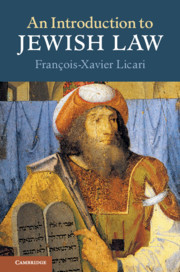
BOOK: François-Xavier LICARI, An Introduction to Jewish Law (Cambridge: CUP, 2019), ISBN 9781108379878

(image source: CUP)

Book abstract:
Jewish law is a singular legal system that has been evolving for generations. Often conflated with Biblical law or Israeli law, Jewish law needs to be studied in its own right. An Introduction to Jewish Law expounds the general structure of Jewish law and presents the cardinal principles of this religious legal system. An introduction to modern Jewish law as it applies to the daily life of Jews around the world, this volume presents Jewish law in a way that answers all the questions that a student of comparative law would ask when encountering an unfamiliar legal system. Sources of Jewish law such as revelation, rabbinical and communal legislation, judicial decisions, and legal reasoning are defined and analyzed, and the authority of who decides what Jewish law is and why their decisions are binding is investigated.
Advance praise:
‘Dr Licari has written an excellent and concise introduction to Jewish law for the reader of English. He provides a masterful overview of the basic jurisprudence of this very unique religious legal system. Many would benefit from reading this work.' (Michael J. Broyde - Emory University, Atlanta)
This penetrating essay will stimulate new research on Jewish law while also providing an invaluable resource for undergraduate and postgraduate courses – on Jewish law, on comparative law, and on religion and law. With rigorous attention to legal methodologies, and with well-chosen and wide-ranging bibliographies for all topics, the essay presents a refreshing account of the unfolding of Talmudic law as a field of study.' (George R. Wilkes, Jewish Law Association)

More information with CUP.

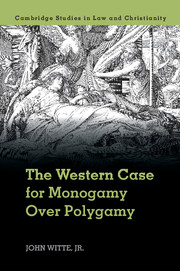
BOOK: John WITTE, The Western Case for Monogamy over Polygamy [Law and Christianity] (Cambridge: Cambridge University Press, 2015). ISBN 9781107499171, £ 37.99


(Source: CUP)

We did not yet report on this publication on monogamy in the Western tradition in Cambridge’s Law and Christianity series, which was published in 2015.

ABOUT THE BOOK

For more than 2,500 years, the Western tradition has embraced monogamous marriage as an essential institution for the flourishing of men and women, parents and children, society and the state. At the same time, polygamy has been considered a serious crime that harms wives and children, correlates with sundry other crimes and abuses, and threatens good citizenship and political stability. The West has thus long punished all manner of plural marriages and denounced the polygamous teachings of selected Jews, Muslims, Anabaptists, Mormons, and others. John Witte, Jr carefully documents the Western case for monogamy over polygamy from antiquity until today. He analyzes the historical claims that polygamy is biblical, natural, and useful alongside modern claims that anti-polygamy laws violate personal and religious freedom. While giving the pro and con arguments a full hearing, Witte concludes that the Western historical case against polygamy remains compelling and urges Western nations to hold the line on monogamy:

·         The first comprehensive history of attitudes toward polygamy in the West, from biblical times until today
·         Includes detailed case studies of polygamist prosecutions in early modern Europe and nineteenth-century America
·         Provides valuable tools for the study of polygamy including definitions of plural marital unions and a detailed background on Biblical, Talmudic, Greek and Roman law

ABOUT THE AUTHOR

John Witte, Jr, Emory University, Atlanta
John Witte, Jr is Robert W. Woodruff University Professor and Director of the Center for the Study of Law and Religion at Emory University, Atlanta. A world authority in legal history, he has directed twelve major international projects on democracy, human rights, religious liberty, marriage, family, and children. He has lectured throughout the world and published twenty-seven books, including, recently, Christianity and Human Rights: An Introduction (Cambridge, 2010) and The Sins of the Fathers: The Law and Theology of Illegitimacy Reconsidered (Cambridge, 2009).

TABLE OF CONTENTS

1. From polygamy to monogamy in ancient Judaism
2. Monogamy versus polygamy in the early church
3. Polygamy in the laws of state and church in the first millennium
4. The medieval case for monogamy over polygamy
5. Polygamous experiments in early Protestantism
6. The Calvinist case against polygamy and its civil law impact
7. The English case against polygamy: theology, politics, and the early modern common law
8. The early modern liberal case for polygamy
9. The Enlightenment liberal case against polygamy
10. The American case against polygamy.

More information here

07 February 2019

ESCLH MEMBERSHIP FEES 2019


All ESCLH-members or prospective members are reminded of the Membership fee due for 2019.

Several options are available (cf. elsewhere on this blog). One can either opt to donate via Paypal, or to make a bank transfer.

Bank transfers can be made to the following account:
Bank: Bankia S.A.
IBAN: ES48 2038 6546 2360 0015 1293

SWIFT/BIC: CAHMESMMXXX

Membership costs € 50 for non-student members and offers many benefits, including a free subscription to Comparative Legal History, the society's journal with Routledge. This year, E. Elgar offers a discount on the Research Handbook Comparative Legal History. 

From 2019 on, the Society equally offers a direct debit option for fees.

BOOK: Kristin O’BRASSILL-KULFAN, Vagrants and Vagabonds : Poverty and Mobility in the Early American Republic (New York: NYU Press, 2019). ISBN 9781479845255, $35


(Source: NYU Press)

NYU Press has published a new book on vagrancy in the Early American Republic

ABOUT THE BOOK

The riveting story of control over the mobility of poor migrants, and how their movements shaped current perceptions of class and status in the United States 

Vagrants. Vagabonds. Hoboes. Identified by myriad names, the homeless and geographically mobile have been with us since the earliest periods of recorded history. In the early days of the United States, these poor migrants – consisting of everyone from work-seekers to runaway slaves – populated the roads and streets of major cities and towns. These individuals were a part of a social class whose geographical movements broke settlement laws, penal codes, and welfare policies. This book documents their travels and experiences across the Atlantic world, excavating their life stories from the records of criminal justice systems and relief organizations. 

Vagrants and Vagabonds examines the subsistence activities of the mobile poor, from migration to wage labor to petty theft, and how local and state municipal authorities criminalized these activities, prompting extensive punishment. Kristin O’Brassill-Kulfan examines the intertwined legal constructions, experiences, and responses to these so-called “vagrants,” arguing that we can glean important insights about poverty and class in this period by paying careful attention to mobility. This book charts why and how the itinerant poor were subject to imprisonment and forced migration, and considers the relationship between race and the right to movement and residence in the antebellum US.  Ultimately, Vagrants and Vagabonds argues that poor migrants, the laws designed to curtail their movements, and the people charged with managing them, were central to shaping everything from the role of the state to contemporary conceptions of community to class and labor status, the spread of disease, and punishment in the early American republic.

ABOUT THE AUTHOR

Kristin O’Brassill-Kulfan is Instructor in the Department of History at Rutgers University.

More information here

BLOGPOST: Tamar Herzog on Legal History Blog


During the month of January, Tamar Herzog (Harvard) made several guests posts on the Legal History Blog. An overview of her blogposts can be found here 

06 February 2019

BOOK: Giuliano AMATO et al. eds., The History of the European Union : Constructing Utopia (London: Bloomsbury, 2018). ISBN 9781509917419, £120.00


(Source: Hart Publishing)

Hart Publishing is publishing a book on the history of the European Union.

ABOUT THE BOOK

The European Union celebrated its 60th anniversary in 2017, but celebrations were muted by Brexit and the growing sense of a crisis of identity. However, as this seminal work shows, the history and ambition of the European Union are considerable. Written by key stakeholders who, between them, acted as architects, adjudicators and arbitrators of the project, it presents the definitive history of the first two generations of the European Union.

This book revisits the birth and consolidation of the great project of a united Europe and the political, institutional, judicial and economical frameworks of the European Union: from the process towards integration, to the advancements and the impasses in building a political union.

ABOUT THE EDITORS

Giuliano Amato is a Judge at the Italian Constitutional Court.
Enzo Moavero-Milanesi is the Minister of Foreign Affairs and International Cooperation of the Italian Republic.
Gianfranco Pasquino is Emeritus Professor of Political Science, University of Bologna and Senior Adjunct Professor, Hopkins SAIS-Europe as well as a Fellow at Accademia dei Lincei.
Lucrezia Reichlin is Professor at London Business School.

More information here


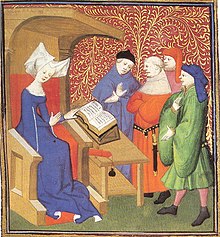
BLOGPOST: Frank Latty on “Founding “Fathers” of International Law: Recognizing Christine de Pisan”, EJIL:Talk!


(Source: Wikipedia)


EJIL: Talk!, the blog of the European Journal of International Law, recently published a text by Professor Latty on Christine de Pisan.

At the start of 2019 and the year long campaign designed around International Women’s Day on 8 March 2019, it may be particularly apt for the readers of EJIL: Talk! to consider Christine de Pisan (around 1365 – around 1430), a medieval woman of letters, as one of the founders of international law – even if somewhat surprising for several reasons […]

Read the full post here

JOB : Postdoctoral Fellowships and PhD positions at The Danish National Research Foundation Centre for Privacy Studies (DEADLINE: 15 April 2019)


We learned of 3-4 fully funded PhD scholarships and 3 fully-funded Postdoc positions at the University of Copenhagen (Centre for Privacy Studies – PRIVACY).

Centre for Privacy Studies (PRIVACY), funded by the Danish National Research Foundation and based in Copenhagen, advertises 3-4 fully funded PhD positions within the fields of Architectural History, Church History, Legal History and History. PRIVACY is established with a grant of 50 mio DKK (ca. 6.7 mio Euro) from the Danish National Research Foundation and based at the University of Copenhagen.   

PRIVACY was launched in the autumn of 2017 under the direction of Professor Mette Birkedal Bruun and runs for six years with the possibility of a four-year extension. It is hosted by the Department of Church His­tory at the Faculty of Theology, University of Copenhagen, in association with the Faculty of Law, Uni­versity of Copenhagen and the School of Architecture, Royal Danish Academy of Fine Arts, Schools of Ar­chitecture, Design and Conservations (KADK), Copenhagen. 

The PRIVACY research team currently consists of six postdocs and three PhD-students as well as affiliated and visiting scholars. 

The Centre   

PRIVACY is dedicated to interdisciplinary and collaborative research into notions of privacy in Early Mod­ern Europe. It focuses on eleven cases from Denmark, England, France, Germany and the Netherlands in the period 1500–1800. The collaborative programme is driven by an interdisciplinary vision of an inte­grated approach in which a team of scholars collaborate, challenge and inspire each other in a joint pursuit of the legislative, religious, social, cultural and architectural aspects of a shared set of cases. Shared re­sponsibility across academic hierarchies is a token of PRIVACY’s vision for interactive research education.   

The aim of PRIVACY is to develop 1) systematized historical knowledge of dynamics that shape, induce or curb privacy in society; 2) an interdisciplinary method equipped to grasp such dynamics; and 3) a strong and vibrant international research environment dedicated to high-profile historical research and equipped to incite a much broader investigation of privacy.   

PRIVACY’s scholarly potency stems from its site-based interdisci­plinary analysis. Across eleven cases the research team will trawl Early Modern material: let­ters, laws, political manuals, newspa­pers, sermons, vis­ual representations, architectural drawings, buildings, diaries, contracts, commu­nity records etc. for no­tions of privacy, analysing the deployment of words with the root ‘priv-ʼ: in privato, privy, Privat-(per­son/andacht etc.), privauté etc. as well as bounda­ries drawn in relation to, e.g., confidentiality, security, family, body, self. The research programme is based on a joint interdisciplinary focus on, e.g., legislative thresholds between home and com­munity; de­crees regarding individ­uals’ bodies, e.g., during epidemics, or the idea of the household’s (oeco­no­mia) impact on civic well-being (politia); ecclesiastical and politi­cal power over ‘hereti­cal’ mind­sets; and architectural demarcation of the household in the community and the individuals’ place in a household.  

PhD students funded by PRIVACY are required to formulate a PhD project within one of the PRIVACY cases and to join an additional case-team. For this round of recruitment, we invite applications focusing on the German cases as well as La Rochelle, Chatsworth, Glasgow and Arc-et-Senans. 

For further description of the project and the eleven cases, please visit the project homepage.   

The two offers can be found here (PhD) and here (postdoc)


05 February 2019

PUBLIC LECTURE: Cours-conférences de Michel Porret (Professeur à l’Université de Genève), (Louvain-la-Neuve, 6 and 7 February 2019)


(Source: UCLouvain)

We learned of a series of three public lectures by Professor Porret (Genève) at the UC Louvain this week.

February 6 2019, 4.15pm-6pm (room Socrate 23) : "Les vestiges du crime : le corps meurtri dans le prisme médico-légal sous l'Ancien Régime"

February 7 2019, 10.30pm-12h30pm (room Socrate 23) : "Le 'moment Beccaria' : sortir de l'Ancien Régime patibulaire"

February 7 2019, 4.15pm-6.15 pm (room : Salle du Conseil de l'Institut Supérieur de Philosophie, Socrate Building, a.124) : "Les bulles sanglantes : crimes et châtiments dans la BD franco-belge"

CALL FOR SUBMISSIONS: ASLH Preyer Award (Deadline: 15 March 2019)


(Source: ASLH)


Via Legal History Blog, we learned of a competition of the American Society for Legal History. Here the call:

Submissions are welcome on any topic in legal, institutional and/or constitutional history. Early career scholars, including those pursuing graduate or law degrees, those who have completed their terminal degree within the previous year, and those independent scholars at a comparable stage, are eligible to apply. At the annual meeting of the Society two early career legal historians designated Kathryn T. Preyer Scholars will present what would normally be their first papers to the Society. While papers simultaneously submitted to the ASLH Program committee are eligible, Preyer Award winners must present their paper as part of the Preyer panel and will be removed from any other panel.

Submissions should be a single MS Word document consisting of a complete curriculum vitae, contact information, and a complete draft of the paper to be presented. Papers should not exceed 50 pages (12 point font, double-spaced) and must contain supporting documentation. In past competitions, the Committee has given preference to draft articles and essays, though the Committee will also consider shorter conference papers, as one of the criteria for selection will be the suitability of the paper for reduction to a twenty-minute oral presentation. The deadline for submission is MARCH 15, 2019.  The two Kathryn T. Preyer Scholars will receive a $500 cash award and reimbursement of expenses up to $750 for travel, hotels, and meals. Each will present the paper that s/he submitted to the competition at the Society's annual meeting. The Society's journal, Law and History Review, has published several past winners of the Preyer competition, though it is under no obligation to do so.

Named after the late Kathryn T. Preyer, a distinguished historian of the law of early America known for her generosity to early career legal historians, the program of Kathryn T. Preyer Scholars is designed to help legal historians at the beginning of their careers. At the annual meeting of the Society two early career legal historians designated Kathryn T. Preyer Scholars will present what would normally be their first papers to the Society. The generosity of Professor Preyer's friends and family has enabled the Society to offer a small honorarium to the Preyer Scholars and to reimburse, in some measure or entirely, their costs of attending the meeting. The competition for Preyer Scholars is organized by the Society's Kathryn T. Preyer Memorial Committee.
Please send submissions by March 15, 2019 to Laura Kalman, Chair, Preyer Award Committee, University of California, Santa Barbara, kalman@history.ucsb.edu.  She will forward them to other committee members.


04 February 2019

BOOK: Ian HUNTER and Richard WHATMORE (eds.), Philosophy, Rights and Natural Law - Essays in Honour of Knud Haakonssen (Edinburgh: Edinburgh University Press, 2019). ISBN 9781474449229, $130.00


(Source: OUP)

Edinburgh University Press is publishing a celebratory collection of essays on philosophy, rights and natural law, inspired by the work of Knud Haakonssen.

ABOUT THE BOOK

A celebratory collection of essays on philosophy, rights and natural law, inspired by the work of Knud Haakonssen

Over his long and illustrious career, Knud Haakonssen has explored the role of natural law in formulating doctrines of obligation and rights in accordance with the interests of early modern polities and churches. A hallmark of his approach has been to show how natural law in early modern Europe was not a unified doctrine, but a field of crosscutting idioms that prosecuted competing political and juridical programmes.

The essays collected in this volume range across this exciting and contested field. These studies acknowledge Haakonssen's immense academic achievement and give us new insights into the cultural and political role of law and rights in a variety of historical contexts and circumstances.

ABOUT THE EDITORS

Ian Hunter is Emeritus Professor of History at the University of Queensland. He is author of The Secularisation of the Confessional State: The Political Thought of Christian Thomasius (Cambridge University Press, 2007). He is co-editor of Law and Politics in British Colonial Thought (Palgrave Macmillan, 2010), Essays on Church, State and Politics(Liberty Fund, 2007), The Philosopher in Early Modern Europe (Cambridge University Press, 2006), Heresy in Transition (Ashgate, 2005) and Natural Law and Civil Sovereignty(Palgrave Macmillan, 2002).

Richard Whatmore is Professor of History at the University of St Andrews and Director of the St Andrews Institute of Intellectual History. He is the author of What is Intellectual History? (Polity, 2015), Against War and Empire (Yale University Press, 2012) and Republicanism and the French Revolution (OUP, 2000). He is the co-editor of Commerce and Peace in the Enlightenment (Cambridge University Press, 2017), Companion to Intellectual History (Wiley-Blackwell, 2016), David Hume (Ashgate, 2013), Advances in Intellectual History (Palgrave, 2006) and Economy, Polity and Society: Essays in British Intellectual History, 2 volumes (Cambridge University Press, 2000).

TABLE OF CONTENTS

Introduction
Part I: Rights, Religion and Morality
1. Calvinists, Arminians, Socinians: Popular Sovereignty and Natural Rights in Early Modern Political Thought
James Moore
2. Truth and Toleration in the Early Modern Period
Maria Rosa Antognazza
3. The History of the History of Ethics and Emblematic Passages
Aaron Garrett
4. Natural law and Natural Rights in Early Enlightenment Copenhagen
Mads Jensen
Part II: Natural Law and the Philosophers
5. Natural Equality and Natural Law in Locke's Two Treatises
Kari Saastamoinen
6. Dignity and Equality in Pufendorf's Natural Law Theory
Simone Zurbuchen
7. Theory and Practice in the Natural Law of Christian Thomasius
Ian Hunter
8. The iura connata in the Natural Law of Christian Wolff
Frank Grunert
9. Hume's Peculiar Definition of Justice
James A. Harris
Part III: Rights and Reform
10. Economising Natural Law: Pufendorf on Moral Quantities and Sumptuary Legislation
Michael Seidler
11. The Legacy of Smith's Jurisprudence in Late-Eighteenth-Century Edinburgh
John W. Cairns
12. Declaring Rights: Bentham and the Rights of Man
David Lieberman
13. Rights After the Revolutions
Richard Whatmore
Index

More information here