Search

Showing posts with label procedure law. Show all posts

28 November 2019

BOOK: Hugh RIDLEY, Law in West German Democracy (Leiden - New York: Brill, 2019). ISBN 978-90-04-41447-1, €105.00


(Source: Brill)

Brill is publishing a new book on law in Western German society.

ABOUT THE BOOK

Law in West German Democracy relates the history of the Federal Republic of Germany as seen through a series of significant trials conducted between 1947 and 2017, explaining how these trials came to take place, the legal issues which they raised, and their importance to the development of democracy in a country slowly emerging from a murderous and criminal régime. It thus illustrates the central issues of the new republic. If, as a Minister for Justice once remarked, crime can be seen as ‘the reverse image of any political system, the shadow cast by the social and economic structures of the day’, it is natural to use court cases to illuminate the eventful history of the Federal Republic’s first seventy years.

ABOUT THE AUTHOR

Hugh Ridley, Ph.D., Dr. h.c. (Essen), MRIA. Emeritus Professor of German at University College Dublin. Author of books on Thomas Mann, Gottfried Benn, US-German literary relations, Darwinism, Richard Wagner and European colonial literature.

TABLE OF CONTENTS

Preface
Acknowledgments
List of Abbreviations

Introduction: The Historical Situation of Law in the Federal Republic
 1 Politics and the Law
 2 The Centrality of Law after the Collapse of 1945
 3 Institutional Structures in German Law: Basic Law and the Federal Constitutional Court
 4 Statute Rather Than Common Law
 5 Anomalies in a Changing Legal Code
 6 History and the Law in the Federal Republic

1 The Trial of Friedrich Flick
 1 Understanding the ns State
 2 Who Was Flick and on What Charges Did He Appear?
 3 Legal Issues
 4 The Sentence
 5 Assessing the Verdict
 6 The Repercussions of the Flick Trial

2 Adjusting the Political Landscape: Banning the kpd
 1 The Banning of Political Parties
 2 Outlawing the kpd
 3 The Deliberations of the BVerfG
 4 The Legal Consequences of the Ban
 5 Reflections on Constitutional Courts and Politics

3 The Lüth Case – at What Price Freedom of Expression?
 1 The Starting-Point: Artists and Nazism
 2 The Call for a Boycott
 3 The Decision of the BVerfG
 4 Repercussions

4 Four Murders, and Reflections on Court-Reporting in the Federal German Press
 1 Reporting the Law
 2 Precedents in Weimar
 3 The Federal Republic
 4 A Routine Murder
 5 Rosemarie Nitribitt
 6 Two Women in Court
 7 Hetzel’s Campaign for a Retrial
 8 Conclusions

5 Personal Matters in Court: Homosexuality and Abortion
 1 The Legacy of the Past
 2 Post-War Shifts of Policy
 3 The Frankfurt Homosexual Trials
 4 § 218 in the Federal Republic
 5 ‘It’s Not You, Doctor, Who Have Offended Me, but the Judges’
 6 The Campaign against § 218 Moves Forward
 7 The Last Razzia

6 The Spiegel Affair
 1 The Dimensions of the Affair
 2 Old Antagonisms
 3 The Principal Legal Issue: Military Secrecy
 4 A Brief Consideration of the BVerfG Judgment

7 The Frankfurt Auschwitz Trial
 1 At Last the Silence Is Broken
 2 The Implications of the Eichmann Trial
 3 Auschwitz-Birkenau
 4 Preparing for the Trial
 5 Gathering Momentum
 6 A New Type of Trial
 7 Individual Moments from the Proceedings
 8 Sentencing and Final Considerations
 9 Final Comments

8 The 1970s: The Campaign against Radicals – Ideology Becomes the Crime
 1 Prologue
 2 Background to the 1970s
 3 The Legal Basis of the Berufsverbot
 4 Three Individual Cases
 5 The Legal Issues
 6 The BVerfG Judgment
 7 Dissenting Judges
 8 Final Thoughts

9 Chasing after Sympathizers – Threats to the Rule of Law
 1 Reactions to an Act of Terror
 2 An Unwanted Requiem
 3 Sympathizing with Terror?
 4 The Knives Come Out
 5 A Chequered History of Controlling Free Speech

10 The Rub of the Green – a Range of Environmental Cases
 1 Historical Prologue
 2 Environmental Protection in the Federal Republic
 3 Violence among the Trees
 4 Chemical Pollution – ‘Everyone the Loser’
 5 Reflections on a Small Victory for the Environment
 6 Problems of Atomic Power: Atomkraft? Nein Danke

11 Danger from the Right
 1 Post-heroic Law
 2 Ten Murders
 3 The Origins of Racist Violence
 4 The Role of the Extreme Right
 5 Institutional Failures
 6 Back to the Crimes
 7 Problems with the Trial
 8 The Trial

Appendix: Background Notes
Bibliography
Index 

More information here

04 September 2019

ENCYCLOPEDIA: Max Planck Encyclopedia of International Procedural Law (Launch 5 SEP 2019)

(image source: Oxford UP)

Launching on 5 September 2019, this new module will sit alongside the existing Max Planck Encyclopedia of Public International Law (MPEPIL) as part of the relaunched Max Planck Encyclopedias of International Law (MPIL). The Max Planck Encyclopedia of International Procedural Law (MPEiPro) will map and analyze the systems and processes through which international law is made and adjudicated in practice. Each article is commissioned by General Editor Professor Hélène Ruiz Fabri and a team of experts at the Max Planck Institute Luxembourg for Procedural Law, providing cutting-edge and rigorously peer-reviewed research on areas of international law that are often under-explored. MPEiPro will take a broad view of international procedure, examining it from three different angles: technical points of procedure within specific institutions or across similar organizations; comparative accounts of families of institutions within specific subject areas or with similar functions; and theoretical, interdisciplinary entries. The scope of the Encyclopedia will mirror the broad understanding of procedure underlying it, encompassing decision-making by international organs in general, including political and administrative bodies. At launch, the Encyclopedia will cover dispute settlement and adjudication. Coverage of non-adjudicatory modes of dispute settlement such as negotiation, mediation, and conciliation, as well as international political and administrative procedures will be added over time. The Encyclopedia will eventually contain over 1000 entries.

Max Planck Encyclopedias of International Law (MPIL)
The Max Planck Encyclopedia of Public International Law (MPEPIL) and the Max Planck Encyclopedia of International Procedural Law (MPEiPro) are comprehensive analytical resources that feature peer-reviewed articles on every aspect of international law. These definitive reference works are the first port of call for anyone interested in international law. Contains the Max Planck Encyclopedia of Public International Law and the Max Planck Encyclopedia of International Procedural Law Search and browse a comprehensive collection of articles on every aspect of international law Read peer-reviewed articles written by an incomparable team of scholars and practitioners Updated throughout the year with new and revised articles.
On the editors:
General Editor (MPEiPro): Hélène Ruiz Fabri, Director of the Max Planck Institute Luxembourg for Procedural Law. General Editor (MPEPIL): Rüdiger Wolfrum, Managing Director, Max Planck Foundation of International Peace and Rule of Law; former Director at the Max Planck Institute for Comparative Public Law and International Law. 
(source: ESILHIL Blog)

16 April 2019

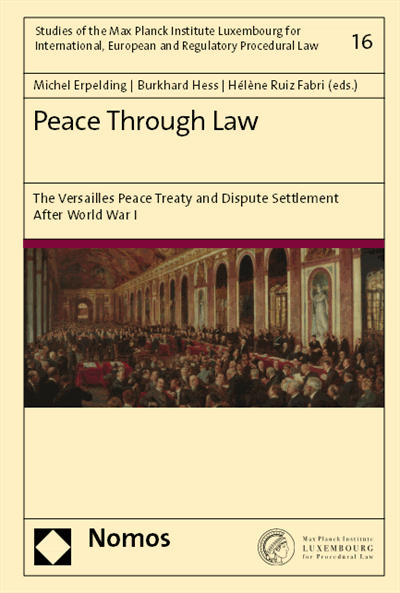
BOOK: Michel ELPERDING, Burkhard HESS & Hélène RUIZ FABRI (eds.), Peace Through: Law The Versailles Peace Treaty and Dispute Settlement After World War I [Studies of the Max Planck Institute Luxembourg for International, European and Regulatory Procedural Law, Bd. 16] (Baden-Baden: Nomos Verlag, 2019), ISBN 978384529916, OPEN ACCESS


Book abstract:
Den Vertrag von Versailles als ein Beispiel von „Frieden durch Recht“ darzustellen, mag rückblickend als Provokation erscheinen. Und doch bestechen der Versailler und die anderen Pariser Friedensverträge von 1919–1920 noch heute durch die schiere Vielfalt und Neuartigkeit der durch sie auf den Plan gerufenen völkerrechtlichen „Experimente“ sowohl substantieller als auch verfahrensrechtlicher Natur. Obwohl viele dieser „Experimente“ auch das Völkerrecht und die internationale Streitbeilegung in der Zeit nach dem Zweiten Weltkrieg grundlegend beeinflusst haben, sind sie heute kaum noch ein Teil des kollektiven Gedächtnisses. Die in diesem Buch vereinigten juristischen und historischen Forschungsarbeiten geben einen Gesamtüberblick über die Art und Weise wie die Pariser Friedensverträge die internationale Streitbeilegung in der Zwischenkriegszeit sowohl substantiell als auch verfahrensrechtlich geprägt haben. Die in diesem Buch enthaltenen Darstellungen teilweise in Vergessenheit geratener internationaler Gerichte und ihren Entscheidungen werden durch Archiv- und Bildmaterial zusätzlich untermauert.
See also conference videos earlier on this blog.

Read the full book on the Nomos website.

(source: ESILHIL Blog)

27 March 2019

Laetizia PUCCIO (collectif sous la dir.), Trésors de procédure. Les dossiers du Tribunal de la Chambre impériale conservés aux Archives de l’État en Belgique (1495-1806) (Bruxelles: Éditions Avant-Propos 2019), 112 p.

(image source: Belgian State Archives)

Book abstract:
Endommagés lors du bombardement de 1944, plus de 200 dossiers de procès du Tribunal de la Chambre impériale viennent d’être restaurés. Publié en février 2019, l’ouvrage « Trésors de procédure » retrace l’histoire de ces archives et permet découvrir quelques-une des plus belles pièces. Les dossiers du Tribunal de la Chambre impériale (1495-1806) sont composés de milliers de procès. Plus de 2.000 d’entre eux sont conservés aux Archives de l’État à Liège. Ces dossiers de procès décrivent entièrement la procédure judiciaire. Ils regorgent de pièces justificatives dont la valeur iconographique et esthétique force l’admiration : cartes, plans, arbres généalogiques, dessins, etc. Quelque 225 dossiers de procès, soit plus de 25.000 feuillets viennent d’être patiemment restaurés et 28 belles pièces ont fait l’objet de soins particuliers. Le 24 décembre 1944, en effet, le dépôt des Archives de l’État à Liège était touché lors d’un bombardement allemand qui avait pour cible le réseau ferroviaire liégeois. Une partie des archives de la Chambre impériale avait alors été détruite et une autre gravement endommagée par le feu et la neige.

On the Reichskammergericht:
En 1495, l’Empire germanique créait une nouvelle cour de justice. Installée à Wetzlar à partir de 1673, la Chambre impériale (Reichskammergericht) faisait office de juridiction suprême en matière civile. Les habitants originaires des anciennes Principautés de Liège et de Stavelot ont eu recours à ce tribunal jusqu’à la fin de l’Ancien Régime. En 1856, les archives relatives à nos régions ont été transférées de Wetzlar (Allemagne) à Bruxelles, puis l'année suivante aux Archives de l’État à Liège.
Project context:
 Paru en février 2019, l’ouvrage Trésors de procédure est le résultat de plus de six années de recherche. Le projet, destiné à faire renaître ces documents et leurs trésors de procédure, a été financé par la Politique scientifique fédérale (Belspo), avec l’intervention du Fonds Baillet Latour. L’ouvrage est en vente à la boutique des Archives générales du Royaume, via publicat@arch.be, Amazon et Bol.
More information with the Belgian State Archives.

(source: Standen en Landen/Aciens Pays et Assemblées d'États

JOURNAL: Vergentis VII (2018): Judicial Process II. Evolution and development in the History of Law

(image source: Innocent III Chair)

Research articles:
"Procedural progress and culture in the ecclesiastical justice" (Manuel Jesús Conde)
"Reforms to the canonical procedural law proposed by the Spanish metropolitans at the beginning of the canonical codification of 1917" (Carlos René Salinas Araneda)
"The value of jurisprudence in Roman Law and in Roman tradition" (Giovanni Luchetti)
"The care of migrants between the pastoral care of mobility and the mobility of pastoral care" (Luigi Sabbarese)
"The contractual nature of the classical litiscontestatio and the theory of the judicial contract. The dawn of the public conception of the process and of the social function of justice" (Elena Di Bernardo)
"The right of asylum in Christian churches on the basis of some imperial constitutions of the 4th and 5th century" (Rosa Mentxaka)
Read the full issue here.

08 June 2018

BOOK: Françoise HILDESHEIMER & Monique MORGAT-BONNET, Le Parlement de Paris. Histoire d'un grand corps de l'État monarchique XIIIe-XVIIIe siècle (Paris: Honoré Champion, 2018), 848 p. ISBN 978-2-74534-812-8, € 75,85

(image source: IHD)

Book abstract:

Si aujourd’hui le nom de « Parlement » désigne nos assemblées délibérantes, il n’en a pas toujours été ainsi : au Moyen Âge et durant l’Ancien Régime, ce terme s’est attaché à la plus haute Cour de justice du royaume de France, le Parlement de Paris. D’abord « partie du corps du roi », puis Grand corps de l’État, il a exercé au nom du roi la justice souveraine avec une compétence universelle, le plus souvent en appel, mais aussi en première instance. Sa fonction judiciaire a été primordiale, car il était l’instrument de la souveraineté royale et représentait le roi qui était avant toute chose en charge de la justice et de la paix. Mais, issu de la Curia regis, ce Parlement a gardé de ses origines d’autres attributions, de nature plus politique, tant dans le domaine législatif, administratif, économique et social, car il a été le conseil du roi et l’est resté même quand le souverain s’est doté d’un Conseil de gouvernement. Qualifié par le roi médiéval de fontaine de justice, d’image de la majesté royale, représentant l’honneur et la personne du roi, ce grand corps de l’État nous a laissé une œuvre judiciaire immense, cinq siècles et demi de jurisprudence engrangée par les greffiers de la Cour, une documentation originale d’archives sur laquelle se fonde le présent ouvrage. À une époque qui ne connaissait ni la distinction des pouvoirs, ni la séparation de la justice civile, criminelle, et administrative, où seule existait une justice de droit commun pour tous, le roi, l’État et les particuliers, le Parlement a été, tout au long de son histoire, non seulement une autorité politique, mais aussi la Cour suprême régulatrice de la jurisprudence et du droit qu’il a contribué à créer.
More information with the publisher.

15 March 2018

BOOK REVIEW: Sven DÜWET (Fürstenwalde) reviews Thorsten SÜß, Partikularer Zivilprozess und territoriale Gerichtsverfassung [Quellen und Forschungen zur höchsten Gerichtsbarkeit im Alten Reich; Bd. 69] (Cologne/Vienna: Böhlau, 2017), 570 p. ISBN 978-3-412-50534-9, EUR 90,00

(image source: Recensio)

First paragraph:
Seit den 1970/80er Jahren gelten die Ordnungen des Reichskammergerichts (1495, 1555) und diejenigen des Reichshofrates (1559, 1654, 1714/66) als weitestgehend erforscht. [1] Doch wie verhält es sich mit den Ordnungen der reichsterritorialen Hofgerichte? Schließlich hatten spätestens seit dem 16. Jahrhundert einerseits deren Gerichtsordnungen wesentlich auf den Inhalten derjenigen der beiden Reichsgerichte basiert. Andererseits hatte das Gewohnheitsrecht jeweils Berücksichtigung finden müssen, sodass das Reichsrecht in diesen territorialen Gerichtsverfassungen gewissermaßen seine Partikularisierung erfuhr. An dieser Stelle setzt die ca. 290 Seiten starke und zumeist auf Akten aus Münster und Paderborn basierende Arbeit von Thorsten Süß an, der als "Prozessrechtshistoriker" (268) in seiner Dissertation aus dem Jahr 2015 das weltliche Hofgericht im Hochstift Paderborn und dessen Ordnungen (1619/66, 1720) untersucht, die der Publikation als Anhang auf 270 Seiten ediert beiliegen. [2] Schließlich sei die Paderborner Justiz- und Gerichtsgeschichte bislang praktisch nicht erforscht worden (267). Der Fokus der Arbeit liegt hierbei auf dem normativen Verfahren, auch weil Beispiele für die praktische Umsetzung aus den Prozessakten leider zumeist fehlen. Eine Ausnahme bildet der 1790er Reichskammergerichtsfall eines Alexius Bachmann im einleitenden Kapitel (15 ff.) - obwohl der Autor den Zeitraum 1587-1720 untersucht hat. Weitere Kapitel behandeln im Hauptteil die Hofgerichte ganz allgemein sowie die Anfänge des Paderborner Hofgerichts ab 1587 im speziellen, dann exegetisch und analysierend die 1619er Gerichtsordnung unter Bischof Ferdinand I. von Bayern und das Prozessrecht. Es folgt der problematische und wohl - zum einen aufgrund der konkurrierenden Rechtsprechungen der Kanzleibehörde und des geistlichen Offizialgerichts, zum anderen aufgrund der Widerstände der Landstände und deren Visitationswünschen - nicht umgesetzte Versuch von Bischof Ferdinand II. von Fürstenberg, im Jahr 1666 eine reformierte Hofgerichtsordnung vorlegen zu wollen. Schließlich klingt die Arbeit mit der 1720er Hofgerichtsordnung unter Bischof Clemens August I. von Wittelsbach aus. Die eigentlichen Reformversuche hatten originär aber die Bischöfe Dietrich IV. von Fürstenberg, Ferdinand II. von Fürstenberg und Hermann Werner von Wolff-Metternich zur Gracht getätigt.
 More information with recensio.

28 May 2015

BOOK: Ramses DELAFONTAINE, Historians as Expert Judicial Witnesses in Tobacco Litigation. A Controversial Legal Practice [Studies in the History of Law and Justice, 4; eds. M. Sellers & G. Martyn], Heidelberg/New York: Springer, 2015, 453 p. ISBN 978-3-319-14291-3

(image source: Springer)

Ramses Delafontaine (UGent, Department of History) published Historians as Expert Judicial Witnesses in Tobacco Litigation. A Controversial Legal Practice with Springer [Studies in the History of Law and Justice, 4; eds. M. Sellers & G. Martyn].

Abstract:
Historian Ramses Delafontaine presents an engaging examination of a controversial legal practice: the historian as an expert judicial witness. This book focuses on tobacco litigation in the U.S. wherein 50 historians have witnessed in 314 court cases from 1986 to 2014. The author examines the use of historical arguments in court and investigates how a legal context influences historical narratives and discourse in forensic history. Delafontaine asserts that the courtroom is a performative and fact-making theatre. Nonetheless, he argues that the civic responsibility of the historian should not end at the threshold of the courtroom where history and truth hang in the balance.
The book is divided into three parts featuring an impressive range of European and American case studies. The first part provides a theoretical framework on the issues which arise when history and law interact. The second part gives a comparative overview of European and American examples of forensic history. This part also reviews U.S. legal rules and case law on expert evidence, as well as extralegal challenges historians face as experts. The third part covers a series of tobacco-related trials. With remunerations as high as hundreds of thousands of dollars and no peer-reviewed publications or communication on the part of the historians hired by the tobacco companies the question arises whether some historians are willing to trade their reputation and that of their university for the benefit of an interested party. The book further provides 50 expert profiles of the historians active in tobacco litigation, lists detailing the manner of the expert’s involvement, and West Law references to these cases.
This book offers profound and thought-provoking insights on the post-war forensification of history from an interdisciplinary perspective. In this way, Delafontaine makes a stirring call for debate on the contemporary engagement of historians as expert judicial witnesses in U.S. tobacco litigation.
Table of Contents:
General Introduction
Delafontaine, Ramses
  • Pages 1-5
    $29.95
  • Introductory Theoretical Remarks on the Alleged Problematic Nature of the Interaction of History and Law
    Pages 9-13
  • Clio’s Modern Paradox Unraveled
    Pages 15-27
  • Introduction Part II
    Pages 31-33
  • Modern Interactions of Law and History
    Pages 35-43
  • The Globalization of the Historian as an Expert Witness
    Pages 45-65
  • Litigation-Driven History
    Pages 67-105
  • A Reassessment of Wijffels’ Concept of Forensic History
    Pages 107-116
  • Introduction Part III
    Pages 119-125
  • A History of Tobacco
    Pages 127-141
  • Tobacco and Health: Towards a Contemporary Perspective
    Pages 143-156
  • The Tobacco Industry and Its Tactics
    Pages 157-171
  • Tobacco Litigation
    Pages 173-209
  • United States v. Philip Morris et al.
    Pages 211-259
  • Debates: Reflections in Academic and National Media
    Pages 261-275
  • Historians in Tobacco Litigation, a Conclusion
    Pages 277-296
  • Final Conclusion on the Involvement of Historians in Tobacco Litigation
    Pages 297-301
  • Final Conclusion
    Pages 303-309
 More information on the publisher's website.

18 March 2015

BOOK: "Il diavolo in Paradiso. Diritto, teologia e letteratura nel Processus Satane (sec. XIV)" by Beatrice Pasciuta (2015)


Beatrice Pasciuta (Professor of Legal History at the University of Palermo), Il diavolo in Paradiso. Diritto, teologia e letteratura nel Processus Satane (sec. XIV)

all information here

Il diavolo sale in Paradiso, deciso a riprendersi l’umanità utilizzando un nuovo formidabile strumento: il processo. Possibile? Composto nel XIV secolo, tramandato come opera giuridica falsamente attribuita a Bartolo da Sassoferrato, il Processus Satane è un processo simulato, in forma di dialogo, fra il diavolo, Cristo e la Madonna. 
Bollato come opera minore e pressoché ignorato dalla storiografia, il testo costituisce in realtà uno straordinario esempio di sincretismo culturale: il linguaggio della teologia serve al diritto come fonte di legittimazione, e di contro la costruzione escatologica e la stessa teoria della Salvezza sono impiantate su una struttura giuridica.
In questa prospettiva, il Processus Satane viene qui riproposto come punto di osservazione ideale per cogliere le interazioni di una cultura poliedrica e complessa, insieme di teatro e di letteratura, di diritto e di teologia, di scuola e di piazza.


13 January 2015

CALL FOR COOPERATION: Appel comme d'abus ('appeal as from abuse') (aca.hypotheses.org)

(the Le Bret family, members of the Aix en Provence parliament, portrayed by Rigaud; source: vikidia.org)
 
Dr. Anne Bozon (Université Paris-VIII, MCF Early Modern History) and Dr. Caroline Galland (Université Paris X Nanterre, MCF Early Modern History) launch an open appeal for cooperation on the theme Appel comme d'abus, an early modern procedural mean for the King of France's sovereign courts to establish his jurisdiction in cases treated by ecclesiastical judges.

The platform text reads as follows (source: aca.hypotheses.org):
 L’inégalité d’accès aux droits est constitutive de la société française d’Ancien Régime, dont tout le fonctionnement est fondé sur le privilège. Dans le domaine judiciaire, cette inégalité se traduit par la pluralité des instances de répression, de régulation sociale et de résolution des conflits : les Parlements coexistent non seulement avec d’autres tribunaux de niveau inférieur, mais aussi avec des justices seigneuriales et ecclésiastiques. Ordre privilégié par excellence, le clergé dispose d’un pouvoir de juridiction et possède ses propres tribunaux, les officialités, lesquelles ont compétence dans les affaires de discipline ecclésiastique, ainsi que dans les matières qui relèvent du spirituel : mariages, testaments, vœux de religion, office divin, etc. L’appel comme d’abus, apparu dans les derniers siècles du Moyen Âge, est un moyen d’utiliser le pluralisme juridique pour remettre en cause une décision émanant d’une officialité ou d’une instance ecclésiastique, et la porter devant les tribunaux royaux. Dans un certain nombre de cas (violation des lois, atteintes aux libertés de l’Église gallicane, incompétence de l’official), les Parlements sont amenés à reconnaître l’abus dans les causes portées devant eux, et à renvoyer l’affaire devant un juge compétent pour un nouveau procès. Cela suppose un travail de définition, de délimitation et d’élucidation. L’appel comme d’abus est traditionnellement présenté comme un procédé utilisé par la monarchie pour affirmer son autorité à l’encontre des justices ecclésiastiques, qui perdent nombre de leurs attributions entre le XVe et le XVIIIe siècle. Son étude recoupe donc celle des relations entre l’Église et l’État, et plus particulièrement la question du gallicanisme. Mais un examen plus approfondi des affaires dans lesquelles il est utilisé montrent que l’appel comme d’abus fonctionne de manière plus subtile et complexe, et qu’il met en jeu les relations d’autorité à l’intérieur même du clergé. Au-delà de l’étude des fondements théoriques, des origines et du fonctionnement de cet appel, il est nécessaire de mettre en évidence les enjeux historiques multiples que son utilisation soulève. Observer les circonstances et le fonctionnement du recours à cet appel devrait permettre de mieux comprendre le travail quotidien des légistes, le fonctionnement du privilège, la définition même de l’abus, et toutes les difficultés qui peuvent naître de la coexistence entre plusieurs systèmes juridiques.

03 July 2013

SEMINAR on Criminal Justice & Politics in Italian History (Milan, 11-12 July 2013)

What: Seminar: "Giustizia penale &  politica, giustizia politica. Forme, modelli, esperienze fra Otto e Novecento".

Where: Università degli Studi di Milano, Dipartimento di diritto privato e storia del diritto, Sala Napoleonica - Palazzo Greppi, via S. Antonio, 10-12, Milano.

When: 11 July, 2:30 pm; 12 July, 9:30 am. 

Contacts: alessandra.bassani@unimi.it; raffaella.bianchi@unimi.it. 

This seminar will present the results of the PRIN Project 2009 (financed by the Italian Ministry of education, university and research) entitled La giustizia penale e la politica. Modelli processuali, profili dottrinali, forme di responsabilità giuridica nell'esperienza italiana tra Otto e Novecento, developed by the following Italian Universities: Università di Macerata (national coordinator), Università di Siena, Università di Milano, Università dell'Insubria, Università di Padova, Università di Catania, Università di Messina. 

Thanks to the number and quality of leading Italian legal historians, experts in the fields of criminal and procedural legal history, that will participate to this event, the seminar resambles more to a conference. The rich program of the event is available here for download. 


11 June 2013

BOOK: R. Riemer, Frankfurt and Hamburg before the Reichskammergericht. A comparison between two trade- and networking centres (Review by J. Haustmann, Sehepunkte 2013)


Jost Hausmann reviewed Robert Riemer's monograph on Frankfurt and Hamburg, two commercial Imperial cities, before the Reichskammergericht. The work (IX + 431 p.) contains a quantitative analysis of proceedings before this tribunal, established in 1495 to counterbalance the Emperor's overlordship. The work builds further on a previous edition of trial documents and focuses on litigation in itself, as well as commercial and social matters. Riemer's work is the published version of a 2006 doctoral dissertation at the University of Greifswald.

A full text of the review can be found online.

23 April 2013

BOOK: Supreme Courts in the Holy Roman Empire and their Communication Strategies [Bibliothek Altes Reich; 11]

(Holy Roman Emperor Emperor Charles VI by Auerbach, Wikimedia Commons)
 
In 2012, Anja Amend-Traut, Anette Baumann, Stephan Wendehorst and Steffen Wunderlich edited a collective work (in German) on the Reichshofrat (Imperial Aulic Council) and Reichskammergericht (Imperial Aulic Chamber), the two most important tribunals in the Holy Roman Empire, representing the Emperor as a feudal lord, on one hand, and the members of the Empire, on the other. A lot has been written on these institutions and their considerable archives. Yet, this volume offers a different perspective, looking at the courts and the early-modern juridification of Habsburg rule through the prism of communication and symbolic representation.

An extensive review in French by Claude Michaud (Orléans) is available on recensio.net, in the digital edition of Francia:Recensio (the book review section of the German Historical Institute in Paris' journal Francia).

22 February 2013

CONFERENCE: Laymen as Judges in European Courts. Comparative Legal History of Procedural Law in the Nineteenth and Twentieth Centuries (Ghent, 15-16 March 2013)


At the occasion of the International Francqui Chair held by Prof. H. Pihlajamäki (Helsinki), Ghent University organizes an international colloquium on the theme "Laymen as Judges in European Courts".

Prof. dr. Paul Van Cauwenberghe (rector, Ghent University) will hand over the University's medal on the first day of the event.

A complete list of speakers, as well as the time schedule, is available on the Ghent Legal History Institute's website. Prior registration with Mrs. Karin Pensaert is compulsory (Karin.Pensaert@UGent.be)