Search

Showing posts with label history of civil law. Show all posts

20 February 2024

CFP: Conference ’Waterloo will wipe out, but that which nothing can wipe out is my Civil Code’. Methods and Models of Reception of Napoleonic Legislation in Europe the Era of the First Half of 19th Century’ (DIOGENES, Jagiellonian University of Cracow, 22 March 2024) [only ONLINE]


We received notice of the following cfp:


Dear Sirs, 

On behalf of the networking platform DIOGENES (Digital Network of European Legal Historians), acting within the framework of Critical Heritage Studies Hub (CHSH), established at the Faculty of Law and Administration of Jagiellonian University in Cracow (Poland), We would like to kindly invite you to participate in the International Scientific Conference ’Waterloo will wipe out, but that which nothing can wipe out is my Civil Code’. Methods and Models of Reception of Napoleonic Legislation in Europe the Era of the First Half of 19th Century’ is aimed at researchers in fields of law and history - in particular at Professors, PhDs, PhD students and graduate students. 

DIOGENES aims to provide the opportunity to participate in attractive workshops and international panel discussions between young legal history researchers (especially PhD students) and budding post-docs, as well as advanced scholars of internationally recognized merit. The first, inaugural meeting, held in Krakow on October 12-13, 2023, gathered more than 50 researchers from around the world (including representatives from such centres as Stanford University, University of Michigan, Massachusetts Institute of Technology, Universität Augsburg, Universität zu Köln, University College London, Universität Wien or Universidad Complutense de Madrid), proved to be a great success, allowing to spread the word about the project among the academic community. 

Aiming to develop a platform and seeking methods to intensify relations between legal historians from different parts of Europe and the world, together with the Chair of History of Polish Law and Chair of General History of State and Law - both at the Faculty of Law and Administration of the Jagiellonian University we have decided to organize an International Scientific Conference on March 22, 2024, entitled: 'Waterloo will wipe out the memory of my forty victories, but that which nothing can wipe out is my Civil Code'; Methods and Models of Reception of Napoleonic Legislation in Europe in the Era of the First Half of the 19th Century. It seems that the subject of the event, focusing on the phenomenon of gradual harmonization of the norms of positive law from the Mediterranean basin to the Vistula Duchy of Warsaw, is a comparative issue that unites legal historians throughout Europe and makes it possible to emphasize the momentous role of the Napoleonic codes in shaping the legal consciousness of the societies of the late 18th and early 19th centuries. In particular, it is impossible to overestimate the influence of the famous Civil Code on changes in legislation, resulting in a slow departure from the model of the absolute enlightened monarch. 

In the course of the Conference, we would like to compare the methods of reception, individual institutions, as well as the sustainability of French solutions in different European countries. For this reason, within the framework of the first expert panel, we would like to give the chance to researchers with recognized achievements and knowledge in the course of a joint debate, in which the audience would be briefly introduced to the process of implementation of Napoleonic regulations, its scope and actual impact on the situation in the Empire itself, as well as beyond its borders - in Spain, Italy, Germany and Poland (Duchy of Warsaw). 

The conference will take place in an online form on the 22nd of March (Friday), 2024. Participation will be possible exclusively via MS Teams.


The event will begin at 10:00 a.m. with an expert debate between eminent specialists in the field of Napoleonic codifications, in which we have the incredible pleasure of hosting the following professors:

 - Prof. Jean-Louis Halpérin (École normale supérieure - PSL, Paris, France)

 - Prof. Aniceto Masferrer (Universitat de València, Spain)

 - Prof. Annamaria Monti (Università degli Studi di Milano, Italy)

 - Prof. Dr hab. Dorota Malec (Jagiellonian University in Cracow, Poland, Vice-Rector for International Relations and Head of the Chair in Administrative History and Thought)


After a short break, three consecutive doctoral-student sessions will be organised, in which, in the course of 15-minute speeches, active participants will present topics related to the conference theme.

Suggested topics include the following:

1. the reception of the Napoleonic Codes throughout the world, especially in Europe

2. the origins of the Napoleonic Code and its legal solutions

3. the influence of the Napoleonic Codes on European legal thought in the 19th century

4. civil codes inspired by the Napoleonic Code in the past and present

5. comparative studies on the differences in how the Napoleonic Codes were received Any other research topics that are in line with the conference topic will of course also be warmly welcomed. If you are interested in taking part in the conference, you just need to send us the topic of your speech and a short abstract (including 250 – 350 words). The length of the speech should not exceed 15 minutes.

Speech can be presented only in English.

We look forward to receiving applications by 10th March 2024.

It is also possible to participate passively in the conference.

Everyone interested in active and passive participation in the conference, please fill in the form below: https://forms.office.com/e/MY1tUHSDuL

Participating in the conference is free of charge. For more information, please contact us by email: diogenes@uj.edu.pl


The rules of this event and the personal data processing clause are available at the link: https://drive.google.com/file/d/1gl5hANVB6RcdYGJ6V1v6Ihjl7jPSdpfS/view?usp=sharing


On behalf of the organising committee,


Yours sincerely,

 Izabela Wasik

 Dariusz Piotrowski

 Piotr Owsiak

18 December 2023

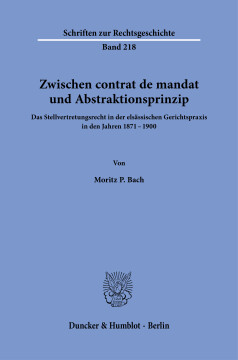
BOOK: Moritz P. BACH, Zwischen contrat de Mandat und Abstraktionsprinzip ; Das Stellvertretungsrecht in der elsässischen Gerichtspraxis in den Jahren 1871–1900 [Schriften zur Rechtsgeschichte; vol. 218] (Berlin: Duncker & Humblot, 2023), 194 p. ISBN 9783428190355, €69,9


(image source: Duncker & Humblot)

Abstract: 
»Between Contrat de Mandat and the Principle of Abstraction. The Principles of Representation in Judicial Practice of Alsace-Lorraine from 1871 to 1900«: In his study, Moritz P. Bach examines the judicial practice in Reichsland Alsace-Lorraine at a place where and time when the German ADHGB from 1862 clashed with the French Code Napoléon from 1804, both conveying very different principles of representation in civil law. After a comparison of aforementioned legal texts, the author uses case law analysis to verify that Alsacian courts interpreted and developed French law according to the German ADHGB and its categories.

On the author:

Moritz P. Bach studierte von 2015 bis 2022 Rechtswissenschaft an der Ludwig-Maximilians-Universität München, hiervon von 2017 bis 2019 im Rahmen des Integrierten Studiengangs Deutsch-Französisches Recht an der ›Université Panthéon-Assas‹ (Paris II). Seine Ausbildung schloss er 2022 mit dem Ersten Juristischen Staatsexamen und der ›Maîtrise en droit‹ ab. Während seines Referendariats am Landgericht Regensburg promovierte er von 2022 bis 2023 an der Universität Regensburg (Lehrstuhl Prof. Martin Löhnig) zu einem rechtvergleichenden deutsch-französischen Thema (Juratisbona-Preis 2023). Moritz P. Bach ist Träger des Exzellenzpreises der Deutsch-Französischen Hochschule 2023 

 Read more here: DOI 10.3790/978-3-428-59035-3.


17 October 2022

CALL FOR PAPERS: The concept of Hazard, Legal historians PhD workshop - University of Lille [Deadline 15 DEC 2022]

 Call for Papers

The Hazard


The concept of hazard having the aim of protecting against the unforeseen, it is very logically in terms of insurance that we first see it emerge in the legal field. Thus, the first attempt to limit the risk appears in French law with the bottomry in the Middle Ages. Likewise, Common Law, with the case law Carter v. Boehm of 1766 focusing on the notion of good faith in terms of contracts, links the hazard with the insurance contract. 

Nevertheless, the definition of hazard is not limited to business law. The French jurist  G. Cornu states that « element of chance, of uncertainty which introduces, into the economy of an operation, a chance of gain or loss for those concerned  {...} is of the essence of certain contracts ». Thus encompassing both the random contract defined by article 1108 of the civil code «when the parties agree to make the effects of the contract, as regards the advantages and losses which will result from it, depend on an uncertain event» that the commutative contract, though supposed to be little subject to hazards. An accidental element can occur in this type of contract without systematically calling into question the commutative nature of the contract. Caton, taken over by Pompon ùius (D., XVIII,I, 8) didn't he consider that the sale of an object was nothing other than a « buying of the hazard » ?

However, limiting the hazard to a purely contractual vision would lead to the exclusion of many legal fields which are nevertheless concerned. Thus, institutional law, unless considering J.-J. Rousseau's social contract, as a real contract, would be excluded from it even though it is directly concerned by the desire to guard against the hazard. The example of the Roman Republic perfectly illustrates this link by its state of emergency system which allows the appointment of a dictator to handle a crisis, a hazard threatening the institutions of the Republic.The principle of choosing a man to deal with the risks and restore the institutional order will cross the ages. Thus, the Constitution of the Fifth French Republic can grant by its article 16, full powers to the head of the executive in order to manage a crisis that could threaten the institutions of the Republic. This constancy of the hazard through the ages is also found in other less visible laws, such as medical law, which is linked to this notion by the therapeutic hazard. The problem is already present under the Old Regime and multiplies with the medical experiments that take place from the 18th century. 

A contrario, some legal fields reject any reference to hazard, such as the law of war. Thus, the modern authors of jus gentium abandon the idea of subjecting war to chance (namely the drawing of lots) that Grotius had admitted in a few cases ('sortis aleae subiici belli exitus licite non semper potest', De iure belli ac pacis, III.20.42). Other fields which traditionally refuse the hazard, such as the climatic and environmental fields are beginning to accept this notion. None of the rules laid down to try to circumscribe the hazard is enough to prove that Mallarmé was wrong. Him who wrote that a throw of the dice had never abolish chance. This is undoubtedly the reason why the concept is the subject of new legal work permanently in positive law. One of the common points of these works is to make the management of the hazard depend on its form. : is it mere chance or risk, is risk a negative or a positive thing ?


A study day of PhD students at the Center d'Histoire Judiciaire de Lille, will be held on March 24, 2023, aims to conduct a legal and historical reflection on the contours of the notion of hazard, around oral presentation of a duration of 15 min in French or in English. Paper proposals, which are mainly aimed at doctoral students and young researchers, will be sent before Thursday, December 15, 2022 midnight to the following email address: doctorantchj@gmail.com. The text will be written in Times New Roman font of size 12 with a line spacing of 1.5 and must not exceed 4,000 characters (including spaces). PDF format is preferred. Communications must be in French or English.


BIBLIOGRAPHY 

I. Monographies  

- BAILLOT ( Philippe ), L’aléa, Paris, Dalloz, 2011  

- BÉNABENT ( Alain ), La chance et le droit, Paris, Libraire générale de droit et de jurisprudence, 1973  - BENSA ( M.E. ), Histoire du Contrat d’Assurance au Moyen-Âge, Paris, Albert Fontemoing, 1897  

- BESSIN ( Marc ) et al., Bifurcations : les sciences sociales face aux ruptures et à l’évènement, Paris, La  Découverte, 2016  

- CARBONNIER ( Jean ), Flexible droit, Paris, Librairie générale de droit et de jurisprudence, 1991  

- CORNU ( Gérard ), Vocabulaire juridique, Association Henri Capitant, Paris, Presses Universitaires de  France, 7e édition, 2005 

- DEMONT ( Bruno ), LEVENEUR ( Laurent ), L’aléa dans le contrat d’assurance, Paris, LGDJ-Lextenso  éditions, 2013  

- DOBRY ( Michel ), Sociologie des crises politiques : la dynamique des mobilisations multisectorielles,  Paris, Presses de la fondation nationale des sciences politiques, 2009 

- DOWNE ( Alexis ), La gestion des risques contractuels par le contrat : étude du droit français à la  lumière du droit anglais, Toulouse, Presses de l’Université de Toulouse, 2018  

- ETIER ( Guillaume ), Du risque à la faute : évolution de la responsabilité civile pour le risque du droit  romain au droit commun, Bruxelles, Bruylant Genève, 2006 

- FRYDMAN ( René ), FLIS-TRÈVES ( Muriel ), L’imprévu : Infortune ou opportunité ?, Paris, PUF, 2016  

- GABAYET ( Nicolas ), L’aléa dans les contrats publics en droit anglais et droit français, Issy-les Moulineaux, LGDJ, 2015  

- GAEL-RAGOT ( Génica ), Le risque de faillite : surveillance et gestion, Paris, Ed. comptable  Malesherbes, 1995  

- HEWARD (Edmund), Lord Mansfield : A Biography of William Murray 1st Earl of Mansfield 1705–1793 Lord Chief Justice for 32 years, London, Barry Rose, 1979 

- HONORAT ( Jean ), L’idée d’acceptation des risques dans la responsabilité civile, Paris, Librairie  générale de droit et de jurisprudence, 1969  

- KAHN ( Raymond ), La notion de l’aléa dans les contrats, Paris, Jouve, 1924  

- LACASSE ( Nicole ), La gestion des risques dans les contrats internationaux, Montréal, Wilson &  Lafleur, 1991  

- MACKAAY ( Ejan ), Les incertitudes du droit :, Uncertainty and the law, Montréal, Thémis, 1999 

- MATHIEU ( Anne-Laure ), Logique et raisonnement juridique, Paris, Presses universitaires de France,  2001  

- MATTÉI ( Jean-Mathieu ), Histoire du droit de la guerre ( 1700-1819 ). Introduction à l’histoire du droit  international, Marseille, Presses universitaires d’Aix-Marseille, 2015  

- MITCHELL (Charles), MITCHELL (Paul), Landmark Cases in the Law of Contract, Oxford, Hart publishing, 2008

- POTHIER ( Robert Joseph ), Traités des contrats aléatoires : selon les règles, tant du for de la  conscience, que du for extérieur, Paris, Debure père, Imp. du Roi, de l'Evêché, & de l'Université, 1770.

- ROSSI (Guido), Insurance in Elizabethan England: The London Code, Cambridge, Cambridge university press, 2016.

WILSON (Mark), Dictator: the evolution of the Roman dictatorship, Ann Arbor, University of Michigan Press, 2021.


Call for Papers

- ROUX ( Jean-André ), La défense contre le crime : répression et prévention, Paris, Félix Alcan, 1922  

- SAISON ( JOHANNE ), Le risque médical : évolution de la responsabilité sans faute du service public  hospitalier, Paris, Éditions L’Harmattan, 1999  

- SANSÉVÉRINO-GODFRIN ( Valérie ), Le cadre juridique de la gestion des risques naturels, Paris, Ed  Tec& doc-Lavoisier, 2008 

- SIMON ( Anne ), L’imprévu et le droit, Paris, Mare & Martin, 2017  

- VERDUN ( Franck ), La gestion des risques juridiques, Paris, Ed. d’Organisation, 2006  

II. Articles  

- BABIN ( Audrey ) et al., « Le droit bousculé par l'imprévu. Actes du Séminaire de l'École doctorale du 15  juin 2012. Contribution du Master 2 Histoire du Droit », Revue juridique de l'Ouest, 2012-4, pp. 457-474 

- BONAH ( Christian ), GAUDILLIÈRE ( Jean-Paul ), « Faute, accident ou risque iatrogène ? La régulation  des événements indésirables du médicament à l’aune des affaires Stalinon et Distilbène », Revue française  des affaires sociales, no3-4, 2007, pp. 123-151 

- BRUNORI ( Luisa ), « Limitation de l’imprévu et protection contre l’imprévisible dans un contrat inédit  du Siglo de Oro espagnol », Rerum novarum ac veterum scientia. Mélanges en l’honneur de Brigitte  Basdevant-Gaudemet, M. Bégou-Davia, F. Demoulin-Auzary, F. Jankowiak (dir.), Mare & Martin, 2020,  pp. 185-198  

- GUYARD ( Nicolas ), « « Calamnitez extremes » et culte des reliques. Les catholiques face aux aléas  climatiques en France au XVIIe siècle », Histoire, monde et cultures religieuses, no40, 2016, pp. 13-25 

- HERVIEU ( Merryl ), « Pas d’aléa, pas d’assurance », Dalloz Actu Étudiant, 2021 

- MARTIN ( Dominique ), « L’indemnisation des victimes d’accidents médicaux et ses mécanismes de  financement », Les tribunes de la santé, no24, 2009, pp.29-40  

- TANGUY ( Jean-François ), « Les magistrats français et les aléas du XIXe siècle : trois générations, une  idée », Les praticiens du droit du Moyen-Âge à l’époque contemporaine, Rennes, Presses universitaires de  Rennes, 2008, pp. 239-254 

- THIVENAUD ( Jean-Marie ), « Le risque et son prix : Genèse d’un concept et de son évaluation juridico financière (XIVe-XVIIe siècles) », Revue d’économie financière, no37, 1996, pp.253-274 

- Y.D ( sic ), « L’aléa contractuel n’empêche pas la réduction judiciaire de la rémunération convenue entre  les parties », Dalloz Actu Étudiant, 2011  

III. Thesis  

- BROUSSY ( Charlotte ), Histoire du contrat d’assurance ( XVI-XXe siècles ), thèse dactyl., Université de  Montpellier, 2016  

- LIVET ( Benoît ), Aléas climatiques, catastrophes naturelles et sociétés dans le Puy-de-Dôme (1783 -  1876), mémoire dactyl., UFR Lettres, Culture et Sciences Humaines Clermont- Auvergne, 2021 

- MENAKANIST ( Twekiat ), Le hasard et l’incrimination, thèse dactyl., Université de Nancy 2, 1992 

- MINET ( Alice ), SEILLER ( Bertrand ), ALBERT ( Nathalie ), DELAUNAY ( Benoit ), PLESSIX  ( Benoit ), La perte de chance en droit administratif, thèse dactyl., 2013  


Call for papers 


- RODET-PROFIT ( Alix ), Le contrat d’assurance maritime à Rouen dans l’Ancien droit, thèse dactyl.,  Paris 2, 2015 

- SABLIER (B.), Les imprévus et les pouvoirs nouveaux de l’administration dans les marchés publics de  travaux, thèse dactyl. Nice, 1979 

- WILLIATTE-PELLITTERI ( Line ), Contribution à l’élaboration d’un droit civil de l’aléa, Lille, thèse  dactyl., 2003  

- ZOUHAL ( ADRA ), Le risque en droit pénal, thèse dactyl., Rennes 1, 2017  


11 January 2022

VIDEO: Inaugurazione di Villa Ruspoli; Presentazione del Libro di Paolo Grossi "il diritto civile in Italia fra moderno e post-moderno"


(Source: https://www.dsg.unifi.it/upload/sub/eventi/eventi%202021/Locandina%20Villa%20Ruspoli%203%20dicembre.pdf)

In 3 December 2021, the Centro Studi per la Storia del Pensiero Giuridico Moderno of the University of Florence inaugurated its seat. At the same occasion, professor emeritus Paolo Grossi has presented his most recent book ""il diritto civile in Italia fra moderno e post-moderno". The registration of both conferences has recently been published in Youtube, in the following links:

https://www.youtube.com/watch?v=w37Jeqdlgfo&t=119s

https://www.youtube.com/watch?v=UDlmr7inRwI


17 June 2021

WEBINAR: O código napoleônico e a cultura jurídica romano-germânica: bicentenário da morte de Napoleão Bonaparte

(Source: https://www.academia.edu/49171472/Webinar_O_c%C3%B3digo_napole%C3%B4nico_e_a_cultura_jur%C3%ADdica_de_tradi%C3%A7%C3%A3o_romano_germ%C3%A2nica_Bicenten%C3%A1rio_da_morte_de_Napole%C3%A3o_Bonaparte_1821_2021_)

The Federal University of Santa Catarina and other Brazilian institutions will be organizing a talk with prof. Paolo Cappellini on the Napoleonic Code, commemmorating the 200 year anniversary of Napoelon's death. 


10 March 2020

BOOK: Ian WARD, English Legal Histories (Oxford: Hart Publishing, 2020). ISBN: 9781509912315, pp. 492, £75.00

Media of English Legal Histories
(Source: Hart Publishing)


ABOUT THE BOOK

English Legal Histories is an exciting and innovative approach to the study of English law. Written in an accessible style intended for students as well as a broader audience, it takes the reader beyond the narrower confines of legal doctrines and cases, and invites them to consider the myriad contexts within which English law has been shaped: the politics, the economics, the art, the poetry. Reaching from the Reformation through to the age of Reform, it tells stories, the 'histories', of English law. Histories of the constitution and government, of crime and contracts, tort and trespass, property and equity. Of the people who made that law, those who wrote it, and those who suffered it. For it is in the end a human story, of justice and injustice, of success and failure, good luck and bad. The law is full of statutes and instruments, cases and precedent, but its history is full of people and peculiarity. Which is what, of course, makes it so endlessly fascinating.

ABOUT THE AUTHOR

Ian Ward is Professor of Law at Newcastle University, and the author of a number of books on law, literature and history including 'Law and Literature: Possibilities and Perspectives' (Cambridge University Press, 1995), 'Shakespeare and the Legal Imagination' (Cambridge University Press, 1999), The English Constitution: Myths and Realities' (Hart Publishing, 2004), 'Law, Text, Terror' (Cambridge University Press, 2009) and most recently 'Law and the Brontes' (Palgrave, 2011).

TABLE OF CONTENTS

Part I - 1613
1. England in 1613
2. 1613: Constitutional Law
3. 1613: Criminal Law
4. 1613: Private Law
5. 1613: Property Law

Part II - 1765
6. England in 1765
7. 1765: Constitutional Law
8. 1765: Criminal Law
9. 1765: Private Law
10. 1765: Property Law

Part III - 1887
11. England in 1887
12. 1887: Constitutional Law
13. 1887: Criminal Law
14. 1887: Private Law
15. 1887: Property Law


More information here