Search

25 May 2022

JOB: 3 PhD Positions + 2 Postdoc positions GOA Project ‘Lordship and Agrarian Capitalism in the Low Countries, c. 1350-1650’ (Ghent University – deadline 31 July 2022)


We learned of 3 open PhD positions for a five-year research project at Ghent University.

In the context of the GOA (Geconcerteerde Onderzoeksactie) funding scheme of Ghent University, a five-year research project will be launched in September 2022 by Professor Frederik Buylaert (promotor-spokesperson), Professor Thijs Lambrecht, Professor Dirk Heirbaut and Dr Jim van der Meulen (promotors). Bringing together the expertise of historians and legal scholars, this project engages with the ongoing debate on political economy in the Low Countries. For this project, 3 PhD positions are available.

Project Description

From an international perspective, the Low Countries are a natural laboratory of history in that this patchwork of wildly divergent landscapes and societies saw the precocious development of agrarian capitalism in some regions (esp. Coastal Flanders, the Guelders riverlands, Holland) whereas other regions saw the persistence of traditional peasant societies until the nineteenth century. Building on older debates on coercive surplus-extraction vis-à-vis markets, historians have speculated that the economic success stories of seventeenth-century Holland, for example, are rooted in the relative absence of seigneurial (‘feudal’) institutions that hampered economic development in most other parts of the Low Countries and Europe. While increasingly influential since the 1990s, this hypothesis has not yet received empirical scrutiny. The GOA-Project aims to remedy this situation by pursuing three lines of enquiry:

  1. Assessing the relative distribution of seigneurial institutions as a proxy for coercive surplus extraction in Flanders, Hainaut, Holland, Zeeland, Brabant, and Guelders, an approach that proceeds mainly from rich sets of feudal registers and pre-existing datasets (Work Package 1; lead researchers: Buylaert, Heirbaut, van der Meulen).
  2. Calculating the nature and scale of seigneurial surplus-extraction with detailed case-studies of seigneuries for which serial accounts survive (Work Package 2; lead researchers: Lambrecht, Buylaert, van der Meulen).
  3. Probing the regulatory constraints of seigneuries on markets for capital, land and labour and how this intersected with the growing involvement of the princely government. This line of enquiry revolves around the cross-checking of extensive sets of seigneurial regulations and ordinances issued by the administration of the Burgundian-Habsburg Low Countries (Work Package 3; lead researchers: Heirbaut, Lambrecht, van der Meulen).

A PhD student will be working in each of these Worck Packages. The PhD students will also be enrolled in the training programme of the Posthumus Institute, the Research School for Economic and Social History in the Netherlands and Flanders.

Applications

Applications are due by 31 July 2022; interviews of selected candidates has been scheduled for 12 August 2022. Applications should be sent by e-mail to Professor Frederik Buylaert. Full details are to be found in the full description (in pdf; see button below).

All info for the PhD positions here

All info for the Postdoc positions here

(Source: Posthumus Institute)

24 May 2022

BOOK: Maria Filomena LOPES DE BARROS, Clara ALMAGRO VIDAL (eds.), Forms of unfreedom in the Medieval Mediterranean (Évora: Publicações do Cidehus, 2021), ISBN : 9791036589201 // OPEN ACCESS


(Image source: Open Edition)


ABOUT THE BOOK
Dependence and loss of freedom – be it partial or total – go hand in hand. During the Middle Ages, people were bonded together through a wide variety of ties that limited their freedom in different ways and to variable degrees.This volume explores these forms of unfreedom. Focusing on both the Iberian Peninsula and the Mediterranean from the eighth century until the fifteenth, the contributors focus on aspects such as transformations of terminology, implementation of different legal traditions across time and space, establishment and dissolution of bonds, and details of everyday life attached to these situations.
Looking at the “ties that bind”, that is, the obligations acquired and everyday implications of the establishment of that dependence, this volume reflects on concepts such as captivity, slavery, manumission and serfdom, among others, and their appearance in the sources.


More information and the entire publication can be found here.


NEWS : SIDHA Conference – 2nd Circular (Brussels, 13-16 September 2022)


(Source: USaintLouis)

NEWS : SIDHA Conference – 2nd Circular (Brussels, 13-16 September 2022)

The Comité Directeur de la Societe F. De Visscher pour l’histoire des droits de l’antiquite has issued a new circular on the upcoming SIDHA conference in Brussels (September 13-16). All info can be found here


COMITÉ DIRECTEUR DE LA SOCIETE F. DE VISSCHER POUR L’HISTOIRE DES DROITS DE L’ANTIQUITE Paul du Plessis (Edinburgh) – Patricio Carvajal (Santiago du Chili) – Annette Ruelle (Bruxelles) Bruxelles, le 19 mai 2022 2nd Circular letter Dear colleagues and friends, In accordance with and following the first circular, I have the pleasure of inviting you to the 75th session of the Société Internationale Fernand De Visscher pour l’Histoire des Droits de l’Antiquité, which will take place at Saint-Louis University – Brussels, from 13 to 16 September 2022, on the theme: Ius et Religio. Law, Ancient Religions and Christianism during the Antiquity Please find the practical information on registration below: • The registration fee is fixed at 350 Euros, without the excursion; • The registration deadline is July 20, 2022. After this date, you will still be able to register until August 16, 2022 (GMT) for an additional amount of 400 Euros (still without the excursion); • The fee for the excursion is fixed at 75 Euros; • The transfer must be made to the account n° : BE57 3100 4670 0435 (Banque ING, avenue Marnix, 24, B – 1000 Bruxelles. Code BIC : BBRUBEBB); • Please specify in the communication in the transfer the following information: surname, first name, "SIHDA 2022 CF 7961" and the option chosen (with or without the excursion): o Example with excursion [425 Euros or 475 Euros]: "Last name, first name, SIHDA 2022, CF 796, with excursion"; o Example without excursion [350 Euros, or 400 Euros]: "Last name, first name, SIHDA 2022, CF 796, without excursion"; • If you wish to obtain an invoice, you are invited to tick the corresponding box in the registration form on the site and to fill in the information requested; • The fee asked to the accompanying persons is fixed at 325 Euros. Information relating to the communications presented by the participants: • You can announce a conference on the online form as soon as you register and attach the abstract afterwards; • The deadline for abstract submission is July 10, 2022 (GMT). You will no longer be able to submit an abstract after this date! • The abstract must contain a maximum of 250 words; • It will be sent to the following address: sihda2022@usaintlouis.be; 1 The number CF 796 is an internal administrative reference at Saint-Louis University. • Only communications for which the speakers have paid their registration fee and provided their abstract by July 10 will be included in the official program; • According to custom, the language of the congress is French, but the conferences can also be given in Latin, English, German, Italian, and Spanish; • A certificate relating to the participation or the conference will be made available to the participants. Looking forward to welcome you in Brussels, where our Societas Amicorum has been founded and in “full presence” in occasion of this anniversary session! Sincerely Yours, Annette Ruelle (sihda2022@usaintlouis.be)

CALL FOR APPLICATIONS: Hermann Conring-Preis 2022 (DEADLINE: 10 June 2022)


(Source: Amazon) 

The Castor & Pollux Stiftung gGmbH, Berlin has a call for applications for the Hermann Conring-Preis for meritorious legal historical, legal-theoretical and legal philosophical work written in German at a German, Swiss or Austrian law faculty. Here all details:

Die Castor & Pollux Stiftung gGmbH, Berlin schreibt für das Jahr 2022 den Hermann Conring-Preis international aus. Es werden in diesem Jahr zwei Preise vergeben. Jeder Preis ist mit EUR 5.000 dotiert und wird von der Castor & Pollux Stiftung gGmbH, Berlin, anlässlich des 43. Deutschen Rechtshistorikertages verliehen, der vom 8. bis zum 12. August 2022 in Zürich stattfindet. Der Preis zeichnet hervorragende Forschungsleistungen auf dem Gebiet der Rechtsgeschichte, Rechtsphilosophie und Rechtstheorie aus. Eingereicht werden können Veröffentlichungen in deutscher Sprache an juristischen Fakultäten der Hochschulen in Deutschland, Österreich und der Schweiz. Der Preis ist nach dem herausragenden Universalgelehrten Hermann Conring (1606 bis 1681) benannt, der nicht nur die deutsche Rechtsgeschichte mitbegründet, sondern auch maßgebliche Beiträge zur politischen Wissenschaft und Philosophie geleistet hat und den bedeutenden Herrschern seiner Zeit als Berater zur Verfügung stand. Eine Jury aus namhaften Wissenschaftlerinnen und Wissenschaftlern, zu der die Professorinnen und Professoren Marietta Auer (Direktorin des Max-Planck-Instituts für Rechtsgeschichte und Rechtstheorie, Frankfurt am Main), Ulrike Babusiaux (Universität Zürich), Stephan Dusil (Eberhard Karls Universität Tübingen), Peter Oestmann (Westfälische WilhelmsUniversität Münster), Johannes Platschek (Ludwig-Maximilians-Universität München), Thomas Simon (Universität Wien) und Andreas Thier (Universität Zürich) gehören, befindet über die Zuerkennung dieser Auszeichnung. Prämiert werden nur die besten Arbeiten. Die vorzulegenden Arbeiten sollen in sich abgeschlossen und entweder innerhalb der letzten vier Jahre publiziert oder im Druck sein. Bewerberinnen und Bewerber können nur Erst- oder Seniorautoren oder -autorinnen der jeweils eingereichten Arbeit sein. Ist die eingereichte Arbeit von mehreren Autoren verfasst, wird der Preis an die Erstautorin bzw. den Erstautor verliehen. Bei gleichberechtigten Autoren ist die schriftliche Zustimmung der Mitautoren erforderlich. Die Arbeiten sind per Post in zweifacher Ausfertigung in deutscher Sprache an den Vorsitzenden der Jury Professor Dr. Andreas Thier M. A., Lehrstuhl für Rechtsgeschichte, Kirchenrecht, Rechtstheorie und Privatrecht, Universität Zürich, Rämistrasse 74/11, CH-8001 Zürich zu senden. Die Arbeit ist außerdem als PDF an den Vorsitzenden der Jury zu zur Weiterleitung an die übrigen Mitglieder der Jury sowie an die Castor & Pollux Stiftung gGmbH übermitteln. Der Arbeit sind folgende Informationen beizufügen: Titel der Arbeit kurze Inhaltsangabe Lebenslauf des Bewerbers (mit beruflicher Stellung und Tätigkeit) genaue Anschrift Einsendeschluss ist der 10. Juni 2022

23 May 2022

JOB: Assistant Professor in Legal History – Tilburg University (DEADLINE: 15 June 2022)


Tilburg University currently has a vacancy for an assistant professor of legal history.


Tilburg University | Tilburg Law School
is looking for a

Assistant Professor Legal History


Department: Public Law & Governance 
Location: Tilburg  
Scientific area: Legal History 
Full time equivalent: 0.8 -1.0 FTE (32-40 hours per week) 
Duration of employment contract: 18 months with prospect of indefinite term 
Monthly full-time salary: €3,821 - €5,230 gross 
Closing date vacancy: June 15, 2022    


This job opportunity is for an Assistant Professor in Legal History, in the department of Public Law and Governance (PLG). PLG is a large, diverse and interdisciplinary department, home to nearly 100 academic staff and a range of legal and social science disciplines. You will develop and grow in teaching as well as research, both individually and as part of a team of ambitious scholars.

The full vacancy can be found here

COLLOQUIUM: Jacques Cujas (1522-2022) e un episodio di cultura giuridica a Torino nella seconda metà del Cinquecento - 26 maggio 2022, Torino

(Source: Academia)
 

SEMINAR: "A Distant Reading of Law Dissertations" with Luca Scholz (Center for Spatial & Textual Analysis, 24 May 2022, Stanford-ONLINE)

(Image source: ResearchGate)

We learned that a seminar about "A Distant Reading of Law Dissertations" will be held by Luca Scholz on Tuesday, May 24, from 12:00 to 1:15 PM PST at the The Center for Spatial & Textual Analysis (CESTA) and via Zoom. Register for Zoom attendance here.


ABOUT THE TALK 

Scholars and students at early modern European universities wrote hundreds of thousands of dissertations. One reason why these sources have often been neglected is that they defy any individual’s capacity for close reading. This talk presents a distant reading of the titles of over 20,000 legal dissertations written at German universities during the seventeenth century. Providing a pathway into a forbidding archive, it highlights the dissertations’ interest for the history of jurisprudence and its receptiveness to social change, the history of universities and academic publishing, baroque rhetoric, and cultural, political, and economic history. The talk also discusses a visualization technique used to examine whether shifts in subjects, methods, or language can be attributed to specific age cohorts or whether they were adopted across generations.


ABOUT THE SPEAKER

I am a scholar of European and digital history who is particularly involved in the relationship of political authority and human mobility, interactions with and perceptions of the atmosphere, and the use of geospatial and computational methods to study the past. I earned a PhD in History at the European University Institute in Florence, an MA in History at the École des hautes études en sciences sociales in Paris and the University of Heidelberg, as well as a BA in Economics at the latter university. Before moving to England, I held a Mellon Postdoctoral Fellowship at Stanford University from 2016 to 2019. I have also taught at the Free University of Berlin and have been a visiting scholar at the University of Saint Andrews and at Columbia University. You can find more information on my work at lucascholz.com.


More information can be found here.

20 May 2022

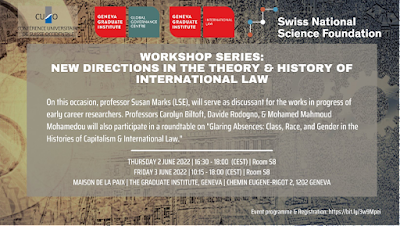
WORKSHOP SERIES: New directions in the theory and history of international law - Geneva Graduate Institute, 2 & 3 June 2022


Join us for the first workshop of the series "New Directions in the Theory & History of International Law." On this occasion, professor Susan Marks (LSE), will serve as discussant for the works in progress of early career researchers.

Professors Carolyn Biltoft, Davide Rodogno, & Mohamed Mahmoud Mohamedou will also participate in a roundtable on "Glaring Absences: Class, Race, and Gender in the Histories of Capitalism & International Law."

Convened by Daniel Ricardo Quiroga-Villamarin, with the generous support of the Swiss National Science Foundation (Doc.CH Grant PoGEP1_20077/1), the Global Governance Centre, and the International Law and International History & PoliticsDepartments at the Graduate Institute, Geneva.

Programme and registration here.

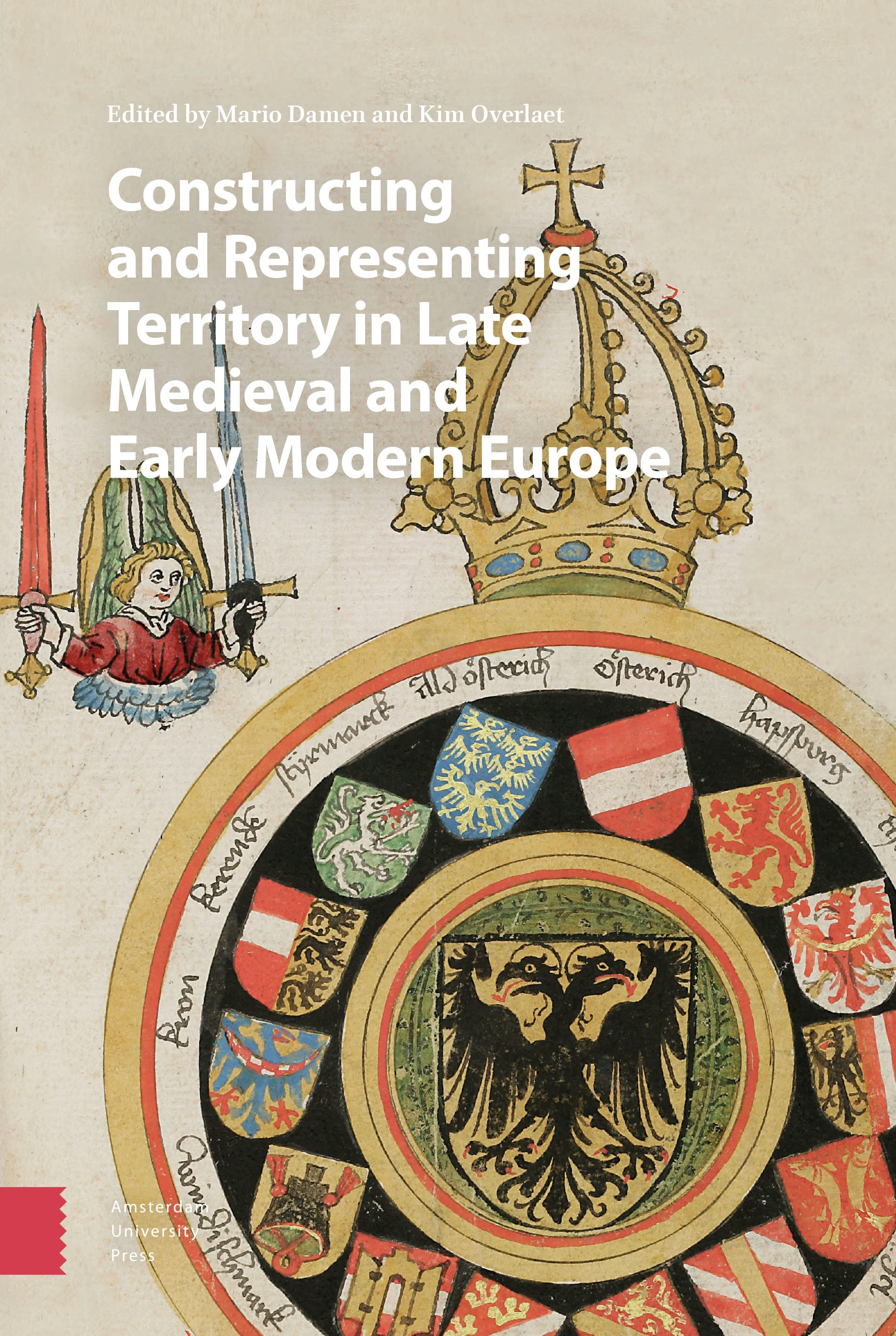
BOOK: Mario DAMEN, Kim OVERLAET (eds.), Constructing and Representing Territory in Late Medieval and Early Modern Europe (Amsterdam: Amsterdam University Press, 2021), ISBN : 9789463726139 OPEN ACCESS


ABOUT THE BOOK

In recent political and legal history, scholars seldom specify how and why they use the concept of territory. In research on state-formation processes and nation building, for instance, the term mostly designates an enclosed geographical area ruled by a central government. Inspired by ideas from political geographers, this book explores the layered and constantly changing meanings of territory in late medieval and early modern Europe before cartography and state formation turned boundaries and territories into more fixed (but still changeable) geographical entities. Its central thesis is that assessing the notion of territory in a pre-modern setting involves analysing territorial practices: practices that relate people and power to space(s). The essays in this book not only examine the construction and spatial structure of pre-modern territories but also explore their perception and representation through the use of a broad range of sources: from administrative texts to maps, from stained-glass windows to chronicles.


ABOUT THE EDITORS

Mario Damen is senior lecturer at the University of Amsterdam. He has published widely on the social and political history of the late medieval Low Countries and is the PI of the research project Imagining a territory. Constructions and representation of late medieval Brabant, financed by the Dutch Research Council (NWO).

Kim Overlaet worked from 2016 till 2019 as a postdoctoral researcher at the University of Amsterdam on the NWO project ‘Imagining a territory’. She currently works as a research manager at the Department of History at Antwerp University.


TABLE OF CONTENTS

Constructing and Representing Territory in Late Medieval and Early Modern Europe: An Introduction (Mario Damen and Kim Overlaet)

Part 1 - The Multiplicity of Territory

  • Were There ‘Territories’ in the German Lands of the Holy Roman Empire in the Fourteenth to Sixteenth Centuries? (Duncan Hardy)
  • Beyond the State: Community and Territory-Making in Late Medieval Italy (Luca Zenobi)
  • Clerical and Ecclesiastical Ideas of Territory in the Late Medieval Low Countries (Bram van den Hoven van Genderen)
  • Marginal Might? The Role of Lordships in the Territorial Integrity of Guelders, c. 1325-c. 1575 (Jim van der Meulen)

Part 2 - The Construction of Territory

  • Demographic Shifts and the Politics of Taxation in the Making of Fifteenth-Century Brabant (Arend Elias Oostindier and Rombert Stapel)
  • From Knights Errant to Disloyal Soldiers? The Criminalisation of Foreign Military Service in the Late Medieval Meuse and Rhine Regions, 1250-1550 (Sander Govaerts)
  • Conquest, Cartography and the Development of Linear Frontiers during Henry VIII’s Invasion of France in 1544-1546 (Neil Murphy)
  • From Multiple Residences to One Capital? Court Itinerance during the Regencies of Margaret of Austria and Mary of Hungary in the Low Countries (c. 1507-1555) (Yannick De Meulder)

Part 3 - The Representation of Territory

  • Heraldry and Territory: Coats of Arms and the Representation and Construction of Authority in Space (Mario Damen and Marcus Meer)
  • The Territorial Perception of the Duchy of Brabant in Historiography and Vernacular Literature in the Late Middle Ages (Bram Caers and Robert Stein)
  • Imagining Flanders: The (De)construction of a Regional Identity in Fifteenth-Century Flanders (Lisa Demets)
  • Mapping Imagined Territory: Quaresmio’s Chorographia and Later Franciscan Holy Land Maps (Marianne Ritsema van Eck)

Constructing and Representing Territory in Late Medieval and Early Modern Europe: A Conclusion (Mario Damen and Kim Overlaet)


The entire publication can be read and downloaded at this link.

19 May 2022

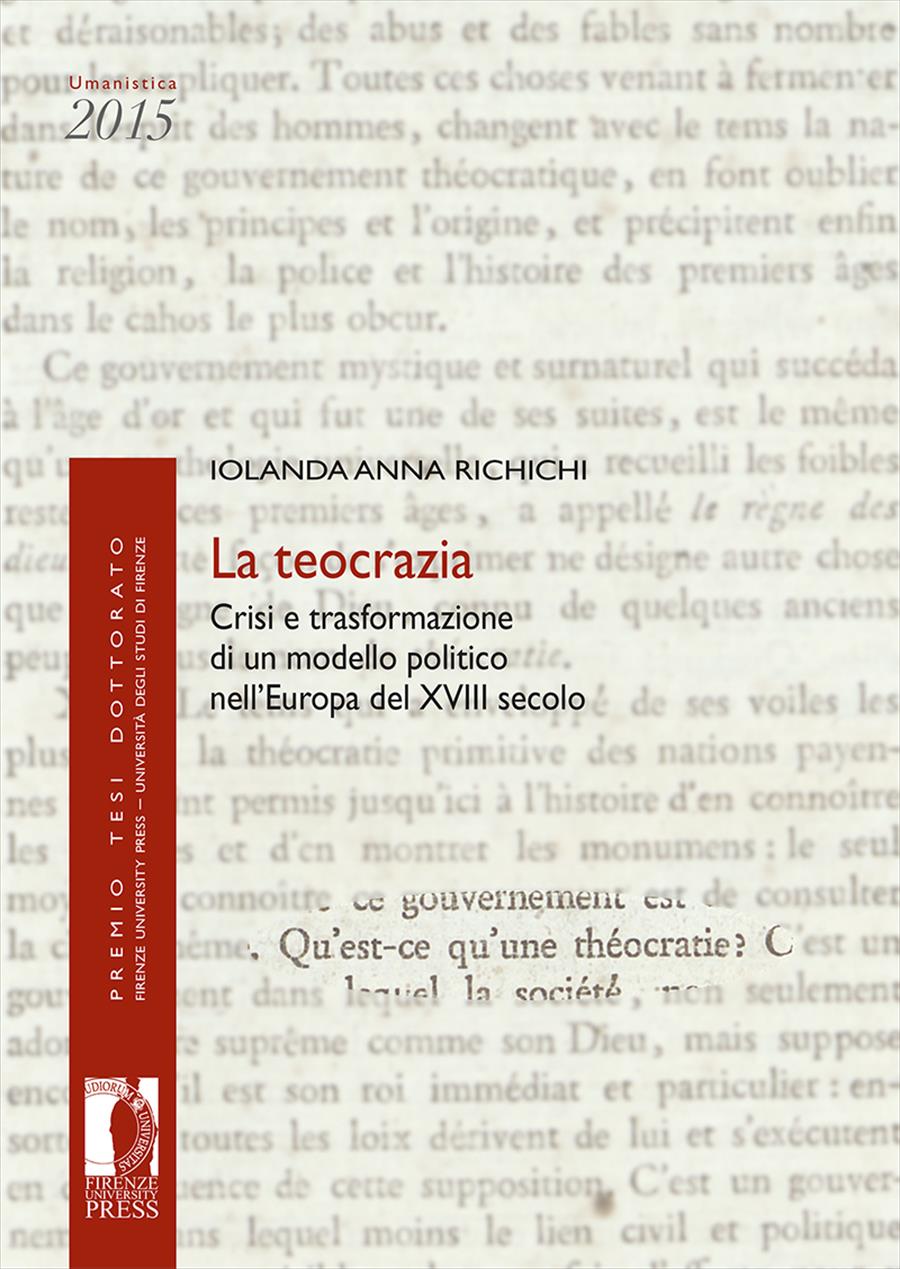
BOOK: Iolanda Anna RICHICHI, La teocrazia. Crisi e trasformazione di un modello politico nell'Europa del XVIII secolo (Firenze: Firenze University Press, 2016), ISBN 978-88-6453-347-6 OPEN ACCESS

(Image source: Firenze University Press)


ABOUT THE BOOK

This study analyses the crisis and transformations of theocracy as a political model in Europe in the first half of the 18th century. The work focuses on the transition from a positive and normative seventeenth-century consideration of theocracy, associated with the Jewish people, to its description in the 18th century as a universal, negative and primitive model. To this end, three authors are examined in their role of emblematic figures of this change, namely: Jacques Basnage, John Toland and Giambattista Vico. The study then highlights a radicalisation phase in mid-eighteenth-century France in the works by Nicolas Antoine Boulanger, and ends with the description of Boulanger’s theocracy in Diderot and d'Alembert’s Encyclopédie.


TABLE OF CONTENTS

I Parte: Teocrazia e respublica Hebraeorum: rielaborazione del modello
a) La «nascita» della coscienza europea
b) La nuova cronologia

Capitolo 1: Jacques Basnage e la storicizzazione del mito ebraico
1.1 Gli ugonotti tra la prima e la seconda generazione: la revoca dell’editto
di Nantes
1.2 Diritto di resistenza e sovranità: Pierre Jurieu e la seconda generazione
monarcomaca
1.3 Ripensare la storia ebraica: Pierre Bayle e Jacques Basnage
1.4 Basnage e la letteratura sulla respublica Hebraeorum: il confronto con Flavio
1.5 Errori e false credenze sulla respublica Hebraeorum: Basnage rilegge Cunaeus

Capitolo 2: John Toland e il mito di una teocrazia ideale
2.1 L’uso del linguaggio biblico nell’Inghilterra del XVII secolo 
2.2 Il modello della respublica Hebraeorum: John Selden e James Harrington 
2.3 John Toland e la diffusione della critica dell’esegesi biblica 

Capitolo 3: Giambattista Vico e la respublica Hebraeorum
3.1 L’orizzonte europeo in Vico
3.2 Le origini della storia umana contro la boria delle nazioni 
3.3 Vico e la respublica Hebraeorum
3.4 La vera teocrazia e le false teocrazie delle nazioni
3.5 La «discoverta» del «vero Mosè»

II Parte: La trasformazione del modello teocratico in senso negativo
a) Le «médailles du déluge»
b) L’Encyclopédie di fronte al mito del Diluvio

Capitolo 4: Nicolas Antoine Boulanger
4.1 Il ritratto del «philosophe» ideale
4.2 La grande «boulangerie» 
4.3 Il «discepolo eterodosso» di Giambattista Vico

Capitolo 5: L’Antichità svelata attraverso i suoi usi
5.1 Il grande progetto del barone d’Holbach
5.2 Le reazioni alla pubblicazione dell’opera
5.3 Il piano dell’opera
5.4 Le fonti erudite di Boulanger
5.5 Una fonte trascurata: la letteratura sulla respublica Hebraeorum

Capitolo 6: Il primo modello politico del genere umano: la teocrazia
6.1 I manoscritti delle Recherches sur l’origine du despotisme oriental
6.2 Montesquieu e Boulanger: la genesi del dispotismo
6.3 La teocrazia primitiva delle nazioni
6.4 Il perno dell’obbligazione politica: la paura

III Parte: Cristallizzazione della teocrazia come modello negativo
a) Teocrazia e respublica Hebraeorum nell’Encyclopédie
Capitolo 7: L’articolo «Théocratie»
7.1 Le fonti
7.2 Attribuzioni
7.3 La prima parte dell’articolo: la teocrazia ebraica
7.4 La seconda parte dell’articolo: l’azione dei preti
Capitolo 8: L’ Œconomie politique
8.1 Quale «Economia politica» per l’Encyclopédie?
8.2 «Économie» ed «Œconomie»: V e XI tomo dell’opera a confronto
8.3 La sotto-voce «Œconomie politique»
8.4 La teocrazia ebraica rispetto alle altre teocrazie

Conclusioni

The entire publication can be read and downloaded at this link

18 May 2022

SEMINAR: The Search for Lasting Peace, A Conversation with Stella Ghervas, Beatrice de Graaf and Miloš Vec (2 pm, Geneva time - 19 MAY 2022) ONLINE


A Conversation with Stella Ghervas, Beatrice de Graaf and Miloš Vec

About the Seminar


The aim of the seminar is to ensure a free and open discussion about peacemaking in international legal history, hosted by Ann-sophie Schoepfel and Daniel Ricardo Quiroga Villamarin.

The seminar will cover topics such as the shift in international politics and alliances, the European idea its changes.

The seminar will consist of a discussion for 40-45 minutes, and then open the floor for a Q/A session.

Registration here.

BOOK: Hermann KAMP (ed.), Herrschaft über fremde Völker und Reiche. Formen, Ziele und Probleme der Eroberungspolitik im Mittelalter, (Wiesbaden: Patmos, 2021), ISBN : 978-3-7995-6893-7

(Image source: Patmos)


ABOUT THE BOOK

Der vorliegende Band rückt Eroberungen zum ersten Mal als ein Phänomen in den Blick, das auch im Mittelalter die politische Geschichte, die Bildung von Herrschaftsräumen und -techniken sowie die Entwicklung politisch wie kulturell bestimmter Identitäten entscheidend prägte. Er betrachtet, vielfach komparativ, die wichtigsten europäischen Eroberungen von der Spätantike bis ins 15. Jahrhundert und zeichnet nach, mit welchen Zielen und Methoden die Eroberer von Theoderich über Karl den Großen bis zu Eduard I., von den Normannen in Süditalien bis zum Deutschen Orden ihre Herrschaft über fremde Völker etablierten und mit deren Widerstand umgingen. Besondere Aufmerksamkeit findet zudem die Rechtfertigung von Eroberungen, ihre religiöse Aufladung in Byzanz und bei der Inbesitznahme nicht-christlicher Gebiete, aber auch die ambivalente Legitimation in Recht und Literatur. Am Ende entsteht so ein äußerst vielfältiges Bild der mittelalterlichen Eroberungspraxis und des mit ihr verbundenen Diskurses.


ABOUT THE EDITOR

Hermann Kamp lehrt Mittelalterliche Geschichte an der Universität Paderborn. Seine Interessen gelten neben der Eroberungspolitik der mittelalterlichen Konfliktführung und Friedensstiftung, den Formen der politischen Kommunikation und der Geschichte des spätmittelalterlichen Burgunds.


More information with the publisher.

17 May 2022

ONLINE LECTURE: Paradigms of Social Order: From Holism to Pluralism and Beyond (19th May 2022, 13:00 CET - Tilburg Law School/ON LINE)

(Image source: Tilburg University)
 

Date: 19th May 2022  Time: 13:00  Location: Online

Sergio Dellavalle - Paradigms of Social Order: From Holism to Pluralism and Beyond (With Guest Speakers Hans Lindahl and Ingo Venzke)


SUMMARY

In the latest I-HILT online e-lecture series, Professor Sergio Dellavalle (University of Turin) will be discussing his most recent book 'Paradigms of Social Order'. This publication focuses on the concept of 'order', surveying the many theories that have been developed to explain what is social order. Through such analysis the book then challenges well-established assumptions about how best to organise a just and effective society, providing the opportunity to question the suitability of a cosmopolitan society in dealing with modern global challenges. Also joining this event as guest speakers are Professor Hans Lindahl (Tilburg University) and Professor Ingo Venzke (University of Amsterdam). 

If you are interested please contact Deepak Mawar (d.r.mawar[at]tilburguniversity.edu) with the email title ‘I-HILT E-Lecture Registration’ and he will provide you with the Zoom link for the e-lecture.


More information can be found here.

16 May 2022

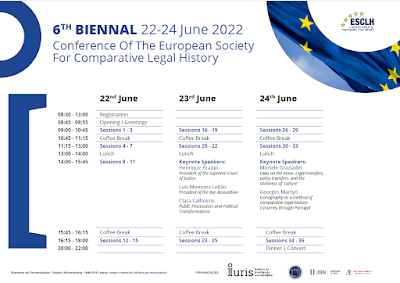
CONFERENCE PROGRAM: 6TH BIENNAL Conference Of The European Society For Comparative Legal History - Lisbon, 22-24 June 2022


(Source: Iuris)

IURIS – Interdisciplinary Research Institute hosts the 6th Biennal Conference of the European Society for Comparative Legal History, running between the 22nd and 24th of June 2022, at the Faculty of Law of the University of Lisbon.

The conference, which will gather in Lisbon over a hundred researchers from around the world, will focus on legal professions and method, especially the methods of legal professionals across Europe and the world, picking up threads of thought from the earlier ESCLH conferences in Valencia (2010), Amsterdam (2012), Macerata (2014), Gdansk (2016), Paris (2018) to explore what roles Professions and Methods have played, and continue to play, within comparative legal history.

See the program and register here.

ESCLH members are exempt from paying the conference fee. The ESCLH annual fee is €50; please find more information here:

http://esclh.blogspot.com/p/donate-to.html

CFP WORKSHOP: Ius Commune Workshop on Comparative Legal History 2022 - Ius Commune in the Making: Innovation in the History of Law - Maastricht (24-25 November 2022) (deadline 15 July 2022)


Ius Commune Workshop on Comparative Legal History 2022

Ius Commune in the Making: 

Innovation in the History of Law


The 27th Ius Commune Conference will take place in Maastricht (24-25 November 2022), and a Workshop will be devoted to “Innovation in the History of Law”. 

The workshops on “Comparative Legal History–Ius Commune in the Making” aim to reveal and understand the nature and effects of various legal formants in the development of law. Indeed, forces of legal formants are too often lost or hidden beneath a superficies of commonalities. History is a living laboratory. In the past, we explored the role of legal actors (Edinburgh 2014), legal sources (Maastricht 2016), force of local laws (Utrecht 2017), methods and dynamics of law (Amsterdam 2018), networks (Leuven, 2019), paradigmatic shifts (Maastricht, online 2020), and great debates in the history of law (Maastricht, online 2021).

The current workshop aims to explore how the (practical) concept of innovation ties in with conceptualizations of law. Innovation is a buzzword, these days. Challenges big as well as small of our contemporary world (such as ecological decline, energy, shortage in raw materials) are calling for innovation on technical and scientific levels, as well as on the normative levels of law. Innovation in technique and science (e.g. robotization) likewise has called for innovation in law. Innovation is a term that ultimately signifies making something new, to improve the existing, and it suggests that at least the existing does not meet the standards required, let alone that the past will reveal solutions.

Is it true that law needs this type of innovation in order to address these and similar issues? What are the implications of (calls for) innovation in law? History has seen factual challenges, and these have obviously confronted law. Foremost examples are ubiquitous: the emergence of the cognitio extraordinaria in Roman times or the emergence of equity in the common law. Further examples can be found in the high middle ages and in early modern times, with the rise of long-distance trade, financing and insurance and the construction of techniques like bills of exchange and bearer documents; industrialization, mechanical transport and the rise of the consumer society has triggered the law of obligations to adapt liability doctrines, duties to protect; various individual and common property arrangements were used to protect or exploit land.

These responses were not just `innovations,’ but reveal a detailed fabric of variety. They were sometimes top down, sometimes bottom up; sometimes borrowed from traditional Roman law, sometimes developed in natural law, canon law or indigenous law; sometimes indeed rather new, but at the same time using traditional legal elements; the same old concepts may be considered useless as well as valuable; reasoning may have been strict or lenient, and even in a mode of reasoning called strict or legalistic, sometimes creative new turns may be seen.

This workshop aims to highlight those particular moments in time in which needs for change were heard and addressed in law. We need to understand and be aware of these innovative changes that took place in the past, and hence understand how law reacted. History is a necessity, as it offers us the opportunity to identify and analyse change. We seek to identify the nature of these innovations and the changes they entailed in the law. Reasons and motivations for changes may be highlighted, and reveal the contextual formants, like prevailing ideologies, in time and space.

Senior researchers and PhD candidates are invited to submit an abstract of a paper related to the above-mentioned theme. Abstracts (max. 400 words) should be sent to Agustín Parise (agustin.parise@maastrichtuniversity.nl) no later than 15 July 2022. Shortly after that, the authors will be informed whether their papers are selected for a presentation during the Workshop. All contributions should be in English. Co-authored papers will be also considered. The organizing committee will give preference to early-career researchers when facing submissions of similar high quality.

Researchers from within and outside the Ius Commune Research School will be eligible to present abstracts. Please also forward this call to colleagues who might be interested.

Should you have any questions please do not hesitate to contact a member of the organizing committee,

Harry Dondorp (j.h.dondorp@vu.nl)

Wouter Druwé (wouter.druwe@kuleuven.be)

Michael Milo (j.m.milo@uu.nl)

Pim Oosterhuis (janwillem.oosterhuis@maastrichtuniversity.nl)

Agustín Parise (agustin.parise@maastrichtuniversity.nl)

14 May 2022

COLLOQUE: « A. V. Dicey (1835-1922) : célébrer le centenaire de la mort d'un juriste, constitutionnaliste et penseur politique britannique » - 2 et 3 juin 2022 (Salle des Conseils, université Paris Panthéon-Assas)


« A. V. Dicey (1835-1922) : célébrer le centenaire de la mort d'un juriste, constitutionnaliste et penseur politique britannique »

“A. V. Dicey (1835-1922): celebrating the centenary of the death of a British jurist, constitutionalist and political thinker”


Jeudi 2 et vendredi 3 juin 2022

(Salle des Conseils, université Paris Panthéon-Assas)


Jeudi 2 juin 2022 : accueil à partir de 14h30


14h45 : Ouverture : Olivier Beaud, Directeur adjoint de l’Institut Michel Villey, université Paris Panthéon-Assas

14h55 : Introduction : Catherine Marshall (Agora) & Céline Roynier (CPJP), Cergy Paris Université (CYU)


Session 1 : 15h-17h 

Dicey : disciple ou source d’inspiration ? / Dicey: follower or source of inspiration?

Président - Renaud Baumert (CYU)


-        Françoise Orazi (Université de Lyon II) : “Anti-suffragists anxieties: A. V. Dicey’s Letters to a Friend on Votes for Women”

-        Gregory Bligh (Sciences Po Lyon) : “Beyond a legal concept of sovereignty. Dicey's conception of political sovereignty in Relations Between Law & Public Opinion”

-        Alan Kahan (Université de Paris-Saclay) : “Dicey’s role in the history of liberalism?”

-        Thibaut Guilluy (Université de Lorraine) : “Dicey et le positivisme”

Questions


Pause : 17h30-18h


-        18h-19h: Keynote speaker : Adam Tomkins (Glasgow University) : “Dicey and Bagehot: How the Nineteenth-Century Constitution Fares in the Twenty-First”


Vendredi 3 juin 2022


Session 2 :  8h45-11h

Dicey à l’essai / Dicey to the test

Présidente - Cécile Bargues (université Paris Panthéon-Assas)


-        Nick Barber (University of Oxford, Trinity College): “Dicey and the Rule of Law”

-        Tom Hickman (University College London): “Dicey’s concept of Parliamentary sovereignty and its influence on 20th and 21st century constitutional law”

-        Aurélien Antoine (Université Jean-Monnet): “Dicey dans les jugements Miller 1 et Miller 2”

-        Timothy Endicott (All Souls, Oxford): “The Structure of the Constitution”

Questions


Pause : 11h-11h20


Keynote speaker :  11h20-12h20

-        Vernon Bogdanor (King’s College, London): “What is left of Dicey’s constitution?”


Déjeuner : 12h30-13h45


Session 3 : 13h45-15h30

Dicey au-delà des frontières/Dicey beyond borders

Président - Carlos Herrera (CYU)


-        Miles Taylor (Humboldt-Universität, Berlin) : “A.V. Dicey, the empire and the turn to “collectivism” in English social policy (1898-1914)”

-        Harshan Kumarasingham (University of Edinburgh) : “Dicey Abroad. The Crown’s Prerogative Powers and the Use of Dicey as a Source in Constitutional Crises in Pakistan and Australia”

-        Frederik Dhondt (VRIJE, Brussels) : “Le referendum royal de Léopold II de Belgique : insérer le peuple dans la monarchie parlementaire”

Questions


Pause: 15h30-15h50

Session 4 : 15h50-17h20

Dicey contre Dicey / Dicey vs. Dicey

Présidentes - Catherine Marshall (CYU) & Céline Roynier (CYU)

-        Nicolas Gabayet (Université de Limoges) : “L’influence de la pensée de Dicey sur le droit administratif britannique”

-        Marie Padilla (Université de Bordeaux & Teaching Fellow, Sciences Po) : “Entre traces et aura, l’œuvre d’A. V. Dicey dans la doctrine publiciste britannique contemporaine”

-        Iain McLean (University of Oxford, Nuffield College) & Scot Peterson (University of Oxford, Corpus Christi College) : “No, really, Dicey was not Diceyan”

Questions


Fin/End 17h30

13 May 2022

CONFERENCE: Notai tra ars e arte. Mediazione, committenza e produzione tra Medioevo ed Età Moderna (27 may 2022, Milan - ONLINE)

(Image source: Project LIMEN)
 

Nell’ambito del progetto LIMEN - Linguaggi della mediazione notarile secoli XII-XVI, Marta Luigina Mangini (Dipartimento di Studi storici), Alessandra Bassani (Dipartimento di Diritto pubblico italiano e sovranazionale), Fabio Scirea (Dipartimento di Beni culturali) ed Elisabetta Fusar Poli (Università degli Studi di Brescia) organizzano il convegno di studio dal titolo Notai tra ars e arte. Mediazione, committenza e produzione tra Medioevo ed Età Moderna che si svolgerà il 27 maggio 2022, in presenza presso l'Università degli Studi di Milano, via Festa del Perdono 3, aula 304, e in sincrono presso l’aula virtuale Zoom.

L’incontro è parte dell’offerta formativa per l’anno 2021-2022 del Dottorato di ricerca in Studi Storici dell’Università degli Studi di Milano.

Per ricevere il link a Zoom è necessario iscriversi a questo link (https://forms.office.com/r/TVDkS4X3pg) entro il 25 maggio alle h. 23.45.  


PROGRAMMA

10.00 Marta Luigina Mangini (Università degli Studi di Milano) - Introduzione ai lavori

10.15 Presiede Stefania Buganza (Università Cattolica del Sacro Cuore)

  • Fabio Scirea (Università degli Studi di Milano) - I notai piacentini e l'arte del disegno
  • Federica Gennari (Centro Culturale Italo-Tedesco di Piacenza - CoolTour) - Armi e amori nei disegni dei registri notarili dell'Archivio di Stato di Piacenza (XIV-XV sec.)
  • Matteo Ferrari (École Pratique des Hautes Études -Laboratoire SAPRAT) - Notariato e sapere araldico: un problema aperto
  • Lorenzo Colombo (Università Cattolica del Sacro Cuore) - La committenza del collegio notarile nel Duomo di Milano: l’altare di San Giovanni Evangelista
  • Carlo Cairati (Università Cattolica del Sacro Cuore) - I notai milanesi tra XV e XVI secolo: nobili e committenti?

12.45 Discussione e pausa

14.30 Presiede Alessandra Bassani (Università degli Studi di Milano)

  • Roberta Braccia (Università degli Studi di Genova) - Committenza artistica e organizzazione del lavoro a Genova tra medioevo ed età moderna: i modelli contrattuali
  • Elisabetta Fusar Poli (Università degli Studi di Brescia) e Enrico Valseriati (Fondazione Bruno Kessler - Istituto Storico-Germanico di Trento) - Artefici, committenti, cronisti: profili ‘irregolari’ nel notariato bresciano della prima età moderna
  • Claudia Passarella (Università degli Studi di Padova) - Collegi notarili e opere d’arte nella terraferma veneta: i casi di Verona, Vicenza e Padova XV-XVIII secolo
  • Paola Casali (notaio in Milano) - Il ruolo del notaio tra diritto vigente e circolazione del patrimonio storico-artistico

16.30 Discussione e conclusioni


More information can be found here. 


CFP: Legal History of Guilds/Companies/Family Firms in East-Central Europe - Sapientia Hungarian University of Transylvania, Romania - October 7, 2022


(Source: Jog Szak, Sapientia Erdélyi Magyar Tudományegyetem)


Call for Presentations and Papers: Legal History of Guilds/Companies/Family Firms in East-Central Europe

Venue: Sapientia Hungarian University of Transylvania, Romania

Date: October 7, 2022


The Sapientia Hungarian University of Transylvania, Romania, located in the city of Cluj-Napoca (Kolozsvár, Klausenburg) is organizing an international conference on the legal history of guilds, companies, and family firms in East-Central Europe on October 7, 2022.

The accepted conference papers will be published in the 2022/2 issue of the Acta Universitatis Sapientiae - Legal Studies, the peer-reviewed law journal of our university [ISSN 2286-0940 (online version), ISSN 2285-6293 (printed version), ISSN-L 2285-6293, indexed in HeinOnline, CEEOL and ERIH+]. Regarding formal requirements of the papers please read carefully the following instructions.

The Organizing Committee shall review the proposed papers and confirm admission to the conference by the end of June 2022. We encourage established scholars but also Ph.D. students conducting their research on a topic related to the conference theme to participate.

For the presenters of accepted papers the organizers will provide full accommodation (hotel for two nights, respectively 6 and 7 October and meals) except travel expenses. Cluj-Napoca is the "capital" of the historical region Transylvania with an international airport.

For example, the following topics can be addressed:
  • Guilds in East-Central Europe
  • Legal History of Certain Companies in East-Central Europe (Historical and Legal Turning Points)
  • Economic Crises and Companies in East-Central Europe
  • Shareholder's Agreements in Historical Context
  • Family Businesses in East-Central European Legal History
  • Historical Insolvency Cases
  • Managers' Liability in Historical Context
  • Beginnings of Capital Markets in East-Central Europe
  • Communist Nationalizations of Companies, Reprivatization

Timeline:

  • June 19, 2022: Submission of abstracts (minimum 300, maximum 500 words), indicating the author's affiliation (submissions should be directed to Dr. Zsolt Fegyveresi, e-mail: forumiurisegyesulet@gmail.com)
  • By the end of June: Notification of authors about the acceptance of their paper proposals
  • October 7, 2022: Conference in Cluj-Napoca
  • November 1, 2022: Submission of final papers
  • December 2022: Publication of the 2022/2 issue of Acta Universitatis Sapientiae. Legal Studies

In case of any questions regarding submission of proposed papers and the conference, please do not hesitate to write to us.

12 May 2022

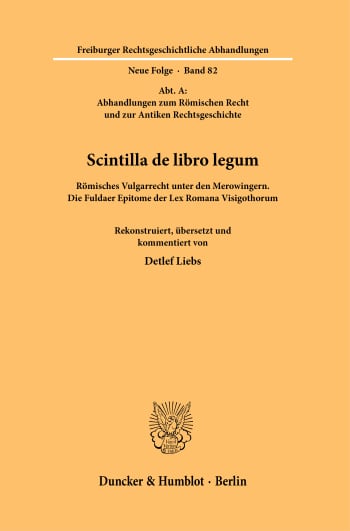
BOOK: Detlef LIEBS, Scintilla de libro legum. Römisches Vulgarrecht unter den Merowingern. Die Fuldaer Epitome der Lex Romana Visigothorum. Rekonstruiert, übersetzt und kommentiert von Detlef Liebs mit einem Beitrag von Gerhard Schmitz (Berlin: Duncker&Humblot - Freiburger Rechtsgeschichtliche Abhandlungen · Neue Folge, Band 82, 2022), ISBN: 978-3-428-18335-7


(Image source: Duncker&Humblot)


ABOUT THE BOOK

Der Autor erschließt einen lateinischen Rechtstext aus dem späten 6. oder 7. Jahrhundert, eine kurze Zusammenfassung des damals unter den Römern im Frankenreich geltenden Rechts. Der Text ist in einer einzigen Handschrift aus dem 8. Jahrhundert erhalten und vieles dort ergibt keinen Sinn; deshalb glaubte man, ihn vernachlässigen zu können. Der Unsinn ist das Ergebnis einer Kette von Abschriften, deren Schreibern vor allem an einer schönen Schrift gelegen war, der Sinn des Niedergeschriebenen kümmerte sie nicht. Die ursprüngliche Fassung lässt sich rekonstruieren, was hier erstmals unternommen wird. Dabei haben sich mannigfache Abweichungen vom Ausgangstext, der Lex Romana Visigothorum aus dem frühen 6. Jahrhundert ergeben, aber auch von anderen späteren Kurzfassungen derselben, mehr Abweichungen und interessantere als in allen vergleichbaren Texten. Die Übersetzung aus einem frühmittelalterlichen Latein erleichtert das Verständnis und der Kommentar hält die Abweichungen von jener Lex Romana fest und erörtert sie.


TABLE OF CONTENTS

A. Einleitung (Die Handschrift — Qualität und Alter der Sammlung — Inhalt — Mängel der Handschrift im Einzelnen — Zur Rekonstruktion — Zur Übersetzung — Zum Kommentar)
B. Text und C. Übersetzung
D. Kommentar
E. Zusammenfassung (E kürzt — Die Vorlage(n) — Rechtsänderungen — Nutzen für die Rechtspraxis)
Literatur
Sachregister


More information with the publisher.

11 May 2022

JOURNAL: Droits (LXXIII, 2021/1: Parenté, moeurs et droit/2)

(Image source: Cairn)


Fondée en 1985, la revue Droits s'est imposée comme la grande revue française de la culture juridique. Deux fois par an, elle propose à ses lecteurs une réflexion collective plurisdisciplinaire sur un grand thème et des variétés. Elle est ainsi devenue le lieu de rencontre de tous ceux qui, à quelque distance du flot de l'actualité législative et jurisprudentielle, souhaitent contribuer à une intelligence plus profonde des savoirs dogmatiques et des jeux de formes des juristes, en particulier en recourant à des mises en perspective historiques, philosophiques et comparatistes.


TABLE OF CONTENTS

  • Peuples romains et germaniques de la première europe entre parenté et fusion (Laura Moscati)
  • Mœurs et droit des militaires : trois siècles de débats autour de l’autorisation de mariage (Paul Chauvin-Madeira)
  • La race, le sang, le droit. La place de la filiation et du mariage dans la définition des catégories du droit antisémite (Danièle Lochak)
  • « Azmat nasab » ou la filiation mise à mal (Édouard Conte)
  • L’ordre public international comme révélateur des conceptions nationales. À propos de quelques évolutions récentes en matière familiale (Samuel Fulli-Lemaire)
  • Affiliation génétique. Perspectives et écueils d’une pratique (Elsa Supiot)
  • Du dualisme théologico-politique à la science kelsénienne du droit. Introduction à « dieu et l’état » (Bernard Bourdin)
  • Dieu et l’État (Hans Kelsen)
  • Les fonctions symboliques de la peine de mort (Francis Hamon)
  • Point de vue sur le mandat constitutionnel du président de la république française (Marie-Aimée Latournerie)
  • Les procurations, documents administratifs ou électoraux ? (Alexis Fourmont)
  • La saisine du conseil constitutionnel par le président de la république. Trois occurrences riches d’enseignements (Ferdinand Faye)
  • L’antigone de sophocle ou la justice au-delà des lois (Sylvain Ravenne)


Read these and other articles on Cairn