Search

Showing posts with label Merovingians. Show all posts

12 May 2026

BOOK: Laury SARTI, Mediterranean Connections: The Frankish Kingdoms and the Roman Empire (476–756) [The Medieval Mediterranean, 145, eds. Frances ANDREWS, Paul MAGDALINO, Jo Van STEENBERGEN, Larry SIMON, Daniel Lord SMAIL, Corisande FENWICK & Maria G. PARANI] (Leiden/Boston: Brill, 2026), 240 p., ISBN: 978-90-04-74607-7, € 153.7

(image source: Brill)

Abstract:
This monograph challenges the idea that Roman imperial authority in the West ended in 476. It shows how the Frankish realm maintained ties to the empire, with real separation only emerging in the late sixth century. Tracing enduring Frankish-Byzantine diplomacy, shared identities, religious controversy, and trade into the seventh century, it reveals a landscape of continued exchange rather than abrupt decline. Including previously overlooked sources, the study offers a new perspective on Frankish identity, imperial affiliation, and the evolving relationship between Rome, the empire, and the Merovingians from the fifth to the eighth century.
On the author:
Laury Sarti, Ph.D. (2012), University of Hamburg, is Heisenberg Fellow at Heidelberg University.
Table of contents:
1. Introduction
     1.1 Outline and Questions
     1.2 Prior Research
     1.3 Approach and Methods
2. The Empire's Western Territories
     2.1 Odoacer and Theodoric
     2.2 One Empire
     2.3 476 in Retrospective
     2.4 The Empire and the West
     2.5 Results
3. Kings of the Empire
     3.1 Clovis and Theudebert I
     3.2 Romans and Franks in Gaul
     3.3 The Empire's Kingdom
     3.4 Franko-Byzantine Exchanges
     3.5 Factors of Alienation
     3.6 Results
4. Christian Community 
     4.1 The Pope between East and West
     4.2 The Tree Chapters Controversy 
     4.3 The Monothelite Controversy
     4.4 Results
5. Mediterranean Connectivity
     5.1 Diplomatic Exchange in a 'Dark Age'
     5.2 Pilgrimages to the East
     5.3 Travel Routes and Trade
     5.4 Language and Knowledge Exchange
     5.5 Results
6. Conclusions
Find more on Brill.

26 January 2024

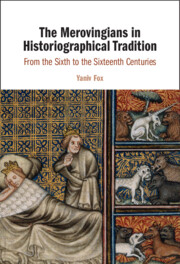
BOOK: Yaniv FOX, The Merovingians in Historiographical Tradition. From the Sixth to the Sixteenth Centuries (Cambridge: Cambridge University Press, 2023). ISBN: 9781009285018


ABOUT THE BOOK

The Merovingian centuries were a foundational period in the historical consciousness of western Europe. The memory of the first dynasty of Frankish kings, their origin myths, accomplishments, and failures were used by generations of chroniclers, propagandists, and historians to justify a wide range of social and political agendas. The process of curating and editing the source material gave rise to a recognizable 'Merovingian narrative' with three distinct phases: meteoric ascent, stasis, and decline. Already in the seventh-century Chronicle of Fredegar, this tripartite model was invoked by a Merovingian queen to prophesy the fate of her descendants. This expert commentary sets out to understand how the story of the Merovingians was shaped through a process of continuous historiographical adaptation. It examines authors from across a millennium of historical writing and analyzes their influences and objectives, charting the often-unexpected ways in which their narratives were received and developed.


ABOUT THE AUTHOR

Yaniv Fox is Associate Professor of History at Bar-Ilan University. He is the organizer of the 2021–2022 Israel Institute for Advanced Studies research group 'Purity and Pollution in Late Antique and Early Medieval Culture and Society' and the author of Power and Religion in Merovingian Gaul: Columbanian Monasticism and the Frankish Elites (2014).


TABLE OF CONTENTS

Introduction

1. Trojans, sea-monsters, and long-haired kings: from Priam to Childeric

2. Capud victuriarum vestrarum Chlodovechus

3. Taedit me memorare: the middle Merovingians

4. Omni ecclesiastica dignitate nobilitavit: 'Good King Dagobert'

5. Regibus solo nomine regnantibus: the Late Merovingians

Conclusions


More information can be find here.


20 June 2022

BOOK: Alexander Callander MURRAY, The Merovingians. Kingship, Institutions, Law, and History (Londra: Routledge, 2022), ISBN: 9781032054230

(Image source: Routledge)


ABOUT THE BOOK

The studies collected here cover a period of about 33 years, from 1986 to 2019, and represent a sustained effort to understand the institutions of the Merovingian kingdom and its history. There has long been a predisposition to cast the Merovingian period in the dark colours of barbarism or to treat it with reference to personal relationships and archaic institutions. The present volume, instead, recognizes the Merovingian world not as an archaic, primitive intrusion on the Mediterranean civilization of the Roman Empire but simply as a participant in the wider commonwealth that existed before and remained after the dissolution of the western imperial system; in so doing, it serves to refute the scholarly tendency to primitivize Merovingian governance, its underlying institutions, and the broader culture upon which these rested.

The collection is divided into four parts. Part I considers the question of whether Merovingian kingship should be viewed as a species of archaic, ‘sacral’ kingship. Part II, on institutions, has chapters that deal with various offices (the grafio and centenarius), public institutions (especially immunity and public security), and the broader makeup of the Merovingian state system. Part III, on charters, procedure, and law, has chapters on the profile of the charter evidence as now presented in the new MGH edition of the Merovingian diplomas and one on particular procedures before the royal tribunal, mistakenly referred to in scholarship as ‘fictitious’ trials; a final chapter provides a reflection on, and basic guide to, the law in general of the successor kingdoms, with an eye to the evidence of Merovingian Gaul. Part IV, a slight change of pace, deals with historiography, both the modern variety (Reinhard Wenskus) and the Merovingian (Gregory of Tours). All chapters deal extensively with the historiography of their subjects.

This book will appeal to students and scholars alike interested in Early Medieval European history, Merovingian history, Early Medieval law and society, Early Medieval historiography, and the influence of Merovingian law and governance on later centuries.


ABOUT THE AUTHOR

Alexander Callander Murray is Professor of History Emeritus, University of Toronto, Canada. He is the author of Germanic Kinship Structure: Studies in Law and Society in Antiquity and the Early Middle Ages (1983); editor of After Rome’s Fall: Narrators and Sources of Early Medieval History, Essays Presented to Walter Goffart (1998) and A Companion to Gregory of Tours (2016); and editor/translator of From Roman to Merovingian Gaul: A Reader (2000) and Gregory of Tours: The Merovingians (2006).


TABLE OF CONTENTS

Part I. Were the Merovingians ‘Sacral Kings’?

1. Post vocantur Merohingii: Fredegar, Merovech, and ‘Sacral Kingship’

2. Gregory of Tours (Hist. II 10) and Fredegar (Chron. III 9) on the Paganism of the Franks: The Relation of the Texts and What They Say

Part II. Institutions

3. The Position of the Grafio in the Constitutional History of Merovingian Gaul

4. From Roman to Frankish Gaul: Centenarii and Centenae in the Administration of the Merovingian Kingdom

5. Immunity, Nobility and the Edict of Paris

6. Merovingian Immunity Revisited

7. The Merovingian State and Administration in the Times of Gregory of Tours

Part III. Charters, Procedure, and Law

8. Review Article: The New MGH Edition of the Charters of the Merovingian Kings

9. So–called Fictitious Trials in the Merovingian Placita

10. The Law of the Post–Roman Kingdoms

Part IV. Historiography

12. The Composition of the Histories of Gregory of Tours and Its Bearing on the Political Narrative

With an Appendix of selections from « Chronology and the Composition of the Histories of Gregory of Tours »


More information can be found here.


12 May 2022

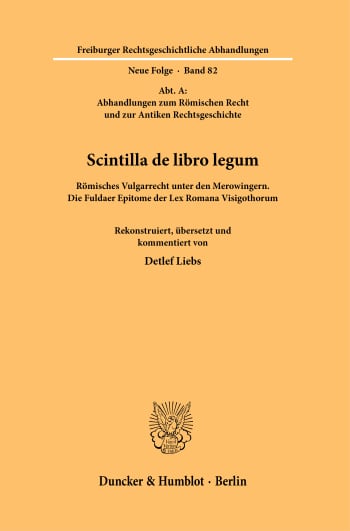
BOOK: Detlef LIEBS, Scintilla de libro legum. Römisches Vulgarrecht unter den Merowingern. Die Fuldaer Epitome der Lex Romana Visigothorum. Rekonstruiert, übersetzt und kommentiert von Detlef Liebs mit einem Beitrag von Gerhard Schmitz (Berlin: Duncker&Humblot - Freiburger Rechtsgeschichtliche Abhandlungen · Neue Folge, Band 82, 2022), ISBN: 978-3-428-18335-7


(Image source: Duncker&Humblot)


ABOUT THE BOOK

Der Autor erschließt einen lateinischen Rechtstext aus dem späten 6. oder 7. Jahrhundert, eine kurze Zusammenfassung des damals unter den Römern im Frankenreich geltenden Rechts. Der Text ist in einer einzigen Handschrift aus dem 8. Jahrhundert erhalten und vieles dort ergibt keinen Sinn; deshalb glaubte man, ihn vernachlässigen zu können. Der Unsinn ist das Ergebnis einer Kette von Abschriften, deren Schreibern vor allem an einer schönen Schrift gelegen war, der Sinn des Niedergeschriebenen kümmerte sie nicht. Die ursprüngliche Fassung lässt sich rekonstruieren, was hier erstmals unternommen wird. Dabei haben sich mannigfache Abweichungen vom Ausgangstext, der Lex Romana Visigothorum aus dem frühen 6. Jahrhundert ergeben, aber auch von anderen späteren Kurzfassungen derselben, mehr Abweichungen und interessantere als in allen vergleichbaren Texten. Die Übersetzung aus einem frühmittelalterlichen Latein erleichtert das Verständnis und der Kommentar hält die Abweichungen von jener Lex Romana fest und erörtert sie.


TABLE OF CONTENTS

A. Einleitung (Die Handschrift — Qualität und Alter der Sammlung — Inhalt — Mängel der Handschrift im Einzelnen — Zur Rekonstruktion — Zur Übersetzung — Zum Kommentar)
B. Text und C. Übersetzung
D. Kommentar
E. Zusammenfassung (E kürzt — Die Vorlage(n) — Rechtsänderungen — Nutzen für die Rechtspraxis)
Literatur
Sachregister


More information with the publisher.