Search

13 February 2026

CALL FOR PAPERS: The Four Nations Law and the Humanities Forums (DEADLINE 28 FEB, 31 MAR, 30 APR 2026)


(image source: Four Nations Law)

 We are excited to announce the calls for papers for Four Nations Law and the Humanities Forums 2026!

Located around the country during 2026, the forums will provide an important space to develop research excellence at the intersections of law and the humanities, and foster intellectual community, supporting early-career scholars. Hosted at the University of Glasgow, Queen’s University Belfast, University of Warwick, and Cardiff University, these workshops are a series held across the four UK nations, in collaboration with the Law and the Humanities Hub (LHub) at the Institute of Advanced Legal Studies.

The forums will workshop ECRs’ work in progress and offer a rigorous context addressing the nature of interdisciplinary research in law and the humanities and its paths of development.

Criteria for Selection

Contributions developed by early-career scholars will be selected based on their:

  • Demonstration of excellence in scholarship and practice. Proposed participation may be written papers or creative work (in visual, sonic, film, etc. form), at any intersection within Law and the Humanities, including research that connects law with history, philosophy, literature, art, performance, linguistics, cultural and media studies, creative practice, and other humanistically-informed fields and methods.
     
  • Eligibility: The forums are open to individuals currently pursuing a PhD or DPhil, or who are within seven years of having completed their PhD, with due accommodation for career breaks, who are actively carrying out research in Law and the Humanities.

Forums Dates

The dates of the workshops are as follows:

  • 21st May - University of Glasgow
  • 25th June - Queen’s University Belfast
  • 2nd  July - Cardiff University
  • 17th July - University of Warwick 

The workshops will bring law and humanities scholarship to wider audiences through the engagement of legal scholars as well as humanities scholars, ensuring that the research is not confined to law or the humanities.

Forums Format

A limited number of works in progress will be selected for each forum. Each forum will be based on pre-reading of all papers and works by all attendees, and will include:

  • A friendly opening session;
     
  • Workshop sessions of 45 minutes dedicated to the submitted papers/works. Each session will include an invited senior commentator and an open discussion addressing subject matter, method, interdisciplinarity, and creativity. The authors/creators will not be expected to present.  The discussion will include all participants in conversational style (not as a Q&A).

The scholarship, creative practice, and networking will be fostered and supported through the participating institutions and LHub, via the Four Nations website, a concluding online plenary, and associated networks such as Legal Humanities Association and the Art/Law Network.

Submissions

Please submit a CV; statement of interest in the forum, including an explanation of your eligibility (up to 250 words); and a 500-1,200-word proposal for a paper, or in the case of an artwork submission, the work and a 300-word description. Please also indicate which location you wish to attend.  
If accepted, submission of the completed paper will be expected a month prior to the chosen workshop, and should be up to 6000 words, or the completed artwork if non-text.

Proposal Submission Deadlines

Dates for the submission are as below.  

  • 28th February - University of Glasgow
  • 31st March - Queen’s University Belfast
  • 30th April - Cardiff University and University of Warwick

NB: Location preferences may not always be possible.
Please send the above to Lucy.FinchettMaddock@gold.ac.uk and LHub@sas.ac.uk.

Completed Works Deadlines for Accepted Proposals

  • 21st May - University of Glasgow
  • 25th May - Queen’s University Belfast
  • 2nd June - Cardiff University
  • 17th June - University of Warwick

For further information, please do contact Lucy.FinchettMaddock@gold.ac.uk and LHub@sas.ac.uk.

With thanks to funding from IALS LHub, Learned Society Wales, and University of Dundee, for their additional funding and support.

Read more here.

(source: Legal History Blog)

SYMPOSIUM: The Meanings of Independence: The American Declaration in Global Context, 1776-1826 (Oxford: Rothermere American Institute, 19 MAR 2026)

(image source: Oxford)
 

Abstract:

The Declaration of Independence, whose 250th anniversary Americans will observe in 2026, is the United States’ founding text, but it was also a transformational international text. Although Congress’s main purpose was to declare thirteen of Britain’s American colonies to be free and independent states, the Declaration’s words and example spoke to audiences well beyond the new union’s borders. Convened by Eliga Gould and Patrick Griffin, Harmsworth Professors, respectively, for 2025-26 and 2022-23, this conference will explore some of the implications of that wider message. In addition to the response to the Declaration in Britain, Ireland, and Europe, we anticipate presentations that focus on North America’s Indian country, Haiti and the Caribbean, Sierra Leone and West Africa, and China and British India. Participants will approach their topic from the broadest possible social and cultural contexts, paying particular attention to how categories of race and class, as well as gender and sexuality, mediated what independence meant. As the choice of 1826 as the conference’s endpoints, we hope to include presentations on the Spanish American Revolutions that extended the quest for independence throughout the Western Hemisphere. 1826 was also the year that two of the main architects of American independence, John Adams and Thomas Jefferson, died, both on July 4.

See here for program and registration. 

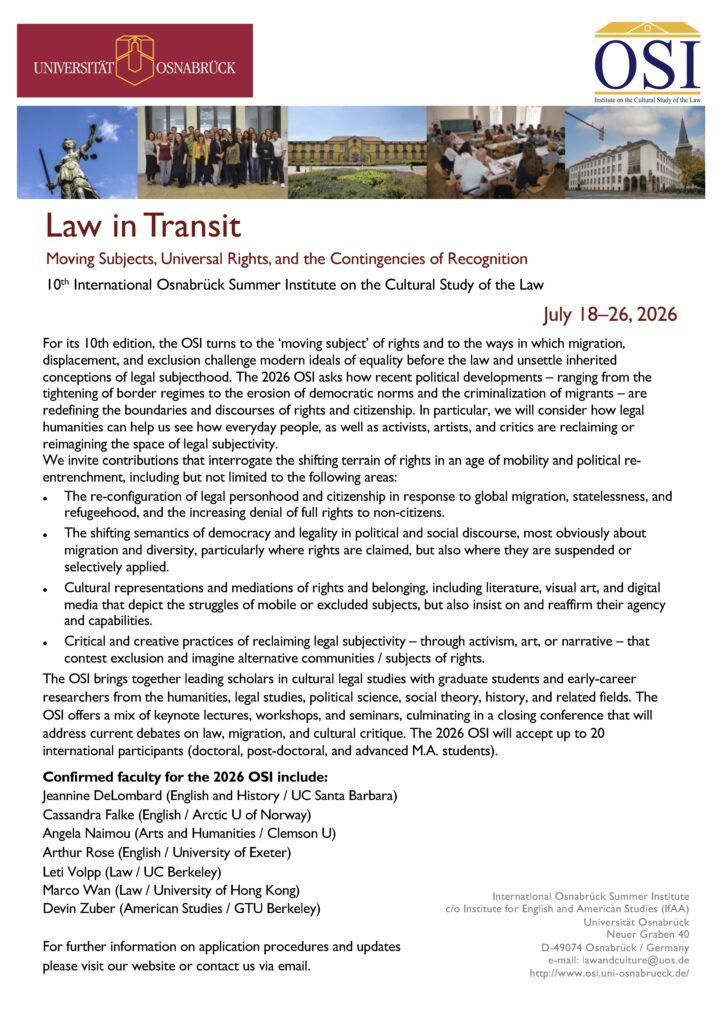
SUMMERSCHOOL: Osnabrück Summer Institute on the Cultural Study of the Law (Osnabrück: Uni Osnabrück, 18-26 JUL 2026) [DEADLINE 1 APR 2026]


(click on image to enlarge; source: Uni Osnabrück)


BLOG: Mario ASCHERI, "Pathways in History and Law" (MILHIS -Milan Legal History)

(click on image to enlarge)

We received the following announcement:

We are pleased to share that **MILHIS**, the new website of the Legal Historians at the University of Milan, has published its first contribution in the section *Pathways in History and Law,* entrusted to professor Mario Ascheri: Categories amidst Law and History

 Read the contribution here.

SEMINAR: "Lo stato di eccezione e la storia delle istituzioni"con Giuseppe Astuto, Elena Gaetana Faraci e Marcello Saija - Incontri de 'Le carte della storia' (13 FEB 2026, 17:00 CET, online)


"Lo stato di eccezione e la storia delle istituzioni"con Giuseppe Astuto, Elena Gaetana Faraci e Marcello Saija

Cinquantaquattresimo incontro de "Le Carte e La Storia. Rivista di storia delle istituzioni", "Lo stato di eccezione e la storia delle istituzioni". Ne discutono Giuseppe Astuto, Elena Gaetana Faraci e Marcello Saija. Coordina Guido Melis.

Venerdì 13 febbraio 2026 ore 17.

Per partecipare all’evento online:
https://unitus.zoom.us/j/97997778275 

BOOK: Manuel HERRERO SÁNCHEZ, Jonatán OROZCO CRUZ & Pedro CARDIM (eds.), The Asiento System and the Transatlantic Trade in Enslaved Africans (circa 1580–1750) [The Atlantic World, ed. Benjamin SCHMIDT & Wim KLOOSTER; vol. 41] (Leiden/Boston: Brill, 2026), xiv + 374 p. ISBN 978-90-04-54929-6, € €157.94


(image source: Brill)

Abstract:

This is the first edited volume to focus explicitly on the asiento, the contractual framework that regulated the transatlantic slave trade to Spanish America between the late sixteenth and mid-eighteenth centuries. As the mechanism that structured a vast system of human trafficking – one of the foundational tragedies of the modern world – the asiento functioned as a legal, political, and commercial instrument of empire. Drawing on new archival research in multiple languages and from repositories across the Atlantic, the chapters trace the negotiated nature of these contracts, the transimperial flows they enabled, and the roles played by formal and informal agents of diverse social, ethnic, and institutional backgrounds. Contributors are: Pedro Cardim, Christopher Ebert, Manuel F. Fernández Chaves, Alejandro García Montón, Miguel Geraldes Rodrigues, Manuel Herrero Sánchez, Wim Klooster, Thiago Krause, Maximiliano Mac Menz, Joseph Mainberger, Ramona Negrón, Linda Newson, Jonatán Orozco Cruz, Edgar Pereira, William Pettigrew, Filipa Ribeiro da Silva, Klaus Weber, and David Wheat.

 On the editors:

Manuel Herrero Sánchez is Professor of Early Modern History at Pablo de Olavide University in Seville. His research focuses on the comparative approach to the history of the Dutch Republic and Genoa, and on the Spanish Monarchy considered as a polycentric imperial structure composed of urban republics. Jonatán Orozco Cruz is Predoctoral Researcher at Pablo de Olavide University, where he is developing his PhD dissertation Transnational Social Networks Connecting Imperial Spaces: the Spanish Monarchy and the Slave Asiento (1675–1694) under the supervision of Prof. Dr. Manuel Herrero Sánchez. Pedro Cardim is Associate Professor of History at Universidade Nova de Lisboa, Portugal. He has published widely on Iberian history, early modern legal history, and Portuguese colonisation of Brazil.

Rad more here: DOI  10.1163/9789004549296.

BOOK REVIEW: Guillaume COT on La Comédie à la lumière du droit. France, Angleterre, Empire (1600–1800), by Gabrielle Vickermann-Ribémont (Comparative Legal History, XIII (2025), nr. 2 (December), pp. 327-332)

(Image source: Taylor&Francis)

A recurring trait among comparatists may be their tendency – if not their instinct – for erudition. This is particularly true of those engaged in what French comparative literature scholar Florence Schnebelen calls comparatisme au carré (‘squared comparatism’): not only do they compare different geographical and cultural contexts, but also different disciplinary fields – simultaneously. Combining the methodologies of both comparative literature and comparative legal history requires a level of intellectual dexterity that Gabrielle Vickermann-Ribémont clearly demonstrates.

Structured in two parts, containing respectively two and three substantial chapters, this ambitious volume offers a history of theatrical comedy in France, England, and the German-speaking world during the seventeenth and eighteenth centuries. It demonstrates how the history of literature and performance in these regions is deeply intertwined with the development of their respective marriage laws. The author’s central argument is that these three cultural spheres share a common cultural foundation – fuelled by transnational influences and cultural transfers – yet differ significantly in their legal traditions. To highlight this tension between shared cultural references and divergent legal systems, the author offers a detailed examination of matrimonial law across these periods and regions.


To read the full review, please click here. Online access is free for members of the European Society for Comparative Legal History. 

DOI: 10.1080/2049677X.2025.2580108


12 February 2026

SEMINAR: PetrIUS and Printed Canon Law Paratexts up to ca. 1600 (Poznań: Centre for Ius Commune, Adam Mickiewicz University, 24 FEB 2026 - 11:00 CET, online)

(Source: Liber extra, edition of Paris 1499, Basel University Library, Nn III 10)

The Centre for Ius Commune has been established at Adam Mickiewicz University to implement the ERC Starting Grant PetrIUS: Petrification of ius commune through printed paratexts led by Piotr Alexandrowicz. The project aims to trace the origins, evolution, and consolidation of marginalia (paratexts) added to printed editions of the Roman and canon law sources. By examining their variations and significance, the project will demonstrate how paratexts shaped the interpretation of Roman and canon law in the early modern period and determine whether the printed marginalia influenced the legal education and practice. More information on the project can be found here: link.

The Centre will also host events related to ongoing research and to broader topics concerning late medieval and early modern ius commune. In the first meeting Piotr Alexandrowicz will talk in general about the project and the first observations on the development of canon law printed paratexts. The meeting will be held on Tuesday, 24.02.2026 at 11 am CET. It will be organised in a hybrid format; to join online use the link to the MS Teams: link.

The Centre welcomes collaboration with scholars working on late medieval and early modern ius commune. If you want to learn more about the Centre or contact the Centre do not hesitate to email the team members Piotr Alexandrowicz (piotr.alexandrowicz@amu.edu.pl) or Matthew Cleary (matthew.cleary@amu.edu.pl).

LECTURE SERIES: Focus (Jewish) law, (Jewish) history & theory (Wien: Universität Wien, JAN-DEC 2026)

(image source: Uni Wien)


University of Vienna

Faculty of Law

Department for Legal & Constitutional History


Team Wendehorst


Focus (Jewish) law, (Jewish) history & theory


10 February 2026


Programme 2026

-        […] not yet decided


13/14 February 2026, Vienna, Juridicum

Empire, Law & Debts. Lessons from the Holy Roman Empire VIII

Workshop

contact: Eric Lanzrath, eric.lanzrath@univie.ac.at; Prof. Dr. Rainer Klump, klump@hof.uni-frankfurt.de

For more see https://rechtsgeschichte.univie.ac.at/news-events/?no_cache=1


21/22 February 2026, Baden bei Wien/Vienna

Engagement at the Margins with Other Legal Systems: Jewish Law Locally and Globally,

CFP/Workshop

Together with the Jewish Law Association (JLA), European Chapter

Contact: Dr George Wilkes george.wilkes@kcl.ac.uk, Dr Stephan Wendehorst, stephan.wendehorst@univie.ac.at

For more see https://rechtsgeschichte.univie.ac.at/news-events/detailansicht/news/call-for-papers-engagement-at-the-margins-with-other-legal-systems-jewish-law-locally-and-globall/?no_cache=1&cHash=462ae2633857659437427640c174fc46


22-28 February 2026, Baden bei Wien, Reichenau & Payerbach an der Rax

Winterschool „Palaeography skills in Jewish, general and legal history 

Contact: Mohamed Attia, mohamed.attia@univie.ac.at

For more see https://jhrr.univie.ac.at/en/teaching/winter-school-palaeography-skills-in-jewish-general-and-legal-history/


22-27 February 2026, Baden bei Wien, Reichenau & Payerbach an der Rax

10th Jewish Law Moot Court, Leg 1 (together with the law faculties of the universities of Belgrade, Rijeka, Tel Aviv and Vilnius, the Masaryk University Brno, the Hebrew University Jerusalem and Cardozo Law School New York)

Contact: david.fuchs@univie.ac.at

For more see https://jhrr.univie.ac.at/en/teaching/historical-jewish-law-moot-court/


26 February 2026, University of Vienna Campus, Spitalgasse 2-4, Courtyard 1, Seminar Rooms 1 & 2

Book Presentation

Daniela F. Eisenstein and Carsten L. Wilke, eds., Mayer Bretzfeld (1747–1823) – der letzte bayerische Landesrabbiner. Briefe aus dem privaten Nachlass mit geschichtlichen Studien, Baden-Baden: Ergon-Verlag, 2025.

In cooperation with the library of the department of Judaic Studies of the University of Vienna

Contact: Paula Somogyi, MA, paula.somogyi@univie.ac.at


6 – 12 April 2026, Jerusalem, Austrian Hospice, Hebrew University of Jerusalem, Israel Institute for Advanced Studies, Jerusalem  

Legal History & Palaeography Clinic

Contact: Vincent Adali vincent.adali@univie.ac.at

For more see https://jhrr.univie.ac.at/en/teaching/paleography-legal-history-clinics/


14 April 2026, Juridicum Vienna

Lecture and Round-Table Discussion

Human Rights to Health and Dignity in Gaza, Physicians for Human Rights and Clean

Shelter

In Cooperation with the New Israel Fund

Contact: Dr Eleonore Lappin-Eppel, eleonore.lappin@chello.at, Dr. Stephan Wendehorst, stephan.wendehorst@univie.ac.at

For more see https://rechtsgeschichte.univie.ac.at/news-events/?no_cache=1


20 Mai 2026, Mühlhausen 

Die Reichsstadt Mühlhausen am Reichshofrat: Regesten, Bde 1-2, hg. von. Stephan Wendehorst, bearb. von Ulrich Hausmann (with numerous Jewish cases before the Imperial Aulc Council)

Contact: Birte Frerichs, birte.frerichs@lesser-stiftung.de, Ulrich Hausmann, MA, ulrich.hausmann@univie.ac.at

For more see https://rechtsgeschichte.univie.ac.at/news-events/?no_cache=1


11 June 2026, Fulda Kanzlerpalais-Volkshochschule

Paula Somogyi, Fuldaer jüdische Familiennamen der frühen Neuzeit (Veröffentlichung des Fuldaer Geschichtsvereins)    

Book Presentation

Contact: Paula Somogyi, MA, paula.somogyi@univie.ac.at, Dr. Thomas Heiler, Fuldaer Geschichtsverein, Thomas.Heiler@fulda.de

For more see https://rechtsgeschichte.univie.ac.at/news-events/?no_cache=1


23-31 July 2026, Kopenhagen, Hamburg-Altona

17th summer academy „History of the Jews in the Holy Roman Empire and its successor states

Contact: Georg Donabauer, B.A., georg.donabauer@univie.ac.at

For more see https://jhrr.univie.ac.at/en/teaching/univiesummerschool/


16.- 24. August 2026, Fulda

10th Jewish Law Moot Court, 2nd Coaching-Week (together with the law faculties of the universities of Vilnius, the Masaryk University Brno, the Hebrew University Jerusalem, Tel Aviv University, Cardozo Law School New York and the University of Rijeka)

Contact: david.fuchs@univie.ac.at

For more see https://jhrr.univie.ac.at/en/teaching/historical-jewish-law-moot-court/


[17.-26. August 2026, Fulda] 

Legal History & Palaeography Clinic

For more see https://jhrr.univie.ac.at/en/teaching/paleography-legal-history-clinics/


25 August 2026, Fulda, City Palace, State Hall 

10th Jewish Law Moot Court, Finals (together with the law faculties of the universities of Vilnius, the Masaryk University Brno, the Hebrew University Jerusalem, Tel Aviv University, Haifa University and Cardozo Law School New York)

Contact: david.fuchs@univie.ac.at

For more see https://jhrr.univie.ac.at/en/teaching/historical-jewish-law-moot-court/


[31 August – 5 September 2026 Mantua]

Legal History & Palaeography Clinic

For more see https://jhrr.univie.ac.at/en/teaching/paleography-legal-history-clinics/


17-22 September 2026, Jerusalem, Austrian Hospice, Hebrew University, Israel Institute for Advanced Studies, Jerusalem  

Legal History & Paleography Clinic

Contact: Vincent Adali vincent.adali@univie.ac.at

For more see https://jhrr.univie.ac.at/en/teaching/paleography-legal-history-clinics/


[November/Dezember 2026, 18.30 Uhr, University of Vienna, Juridicum

8th Salo-Wittmayer-Baron Lecture


In connection with the book presentations of the previous Salo-Wittmayer-Baron lectures

Contact: Dr Stephan Wendehorst, stephan.wendehorst@univie.ac.at

For more see https://jhrr.univie.ac.at/en/salo-wittmayer-baron-society/


17-22 December 2026, Jerusalem, Austrian Hospice, Israel Institute for Advanced Studies, Jerusalem  

Legal History & Palaeography Clinic

For more see https://jhrr.univie.ac.at/en/teaching/paleography-legal-history-clinics/


More information : Vincent dot adali at univie dot ac.

vincent.adali@univie.ac.at

BOOK: Kelly MADDOX, Tino SCHOLZ & Urs Matthias ZACHMANN (eds.), Military Justice in Modern History. The Adjudication of War and Violence in a Globalising World [War and Violence in the Japanese Empire, ed. Kelly MADDOX, Tino SCHÖLZ, Nicolas STASSAR & Urs Matthias ZACHMANN; vol 1] (Berlin: DeGruyterBill, 2025), OPEN ACCESS


(image source: DeGruyterBrill)

Abstract:
Military justice has long played a central role in the adjudication of war and violence throughout the world. It is one of the principal mechanisms used to maintain soldierly discipline as well as to protect civilian populations. At the same time, military justice also has served as an instrument of power in occupied territories by adjudicating the crimes of local inhabitants and has been vital to upholding order among prisoners of war. This volume explores the adjudication of wartime violence through diverse case studies of military justice within modern history (c. 1850–1945). This was a formative period in which our contemporary international legal framework emerged against the backdrop of the internationalisation and standardisation of national, customary practices and the increasing totalisation and globalisation of modern warfare. By examining the evolving and dialectic functions of military justice within this dynamic context, the volume develops important historical perspectives on the enforcement of discipline in armed forces, the punishment of enemy combatants and the administration of law and justice over civilians in occupied areas. "Military Justice in Modern History" reflects on issues in the adjudication of war and violence that are still prevalent in the conflict zones of our world today.

Read the whole book for free here: DOI 10.1515/9783110989588.

11 February 2026

JHIL ANNUAL LECTURE: Michel ERPELDING, "Reflections on a non-lieu de mémoire of international law: the rise and fall of mixed courts for the adjudication of private rights" (Cologne: Akademie für europäischen Menschenrechtsschutz, 16 MAR 2026)

(click on image to enlarge poster)

dr. Michel Erpelding (Research Group Leader, MPILHLT) will deliver this year's JHIL Lecture at the Akademie für europäischen Menschenrechtsschutz in Cologne, organised by the Journal of the History of International Law/Revue d'histoire du droit international.

On the speaker:

Michel Erpelding is Research Group Leader at the Max Planck Institute for Legal History and Legal Theory in Frankfurt am Main, Germany. His current research focusses on the history of international and European integration law, with a special interest in their interaction with colonial law and practices. He is an associate member of the Institut de recherche en droit international et européen de la Sorbonne (IREDIES) and teaches at the University of Luxembourg and the Sorbonne Law School.

Abstract:

Present-day commentators often present the rise of the individual as a subject of international law – and notably as a fully-fledged claimant before international courts – as a phenomenon that only emerged after 1945. However, between the end of the 19th century and the first half of the 20th century, several treaty regimes had already established internationally composed judicial institutions endowed with jurisdiction over treaty-based claims by private persons both against other private persons and sovereign states. Despite their pioneering role and their rich practice, these early international courts have today largely disappeared from the collective memories of international lawyers and the broader public, resulting in the creation of what the French historian Gérard Noiriel has described as ‘spaces of collective amnesia’ (non-lieux de mémoire). This presentation will retrace the creation, expansion, and eventual disappearance of this phenomenon while questioning why it fell into oblivion.

The event will take place on Monday 16 March 2026 at 18:00 Cologne time.

Address below:

RSVP with submissions dot jhil at mpil dot de.

JOURNAL: Special Issue Actes du colloque Les écritures judiciaires. Formes et légitimités des décisions de justice depuis le Moyen Âge (dir. Martine CHARAGEAT & Mathieu SOULA) (Criminocorpus 29 (2025)) [OPEN ACCESS]


(image source: criminocorpus)

Powers and functions of judicial documents (Martine Charageat & Mathieu Soula) [English translation]
DOI 10.4000/15dmp
First paragraph:

In the renewal of analyses concerning the history of justice, judicial practice and the application of penalties from the Middle Ages to the present day are often the focus of attention1 . The focus on the desired effects of this justice (pacification, the imposition of a state legal order) leads to an emphasis on judicial ritual, criminal ritual, amicable or negotiated modes of conflict resolution, as well as avoidance and resistance to justice2 . In a way, it is as if the actual work of justice were limited to procedure, punishment and the strategies of those subject to justice, the latter field having benefited from gender analysis, particularly in terms of agency3 . However, the work of shaping court decisions remains in the shadows, i.e. the means deployed by the institution to make its verdicts visible and assertive, to express them and make them acceptable; in short, to legitimise the brute force of its decisions through a process of formalisation4 . Putting them in writing was part of the documentary revolution that began in the 12th century and was in line with a shift towards a different relationship with the written word, the spoken word and the written word5 . However, it cannot be reduced to a simple operation of storage and memory construction, even though this dual dimension remains intrinsic to the production of these acts, beyond their vocality6 .

 I. Mettre en formes : enjeux de rédaction et stratégies discursives

L’élaboration de la décision judiciaire d’après les Year Books des xiiie-xve siècles (Christophe Archan)
DOI 10.4000/15dmq
Abstract:

The Year Books of the 13th-15th centuries contain recordings of the hearings of the English high royal courts, in the form of dialogues in French (law French). Written primarily for educational purposes, they inform the reader of the exchanges that took place between the different actors in the trial. They are therefore very valuable to us in understanding how a legal decision was taken. We indeed see judges who seek to ensure a certain legal continuity and who also demonstrate pedagogy to justify their judgment.

L’imagerie du Vieux coustumier de Poictou, témoin de la validation des formes de justice à la fin du Moyen Âge (Pierre Prétou)
DOI 10.4000/15dn9
Abstract:

The Vieux Coustumier de Poictou, a painted book from the second half of the 15th century [Médiathèque Niort, Res MSF] features an exceptional iconography that illustrates the validation of legal and judicial forms. In addition to the procedural texts previously studied by René Filhol, consigned to an era of consecutive writing of the ordinances of Charles VII, the painters emphasize the scriptural forms in the context of their production. As a result, this archive enhances our anthropological understanding about the materials shapes drawn up, sealed, exhibited, produced, or delivered by the judges and their court officers. Despite the modern context and the rise of writings, the place of real traditions, of witnesses receiving and validating, or sergeants delivering the charter, remind us of the strength and resilience of orality and living testimony in the process of validating the acts of justice.

Les registres des officialités champenoises : dire et écrire le droit (Véronique Beaulande-Barraud)
DOI 10.4000/15dmr
Abstract:

In 1350, the cathedral chapter of Cambrai excommunicate Jean de Bourlon and pronounce an « aggravation » of the sentence. The document presented here is a translation of the chapter's mandement asking all priests in the diocese to enforce the sentence. If Jean’s crime remains unknown, the document is an efficient source for understanding the content of the excommunication, the forms of its aggravation and the means of its application. Excommunication is a canonical censure wich deprives from all sacraments and social relationships, as recalled by the litany of forbidden actions contained in the document, but also as expressed in the ritual of the anathema. Whoever disobeys excommunication is ipso facto also excommunicated. This mandate to publicize Jean de Bourlon’s excommunication reveals the form and use of the most serious sanction that the Church in the Middle Ages.

Justice et argent public. La mise en forme des condamnations du juge ad sindacatum de la commune de Bologne en 1315 (Marco Conti)
DOI 10.4000/15dms
Abstract:

Medieval judicial sources from Italian municipalities are among the most important documentary collections in terms of quantity and variety, and enable us to study institutions. In Bologna, as in most Italian communes at the end of the 13th century, the administration of justice was entrusted to two foreign officers: the podestà and the captain of the Popolo. These two officers arrived in the city with their collaborators. Among these people, a judge was responsible for investigating the work of all the city officers who managed public funds. In this article, we will examine the work of this officer and his tools at the beginning of the 14th century. After a brief overview of the administration of justice and the work of the officers responsible for controlling municipal finances, we will study the codicological aspects of a register of convictions and acquittals from 1315. This will enable us to understand how this document was used within the municipal administration.

La mise en forme des sentences judiciaires à Dijon. Entre gestion administrative et judiciaire et défense des droits de juridiction de la mairie (Rudi Beaulant)
DOI 10.4000/15dmt
Abstract:

The formatting of judicial sentences is of particular importance in a town such as Dijon, where the town hall had the right of high justice. Firstly, it is important to show the diversity of sources in which high justice sentences were recorded by municipal officers, in order to highlight the issues and purposes of these documents. The second part of the study focuses on the Papier Rouge register, which, although it is intended to contain high justice sentences, is not exhaustive and is linked to other judicial records that still record some of these sentences. Finally, an overview of the urban sources shows the importance of the formatting of judicial sentences, which were particularly useful in the event of a jurisdictional conflict between the commune and the officers of the Duke of Burgundy in the 15th century, and then of the King of France in the early 16th century.

Juger et sanctionner les délits relatifs aux eaux et forêts (domaine du roi, apanages d’Orléans et de Provence, xve- xviiie siècles) (Isabelle Bretthauer & Maïa Pirat)
DOI 10.4000/15dmu
Abstract:

Starting in the late Middle Ages, the French monarchy established a specific administration for managing forests and waterways, which evolved through the early modern period. Although often studied from an environmental perspective, this administration also had a genuine judicial role, with complex procedures and specialized jurisdictions. A series of royal ordinances—notably those from 1346, 1389, 1402, and especially the major 1669 ordinance under Colbert—gradually structured this system. The Eaux et Forêts courts, operating both in the royal domain and in princely apanages like Orléans and Provence, handled forest-related offenses, carried out large-scale inspections (réformations), and produced extensive judicial documentation. Despite being scattered, the surviving archives allow historians to study these practices and reveal a long-term effort toward administrative centralization and standardization.

Des arrêts en millefeuille. Strates de rédaction d’arrêts criminels et gestion de l’information au parlement de Paris (xvie-xviiie siècle) (Aurélien Peter)
DOI 10.4000/15dmv
Abstract:

The criminal arrests of the Parliament of Paris in the 16th to 18th centuries constitute judicial decisions. Far from being simple judgements, they are the result of a long process of writing and formatting involving multiple layers of documentation. Clerks and secretaries played a central role in this process. Writing practices evolved over time, moving from lively, annotated writing to mechanical, standardised copying in the 18th century. Royal reforms, notably the ordinances of 1667 and 1670, streamlined these practices. The production of judgments thus appeared to be a collective and hierarchical process, revealing a strong administrative power. Internal rivalries existed between registry officials, each seeking to control the drafting and dissemination of these acts. The judgment thus became an instrument of justice, a tool of memory and a symbol of royal authority.

La rédaction, la présentation et la publication des jugements du Tribunal de cassation, (1799-1799) (Jordan Hain)
DOI 10.4000/15dmw
Abstract:

During the French Revolution, the law of August 16–24, 1790 reformed the judiciary and required a uniform structure for judgments to limit judicial power. The Court of Cassation, governed by the law of December 1790, followed specific rules without providing reasoning for its decisions. Rejection judgments are rare and poorly preserved, while cassation judgments, better documented, evolved over time: initially very formal, they became increasingly reasoned after 1793, marking the beginnings of judicial decision-making justification.

II. Fonctions et usages de l'écrit

En quête de fama. L’écrit, le droit et la procédure dans les registres d’un évêque italien (v. 1290-1300) (Arnaud Fossier)
DOI 10.4000/15dmx
Abstract:

Four registers containing the records of approximately ninety trials have come down to us from the court of the bishop of Pistoia, Tommaso Andrei (1285-1303). In theory, each of these four volumes should have included the indictments or denunciations, the plaintiffs’ libels, the defendant’s litis contestatio, the oaths of both parties, the witness’ statements, and even the interlocutory or final sentences, at least when the trial went all the way to sentencing. In practice, however, this is not the case, as it is mainly witness’ statements that have been written down and preserved. The aim of this article is to understand why. Was it to keep and preserve in writing what was volatile (that is the “public voice”)? Whereas the orality of the sentence might be enough for it to be effective, the written word enabled rumor - a labile and elusive object - to be transformed into a fama that could thereafter serve for the judge as evidence and support for a verdict.

Les faillites à Florence : quelques éléments sur l’écriture et l’organisation des sentences devant le tribunal de la Mercanzia (années 1330) (Cédric Quertier) 
DOI 10.4000/15dn3
Abstract:

The famous serial bankruptcies of Florentine companies during the 1340s had a major impact on Europe's leading economic metropolis, yet their judicial settlement remains little-known. We have undertaken a long-term investigation to put these bankruptcies into series and perspective. The aim is to examine some twenty bankruptcy sentences pronounced by the Florentine Mercanzia court in 1329 and 1330, to determine how the court's bankruptcy sentences were archived and how they were drafted in order to achieve maximum legal efficiency in a court that judged in equity and relied above all on written evidence. Next, we'll look at the internal structure of sentences. Finally, although jurists advise against justifying them, they do not forbid it; this is why the opening (petition) and conclusion (sentence) of bankruptcy proceedings regularly insist on compliance with the Mercanzia statute.

De la plume du greffier à l’imprimé. La fabrique et le devenir de la sentence pénale des tribunaux supérieurs castillans au XVIIe siècle (Olivier Caporossi)
DOI 10.4000/15dmy
Abstract:

The writing of criminal sentences by the Castilian higher courts (Chancelleries of Valladolid and Granada, Alcades de Cour, audiences, Council of Castile) by the clerks of the court underwent a formalization and specialization (1560-1700). For this reason, it is necessary to retrace the course of the judicial writing of criminal sentences, from the clerk's pen to the public cry of its execution and to the printed word in order to grasp the stakes of this evolution inside the judicial machine as well as outside with the public opinion of the elites.

Entre oralité et écriture, entre acquiescements, silences, grondements ou éruptions. L'écriture des sentences criminelles de la cour des capitouls au xviiie siècle et leur réception par les accusés et condamnés toulousains (Géraud de Lavedan)
DOI 10.4000/15dmz
Abstract:

The case of Jean Auriol, sentenced in 1756 to ten years in the galleys and protesting his verdict, serves as a lens to explore the judicial workings of Toulouse’s capitouls in the 18th century. Archival records reveal the tension between official written form and courtroom orality, where clerks, judges, and defendants show individual traits. Each trial follows a set ritual: the prosecutor’s conclusions, a largely formal last interrogation, deliberation, and the drafting of the sentence. Verdicts stem from debated opinions before being written by the clerk, who is far from neutral, reformulating and translating the accused’s words. Finally, the sentence is read publicly, reflecting a justice both codified and deeply human in its imperfections.

La justice militaire après l’armistice de 1940, un enjeu de légitimité. Regards croisés entre Vichy, Londres et les colonies françaises (Robin Leconte) 
DOI 10.4000/15dn0
Abstract:

Valuable insights into the establishment of the political legitimacy of Vichy and Free France are provided by the 1940-1945 military justice archives. By means of an analysis of the materiality of the acts in question, historians can measure the crucial issues at stake in the judicial writings after the brutal defeat of May-June 1940. This article examines the contrast between the Free French military justice quest for legitimacy and the Vichy regime's efforts to demonstrate the severity of its justice, despite its geographical and political impotence, in a context dominated by the colonial dimension of the French army. We then examine how court records transcribe the words of colonial soldiers. Then we look at Vichy's attempt to rewrite the code of military justice to deal with the issue of prisoners of war. Or how severity gives way to pragmatism.

Juger et dire l’histoire : vrai judiciaire et vrai historique dans les arrêts de la Haute cours de justice contre Philippe Pétain et Pierre Laval (Mathieu Soula)
DOI 10.4000/15dn1
Abstract:

"A trial for history." The expression has now become a commonplace in analyses of "major trials," those that are thought to reorder, reestablish, or repair a collective trauma. Making history or remembering is a function in its own right of the justice system that came with the belated trials for crimes against humanity. The months following the end of the fighting are filled with historical trials or trials for history, because the point is, then, to repair history, to reestablish the chain of time by imposing a common retrospective representation of a recent past that has disrupted established orders and certainties. Imposing a common vision of this past to inscribe the present within a framework of historical legitimacy. In this contribution, we would like to analyze the historical function of the Pétain and Laval trials by questioning the role of justice in the writing or rewriting of history.

Une brève histoire des écritures des parties depuis le Moyen Âge (Cédric Meurant)
DOI 10.4000/15dn2
Abstract:

In the French procedural tradition, the contentious writings by the parties constitute the heart of the trial. Indeed, the essence of the judge's mission consists of resolving the dispute by responding to the parties’ submissions. But this procedural tradition which gives an important place to the parties is in reality very old: it has been in development since at least the High Middle Ages. If the various trials were then mainly oral and accusatory, the gradual rise of the written word reinforced the essential role of the parties who were responsible for writing judicial briefs. Their analysis reveals that these contentious writings have undergone two major developments: first, the picky formalism which initially surrounded the validity of these writings has gradually and fortunately faded away. Then, if many of the writings written by the parties were public in society before 1789, post-revolutionary society, although deemed more transparent, concealed them under thick secrecy. This reminds us that historical developments are sometimes surprising.

Read all articles here in open acces.