Search

30 June 2022

CALL FOR BLOG PIECES: Cross-jurisdictional dialogues between WWI and WWII and their impact on law development: the less-known stories / blog of the British Association of Comparative Law (deadline 16 September 2022)


CALL FOR BLOG PIECES 

Cross-jurisdictional dialogues between WWI and WWII and their impact on law development: the less-known stories 


The period between World War I and World War II was characterised by vigorous debates and legal innovation in response to extreme social and economic challenges. This was a time of disillusionment with well-established paradigms and legislative models, but also a time of hope in which comparative dialogue and exchange of ideas between jurisdictions thrived. Some of these exchanges have had a long-lasting impact both on doctrinal and legislative development, but not all stories are well-known.  

Are there tales of cross-jurisdictional dialogue in the interwar period to which comparative lawyers should pay more attention? From which legal systems did your jurisdiction borrow legal ideas in this period? Were there foreign scholars whose work impacted doctrinal writing or even legislation in your jurisdiction? Or maybe it was legal innovation and scholarly writing from your jurisdiction which sparked important debates and legislative changes elsewhere? To give an example – the 1933 Polish Code of Obligations inspired a conference in Bratislava at which the main topic was whether all Slavic countries should unify their law of obligations based on this model. The idea was rejected for being too ambitious, but it motivated leading Bulgarian scholar Yosif Fadenhecht to write a monograph comparing the provisions of the Polish code with the rules on obligations in Bulgaria, France, Italy, Germany, Austria, and Switzerland. While Fadenhecht's in-depth interest in Polish law remains unmatched in Bulgaria, he managed to put the Polish legal tradition in the spotlight for years to come.  

Do you know of other fascinating stories of how cross-jurisdictional dialogues between World War I and World War II have impacted law development? You can focus on one legal principle, the work of a scholar or a group of scholars, or provide a general overview of how cross-jurisdictional dialogue has impacted a legal system that you research.  


  • The blog piece should be between 1,500 and 1,800 words and in English  
  • Please use hyperlinks instead of footnotes or include references in the text itself 
  • Pictures to illustrate the text are welcome 
  • Authors choose the title and focus of their blog piece 
  • Deadline: 16 September 2022  
  • Please send blog piece to r.vassileva@mdx.ac.uk, copying ymarique@essex.ac.uk 

29 June 2022

JOURNAL: Law and History Review - Volume 40, Issue 2


(Source: CUP)


Law and History Review - Volume 40, Issue 2


ARTICLES


Using Topic-Modeling in Legal History, with an Application to Pre-Industrial English Case Law on Finance

Peter Grajzl, Peter Murrell

Published online by Cambridge University Press: 20 June 2022, pp. 189-228


Rebellion, Sovereignty, and Islamic Law in the Ottoman Age of Revolutions

Will Smiley

Published online by Cambridge University Press: 04 February 2022, pp. 229-259


The Surveillance State and the Surveillance Private Sector: Pathways to Undercover Policing in France and the United States

Jacqueline E. Ross

Published online by Cambridge University Press: 05 April 2022, pp. 261-303


Religion, Law, and the Dynamics of Intellectual Transmission: Weimar Jurisprudence among Religious Socialists in Israel

Alexander Kaye

Published online by Cambridge University Press: 20 June 2022, pp. 305-333


Heart Transplants, Legislating Death, and Disruptive Anti-Apartheid Advocacy

Meredith Terretta

Published online by Cambridge University Press: 06 April 2022, pp. 335-369


BOOK REVIEWS

Sara M. Butler, Pain, Penance, and Protest: Peine Forte et Dure in Medieval England. Cambridge: Cambridge University Press, 2022. Pp. xiv, 474. $135.00 hardcover (ISBN 9781316512388).

Henry Summerson

Published online by Cambridge University Press: 20 June 2022, pp. 371-373


Tom Johnson, Law in Common: Legal Cultures in Late-Medieval England. Oxford: Oxford University Press, 2020. Pp. xii, 324. $105.00 hardcover (ISBN 9780198785613).

Anthony Musson

Catherine L. Evans, Unsound Empire: Civilization & Madness in Late-Victorian Law. New Haven and London: Yale University Press, 2021. Pp. 304. $65.00 hardcover (ISBN 9780300242744).

Katherine D. Watson

Published online by Cambridge University Press: 20 June 2022, pp. 375-377


Christopher W. Schmidt, Civil Rights in America: A History. Cambridge: Cambridge University Press, 2020. Pp.250. $114.95 hardcover (ISBN 9781108426251); $39.95 paperback (ISBN 9781108444972).

Sophia Z. Lee

Published online by Cambridge University Press: 20 June 2022, pp. 377-380


CORRIGENDUM

Garland's Million; or, the Tragedy and Triumph of Legal History: American Society for Legal History Plenary Lecture, New Orleans, 2021 – CORRIGENDUM

John Fabian Witt

Published online by Cambridge University Press: 20 June 2022, p. 381


More information and access to the issue here.

JOURNAL: Journal on European History of Law, 1/2022


Journal on European History of Law, 1/2022


TABLE OF CONTENTS


Christian Neschwara: Beethovens Schicksal als „Migrant“ in Wien vor 200 Jahren: Vom Untertanen des Erzbischofs von Köln zum österreichischen Staatsbürger

Andrew Watson: The Origins and Development of the Cab Rank Rule for Barristers in England and Wales

Lana Bubalo, Šejla Maslo Čerkić: Protection of the Right to Honor and Reputation – A Historical Overview

Carlos Manuel de Morais Seixas Pires Sardinha: Regeneração, Economic Development and Public-Private Partnership in Nineteenth Century Portugal: a Legal Historical Example

Adriana Švecová, Peter Gergel: Materiellrechtliche und linguistische Überlegungen zum Pflichtteil im geltenden Recht der Slowakei an der Wende vom 19. zum 20. Jahrhunderts bis 1950


Adrián Gajarský: Enabling Powers of the Government of the First Slovak Republic from the Perspective of the Constitutional War Practice of 1939 – 1945

David Kolumber: Disputes over Ownership of the Baťa Empire

Milan Dobeš: Prostitution as a Special Form of the Offence of Social Parasitism in Socialist Czechoslovakia

Marta Baranowska: International Organization as the Foundation of a Peaceful Order after the First World War in the Views of Szymon Rundstein

Thomas Gergen: Volksmission und Politik an der Saar bei der Arbeit des Redemptoristenklosters Bous. Ein Blick in die Quellen von 1949 bis 1956

Mohammad Alipour: Evolution of Peace: from Social Value to Legal Axiom

Lénárd Darázs: Die Entstehung der Teilnichtigkeitsproblematik in dem antiken griechischen und römischen Recht

Adam Boóc: Some Issues of Gift Contracts (Donations) in Hungarian Private Law – from a Historical and Comparative Point of View

Norbert Varga: Lawsuits on Cartel Presentation Omission After the 20th Act of 1931 Came into Effect

Enikő Kovács-Szépvölgyi: Die Jugendgerichtsbarkeit – als Eroberer der Rechtsgeschichte

András Karácsony: Additions to the Idea of Nature in Natural Law Thinking – Transition to Modernity

Gergely Gosztonyi: Aspects of the History of Internet Regulation from Web 1.0 to Web 2.0

Dmitry Poldnikov: Overcoming ‘Cultural thesis’ in Comparative Legal Studies of Non-Western Societies: the Case of the Nineteenth Century Modernisation in Japan and Russia

Natig Khalilov: Codification of Civil Law in Azerbaijan: History, Current Situation and Development Perspectives

Katalin Siska: Thoughts on the Role of the Mosul Boundary Commision of the League of Nations in the Mosul Question


BOOK REVIEWS

Susanne Beck / Stephan Meder (Hg.): Jenseits des Staates? Über das Zusammenwirken von staatlichem und nichtstaatlichem Recht

Julia Paschwitz: Verantwortlichkeit von Online-Archiven bei überholter identifizierender  Verdachtsberichterstattung

Christian Augustin / Thomas Gergen: „von Natur im Besitze des Gedankens selbst“. Elmar Wadles Auseinandersetzung mit dem gewerblichen Rechtsschutz und dem Urheberrecht im Deutschen Bund

Marek Kuryłowicz: Rzymskie prawo oraz zwyczaje grobowe i pogrzebowe. Studia i szkice.

Paul Bushkovitch: Succession to the Throne in Early Modern Russia. The Transfer of Power 1450-1725

Jiří Bílý: Od Homéra k Alexandru Velikému. Boj o moc a právo v klasickém Řecku


ANNEX: XV. JAHRESTREFFEN DER JUNGEN ROMANISTEN

Matthias Ehmer und Francesco Verrico: Einleitende Bemerkungen zu den Beiträgen der

Referentinnen und Referenten des XV. Jahrestreffens der Jungen Romanisten

István Bajánházy: Urkundenfälschung im römischen Recht, Cicero als Schriftsachverständiger

Michael Binder: Procedural Peculiarities of the Lex Publilia de sponsu

Julia-Katharina Horn: Gaius libro septimo decimo ad edictum provinciale D.29,5,25 – Betrachtungen zum SC Silanianum in Gaius’ Kommentar ad edictum provinciale

23 June 2022

PRIZE: Van Caenegem Prize 2022 awarded to dr. Paolo ASTORRI (Copenhagen)

(Image source: ESCLH Secretary-General)

The ESCLH awarded the 2022 Van Caenegem Prize to dr. Paolo Astorri (Copenhagen) for his article “Can a judge rely on his private knowledge? Early modern Lutherans and Catholics compared”, which appeared in issue 1 of vol IX of the Society’s journal Comparative Legal History (DOI 10.1080/2049677X.2021.1908935).

Abstract:

This article examines the opinions of Catholic and Lutheran authors on the question of whether a judge should decide a case according to his personal knowledge when that knowledge conflicts with the charges and evidence at the trial. The majority of the Catholics contended that the judge had to follow the evidence. They distinguished between the judge as a public functionary and as a private man. The judge could not use in a trial what he knew as a man. There were certain Lutherans whose opinions remained close to this position. However, a significant number argued that the distinction between the judge as a functionary and as a man lacked foundation. Divine law commanded the judge to avoid lies and not to kill an innocent. If the judge knew that someone was innocent and nonetheless condemned him by following the evidence at the trial, he committed a sin. To avoid giving an unjust sentence, the judge had to use the knowledge he had obtained privately.

Previous winners can be found on the Prize’s page on this blog. 

For more information on the contribution to legal history of the late prof. Em. Dr. Dr. H.c. Mult. Raoul Charles Baron Van Caenegem, we refer to this article by prof. Dr. Dirk Heirbaut.


ESCLH Biennial Conference: book of abstracts (Free download)

The organisers of the 6th ESCLH Biennial Conference in Lisbon announce that a book of abstracts is now available for download on the Iuris website.

22 June 2022

CONFERENCE: Start of the 6th Biennial Conference of the European Society for Comparative Legal History (Lisbon: Faculty of Law, 22-24 JUN 2022)

Today marks the start of the 6th Biennial Conference of this society, after Valencia (2010, Founding conference), Amsterdam (2012), Macerata (2014), Gdansk (2016) and Paris (2018).

As this event (organised by Prof. Pedro Barbas Homem, dr. Ana Caldeira Fouto and their team) had originally been foreseen for June 2020, we are happy that it is finally possible to see so many colleagues from Europe and outside in Lisbon. The full program (36 sessions, 5 keynote speakers) can be consulted on the website of IURIS (Faculty of Law, University of Lisbon), or by clicking here.


We look forward to welcoming you at the conference site, at the Lisbon Law School:

20 June 2022

BOOK: Alexander Callander MURRAY, The Merovingians. Kingship, Institutions, Law, and History (Londra: Routledge, 2022), ISBN: 9781032054230

(Image source: Routledge)


ABOUT THE BOOK

The studies collected here cover a period of about 33 years, from 1986 to 2019, and represent a sustained effort to understand the institutions of the Merovingian kingdom and its history. There has long been a predisposition to cast the Merovingian period in the dark colours of barbarism or to treat it with reference to personal relationships and archaic institutions. The present volume, instead, recognizes the Merovingian world not as an archaic, primitive intrusion on the Mediterranean civilization of the Roman Empire but simply as a participant in the wider commonwealth that existed before and remained after the dissolution of the western imperial system; in so doing, it serves to refute the scholarly tendency to primitivize Merovingian governance, its underlying institutions, and the broader culture upon which these rested.

The collection is divided into four parts. Part I considers the question of whether Merovingian kingship should be viewed as a species of archaic, ‘sacral’ kingship. Part II, on institutions, has chapters that deal with various offices (the grafio and centenarius), public institutions (especially immunity and public security), and the broader makeup of the Merovingian state system. Part III, on charters, procedure, and law, has chapters on the profile of the charter evidence as now presented in the new MGH edition of the Merovingian diplomas and one on particular procedures before the royal tribunal, mistakenly referred to in scholarship as ‘fictitious’ trials; a final chapter provides a reflection on, and basic guide to, the law in general of the successor kingdoms, with an eye to the evidence of Merovingian Gaul. Part IV, a slight change of pace, deals with historiography, both the modern variety (Reinhard Wenskus) and the Merovingian (Gregory of Tours). All chapters deal extensively with the historiography of their subjects.

This book will appeal to students and scholars alike interested in Early Medieval European history, Merovingian history, Early Medieval law and society, Early Medieval historiography, and the influence of Merovingian law and governance on later centuries.


ABOUT THE AUTHOR

Alexander Callander Murray is Professor of History Emeritus, University of Toronto, Canada. He is the author of Germanic Kinship Structure: Studies in Law and Society in Antiquity and the Early Middle Ages (1983); editor of After Rome’s Fall: Narrators and Sources of Early Medieval History, Essays Presented to Walter Goffart (1998) and A Companion to Gregory of Tours (2016); and editor/translator of From Roman to Merovingian Gaul: A Reader (2000) and Gregory of Tours: The Merovingians (2006).


TABLE OF CONTENTS

Part I. Were the Merovingians ‘Sacral Kings’?

1. Post vocantur Merohingii: Fredegar, Merovech, and ‘Sacral Kingship’

2. Gregory of Tours (Hist. II 10) and Fredegar (Chron. III 9) on the Paganism of the Franks: The Relation of the Texts and What They Say

Part II. Institutions

3. The Position of the Grafio in the Constitutional History of Merovingian Gaul

4. From Roman to Frankish Gaul: Centenarii and Centenae in the Administration of the Merovingian Kingdom

5. Immunity, Nobility and the Edict of Paris

6. Merovingian Immunity Revisited

7. The Merovingian State and Administration in the Times of Gregory of Tours

Part III. Charters, Procedure, and Law

8. Review Article: The New MGH Edition of the Charters of the Merovingian Kings

9. So–called Fictitious Trials in the Merovingian Placita

10. The Law of the Post–Roman Kingdoms

Part IV. Historiography

12. The Composition of the Histories of Gregory of Tours and Its Bearing on the Political Narrative

With an Appendix of selections from « Chronology and the Composition of the Histories of Gregory of Tours »


More information can be found here.


17 June 2022

BOOK: Lucie ECORCHARD, Les lieux de justice parisiens à la fin du Moyen Âge (Paris: L’Harmattan, 2022), ISBN : 978-2-343-24636-9

(Image source: L’Harmattan)


ABOUT THE BOOK

Violent, cruel, barbare... C'est encore ainsi que le Moyen Âge est décrit et imaginé. En étudiant les lieux et les structures grâce auxquels les nombreux seigneurs parisiens rendaient la justice, cet ouvrage remet en cause l'image traditionnelle de la justice médiévale. Recensant l'ensemble de ces lieux de l'espace public dans la capitale et ses faubourgs, du XIIe à la fin du XVe siècles, l'étude offre une représentation globale des pratiques pénales parisiennes. Au croisement d'une histoire matérielle et politique, ce travail inédit manifeste les politiques territoriales des seigneurs de la capitale en cette fin du Moyen Âge et montre que ces structures judiciaires étaient multifonctionnelles. Bien plus que de simples supports des exécutions, ces objets portent en eux des usages politiques, territoriaux et symboliques.


ABOUT THE AUTHOR

Formée en histoire et histoire de l'Art et archéologie à l'Université de Paris 1, Lucie Ecorchard a poursuivi ses études en master d'histoire et anthropologie des sociétés médiévales. Actuellement, elle travaille au musée national Eugène Delacroix.


More infromation can be found here.

16 June 2022

COLLOQUE: Justices manifestes. L’enregistrement de la scène judiciaire (22-23 Juin 2022, Paris)

(Image source: Réseau des médiévistes belges de langue française)


Les institutions judiciaires ne gardent pas seulement la trace des crimes et délits, du contentieux et des éventuelles décisions des magistrats, mais aussi du caractère apparent, ritualisé de la justice. Elles rendent ainsi, en leurs écrits, la justice manifeste. En considérant la scène judiciaire comme une rencontre, ce colloque vise à en envisager le déroulement, les espaces et les acteurs, mais aussi le décor, les paroles, les gestes et les objets ; tous en tant qu’ils sont saisis par l’enregistrement judiciaire. De la réception des magistrats à la prononciation et à l’exécution des décisions de justice en passant par le déroulé des audiences, les pratiques d’enregistrement du rituel judiciaire sont ainsi examinées dans la diversité des institutions judiciaires médiévales et modernes.


Informations pratiques:

  • 22 et 23 juin 2022
  • Archives Nationales: Caran, Salle d'Albâtre - 11, rue des Quatre-Fils, Paris, France (75003)
  • Contacts: Elisabeth Schmit (elisabeth [dot] schmit [at] gmail [dot] com), Aurélien Peter (courriel : aurelien [dot] peter [at] gmail [dot] com)


***

MERCREDI 22 JUIN

9h30 Accueil
10h00 Ouverture du colloque par Bruno Ricard, directeur des Archives nationales
10h15 Introduction générale - Élisabeth Schmit (Labex Hastec, Archives nationales – LAMOP)

Session 1 - Écrit, efficacité et performativité du rituel judiciaire.
Discutante : Claude Gauvard (professeure émérite, Université Paris 1 Panthéon-Sorbonne, LAMOP)

11h00 La conservation des rituels d’humiliation publique dans les registres d’arrêts de la chambre criminelle du Parlement de Paris au XIVe siècle - Isabelle Liliane d’Artagnan (Sorbonne Université, Centre Roland Mousnier)
11h30 Legal rituals and language objects in the late medieval courts of Utrecht, York and Paris - Frans Camphuijsen (University of Amsterdam, Department of History)
12h00 Juger avec un bâton et une épée : rituels et manifestations de la juridiction des maréchaux de France aux XVIIe et XVIIIe siècles - Romain Benoit-Lévy (Université Rennes 2, Tempora)
12h30 Questions & discussion


Session 2 – Enregistrer les procès politiques.
Discutant : Olivier Mattéoni (Université Paris 1 Panthéon-Sorbonne, LAMOP)

15h00 Sur les traces de l’enregistrement des procès par les pairs de France. Comparaison de deux affaires célèbres, celle de Robert III d’Artois (1332) et de Jean II duc d’Alençon (1458) - Vincent Léthumier (Université Paris 1 Panthéon-Sorbonne, LAMOP)
15h30 Le rôle de l’enregistrement dans les procès politiques devant la Chambre des comptes de Savoie : le cas du procureur fiscal contre Jacques de Valpergue accusé de trahison (1458-1461) - Daniela Cereia (Archives d’État de Turin)
16h00 Questions & discussion

16h30 Visite des dépôts, guidée par M. Michel Ollion (Archives nationales, Département du Moyen Âge et de l’Ancien Régime)


JEUDI 23 JUIN
Session 3 – Justices locales : enjeux de mémoire et concurrences des pouvoirs.
Discutant : Guillaume Calafat (Université Paris 1 Panthéon-Sorbonne, IHMC)

10h15 (D)écrire la procédure judiciaire à Dijon à la fin du Moyen Âge - Rudi Beaulant (Université de Bourgogne, ARTEHIS)
10h45 Les juges, le médecin et la guérisseuse : procédures judiciaires et pratiques de l’écrit dans les villes allemandes à la fin du Moyen Âge - Dominique Adrian (Université de Lorraine, CRULH)
11h15 Rendre la justice dans le monde corporé : un enjeu de pouvoirs entre administrés, autorités municipales et pouvoir central à l’époque moderne - Agathe Leyssens (INSPE-HdF Université de Lille, HLLI)
11h45 Justices sommaires, justices manifestes. Les justices des manufactures dans la France du XVIIIe siècle - François Pineau (Université Paris 8, IDHE.S)
12h15 Questions & discussions


Session 4 – Le rituel par traces 
Discutante : Simona Cerutti (EHESS, LADEHIS)

15h00 Faire des plans sur la sellette. Figurer les tribunaux du Palais sous l’Ancien Régime - Adrien Pitor (Sorbonne Université, Centre Roland Mousnier)
15h30 Rendre des comptes au XVIe siècle : les pratiques juridictionnelles de la Chambre des comptes de Paris par le prisme des comptabilités urbaines de Touraine - Rémi Demoen (Université de Tours, CESR de Tours)
16h00 Questions & discussion

16h30 Mise en perspective : l’exposition « Filmer les procès » aux Archives nationales, avec Martine Sin Slima-Barru, responsable du Département de l’administration des données aux Archives nationales
17h00 Conclusions - Aurélien Peter (Université Paris 1 Panthéon-Sorbonne, IHMC)

More information can be found here.

15 June 2022

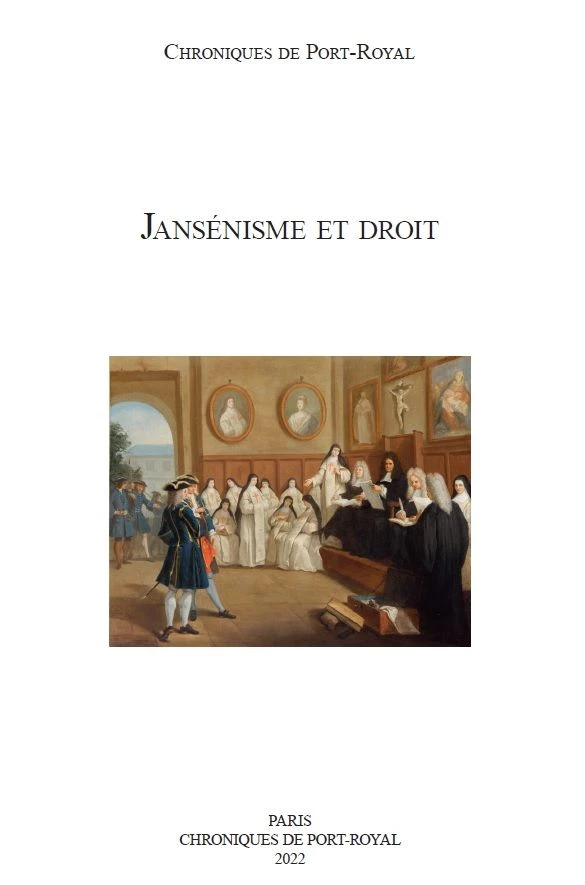
JOURNAL: Special issue Jansénisme et droit [eds. Bernard CALLEBAUT, Blandine HERVOUËT, Simon ICARD & Gilles OLIVO], Chroniques de Port-Royal, n° 72 (2022)


(image source: fabula)

Presentation:

Depuis la thèse controversée de Lucien Goldmann, un constat sociologique semble faire l’unanimité : si les jansénistes ne furent pas tous juristes, si les juristes ne furent pas tous jansénistes, les milieux jansénistes et juridiques se sont souvent recoupés ou ont entretenu des relations étroites. Ce fait social invite à se poser deux questions, non exclusives l’une de l’autre. Existe-t-il un droit janséniste, c’est-à-dire une conception, une interprétation ou une pratique du droit spécifiquement jansénistes ? Quel rôle ont joué la culture, les doctrines, les controverses juridiques dans l’émergence, le développement et les mutations du jansénisme ? Les contributions du présent ouvrage visent à éclairer les effets juridiques du jansénisme sur les relations Église-État. Ce numéro des Chroniques de Port-Royal regroupe les actes du colloque organisé par la Société des amis de Port-Royal en octobre 2021, sous la direction scientifique de Bernard Callebat, Blandine Hervouët, Simon Icard et Gilles Olivo.

Table of contents:

Actes du colloque Jansénisme et droit

Introduction
Blandine Hervouët et Simon Icard 

Communications

Le modèle du juge dévot dans l’entourage de Port-Royal : L’Idée du bon magistrat en la vie et la mort de M. de Cordes, par Antoine Godeau (1645)
Jean-Benoît Poulle

Remarques sur les origines juridiques de la distinction du fait et du droit
Alberto Frigo

La théorie tardive du juge de Domat : une création des Provinciales ?
Gabriel Regef

« Cette lumière restée à l’homme après sa chute » : conceptions du droit naturel chez Arnauld, Domat et Duguet
Frédérick Vanhoorne

À propos de la réception du bref Cum Nuper (1703) : contestation des parlements et réaction des prélats
Norihiro Morimoto

Un avocat général au parlement de Paris face à l’appel comme d’abus : l’exemple de Pierre Gilbert de Voisins
Louis de Carbonnières

L’Accommodement de 1720 et ses échos dans les sources, de la chancellerie au palais
Isabelle Brancourt

Soanen canoniste
Philipp Stenzig

Quand l’Unigenitus est devenue loi d’État : la déclaration royale du 24 mars 1730 ou faire du dogme une vérité légale
Olivier Andurand

Jansénisme et droit dans le Saint‑Empire : la question de l’Unigenitus dans la principauté-évêché de Liège
Juliette Guilbaud

Le droit matrimonial au synode de Pistoie de 1786 et sa retombée dans la modernité juridique
Bernard Callebat

Les appelants et le droit paroissial
Julien Béchard

Conclusions
Jean-Robert Armogathe

Suppléments au colloque

Les affres du parquet face à l’enregistrement de la bulle Unigenitus en février 1714
Blandine Hervouët

La relation entre l’État et l’Église selon un mémoire, fait en 1731, à la demande du chancelier d’Aguesseau, par Guillaume-François Joly de Fleury
Wolfgang Mager

Varia
Modiano saisi par Port-Royal (L’Horizon)
Jean-Yves Mérindol

In Memoriam

Michel Van Meerbeeck (1954-2022)

Résumés
Abstracts
Informations diverses
Index

Liste des contributeurs

More information on fabula. 


ESCLH Conference in Lisbon (22-24 June 2022): Anti Covid measures currently implemented in Portugal


(Source: visit Portugal)


Measures Implemented in Portugal
[Updated on 9 June]

Portuguese government has been taking all necessary public health measures to protect the entire population as well as our visitors.

Measures in force may be reviewed in accordance to the evolution of the pandemic.

I – ACCESSIBILITY

1) Arriving to Portugal by Plane

MAINLAND Portugal

Allowed air traffic
All passengers are authorized to enter national territory, regardless of their origin or purpose of travel.

  • Mandatory to present:
    - A valid vaccination EU Digital COVID Certificate (with a complete vaccination schedule or with a complete vaccination schedule and a vaccine booster)
    - 
    Or a valid test or recovery EU Digital COVID Certificate,
    - Or a valid vaccination certificate (with a complete vaccination schedule or a vaccine booster) or recovery certificate issued by a third country, under reciprocal conditions
    - Or a negative RT-PCR Test (or similar NAAT test) - 72h before boarding, or
    - Or a negative Laboratorial Rapid Antigen Test- 24h before boarding (according to the European Commission list)

    Accepted vaccination certificates issued by third countries under reciprocal conditions: Albania, Andorra, Armenia, Benin, Cabo Verde, Colombia, El Salvador, Faroe Islands, Georgia, Indonesia, Israel, Iceland, Jordan, Lebanon, Liechtenstein, Malasya, Moldova, Monaco, Montenegro, Morocco, New Zealand, North Macedonia, Norway, Panama, San Marino, Seychelles, Serbia, Singapore, Switzerland, Taiwan, Thailand, Tunisia, Togo, Turkey, Ukraine, United Arab Emirates, United Kingdom and the Crown Dependencies (Jersey, Guernsey and the Isle of Man), Uruguay, The Vatican, Vietnam (https://ec.europa.eu/info/live-work-travel-eu/coronavirus-response/safe-covid-19-vaccines-europeans/eu-digital-covid-certificate_en).
  • Children under 12 do not need to present certificate or test.
  • The law that required filling in the Passenger Locator Form on all flights to Portugal has been revoked, so it is no longer necessary to present it at the time of boarding.

  • This information has been updated in accordance with Order No. 4829-A/2022, of 22 April, published by the Portuguese government, which determines the measures applicable to airports and maritime borders and defines the supervision of their operation. In Portugal, border control is ensured by ANA, S.A., by the PSP (Public Security Police), and by SEF (Portuguese Immigration and Border Service) and is carried out randomly to 25% of passengers upon arrival in the territory. For further information, contact SEF - Serviço de Estrangeiros e Fronteiras directly (www.sef.pt / sef@sef.pt / gricrp.cc@sef.pt), the most suitable entity to clarify any issues related to border control in Portugal.

Domestic flights
Control measures do not apply to domestic flights.

2) Arriving to Portugal by Land

  • There are no restrictions on entry into national territory by land. In the case of travel by land, each traveller must obtain information about the measures and restrictions existing in each one of the countries of transit, directly with their authorities.

3) Arriving to Portugal by Sea

Same rules as arriving by air apply.

IMPORTANT: The information available on this page is a summary of the measures published by the Portuguese government during COVID-19 pandemic. Before traveling, it is important to confirm the entry formalities and procedures with the airline company and the Portuguese border service - SEF (www.sef.pt / gricrp.cc@sef.pt), the entity responsible for the border control.  

II – GENERAL RULES

RULES IN MAINLAND PORTUGAL

  • Mandatory mask:
    - in public transports, taxis and similar passenger transports;
    - access and visits to care and nursing homes and health facilities.

  • General behavior guidelines
    - Social distancing;
    - Frequent hand washing;
    - Respiratory etiquette.

III – ADDITIONAL INFORMATION

Clean & Safe
In tourism, the “Clean & Safe” seal was implemented  allowing tourists to have increased security and confidence in the use of accommodation establishments, in the various tourist services and tourist attractions.

National measures -  https://covid19estamoson.gov.pt/ (in Portuguese)
Azores -  www.visitazores.com / https://www.visitazores.com/en/trip-info / https://destinoseguro.azores.gov.pt
Madeira - www.visitmadeira.pt / www.madeira.gov.pt/Covid19 / https://covidmadeira.pt
Updated information on the evolution of the COVID-19 pandemic in Portugal at WHO - World Health Organization (https://covid19.who.int/region/euro/country/pt) or at DGS – Portuguese General Directorate of Health (https://covid19.min-saude.pt/).

Essential Travel definition
“Essential travel” is defined as trips allowing the transit, entry into and departure from Portugal for professional purposes, study, family reunions, health and humanitarian reasons and under the reciprocity principle.

Tests
a. Controls might be undertaken upon arrival to airport;

b. The test result performed in a test certified centre must include:
- type of test taken;
- passenger name (as per passport);
- date of birth;
- clear identification of the laboratory including the certification;
- the date and time the sample was collected and the explicit negative test result;
SMS is not a valid format.
Laboratorial Rapid Antigen Tests accepted according to the European Commission list.

c. Passengers who present tests that do not comply with the requirements must undergo a new test on arrival, before entering Portuguese territory, at their own expense, and must wait in a designated place, inside the airport, until the result is notified.

d. If you are a foreigner visitor and want to do the test for Covid-19 shortly after arrival, before departure or at any time in mainland Portugal or Madeira you can do it:

- at the Airport. Information at https://www.ana.pt/en/corporate/ana/faq;
- in a laboratory approved by the Portuguese Health General Directorate. Find the list at https://covid19.min-saude.pt/infoadrpcc/;
- if you are in the Algarve, you find information about testing points at www.visitalgarve.pt 

Vaccination
The vaccination schedule is considered complete after taking:
a) From a single-dose vaccine, for vaccines with a one-dose vaccine schedule;
b) The second dose of a vaccine against COVID-19 with a two-dose vaccine schedule, even if doses of two different vaccines have been administered; or
c) A single dose of a vaccine against COVID -19 with a two-dose vaccination schedule for people who have recovered from the disease, if it is indicated in the vaccination certificate that the vaccination schedule was completed after administration of one dose.

The vaccination schedule is complete 14 days after the last dose has been taken.

More information: www.dgs.pt / geral@dgs.min-saude.pt

EU Digital COVID Certificate
The EU Digital COVID Certificate is a digital proof that a person:

√ Has been vaccinated against COVID-19, or
√ Has received a negative test result (NAAT test or Rapid Antigen test), or
√ Has recovered from COVID-19.

* Children under 12 years old are exempt of presenting the EU Digital COVID Certificate or testing requirements
* It is valid for 270 days since the last dose has been taken, in a complete vaccination schedule (see "Vaccination", above). Under 18 years old, the vaccination certificate indicating the complete vaccination schedule will also be valid for periods of 270 days after issuance.

More information at https://ec.europa.eu/info/live-work-travel-eu/coronavirus-response/safe-covid-19-vaccines-europeans/eu-digital-covid-certificate_en


Certificates issued by third countries, under reciprocal conditions

Vaccination certificates must include:
– Given name(s) and surname(s) of the holder;
- Date of birth;
– Disease or agent targeted: COVID-19 (SARS-CoV-2 or one of its variants);
– Vaccine against COVID-19 or prophylaxis;
– Name of the vaccine against COVID-19;
– Marketing authorization holder or manufacturer of the vaccine against COVID-19;
– Number in a series of doses as well as the total number of doses in the series;
– Date of vaccination, indicating the date of the last dose administered;
– Member State or third country where the vaccine was administered;
– Entity issuing the certificate.

Recovery certificates must include:
– Given name(s) and surname(s) of the holder;
- Date of birth;
- Disease or agent from which the holder recovered: COVID-19 (SARS-CoV-2 or one of its variants);
– Date of the first positive result of the diagnostic test;
– Member State or third country in which the diagnostic test was performed;
– Entity issuing the certificate;
– Valid certificate

Non-reciprocity in the recognition by third countries of the validity of the EU COVID Digital Certificate issued by Portugal, in the modalities of vaccination or recovery certificates, prevents the recognition of the validity of certificates issued by these third countries.

More Travel Information
At the European Union website - https://reopen.europa.eu - you can find information on each country about borders, available means of transport, travel restrictions, health and public safety measures, as well as other practical information.

To know which are the travel regulations all around the world, check the map at the IATA Travel Centre.

The Portuguese airports (Lisboa, Porto, Faro, Ponta Delgada e Funchal) have implemented several initiatives to keep staff and passengers safer. A body temperature measurement system was implemented on arrival. More information at https://www.ana.pt/en/passenger-guide/what-you-need-to-know/covid-19

Portuguese Travellers
If you are Portuguese or you live in Portugal, in case you have a scheduled trip, you should consult the restrictions in each country on the Portal das Comunidades:
www.portaldascomunidades.mne.pt/pt/conselhos-aos-viajantes

If you are travelling and you need support on your return to Portugal, you can contact the Ministry of Foreign Affairs:
Portuguese travellers line - gec@mne.pt/ +351 217 929 714 / +351 961 706 472

14 June 2022

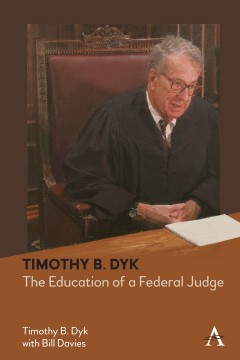
BOOK: Timothy B. DYK (with Bill DAVIES), Timothy B. Dyk. The Education of a Federal Judge, (London-New York-Melbourne-Delhi: Anthem Press, 2022), ISBN: 9781839982149

(Image source: Anthem Press)


ABOUT THE BOOK

This book closely recounts Judge Dyk’s life and experiences in connection with some of the most significant times in modern American law, ranging from his time at the Warren Court, through a private career in First Amendment and other high profile practice, to his current role in the US Court of Appeals. Based on his own account of his long career and supplemented with documentary evidence from archives, media sources and scholarship, the book not only details Dyk’s experiences but also offers a significant contribution to our understanding of the seismic changes in US law since the 1960s.  


ABOUT THE AUTHORS

Timothy B. Dyk was appointed by President Clinton in 2000. Prior to his appointment, Judge Dyk was Partner and Chair, Issues and Appeals Practice Area, at Jones, Day, Reavis & Pogue. Judge Dyk was Associate and Partner, Wilmer Cutler & Pickering from 1964 to 1990. From 1961 to 1964, Judge Dyk served as Special Assistant to Assistant Attorney General Louis F. Oberdorfer, Law Clerk to Chief Justice Warren, and to Justices Reed and Burton (retired). He has taught at Yale, Georgetown and University of Virginia Law Schools. Judge Dyk graduated Harvard College in 1958 and Harvard Law School in 1961. 

Bill Davies is an associate professor in justice, law and criminology at American University in Washington, DC.  He has published works on legal historical methodology, historical biography, the Court of Justice of the European Union (EU) and the evolution of EU law. He is the author of Resisting the European Court of Justice (2012) and editor of EU Law Stories (2017).  He graduated with a Ph.D. from King’s College London in 2007.


More information can be found here.

13 June 2022

CFP: Natural law and domestic government. Transformative legal theory in Early Modern Europe - Leuven, 27-28 April 2023 [EXTENDED DEADLINE: 15 September 2022]

(Ambrogio Lorenzetti - Allegory of Good Government. 


Natural law and domestic government

Transformative legal theory in Early Modern Europe

Leuven – 27-28 April 2023

The Early Modern natural law tradition as received from Antiquity and the Middle Ages was in many senses a bridging paradigm. While natural law had been a significant subject of debate among late-medieval theologians, civilians and canonists, it gained a far more central role in legal theory and scholarship from the sixteenth century onwards, in the writings of theologians and jurists alike. As natural law discourse developed over its Early Modern lifespan, it increasingly started to acquire the trappings of a legal theory – underpinning concrete legal notions and offering a paradigm which could be applied to a variety of legal domains and facts. By the early seventeenth century, it had become a major vehicle for conceptions, principles and institutions of law, relating to both private transactions and public governance.

This emergence of natural law as legal theory coincided with the emergence of one legal field to which it would be readily applied; the sphere of the state or the domain of domestic public law. In another sense, it was precisely the growing autonomy and importance of public law and the need for a legal theory underpinning it (as the classic Roman law texts provided insufficient textual support and canon law lost its universality), which fed the rise of legal natural law thinking. This intimate link between natural law and the sphere of domestic governance is made manifest especially in the first modern theories of the polity, where i.a. the articulation of the idea of a state of nature is closely tied together with the Catholic notion of natural rights. It is around this link and its two components that this two-day conference revolves.

We hence especially welcome contributions dealing with the role of natural law in the development of domestic public law in the 16th and 17th centuries (with the possibility to accommodate papers on Early Modern subjects set in the 18th century, before 1789). Subjects of private law with a meaningful link to questions of domestic governance within the outlined period are also welcomed. After all, e.g. the all-important natural law notion of private property was at least in part developed as a premise for theories of the state. Likewise, contributions dealing with the development of domestic public law as a scientific discipline in general will also be considered.

Potential participants are to send in a summary of the proposed paper (200-400 words) to naturallawconference@kuleuven.be by 15 September 2022, also including their academic affiliation and a brief cv (max. 200 words). A maximum of twenty participants will be chosen from among the applicants by the selection committee. Hotel accommodation for the duration of the conference and a conference dinner will be arranged for the speakers at the organiser’s expense. However, we can offer no reimbursement for travel costs.

Full manuscripts will be required by the start of the conference. The contributions of the participants will, after a peer-reviewing process, be published as a collection volume at an internationally reputed publishing house. Professors Annabel Brett (University of Cambridge) and Marie Seong-Hak Kim (St. Cloud State University) will deliver the keynote addresses.      


The conference organisers,     
Wouter Druwé, Randall Lesaffer and Geert Sluijs