Search

Showing posts with label Van Caenegem prize. Show all posts

03 July 2025

VAN CAENEGEM PRIZE 2025: dr. Piotr ALEXANDROWICZ for "Early modern comparative contract law" (Comparative Legal History XIV (2024), nr. 1)


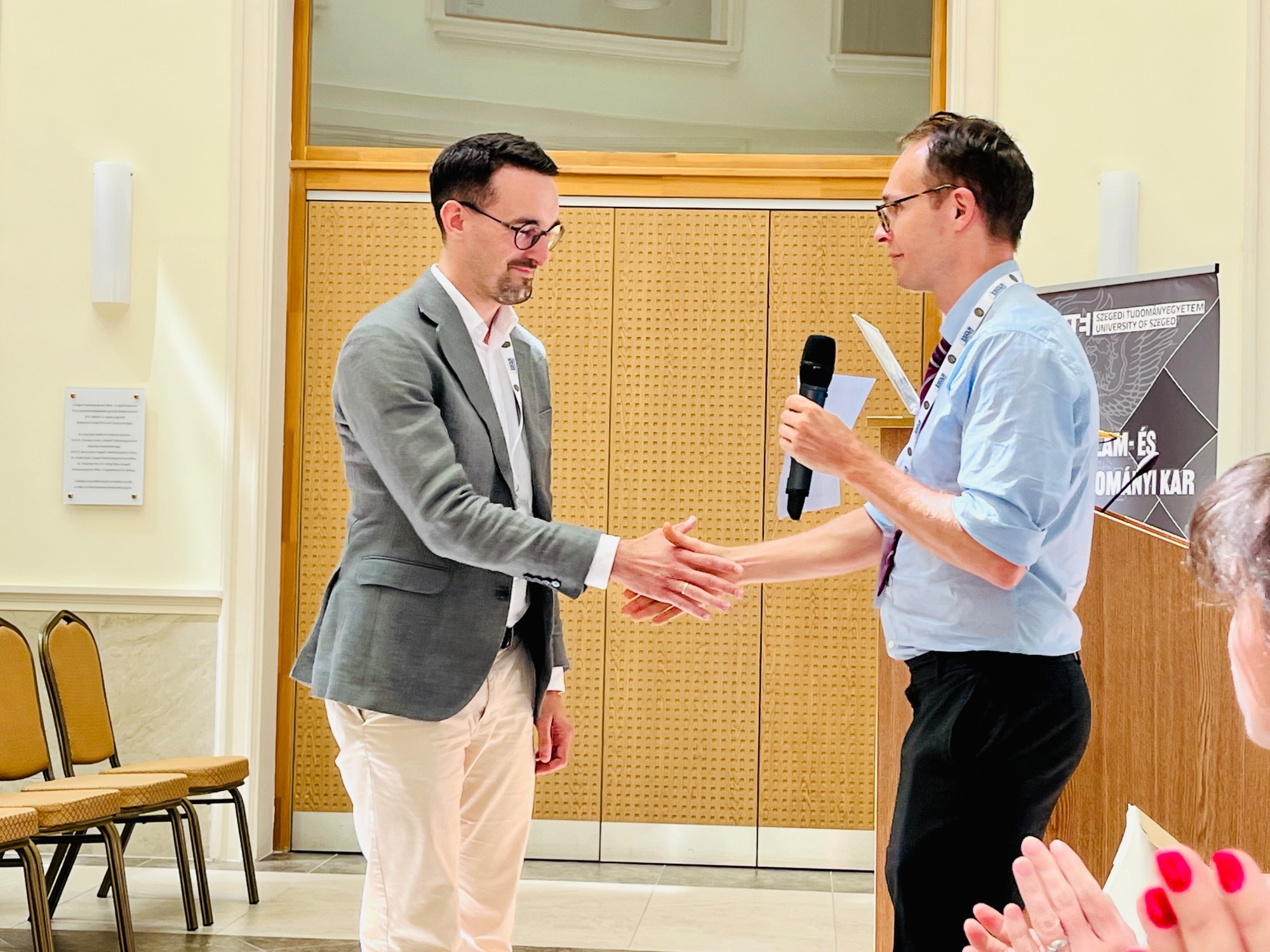
(ESCLH President Prof. Matt Dyson (Oxford) handing over the Van Caenegem Prize 2025 Certificate to dr. Alexandrowicz)

The Van Caenegem Prize 2025 was awarded in the Faculty of Law and Political Sciences of the University of Szeged to ERC Grantee dr. Piotr Alexandrowicz (Poznań) for his article "Early modern comparative contract law", published in our journal Comparative Legal History XIV (2024), nr. 1. 

Abstract:

Contract law was one of the main subjects discussed in the early modern legal genre of differentiae iuris civilis et canonici (‘differences between civil and canon law’). Similar topics were covered in both late medieval and early modern differentiae – hence this genre offers a good opportunity for comparative historical research dedicated to selected topics of contract law (such as those discussed here: the actionability of bare agreements, stipulation for the benefit of a third party, overreaching in contract formation and the lease of a house to a scholar). An examination of the sources proves that the authors of early modern differentiae applied the comparative method in their works. This involved the presentation of sources and rationales from the two bodies of law, the interpretation of sources and arguments in favour of the solutions offered, references to the then-current legal literature and practice and most importantly the preferred method of reconciliation for conflicting laws.

DOI 10.1080/2049677X.2024.2349850

16 December 2024

REMINDER: Van Caenegem Prize 2025 (articles published or accepted in 2023, 2024)

The European Society for Comparative Legal History (ESCLH) President and Executive Council are pleased to present the ESCLH Van Caenegem Prize competition. The prize will be awarded to a young legal historian deemed to have written the best article published in Comparative Legal History, the ESCLH journal, in 2022, 2023 and 2024 or on comparative legal history in another journal in the same two calendar years. Articles published or accepted for publication in 2022, 2023 or 2024 are eligible to compete. In the case of acceptance, a letter from the journal is required.


Art. 1: Name of the prize

The Van Caenegem prize is named in honour of Raoul Charles Van Caenegem, a pioneering author in the field of comparative legal history.

Art. 2: The best article in the field of comparative legal history

(1)           The Van Caenegem prize is awarded to the young legal historian(s) in the meaning of Art. 3 who wrote the best article in the field of comparative legal history.
(2)          Every article by a young legal historian published in the Society's journal (Comparative Legal History) in the two calendar years preceding the year in which the Society's Conference is held at which the prize is to be awarded will automatically be considered for the prize.
(3)           The Van Caenegem Prize Committee may consider articles in the field of comparative legal history which are published in the same years in other journals in the English language for the prize.
(4)           Authors and third parties may submit articles in the meaning of paragraph (3) to be considered for the prize. Submission should be made by 1 January of the year in which the Society’s Conference is held at which the prize is to be awarded. The submission must be made by email to the President of the ESCLH. The submission must include a pdf of the published article and a statement indicating that the author fulfils the requirements of Art. 3.

Art. 3: Young legal historian(s)

(1)   A legal historian is regarded to be a young legal historian in the meaning of these rules if he or she is in his or her early career. Accordingly, a legal historian is eligible for the prize if on 1 January of the year of the award ceremony he or she is still within eight years after completing his or her PhD; the Prize Committee can, in exceptional cases and on application, grant an extension of this period. Normally, a legal historian fulfilling the requirement of sentences 1 and 2 will not be eligible if he or she is already a full professor.
(2)   A legal historian who has previously received the prize is not eligible to receive the prize a
second time.
(3)   In case of co-authorship all co-authors must fulfil the requirements set out in Art. 3(1) and (2). Co-authors share the prize.

Art. 4: Van Caenegem Prize Committee

(1)           The Society awards the prize to the winner as determined by the Van Caenegem Prize Committee.
(2)           The Committee shall be appointed by the Society’s Executive Council in the year before the award ceremony. The Committee consists of a president and four further members:
(a)           At least two members (including the president of the committee) shall belong to the Society's Advisory Board.
(b)           Two members shall be chosen from the organisers of the Young Legal Historians Forum which took place within two years of the appointment of the Prize Committee. These two members should not currently be supervised for doctoral work by any other member of the committee. If the Young Legal Historians Forum did not have a conference in the two years period or if it ceases to exist or if for any other reason it is not possible to appoint two members from the organisers of the Young Legal Historians Forum, the Executive Council must chose two members who are themselves young legal historians within the meaning of
Art. 3(1).
(c)            The last member of the Committee shall be chosen from the international community of scholars in comparative legal history.
(d)           No member may be affiliated to the same institution as another member. No member’s institution may be in the same country as another member’s institution. 
(5)  The Society's president can, by appointment, fill a vacancy on the Prize Committee.
(6)  After reviewing the articles, a majority of votes determines the winner. The committee may decide that the prize is shared between two authors.
(7)  A member cannot vote if the vote concerns a relative within the fifth degree, a co-author of a publication or co-applicant of a project or the author is or has been an employee or grantholder at the same institution.

Art. 5: The award of the prize

The prize is awarded by the Society's president at the Society's Conference. The winner will be announced in the issue of the Comparative Legal History following the conference.

Art. 6: Prize money and certificate

The prize consists of a sum to be determined by the Executive Council and a certificate. The Prize Committee will write a one page report, detailing the academic qualities and importance of the article. The president and the further members of the Committee cannot communicate with those outside the Committee in any other way about their decision.

Art. 7: Dispute resolution


Any dispute in respect of a Van Caenegem Prize must be submitted to the president of the Society whose determination is final. 

Potential authors should consult the submission information on Comparative Legal History.

Past winners
2014 (Macerata Conference)

Bram Delbecke (KULeuven) for his article "The Political Offence and the Safeguarding of the Nation State: Constitutional Ideals, French Legal Standards and Belgian Legal Practice, 1830–70", Comparative Legal History I (2013), 45-74 (article link)

2016 (Gdańsk Conference)

Frederik Dhondt (VUB/UGent) for his article "‘Inter ruinas publicas scriptum’: Ernest Nys, a legal historian in defence of Belgian tax payers during the Great War", Comparative Legal History III (2015), 131-151 (article link)


2018 (Paris conference)

Shavana Musa (Manchester) for her article "Victims of maritime conflict, compensation claims and the role of the admiralty court in the early modern period", Comparative Legal History V (2017), 125-141 (article link)

2020 (Lisbon conference/postponed)

Nadeera Rupesinghe (Sri Lanka National Archives) for her article "Do you know the ninth commandment? Tensions of the oath in Dutch colonial Sri Lanka", Comparative Legal History VII (2019), 37-66 (article link)

2022 (Lisbon conference)

Paolo Astorri (Copenhagen) for his article “ Can a judge rely on his private knowledge? Early modern Lutherans and Catholics compared”, Comparative Legal History IX (2021), 56-88 (article link)

02 December 2024

REMINDER: Van Caenegem Prize 2025 (articles published or accepted in 2023, 2024)

The European Society for Comparative Legal History (ESCLH) President and Executive Council are pleased to present the ESCLH Van Caenegem Prize competition. The prize will be awarded to a young legal historian deemed to have written the best article published in Comparative Legal History, the ESCLH journal, in 2022; 2023 and 2024 or on comparative legal history in another journal in the same two calendar years. Articles published or accepted for publication in 2022; 2023 or 2024 are eligible to compete. In the case of acceptance, a letter from the journal is required.


Art. 1: Name of the prize

The Van Caenegem prize is named in honour of Raoul Charles Van Caenegem, a pioneering author in the field of comparative legal history.

Art. 2: The best article in the field of comparative legal history

(1)           The Van Caenegem prize is awarded to the young legal historian(s) in the meaning of Art. 3 who wrote the best article in the field of comparative legal history.
(2)          Every article by a young legal historian published in the Society's journal (Comparative Legal History) in the two calendar years preceding the year in which the Society's Conference is held at which the prize is to be awarded will automatically be considered for the prize.
(3)           The Van Caenegem Prize Committee may consider articles in the field of comparative legal history which are published in the same years in other journals in the English language for the prize.
(4)           Authors and third parties may submit articles in the meaning of paragraph (3) to be considered for the prize. Submission should be made by 1 January of the year in which the Society’s Conference is held at which the prize is to be awarded. The submission must be made by email to the President of the ESCLH. The submission must include a pdf of the published article and a statement indicating that the author fulfils the requirements of Art. 3.

Art. 3: Young legal historian(s)

(1)   A legal historian is regarded to be a young legal historian in the meaning of these rules if he or she is in his or her early career. Accordingly, a legal historian is eligible for the prize if on 1 January of the year of the award ceremony he or she is still within eight years after completing his or her PhD; the Prize Committee can, in exceptional cases and on application, grant an extension of this period. Normally, a legal historian fulfilling the requirement of sentences 1 and 2 will not be eligible if he or she is already a full professor.
(2)   A legal historian who has previously received the prize is not eligible to receive the prize a
second time.
(3)   In case of co-authorship all co-authors must fulfil the requirements set out in Art. 3(1) and (2). Co-authors share the prize.

Art. 4: Van Caenegem Prize Committee

(1)           The Society awards the prize to the winner as determined by the Van Caenegem Prize Committee.
(2)           The Committee shall be appointed by the Society’s Executive Council in the year before the award ceremony. The Committee consists of a president and four further members:
(a)           At least two members (including the president of the committee) shall belong to the Society's Advisory Board.
(b)           Two members shall be chosen from the organisers of the Young Legal Historians Forum which took place within two years of the appointment of the Prize Committee. These two members should not currently be supervised for doctoral work by any other member of the committee. If the Young Legal Historians Forum did not have a conference in the two years period or if it ceases to exist or if for any other reason it is not possible to appoint two members from the organisers of the Young Legal Historians Forum, the Executive Council must chose two members who are themselves young legal historians within the meaning of
Art. 3(1).
(c)            The last member of the Committee shall be chosen from the international community of scholars in comparative legal history.
(d)           No member may be affiliated to the same institution as another member. No member’s institution may be in the same country as another member’s institution. 
(5)  The Society's president can, by appointment, fill a vacancy on the Prize Committee.
(6)  After reviewing the articles, a majority of votes determines the winner. The committee may decide that the prize is shared between two authors.
(7)  A member cannot vote if the vote concerns a relative within the fifth degree, a co-author of a publication or co-applicant of a project or the author is or has been an employee or grantholder at the same institution.

Art. 5: The award of the prize

The prize is awarded by the Society's president at the Society's Conference. The winner will be announced in the issue of the Comparative Legal History following the conference.

Art. 6: Prize money and certificate

The prize consists of a sum to be determined by the Executive Council and a certificate. The Prize Committee will write a one page report, detailing the academic qualities and importance of the article. The president and the further members of the Committee cannot communicate with those outside the Committee in any other way about their decision.

Art. 7: Dispute resolution


Any dispute in respect of a Van Caenegem Prize must be submitted to the president of the Society whose determination is final. 

Potential authors should consult the submission information on Comparative Legal History.

Past winners
2014 (Macerata Conference)

Bram Delbecke (KULeuven) for his article "The Political Offence and the Safeguarding of the Nation State: Constitutional Ideals, French Legal Standards and Belgian Legal Practice, 1830–70", Comparative Legal History I (2013), 45-74 (article link)

2016 (Gdańsk Conference)

Frederik Dhondt (VUB/UGent) for his article "‘Inter ruinas publicas scriptum’: Ernest Nys, a legal historian in defence of Belgian tax payers during the Great War", Comparative Legal History III (2015), 131-151 (article link)


2018 (Paris conference)

Shavana Musa (Manchester) for her article "Victims of maritime conflict, compensation claims and the role of the admiralty court in the early modern period", Comparative Legal History V (2017), 125-141 (article link)

2020 (Lisbon conference/postponed)

Nadeera Rupesinghe (Sri Lanka National Archives) for her article "Do you know the ninth commandment? Tensions of the oath in Dutch colonial Sri Lanka", Comparative Legal History VII (2019), 37-66 (article link)

2022 (Lisbon conference)

Paolo Astorri (Copenhagen) for his article “ Can a judge rely on his private knowledge? Early modern Lutherans and Catholics compared”, Comparative Legal History IX (2021), 56-88 (article link)

01 November 2024

REMINDER: Van Caenegem Prize 2025 (articles published or accepted in 2023, 2024)

The European Society for Comparative Legal History (ESCLH) President and Executive Council are pleased to present the ESCLH Van Caenegem Prize competition. The prize will be awarded to a young legal historian deemed to have written the best article published in Comparative Legal History, the ESCLH journal, in 2022; 2023 and 2024 or on comparative legal history in another journal in the same two calendar years. Articles published or accepted for publication in 2022; 2023 or 2024 are eligible to compete. In the case of acceptance, a letter from the journal is required.


Art. 1: Name of the prize

The Van Caenegem prize is named in honour of Raoul Charles Van Caenegem, a pioneering author in the field of comparative legal history.

Art. 2: The best article in the field of comparative legal history

(1)           The Van Caenegem prize is awarded to the young legal historian(s) in the meaning of Art. 3 who wrote the best article in the field of comparative legal history.
(2)          Every article by a young legal historian published in the Society's journal (Comparative Legal History) in the two calendar years preceding the year in which the Society's Conference is held at which the prize is to be awarded will automatically be considered for the prize.
(3)           The Van Caenegem Prize Committee may consider articles in the field of comparative legal history which are published in the same years in other journals in the English language for the prize.
(4)           Authors and third parties may submit articles in the meaning of paragraph (3) to be considered for the prize. Submission should be made by 1 January of the year in which the Society’s Conference is held at which the prize is to be awarded. The submission must be made by email to the President of the ESCLH. The submission must include a pdf of the published article and a statement indicating that the author fulfils the requirements of Art. 3.

Art. 3: Young legal historian(s)

(1)   A legal historian is regarded to be a young legal historian in the meaning of these rules if he or she is in his or her early career. Accordingly, a legal historian is eligible for the prize if on 1 January of the year of the award ceremony he or she is still within eight years after completing his or her PhD; the Prize Committee can, in exceptional cases and on application, grant an extension of this period. Normally, a legal historian fulfilling the requirement of sentences 1 and 2 will not be eligible if he or she is already a full professor.
(2)   A legal historian who has previously received the prize is not eligible to receive the prize a
second time.
(3)   In case of co-authorship all co-authors must fulfil the requirements set out in Art. 3(1) and (2). Co-authors share the prize.

Art. 4: Van Caenegem Prize Committee

(1)           The Society awards the prize to the winner as determined by the Van Caenegem Prize Committee.
(2)           The Committee shall be appointed by the Society’s Executive Council in the year before the award ceremony. The Committee consists of a president and four further members:
(a)           At least two members (including the president of the committee) shall belong to the Society's Advisory Board.
(b)           Two members shall be chosen from the organisers of the Young Legal Historians Forum which took place within two years of the appointment of the Prize Committee. These two members should not currently be supervised for doctoral work by any other member of the committee. If the Young Legal Historians Forum did not have a conference in the two years period or if it ceases to exist or if for any other reason it is not possible to appoint two members from the organisers of the Young Legal Historians Forum, the Executive Council must chose two members who are themselves young legal historians within the meaning of
Art. 3(1).
(c)            The last member of the Committee shall be chosen from the international community of scholars in comparative legal history.
(d)           No member may be affiliated to the same institution as another member. No member’s institution may be in the same country as another member’s institution. 
(5)  The Society's president can, by appointment, fill a vacancy on the Prize Committee.
(6)  After reviewing the articles, a majority of votes determines the winner. The committee may decide that the prize is shared between two authors.
(7)  A member cannot vote if the vote concerns a relative within the fifth degree, a co-author of a publication or co-applicant of a project or the author is or has been an employee or grantholder at the same institution.

Art. 5: The award of the prize

The prize is awarded by the Society's president at the Society's Conference. The winner will be announced in the issue of the Comparative Legal History following the conference.

Art. 6: Prize money and certificate

The prize consists of a sum to be determined by the Executive Council and a certificate. The Prize Committee will write a one page report, detailing the academic qualities and importance of the article. The president and the further members of the Committee cannot communicate with those outside the Committee in any other way about their decision.

Art. 7: Dispute resolution


Any dispute in respect of a Van Caenegem Prize must be submitted to the president of the Society whose determination is final. 

Potential authors should consult the submission information on Comparative Legal History.

Past winners
2014 (Macerata Conference)

Bram Delbecke (KULeuven) for his article "The Political Offence and the Safeguarding of the Nation State: Constitutional Ideals, French Legal Standards and Belgian Legal Practice, 1830–70", Comparative Legal History I (2013), 45-74 (article link)

2016 (Gdańsk Conference)

Frederik Dhondt (VUB/UGent) for his article "‘Inter ruinas publicas scriptum’: Ernest Nys, a legal historian in defence of Belgian tax payers during the Great War", Comparative Legal History III (2015), 131-151 (article link)


2018 (Paris conference)

Shavana Musa (Manchester) for her article "Victims of maritime conflict, compensation claims and the role of the admiralty court in the early modern period", Comparative Legal History V (2017), 125-141 (article link)

2020 (Lisbon conference/postponed)

Nadeera Rupesinghe (Sri Lanka National Archives) for her article "Do you know the ninth commandment? Tensions of the oath in Dutch colonial Sri Lanka", Comparative Legal History VII (2019), 37-66 (article link)

2022 (Lisbon conference)

Paolo Astorri (Copenhagen) for his article “ Can a judge rely on his private knowledge? Early modern Lutherans and Catholics compared”, Comparative Legal History IX (2021), 56-88 (article link)

23 June 2022

PRIZE: Van Caenegem Prize 2022 awarded to dr. Paolo ASTORRI (Copenhagen)

(Image source: ESCLH Secretary-General)

The ESCLH awarded the 2022 Van Caenegem Prize to dr. Paolo Astorri (Copenhagen) for his article “Can a judge rely on his private knowledge? Early modern Lutherans and Catholics compared”, which appeared in issue 1 of vol IX of the Society’s journal Comparative Legal History (DOI 10.1080/2049677X.2021.1908935).

Abstract:

This article examines the opinions of Catholic and Lutheran authors on the question of whether a judge should decide a case according to his personal knowledge when that knowledge conflicts with the charges and evidence at the trial. The majority of the Catholics contended that the judge had to follow the evidence. They distinguished between the judge as a public functionary and as a private man. The judge could not use in a trial what he knew as a man. There were certain Lutherans whose opinions remained close to this position. However, a significant number argued that the distinction between the judge as a functionary and as a man lacked foundation. Divine law commanded the judge to avoid lies and not to kill an innocent. If the judge knew that someone was innocent and nonetheless condemned him by following the evidence at the trial, he committed a sin. To avoid giving an unjust sentence, the judge had to use the knowledge he had obtained privately.

Previous winners can be found on the Prize’s page on this blog. 

For more information on the contribution to legal history of the late prof. Em. Dr. Dr. H.c. Mult. Raoul Charles Baron Van Caenegem, we refer to this article by prof. Dr. Dirk Heirbaut.


26 November 2021

PRIZE: The Van Caenegem Prize 2022

 The European Society for Comparative Legal History (ESCLH) President and Executive Council are pleased to present the ESCLH Van Caenegem Prize competition. The prize will be awarded to a young legal historian deemed to have written the best article published in Comparative Legal History, the ESCLH journal, in 2020 and 2021 or on comparative legal history in another journal in the same two calendar years.


Art. 1: Name of the prize

The Van Caenegem prize is named in honour of Raoul Charles Van Caenegem, a pioneering author in the field of comparative legal history.

Art. 2: The best article in the field of comparative legal history

(1)           The Van Caenegem prize is awarded to the young legal historian(s) in the meaning of Art. 3 who wrote the best article in the field of comparative legal history.
(2)          Every article by a young legal historian published in the Society's journal (Comparative Legal History) in the two calendar years preceding the year in which the Society's Conference is held at which the prize is to be awarded will automatically be considered for the prize.
(3)           The Van Caenegem Prize Committee may consider articles in the field of comparative legal history which are published in the same years in other journals in the English language for the prize.
(4)           Authors and third parties may submit articles in the meaning of paragraph (3) to be considered for the prize. Submission should be made by 1 January of the year in which the Society’s Conference is held at which the prize is to be awarded. The submission must be made by email to the President of the ESCLH. The submission must include a pdf of the published article and a statement indicating that the author fulfils the requirements of Art. 3.

Art. 3: Young legal historian(s)

(1)   A legal historian is regarded to be a young legal historian in the meaning of these rules if he or she is in his or her early career. Accordingly, a legal historian is eligible for the prize if on 1 January of the year of the award ceremony he or she is still within eight years after completing his or her PhD; the Prize Committee can, in exceptional cases and on application, grant an extension of this period. Normally, a legal historian fulfilling the requirement of sentences 1 and 2 will not be eligible if he or she is already a full professor.
(2)   A legal historian who has previously received the prize is not eligible to receive the prize a
second time.
(3)   In case of co-authorship all co-authors must fulfil the requirements set out in Art. 3(1) and (2). Co-authors share the prize.

Art. 4: Van Caenegem Prize Committee

(1)           The Society awards the prize to the winner as determined by the Van Caenegem Prize Committee.
(2)           The Committee shall be appointed by the Society’s Executive Council in the year before the award ceremony. The Committee consists of a president and four further members:
(a)           At least two members (including the president of the committee) shall belong to the Society's Advisory Board.
(b)           Two members shall be chosen from the organisers of the Young Legal Historians Forum which took place within two years of the appointment of the Prize Committee. These two members should not currently be supervised for doctoral work by any other member of the committee. If the Young Legal Historians Forum did not have a conference in the two years period or if it ceases to exist or if for any other reason it is not possible to appoint two members from the organisers of the Young Legal Historians Forum, the Executive Council must chose two members who are themselves young legal historians within the meaning of
Art. 3(1).
(c)            The last member of the Committee shall be chosen from the international community of scholars in comparative legal history.
(d)           No member may be affiliated to the same institution as another member. No member’s institution may be in the same country as another member’s institution. 
(5)  The Society's president can, by appointment, fill a vacancy on the Prize Committee.
(6)  After reviewing the articles, a majority of votes determines the winner. The committee may decide that the prize is shared between two authors.
(7)  A member cannot vote if the vote concerns a relative within the fifth degree, a co-author of a publication or co-applicant of a project or the author is or has been an employee or grantholder at the same institution.

Art. 5: The award of the prize

The prize is awarded by the Society's president at the Society's Conference. The winner will be announced in the issue of the Comparative Legal History following the conference.

Art. 6: Prize money and certificate

The prize consists of a sum to be determined by the Executive Council and a certificate. The Prize Committee will write a one page report, detailing the academic qualities and importance of the article. The president and the further members of the Committee cannot communicate with those outside the Committee in any other way about their decision.

Art. 7: Dispute resolution


Any dispute in respect of a Van Caenegem Prize must be submitted to the president of the Society whose determination is final. 

Potential authors should consult the submission information on Comparative Legal History.

Past winners
2014 (Macerata Conference)

Bram Delbecke (KULeuven) for his article "The Political Offence and the Safeguarding of the Nation State: Constitutional Ideals, French Legal Standards and Belgian Legal Practice, 1830–70", Comparative Legal History I (2013), 45-74 (article link)

2016 (Gdańsk Conference)

Frederik Dhondt (VUB/UGent) for his article "‘Inter ruinas publicas scriptum’: Ernest Nys, a legal historian in defence of Belgian tax payers during the Great War", Comparative Legal History III (2015), 131-151 (article link)


2018 (Paris conference)

Shavana Musa (Manchester) for her article "Victims of maritime conflict, compensation claims and the role of the admiralty court in the early modern period", Comparative Legal History V (2017), 125-141 (article link)

2020 (Lisbon conference/postponed)

Nadeera Rupesinghe (Sri Lanka National Archives) for her article "Do you know the ninth commandment? Tensions of the oath in Dutch colonial Sri Lanka", Comparative Legal History VII (2019), 37-66 (article link)

26 June 2020

VAN CAENEGEM PRIZE 2020: Dr. Nadeera RUPESINGHE (Sri Lanka National Archives)

(image source: dr. Nadeera Rupesinghe)

The jury of the Van Caenegem Prize 2020, attributed to the best article in legal history written by a young scholar in a two-year period following the previous ESCLH Biennial Conference (in this case, the 2018 conference at the Ecole Normale Supérieure in Paris), goes to Dr. Nadeera Rupesinghe (Sri Lanka National Archives).

Ms. Rupesinghe published the article 'Do you know the ninth commandment? Tensions of the oath in Dutch colonial Sri Lanka' in our society's journal Comparative Legal History VII (2019), N° 1, pp. 37-66 (DOI 10.1080/2049677X.2019.1613308).

The Van Caenegem Prize is normally awarded at the ESCLH Biennial Conference. Due to the COVID-19-crisis, we have been compelled to postpone the conference to 2021.

The Jury of the Van Caenegem Prize 2020 and the ESCLH Executive Council wish to express their warmest congratulations to Ms. Rupesinghe on obtaining this award.

29 August 2018

ESCLH Van Caenegem Prize and Springer Poster Prize

dr. Shavana Musa (Manchester): Winner of the Van Caenegem Prize 2018
Murat Burak Aydin (MPI Frankfurt): Winner of the Second ESCLH Poster Competition funded by Springer

The Van Caenegem Prize is awarded every second year to the young legal historian who is deemed to have written the best article published in the society's journal "Comparative Legal History". The winner is determined by a committee. For the Van Caenegem Prize 2018, the committee has selected dr. Shavana Musa (University of Manchester), for her article "Victims of maritime conflict, compensation claims and the role of the admiralty court in the early modern period", (2017) 5 Comparative Legal History 125-141, as the winner.

The abstract of dr. Musa's article:
Victims of war have existed since time immemorial and, in the same vein, so have certain mechanisms for the redress of their injuries. Admiralty courts in early modern Europe are historical platforms in which certain groups of victims of maritime conflict could seek compensation under an international prize jurisdiction, as per the law of nations. This article will briefly introduce the reader to the way in which European countries applied their prize jurisdiction. It will then focus on compensation cases during the Anglo-Dutch Wars of the seventeenth century to show how admiralties implemented the right to compensation during these conflicts.
The fulltext is available here.

At the 2018 ESCLH conference in Paris the society was able to award the Second ESCLH Poster Prize funded by Springer. The poster competition allows PhD-students to present their research in the field of comparative legal history in form of a poster. The competition was won by Murat Burak Aydin, MaxPlanck Institute for European Legal History, Frankfurt." Burak Aydin's poster can be found below (click to enlarge).


29 August 2014

VAN CAENEGEM PRIZE AWARDED TO BRAM DELBECKE


 Pictures: the certificate of the Van Caenem prize. Photo of Prof. em. dr. dr. h.c. mult. Raoul Van Caenegem congratulating Bram Delbecke.

To encourage promising young  researchers, the ESCLH established the Van Caenegem prize, named after  R.C. Van Caenegem a leading scholar  in the field of comparative legal history.  The prize is awarded biyearly to a young legal historian deemed to have written the best article in Comparative Legal History, the ESCLH journal, in the two years before ESCLH conferences.

On recommendation of the Van Caenegem Prize Committee the ESCLH has decided at its meeting in Macerata in July 2014 to give this prize to Bram Delbecke for his article

"The Political Offence and the Safeguarding of the Nation State: Constitutional Ideals, French Legal Standards and Belgian Legal Practice, 1830–70."

The members of the Van Caenegem Prize Committee were:  Kjell Åke Modéer (Lund) (president of the Committee), Thomas Duve (Frankfurt), Richard H. Helmholz (Chicago), Bruno Debaenst (Ghent) and  Kamila Staudigl-Ciechowicz (Vienna).

The motives of the Committee
“The article on the political offence and it's reproduction in the Belgium constitutional law is a convincing paper, which combines solid scholarship, readings of historical texts, with a clear question of great importance for the comparative constitutional history of Europe.  We regard it as an added value that he has brought up a problem within comparative constitutional law, also masterly handed by Raoul van Caenegem himself. Delbecke obviously masters his topic, he has both an eye for detail, while always keeping the general overview. Even if he concentrates on the legal aspects of his topic, he also contextualizes by putting the legal development in relation to socio-religious as well as economic questions. The dynamic, expressive way in which the article is written, demonstrates Bram Delbecke’s skilful approach to comparative European legal history. To sum up: It fits perfectly within the framework of “comparative legal history”.”

The board of the ESCLH wants to congratulate dr. Bram Delbecke for his fine piece of scholarship. The board and the editors of Comparative legal history call for other young legal historians who are eligible under the rules of the Van Caenegem prize to send manuscripts for review to the articles editor of Comparative legal history (Heikki.pihlajamaki@helsinki.fi).

The prize consists of certificate and a sum of money.
(text: Dirk Heirbaut (Gent))