Search

17 September 2015

BOOK: "Amne adverso. Roman Legal Heritage in European Culture" by Laurent Waelkens (September 2015)


Laurent Waelkens, Amne adverso. Roman Legal Heritage in European Culture 

all information here

Introduction to the history of Roman law and its institutions

Throughout its history, Europe has been influenced by Roman culture, a culture with a strong sense of society and highly legal-minded. Hence, Roman law is of major importance in European thinking. It was the first subject to be taught at university and it remains tightly interwoven with all layers of European civilisation. This book provides an introduction to the history of Roman law and its institutions, as they developed from Antiquity until the nineteenth century. Concepts such as fundamental rights and freedoms, lawsuits, family law, rightsin rem, and obligations have their origins in classical Antiquity and were developed further throughout European history. The historical processing of our Roman legal heritage is treated from the perspective of comparative legal history. The book is written for undergraduate law students, but is also relevant for scholars from other disciplines.

Laurent Waelkens is Full Professor of Roman Law and Legal History at KU Leuven

This is an excellent book aimed at students and intended to develop student interest and giving them considerable knowledge to understand Roman law. It provides a coherent point of view, and stresses the different contexts of Roman law, in a healthy and fruitful way. An up-to-date book, which takes into account the most recent learning and publications in the field.’ – Professor John W. Cairns, University of Edinburgh

16 September 2015

FELLOWSHIP: Pre-doctoral fellowships, three months at the MPI Florenz. Start: Jan 2016 or later (DEADLINE 15 NOVEMBER 2015)

(image source: MPI Florenz)

The MPI in Florence (Italy) grants two three month-fellowships for pre-doctoral candidates willing to work on legal iconography.

Call:
The Kunsthistorisches Institut in Florenz – Max-Planck-Institut invites scholars to apply for two pre-doctoral fellowships, for 3 months (starting in January 2016 or later). The fellowship is awarded in conjunction with the Minerva Research Group (MRG) "The Nomos of Images. Manifestation and Iconology of Law".

The research project is mainly concerned with formulating an analytical framework for an iconology of law that seeks to explain diachronically -  adopting a transcultural perspective - dimensions of legal history in relation to materiality and constructs. Such juridical manifestations defy the disciplinary boundaries of Art History and Visual Culture in how they relate to form, content and style as well as tradition. Notwithstanding the vast inventory of discrete analyses of legal iconography, no systematic approach exists to date that factors in the relevant domains of legal practice and norm. Broad parameters must yet be fashioned to extend the analysis of the forms, functions, and meanings of these numerous artifacts to their embeddedness in the history of law.

The Minerva Research Project is dedicated to the study of such manifestations as a way to highlight how their forms, meanings and connotations underlie the legitimation of law and legal acts. Please find more information here: http://www.khi.fi.it/en/Nomos


Research proposals should fit within the frame of the MRG and can address any cultural context or period. Comparative studies are welcome. Projects should have an art historical component, this may be in art history specifically or cultural studies in general, with relevant disciplinary perspectives including legal history, comparative literature, history of philosophy, political sciences and others. Doctoral candidates must already be registered for PhD studies at their home university.


Applications must include the following materials:
•A cover letter explaining the applicant's interest in the fellowship.
•An abstract, not to exceed three typed pages (10.000 characters), describing the applicant's area of research and PhD project.
•A complete curriculum vitae of education, employment, awards, and a list of publication.
•A copy of a published paper or a writing sample.
•One letter of recommendation (academic and professional) and the name of a second referee.


The Max-Planck-Institute for Art History in Florence is an international research institute. Candidates of all nationalities are encouraged to apply. Fellows are expected to participate in the research activities at the Institute. The Institute's language is English, German or Italian; it is expected that candidates will be able to present their own work and discuss that of others fluently in one of these languages. The recipient of the fellowship will be expected to be in residence in Florence for the entire period of her or his appointment. KHI grants (including additional allowances and/or reimbursements) have to follow the MPG Support Guidelines for Junior Scientists (in their current version). The fellowship’s monthly stipend will be at least € 1,365.

The Minerva Research Group is also accepting proposals for non-funded visiting fellowships from one to six months. These positions are normally open to doctoral candidates or post-docs who have external funding. All queries regarding the fellowships affiliated to the Minerva Research Group should be sent via e-mail to Carolin Behrmann carolin.behrmann@khi.fi.it.


Please send your application in English or German no later than November 15, 2015
•via e-mail (pdf format) to: Carolin Behrmann carolin.behrmann@khi.fi.it
•or by mail to:
Kunsthistorisches Institut in Florenz
Max-Planck-Institut
Administration/Verwaltung (Minerva Research Group)
Via Giuseppe Giusti 44
I-50121 Florence

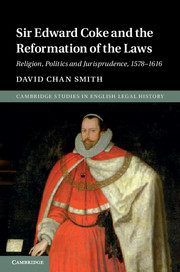
BOOK REVIEW: Daniel Gosling reviews David Chan Smith, Sir Edward Coke and the Reformation of the Laws. Religion, Politics and Jurisprudence, 1578–1616 [Cambridge Studies in English Legal History] (Reviews in History, 2015, Sep)

(image source: Cambridge UP)

Daniel Gosling reviewed David Chan Smith (Wilfried Laurier University)'s book Sir Edward Coke and the Reformation of the Laws. Religion, Politics and Jurisprudence, 1578-1616 ([Cambridge Studies in English Legal History], Cambridge, Cambridge UP, 2014, 308 p., ISBN 9781107069299, £ 110).

First paragraphs:
To say that Sir Edward Coke is a much-studied man is somewhat of an understatement. However, in Sir Edward Coke and the Reformation of the Laws David Chan Smith has managed to craft a history of the great Elizabethan and Jacobean jurist that sets itself apart from other histories, in viewing Coke’s life through the prism of his legal reforms, rather than offering another general biography of the English common lawyer.
Smith acknowledges the wealth of existing literature on Edward Coke early on in his discussion (p. 1), specifically identifying a total of eleven biographies ranging from Cuthbert Johnson’s The Life of Sir Edward Coke, published in 1837, to more recent contributions such as Allen Boyer’s Sir Edward Coke and the Elizabethan Age, published in 2003.(1) Additionally, Smith identifies a number of separate works that delve into different aspects of Coke’s character and use of the law, from Charles Gray’s analysis of his use of the Writ of Prohibition, to George Garnett’s analysis of Coke’s abilities as an historian.(2) Instead of repeating the content of these works, Smith’s text instead looks to reframe the origins of Coke’s legal thought within the context of law reform, and in so doing provide a new interpretation of Coke’s early career, the development of his legal though, and ultimately his path from royalism to opposition. It is this final point that is most strongly argued throughout the book.

The fulltext (including a response by the author) is online on recensio.net

BOOK: Heinhard STEIGER, Universalität und Partikularität des Völkerrechts in geschichtlicher Perspektive [Studien zur Völkerrechtsgeschichte, 33], Baden-Baden, Nomos Verlag, 2015, 519 p. ISBN 9783848723997, € 142

(image source: Nomos)

Prof. em. dr. H. Steiger (Giessen) published Universalität und Partikularität des Völkerrechts in geschichtlicher Perspektive with Nomos Verlag. This collection of essays is a follow-up to his earlier Von der Staatengesellschaft zur Weltrepublik? (Nomos, 2009).

Abstract:
Völkerrechtsgeschichte ist international und global ein aufstrebendes Fach. Die hier gesammelten Aufsätze thematisieren die Geschichte des Völkerrechts in der Spannung zwischen den beiden Polen Universalität und Partikularität des Völkerrechts.
Der erste Teil der hier aufgenommenen Aufsätze ist unmittelbar oder mittelbar Fragen der Universalität des Völkerrechts und einer universellen oder globalen Völkerrechtshistoriographie gewidmet. In den Aufsätzen des zweiten Teils werden unterschiedliche Fragestellungen des partikularen europäischen Völkerrechts erörtert. Die Aufsätze sind bis auf den fünften Aufsatz zwischen 2008 und 2015 erschienen. Der Band schließt an den 2009 in dieser Reihe erschienenen ersten Aufsatzband „Von der Staatengesellschaft zur Weltrepublik?“ an. 
An excerpt can be downloaded for free here.

(source: International Law Reporter)

15 September 2015

CALL FOR PAPERS: Police Science at the End of the Old Regime. From theory to practice (Universidade de Évora, 14-15 January 2016); DEADLINE 30 SEPTEMBER 2015

(image: Evora; source: Wikimedia Commons)

The University of Évora (Portugal) organises a colloquium on "Police Science" around the End of the Old Regime, an established theme in Western legal history.

Proposals are due for 30 September. The conference itself will take place on 14 and 15 January 2016.


Summary (in Portuguese):
Este colóquio tem como objecto de estudo a recepção das práticas modernas de polícia associadas à concepção da ordem pública. A mais recente historiografia sobre a polícia tem privilegiado a análise dos mecanismos de recepção e circulação dos saberes e práticas de polícia no espaço europeu, abandonando as explicações tradicionalistas, presas a quadros quase exclusivamente nacionais, mais focadas nas questões organizacionais e de funcionamento das instituições tutelares. Fruto destas novas abordagens sabe-se hoje que o conceito de polícia se moldou em função dos espaços onde foi aplicado e da visão que os homens da polícia tinham das suas competências e dos meios para as executar.  Nesta mesma linha, pretende-se conhecer os dispositivos de vigilância mas também as experiências económicas e sociais que então foram implementadas. O que defendiam as ciências de polícia em relação à gestão da população e do território? Ou melhor, como se propunham fomentar o desenvolvimento da economia e a expansão demográfica? E o que postulavam em termos de Felicidade Pública? Como foram acolhidas semelhantes ideias?
O colóquio organiza-se nas seguintes temáticas: 
  1. Pressupostos ideológicos e modelos de actuação da polícia na Europa
  2. Controlo do território e da população: produção e utilização do conhecimento
  3. As Intendências e a criminalidade: os indivíduos e as instituições de reclusão
  4. Intendência Geral de Polícia da Corte e do Estado do Brasil: uma identidade diferenciada?
Practical information:
Calendário provisório
30 de Setembro de 2015 : Data limite para a submissão de propostas
  • 15 de Outubro de 2015 : Resposta sobre a admissão das propostas
  • 01 de Novembro de 2015 : Publicação do programa
  • Novembro de 2015 : Período de inscrição
  • 14 e 15 de Janeiro de 2016 : Realização do colóquio As ciências de Polícia nos Finais do Antigo Regime: da teoria às práticas
Para submissão de resumos e inscrições
  1. Realize o seu registo em https://sge.uevora.pt (receberá um email de confirmação para finalizar o seu registo)
  2. Realize o login em https://sge.uevora.pt e aceda ao link https://sge.uevora.pt/eventos/ver/140
  3. Selecione a opção "Inscrever" nas opções laterais do lado direito
  4. (Opcional, se quiser submeter um resumo) Selecione a opção "Submeter resumo" nas opções laterais do lado direito (as propostas deverão ter o título e o resumo da comunicação, entre 250 a 500 palavras e no mesmo ficheiro deverá enviar um breve CV)
  5. Depois da inscrição selecione a opção "Confirmar Inscrição"
  6. Depois de confirmada a inscrição, selecione a opção "Confirmar o Pagamento" onde lhe serão pedidos os dados para a facturação e onde deverá fazer o upload do comprovativo de pagamento.
Custo de Inscrição
  • Conferencistas (não-estudantes) - 30 €
  • Conferencistas (estudantes) - 25 €
  • Participantes sem comunicação - 20 €
 Source: calenda.org.

CALL FOR PAPERS: Imperial Insularities (Toulouse); DEADLINE 15 DECEMBER 2015

 
(image: Toulouse, the Capitole; source: Wikimedia Commons)

The University of Toulouse organizes a conference on "Imperial Insularities" on 25 March 2016. Proposals can be made until 15 December 2015.

Abstract:
Nous proposons d’interroger l’articulation problématique entre donne insulaire et situation impériale. Il s’agit en l’occurrence d’enquêter sur la manière dont les empires gouvernent, administrent et (se) représentent leurs territoires insulaires, dans une perspective visant à mettre en échec la simple caractérisation de ces derniers comme des espaces naturellement périphériques ou négligeables – des « marges » ou des « poussières d’empires » par définition. On s’attachera donc en particulier à cerner la manière dont la problématique insulaire percole les différentes dynamiques de reconfiguration territoriale comme les logiques d’affirmation identitaire des empires modernes, envisagées ici dans une perspective comparatiste large entre espaces méditerranéen et atlantique.
Platform text:
Les espaces insulaires ont suscité ces dernières années l’intérêt toujours croissant de la communauté historienne[1]. Les rapports entre îles et terre ferme, entre donne insulaire et logique d’archipel, ou encore entre insularité et « iléité » ont été interrogés au moyen de questionnaires largement renouvellés, empruntant autant à l’histoire qu’à la géographie, la sociologie, l’anthropologie et la littérature. Loin d’épuiser le thème, les différentes manifestations scientiques consacrées à ce thème ont permis d’en montrer à la fois la polysémie et la richesse heuristique.
C’est dans le prolongement de ces réflexions pionnières que nous proposons d’interroger l’articulation problématique entre donne insulaire et situation impériale. Il s’agit en l’occurrence d’enquêter sur la manière dont les empires gouvernent, administrent et (se) représentent leurs territoires insulaires, dans une perspective visant à mettre en échec la simple caractérisation de ces derniers comme des espaces naturellement périphériques ou négligeables – des « marges » ou des « poussières d’empires » par définition. On s’attachera donc en particulier à cerner la manière dont la problématique insulaire percole les différentes dynamiques de reconfiguration territoriale comme les logiques d’affirmation identitaire des empires modernes, envisagées ici dans une perspective comparatiste large entre espaces méditerranéen et atlantique.
La journée d’étude propose de réunir plusieurs études de cas afin de mieux comprendre cette intersection entre îles et empires au cours d’une longue modernité. Elle vise également à améliorer nos connaissances sur l’intégration des îles aux différents empires (au travers et au-delà des cas bien connus de la France, de l’Espagne ou de l’Angleterre), et à saisir, s’il y a lieu, les différences et évolutions selon les lieux et les périodes. Les interventions pourront porter sur une île ou un archipel en particulier, sur un empire dans son ensemble, ou encore sur un type d’administration ou d’administrateur ayant pour vocation d’assurer la gouvernance des territoires insulaires, ou tout autre tâche relative à leur bonne administration. Ils pourrons également s’intéresser aux enjeux stratégiques, économiques ou migratoires de ces espaces, ainsi qu’aux logiques de transgression des frontières politiques, juridiques et sociales auxquelles ceux-ci sont fréquemment associés.
[1] Voir par exemple Anne Brogini et Maria Ghazali (dir.), Des marges aux frontières. Les puissances et les îles en Méditerranée à l’époque moderne, Paris, Classiques Garnier, 2010 ; Marguerite Figeac-Monthus et Christophe Lastécouères (dir.), Territoires de l’illicite : ports et îles de la fraude au contrôle (XVIe-XXe siècles), Paris, Armand Colin, 2012 ; Nicolas Vatin et Gilles Veinstein (dir.), Insularités ottomanes, Paris, Maisonneuve & Larose, 2004 ; Jean-Frédéric Schaub, L’île aux mariés. Les Açores entre deux empires (1583-1642), Madrid, Casa de Velázquez, 2014.
Practical details:
Les propositions de communication sont à adresser, par voie électronique, au comité scientifique de la manifestation (guillaume.gaudin@univ-tlse2.fr  ; mathieu.grenet@univ-jfc.fr).

avant le 15 décembre 2015 

La journée se tiendra le 25 mars 2016 à l’Université de Toulouse Jean-Jaurès.
Les langues du colloque seront le français, l’anglais, l’espagnol et l’italien.
L’hébergement et le couvert seront pris en charge par les organisateurs, le transport sera, en revanche, à la charge du communicant.

 Source: Calenda.org.

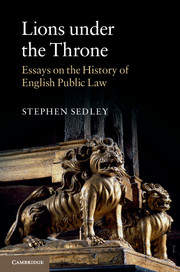
BOOK: Stephen SEDLEY, Lions Under The Throne (Cambridge: Cambridge UP, 2015), 303 p. ISBN 9781107559769, £25,99

(image source: Cambridge UP)

Cambridge University Press published Lions Under The Throne, an essay collection by former Lord Justice of Appeal Stephen Sedley.

Abstract:
Francis Bacon wrote in 1625 that judges must be lions, but lions under the throne. From that day to this, the tension within the state between parliamentary, judicial and executive power has remained unresolved. Lions under the Throne is the first systematic account of the origins and development of the great body of public law by which the state, both institutionally and in relation to the individual, is governed.
Table of Contents:

Introduction
 Part I. Histories:
1. Lions in winter: public law in the twentieth century
 2. The dark satanic mills: the Victorian state
 3. New corn from old fields: the Hanoverian harvest
 4. Parchment in the fire: public law in the Interregnum
 5. The future of public law
 Part II. Themes:
6. The royal prerogative
 7. The sovereignty of Parliament and the abuse of power
 8. The right to be heard
 9. The separation of powers
 10. Public law and human rights
 11. The state and the law
 12. Standing and 'sitting'
 13. Law without courts: the tribunal system
 14. The rule of law.

13 September 2015

CONFERENCE AND CFP: "On Legal Discourses, Narratives and Representations: Trials, Court Coverage and Fiction " (Toulouse, March 10-11, 2016)


WHAT On Legal Discourses, Narratives and Representations:  Trials, Court Coverage and Fiction, Conference and Call for papers

WHEN March 10-11, 2016  

WHERE Toulouse

Proposals in French or English will be sent in Microsoft Word file format to one of the organizers bellow before December 1, 2015: 
Submissions should include the paper title, a 3000 character-limit abstract and a short biographical note. 
The scientific committee will consider the proposal and inform the colleagues of their decisions before December 15, 2015

Presentation

Trials, meant to solve conflicts and restore social peace, are part of a ritual—the judicial ritual—which internationally symbolizes the act of judging whatever the national legal system has implemented in a given country. As rituals, trials have their temples, temporality, performers, and costumes: justice is therefore akin to a staging, which follows specific rules. The legal process, regulated by the law, concludes in the delivering of a sentence, which is then discussed and analyzed by a variety of experts who express their opinions, approvals or disapprovals of the decision and consequently question the doctrine. In addition to the community of jurists, other people are interested in the legal proceeding and the sentencing of criminal cases from front-page affairs to petty crimes. The trial engenders various types of discourses, narratives and representations from journalistic coverage, to novels, plays, or films. This conference will give centre stage to these “other” types of discourses, narratives and representations by turning the floor over to scholars specialized in diverse disciplines—law, literature, history, sociology, cinema, journalism, etc…. Pluridisciplinary, this event will also be pluricultural since we will focus on the writing and re-writing of judicial procedure from the coverage of trials to their fictionalization from the perspective of both the French-speaking and English-speaking worlds. This geographical opening will lead us to not only consider the discursive characteristics specific to each culture but also to compare their different modes of discourse. 

COLLOQUIUM: "L'étranger et le droit. Ce que l'’altérité fait au droit" (Nanterre, October 9 2015)


WHAT L'étranger et le droit. Ce que l'’altérité fait au droit, Université Paris Ouest Nanterre La Défense - Centre d’'Histoire et d’'Anthropologie du Droit Orient-Occident - Rencontres Kasra Vafadari, journée d'’histoire et anthropologie du droit 

WHEN October 9 2015

WHERE Salle des Commissions F142 1er étage du bâtiment F, Université Paris Ouest, 200 avenue de la République, Nanterre

all information here

L’'Enfer, c’est les autres... Dans son Théâtre des situations, Sartre expliquait le sens de sa déclaration qui, loin de stigmatiser l'’autre, insistait sur son importance dans la constitution de soi, sur la nécessité de connaître cet autre pour parfaire sa propre connaissance. Le discours est connu, se décline dans des registres aussi variés que la philosophie, la littérature ou la psychanalyse. Mais la science juridique a peut-être trop délaissé cette quête de l'’altérité, occupée qu’elle était pendant longtemps à travestir son histoire pour promouvoir celle d’une culture juridique française, articulée autour d’'un droit porteur des valeurs de la Nation.

COLLOQUIUM: "Circulations juridiques et pratiques culturelles en Europe au Moyen Âge (XIIIe – XVe siècle)" (Lisbon, February 25 2016)


WHAT Circulations juridiques et pratiques culturelles en Europe au Moyen Âge (XIIIe – XVe siècle), Colloquium

WHEN February 25 2016

WHERE Lisbon, Faculdade de Ciências Sociais e Humanas (FCSH)

Le colloque international Medieval Europe in Motion 3 poursuit la série de rencontres scientifiques inaugurée en 2013 par l’Institut d’Études Médiévales (IEM) de l’Université Nouvelle de Lisbonne sur la thématique des mobilités artistiques et culturelles en Europe au Moyen Âge (https://sites.google.com/site/medieva...). 
L’objectif principal de ce nouveau colloque, en continuité thématique avec les deux éditions précédentes, est d’analyser les phénomènes de circulation et de mobilité des élites lettrées (clercs, universitaires, praticiens), des enlumineurs, des manuscrits, des textes, des modèles artistiques et des idées liés à la pratique du droit dans le territoire européen avec une attention particulière pour les contrées méridionales (péninsule Ibérique, France du Midi et Italie).

CONFERENCE: "La morte nel prisma criminale (19th-20th centuries)" (Benevento, September 21-22 2015)


WHAT La morte nel prisma criminale (19th-20th centuries), Conference

WHEN September 21-22 2015

WHERE Conference hall, Piazza Arechi II —Palazzo De Simone, University of Sannio, Law Faculty, Benevento

Organizzato in collaborazione con il Centro di studi e ricerche per la storia della giustizia criminale dell’Università di Bologna, l’incontro si propone di indagare il modo in cui tra Ottocento e Novecento la cultura giuridica, tra legislazione, dottrina e giurisprudenza, ha affrontato il tema della morte con particolare riferimento alla prospettiva del diritto penale, con interventi che andranno dalla pena di morte e le pene alternative ad essa all’eutanasia, dalla violenza di massa alla giustizia di transizione, dai crimini contro l’umanità e quelli contro i cadaveri ai profili processuali della morte dell’imputato e al suicidio  

Program

10 September 2015

JOB: Assistant Professorship in Global Legal History at Tilburg University; DEADLINE 18 OCTOBER 2015

(image source: academictransfer)


Tilburg University (The Netherlands) has advertised an Assistant Professorship for 4 or 5 years in Global Legal History.

More information below:

Functiebeschrijving


Tilburg Law School is looking for 

An Assistant Professor in the field of Global Legal History (1,0 fte – fixed term 4 or 5 years)

 In 2013, Tilburg Law School launched a new LLB in Global Law. The Department of Public Law, Jurisprudence and Legal History is hiring an assistant professor in Global Legal History, with the aim of developing and teaching courses and writing course materials in the field of comparative/global legal history. Global legal history is here to be understood as the study of the historic development of the major legal traditions of the world and their crossfertilizations.

Teaching (± 40%)
We expect the successful candidate to contribute to courses in various degree programs. He/she will in particular teach comparative and global legal history in the LLB Global Law as well as in the regular LLB program of the School (in English). He will also supervise graduate students and is willing to engage in public and professional education.

Research and Publications (± 40%)
Apart from doing research in his/her field of specialism in legal history, the new assistant professor will develop and write a teaching book, in cooperation with Professor Randall Lesaffer, on global legal history. The aim is to publish the book with a major international publishing house.

Management and service (± 20%)
The assistant professor will assist the director of studies of the LLB Global Law in the further development and management of the program.


Functie-eisen


The successful candidate has:
- A law degree and a doctoral degree (PhD) in a relevant field;
- A track record of high-impact publications or a demonstrable ability to develop one;
- Excellent teaching skills (as evidenced by a ‘BKO qualification’ for those applicants currently working at a Dutch University);
- A willingness to integrate themselves fully in Tilburg Law School;
- An excellent command of English.


Arbeidsvoorwaarden


Tilburg University is among the top of the Dutch employers and has an excellent policy concerning terms of employment. The salary for the position of an assistant professor on a fulltime basis ranges between € 3324,- and € 4551,- gross per month. Foreigners and long-term Dutch expats can apply for tax-free allowance of 30% of their taxable salary for a maximum duration of 8 years.

Dienstverband: Temporary, Fixed term contract for 4 or 5 years


Organisatie
http://www.tilburguniversity.edu/


Afdeling

The Department of Public Law, Jurisprudence and Legal History


At the department of Public Law, Jurisprudence and Legal History History teaching and research on a variety of legal areas is being carried out.

Within the broad area of Public Law, the department hosts expertise in European constitutional and administrative law, education law, regulatory studies, the law of administrative procedure and fundamental rights.

The department’s activities in the field of Jurisprudence focus on general themes in public law such as the meaning and the development of the democratic state with the rule of law principle. The specialism of our Legal History group is history of international law (i-HILT).


Additionele informatie


Specific information about the vacancy can be obtained from prof. Randall Lesaffer, e-mail: lesaffer@tilburguniversity.edu.
(source: AcademicTransfer)

08 September 2015

CALL FOR PAPERS: 4TH ESCLH BIENNAL CONFERENCE 2016 28 Jun-1 Jul GDANSK: Culture, Identity and Legal Instrumentalism; DEADLINE 15 NOVEMBER 2015

(image source: dr. Anna Klimaszewska)

The Organising Committee of the 4th Biennal Conference and the Executive Council of the European Society for Comparative Legal History are pleased to call for papers for the upcoming conference to be held on 28 June – 1 July 2016 at the University of Gdańsk (Poland) on: “Culture, Identity and Legal Instrumentalism”. The main theme picks up threads of thought from the earlier ESCLH conferences in Valencia (2010), Amsterdam (2012) and Macerata (2014).

The conference will focus on the issue of law as an instrument of transforming reality in the individual cultural circles and sub-circles of Europe and the world. Papers addressing this theme are welcome, to be submitted before 15 November 2015 as explained below.

The conference seeks to understand the instrumentality of law through two broad themes. Law may be considered as an instrument either (1) through the prism of analysis of techniques (functional approach) or (2) of objectives (axiological approach). Within the first approach, particularly welcome are those papers which address how legal problems are identified and their solutions developed, whether autonomously or by transplantation and subsequent adaptation. Within the second approach, we welcome papers exploring how law can transform reality, especially as a tool of modernisation and/or as a means to shape and strengthen national identity or other goals defined through the prism of national interest.

Papers should be novel, properly researched and referenced. They should address the conference theme, exploring doctrinal, theoretical, cultural or methodological aspects of comparative legal history. The organisers particularly welcome addressing multiple cultures. This includes where a similar legal system functions in two different cultural circles as a result of en masse transplantation of foreign legal solutions and where a given homogeneous cultural circle has been divided and various legal systems function in its individual parts.

The conference organisers intend to publish a volume, drawing on the best papers presented at the conference as developed in line for publication.

Practical details:
1. To offer a paper, please send the title of their paper, a short abstract (of 200-400 (strict maximum) words) and a short CV (no more than 4 pages) by 15 November 2015 to the organizing committee, c/o Anna Klimaszewska, University of Gdańsk (anna.klimaszewska@prawo.ug.edu.pl) or Michał Gałędek, University of Gdańsk (michal.galedek@prawo.ug.edu.pl).
2. The presentations should be in English.
3. It is also possible to submit a complete proposal for one or more panels (3-4 papers for every panel).
4. The list of accepted papers will be announced by 6 December 2015.

Shortly, a conference website will be launched with fuller details of the conference. For the moment, some transport and accommodation information follows.

Gdańsk is well-communicated city. Lech Walesa Airport, 10 km west of Gdańsk, is one of three most important international airports in Poland, effectively operating as a spare airport for Okecie Airport in Warsaw. A new terminal opened ahead of the football competition, Euro 2012, offers frequent direct flights to London, Paris, Frankfurt, Munich, Copenhagen, Helsinki, Stockholm, Amsterdam, Rome and Berlin. The major airlines flying into the airport include Lufthansa, SAS Scandinavian Airlines, AirBaltic, Air Berlin, Norwegian Air Shuttle, Swiss, TAP Portugal, and Poland's national carrier LOT. Additional low cost airlines operating to and from Gdańsk include Ryanair and Wizz Air. A new train line linking the Pomeranian Metropolitan Area has recently opened and there are otherwise extensive road connections; it is about a 20 minute journey to Gdańsk, and Sopot and Gdynia are easily accessible as well. Gdańsk is linked to the Polish highway network by the A1 motorway (E75). You can also get to Gdańsk from Warsaw in around three hours on the Express InterCity Premium trains (or fly in around 40 minutes). Gdańsk offers many accommodation possibilities ranging from five-star hotels, through elegant pensionsin historical houses and private rooms to beds in youth and student hostels. For postgraduates the University of Gdansk offers cheaper accommodation in student dormitories.

BOOK: Luisa BRUNORI, Societas quid sit. La société commerciale dans l'élaboration de la Seconde Scolastique [Collection des Presses de l’Université de Sceaux] Paris, Mare & Martin , 2015, 248 p., ISBN: 9-782849-341797, € 30

 
(image source: Mare et Martin)


Nomôdos signals the following work at the crossroads of legal history and theology:

La pratique marchande du XVIème siècle, en pleine transformation à la suite des grandes découvertes, devance la doctrine et sollicite avec force l'élaboration de couvertures juridiques nouvelles adaptées à un commerce devenu transatlantique.
  Dans ce contexte économique, un particulier ne peut assumer seul les dépenses et le risque liés aux traversées transocéaniennes. Ainsi une grande nouveauté émerge : ces expéditions aux coûts exorbitants et aux risques très élevés imposent aux sociétés commerciales de recourir à des personnes contribuant par un seul apport en liquidités, sans participation aux traversées, et attendant d'en tirer un gain en retour. Il s'agit des associés capitalistes.
  Dès lors, les problèmes juridiques se compliquent : le contrat de société est-il un prêt usuraire déguisé ? Apporter uniquement du capital dans une société et en percevoir des bénéfices revient-il à accorder un prêt onéreux et donc usuraire ? Et par conséquent : quelle est la nature de ce capital social, distinct des apports d'opéra et industria ? Comment classer une société commerciale dans laquelle certains associés n'apportent que de l'argent pour en tirer une rémunération, et qui devient, par là même, une société "de capitaux" plutôt que "de personnes" ?
  Les auteurs de la Secode Scolastiques s'interrogent sur ces problématiques. Ces docteurs sont contraints de remettre en cause les piliers de l'économie et du droit médiévaux. Ils reconsidèrent la conception de la valeur de l'argent et repensent ainso tout le sytème du droit des contrats, c'est-à-dire du droit des échanges entre les particuliers. Et le contrat de société, âme du droit des affaires, était le plus problématique de toutes les formes contractuelles.
 Table of contents:
Introduction, p. 19

Partie I. L’autonomie du contrat de société commerciale : le dépassement des limites de la société de personnes

Chapitre 1. Une nécessaire mise en contexte de la société commerciale, p. 37

Section 1. Le contexte culturel et l’angle d’observation : théologie et économie vers un droit averti des sociétés, p. 37
Section 2. « Économie oblige ». Les nouveaux défis du droit des affaires, p. 58

Chapitre 2. Personnes et capitaux dans les nouvelles sociétés commerciales entre le XVe et le XVIIesiècle, p. 75

Section 1. Identifications, définitions, distinctions, p. 75
Section 2. Autonomie et filiation par rapport à la société de personnes, p. 98

Partie II. Le capital dans la société commerciale : titre légitime de profit

Chapitre 1. Les terrains de tensions entre personnes et capitaux, p. 143

Section 1. L’assise de la société commerciale, p. 143
Section 2. Les différents types de société, p. 163

Chapitre 2. La rémunération du capital : usure ou titre légitime de profit pour le socius stans ?, p. 177

Section 1. Patrimoine de la société et patrimoine des associés : autonomie et superposition, p. 177
Section 2. La participation capitaliste au contrat de société commerciale comme titre légitime de profit, p. 213

Conclusion, p. 229
Bibliographie, p. 233

More information at the publisher's website.

BOOK: Jean-Claude FARCY, History of Justice in France, from 1789 until the Present [Repères, nr. 657] (Paris: La Découverte), 2015, 128 p. ISBN 9782707182890, € 10.

(image source: La Découverte)


Jean-Claude Farcy (Centre Georges Chevrier/CNRS, Dijon) published a general overview of the history of justice in France from the Revolution on.

Abstract:
L’histoire de la justice a été profondément renouvelée au cours des dernières décennies, parallèlement à la place nouvelle acquise par les juges dans la société comme dans leurs rapports avec le pouvoir politique. Ce livre en propose une synthèse en mettant l’accent sur l’évolution des institutions juridictionnelles, de la magistrature et de la façon dont celle-ci régule les conflits civils et réprime les infractions pénales.Il met en lumière la succession de trois modèles de justice. La révolution de 1789 institue une justice libérale et démocratique fondée sur la souveraineté nationale, les citoyens étant étroitement associés à son exercice. Ce modèle libéral fait place, à partir du Consulat, à celui d’une justice étatisée, contrôlée par le pouvoir politique, exécutif dans les périodes autoritaires, parlementaire sous les régimes républicains. Le mouvement d’émancipation des juges, amorcé dans les années 1970, conduit à s’interroger depuis sur l’existence d’un nouveau modèle : au sein d’un État de droit, la justice aurait acquis sinon une place dominante, du moins plus d’indépendance.
 Table of contents:
Introduction

I / Du modèle libéral à la justice étatisée (la Révolution et l’Empire)
  • La justice à la fin de l’Ancien Régime
  • Le roi, juge suprême - L’enchevêtrement des juridictions - Une justice vénale - L’opposition parlementaire et la réforme impossible de la justice
  • Le modèle libéral de la Constituante
  • Justice et souveraineté populaire - Concilier plutôt que juger - Rationalisation de la justice civile - Une répression pénale partagée avec les citoyens - Des juges élus
  • La justice révolutionnaire
  • Justice politique et défense de la Révolution - Les tribunaux révolutionnaires
  • Vers un modèle étatique de justice
  • Le Directoire et les premiers reculs du modèle libéral - Les réformes consulaire et impériale : une justice étatisée - Une justice pénale pour régime autoritaire
II / La stabilité du modèle napoléonien (1810-milieu du XXe siècle)
  • Une relative stabilité institutionnelle
  • Une carte judiciaire immobile - L’impossible réforme judiciaire - Le développement des juridictions professionnelles - Création et essor de la justice coloniale
  • Un personnel judiciaire sous contrôle
  • Des juges notables aux couches nouvelles - Le contrôle de la magistrature - Les épurations lors des changements de régime - Culture professionnelle et soumission au pouvoir en place - L’exception des avocats ?
  • L’évolution de la justice civile
  • Une demande de justice stable - Apogée et déclin de la justice de paix - Procédure accusatoire et rôle du juge
  • L’évolution de la justice pénale
  • L’évolution du contentieux pénal - La montée en puissance du parquet - Le juge d’instruction, tout puissant et marginalisé - Un jury criminel toléré, mais diminué - La peine entre exclusion et atténuation - La prison : l’impossible réforme - Les mineurs : de la correction à l’éducation surveillée
  • Le développement des juridictions spécialisées
  • Échevinage et essor des juridictions spécialisées d’après guerre - Une justice administrative plus autonome - La justice militaire 
  • Justice et politique
  • Le parquet, instrument du gouvernement - Haute Cour et procès politiques - Juridictions d’exception et magistrature
III / Du milieu du XXe siècle au début du XXIe siècle : une nouvelle justice ?
  • Permanences et réformes institutionnelles (années 1950-1960)
  • Guerres coloniales et justice d’exception - Les réformes de 1958
  • La justice face aux mutations d’une société en crise (années 1970-début du XXIe siècle)
  • Crise et croissance des contentieux civils - Une justice civile de service public - L’explosion du contentieux pénal - Une justice pénale sous l’emprise du parquet - Des prisons sous tension
  • Vers une renaissance du pouvoir judiciaire ?
  • Une nouvelle magistrature - Des juges contestataires - Un gouvernement des juges ?
  • Les limites à la montée en puissance de la justice
  • Une reprise en main par le pouvoir au début du XXIe siècle ? - Les moyens de la justice
Conclusion
More information on the publisher's website.
Source: Nomôdos.

01 September 2015

PRIZE: 2015 Sarton Medal for Legal History to prof. dr. Jean-Louis HALPERIN (Ecole Normale Supérieure, Paris), 29 Oct 2015


(image source: sartonchair.ugent.be)

The Ghent Law Faculty decided to award the Georges Sarton Medal 2015 for Legal History to Prof. dr. Jean-Louis Halpérin (Ecole Normale Supérieure, Paris), a renowned scholar of French and even world legal history.

Previous medallists include professors Anne Lefebvre-Teillard (Paris II Panthéon-Assas), Raoul Van Caenegem (UGent), Jos Monballyu (KULeuven), Randall Lesaffer (KULeuven/Tilburg), Heiner Lück (Halle), Robert Feenstra (Leiden), Emmanuele Conte (Roma III) and Serge Dauchy (Lille II/Université Saint-Louis).

The Faculty sent out the following public invitation:

Prof. Dr. Robert Rubens, Chairman of the Ghent University Sarton Committee,
Prof. Dr. Michel Tison, Dean of the Faculty of Law,
Prof. Dr. Dirk Heirbaut, Director of the Institute for Legal History,
Have the honour to invite you to the Sarton lecture
and the laudatio and handing over of the Sarton medal

On Thursday 29 October at 16:00 PM
Auditorium NB III
Faculty of Law, Universiteitstraat 4, 9000 GHENT

Programme
- Welcome by the dean, Prof. Dr. Michel Tison.
- Laudatio of professor Dr. Jean-Louis Halpérin by Prof. Dr. Dirk Heirbaut.
- Sarton lecture by Prof. Dr. Jean-Louis Halpérin:
"Returning to the primacy of statutory law in legal history?"
- Handing over of the Sarton Medal by Prof. Dr. Robert Rubens.
- Drink offered by the Faculty of Law.
 On Georges Sarton:
George Sarton (1884-1956), one of the founding fathers of the history of science as an academic discipline, was an alumnus of Ghent University. In 1912, one year after his graduation in physics and mathematics, he wrote to a friend: “J'ai décidé de vouer ma vie à l'étude désintéressée de l'histoire des sciences”. He established two leading journals in the field (Isis in 1912 and Osiris in 1934) and the History of Science Society. In 1984, at the centenary of Sarton's birthday, Ghent University decided to establish a Sarton Chair of History of Science. Each year the Sarton committee, consisting of representatives of the faculties of Ghent University, selects the Sarton chair holder and the Sarton medallists. The Sarton chair holder and the medallists are invited to lecture on the history of science in the faculties of the university. The lectures are published in the annual journal Sartoniana.(www.sartonchair.ugent.be)

Please confirm your presence with Mrs. Karin Pensaert: Karin.Pensaert@UGent.be.