Search

19 December 2025

WINTER BREAK: the ESCLH Blog will be back on 5 January 2026

(image: François Boucher, lady reading a book; source: Bildindex/Europeana)

The ESCLH Blog will be slowing down briefly. We will return in the New Year, from 5 January onwards, with new publications, calls, and other announcements of relevance to the Society’s members and to our wider readership.

Over the past twelve months, the Blog has attracted 1.44 million views, with visitors from the United States, Brazil, France, Germany, China, Argentina, Israel, the United Kingdom, Austria, Russia, Mexico, Canada, Poland, Turkey, and many other jurisdictions. The ESCLH Blog team is proud of this achievement and looks forward to continuing the journey in 2026.

We wish the Society’s members and our readers a relaxing winter break, and hope they will have the opportunity to step away from their screens, as the lady depicted by François Boucher.

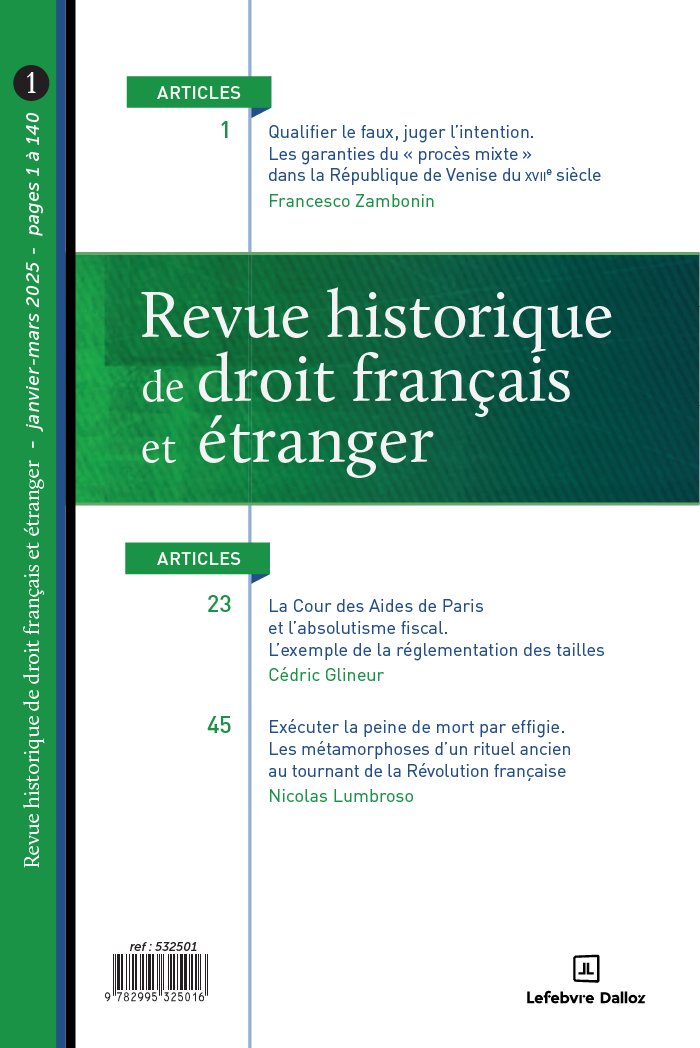
JOURNAL: Tijdschrift voor Rechtsgeschiedenis/Revue d'histoire du droit/The Legal History Review CXIII (2025), nr. 3-4


(image source: Brill)

Articles

The Hexabiblos: the Humanist quest for the text (Lorena Atzeri)
DOI 10.1163/15718190-20253401
Abstract:

Since the publication of its editio princeps in 1540, the Hexabiblos of Constantinos Harmenopoulos attracted the attention of many legal humanists, including Cujas, Contius, Soarez de Ribeira, Falkenburg, and others. As was their practice, they wrote annotations, emendations and comments in the margins of their personal copies, often collating the printed text with other manuscripts they discovered in various libraries. Some of this precious evidence has been preserved in a set of seven copies now in the Advocates Library in Edinburgh. These copies were used in the 18th century by Otto Reitz, the scholar entrusted by Meerman with the preparation of a new edition of the Hexabiblos. The books were later sold at the auction of Meerman’s library in 1824. This late Byzantine source offers an illuminating example of the philological approach of the legal humanists, and of the process which, over the centuries, led from manuscript text to printed edition.

Frühklassische Testamentsauslegung im Spiegel von Phaedrus Fab. iv,5 (Andreas Herrmann)
DOI 10.1163/15718190-20253402
Abstract:

In Phaedrus we find striking examples of law in literature. Not only does Phaedrus exhibit a propensity for juristic parlance, he shows a recurring interest in questions of law as well as an understanding of legal concepts. His Fab. iv,5 in particular reflects topics which will have occupied early classical Roman jurists in their attempts to interpret testamentary dispositions. Read with a view to law as literature, Phaedrus’s narration draws attention to a particular pattern in which arguments are presented in some texts composed by Roman jurists.

‘Quibus permissum est iura condere’ Some ideas on the origin of the Ius respondendi (W.J. Zwalve) [OPEN ACCESS]
DOI 10.1163/15718190-20253403
Abstract:

It is contended in this article that there has never been a ‘ius respondendi’, a licence to respond, introduced by the emperor Augustus. Instead, Justinian, after having repealed the 426 Law of Citations, wanted to stress that the authority of Roman jurisprudence (ius) had always been dependent on imperial authority even before the Law of Citations, retroactively granting an imperial ‘licence to explain the law’ to all jurists mentioned in his Digest.

Publication and the validity of constitutions in the Late Roman Empire (A.J.B. Sirks) [OPEN ACCESS]
DOI 10.1163/15718190-20253404
Abstract:

Contrary to the current view of Mommsen, Seeck and Schwind that imperial legislation required publication to gain validity, Bianchi Fossati Vanzetti and particularly Kreuzsaler maintained that imperial legislation gained validity directly by the issuing by the emperor (the datio). Purpose of publication was merely to make the law known. For legal acts performed in the period between datio and publication according to the old law generally restitution was granted. In a reaction Kaiser has submitted arguments against this position. The present article examines his and Kreuzsaler’s arguments and confirms the conclusion of Kreuzsaler.

Henricus Kinschotius (1541–1608) On practices of grace and debt relief before the Sovereign Council of Brabant (Nicolas Ruys)
DOI 10.1163/15718190-20253405
Abstract:

This article is aimed at investigating the power to pardon insolvent debtors in the early modern Duchy of Brabant through the analysis of Henricus Kinschotius’ treatise De solutionum induciis, 4th part of his opus De rescriptis Gratiae, a supremo Brabantia senatu nomine Ducis concedi solitis. In his treatise, Kinschotius, a Brabantian lawyer of the second part of the xvith century, seeks to study the so-called letters of atterminatio and respite, which are ducal grace letters intended to grant payment suspension to insolvent bona fide debtors. As supreme jurisdiction of the duchy, the Sovereign Council of Brabant is the main institution empowered to issue these pardon letters on behalf of the Duke. But granting such debt deferral is likely to affect the creditors’ interests. As a matter of consequence, several legal requirements must be fulfilled to benefit from a letter of atterminatio: the requesting debtor must notably provide a sufficient guarantee and obtain the consent of the majority of his creditors. This paper will thus discuss the procedural aspects for acquiring those letters, the scope of application ratione personae and materiae (with a list of claims that cannot be subject to a debt deferral) as well as their legal conditions and effects. Finally, special attention will be paid to the common practices of abuse committed by fraudulent debtors and which solutions Kinschotius proposes to put an end to it. As it will be concluded, Kinschotius’ study of the practice of letters of atterminatio and respite by the Council of Brabant illustrates a strong and tenacious autonomy of a provincial institution in the context of the assertion of sovereignty and centralisation of power that characterised the modern Habsburg Low Countries.

Passer lectres et contraitz entre les parties consentens et eux soubmectans a ladicte jurisdicion volontaire De vrijwillige rechtspleging voor publieke notarissen, grafelijke leenmannen en lokale schepenbanken binnen laatmiddeleeuws Henegouwen (14de–15de eeuw) (Falco Van Der Schueren)
DOI 10.1163/15718190-20253406
Abstract:

In late medieval Hainaut, notaries public, comital vassals, and local benches of aldermen alike were competent to authenticate deeds of various legal transactions. As they could all exercise voluntary or non-contentious jurisdiction, they competed with one another in a free legal market. From a legal-historical perspective, this contribution aims to assess their relative market share. Methodologically, it uses the concepts of ‘validity’ and ‘proof’ as objective analytical criteria in a contextual framework combining normative texts, a unique fifteenth-century formulary, and a substantial corpus of chirographs, sealed charters, and notarial instruments. In doing so, it examines how these three legal actors ensured the validity of the transactions they handled, and to what extent their deeds had any probative value.

Versions of War Slavery: Grotius, Hobbes and the reception of their ideas (Gustaaf van Nifterik)
DOI 10.1163/15718190-20253407 [OPEN ACCESS]
Abstract:

This article discusses two approaches to war slavery, one by Hugo Grotius based on jus gentium with a moral appeal to treat one’s war slaves well, the other by Thomas Hobbes for whom jus gentium plays no role and who focuses on the difference between chained and unchained slaves. Next, we look at the works of Pufendorf, Huber, and Noodt. There we find elements of both Grotius and Hobbes, in various combinations and with different outcomes. We see Grotius’ moral appeal gradually becoming an integrated part of jus gentium, applying to both chained and unchained slaves.

Book reviews

  • Daphne Penna [and] Roos Meijering, A sourcebook on Byzantine law, Illustrating Byzantine law through the sources. [Medieval law and its practice, 34]. Brill, Leiden – Boston [2022]. xvii + 224 p. (Philipp Scheibelreiter)
  • Isabel Alfonso, José M. Andrade [and] André Evangelista Marques (eds.), Records and processes of dispute settlements in early medieval societies, Iberia and beyond. [Medieval law and its practise, 41]. Brill, Leiden – Boston 2024. xiv + 425 S. isbn 978-90-04-68295-5 (hardcopy), 978-90-04-68300-6 (e-book) (Steffen Schlinker)
  • Frisian Land Law, A critical edition and translation of the Freeska Landriucht, edited by H. Nijdam, J. Hallebeck [and] Hylkje de Jong. [Medieval law and its practice, 33]. Brill, Leiden – Boston [2023]. viii + 449 p. (Helle Vogt)
  • Srđan Šarkić, A history of Serbian mediaeval law. [Medieval law and its practice, 39]. Brill, Leiden – Boston [2023]. xiii + 616 p. (Tomislav Karlović)
  • G. Mazzanti, Matrimoni post-tridentini, Un dibatto dottrinale fra continuità e cambiamento (secc. xvi–xviii). [Diritto cultura società, Storia e problemi della giustizia criminale, 14]. Bononia University Press, [Bologna 2020]. 235 p. (Ton Meijers)
  • Sir John Baker, Sources of English legal history, Public law to 1750. Oxford University Press, [Oxford] 2024. lii + 788 p. (Guillaume Leyte)
  • T. Pasquiet-Briand (dir.), Les conflits doctrinaux du xix e siècle, Une analyse des fondements politiques du droit. Éditions mare & martin, [Paris 2023]. 261 p. (Guillaume Grégoire)
  •  A. Cordes, H.-P. Haferkamp, B. Kannowski, H. Lück, H. de Wall, D. Werkmüller† und C. Bertelsmeier-Kierst (Hrg.), Handwörterbuch zur deutschen Rechtsgeschichte hrg , 2., völlig überarbeitete und erweiterte Auflage, Redaktion: A.M. Auer, A.-M. Heil, R. Penssel, L. Samad-Tari, S. Schmidt, P.-M. Schmitt, O. Walther, Th. Wanninger und M. Wolter, Band iv: Nüchternheit, nüchtern – Richtsteig. Erich Schmidt Verlag, [Berlin 2024]. xvi S. + 2016 Sp. (Alain Wijffels)
  • P. Collin [and] A. Casagrande (eds.), Law and diversity: European and Latin American experiences from a legal historical perspective, vol. 1: Fundamental questions. [Global perspectives on legal history, 21]. Max-Planck-Institut für Rechtsgeschichte und Rechtstheorie, Frankfurt am Main 2023. xii + 764 p. (Sandrine Brachotte)
Kroniek/Chronique/Chronicle

Ontvangen werken/ouvrages reçus/publications received

Read the full issue here.

BOOK: Konstantinos POULIOS, The Congress of Carlowitz (1698/99). Supra-cultural Diplomatic Norms and Practices of Peacemaking at the End of the Seventeenth Century [Legal History Library, eds. Dirk HEIRBAUT, Michelle MCKINLEY, Matthew C. MIROW & C.H. VAN RHEE, 82; Studies in the History of International Law, ed. Randall LESAFFER, 29] (Leiden/Boston: Martinus Nijhoff/Brill, 2025), ISBN 978-90-04-45611-2


(image source: Brill)

Abstract:

This book delivers the first comprehensive analysis of the Peace Congress of Carlowitz (1698/99), challenging traditional Eurocentric views on early modern diplomacy. It demonstrates that peacemaking norms and practices were largely ‘supra-cultural’—transcending cultural and religious divides across Europe and the Ottoman Empire. Carlowitz emerges as a significant multi-religious congress that introduced pioneering practices, particularly in ceremonial regulations. By confronting cultural essentialism, provincialising the Westphalian congress-model paradigm, and demythologising Carlowitz as a decisive political turning point—notably marking the adoption of a Western European-style diplomacy by cultural ‘outliers’ such as the Ottoman Empire and Muscovy—this study offers fresh insights into the complexity and polycentric nature of early modern multilateral diplomacy.

On the author:

Konstantinos Poulios, Ph.D. (2024), European University Institute, is a postdoctoral researcher at the National and Kapodistrian University of Athens. He specialises in early modern diplomatic history and peacemaking practices. His research interests encompass early modern conflict resolution mechanisms, with a focus on peace congresses and third-party mediation in southeastern Europe, the diplomatic relations between the Ottoman Empire and Christian European states, early modern diplomatic archival practices, and the intersection of diplomatic and intellectual history.

Read more here: DOI 10.1163/9789004458499

BOOK REVIEW: Donal K. COFFEY on Brexit, union, and disunion: the evolution of British constitutional unsettlement by Sionaidh Douglas-Scott (Comparative Legal History, XIII (2025), nr. 2 (December), pp. 362-366)

(Image source: Taylor&Francis)

Brexit blew up the United Kingdom’s constitutional settlement. When the UK voted to leave the European Union, it threw into sharp relief a series of delicate constitutional arrangements that governed the relationship of the Government to Parliament through prorogation, the integration of direct democracy into a system ostensibly founded on representative democracy, the balance of power between Westminster and the devolved regions, the rights that citizens held in the UK – and that is merely to scratch the surface. In the current volume, Sionaidh Douglas-Scott takes the crisis offered by Brexit to provide an overview of the British constitutional settlement across a number of different axes. The monograph as a whole is an entertaining scholarly tour de force which demonstrates the application of a wide range of methodologies in a sophisticated fashion.

To read the full review, please click here. Online access is free for members of the European Society for Comparative Legal History.

DOI: 10.1080/2049677X.2025.2580105


18 December 2025

BOOK: Wouter DRUWÉ, Randall LESAFFER & Geert SLUIJS (eds.), Natural Law and Domestic Government in the Early Modern Period [Legal History Library, eds. Dirk HEIRBAUT, Michelle MCKINLEY, Matthew C. MIROW & C.H. VAN RHEE; vol. 80] (Leiden/Boston: Martinus Nijhoff/Brill, 2025), ISBN 978-90-04-74871-2, €160,93


(image source: Blackwell's)

Abstract:

Natural Law and Domestic Government in the Early Modern Period examines how natural law informed evolving ideas of governance from the sixteenth to eighteenth centuries. Through case studies spanning France, the Low Countries, England, Iberia, and colonial America, this volume explores how jurists, theologians, and political thinkers grappled with questions of sovereignty and justice. Contributors analyse influential figures from Bodin and Coke to Tuldenus and Lipsius, tracing how natural law intersected with legal concepts of rights, obligations, contracts, and associations. By uncovering diverse and contested uses of natural law, this collection offers a nuanced account of its enduring role in shaping early modern statecraft and political thinking.

On the editors:

Wouter Druwé is an associate professor of Roman law and legal history at KU Leuven. He studies the interaction between late medieval and early modern learned law (ius commune) and legal practice, with a particular focus on the Low Countries. Randall Lesaffer is a professor of legal history at KU Leuven and Tilburg University. His research focuses on the history of international law in early modern Europe. He is the general editor of The Cambridge History of International Law and the Brill book series Studies in the History of International Law. Geert Sluijs is a Ph.D. candidate at KU Leuven, holding degrees in law, philosophy, and intellectual history. His research interests include early modern legal and intellectual history. He has previously published on these topics, in particular regarding the Leuven scholar Tuldenus. 

Read more here: DOI 10.1163/9789004748712.

17 December 2025

BOOK: H. Alberto FEENSTRA, Frontiers of Finance: The Political Economy of Public Debt in the Dutch Republic [Library of Economic History, eds. Jeremy LAND, Tomoko SHIROYAMA & Jeroen TOUWEN] (Leiden/Boston: Brill, 2025), ISBN


(image source: Brill)

Abstract:

This book analyses the political economy of provincial public debt within the federal Dutch Republic. Frontiers of Finance: The Political Economy of Public Debt in the Dutch Republic shows that the domestic effect of Holland's financial revolution and Amsterdam's subsequent rise to an international financial centre was limited. Instead, the fiscal and legal fragmentation caused differences in risk, capital supply, transaction costs and, consequently, borrowing costs. The merits of Holland’s financial revolution were thus not transferable to another context. The results are relevant for wider debates about the role of institutions and the financial sector for economic growth.

On the author:

Alberto Feenstra, Ph.D. (2018), University of Amsterdam, is postdoctoral researcher at Utrecht University. He publishes on Dutch financial history, including provincial debt and monetary colonial history. 

Read more here: DOI  10.1163/9789004745254.

16 December 2025

JOURNAL: The Journal of Legal History XLV (2024), No. 1


The Prosecution of Heresy in the Henrician Reformation (Paul Cavill) (OPEN ACCESS)

DOI 10.1080/01440365.2024.2320968
Abstract:

At the beginning of Henry VIII’s reign, the prosecution of heresy was based on three statutes of the late fourteenth and early fifteenth centuries. Under this system, the Church tried the crime with the assistance of secular authority. Juries presented suspects, whose cases were then transferred to the church courts for determination. In 1532, the Supplication against the Ordinaries challenged the conduct of heresy trials. It invoked common-law principles about due process and standards of proof. Two years later, a new statute modified the system, although less drastically than had been proposed. The royal supremacy and new religious policies changed the context in which heresy was prosecuted. Up until 1539, however, the church courts still determined accusations. Thereafter, in the case of specified heresies, the Act of Six Articles made lay juries responsible for determining guilt or innocence. Commissions under this act combined elements of canon law and common law. These reforms were, however, not seen to have improved the conduct of heresy trials. It proved easier to criticize the traditional method of prosecution than to devise a better one.

More Than a Species of Larceny: Fraud Laws and Their Uses in the Eighteenth Century (Cerian Griffiths) (OPEN ACCESS)

DOI 10.1080/01440365.2024.2320967
Abstract:

This article explores the under-researched area of fraud in the eighteenth and early nineteenth centuries. Fraud offences rarely feature in criminal law historiography, and where they do, they are positioned as an afterthought to theft and forgery. This article redresses this oversight and presents an in-depth analysis of eighteenth-century jurisprudence around frauds, providing a long-overdue mapping of the most common offences within this diffuse area of law. This article reveals the ways in which fraud offences were situated in the wider criminal law, and how frauds interacted with other property offences. This article maps the contours of the emerging modern offence of fraud, and in doing so makes the case for a rethinking of the significance of the criminal law of fraud and its place in the development of the modern criminal law. Finally, by assessing the ways in which fraud straddled the line between felony and misdemeanour, this article provides a lens through which to better understand eighteenth and early nineteenth century criminal procedure.


Subversion Down-Under: Innovation, Ambition and the Introduction of Survival of Causes of Action Legislation in South Australia and Victoria (Mark Lunney) (OPEN ACCESS)
DOI 10.1080/01440365.2024.2320964
Abstract:

For much of the twentieth century, the standard characterization of the relationship between the English common law metropole and the Dominion periphery has been one of the subservience and deference of the latter to the former. While the relationship was hierarchical, such characterizations undersell the innovation and ambition that the periphery, working within imperial legal constraints, could bring to the shared common law of the empire. This article considers the introduction of survival of actions legislation in two Australian jurisdictions, South Australia and Victoria, in the early 1940s. While based on the antecedent English legislation, both jurisdictions toyed with – and in South Australia’s case delivered – a much wider reform than took place in England. Rather than being mechanical recipients of law crafted in the metropole, Australian jurisdictions were well able to decide whether the English model was the best reform for their common law.

Scottish Legal History Group Report 2023 

Migrations of Manuscripts 2023 (John Baker)

Book reviews:

  • Common Law, Civil Law, and Colonial Law: Essays in Comparative Legal History from the Twelfth to the Twentieth Centuries edited by William Eves, John Hudson, Ingrid Ivarsen and Sarah B. White, Cambridge, Cambridge University Press, 2021, x + 338pp, £85.00 (hardback, also available as Open Access on Cambridge Core and in paperback), ISBN: 978-1-108-92512-9 (Joyman Lee)
  • Going the Distance: Eurasian Trade and the Rise of the Business Corporation, 1400–1700 by Ron Harris, Princeton, Princeton University Press, 2020, xi + 465 pp. (including index), £40 (hardback), ISBN 9780691150772 (Jonathan Hardman)
  • Lawyers at Play: Literature, Law, and Politics at the Early Modern Inns of Court, 1558–1581, by Jessica Winston; Law as Performance: Theatricality, Spectatorship, and the Making of Law in Ancient, Medieval, and Early Modern Europe, by Julie Stone Peters; Libel and Lampoon: Satire in the Courts. 1670–1792, by Andrew Benjamin Bricker, Oxford, Oxford University Press, 2022, vii & 270 pp., £20 (paperback), ISBN 9780192872326; Oxford, Oxford University Press, 2022, xiv & 350 pp., £70 (hardback), ISBN 9780192898494; Oxford, Oxford University Press, 2022, xii & 326 pp., £70 (hardback), ISBN 9780192846150 (Ian Ward)
  • Palles: The Legal Legacy of the Last Lord Chief Baron, edited by Oonagh B. Breen and Noel McGrath, Dublin, Four Courts Press, 2022, 256 pp (including index), €55.00/£50.00 (hardback), ISBN 9781801510356 (Richard McBride)
Read all articles here

BOOK: Cátia P. ANTUNES, Alejandro GARCíA-MONTON, Elisabeth HEIJMANS et al., A Hydra of Business and Men: The Habsburg Asiento de Negros in Structuring the European Transatlantic Slave Trade [Library of Economic History, eds. Jeremy LAND, Tomoko SHIROYAMA & Jeroen TOUWEN; 21] (Leiden/Boston: Brill, 2025), ISBN 978-90-04-74509-4 [OPEN ACCESS]


(image source: Brill)

Abstract:

This book offers a historical and historiographical analysis of the Spanish asiento de negros, a contract between the Spanish Monarchy and private parties to introduce specific number of enslaved Africans to Spanish America. As the Spanish American market was the largest single market for enslaved people prior to 1720, studying this colonial contract is essential for understanding the development of the most significant colonial contract of the long 17th century. The asiento framed the European transatlantic slave trade for nearly two centuries and shaped much of the political economy of the Spanish Atlantic empire. This book is unique in providing the first comprehensive study of the asiento since George Scelle’s 1906 work (La traite négrière aux Indes de Castille. Contracts et traités d’assiento, 2 vols.). Unlike Scelle, who focused on legal frameworks and presented the monarchy’s perspective, this book examines the asientistas themselves, offering insights into their business decisions and organizations. It concentrates on the period that gave rise to the idea of an asiento and the Habsburg-era asientos (1595–1713), preceding the so-called Bourbon reforms.

Discover the full book for free here: DOI 10.1163/9789004745094.

15 December 2025

BLOG SYMPOSIUM: Imperialism, Sovereignty and the Making of International Law at 20 (National University of Singapore)


(image source: NUS)

The Centre for International Law Dialogues of the National University of Singapore hosts a blog series on Anthony Anghie's seminal monograph Imperialism, Sovereignty and the Making of International Law (CUP, series Cambridge Studies in International and Comaprative Law, eds. James Crawford and John Bell).

Read more here.

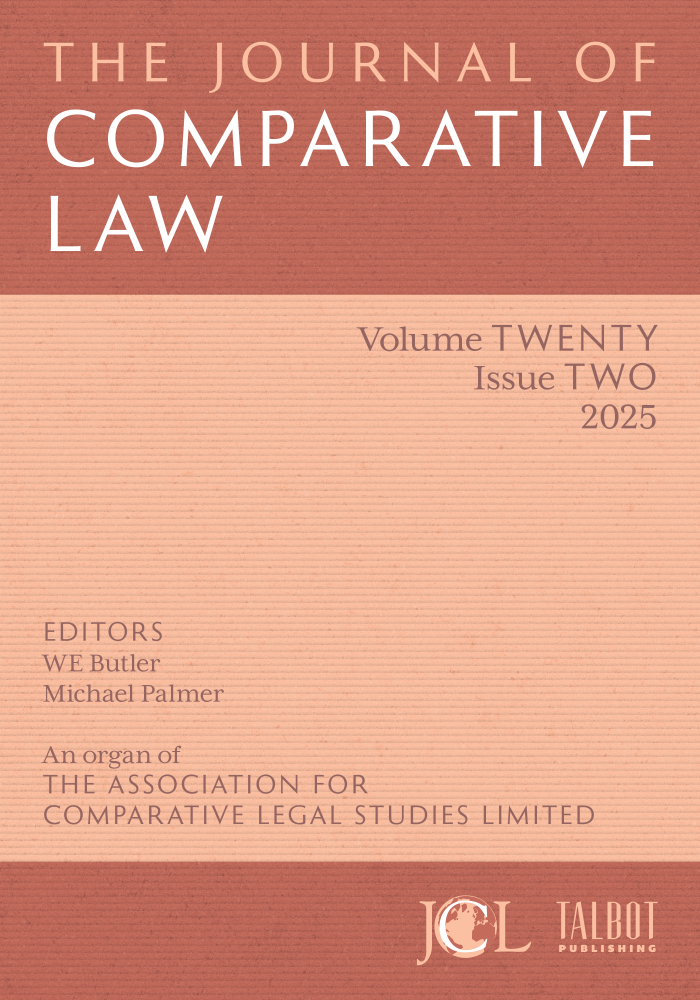
CALL FOR PAPERS: Global Law and Particular Legalities: Essays in Honour of William Twining (special issue in "The Journal of Comparative Law"; DEADLINE 9 JAN 2026)


(Image source: Lawbook Exchange)

When William Twining passed away on 9 October 2025, the global legal academy lost one of its most original and eclectic thinkers. Twining was a scholar of extraordinary range, leading debates not only within comparative law and comparative legal studies, but also within general jurisprudence, legal history, socio-legal studies, and the law of evidence. He argued passionately for legal scholarship as an open and inclusive enterprise, frequently magnifying voices from the Global South and fiercely critiquing what he saw as an over-reliance upon Anglo-American assumptions and perspectives within the academic writing of his peers. Twining can be credited not only with the meteoric rise of the ‘Law in context’ movement, but also with the expansion of general jurisprudence and the philosophy of law into fields such as legal pluralism and law and globalisation. For Twining, law was both everywhere and always from somewhere in particular. 

This special issue is dedicated to these, and other aspects, of Twining’s towering legacy. The guest editors invite the submission of abstracts of no more than 250 words by 9 January 2026, with an expectation that, if initially accepted, complete papers will be delivered no later than 30 June 2026, for final review and publication within the Journal of Comparative Law. Completed papers should be no more than 10,000 words, including footnotes. Submissions may concern any aspect of Twining’s intellectual or pedagogical legacy, however, the guest editors would particularly welcome abstracts and papers engaging with the following, either alone or in combination:

  • Comparative law and comparative legal studies as intellectual disciplines.
  • General jurisprudence, understood as both a descriptive and an inclusive enterprise.
  • Law both about, and within, the Global South.
  • Law, empire, and imperialism.
  • Law as a global and transnational phenomenon.
  • ‘Law in context’ as method and methodology.
  • Legal and normative pluralism.
  • Legal pedagogy and law teaching from a comparative perspective.
  • Legal realism in historical and comparative perspective(s).
  • Socio-legal studies and its connection(s) to comparative law.
  • The law of evidence in comparative perspective(s).

Abstracts are particularly welcome from scholars from the Global South, as well as from early career academics and colleagues with backgrounds otherwise under-represented within the academy. Initial submissions should be sent, together with a short biography of no more than 150 words, to Prof. Alex Green at aggreen@cuhk.edu.hk.


Guest Editors:

  • Prof. Alex Green (文浩航), Associate Professor, Chinese University of Hong Kong; Academic Associate, 23ES Chambers (London and Manchester)
  • Prof. Jennifer Hendry (文林言), Professor, Chinese University of Hong Kong; Academic Associate, 23ES Chambers (London and Manchester)

BOOK: Brecht DESEURE (ed.), Constitution de la Belgique. Projets et propositions pour la constitution belge de 1831 : édition critique (Brussels: Commission royale pour la publication des anciennes lois et ordonnances de Belgique/SPF Justice, 2020), 469 p. ISBN 9782960272406 [OPEN ACCESS]


Dr Brecht Deseure (ULB/KBR, FedTWin) has brought together 282 pages of drafts of the Belgian Constitution, debated and adopted in record time by the National Congress between November 1830 and February 1831.

This volume collects texts by Simon Merlin, Antoine Becart, Ferdinand Paridaens, Charles-Hyppolyte Vilain XIIII, Charles Moulan, Adolphe Bayet, Louis Glorieux, Joseph Mouremans, Joseph-Ferdinand Toussaint, François Grenier, Joseph Forgeur, Jean-Pierre Barbanson, Joseph-Stanislas Fleussu, Charles Liedts, Victor Delecourt, Charles Moulan, as well as several anonymous texts.

The editor has also prepared bio-bibliographical notes in Dutch, French, and English.

In the appendices, readers will find the draft Belgian Constitution of the Provisional Government, the text of the Constitution of February 1831, together with a chronology, a bibliography, and an index of names and subjects.

The Royal Commission for the Publication of the Ancient Laws and Ordinances of Belgium welcomes the availability of this work of primary importance for a broad audience through the website rechtsreeks.be (an initiative of the Library of the Faculty of Law and Criminology at KU Leuven).

The international significance of this publication is reflected in its association with the ERC Advanced Grant project ReConFort (University of Passau), within whose framework the volume has been published.

The book includes a foreword by the then Minister of Justice and Deputy Prime Minister, Mr Vincent Van Quickenborne (pp. 5–7).


The text can be accessed at this link.


12 December 2025

CONFERENCE: Protestantisme et pensée juridique (Malakoff: Université Paris Cité, 15-16 DEC 2025)

(image source: Wikimedia Commons)

Lundi 15 décembre, 14 h 00, sous la présidence de Pierre-Yves Quiviger, directeur de l’UFR de philosophie, Université Paris 1 Panthéon-Sorbonne


Guerric Meylan, maître de conférences en histoire du droit, université Paris-Saclay, Les Termes de l’Alliance selon Jean Calvin : proposition de lecture institutionnelle du Décalogue (Ex., 20)
Attila Pokecz Kovacs, professeur d’histoire du droit, université nationale du service public et université réformée Károli Gáspár de Budapest, L'influence du calvinisme sur la pensée juridique européenne et la jurisprudence : le cas de la Hongrie
Fabrice Bin, professeur de droit public, Science po Toulouse, Le devoir du contribuable et la légitimité de la loi fiscale à partir de Luther et Calvin
Paolo Astorri, professeur associé d’histoire du droit, université de Copenhague, Reforming Marriage, Reforming Law: Parental Consent and the Juridical Culture of Lutheranism 

Sous la présidence de Marianne Carbonnier-Burkard, maître de conférences honoraire à l’Institut protestant de théologie
Arnaud Le Gonidec, docteur en histoire du droit, université Toulouse Capitole, La condamnation de l'Eucharistie par les juristes protestants français de la seconde moitié du XVIe siècle: arguments juridiques
David El Kenz, maître de conférences en histoire moderne, université Bourgogne Europe, Les « héros de la foi » au XVIe siècle : le droit, à l’origine de la martyrologie protestante
Romain Dubos, docteur en histoire du droit, université Paris 1 Panthéon-Sorbonne, Un combat humaniste contre l'absolutisme : la Prinicipum monitrix musa d'Henri Estienne (1590)
Adrien Boniteau, docteur en théologie protestante, université de Strasbourg, Protestantisme et contractualisme : de l'alliance théologico-juridique des monarchomaques au contrat social de Thomas Hobbes 


Mardi 16 décembre, 09 h 30, sous la présidence d’Anne Rousselet-Pimont, codirectrice de l’École de droit de la Sorbonne, université Paris 1 Panthéon-Sorbonne


Clara Cwikowski, enseignante contractuelle en histoire du droit, université de Toulon, La conception de la loi et du contrat dans la littérature protestante sur la tolérance civile en France au XVIIIe siècle
Alexis Verhassel, doctorant en histoire du droit, université de Montpellier, Kant et le renversement des catégories du droit romain
Florian Reverchon, professeur d’histoire du droit, université de Toulouse, Enseigner le droit canonique en terre protestante : le Kirchenrecht dans les facultés de droit allemandes (XVIIe-XXe siècle)
Julien Broch, maître de conférences en histoire du droit, Aix-Marseille université, La part protestante de l’esprit du droit républicain : Jules Simon et la doctrine de la liberté dans l’ordre
Franck Zarlenga, docteur en histoire du droit et chercheur associé à Institut d’histoire du droit, Université Paris Cité, L’influence du droit protestant sur la nature juridique de l’Église dans le processus de séparation des Églises et de l’État
Jean-Pierre Jézéquel, directeur de recherche émérite, Institut national de l’audiovisuel, Ellul protestant et juriste

14 h 30, sous la présidence de Bruno Daugeron, directeur de Centre Maurice Hauriou, université Paris Cité
Isabelle Kalinowski, directrice de recherche, UMR Pays Germaniques (UMR 8547, CNRS/ENS), Les références au droit dans L'Éthique protestante et l'esprit du capitalisme de Max Weber
Quentin Roueche, doctorant en philosophie, université Paris 1 Panthéon-Sorbonne, Le paradoxe de l'individualisme politique protestant selon le juge Jerome Frank : éléments pour une théologie réformiste et réaliste
Adrien Aracil, docteur en histoire moderne, Sorbonne université, Le régime de l’édit de Nantes peut-il être un régime juridique ? Institutions réformées et pensée juridique dans la France du premier XVIIe siècle
Cyril Selzner, maître de conférences en langue et littératures anglaises et anglosaxonnes, université Paris 1 Panthéon-Sorbonne, Droit et radicalité de la conscience : les quakers et le serment au XVIIe siècle
Gilles Dumont, professeur de droit public, université Paris Cité, Existe-t-il une science administrative protestante ?
Sylvain Bloquet, maître de conférences en histoire du droit, université Paris Cité, Protestantisme et doctrine civiliste du XIXe siècle à Jean Carbonnier
Céline Borello, professeur d’histoire moderne, université du Mans, Conclusion


Practicalities:

Salle Jean-Pierre Machelon, Faculté de Droit, d’Économie et de Gestion, Université Paris Cité (10 avenue Pierre Larousse, 92240 Malakoff)

ARTICLE: Laurine MANAC'H, "Historiciser et politiser le pouvoir administratif", Rives Méditerranéennes 67 (2025), 169-185 [OPEN ACCESS]


(image source: openedition)

First paragraph:

Peut-on et comment faire l’histoire du « pouvoir administratif » dans des sociétés d’Ancien Régime qui ne connaissent pas de séparation des pouvoirs ? À condition de se défaire de l’idée téléologique d’une fonction et d’une organisation autonomes au sein du système de pouvoirs, dont la réalité ne remonte qu’au xixe siècle en Occident, et d’envisager avant tout le pouvoir « d’administrer », c’est-à-dire la capacité et la pratique de gouverner les hommes et les choses, il est possible d’analyser les manifestations historiques du pouvoir administratif. De l’ouvrage collectif coordonné par François Godicheau et Mathieu Grenet, il ressort plus encore que cette analyse, conduite dans une perspective transdisciplinaire au croisement de l’histoire politique et de l’histoire du droit, contribue plus généralement à la compréhension des enjeux politiques et institutionnels de l’action publique.

Read more here: DOI 10.4000/153ku.

BOOK REVIEW: Sara L. KIMBLE on International law and women’s history: historical methods for egalitarian scholarship: A Review of Portraits of Women in International Law: New Names and Forgotten Faces?, edited by Immi Tallgren (Comparative Legal History, XIII (2025), nr. 2 (December), pp. 306-314)

(Image source: Taylor&Francis)


Nearly a century ago, Virginia Woolf asked ‘If Shakespeare Had a Sister’ in A Room of One’s Own Woolf imagined Shakespeare’s sister who was equally gifted, ‘as adventurous, as imaginative, as agog to see the world as he was’ but denied access to school, books, and the opportunities for intellectual work. Talent with no room to develop would spell only grief for Shakespeare’s hypothetical sister, Woolf concluded. The cause of ‘Judith Shakespeare’s’ tragedy, however, was not on her shoulders alone but rather on the patriarchal society that limited all women’s access to education, shackled them to unending domestic and reproductive duties, and prevented their civic, financial, and personal independence.
Historians and legal scholars are still writing about the ways in which women struggled against societal, legal, religious, scientific, and educational limits to seek lives of meaning and satisfaction according to their own potential. In Portraits of Women in International Law, edited by Immi Tallgren, we have legal history’s corollary: what of Hugo Grotius’s wife, Maria van Reigersberch? Her current place in history is that of a wife loyal in service to her husband. But in Tallgren’s volume we meet an intrepid, intelligent woman who was resourceful and knowledgeable about finances, spoke boldly to court officials, sought contracts with printers, and travelled independently. Readers are encouraged to ask: did Grotius’s wife also make contributions to legal thought beyond saving the life of her husband, the man whose writings laid the foundations for international law as recognised today?

To read the full review, please click here. Online access is free for members of the European Society for Comparative Legal History. For further information about the volume on our blog, please visit here.

DOI: 10.1080/2049677X.2025.2580105


10 December 2025

VACANCIES: 14 PHD Positions in Cultural Heritage - Cultural Heritage Outreach in RomAnce Languages (MSCA CoFund) (DEADLINE 17 JAN 2026)

(image source: wikimer)


Presentation

  • Selected candidates will be enrolled in PhD programmes under joint supervision, awarding a double degree and requiring international mobility.
  • High-Quality Training: Receive expert-led research training through the UNITA Alliance’s dedicated Cultural Heritage Hub, encompassing diverse fields within and beyond cultural heritage.
  • Comprehensive Support: Benefit from dedicated guidance from the initial stages of your PhD to professional integration.
  • Transformative Impact: Contribute to the socio-economic and cultural transformation of rural and cross-border mountain territories.
  • Financial Support: Includes travel, mobility, and research costs.
  • Double Degree: Graduate with a double degree from two European universities.
  • Funding: 3-year fully funded PhDs, starting autumn 2026
How to Apply
  • A CV (template provided) that includes all personal information, education background, research activities (if any) and information about two referees
  • Two Reference letters (in a single PDF file): each referee will submit a letter concerning the applicant’s previous research activities and the applicant's research capacity and working experience
  • A personal statement (template provided - maximum of 5 pages) that includes general motivation letter for participation in CHORAL and the research topic, qualifications and achievements, career development objectives, collaboration requested beyond higher education sector for short stays
  • An ethics and security issues self-assessment
  • A copy of the Master’s degree and academic transcripts translated into English; Candidates waiting for their diploma to be officially issued must submit their marks and rankings
  • Copies of certificates of English language proficiency (for non-English native speaking applicants): Cambridge First Certificate or equivalent, TOEIC, TOEFL, a certificate of your Master’s university attesting the English
  • Copies of a valid identity card (for EU citizens) or a valid passport (for visa application if selected)
  • A declaration on honour (template provided) about the conformity of the mobility information
Fellowship conditions
  • France: 2300€/month
  • Italy: 2270€/month
  • Spain: 2164€/month
  • Romania: 2740€/month
  • Mobility allowance up to 4500 € over the 3-year period to partially cover travels, accommodation, etc. linked to secondments for the project duration.
  • Conference allowance up to 3500 € over the 3-year period of the PhD, to cover expenses related to the travel for attendance or participation to conferences, workshops.
  • Research allowance of 5000€ over the 3 years to cover expenses related to the research;
Scientific coordination
  • Université de Pau et des Pays de l’Adour (UPPA - France)
  • Université Savoie Mont Blanc (USMB - France)
  • Università degli studi di Torino (UNITO - Italy)
  • Universidad de Zaragoza (UNIZAR - Spain)
  • Università degli Studi di Brescia (UNIBS - Italy)
  • Universitatea Transilvania din Brașov (UNITBV - Roumania)

As part of the UNITA Alliance, 14 excellent Doctoral Candidates (DCs) will enrol the CHORAL programme in Cultural Heritage.

UNITA is an alliance of twelve universities supported by the European Union. Launched in November 2020, the alliance is helping to build the European Higher Education area. The partner universities, all of which are in Romance-speaking countries, have in common that they are located in mountainous and border areas.

Coordinated by the Université de Pau et des Pays de l'Adour, CHORAL (Cultural Heritage Outreach in RomAnce Languages) is a Horizon Europe Marie Skłodowska-Curie programme co-funded by the European Union. This prestigious programme is linked to the Cultural Heritage Hub, an international research network within the Alliance, which structures its research ecosystem facing cultural related challenges.

CHORAL aims to train high-quality international researchers and to nurture the development of interdisciplinary, international and inter-sectoral research that addresses any aspect of Cultural Heritage. While rooted in cultural heritage, the programme spans a wide range of scientific domains, including architecture, anthropology, arts and culture, computer science, history, literature, linguistics, management, musicology and more.

Applications are open until January 17, 2026 for 14 grants on multiple PhD research topics in 6 Universities of the UNITA Alliance for fully funded 3-years PhDs, starting on autumn 2026 : https://aap.univ-pau.fr 

The application form should contain all the following mandatory documents:

Detailed information about the PhD Research Topics and the conditions to apply: https://www.research.univ-unita.eu/en/choral-project.html

CHORAL fellows will benefit from the following advantages:

The monthly gross salary will depend on the recruiting country. The following list presents an indicative gross salary after employers' taxation, provided as guidance. The salary gross amount may be subject to changes corresponding to taxes increases/decreases 

The net salary amount may be subject to changes and corresponding personal tax position.

20 PhD Research Topics for 14 positions in 6 universities within the UNITA Alliance.

Read more on calenda.

PRIZE: American Society for Legal History Article Prize to Grace MALLON (co-winner), "Negotiated Federalism: Intergovernmental Relations on the Maritime Frontier, 1789-1815"


(image source: Rothermere American Institute, Oxford)

On the article:

Grace Mallon’s “Negotiated Federalism” examines the federal government’s efforts to enforce its new authority after the Founding. Federal officials quickly realized that they required the participation and consent of state governments, as federal laws could not take effect without the legislation, investment, and manpower of state governments. The piece showcases how Atlantic port cities presented a crucial test case for negotiated federalism, where the federal government sought to exercise power in spaces where states had already entrenched their authority. As early federal officials set up customs and lighthouse services, rebuilt coastal fortifications, and enforced regulations, they had to negotiate with states to determine “which powers each level of government could exercise.” As a result, federal power depended on a state’s willingness to negotiate its authority. The crisply written article tackles big questions of federalism through granular details of practical problems and personality conflicts. Based in impressive primary source research in state and federal official records and correspondence, Mallon brings multiple areas of scholarship together to describe how power was worked out ‘in the course of ordinary government administration instead of in high theory. “Negotiated Federalism” takes something that we feel is well-understood (federalism at the founding) and through a creative path through the archive mines new and provocative ways of seeing the past that help us see the present more clearly.

Link to the article here: 10.1353/wmq.2024.a941486 

(source: RAI - Oxford University

PRIZE: d'Aguesseau Thesis Prize 2025 to Francesco Saverio TAVAGLIONE (ULiège), "Entre punition et réparation. Pour une histoire culturelle de la fonction de la responsabilité aquilienne"

(image source: daguesseau.fr)

Announcement:

Le jury du Prix d’Aguesseau s’est réuni le 1er décembre 2025. À l’unanimité des présents lors de la délibération, c’est la thèse de Monsieur Francesco Saverio Tavaglione, « Entre punition et réparation. Pour une histoire culturelle de la fonction de la responsabilité aquilienne« , soutenue à l’Université de Liège, thèse conduite sous la direction de Mme Patricia Giunti et M. Jean-François Gerkens, qui a été retenue comme lauréate.

Read more here