Search

Showing posts with label Women history. Show all posts

30 April 2026

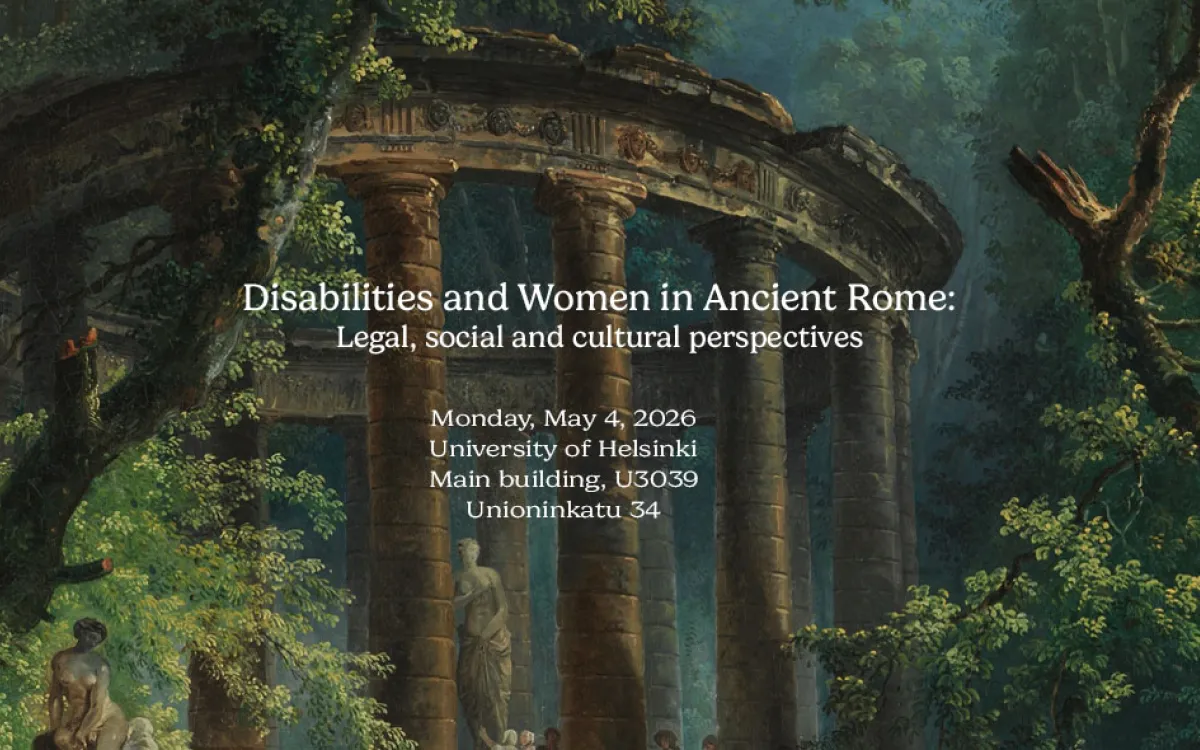
SEMINAR: Disabilities and Women in Ancient Rome: Legal, social and cultural perspectives (Helsinki: University of Helsinki, 4 MAY 2026) [HYBRID]


(image source: UH)

Disabilities and Women in Ancient Rome: Legal, social and cultural perspectives 
 University of Helsinki

Workshop: In-person&Online

In person participation: University of Helsinki, Main Building (Unioninkatu 34), Room U3039 (3rd floor)

Registration through this form

Remote participation: via Zoom (https://helsinki.zoom.us/j/69089076203)

 Monday, 4 May 2026, from 10:00 to 17:30 EEST


Program:

10:0011:15 keynote: Prof. Christian Laes: Women and disabilities in Antiquity: between presentism and daily life 

11:3013:00 session 1: Disabled Women in the Roman Narratives 

Sofia Vierula: The case of Harpaste: Lived experience of disability in Seneca’s letter to Lucilius 

Mathilde Chartrand: The Daily Life of a Furiosa: On the Gendered Consequences of Mental Illness

Fran Geldard: Enslavement and Disability in Eusebian Martyr Narrative

[Lunch] 

14:0015:30 session 2: Women, Disability and Roman Law

Arnaud Paturet: Some Reflections on the Status of Deaf People by Roman Jurists 

Kaius Tuori: Infirmity and monstrosity: on the legal construction of female disability in law

Jana Mauri Marlborough: Against All Odds: The Legal Position of Wet Nurses in Roman Law

[Coffee]

16:0017:30 session 3: Intersections of Gender and Disability in Late Antiquity 

Gaetana Balestra: Muta puella fuit: The Mute Woman between tutela mulierum and Justinian's Legislation.

Elena Pezzato Heck: Mental Illness as Grounds for Repudiation in Late Antiquity and the Justinian Era

Arttu Alaranta: Vulnerable Life-Cycle Moments and Disabilities in Women’s Asceticism during Late Antiquity 

More information is available on UH website. 


12 December 2025

BOOK REVIEW: Sara L. KIMBLE on International law and women’s history: historical methods for egalitarian scholarship: A Review of Portraits of Women in International Law: New Names and Forgotten Faces?, edited by Immi Tallgren (Comparative Legal History, XIII (2025), nr. 2 (December), pp. 306-314)

(Image source: Taylor&Francis)


Nearly a century ago, Virginia Woolf asked ‘If Shakespeare Had a Sister’ in A Room of One’s Own Woolf imagined Shakespeare’s sister who was equally gifted, ‘as adventurous, as imaginative, as agog to see the world as he was’ but denied access to school, books, and the opportunities for intellectual work. Talent with no room to develop would spell only grief for Shakespeare’s hypothetical sister, Woolf concluded. The cause of ‘Judith Shakespeare’s’ tragedy, however, was not on her shoulders alone but rather on the patriarchal society that limited all women’s access to education, shackled them to unending domestic and reproductive duties, and prevented their civic, financial, and personal independence.
Historians and legal scholars are still writing about the ways in which women struggled against societal, legal, religious, scientific, and educational limits to seek lives of meaning and satisfaction according to their own potential. In Portraits of Women in International Law, edited by Immi Tallgren, we have legal history’s corollary: what of Hugo Grotius’s wife, Maria van Reigersberch? Her current place in history is that of a wife loyal in service to her husband. But in Tallgren’s volume we meet an intrepid, intelligent woman who was resourceful and knowledgeable about finances, spoke boldly to court officials, sought contracts with printers, and travelled independently. Readers are encouraged to ask: did Grotius’s wife also make contributions to legal thought beyond saving the life of her husband, the man whose writings laid the foundations for international law as recognised today?

To read the full review, please click here. Online access is free for members of the European Society for Comparative Legal History. For further information about the volume on our blog, please visit here.

DOI: 10.1080/2049677X.2025.2580105


08 April 2020

BOOK: Teresa PHIPPS, Medieval Women and Urban Justice Commerce, Crime and Community in England, 1300–1500 (Manchester: Manchester University Press, 2020). ISBN 978-1-5261-3459-2, £80.00


Manchester University Press is publishing a new book on medieval women and urban justice in late-medieval England.

ABOUT THE BOOK

This book provides a detailed analysis of women's involvement in litigation and other legal actions within their local communities in late-medieval England. It draws upon the rich records of three English towns - Nottingham, Chester and Winchester - and their courts to bring to life the experiences of hundreds of women within the systems of local justice. Through comparison of the records of three towns, and of women's roles in different types of legal action, the book reveals the complex ways in which individual women's legal status could vary according to their marital status, different types of plea and the town that they lived in. At this lowest level of medieval law, women's status was malleable, making each woman's experience of justice unique.

ABOUT THE AUTHOR

Teresa Phipps is Honorary Research Fellow at Swansea University

TABLE OF CONTENTS

Introduction
1 Women, town courts and customary law in context
2 Commerce, credit and coverture: women and debt litigation
3 Law and the regulation of women's work
4 Violence, property and 'bad speech': women and trespass litigation
5 Public disorder, policing and misbehaving women
Conclusion
Index

More info here

03 August 2012

NOTICE: Women and Justice between Middle Ages and Modern Era (Bologna, 30-31 August 2012)

At the end of August 2012 a two days conference (papers in Italian and French) on Women and Justice in medieval and modern legal history will take place at the Alma Mater Studiorum, the University of Bologna Law Faculty.

What: Le donne e la giustizia fra Medioevo ed età moderna. Il caso di Bologna a confronto
When: 30 (3:00 pm) and 31 (9:30 am) August 2012
Where: University of Bologna Law Faculty, Facoltà di Giurisprudenza, Palazzo Malvezzi - Via Zamboni 22, Bologna (Italy)
Who: Marco Cavina, Gigliola Di Renzo Villata, Bernard Ribemont, Ettore Dezza, Philippe Haugeard, Giovanni Rossi, Elio Tavilla, Denis Bjai, Cesarina Casanova, Tanguy le Marc'Hadour, Antonio Grilli.

Organization: Prof. Marco Cavina: marco.cavina6@unibo.it (University of Bologna)