Search

Showing posts with label disability. Show all posts

30 April 2026

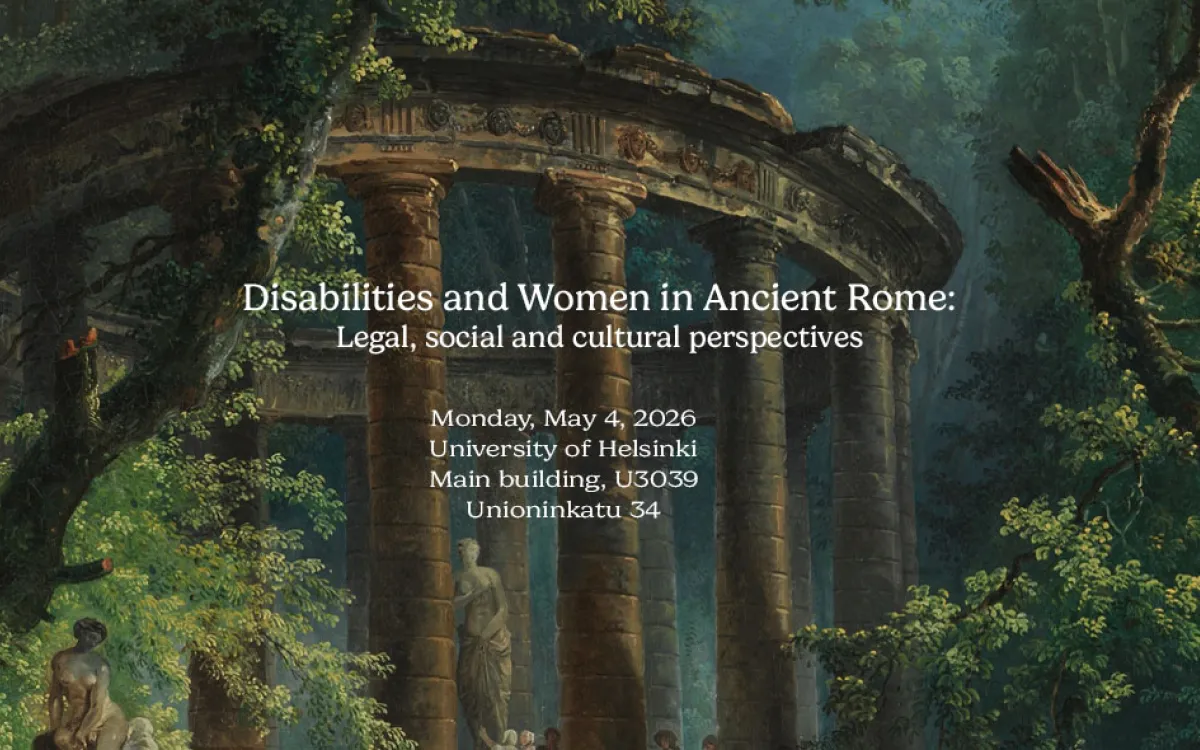
SEMINAR: Disabilities and Women in Ancient Rome: Legal, social and cultural perspectives (Helsinki: University of Helsinki, 4 MAY 2026) [HYBRID]


(image source: UH)

Disabilities and Women in Ancient Rome: Legal, social and cultural perspectives 
 University of Helsinki

Workshop: In-person&Online

In person participation: University of Helsinki, Main Building (Unioninkatu 34), Room U3039 (3rd floor)

Registration through this form

Remote participation: via Zoom (https://helsinki.zoom.us/j/69089076203)

 Monday, 4 May 2026, from 10:00 to 17:30 EEST


Program:

10:0011:15 keynote: Prof. Christian Laes: Women and disabilities in Antiquity: between presentism and daily life 

11:3013:00 session 1: Disabled Women in the Roman Narratives 

Sofia Vierula: The case of Harpaste: Lived experience of disability in Seneca’s letter to Lucilius 

Mathilde Chartrand: The Daily Life of a Furiosa: On the Gendered Consequences of Mental Illness

Fran Geldard: Enslavement and Disability in Eusebian Martyr Narrative

[Lunch] 

14:0015:30 session 2: Women, Disability and Roman Law

Arnaud Paturet: Some Reflections on the Status of Deaf People by Roman Jurists 

Kaius Tuori: Infirmity and monstrosity: on the legal construction of female disability in law

Jana Mauri Marlborough: Against All Odds: The Legal Position of Wet Nurses in Roman Law

[Coffee]

16:0017:30 session 3: Intersections of Gender and Disability in Late Antiquity 

Gaetana Balestra: Muta puella fuit: The Mute Woman between tutela mulierum and Justinian's Legislation.

Elena Pezzato Heck: Mental Illness as Grounds for Repudiation in Late Antiquity and the Justinian Era

Arttu Alaranta: Vulnerable Life-Cycle Moments and Disabilities in Women’s Asceticism during Late Antiquity 

More information is available on UH website. 


14 January 2026

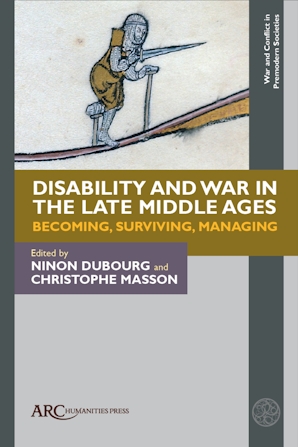
BOOK: Ninon DUBOURG & Christophe MASSON, Disability and War in the Late Middle Ages. Becoming, Surviving, Managing [War and Conflict in Premodern Societies] (York: ARC Humanities Press, 2025), 256 p. ISBN 9781802701647


(image source: ARC Humanities Press)

Abstract:
Issues relating to disability and war remain largely overlooked by military and disability historians. This exclusion is all the more striking since there was hardly a more likely place for receiving permanent injury than a battle, and we can barely imagine a worse place for disabled people than a battlefield. This volume aims to shed new light on a topic pertaining to multiple fields of research: social history, technical medical history, disability history, military history, and the Genesis of the Modern State. This book gathers specialists of premodern history to bring together new research from a variety of disciplines—history, archaeology, literature, and modern medicine—and working with diverse sources, such as account books, biographies, poems, romance texts, Icelandic sagas, petitions and pardon letters, post-battle records, prostheses, skeletons and funerary treatments, chronicles, and theoretical treatises.

Table of contents:

List of Illustrations

Preface

Introduction. "Disability and War: Becoming, Surviving, Managing" by Ninon Dubourg and Christophe Masson

Chapter 1. "The Recidivists: Healed Cranial Trauma from Conflicts in the Late Medieval Period" by Christopher J. Knüsel

Chapter 2. "Disability and Trauma in Battle in the Medieval Icelandic Sagas" by Yoav Tirosh

Chapter 3. "Hungry for Love: Disabling the Knightly Body and Mind through Starvation in Sir Thomas Malory’s Le Morte Darthur" by Kristina Hildebrand

Chapter 4. "A Vulnerable Military Masculinity: Soldiers and Disability in Late Medieval Pardon Letters (France, England, and the Low Countries)" by Quentin Verreycken

Chapter 5. "Traumatic Repercussions: Warfare and Disability in the French Countryside" by Aleksandra Pfau

Chapter 6. "Investigating the Lifecycle of the Medieval English Soldier: Disability, Mental Trauma, and Medicine in Connection with War in Late Medieval English Records" by Wendy J. Turner

Chapter 7. “'What pain I suffered at that time, anyone can well imagine...': Experiences of War, Injury, and Pain in Fifteenth- and Sixteenth-Century Germany and Switzerland" by Bianca Frohne

Chapter 8. "Mechanism/Organism: The Premodern Iron Hand as Conceptual Interface" by John Gagné

Chapter 9. "After Combat: War Wounds, Soldiers’ Benefits, and Dynastic Policies in the Burgundian–Habsburg Armies (1363–1506)" by Michael Depreter

Select Bibliography

Index

On the editors:

Ninon Dubourg is an Alexander von Humboldt Fellow based at the University of Cologne. She studies physical and mental disability, as well as old age, among lay and clerical individuals in late medieval Europe. Christophe Masson is a Permanent Researcher for the Fund for Scientific Research (FNRS) in Belgium. His work addresses the social, cultural, institutional, and technical dimensions of late medieval warfare. 

Read more here.