Search

19 September 2022

CALL FOR EDITORS: Comparative Legal History (DEADLINE 10 OCT 2022)

(image source: Routledge)


The European Society for Comparative Legal History (ESCLH) is seeking applications for the position of Articles Editor of its flagship journal, Comparative Legal History.

Evidence of scholarly ability, experience in editing or a willingness to learn quickly, and membership (or a commitment to become a member if appointed) of the ESCLH are requirements. Full training in the journal's processes will be provided as needed.

You would contribute to the advancement of comparative legal history as part of a warm, supportive, and dedicated team.

The journal is an official academic forum of the ESCLH. It was first published in 2013 and aims to offer a space for the development of comparative legal history. Based in Europe, it welcomes contributions that explore law in different times and jurisdictions from across the globe.

Applications, with a brief cover letter and short CV (no more than 4 pages) should be sent to Matthew Dyson, matthew.dyson@law.ox.ac.uk (President of the ESCLH) by 10 October 2022.

This position is not paid.

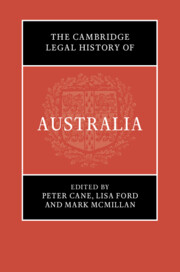
BOOK: Peter CANE, Lisa FORD & Marc MCMILLAN (eds.), The Cambridge Legal History of Australia (Cambridge: CUP, 2022), 814 p. ISBN 9781108633949, 120 GBP


(image source: CUP)

Abstract:

Featuring contributions from leading lawyers, historians and social scientists, this path-breaking volume explores encounters of laws, people, and places in Australia since 1788. Its chapters address three major themes: the development of Australian settler law in the shadow of the British Empire; the interaction between settler law and First Nations people; and the possibility of meaningful encounter between First laws and settler legal regimes in Australia. Several chapters explore the limited space provided by Australian settler law for respectful encounters, particularly in light of the High Court's particular concerns about the fragility of Australian sovereignty. Tracing the development of a uniquely Australian law and the various contexts that shaped it, this volume is concerned with the complexity, plurality, and ambiguity of Australia's legal history.

On the editors:

Peter Cane, University of Cambridge Peter Cane has written widely in areas of public law, private law and legal theory. He is co-editor (with H. Kumarasingham) of The Cambridge Constitutional History of the United Kingdom and author of Controlling Administrative Power: An Historical Comparison (2016). He is a Corresponding Fellow of the British Academy and a Fellow of the Academy of the Social Sciences in Australia. Lisa Ford, University of New South Wales, Sydney Lisa Ford is Professor of History at UNSW, Sydney. A prize-winning legal historian whose work explores jurisdictional politics in the United States and the British Empire to 1850, she is author of The King's Peace (2021) and Settler Sovereignty (2010), and co-author (with L. Benton) of Rage for Order (2016). She is a Fellow of the Academy of Humanities in Australia. Mark McMillan, RMIT University, Melbourne Dr Mark McMillan is a Wiradjuri man from Trangie in New South Wales who was NAIDOC scholar of the year in 2013. Dr McMillan has published widely on the achievement of human rights for Australian Indigenous people, recovering Indigenous self-governance and promoting settler recognition for Indigenous law in Australia.

Contributors:

Peter Cane, Lisa Ford, Mark Macmillan, Shaunnagh Dorsett, David Lieberman, Spiers Williams, Bruce Kercher, Ann Curthoys, Jessie Mitchell, Lim, Cheryl Saunders, Tim Rowse, Jennifer Green, Daryle Rigney, Denis Rose, Alison Vivian, Miriam Jorgensen, Steve Hemming, Shaun Berg, Kirsty Gover ,Eddie Cubillo, Miranda Johnson and Cait Storr, Coel Kirkby, Lisa Ford, David Andrew Roberts, Maureen Tehan, Amanda Kearney, Jason Behrendt, Sean Brennan, Ruth A Morgan, Judith Jones, Terri Libesman, Katherine Ellinghaus, Paul Gray, Alecia Simmonds, Amanda Nettelbeck, Anne O'Brien, Gary Foley and Crystal McKinnon, Bongiorno, Rayner Thwaites, David Andrew Roberts, Andy Kaladelfos, Alana Piper, Mark Finnane, Mark Lunney, Diane Kirkby, Kathy Bowrey, Nicole Watson, Shino Konishi 

More information with CUP. 


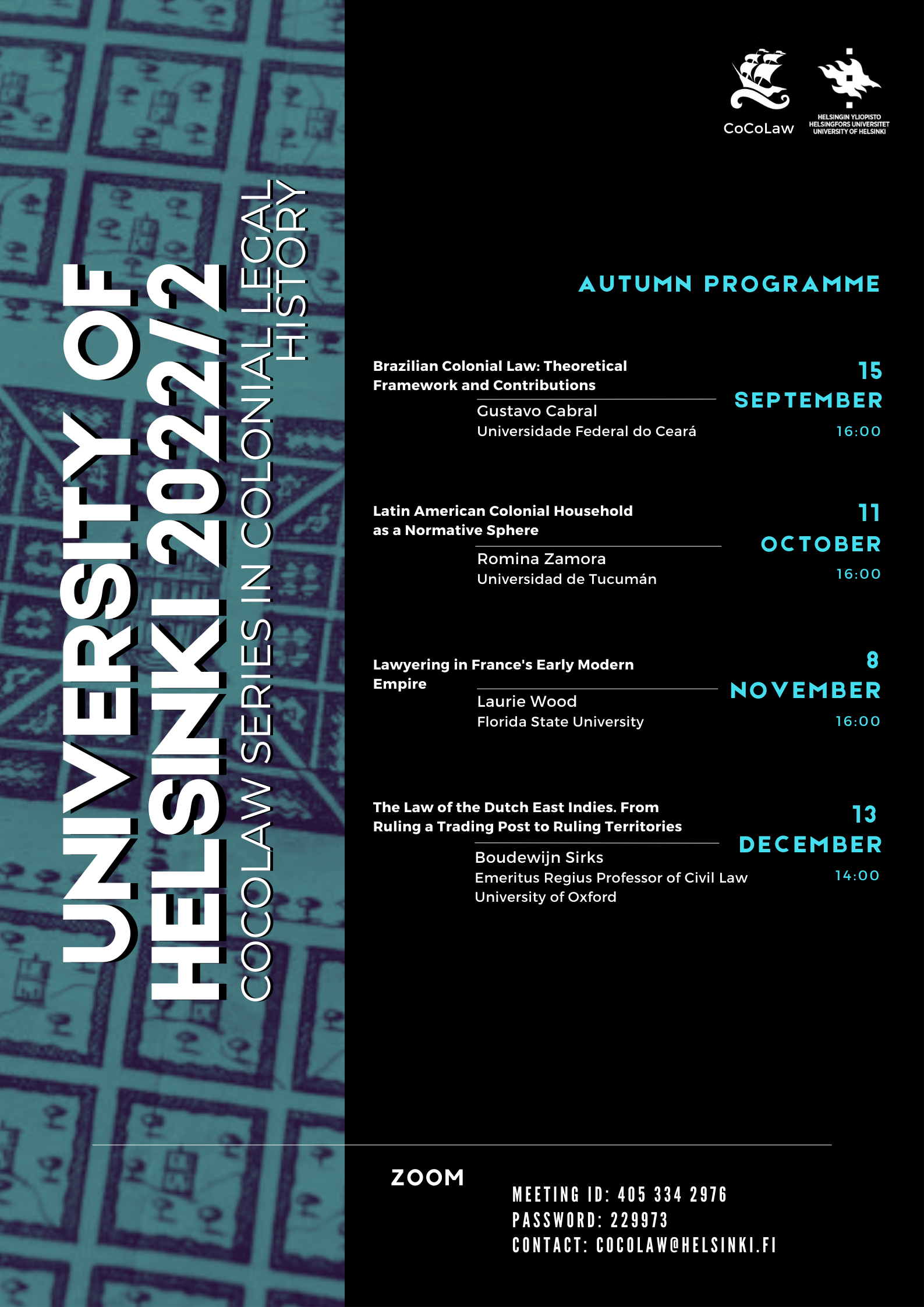
LECTURE SERIES: CoCoLaw Series on Colonial Legal History 2022/2 - University of Helsinki (on Zoom)


We have been informed of the following lecture series:


Dear colleagues,

We are pleased to announce and invite you the Autumn Program for the CoCoLaw Series on Colonial Legal History 2022/2. There will be four lectures, one each month from September to December, to discuss the latest investigations about the law enacted on colonial spaces during the early modern period.

For this semester, we will have the following speakers:

15.09 – Brazilian Colonial Law: Theoretical Framework and Contributions - Gustavo Cabral, Universidade Federal do Ceará

11.10 – Latin American Colonial Household as a Normative Sphere - Romina Zamora, Universidad de Tucumán

8.11 – Lawyering in France’s Early Modern Empire - Laurie Wood, Florida State University

13.12 – The Law of the Dutch East Indies. From Ruling a Trading Post to Ruling Territories - Boudewijn Sirks, University of Oxford

All lectures will take place online via Zoom and everyone are welcome to join (Meeting ID 405 3342976, Password 229973).

Kind regards,


CoCoLaw Project - Comparing Early Modern Colonial Laws

University of Helsinki

16 September 2022

WORKSHOP SERIES: New Directions in the Theory & History of International Law - Workshop II: "Beauty and Power: Aesthetics, History, & International Law" - Geneva, October 19-20, 2023 [deadline 25 November 2022]


The field of international legal history finds itself at a crossroads. After some decades, the tone of the literature on the “turn to history” has turned from celebration to self-critique. Indeed, the last couple of years has witnessed increased calls to pursue new directions in international legal history, departing from the “well-worn paths” initially explored. In this vein, some urge for a localized approach to the study of “legal politics,” while others push for a “history of international law in the vernacular,” a “grassroots analysis,” or a “radical historical critique.” In my own work, I have argued for a (new) materialist approach,  which resonates with other broader drives for the retrieval of Marxist perspectives in international legal history. Moreover, the “marked absences” of class, gender, and race from the traditional canon of the discipline seem like an increasingly inexcusable exclusion.  In sum, the stage is set for a profound reconsideration of the aims, methodologies, and archives of contemporary international legal history.

With this in mind, the interdisciplinary workshop series “New Directions in the Theory & History of International Law” aims to create a space where emerging and senior scholars of different traditions can meet and rethink on the past, present, and future of the theory and history of the discipline. For this purpose, the Geneva Graduate Institute will host a series of two-day academic workshops to promote productive conversations between different disciplinary sensibilities and perspectives along three core issues over the next three years.

These three cross-cutting themes are:

  • Political Economy, History, and International Law - held on June 2-3, 2022
    with Professor Susan Marks, London School of Economics

  • Beauty and Power: Aesthetics, History, and International Law - October 19-20, 2023
    with Professor Kate Miles, University of Cambridge

  • Space and Scale in International Legal History - Spring 2024 (tentative date TBD)
    with Professor Luis Eslava, University of Kent

Scholars who would like to present a paper at the second workshop on “Beauty and Power: Aesthetics, History, & International Law” are invited to submit a title and abstract (250─500 words) to daniel.quiroga@graduateinstitute.ch before November 25, 2022 (23:59 Geneva Time - CEST). A decision on acceptance of the abstract will be communicated by late October. We expect to host these workshops in person, but hybrid participation might be considered depending on the overall sanitary situation and the guidelines issued by the Geneva Graduate Institute. We are keen on exploring options for a collective publication effort after the workshop. As such, we encourage potential participants to bear this in mind as they prepare their abstracts.


All the relevant info here.

BOOK: Romano FERRARI ZUMBINI, Il grande giudice. Il tempo e il destino dell'occidente (Roma: Luiss University Press, 2022). ISBN: 8861057578, pp. 343, € 35.00


(Source: laFeltrinelli)

ABOUT THE BOOK

Riscoprire la prismaticità del reale. Si potrebbe sintetizzare così, icasticamente, l'obiettivo programmatico de Il grande giudice, annunciato fin dalle premesse. "Questo libro tiene conto della cancellazione della Storia" dichiara l'autore, attribuendo alla "disintegrazione del senso del Tempo", a un pensiero collettivo ideologicamente schiacciato su un eterno presente, anche la crisi del linguaggio. Tempo e logos sono i due protagonisti di questo saggio, entrambi da recuperare per poter disporre di perni di riflessione. È un'operazione che si snoda attraverso punti che creano linee che possono confluire in nuove traiettorie argomentative. Si parte dall'esigenza di (ri)definire parole che fanno parte dell'esperienza pubblica, cominciando dal lemma forse più significativo di tutti, "Costituzione", e ci si addentra nei percorsi storico-culturali delle civiltà occidentali per approdare ai lemmi della contemporaneità - comunicazione e Big Tech, sovranità e legittimazione, post-democrazia e iper-mo-rale, solo per citarne alcuni - scoprendo in loro significati inediti e riproponendo in modo più assertivo l'iniziale "Perché?".

ABOUT THE AUTHOR

Romano Ferrari Zumbini ha conseguito abilitazioni nazionali a professore ordinario di Storia delle istituzioni. Insegna Storia del diritto presso la Luiss. È autore di monografie sul processo medioevale e di storia costituzionale, nonché di numerosi studi apparsi, tra l’altro, su riviste quali Bocconi Legal Papers, Quaderni costituzionali, Il Mulino, Analisi giuridica dell’economia, Giornale di storia costituzionale e Federalismi.it.

WORKSHOP SERIES: Stanford Center for Law and History --- 2022-2023 Legal History Workshop Series --- (hybrid)


14 September 2022

VACANCY: Postdoc position in Legal History and Construction History (4 years - Full time) (DEADLINE: 26 October 2022)


This vacancy fits within the framework of the EOS research project “Construction History, Above and Beyond. What History Can Do for Construction History”, directed by professors Michiel Dehaene (UGent), Dave De ruysscher (VUB, Tilburg University), Rika Devos (ULB), Johan Lagae (UGent), Stephanie Van de Voorde (VUB) and Ine Wouters (VUB). In total, 3 PhD positions and 4 postdoc positions are included in this project (the fourth postdoc mandate will be opened later in 2023). An overview of the full project and all mandates involved can be consulted on: www.vub.be/arch/project/eos.

The EOS research project will set up a dialogue (in terms of sources, methodologies, concepts and cognitive interests) between Construction History and three other fields of history, namely Colonial History, Legal History and Planning History. As such, the project sets out to strengthen the historical dimension of Construction History, while simultaneously demonstrating its relevance and potential to other fields and disciplines. The project overall concentrates on selected aspects in 19th and 20th -century building knowledge and building practice in Belgium and its former colony, with particular attention for tacit knowledge, in order to voice crucial yet underrated actors, sources and types of knowledge.

The individual trajectory of each postdoc researcher is embedded in this larger team, operating in the 3 universities (ULB, UGent and VUB). Intensive exchange and shared outcomes among team members are crucial for the success of the project. The postdoc positions are each situated in one of the 3 fields of dialogue: (1) colonial history – construction history; (2) legal history – construction history and (3) planning history – construction history.

This specific vacancy is issued by the Université Libre de Bruxelles (ULB) and engages in the dialogue between legal history and construction history. It is co-supervised by profs. Rika Devos (ULB) and Dave De ruysscher (VUB, Tilburg University).

This postdoc study focusses on the normativity of ‘implicit’ and ‘practical’ knowledge building in Belgium, during the 19th and 20th centuries. This type of knowledge is often enforced through informal rules, in many segments of society. The field of Construction History holds promising opportunities to further disentangle normativity and informal rules, as they can be enforced in the case of harm orconstruction faults. The liability of architects, contractors and even workers was tested against ‘rules of the trade’, which were rules of implicit, practical knowledge. The sources that can be used range from instructional literature to case law, in which the liability of constructors is explored. These sources shed light not only on the appraisal of ‘rules of the trade’ but also on how legal practitioners categorized ‘practical knowledge’.

The post-doc study in the dialogue between Legal History and Construction History explores the types of normativity as found in instructional literature for construction professionals. As such, this research will link up not only with recent developments in Legal History, but also engage with the larger knowledge gaps identified in this project by assessing not only the relation between different types of knowledge engaged in normativity, but also the relations between the actors involved – both professional builders and professional legal actors – and the untapped sources to assess this normativity, including their technical and legal challenges. Legal practitioners and construction practitioners produce very different types of documents, from different viewpoints, in different ‘languages’. How do they interact and integrate the insights of the other field? How can they be understood by the other field and were these sources accessible and used? Do they reflect the standard of building? How and when does practical knowledge turn into a normative set of (implicit or explicit) rules or guidelines? These issues are tested through case studies in the archives of construction companies, such as the private archives of the Blaton archives and Entreprises Louis de Waele.

The successful candidate will be based alternatingly at ULB and VUB, to allow a dynamic interaction with the team members and a full insertion in both institutions.

More information: here

BOOK: Pierluigi CIPOLLA, Iustus iudex. La deontologia giudiziaria secondo Jean Domat (Roma: Aracne, 2022). ISBN: 979-12-218-0112-5, pp. 490, 25 €


ABOUT THE BOOK

Questo libro espone le idee di un giurista francese del XVII secolo – Jean Domat, il “precursore del codice civile” – sui doveri e sulle responsabilità dei magistrati e, tramite esse, racconta un Seicento “altro”, diverso dal mirabolante Barocco romano e anche dal secolo “pompa e paura” descritto dal Manzoni. Si tratta di un Seicento fatto di probità, impegno, rigore, i cui protagonisti sono Pascal, Giansenio, Cartesio. Un mondo ideale, proteso verso le altezze del Vero e del Giusto, le cui linee rette non riescono ad occultare una forte tensione, dovuta al contrasto con le urgenze del mondo reale, in un’epoca in cui già si avverte la fine dell’Ordine antico.


More information with the publisher.

13 September 2022

CONFERENCE: 18èmes journées Poitiers - Roma TRE « Jean Beauchard - Paolo Maria Vecchi » : La Répresentation – Poitiers, 30 septembre/1 octobre 2022


JOB : Research Professor in Canon Law (KU Leuven) (DEADLINE: 15 September 2022)


(Source: KU Leuven) 

The KU Leuven has a vacancy for a research professor in canon law.

The Faculty of Canon Law has a strong national and international reputation in teaching, research, and scientific services in the field of Canon Law and aims for leadership in each of these activities at the national, European, international and ecclesiastical levels in each of these activities. The Faculty of Canon Law currently has more than 130 students from the five continents. Based on its extensive research expertise, teaching is offered in Dutch and English, both at master's and advanced master's level. The Faculty’s aim is to distinguish itself through the academic character of its initiatives, and by emphasizing the social role of law, and the ecclesiastical and church-political role of Canon Law. This requires sufficient levels of abstraction and originality in research and teaching, as well as attention to values and to the theological and philosophical foundations of Canon Law. In this context, the function requires academic teaching, research and service which necessarily transcends purely descriptive work, by fostering awareness of the interdependence and dynamics of legal rules.

Website unit

Duties

Research

As research professor you will develop a broad nationally and internationally oriented research programme with a focus on specific areas in this field. You must correspond to a strong methodological profile. The candidate is expected to have a multidisciplinary attitude and a willingness to cooperate intensively with other researchers and research units, in the Faculty of Canon Law and beyond, in particular in Law and in Theology.

  • You strengthen existing research lines and you offer new and complementary expertise.
  • You develop your own research programme with a focus on areas in Canon Law.

  • You develop your own research group.

  • You attempt to acquire competitive research funding with national and/or international agencies and you submit research proposals to funding bodies in order to reach this goal.

  • You set up international cooperation in the context of your research programme.

  • You set up cooperation inside and outside the Faculty on the level of the research of the Research Unit.
  • You strive for excellence in your research and in this way you offer a contribution to the international character of the research unit and the Faculty.
  • You publish at the highest academic level, among others by publishing monographs in leading series and by contributing articles to various leading internationally reviewed journals in your field.
  • You attract national and international doctoral students and you supervise doctoral research in your research field.
  • You pay the necessary attention to the valorisation of your research.

Education

As stipulated in the BOF Decree, you will be expected to participate in limited teaching.

The candidate should possess excellent teaching skills, enabling him/her to contribute to the high quality of his/her research unit and the research based and research oriented educational programmes to which he/she will contribute both in the Faculty of Canon Law and in other faculties. Commitment to the quality of the programme as a whole is taken for granted.

Service

KU Leuven expects its academic staff to contribute to institutional management in the Faculty and the University and to engage in societal outreach initiatives.

Requirements

The candidate should hold a PhD in Canon Law (JCD), and if not: a PhD in Law or Theology (STD) and a Canonical degree Iuris Canonici Licentiatus (JCL).

You have an excellent research profile which is proven by among others the publication of monographs in leading series and articles in various leading international, peer-reviewed journals. 

You have demonstrable qualities related to university- level teaching and didactic skills. Experience in acquiring research funding is an asset.

Proficiency in English is required.

The official administrative language used at KU Leuven is Dutch. If the candidate does not speak Dutch (or does not speak it well) at the start of employment, KU Leuven will provide language training to enable him/her to take part in administrative meetings. Prior to teaching Dutch and/or English courses, the candidate will be given the opportunity to acquire or improve necessary language skills.

Before teaching courses in Dutch or English, you will be given the opportunity to acquire or improve the language skills, if necessary.

Other languages are an added value.

Offer

The Humanities and Social Sciences Group has decided to encourage and strengthen the (inter)disciplinary research in Canon Law by recruiting a research professor in that specific domain.

The successful candidate will be hired in the rank of Assistant Professor, Associate Professor or (Full) Professor depending on his/her qualifications and academic experience. Junior researchers will be appointed as assistant professor in tenure track for a period of 5 years, which in case of a positive evaluation is followed by an appointment as a tenured associate professor.

Your assignment includes tasks of research, education and service provision, but during the period of the BOF status will mainly consist of research in (sub-domains of) Canon Law.

The KU Leuven pursues a policy of equal opportunity and diversity and explicitly encourages underrepresented groups at the university to apply.

KU Leuven is well set to welcome foreign professors and their family and provides practical support with regard to immigration & administration, housing, childcare, learning Dutch, partner career coaching.

To facilitate scientific onboarding and accelerate research in the first phase a starting grant of 100.000 euro is offered to new professors without substantial other funding, appointed for at least 50%.

More information

full application and selection procedure research professorships (BOFZAP)


Interested?

More information on the content of the job can be obtained from the academic contact person Prof. dr. Rik Torfs, Dean of the Faculty of Canon Law, (rik.torfs@kuleuven.be, tel. +32 16 32 51 58). 

More information on the guidelines, regulations and application file [see footnote 1] is available from Ms. Kristin Vermeylen (kristin.vermeylen@kuleuven.be , tel. +32 16 32 09 07) or Ms. Christelle Maeyaert (christelle.maeyaert@kuleuven.be , tel. +32 16 31 41 94).


You are expected to add to the application file: a motivation letter; a text on the vision of academic research ; a text about the vision on academic education; and all teaching evaluations of the past five years in your possession.


You can apply for this job no later than September 15, 2022 via the online application tool

KU Leuven seeks to foster an environment where all talents can flourish, regardless of gender, age, cultural background, nationality or impairments. If you have any questions relating to accessibility or support, please contact us at diversiteit.HR@kuleuven.be.


More info here.


BOOK REVIEW: Faustino J. MARTÍNEZ MARTÍNEZ on Silvia Acerbi y Ramón Teja, El primado del obispo de Roma. Orígenes históricos y consolidación. Siglos IV-VI. (Forum Historiae Iuris, 1 MAR 2022) (OPEN ACCESS)


(image source: libreria siglo)

Faustino J. Martínez Martínez reviewed Silvia Acerbi and Ramón Teja's El primado del obispo de Roma. Orígenes históricos y consolidación. Siglos IV-VI. for Forum Historiae Iuris.


Read the review: DOI 10.26032/fhi-2022-002.

12 September 2022

EVENT: Book launch ‘De Salamanque à Guantanamo – Une histoire du droit international’ (Brussels, 5 October 2022)


(Source: ULB)

The Centre de droit international at the Université Libre de Bruxelles is organising a book launch for a new comic strip on the history of international law on October 5.

Parler du droit international en bandes dessinées. C’est le défi qu’ont relevé Olivier Corten et Pierre Klein en scénarisant, sur des dessins de Gérard Bedoret, De Salamanque à Guantanamo – Une histoire du droit international.
Ce document graphique explique l’évolution du droit international au fil des siècles. Des premières doctrines de la guerre juste, formulées par l’école de Salamanque au XVe siècle, jusqu’à la prison de Guantánamo ou à la guerre en Ukraine, il montre comment les États ont créé un nombre toujours croissant de règles et d’institutions pour régir leurs interactions.
Il propose une lecture critique du droit international, tiraillé à toutes les époques entre une dimension éthique (le droit comme vecteur de progrès et de civilisation) et une dimension politique (le droit comme instrument du pouvoir entre les États).
L’ouvrage, publié chez Futuropolis (Gallimard), sortira le 5 octobre 2022.

À l’occasion de sa parution, le Centre de droit international de l’Université libre de Bruxelles et les éditions Futuropolis organisent une table-ronde animée par Anne Lagerwall (directrice du Centre de droit international) sur le thème « Du droit international par la bande (dessinée) » avec

  • Gérard Bedoret (dessinateur)
  • Olivier Corten et Pierre Klein (scénaristes)
  • Philippe Sands (University College London, auteur de la préface)
  • Anne-Charlotte Martineau (Centre national de la recherche scientifique, Paris)
  • Sébastien Gnaedig (éditions Futuropolis)

Mercredi 5 octobre 2022 à 17h30, à la salle Dupréel (Institut de Sociologie de l’ULB, Avenue Jeanne 44, 1050 Bruxelles).
La table-ronde sera suivie d’une réception.
Inscription requise avant le 30 septembre 2022: cdi@ulb.be

More info here

VALEDICTORY LECTURE: David Ibbetson - University of Cambridge, 25 November 2022


Valedictory Lecture:


The Centre for English Legal History is delighted to invite you to a valedictory lecture to mark the retirement of David Ibbetson FBA from the Regius Professorship of Civil Law at Cambridge. The lecture will be introduced by Mr Justice Foxton. 


Location: Faculty of Law, University of Cambridge

Date: 25 November 2022

Time: 5:15pm


All are welcome, though booking is essential. You can reserve your place at https://www.eventbrite.com/e/valedictory-lecture-roman-law-comparative-law-legal-history-tickets-406793930597


Organisers: Joe Sampson & Neil Jones

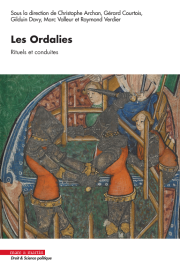
BOOK: Gilduin DAVY, Raymond VERDIER, Christophe ARCHAN, Gérard COURTOIS, Marc VALLEUR (dir.), Les ordalies. Rituels et conduites (Paris: Mare et Martin, 2022), ISBN: 9782849345511


(Image source: Mare et Martin)


ABOUT THE BOOK

Les ordalies, pratique déduite d’une cosmogonie immémoriale, ont participé en bien des temps et des lieux au règlement des conflits. Leurs rituels mettent en scène une épreuve dangereuse (voire mortelle) où accusés et accusateurs en appellent à une puissance sacrée pour que se manifeste la vérité. Très présente en Inde et en Mésopotamie, la culturede l’ordalie se repère dans de nombreux épisodes mythiques de l’Antiquité. Au Moyen-Age, les épreuves ordaliques, dont le duel judiciaire, dominent le système probatoire tout en subissant les critiques d’une Église qui rechigne à y voir une intervention divine. En Afrique et à Madagascar, ces épreuves, parfois encore prégnantes de nos jours, privilégient la puissance sacrale et justicière de l’eau et du feu, là où coexistent le visible et l’invisible. De ces rituels institués, nos contemporaines « conduites ordaliques » pourraient être une survivance, dans un monde où leur place devrait être cantonnée à l’imaginaire des productions culturelles.


ABOUT THE EDITORS

Christophe Archan est agrégé des Facultés de droit, Professeur d'Histoire du droit à l'université Paris Nanterre.

Gérard Courtois est agrégé des universités, Professeur émérite d'histoire du droit à l'université d'Artois.

Gilduin Davy est agrégé des Facultés de droit, Professeur d'Histoire du droit à l'université Paris Nanterre.

Marc Valleur est psychiatre, et ancien médecin chef de l'hôpital Marmottan à Paris.

Raymond Verdier est directeur de recherche honoraire au CNRS, fondateur de la Revue Droit et Cultures à l'université Paris Nanterre.


TABLE OF CONTENTS

Avant-propos (Raymond Verdier)

PREMIERE PARTIE. EGYPTE, INDE, OCCIDENT (Gèrard Courtois)

  • Le serment par la Vie, démarche ordalique dans l'Egypte pharaonique? (Bernadette Menu)
  • L'ordalie dans le droit de l'Inde classique (Jean-Claude Bonnan)
  • L'ordalie des quatre éléments. Empédocle, fragment 115 DK (Alain Petit)
  • Les expositions d'enfants dans la tragédie grecque: une pratique ordalique? (Sébastien Dalmon)
  • Procédés ordaliques et pratiques du serment dans le monde grec d'époque hellénistique et romaine (Andréas Helmis)
  • L'hybridation des vérités. L'ordalie dans l'Empire romain tardif (Soazick Kerneis)
  • Ordalies: du mécanisme à la forme de vérité (Antoine Garapon)
  • Sur le dédain du rituel (Gérard Courtois)

DEUXIEME PARTIE. LES DUELS ORDALIQUES DANS L'OCCIDENT MEDIEVAL (Christophe Archan, Gilduin Davy)

  • Le duel judiciaire dans l'Irlande médiévale (Christophe Archan)
  • Le sang des guerriers et l'ilot de l'honneur. Aperçu sur le duel dans la société viking (Gilduin Davy)
  • Résistance du duel judiciaire et réactions canoniques dans la Chrétienté occidentale (XI-XIII siècle) (Bruno Lemesle)
  • Le duel judiciaire dans la chanson de geste (XII et XIII siècles) (Philippe Haugeard)

TROISIEME PARTIE. RITUELS DIVINATOIRES, JURATOIRES ET ORDALIQUES. AFRIQUE NOIRE - MADAGASCAR (Raymond Verdier)

  • L'interrogation du mort en pays Joola jamaat (sud du Sénégal / nord de la Guinée-Bissau) (Odile Journet-Diallo)
  • L'ordalie de la masse-enclume. La forge et le fer chez les Masango du Gabon (Christian Mayisse)
  • Les ordalies en pays Gbaya (Paulette Roulon-Doko, Jeannette Sylvie Pilo-Atta)
  • Le verdict incontestable d'un juge invisibile en pays Bobo (Burkina-Faso) (Maurice Sanou)
  • Nature humaine, Justice cosmique, Paole et Vérité. L'épreuve du feu en pays Kabiyé (Togo) (Raymond Verder et Balaibaou Badameli-Kassan)

QUATRIEME PARTIE. LES CONDUITES ORDALIQUES: "L'ANIMISME" DES MODERNES? (Marc Valleur)

  • Les conduites ordaliques au cinéma (Mario Blaise)
  • Note critique sur la notion de "suicide ordalique" (Michel Debout)
  • Entre jeu et suicide: les conduites ordaliques (Marc Valleur)


More information can be found here

09 September 2022

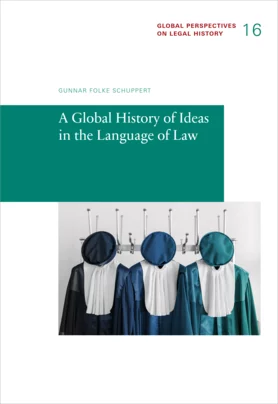
BOOK: Gunnar Folke SCHUPPERT, A Global History of Ideas in the Language of Law [Global Perspectives on Legal History; 16] (Frankfurt am Main: MPILHLT, 2021), XI + 328 p. ISBN 978-3-944773-30-8, OPEN ACCESS


(image source: MPILHLT)

Abstract:

The book is based on the observation that the study of the global history of ideas is currently dominated by historians, philosophers and political theorists. Scholars of law play almost no role in this context. This neglect of the perspectives of legal history and legal sociology conflicts with the easily established finding that many central concepts of the history of political ideas are at the same time legal concepts, such as natural law, human rights, constitution, and the rule of law. Moreover, many key figures in the history of ideas engaged deeply with the world of law and some – such as Kant, Hegel, and Weber – published their own philosophy or sociology of law.  From this point of departure, the book explores the global history of ideas by asking to what extent the history of political ideas can also be told in the language of law. The result, unsurprisingly, is that a global history of political ideas not only can but should be written in the language of law. This book wants to make a small contribution to that end.

Read the book for free here. 

ONLINE SEMINAR: Journal Comparative Legal History - Dialogues on Teaching Comparative Legal History - 19 October 2022: 17:00-18:00hs (CEST) [on Zoom]


Journal Comparative Legal History

Dialogues on Teaching Comparative Legal History

19 October 2022 – 17:00-18:00hs (CEST)


The journal Comparative Legal History is an official academic forum of the European Society for Comparative Legal History. It was first published in 2013 and aims to offer a space for the development of comparative legal history. Based in Europe, it welcomes contributions that explore law in different times and jurisdictions from across the globe. Submissions are currently welcome and are being assessed on a rolling basis.

The journal will host a one-hour public session to discuss the necessity and practicality of including comparative legal history in the law school curriculum. Editors (past and present) will present exploratory points and all attendees will be invited to join in a general discussion. Ought comparative legal history be routinely taught at schools of law? The presence of comparative legal history in the classroom may have an impact on the development of disciplinary autonomy and invite the revisiting of uncontested dogmas. It may further offer a forum for future generations to gain interest in the evolution of law across time and space. Does the teaching in this field have the potential to include new or otherwise marginalised perspectives? How would it fit within the framework of a demanding curriculum, often linked to regulatory requirements inherent to a profession? How would this teaching interplay with doctrinal studies? These and other questions will be explored during this public session.

The event is free and open to the public, and it will take place via Zoom.

Registration is required by sending an email to clhdialogues@gmail.com.

08 September 2022

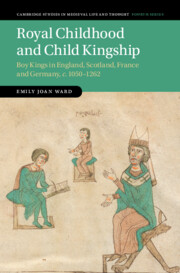
BOOK: Emily Joan WARD, Royal Childhood and Child. Kingship Boy Kings in England, Scotland, France and Germany, c. 1050–1262 (Cambridge: Cambridge University Press, 2022), ISBN: 9781108838375


ABOUT THE BOOK

Refining adult-focused perspectives on medieval rulership, Emily Joan Ward exposes the problematic nature of working from the assumption that kingship equated to adult power. Children’s participation and political assent could be important facets of the day-to-day activities of rule, as this study shows through an examination of royal charters, oaths to young boys, cross-kingdom diplomacy and coronation. The first comparative and thematic study of child rulership in this period, Ward analyses eight case studies across northwestern Europe from c.1050 to c.1250. The book stresses innovations and adaptations in royal government, questions the exaggeration of political disorder under a boy king, and suggests a ruler’s childhood posed far less of a challenge than their adolescence and youth. Uniting social, cultural and political historical methodologies, Ward unveils how wider societal changes between the eleventh and thirteenth centuries altered children’s lived experiences of royal rule and modified how people thought about child kingship.


ABOUT THE AUTHOR

Emily Joan Ward is a postdoctoral fellow at the University of Edinburgh. She began her British Academy funded project on ‘Adolescence and Belonging in Medieval Europe, c.1000–c.1250’ in her previous role at University College London. Royal Childhood and Child Kingship is her first book.


TABLE OF CONTENT

1. Royal childhood and child kingship: An introduction

Part I. Royal Childhood and Child Kingship: Models and History

2. Children and kingship in the early and central Middle Ages

3. Woe to thee, O land? Models of child kingship

Part II. Royal Childhood: Preparation for the Throne

4. Familial education: Preparing boys to be kings

5. Loyalty, diplomacy and (co-)kingship: Preparing political communities

6. The royal deathbed: Preparing for child kingship

Part III. Child Kingship: Guardianship and Royal Rule

7. Guardianship, regency and legality

8. Adapting and collaborating: Child kingship and royal rule

9. Feasting princes? Violence, conflict and child kingship

10. Entering adolescence: Knighting, seals and royal maturity

Conclusion: Re-thinking child kingship, c. 1050–1262.


More information can be found here

07 September 2022

CALL FOR PAPERS: Heraldry and the Law - XXIInd Colloquium of the International Academy of Heraldry, Lund 16-19 August 2023 (deadline 22 November 2022)


Welcome to the XXIInd Colloquium of the International Academy of Heraldry, 16-19 August 2023. The theme of the colloquium is “Heraldry and the Law”. It is an interesting theme for several reasons. In some countries there are authorities that grant or registers heraldic arms, also to private individuals (e.g. England and Scotland). In other countries, heraldry is almost unregulated, which means non-profit organizations have taken on the task of developing good heraldic custom. In many countries there is some regulation of heraldry, such as e.g. in Sweden where public coats of arms are protected against use as trademarks. The legal regulation of heraldry in different countries, and its historical development, has so far not been studied and compared. At the colloquium, we will also discuss other aspects of the theme heraldry and the law, such as symbols of law.


Examples of subject areas:

 The authorities granting and registering arms, present and in history

 The legal protection of heraldic arms

 Inheritance of heraldic arms

 Right to bear heraldic arms

 Symbols of courts, associations of advocates etc.

 Symbols of law in heraldry


We need an abstract of approximately 400 words. We also need information about the applicant’s affiliation, a short CV, and contact details.

Proposals should be sent to Lund2023@heraldik.org at the latest 22nd November 2022.

Notification of acceptance will be sent at the latest early in 2023.

More information: https://heraldik.org/colloquium-lund-2023/

BOOK: Michelle BUBENICEK, François FORONDA (dir.), Doléances. La plainte politique, voie de régulation des rapports gouvernés-gouvernants (XIIIe-XVIIIe siècle) (Paris: École nationale des chartes, 2022), ISBN: 9782357231665


ABOUT THE BOOK

Entre la révolution du gouvernement, au XIIIe siècle, et la révolution de la citoyenneté, au xviiie siècle, la doléance, ou la plainte politique, a fonctionné telle une voie de régulation du rapport entre gouvernés et gouvernants. Si l’histoire d’autres formes de demandes est bien connue, la requête par exemple, celle de la doléance restait à entreprendre. Cet ouvrage en propose les premiers jalons, sur la base d’une enquête documentaire de dimension européenne visant à déterminer l’identité propre de la doléance. Émerge ainsi toute la complexité des supposées origines des « cahiers de doléances », dont la mémoire a été avivée, en France, par le récent Grand débat national et les « cahiers des mairies ». À travers des contributions d’historiens spécialistes du politique et du social ainsi que de juristes historiens du droit, l’ouvrage met délibérément l’accent sur les sources qui permettent d’exprimer et donc de connaître la doléance, qu’il s’agisse de suppliques, de requêtes, de mémoires, de billets manuscrits, de cahiers synthétiques, de placets ou de recueils imprimés. Une attention particulière est également apportée à l’économie interne de ces supports, et notamment à la langue et au vocabulaire employés. Ces approches croisées permettent ainsi d’appréhender la doléance comme un objet historique à part entière.


ABOUT THE EDITORS

Professeur des universités, directrice de l’École nationale des chartes – PSL, Michelle Bubenicek s’intéresse à la place des femmes dans la sphère politique médiévale, ainsi qu’aux modalités d’implantation et de réception des pouvoirs.

Maître de conférences HDR à l’université Paris 1 Panthéon-Sorbonne, François Foronda travaille sur la production sociale d’un pouvoir d’État à la fin du Moyen Âge, à partir d’un champ d’observation castillan confronté à l’horizon européen.


TABLE OF CONTENT

Introduction générale : Michelle Bubenicek : « Une approche comparée de la plainte politique est-elle possible ? »

Première partie. Pour une sociologie de la plainte en politique

  • « Introduction », par Jan Dumolyn
  • « Vox populi, vox regis ou l’art du monologue politique : les réunions publiques sous Philippe IV le Bel », par Caroline Decoster
  • « Pétitions et plaintes collectives en Flandre médiévale : les acteurs et les institutions », par Jonas Braekevelt et Jan Dumolyn
  • « Les capitula des villes de Provence au xv e siècle : jalons pour une enquête », par Michel Hébert
  • « Les remontrances du parlement de Paris : instrument de conseil et arme de contestation du pouvoir monarchique au xviii e siècle », par David Feutry 
  • « Pétitions et engagements collectifs dans les territoires frontaliers septentrionaux (juin 1791-août 1792) », par Maxime Kaci

Deuxième partie. La plainte : du rituel au genre

  • « Introduction », par Emilie Rosenblieh
  • « Pétitions parlementaires et littérature politique en Angleterre, xiiie-xiv e siècles », par Frédérique Lachaud
  • « Corriger le roi : la doléance comme source de légitimation de la noblesse de Bohême dans la Chronique de Dalimil (vers 1309-1313) », par Eloïse Adde
  • « “Se acord ne concorde ne s’y met, tout est taillé de périr” : doléances et réforme en France et dans l’empire médiéval », par Gisela Naegle
  • « “Requestes et remonstrances” : anatomie de la plainte politique huguenote dans la seconde moitié du xvie siècle », par Hugues Daussy
  • « Le discours remontrant parlementaire à la veille de la Révolution : de l’audace, rien que de l’audace ? », par Frédéric Bidouze
  • « “Projets des têtes fêlées” ou voix d’une France majeure ? Les formes de la revendication citoyenne à la fin de l’Ancien Régime », par Edmond Dziembowski

Troisième partie. Administration et efficacité de la plainte

  • « Introduction », par Jérôme Loiseau
  • « Entre économie du salut et construction de l’État moderne : les querimoniae collectées par Louis IX lors des enquêtes de réparation (1247-1270) », par Marie Dejoux
  • « Doléances de la noblesse comtoise dans l’État bourguignon naissant (1384-1404) », par Michelle Bubenicek
  • « Clameur et complainte dans le discours législatif royal à la fin du Moyen Âge », par Sophie Petit-Renaud
  • François Foronda : « L’audience en actes et l’acte d’audience : le tournant administratif sous le règne d’Isabelle la Catholique »
  • Jérôme Loiseau : « La plainte dans l’économie politique de quelques états provinciaux en France et en Franche-Comté (xviie-xviiie siècles) »
  • Raphaël Barat : « La “voie des signatures” dans les doléances populaires (République de Genève, fin xviie-début xviii e siècle) »

Conclusion générale : François Foronda : « Entre deux révolutions : doléances et plainte politique dans l’écocomie de la demande »

Résumés

Index des noms propres


More information can be find here

05 September 2022

CALL FOR PAPERS: The European Society for Comparative Legal History's Seventh Biennial Conference (Augsburg: University of Augsburg, 21 – 23 JUN 2023); DEADLINE 15 NOV 2022


(image source: Blogger)

The Organising Committee and the Executive Council of the European Society for Comparative Legal History are pleased to call for papers for the upcoming Society’s Seventh Biennial Conference to be held from 21 to 23 June 2023 at the University of Augsburg, Germany.

A conference in 2023 will be a change to our normal timing. We began in Valencia (2010), followed by Amsterdam (2012), Macerata (2014), Gdańsk (2016), Paris (2018), and most recently, after a delay caused by Covid, we enjoyed the event in Lisboa (2022). However, not only does that mean we did not have a conference for four years. Covid has also moved some other large international conferences now to even-numbered years. To avoid collision with these other conferences, the ESCHL conferences would after 2023 continue at two-year intervals moving them to uneven-numbered years. The offer from Augsburg was made some years ago, but kindly deferred and the Executive Council is delighted to be able to take it up now.

For the Augsburg event in 2023, there is no general conference theme. Rather, the organisers hope that the sessions will reflect – in terms of covered topics, time periods, and regions – the full breadth of international research in comparative legal history. The Organising Committee does so in the believe that the Society’s Biennial Conference should foremost be a platform for researchers to present their most recent research in comparative legal. Papers should address and explore doctrinal, theoretical, cultural, or methodological aspects of comparative legal history. Papers should also be comparative, covering at least two legal systems, as well as historical.

To offer a paper, please send an abstract of up to 400 words by 15 November 2022. Papers, and abstracts, should be in English. The abstract should give the title of your paper and your personal data (full name, email address, work affiliation). Please also send a short CV (no more than 4 pages). Everyone, at whatever stage in their research career can offer a paper. The application should be sent to: phillip.hellwege@jura.uni-augsburg.de. Abstracts will be assessed against: (1) the aim to have a diverse conference; (2) the novelty of the work; (3) the evidence of scholarly rigour and promise of a fully researched and referenced paper; (4) in order to allow as many people as possible to speak at the conference, a person may normally offer only one paper.

It is also possible to submit a proposal for a complete panel. Panels normally consist of three papers. A panel proposal should – in addition to the abstracts and CVs of those who wish to present a paper in that panel – include an abstract for the entire panel as well as a CV of the panel organizer.

Applicants will be informed by 15 December 2022 whether their paper has been accepted. The conference programme will be published on 31 December 2022 on the conference website:

https://www.uni-augsburg.de/de/fakultaet/jura/lehrende/hellwege/seventh_esclh_conference_2023/

(image: Augsburg, in Swabenland, aan de Leck, boven den Donau; behoorende onder het Duitsche rÿk; Amsterdam: Pieter Schenk, 1700; source: Europeana/Central Library of Florence)

The conference website will also contain information on the attendance fee for those who are not members of the ESCLH, on transport to and from Augsburg, on accommodation in Augsburg. Finally, the conference website will allow, starting 15 December 2022, registration for the conference.

Finally, the conference will be preceded by an additional PhD-workshop on 21 June 2023. Further information about the workshop will also be published on 15 December 2022.

SEMINAR: I conti delle università. I salari dei professori universitari tra medioevo ed età moderna - Università di Bologna, 15 settembre 2022


02 September 2022

REMINDER ONLINE SEMINAR: on Martti Koskenniemi's book "To the Uttermost Parts of the Earth: Legal Imagination and International Power, 1300-1870" (Cambridge University Press, 2021) - 6th September 2022 - organised by the Journal of the History of International Law (on ZOOM)


On 6 September 2022, the Journal of the History of International Law is organising an online evening symposium (CET 20.00h-22.00) to celebrate the publication of Martti Koskenniemi's book 'To the Uttermost Parts of the Earth: Legal Imagination and International Power, 1300-1870 (Cambridge University Press, 2021). The event will take place on Zoom.


This is the program:


Chair: Dr. Inge Van Hulle (Max Planck Institute for Legal History and Legal Theory)


20.00h: Welcome by Prof. Randall Lesaffer (KU Leuven/Tilburg University) 

20.05h: Presentation of book by Prof. Martti Koskenniemi (University of Helsinki)

20.30h: Comments by Prof. Koen Stapelbroek (James Cook University): 'Commerce, capitalism and the law of nations'

20.45h: Comments by Prof. Jennifer Pitts (University of Chicago): 'The struggle between statehood and civil society'

21.00h: Comments by Prof. Wim Decock (UCLouvain): 'Theology and the justification of sovereignty and property'

21.15h: Response by Prof. Martti Koskenniemi

21.30h: Open discussion and questions


Please register by sending an email to: vanhulle@lhlt.mpg.de