Search

Showing posts with label australian legal history. Show all posts

19 September 2022

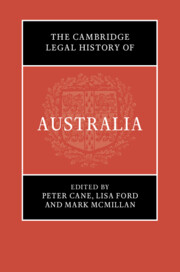
BOOK: Peter CANE, Lisa FORD & Marc MCMILLAN (eds.), The Cambridge Legal History of Australia (Cambridge: CUP, 2022), 814 p. ISBN 9781108633949, 120 GBP


(image source: CUP)

Abstract:

Featuring contributions from leading lawyers, historians and social scientists, this path-breaking volume explores encounters of laws, people, and places in Australia since 1788. Its chapters address three major themes: the development of Australian settler law in the shadow of the British Empire; the interaction between settler law and First Nations people; and the possibility of meaningful encounter between First laws and settler legal regimes in Australia. Several chapters explore the limited space provided by Australian settler law for respectful encounters, particularly in light of the High Court's particular concerns about the fragility of Australian sovereignty. Tracing the development of a uniquely Australian law and the various contexts that shaped it, this volume is concerned with the complexity, plurality, and ambiguity of Australia's legal history.

On the editors:

Peter Cane, University of Cambridge Peter Cane has written widely in areas of public law, private law and legal theory. He is co-editor (with H. Kumarasingham) of The Cambridge Constitutional History of the United Kingdom and author of Controlling Administrative Power: An Historical Comparison (2016). He is a Corresponding Fellow of the British Academy and a Fellow of the Academy of the Social Sciences in Australia. Lisa Ford, University of New South Wales, Sydney Lisa Ford is Professor of History at UNSW, Sydney. A prize-winning legal historian whose work explores jurisdictional politics in the United States and the British Empire to 1850, she is author of The King's Peace (2021) and Settler Sovereignty (2010), and co-author (with L. Benton) of Rage for Order (2016). She is a Fellow of the Academy of Humanities in Australia. Mark McMillan, RMIT University, Melbourne Dr Mark McMillan is a Wiradjuri man from Trangie in New South Wales who was NAIDOC scholar of the year in 2013. Dr McMillan has published widely on the achievement of human rights for Australian Indigenous people, recovering Indigenous self-governance and promoting settler recognition for Indigenous law in Australia.

Contributors:

Peter Cane, Lisa Ford, Mark Macmillan, Shaunnagh Dorsett, David Lieberman, Spiers Williams, Bruce Kercher, Ann Curthoys, Jessie Mitchell, Lim, Cheryl Saunders, Tim Rowse, Jennifer Green, Daryle Rigney, Denis Rose, Alison Vivian, Miriam Jorgensen, Steve Hemming, Shaun Berg, Kirsty Gover ,Eddie Cubillo, Miranda Johnson and Cait Storr, Coel Kirkby, Lisa Ford, David Andrew Roberts, Maureen Tehan, Amanda Kearney, Jason Behrendt, Sean Brennan, Ruth A Morgan, Judith Jones, Terri Libesman, Katherine Ellinghaus, Paul Gray, Alecia Simmonds, Amanda Nettelbeck, Anne O'Brien, Gary Foley and Crystal McKinnon, Bongiorno, Rayner Thwaites, David Andrew Roberts, Andy Kaladelfos, Alana Piper, Mark Finnane, Mark Lunney, Diane Kirkby, Kathy Bowrey, Nicole Watson, Shino Konishi 

More information with CUP


08 September 2021

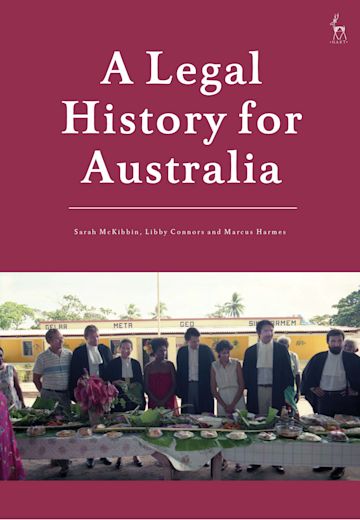
BOOK: Sarah McKIBBIN, Libby CONNORS & Marcus HARMES, A Legal History for Australia (London: Bloomsbury/Hart, 2021), 392 p. ISBN 9781509939572, 29,69 GBP


(image source: Hart)

Book presentation:

This is a contemporary legal history book for Australian law students, written in an engaging style and rich with learning features and illustrations. The writers are a unique combination of talents, bringing together their fields of research and teaching in Australian history, British constitutional history and modern Australian law.

The first part provides the social and political contexts for legal history in medieval and early modern England and America, explaining the English law which came to Australia in 1788. This includes:
The origins of the common law
The growth of the legal profession
The making of the Magna Carta
The English Civil Wars
The Bill of Rights
The American War of Independence.

The second part examines the development of the law in Australia to the present day, including:
The English criminal justice system and convict transportation
The role of the Privy Council in 19th century
Indigenous Australia in the colonial period
The federation movement
Constitutional Independence
The 1967 Australian referendum and the land rights movement.

The comprehensive coverage of several centuries is balanced by a dynamic writing style and tools to guide the student through each chapter including learning outcomes, chapter outlines and discussion points.

The historical analysis is brought to life by the use of primary documentary evidence such as charters, statutes, medieval source books and Coke's reports, and a series of historical cameos - focused studies of notable people and issues from King Edward I and Edward Coke to Henry Parkes and Eddie Mabo - and constitutional detours addressing topics such as the separation of powers, judicial review and federalism.

A Legal History for Australia is an engaging textbook, cogently written and imaginatively resourced.

Table of contents:

Table of Contents


1. The Origins of the Common Law
Introduction
The Sources for Medieval Legal History
Documentary Evidence
Treatises
Educational
Law and Governance in Pre-Conquest England
Impact of the Norman Conquest
Feudalism
Centralisation of Royal Justice
Juries
Instruments of Justice
Experiences of Justice
In the Wake of Magna Carta
Thirteenth Century Law
From the Middle Ages to Mabo
Conclusion
2. The Intellectual Life of the Law and Lawyers from the Middle Ages to Edward Coke
Introduction
The Crown and the Courts
The King's Judges
Forms of Action and Types of Court
Jurisdiction of the Royal Courts
Being in a Medieval Court
Trespass: The Versatile Action
The Humber Ferry Case
The Legal Profession and its Education
Law Reporting
The Year Books
Nominate Reports
Official Reports
Assumpsit Again: Slade's Case and the Law in Tudor England
Slade's Case, 1597–1602
Conclusion
3. The English Revolutions: Parliament, the King and the Law Courts
Introduction
Law and Religion: Sixteenth to Seventeenth Centuries
The Ecclesiastical High Commission
The Crown and Common Law
Equity and the Common Law
Chancery
Star Chamber and Court of Requests
The Common Law and Parliament
The King and Parliament
Parliament and the Common Law
Law and the English Civil Wars
The Interregnum, 1649–60
The Restoration (1660)
The Glorious Revolution
Before the Revolution
Aft er the Revolution
Conclusion
4. Responsible Government, Law and Justice in Eighteenth-Century England
Introduction
The Act of Settlement 1701
The Protestant Succession
The Acts of Union 1707
Emergence of Responsible Government
The Office of Prime Minister
Cabinet Government
Criminal Law and Criminal Trials in the Eighteenth Century
Developments in Criminal Law
Public Execution and Justice
The Reception of English Law Abroad
Abolition of the Slave Trade
Conclusion
5. The American Constitutional Settlement
Introduction
The Stamp Act Furore
The Boston Tea Party and the Intolerable Acts
The First Continental Congress
The Declaration of Independence
The Articles of Confederation
The Constitution of the United States
Two Early Political Factions: Federalists and Democratic-Republicans
Conclusion
6. Reform of British Parliament, Society and Courts in Nineteenth-Century England
Introduction
Reform of the Courts
The Court for Divorce and Matrimonial Causes
Courts of Common Law and Equity
The Judicature Acts
Reform of the British Parliament: Modern Political Parties
Catholic Emancipation and Jewish Relief
The Great Reform Act 1832
The Second Reform Acts of 1867–68
Later Nineteenth-Century Reforms
Codification Movement
Law and Society in the Nineteenth Century
Conclusion
7. The Reception of English Law in Australia
Introduction
The Eighteenth-Century Context: Idealism and Slavery
The English Criminal Justice System and Convict Transportation
Convicts' Rights
The Governor's Powers
Early Colonial Legal System
The Court of Criminal Judicature
The Court of Civil Jurisdiction
The First Supreme Court of New South Wales
The New South Wales Act 1823, the Third Charter of Justice and the Supreme Court of New South Wales
The Legal Profession in New South Wales: 1788–1859
Reception of English Law
Conclusion
8. Self-Government and Law in Colonial Australia
Introduction
The End of an Era: Convict Transportation
The Amateur Magistracy in the Colonies
The Path to Responsible Government: 1823–50
The New South Wales Act 1823
Australian Courts Act 1828
New South Wales Constitution Act 1842
Australian Constitutions Act 1850
Representative and Responsible Government from 1850
Bicameralism
Separation, Responsible Government and Unicameralism in Queensland
Colonial Laws Validity Act 1865
Manner and Form
The Federal Idea and the Federal Council of Australasia
Conclusion
9. Indigenous Australia and the Law in the Colonial Period
Introduction
Aboriginal Australia before European Contact
International Law by 1787
Settlement, Conquest and Cession
Early Contact: British Sovereignty?
A New Legal Fiction
The Myall Creek Massacre and Trials
'One Law for All' in Other Australian Colonies
The Melanesian Labour Trade
Annexation of the Torres Strait Islands to Queensland
Conclusion
10. Federation
Introduction
The Federation Movement
Influence of the United States Constitution and Canada's British North America Act 1867
Federation Debates
Australasian Federation Conference, 1890
National Australasian Convention, 1891
Corowa Federation Conference, 1893
National Australasian Convention, 1897–98
Referenda on the Constitution Bill
The Commonwealth of Australia
The Commonwealth of Australia Constitution Act 1900 (UK)
High Court of Australia
The Privy Council's Continuing Role
Investing Federal Jurisdiction in State Supreme Courts: The 'Autochthonous Expedient'
The Office of Governor-General
Conclusion
11. Australian Constitutional Independence and Legal Developments of the Twentieth Century
Introduction
White Australia Policy
Immigration Restriction Act 1901
The Case of Egon Kisch
Changing Views of States' Rights
Case Study of Amalgamated Society of Engineers v Adelaide Steamship Co Ltd
Constitutional Independence in Australia
Treaty of Versailles 1919
Balfour Declaration of 1926
Statute of Westminster 1931
Australia in World War II: The Statute of Westminster Adoption Act 1942 (Cth)
Judicial Review During the Cold War
The Dismissal of Gough Whitlam
Commonwealth and State Alignment: Australia Acts 1986
Termination of Privy Council Appeals
The Mason Court
Conclusion
12. The Painful Legacy of Colonialism: Aboriginal and Torres Strait Islander People and the Law in Modern Australia
Introduction
1967 Australian Referendum
Indigenous Australians and the Right to Vote
Amending the Constitution
The Gove Land Rights Case
Land Rights Movement
The Commonwealth Racial Discrimination Act 1975
Koowarta v Bjelke-Petersen
Mabo v Queensland (No 1)
Mabo v Queensland (No 2)
Native Title at Last!
The Legal Foundations of the Stolen Generations and Stolen Wages
Stolen Generations
Stolen Wages
Deaths in Custody
Indigenous Sentencing Courts
The Northern Territory Intervention
The Uluru Statement from the Heart

Conclusion 

15 December 2020

BOOK: Steven ANDERSON, A History of Capital Punishment in the Australian Colonies, 1788 to 1900 (Cham: Springer, 2020). ISBN 978-3-030-53766-1, 83.19 EUR


(Source: Springer)

Springer has published a new book on the history of capital punishment in the Australian Colonies.

ABOUT THE BOOK

This book provides a comprehensive overview of capital punishment in the Australian colonies for the very first time. The author illuminates all aspects of the penalty, from shortcomings in execution technique, to the behaviour of the dying criminal, and the antics of the scaffold crowd. Mercy rates, execution numbers, and capital crimes are explored alongside the transition from public to private executions and the push to abolish the death penalty completely. Notions of culture and communication freely pollinate within a conceptual framework of penal change that explains the many transformations the death penalty underwent. A vast array of sources are assembled into one compelling argument that shows how the ‘lesson’ of the gallows was to be safeguarded, refined, and improved at all costs. This concise and engaging work will be a lasting resource for students, scholars, and general readers who want an in-depth understanding of a long feared punishment.

ABOUT THE AUTHOR

Dr. Steven Anderson is a Visiting Research Fellow in the History Department at The University of Adelaide, Australia. His academic research explores the role of capital punishment in the Australian colonies by situating developments in these jurisdictions within global contexts and conceptual debates. 

TABLE OF CONTENTS

Introduction: Thinking About Punishment Over Time

Australia’s Hanging Years

The Ideal and Reality of Execution Procedure

The Criminal at the Gallows

The Scaffold Crowd

The End of Public Executions

Race and the Reprisal of Public Hangings

The Push to Abolish Capital Punishment

Conclusion: Death of a Spectacle


More info here

04 November 2020

BOOK: Amanda WHITING and Ann O’CONNELL (Eds.), Legal History Matters - From Magna Carta to the Clinton Impeachment (Melbourne: Melbourne University Press, 2020). ISBN 9780522877571, 69.99 AUD


(Source: MUP)

Melbourne University Press is publishing a new collection of essays on the significance of legal history to our understanding of legal processes and institutions.

ABOUT THE BOOK

As a field of study, legal history has an unsteady place in Australian law schools yet academic research and writing in the field of legal history and at the intersections of the disciplines of 'law' and 'history' is undergoing something of a renaissance, with rich and vibrant new works regularly appearing in specialist journals and scholarly monographs. This collection seeks to reinvigorate the study of history within the law school curriculum, by showcasing what students of the law can achieve when, addressing topics from the use of Magna Carta as history and precedent in sixteenth-century England to the political manoeuvres behind the failed impeachment of President Bill Clinton in late twentieth-century America, they seek to understand legal processes and institutions historically. The volume comprises outstanding legal history papers authored by graduate (final year JD) students in the Melbourne Law School. This collection is dedicated to two women who championed the teaching of legal history at the Melbourne Law School in the 1960s-Dr Ruth Campbell and Mrs Betty Hayes.

ABOUT THE EDITORS

Ann O'Connell is Professor at Melbourne Law School. Her scholarly research and teaching interests include taxation generally as well as taxation of not-for-profits; and not-for profits and the law.

Amanda Whiting is an Associate Professor at Melbourne Law School. Her scholarly research and teaching traverses the disciplines of History and Law, with particular focus on early-modern English history, and the legal profession and law reform in post-colonial Malaysia.


More info here

12 December 2019

BOOK: Anthony O’DONNELL, Inventing Unemployment Regulating Joblessness in Twentieth-Century Australia (Oxford: Hart Publishing, 2019). ISBN 9781509928194, £50.00


(Source: Bloomsbury)

Bloomsbury is publishing a new book on the regulation of joblessness in 20th century Australia.

ABOUT THE BOOK

This book examines the evolution of Australian unemployment law and policy across the past 100 years. It poses the question 'How does unemployment happen?' But it poses it in a particular way. How do we regulate work relationships, gather statistics, and administer a social welfare system so as to produce something we call 'unemployment'? And how has that changed over time?

Attempts to sort workers into discrete categories – the 'employed', the 'unemployed', those 'not in the labour force' – are fraught, and do not always easily correspond with people's working lives. Across the first decades of the twentieth century, trade unionists, statisticians and advocates of social insurance in Australia as well as Britain grappled with the problem of what forms of joblessness should be classified as 'unemployment'. This book traces those debates. It also chronicles the emergence and consolidation of a specific idea of unemployment in Australia after the Second World War. It then charts the eventual unravelling of that idea, and relates that unravelling to the changing ways of ordering employment relationships.

In doing so, Inventing Unemployment challenges the preconception that casual work, self-employment, and the 'gig economy' are recent phenomena. Those forms of work confounded earlier attempts to define 'unemployment' and are again unsettling our contemporary understandings of joblessness.

This thought-provoking book shows that the category of 'unemployment', rather than being a taken-for-granted economic variable, has its own history, and that history is intimately related to our changing understandings of 'employment'.

ABOUT THE AUTHOR

Anthony O'Donnell is Senior Lecturer in Law at La Trobe University, Melbourne.

More info here


24 September 2019

BOOK: Susan BARTIE, Free Hands and Minds Pioneering Australian Legal Scholars (Oxford: Hart Publishing, 2019). ISBN 9781509922611, £70.00


(Source: Bloomsbury)

Bloomsbury is publishing a new book on Peter Brett (1918–1975), Alice Erh-Soon Tay (1934–2004) and Geoffrey Sawer (1910–1996) (three Australian, 20th century legal scholars).

ABOUT THE BOOK

Peter Brett (1918–1975), Alice Erh-Soon Tay (1934–2004) and Geoffrey Sawer (1910–1996) are key, yet largely overlooked, members of Australia's first community of legal scholars. This book is a critical study of how their ideas and endeavours contributed to Australia's discipline of law and the first Australian legal theories. It examines how three marginal figures – a Jewish man (Brett), a Chinese woman (Tay), and a war orphan (Sawer) – rose to prominence during a transformative period for Australian legal education and scholarship.

Drawing on in-depth interviews with former colleagues and students, extensive archival research, and an appraisal of their contributions to scholarship and teaching, this book explores the three professors' international networks and broader social and historical milieux. Their pivotal leadership roles in law departments at the University of Melbourne, University of Sydney, and the Australian National University are also critically assessed.

Ranging from local experiences and the concerns of a nascent Australian legal academy to the complex transnational phenomena of legal scholarship and theory, Free Hands and Minds makes a compelling case for contextualising law and legal culture within society. At a time of renewed crisis in legal education and research in the common law world, it also offers a vivid, nuanced and critical account of the enduring liberal foundations of Australia's discipline of law.

ABOUT THE AUTHOR

Susan Bartie is Lecturer in Law at the University of Tasmania, Australia.

More information here