Search

Showing posts with label kingship. Show all posts

25 August 2025

BOOK: Ernst KANTOROWICZ, Radiances. Unpublished Essays on Gods, Kingship, and Images of the State (Ithaca: Cornell University Press, 2025), 258 p. ISBN 9781501782534

(Image source: Cornell University Press)

Abstract:
Radiances gathers previously unpublished essays by one of the greatest historians of the twentieth century. Although best known for The King's Two Bodies (1957), Ernst Kantorowicz's scholarly expertise ranged from classical antiquity to early modernity and from political pageantry to numismatics. These essays traverse the breadth of his expertise, exploring "radiations" of the themes that were central to his published work: sovereignty, theology, law, and iconography.
The radiations in these engaging essays include the imagery of throne-sharing from the Hellenistic era and Pharaonic Egypt to early Christianity, coronation ceremonies in Byzantium and the West, the Carolingian and Burgundian Renaissances, the relationship between Rome and Christianity, the importance of history as a humanistic pursuit, and the significance of postage stamps in political myth-building. Robert E. Lerner discusses each essay's composition, themes, and place in Kantorowicz's oeuvre. Combining vast knowledge with intellectual delight, Radiances teems with the profound historical insights that distinguished Kantorowicz's scholarship.

On the author:
Ernst Kantorowicz (1895–1963) taught at the University of Frankfurt and University of California, Berkeley, and was a member of the Institute for Advanced Study in Princeton.

More information can be found here.

10 September 2024

CONFERENCE: Si rex periit, regnum remansit (‚Ist der König tot, so bleibt doch das Reich bestehen‘). Die Pfalzen, das Reich und der Wechsel der Herrschaft/Dynastie (Halle: Hallischer Saal / Burse zur Tulpe, 8-9 NOV 2024)

(Image source: Wikimedia Commons) 


Unter dem Titel Si rex periit, regnum remansit (‚Ist der König tot, so bleibt doch das Reich bestehen‘) versammelt sich der am Lehrstuhl für Mittelalterliche Geschichte der Otto-von-Guericke-Universität Magdeburg angesiedelte Pfalzenarbeitskreis Sachsen-Anhalt zum nunmehr elften Mal. Die Tagung geht der Frage nach, ob und falls ja wie sich der Dynastiewechsel des Jahres 1024, als das Königtum nach dem kinderlosen Tod Heinrichs II. († 13. Juli 1024) auf die Salier überging, auf die Pfalzen und das Reich auswirkte. Aus unterschiedlichen Fachgebieten und zu unterschiedlichen Regionen des mittelalterlichen Reiches sowie zu unterschiedlichen Aspekten der Thematik werden vielfältige Forschungsergebnisse präsentiert. Im Fokus stehen Brüche und Kontinuitäten im Herrschaftsverständnis und in der Herrschaftspraxis, aber auch die Auswirkungen des Dynastiewechsels auf die Eliten des Reiches. Darüber hinaus werden – in bewährter Tradition – Einblicke in die Archäologie des Tagungsortes selbst sowie zu anderen Pfalzstandorten geboten.

Alle Interessierten sind zur Teilnahme herzlich eingeladen. Eine Tagungsgebühr wird nicht erhoben. Aus organisatorischen Gründen wird um eine Anmeldung gebeten: pfak.sachsen-anhalt@ovgu.de


PROGRAM

Freitag, 8. November

  • 14.00 - Grußworte und Einführung
  • 14.15 - Simon Groth (Magdeburg): Karolinger‘ – ‚Ottonen‘ – ‚Salier‘ – ‚Staufer‘. Oder: Vom Nutzen und Nachteil der Dynastie für die Darstellung
  • 15.00 - Stephan Freund (Magdeburg): Heinrich II., Konrad II. und die Königspfalzen. Neue Herrscher, neue Gewohnheiten?
  • 16.15 - Luise Margarete Jansen (Bonn): Die Herrscherin und der Herrscherwechsel. Kaiserin Kunigunde und Königin Konstanze im Vergleich
  • 17.00 - Carolin Triebler (Aachen): Der sächsische Adel und der Herrscherwechsel 1024
  • 17.45 - Alena Reeb (Magdeburg): Neuer König, neue Verhältnisse? Sächsische Geistliche in Phasen von Herrschaftswechseln
  • 19.00 - Ludger Körntgen (Mainz): Abendvortrag. Brüche und neue Kontinuitäten. Die Dynastiewechsel im hochmittelalterlichen Reich (1002 – 1024 – 1152)

Samstag, 9. November

  • 9.00 - Caspar Ehlers (Frankfurt/Main): Aachen, Frankfurt, Memleben, Goslar: Transdynastische Zentralorte im Reich
  • 9.45 - Étienne Doublier (Köln): Talia fluctuante Italia. Die Herrscherwechsel von 1002 und 1024 aus italienischer Perspektive
  • 11.00 - Markus C. Blaich (Hannover): Neues von altbekannten Plätzen: Goslar und Pöhlde
  • 11.45 - Matthias Becker (Halle/Saale): Merseburg vor 1000 Jahren
  • 12.30 - Caroline Schulz (Halle/Saale): Sachgeschichten: Halle im Lichte archäologischer Quellen
  • 13.15 - Zusammenfassung und Tagungsende


More information can be found here.


03 July 2024

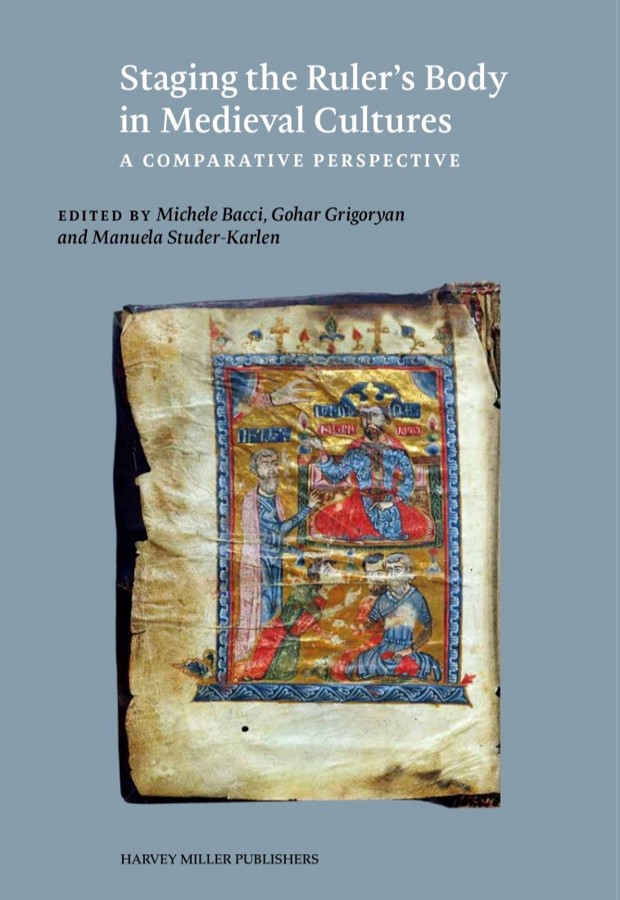
BOOK: Michele BACCI, Gohar GRIGORYAN, Manuela STUDER-KARLEN (eds.), Staging the Ruler’s Body in Medieval Cultures: A Comparative Perspective (Turnhout: Brepols, 2023). ISBN: 9781915487087 [OPEN ACCESS]

(Image source: Brepols)


ABOUT THE BOOK

This book explores the viewing and sensorial contexts in which the bodies of kings and queens were involved in the premodern societies of Europe, Asia, and Africa, relying on a methodology that aims to overcoming the traditional boundaries between material studies, art history, political theory, and Repräsentationsgeschichte. More specifically, it investigates the multiple ways in which the ruler’s physical appearance was apprehended and invested with visual, metaphorical, and emotional associations, as well as the dynamics whereby such mise-en-scène devices either were inspired by or worked as sources of inspiration for textual and pictorial representations of royalty. The outcome is a multifaced analysis of the multiple, imaginative, and terribly ambiguous ways in which, in past societies, the notion of a God-driven, eternal, and transpersonal royal power came to be associated with the material bodies of kings and queens, and of the impressive efforts made, in different cultures, to elude the conundrum of the latter’s weakness, transitoriness, and individual distinctiveness.


ABOUT THE EDITORS

Michele Bacci is Professor of Medieval Art History at Fribourg University, Switzerland, and a member of the Academia Europaea. His research has been focused on artistic interactions in the Medieval Mediterranean and beyond, and the history of cult-objects and holy sites from a phenomenological-comparative viewpoint. He is the author of numerous publications, including Il pennello dell’Evangelista (1998), The Many Faces of Christ (2014), the Mystic Cave (2017), and Veneto-Byzantine Artistic Interactions (2021).

Gohar Grigoryan, Ph.D. (2017), University of Fribourg, is currently senior researcher at the same university within an SNSF-funded project. She is the author of over two dozen peer-reviewed articles on medieval Armenian art and history and of an upcoming monograph on royal imagery in Cilician Armenia.

Manuela Studer-Karlen, Ph.D. (2010), University of Fribourg, is a SNSF Professor for Medieval Art at the University in Bern. She has published a monograph on late antique sarcophagi and recently her habilitation has been published with the title: "Christus Anapeson. Image and Liturgy". Her research centres on the history of visual-cultural processes in late antiquity, the interactions among text, image and space in Byzantine churches, medieval Georgian art, and Gothic ivories.


TABLE OF CONTENTS

  • The Ruler’s Multiple Bodies and Their Mise-en-Scène: Some Introductory Remarks (MICHELE BACCI)

  1. Staging the Body of the Lord of the Sevenfold World. Methectic Spaces and Chiasmatic Viewing in Sasanian Iran (MATTHEW P. CANEPA)
  2. Queen Consort Mariam Dadiani and Female Architectural Patronage in Late Medieval Georgia (NATIA NATSVLISHVILI)
  3. The ‘Just Judgement’ of King Lewon IV. Representational Strategies of Righteous Rulership in Cilician Armenia (GOHAR GRIGORYAN)
  4. Royal Imagery and Devotional Spaces in Early Solomonic Ethiopia. The Case of Gännätä Maryam (JACOPO GNISCI)
  5. Staging as Metaphor. The King’s Body and the Theatricality of Power (ANTONY EASTMOND)
  6. Clothes maketh the emperor? Embodying and Performing Imperial Ideology in Byzantium through Dress (MARIA PARANI)
  7. Staging for Commemoration: The Cherubikos Hymnos (MANUELA STUDER-KARLEN)
  8. The Khan in the West. The Reception of Mongol Political Power in the Texts and Images of Medieval Latin Europe (ELEONORA TIOLI)
  9. Staging the Virgin Mary as the Ruler of the Sienese City-State (KAYOKO ICHIKAWA)
  10. Shaping the Face of Power. The Portraits of King Robert of Anjou (1309-1343) (MIRKO VAGNONI)
  11. Staging the Royal Corpse. Reburials of Monarchical Bodies at the Basilica of San Isidoro in León (ALEKSANDRA RUTKOWSKA)
  12. The Presence and Propaganda of Jaime the Conqueror of Aragon (r. 1213-76) in the Llibre dels Fets. The Image, Action, and Rhetoric of a King (SOFIA FERNANDEZ POZZO)
  13. The Royal Presence of Pedro IV (r. 1336-87) in Contemporary Textual and Iconographic Sources (MARTA SERRANO-COLL)
  14. Staging the Absent King. Effects of Presence on Medieval Royal Thrones (SABINE SOMMERER)

More information can be found here.

08 December 2021

BOOK: Grischa VERCAMER and Dušan ZUPKA, Rulership in Medieval East Central Europe. Power, Ritual and Legitimacy in Bohemia, Hungary and Poland (Leiden: Brill, 2021). ISBN: 978-90-04-49980-5, € 166.00

(Source: Brill)

ABOUT THE BOOK

Series: East Central and Eastern Europe in the Middle Ages, 450-1450, Volume: 78
 
This book provides the first detailed overview of research on rulership in theory and practice, with a particular emphasis on the monarchies of Bohemia, Hungary and Poland in the High and Late Middle Ages. The contributions examine the legitimation of rule of the first local dynasties, the ritual practice of power, the ruling strategies and practices of power in the established monarchies, and the manifold influences on the rulership in East Central Europe from outside the region (such as from Byzantium, and the Holy Roman Empire). The collection shows that these ideas and practices enabled the new polities to become legitimate members of Latin Christendom.

ABOUT THE EDITORS

Grischa Vercamer, Ph.D. (2008, Freie Universität Berlin), habilitation (2016), is Professor at the Technical University of Chemnitz. He has published monographs, articles, and collective volumes on the High and Late Middle Ages, including Perception of Good and Bad Power/Rulers in England, Poland and the Holy Roman Empire in the 12th century in the Historiography (Harrassowitz, 2020). 

Dušan Zupka, Ph.D. (2009, Comenius University in Bratislava) is Assistant Professor at that same University. He has published monographs and articles on power, rulership, and communication in medieval East Central Europe, including Ritual and Symbolic Communication in Medieval Hungary under the Árpád Dynasty, 1000–1301 (Brill, 2016).

TABLE OF CONTENTS

Acknowledgments 
List of Figures and Maps 
Notes on Contributors 

PART 1: Introduction


1 Rulership in Medieval East Central Europe 
  Dušan Zupka 

2 Rulership and Power in Western Medieval Europe (A Theoretical and Conceptual Introduction) 
  Grischa Vercamer 

PART 2: Legitimacy and Rulership – Beginning and Development of the First Dynasties in the Early and High Middle Ages


3 After Avars: The Beginning of the Ruling Power on the Eastern Fringe of Carolingian Empire 
  Martin Wihoda 

4 The Rulership of the Árpádian Dynasty in the 10th–13th Centuries 
  Márta Font 

5 The Piast Rulership 
  Zbigniew Dalewski 

PART 3: Ritual and Politics: Established Rulership in the High and Late Middle Ages


6 Political, Religious and Social Framework of Religious Warfare and Its Influences on Rulership in Medieval East Central Europe 
  Dušan Zupka 

7 The Ritual Practice of Power in Bohemia during the 14th Century 
  Robert Antonín 

8 Language of Power and Communication in the Piast Dynasty: Toward a Reappraisal of Polish Political Culture of the 12th–13th Century 
  Marcin R. Pauk 

9 Assemblies in the Holy Roman Empire and the East Central European Kingdoms: A Comparative Essay on Political Participation and Representation 
  Julia Burkhardt 

PART 4: Structures of Power in the Late Middle Ages


10 The Irruption of the Sacred into the History of Hungarian Kings in the Mirror of the Angevin “Illuminated Chronicle” (around 1358) 
  Vinni Lucherini 

11 The Last Piasts: Legitimating Royal Rule in Fourteenth Century Poland 
  Paul W. Knoll 

12 Royal Power and Military Administration in Angevin Hungary 
  Attila Bárány 

13 Governance System in Poland during the 15th Century 
  Bożena Czwojdrak 

PART 5: Influences on Rulership in East Central Europe from Outside


14 Byzantium and East Central Europe: A Brief Outline of Political and Cultural Relations 
  Panos Sophoulis 

15 The Kingdom of Rus’: Towards a New Theoretical Model of Rulership in Medieval Europe 
  Christian Raffensperger 

16 The “Mongol Experience” of East Central Europe in Image and Political Reality during the Later Middle Ages 
  Felicitas Schmieder 

17 Holy Roman Empire and East Central Europe (High Middle Ages): Politics and Influences 
  Grischa Vercamer 

18 The Holy Roman Empire and East Central Europe (Late Middle Ages): Politics and Influences 
  Stephan Flemmig 

19 Authority without Power? Papal Rulership over East Central Europe in the Late Middle Ages 
  Monika Saczyńska-Vercamer 

General Bibliography 
Index 


More information with the publisher.

09 October 2020

BOOK: Nils HYBEL, The Nature of Kingship c. 800-1300. The Danish Incident (Leiden: Brill, 2017). ISBN: 978-90-04-35834-8, pp. 400, € 159.00

(Source: Brill)

ABOUT THE BOOK

Series: The Northern World, Volume: 83.

In The Nature of Kingship c. 800-1300. The Danish Incident Nils Hybel presents the first comprehensive history of the changeable nature of monarchial power in Danish territories from the Viking Age to the Central Middle Ages. The work offers a pioneering methodological approach entirely based on medieval conceptions on sovereign power. This innovative approach involves contemporary ideas, not modern notions of power and kingship, being used to undertake the analysis. The Danish “Incident” is therefore integrated within the European context. Kingship experienced a profound transformation during the half millennium investigated. A royal genealogy and strong bonds with Christian institutions were established in the late eleventh century. In the middle of the twelfth century the Danish realm was united, followed by the final liberation from German hegemony and the expansion of the realm with German and Slavic fiefs in the late twelfth century. At the same time, with the first signs of taxation, legislation, law enforcement and the notion of a national, military force, kings began the transition from warlords to medieval kingship. With stirrings of constitutionalism from 1241 onwards, this development of a national, medieval, kingdom intensified, though by c. 1300 the kingdom had not yet reached the point of total sovereign power.

ABOUT THE AUTHOR

Nils Hybel, Ph.D. (1989), is Professor at the Saxo Institute, the University of Copenhagen. He has published extensively on many aspects of European medieval history and historiography.

TABLE OF CONTENTS

List of Figures, Charts and Maps 

Abbreviations 

Introduction 

1. Historiography 

  Kings and Clans 

  The Birth of the Viking Age 

  Regnum and Sacerdotium 

  A Tenth-Century Central Power 

  The Historical Turning Point 

  A Medieval Kingdom of the Viking Age 

  The Janus-Faced King 

  The Birth of Medieval Kingship 

  Conclusion 

2. A Speculum Regale 

  The European Context 

  Rex Gratia Dei 

  Popular Legitimation of Kingship 

  The Lawmaker 

  The Ideal Leader 

  Conclusion 

3. Genealogy 

  Historical Kings until c. 1140 

  Legendary Kings 

  Historic Kings in Sources from c. 1140 

  Conclusion 

4. Marca, Feudum, and Sovereignty 

  The Danish Marca 

  Feudum 

  Sovereignty 

  Sovereignty—An Anachronism? 

  Conclusion 

5. Law, Justice, and Constitution 

  Sources of Medieval Law 

  Narratives of the Earliest Danish Laws 

  Extant Laws and Ordinances before 1241 

  Monarchical Legislation and Jurisdiction before 1241 

  Extant Laws and Ordinances from 1241 

  Monarchical Legislation and Jurisdiction from 1241 

  Constitution 

  Conclusion 

6. Landownership 

  Ownership in Roman Law 

  Ownership in Medieval Jurisprudence 

  Family Ownership 

  Private Property 

  Ways of Acquiring Land 

  Common Rights and Dominium Utile 

  Conclusion 

7. Tax 

  Tribute, Plunder, and Gifts 

  Mint Taxes 

  Town and Market Taxes 

  Customs Duties 

  Urban and Commercial Duties 

  Rural Taxes 

  Conclusion 

8. War and Peace 

  Viking Kings and/or Warlords 

  Medieval Kings and/or Warlords 

  Towards a Public Army? 

  Military Law 

  Conclusion 

9. The Realm 

  Dane 

  Denmark 

  The Geopolitical Area of Denmark before the Mid-Eleventh Century 

  Towards the Formation of a Realm 

  The Danish Realm 

  Conclusion 

10. Overall Assessment 

Bibliography/ Index of Persons and Places/ Subject Index 


More information with the publisher.