Search

Showing posts with label history of EU law. Show all posts

19 June 2026

BOOK: Bill DAVIES & Morten RASMUSSEN (eds.), The History of European Union Law. Constitutional Practice, 1950 to 1993 (Cambridge: Cambridge University Press, 2026), ISBN 9781009673891, € 122,55


(image source: CUP)

Abstract:

This formative period of EU law witnessed an intense struggle over the emergence of a constitutional practice. While the supranational institutions, including the European Commission, the European Court of Justice and the European Parliament, as well as EU law academics helped to develop and promote the constitutional practice, member state governments and judiciaries were generally reluctant to embrace it. The struggle resulted in an uneasy stalemate in which the constitutional practice was allowed to influence the doctrines, shape and functioning of the European legal order that now underpins the EU, but a majority of member state governments rejected European constitutionalism as the legitimating principle of the new EU formed on basis of the Treaty of Maastricht (1992). The struggle and eventual stalemate over the constitutional practice traced in this book accounts for the fragile and partial system of rule of law that exists in the EU today.

Read more here: DOI 10.1017/9781009673891

04 May 2026

BOOK LAUNCH: Bill DAVIES & Morten RASMUSSEN (eds.), The History of European Union Law: Constitutional Practice, 1950 to 1993 (Cambridge: Cambridge University Press, 2026) (London: UCL Laws, 24 FEB 2026) [RECORDING]


Abstract:

On Tuesday, 24 February 2026, the Global Centre for Democratic Constitutionalism (GCDC), along with the European Institute, organised a panel event to celebrate the launch of The History of European Union Law: Constitutional Practice, 1950 to 1993 (Cambridge University Press), edited by Dr Bill Davies (American University, Washington DC) and Dr Morten Rasmussen (University of Copenhagen). Following introductory remarks by the event chair, Dr Megan Donaldson (UCL Laws, GCDC), Dr Rasmussen provided an overview of the book. He explained that the book – the first of its kind – is grounded in extensive archival research and traces the historical development of EU law, with a focus on constitutional practice. The book’s rich empirical basis enables the identification of key actors and provides insight into the inner workings of EU institutions, allowing the authors to trace the complex and multifaceted processes that contributed to the development of EU law. According to Dr Rasmussen, the picture presented decentres the position of the Court of Justice of the EU (CJEU), as the Court was surrounded by a wide range of institutions and actors – including European and national institutions, lawyers, and academics – all of whom shaped the trajectory of EU law. Dr Rasmussen further described the book as offering a revisionist account that complicates the core narratives of the discipline of EU law. It argues that an uneasy standoff was negotiated between a rejection of European constitutionalism and an acceptance of the legal order developed by the CJEU. This implies that European constitutionalism has not yet become the foundational legitimating principle of the EU. The historical analysis also shows that while constitutional practice has led to a relatively effectual and coherent legal order, it rests on a politically fragile basis.

Panel:

Professor Erin Delaney (UCL Laws, GCDC) then remarked that one of the book’s great strengths is in its methodology, as its extensive and impressive use of archival material advances a thick account of the historical development of European law. She highlighted the value of this historical approach, but wondered whether a wider interdisciplinary lens might further enrich the analysis. Additionally, she contended that the book’s method invites further inquiry as to what the historical account tells us about (i) the range and depth of constitutional practices and their relationship to federalism, and (ii) what constitutes a process of constitutionalisation. Broader questions, she suggested, include whether the EU represents a failed process of federalisation or constitutionalisation, how these two processes interact, and what to expect about an ongoing dialectic of constructed constitutionalism through a document/convention-based process. Professor Piet Eeckhout (UCL Laws, European Institute) commented that the book’s chapters on the role of the CJEU and other institutions were particularly interesting and prompt reflection on the pivotal moments of Van Gend en Loos and Costa – two cases that provided the tools needed to facilitate European integration. Professor Eeckhout suggested that the key point for EU lawyers is the divergence between two paradigms. One group of scholars seeks to frame EU law in constitutional terms, while another views the EU as transcending the nation state (including constitutions) and creating a ‘new legal order’, as reflected in the language used in Van Gend en Loos and Costa. Professor Nicola Countouris (UCL Laws) emphasised the importance of historical research to understand European integration. He found Chapter 9 of the book to be particularly useful to understand the growing Euroscepticism of Scandinavian countries with regard to social integration. In particular, Professor Countouris highlighted the uniqueness of the Scandinavian social democratic model and the role of state administration in preserving this model against some of the challenges posed by EU integration. This was illustrated through two examples from Denmark: the introduction of the AMBI levy and equal pay legislation, with the Danish civil service playing a crucial role in managing and accompanying their implementation. In this light, Professor Countouris suggested that resistance to labour law directives may be rooted just as much in the Scandinavian model that allows bureaucracy to perform certain types of economic tasks as in a deeper ideological adversity towards European integration. Responding to the comments, Dr Rasmussen made some reflections. First, he clarified that the concept of constitutional practice used in the book is not intended to contribute to legal scholarship on constitutional theory. Rather, it is simply a descriptive concept of the practice and opinions of a broad range of actors. Second, on the relationship between federalisation and constitutionalisation, he posited that while the CJEU may have pursued a form of judicial constitutionalism, other actors such as the European Commission and a majority of the European Parliament were seeking to advance a gradual federalisation through the Treaty of Rome, which would lay the groundwork for a federal European union. Finally, he observed that the Danish case exemplified broader trends across Member States, where governments often found ways to adapt or circumvent EU law before 1986. After the Single European Act that launched the Single European Market, Member States had to come to terms with the legal order the CJEU had built.


05 January 2026

ARTICLE: Leonardo RAVAIOLI, "Towards a Conceptual History of the Material Constitution of the EU: Riccardo Monaco’s Contribution to Legal Scholarship" (German Law Journal, Advance Article) [OPEN ACCESS]


(image source: CUP)

Abstract:

This Article examines the evolving concept of the material constitution and its application to the EU. The first part focuses on the theory of Italian jurist Costantino Mortati, exploring both its foundations and its contemporary relevance. Mortati’s understanding of the material constitution—deeply rooted in the framework of the modern nation-state—faces significant challenges when extended to supranational entities such as the EU. The second part turns to the work of Riccardo Monaco, who reimagined constitutional normativity in light of European integration. His analysis highlights the dynamic, institutional character of the European Communities’ legal order. The Article traces how the concept of the material constitution has been adapted—and ultimately transformed—within transnational contexts. This transformation reveals both the concept’s interpretive value and the theoretical tensions involved in applying it beyond the boundaries of the nation-state. In particular, it underscores the normative significance of the ECs’ underlying political economy.

Read the article here: DOI 10.1017/glj.2025.10168

24 November 2025

ARTICLE: Paolo AMOROSA, "Before Integration through Law: Cappelletti and Calamandrei on Judicial Review as Social Justice, 1944–1957", European Constitutional Law Review XXI (2025), nr. 3 [OPEN ACCESS]

(image source: CUP)

Abstract:

The intellectual legacy of Cappelletti and Calamandrei – envisioning judicial review as an instrument of social justice – the post-war project of substantive legality – groundwork for the Integration through Law project – the EU’s neoliberal turn – the European Court of Justice’s entrenched market constitutionalism – the elusive goal of a Social Europe

Read more here  (open access): 10.1017/S1574019625100849

10 November 2025

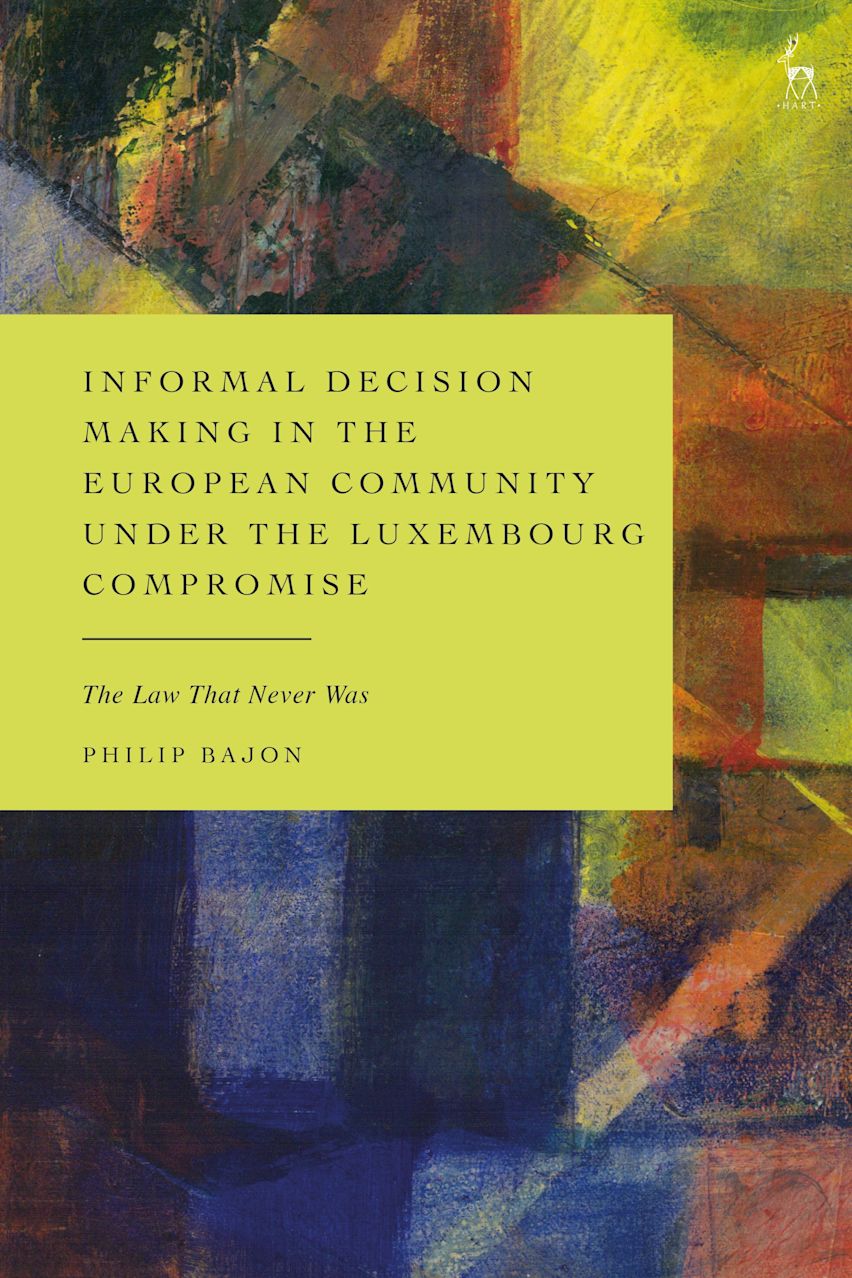
BOOK: Philip BAJON, Informal Decision Making in the European Community under the Luxembourg Compromise. The Law that Never Was (London: Bloomsbury/Hart, 2025)


(image source: Hart)

Abstract:

This book analyses the informal decision making process in the EU against the background of a gradually emerging European legal order. Based on extensive multi-archival research in the UK, France, Germany, the Benelux countries and in Community institutions, the book explores the resistance against majority rule under the so-called Luxembourg Compromise of 1966, a European 'soft law' that allowed Member States to invoke 'vital national interests' and to veto legislation. This 'gentlemen's agreement' was never sanctioned or codified. However, as a 'rule of the game' it had a significant impact on the operations of the EU for several decades and became an integral part of the EU's 'consensus' approach. Its underlying rationale is still alive in the present-day EU. Presenting a deeply revisionist account of European law and politics, the book demonstrates how the Luxembourg arrangement served as a compromise between the Treaty text and political reality, as a counterweight to technocratic ideas, and as a bridge between irreconcilable divides over European unification. It includes case studies from 1965 - 2000, such as the 'Eurosclerosis' of the 1970s, British exceptionalism as an EU member, the European revival of the mid-1980s, and intergovernmentalism on the verge of negotiating the Maastricht Treaty. Highly original in its interdisciplinary, comprehensive and archivally-rooted method, the book interrogates the most important and controversial debates about the past, present and future of the European Union.

Table of contents:

Part 1: The Gaullist Legacy 1965–72
1. The 'Empty Chair' Crisis
2. Suspending the Transition to Majority Voting
3. Decision-Making Sociology after the 'Empty Chair'

Part 2: Transition 1972–78
4. British Accession
5. The Lifting of the 'Culture of Unanimity' in the Mid–1970s
6. The Tindemans Report
7. Southern Enlargement
8. The Three Wise Men Report

Part 3: Transformation 1978–84
9. Reconceptualising the Compromise
10. A Case Law History
11. The Search for Clarification

Part 4: Trade-Off 1984–86
12. The European Revival of 1984
13. The Dooge Committee and the Reception of its Report
14. The Milan European Council of 1985
15. The Single European Act

Part 5: Towards Maastricht Europe and Beyond 1986–2016
16. The SEA Ratification Debates
17. The Council Internal Rules of Procedure
18. The 'Evocability' of the Compromise
19. The Maastricht Treaty and the GATT
20. The Compromise in Today's European Union

On the author:

Philip Bajon is Senior Lecturer in Law at Aston University, Birmingham, UK.

Read more here


11 March 2021

BOOK: Albertina ALBORS-LLORENS, Catherine BARNARD, Brigitte LEUCHT (Eds.), Cassis de Dijon - 40 Years On (Oxford: Hart Publishing, 2021). ISBN 9781509936632, 72.00 GBP


(Source: Hart Publishing)

Hart Publishing is publishing a new book on the history of the Cassis de Dijon-case.

ABOUT THE BOOK

Why is the 1979 the Court of Justice judgment in Cassis de Dijon so famous and so significant in the evolution of EU trade law?. As this landmark judgment approaches middle age, this book revisits this decision with the benefit of hindsight: why did the Court of Justice decide Cassis de Dijon as it did? How has the decision been developed by the EU? And, looking forward, how has the decision been used to develop international trade? This book brings together some of the leading writers in the field of EU trade law, constitutional law and European history for a fresh examination of his ground-breaking judgment, looking at it from the perspective of its past (who, what and why); its present (is it making a difference?); and its future (how does it fit in international trade agreements, including the future UK-EU FTA?).

ABOUT THE EDITORS

Albertina Albors-Llorens is University Senior Lecturer, Fellow of St John's College and Member of the Centre for European Legal Studies at the Faculty of Law, University of Cambridge.

Catherine Barnard is Professor of EU Law and Employment Law and Fellow of Trinity College, University of Cambridge.

Brigitte Leucht is Senior Lecturer in German and European Studies at the University of Portsmouth, UK. She is the editor, along with Wolfram Keiser and Morten Rasmussen, of The History of the European Union: Origins of a Trans- and Supranational Polity 1950-72 (2008) and, with Wolfram Keiser and Michael Gehler, Transnational Networks in Regional Integration (2010).


More info here


03 July 2020

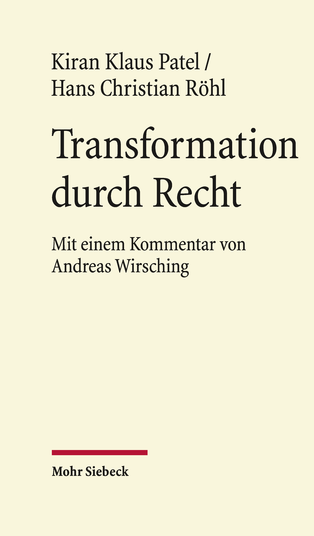
BOOK: Kiran KLAUS PATEL and Hans Christian RÖHL, Transformation Durch Recht - Geschichte Und Jurisprudenz Europäischer Integration 1985–1992 (Tübingen: Mohr Siebeck, 2020). ISBN 978-3-16-159020-7, 29.00 EUR


(Source: Mohr Siebeck)

Mohr Siebeck is publishing a new book on the history and jurisprudence of European integration 1985-1992.

ABOUT THE BOOK

The period from 1985 to 1992 saw a fundamental transformation of European integration, the impact of which can still be felt to this day. Building on an interdisciplinary dialogue between history and legal studies, this book offers fresh perspectives and findings on these historical processes and demonstrates their importance for current research and EU politics.

ABOUT THE AUTHOR

Kiran Klaus Patel Geboren 1971; Professor für Europäische Geschichte des 19. und 20. Jahrhunderts an der Ludwig-Maximilians-Universität München.

Hans Christian Röhl ist Professor für Staats- und Verwaltungsrecht, Europarecht und Rechtsvergleichung an der Universität Konstanz.

The table of contents can be found here

More info here

11 March 2019

JOURNAL: Special issue "L'archive européenne", Revue Française de Science Politique LXIX (2019), Issue 1

(image source: Cairn)

Savoirs et pouvoirs dans le gouvernement de l’Europe Pour une sociohistoire de l’archive européenne (Francisco Roa Bastos & Antoine Vauchez)
Abstract:
Cet article (et le dossier qu’il introduit) propose de renouveler l’étude des formes de connaissance de l’Europe à partir de la notion-test d’Archive. Reprise à la fois aux historiens et à L’archéologie du savoir de Michel Foucault, la notion d’Archive – ici retravaillée pour la mettre au service d’une sociohistoire attentive aussi bien aux acteurs, à leurs luttes d’intérêt qu’à leurs discours – permet d’inclure dans l’analyse des « savoirs d’Europe » ce qui a été jusqu’ici laissé dans l’ombre. Car si l’étude des savoirs de gouvernement transnationaux est en plein essor, elle s’est concentrée pour l’instant sur les catégories et les paradigmes les plus consacrés, et donc sur ce qu’on pourrait appeler la doxa européenne. Mais elle a laissé de côté tous les savoirs avortés de la « construction européenne » : les catégories oubliées, les objets perdus, les savoirs contestés et rejetés... bref, tous ces « échecs doxiques » que la notion d’Archive permet de prendre en compte, en élargissant la focale pour inclure tous les discours, souvent contradictoires, qui ont été formulés sur l’Europe, par des acteurs bien plus divers que les traditionnels « entrepreneurs d’Europe » bien identifiés. Une manière de réencastrer l’« Europe de Bruxelles » dans ses différents contextes historiques et sociaux, pour mieux en comprendre les logiques de structuration.
 Mettre l’Europe en boîtes L’édification des archives historiques de l’Union européenne (Morgane Le Boulay)
Abstract:
Monument en trompe-l’œil dans la mesure où nombre de documents n’y sont pas accessibles, les Archives historiques de l’Union européenne (AHUE) restent malgré tout l’un des éléments matériels et symboliques incarnant le pouvoir européen. Cet article montre qu’elles sont le fruit de la mobilisation de divers acteurs : institutions communautaires (au premier rang desquelles la Commission), acteurs historiques de la construction européenne, mais aussi historiens et archivistes. Ces « coentrepreneurs d’archives » ne sont pas uniquement animés par le souci de légitimer l’Union européenne. Malgré des conflits, ils coopèrent et privilégient une histoire officielle, celle des institutions et des dirigeants, au détriment d’autres visions de l’Europe moins héroïques qui ont été envisagées mais bientôt abandonnées. L’effet de ces archives sur les publications scientifiques doit cependant être nuancé, car les chercheurs utilisent aussi des sources complémentaires
 Les sciences sociales européennes font-elles l’Europe ? L’institut universitaire européen, le béhavioralisme et la légitimation de l’intégration européenne (Thibaud Boncourt)
Abstract:
L’Institut universitaire européen (IUE), ouvert en 1976 à Florence, incarne l’ambition de légitimer la construction européenne par la connaissance scientifique. Cet article cherche à comprendre comment ces injonctions politiques se réfractent dans l’activité scientifique de l’IUE, à identifier le type de savoirs produits à l’institut et à comprendre leur contribution à la structuration d’une archive européenne. À partir d’une étude de l’histoire du département de sciences politiques et sociales (SPS) sur la base d’archives diversifiées, il montre la manière dont s’impose au département une science politique béhavioraliste, quantitative et comparative de l’Europe. L’histoire de cette victoire paradigmatique met en évidence l’un des mécanismes par lesquels se structurent certaines des approches aujourd’hui centrales pour les études européennes.
 L’impossible doctrine européenne du service public. Aux origines du service d’intérêt économique général (1958-1968) (Mélanie Vay)
Abstract:
Cet article explore un recoin délaissé de l’Archive européenne, à savoir l’étonnant échec de la bipartition « public »-« privé » (pourtant si structurante à l’échelon national) à prendre racine dans les catégories d’entendement dominantes du « projet européen ». En repartant des conflits historiques des débuts de la Communauté européenne autour des notions d’« entreprise publique » et de « service d’intérêt économique général » (Sieg), on retrace l’impossible formation d’une doctrine européenne du service public, dans un contexte où le secteur étatique et para-étatique est pourtant florissant dans les six pays fondateurs. Observer la trajectoire de ces labels dominés permet de mieux comprendre comment s’est construite initialement la doxa économique européenne, mais aussi les savoirs qui ont été oubliés, dans l’« Archive » plus large de l’Europe.
Un marché sans économistes ? La planification et l’impossible émergence d’une science économique européenne (1957-1967) (Hugo Canihac)
Abstract:
La contribution des savants à la construction européenne a fait l’objet d’un intérêt nouveau ces dernières années. Mais, si le rôle des juristes dans la production de formes de connaissance de l’Europe a été mis en évidence, la contribution des économistes semble étrangement limitée durant les premières années d’existence du Marché commun. C’est ce paradoxe d’un savoir économique qui ne « vient pas » au Marché commun qu’interroge cet article. Nous étudions pour cela les mobilisations, au début des années 1960, d’un collectif évoluant entre science économique et politique pour faire exister une « programmation économique communautaire ». Nous avançons que la difficulté à produire un savoir reconnu comme « scientifique » est une raison importante de la faiblesse de leur entreprise. Il s’agit alors de souligner la tension à laquelle est confrontée toute entreprise de mobilisation de la science (économique) dans le jeu politique : le succès des revendications d’un gouvernement « scientifique » dépend de la capacité de ses partisans non seulement à enrôler la science, mais aussi à stabiliser une distinction entre le savant et le politique.
Penser l’État contre l’Europe La genèse d’une orthodoxie juridique dans la République fédérale d’Allemagne de 1949 à l’arrêt Maastricht (Christophe Majastre)
Abstract:
En prenant pour point de départ la décision sur le traité de Maastricht de la Cour constitutionnelle fédérale allemande (CCF), cet article s’intéresse aux conditions de formalisation d’un « contre-savoir » juridique sur l’Europe. Dans l’ombre des juristes européens et des juges de la Cour de justice européenne qui constituent des objets privilégiés d’une sociologie politique de la construction européenne, les juges de la CCF se voient souvent attribuer un pouvoir particulier d’influence et de mise en forme de la politique européenne. L’arrêt dit Maastricht constitue à ce titre un épisode fondateur, qui a largement été interprété comme reflétant un point de vue souverainiste et une attitude hostile envers la construction européenne. Prenant le contrepied de cette lecture canonique, cet article montre que cette décision ne peut s’expliquer qu’au regard des luttes qui opposent les « légistes », les professeurs de droit public, pour le monopole de l’interprétation constitutionnelle. Il analyse ensuite la controverse constitutionnelle sur le traité de Maastricht pour montrer comment un groupe de professeurs de droit a imposé le « droit de l’État » comme savoir privilégié pour analyser le jeu politique. 
Du droit international au droit européen Une sociologie du droit social comme entreprise de cause (Karim Fertik & Julien Louis)
Abstract:
Sociologie politique du droit, cette recherche met en évidence les liens entre le développement après la Seconde Guerre mondiale du droit social international et la mise en place du droit social européen. En s’appuyant sur une sociologie de la mobilisation transnationale des professionnels du droit social, l’enquête analyse le rôle d’intermédiaires que jouent ces juristes (fonctionnaires nationaux et internationaux, universitaires) qui connectent champs académiques nationaux, administrations nationales et organisations internationales entre eux. L’article insiste en particulier sur l’importance des juristes de la Société internationale de droit du travail et de la Sécurité sociale, une association internationale créée avec l’aide de l’Organisation internationale du travail. L’article montre que le développement du droit social européen repose sur des conceptions et des pratiques professionnelles éprouvées internationalement. La mobilisation des juristes de droit social par les fonctionnaires des Communautés européennes rend ainsi le droit social européen dépendant de formes juridiques internationales préexistantes. Le droit social européen s’analyse donc comme le produit d’une régionalisation de savoirs juridiques internationaux.
Read more on cairn.