Search

Showing posts with label Law Reform. Show all posts

29 January 2024

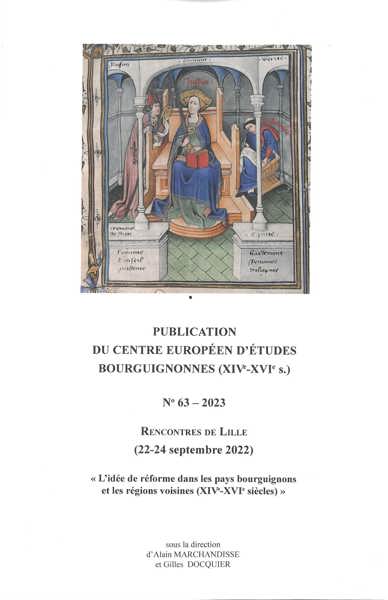
BOOK: Alain MARCHANDISSE, Gilles DOCQUIER (eds.), L’idée de réforme dans les pays bourguignons et les régions voisines (XIVe-XVIe siècles) (Turnhout: Brepols, 2023). ISBN: 9782839940344


(Image source: Brepols)


ABOUT THE BOOK

For nearly fifty years, the Centre européen d’études bourguignonnnes (fourteenth and fifteenth centuries) – known until 1984 as the Centre européen d’études burgondo-médianes – has published annually the acts of the scholarly meetings it organizes in cities within the territory covered by its activities. Its objectives, as stated explicitly in its statutes, are the promotion, the encouragement, and the coordination of historical studies relating to the period of the Dukes of Burgundy of the house of Valois and of the first Hapsburgs, between the North Sea, the Rhine-Danube river system, and the Mediterranean. The themes of these meetings relate to different aspects of the past of these lands, with particular emphasis on the political, economic, cultural and spiritual links that existed between them. Because of their international and multilingual nature (French, German, English and Italian), the volumes of the collection hold a position of choice in the bibliography of studies devoted to this historical period which marks the transition between the Middle Ages and the Renaissance in the Western world.


TABLE OF CONTENTS

  • Allocution inaugurale, par S.A.S. le Duc d’Arenberg
  • Rapport d’activités pour 2021-2022, par Alain Marchandisse
  • In memoriam Philippe Contamine (1932-2022), par Bertrand Schnerb
  • Gisela Naegle, Aux armes pour la réforme ? Rêves de réforme entre paix, guerre, révolte et croisade (France/Empire, XIVe-XVIe siècles)
  • Sylvie Bépoix, « De grandes réformations » : les idées de réformes et leur application concrète dans le comté de Bourgogne sous Jean sans Peur au début du XVe siècle
  • David Bardey, La réforme comme arme politique ? Eudes IV et la réformation du duché de Bourgogne en 1343
  • Jean-Baptiste Santamaria, A nous appartient la correction des aministrateurs et la reformation de nos villes. Les ordonnances de réformation des villes d’Artois à la fin du Moyen Âge
  • Élodie Lecuppre-Desjardin, Ordre et rigueur dans la ville. Lille, un laboratoire de réformes pour Charles le Téméraire ?
  • Hendrik Callewier, La cour des ducs de Bourgogne et la réforme du clergé séculier dans le diocèse de Tournai
  • Pierre Fournier, La réforme du clergé dans la Sporta fragmentorum de Gilles Charlier : un champ discursif contesté entre clercs et laïcs
  • Éric Bousmar, « Seigneurs, voulez-vous être damnés ? ». Le cordelier Olivier Maillard face à la cour de Philippe le Beau (Bruges, 1501)
  • Autre communication présentée aux Rencontres de Lille.


More information can be found here.

17 December 2021

BOOK: Barbara J. SHAPIRO, Law Reform in Early Modern England. Crown, Parliament and the Press (Oxford: Hart Publishing, 2020). ISBN: 9781509934218, pp. 280, £45.50 (hard back)

(Source: Bloomsbury)

ABOUT THE BOOK

This book provides an illuminating commentary of law reform in the early modern era (1500–1740) and views the moves to improve law and legal institutions in the context of changing political and governmental environments. Taking a fresh look at law reform over several centuries, it explores the efforts of the king and parliament, and the body of literature supporting law reform that emerged with the growth of print media, to assess the place of the well-known attempts of the revolutionary era in the context of earlier and later movements. Law reform is seen as a long term concern and a longer time frame is essential to understand the 1640–1660 reform measures.

The book considers two law reform movements: the moderate movement which had a lengthy history and whose chief supporters were the governmental and parliamentary elites, and which focused on improving existing law and legal institutions, and the radical reform movement, which was concentrated in the revolutionary decades and which sought to overthrow the common law, the legal profession and the existing system of courts. Informed by attention to the institutional difficulties in completing legislation, this highlights the need to examine particular parliaments. Although lawyers have often been seen as the chief obstacles to law reform, this book emphasises their contributions – particularly their role in legislation and in reforming the corpus of legal materials – and highlights the previously ignored reform efforts of Lord Chancellors.

ABOUT THE AUTHOR

Barbara J Shapiro is Professor Emerita and Professor in the Graduate School at the University of California, Berkeley.

TABEL OF CONTENTS

1. Introduction
2. The Early Tudors and Law Reform 1509–58
3. The Elizabethan Era 1558–1603
4. The Early Stuarts 1603–40
5. The Civil War and Parliamentary Rule 1640–49
6. Commonwealth and Protectorate 1649–60
7. The Restoration Era 1660–88
8. Revolution and Beyond 1688–1740
9. Conclusion


More information with the publisher.