Search

12 January 2026

JOURNAL: The Journal of Legal History XLVI (2025), No. 3


A New Manuscript Witness of William Fleetwood’s ‘Instruccions coment et en quell maner Statutes serrount expoundes’ (c. 1578) (Jonathan McGovern) 

DOI 10.1080/01440365.2025.2535581
Abstract:

This article introduces and transcribes a hitherto unidentified manuscript witness of William Fleetwood’s ‘Instruccions coment et en quell maner Statutes serrount expoundes’ (Folger Shakespeare Library MS X.d.656). It proposes a revised account of Fleetwood’s work on statutory interpretation. Scholars have failed to distinguish between two separate works on statute law composed by Fleetwood. The first is ‘A discourse upon the exposicion & understandinge of statutes’, written in English between 1557 and 1571, and edited by Samuel E. Thorne in 1942. The second is ‘Instruccions coment et en quell maner Statutes serrount expoundes’, a digest from Plowden’s Reports written in Law French in c. 1578. Both texts were later combined into a single English treatise, printed in 1657. This later act of compilation has confused later scholarship by occluding the fact that the two texts were originally independent compositions.

The Archival Sources and the Administration of Criminal Justice: Using the Scottish Justiciary Court Records (Stephanie Dropuljik) (OPEN ACCESS)
DOI 10.1080/01440365.2025.2561571

Abstract:

This article examines the records of Scotland's early modern criminal court, the justiciary court, which sat in Edinburgh. The focus is on the JC2, JC6, and JC1 series of records. While some of these records have been selectively published, their formation, compilation, and custodial practices have not been thoroughly studied before. This study represents the first in-depth investigation into these records and draws several significant conclusions. By analyzing the court's administrative practices, this study sheds new light on criminal justice administration, the court's clerking and record-keeping traditions, and how these records were created. It also identifies a previously unrecognized change in practice – the discontinuation of minute books. By revisiting these archival records, this article aims to reveal valuable insights into the justiciary court's practices and to enhance our understanding of its record-keeping traditions.

The Satsuma Mutiny and the Inter-colonial Origins of the Fugitive Offenders Act 1881 (Ivan Lee)

DOI 10.1080/01440365.2025.2530429
Abstract:

This article explores the origins of the Fugitive Offenders Act 1881, which regulated the surrender or ‘rendition’ of fugitives between British territories until 1967. Notable as the precursor to modern laws regulating extradition between independent Commonwealth nations – laws that still exist today – the 1881 Act was enacted after a mutiny on the Satsuma, a British merchant ship, in 1874. The story of this mutiny and its legal context has never been told. Recorded in court depositions, newspaper reports, and official correspondence, the Satsuma case involved five seamen who, after mutinying at sea, fled to Melbourne, London, and Hong Kong. Imperial and colonial officials struggled to bring the mutineers to justice, as the case exposed the inadequacies of existing laws for arresting and trying fugitives who crossed the many internal borders of the nineteenth-century British Empire. Earlier attempts to reform the law had failed owing to official inaction, parochialism, and deference to the imperial repugnancy doctrine. Where those attempts failed, the Fugitive Offenders Act succeeded in creating a new rendition regime, anchoring the imperial history of international criminal law.

Book reviews:

  • Execution, State and Society in England, 1660–1900 by Simon Devereaux, Cambridge, Cambridge University Press, 2023, 19+ 378 pp., £100 (hardback), ISBN 978-1-009-39215-0 (James Gregory)
  • The Immigration of Irish Lawyers to Australia in the 19th Century: Causes and Consequences by the late Dr John Kennedy Mclaughlin AM, Sydney, Federation Press, 2024, v-xxv, 292 pp, AU$79.95 (hardback), ISBN: 978-1-76002-453-6 (Mark Lunney)
Read all articles here.

CALL: Positions on the Editorial Board (Comparative Legal History; DEADLINE 15 JAN 2026) [REMINDER]


Journal Comparative Legal History


Call for Positions on the Editorial Board


Deadline: 15 January 2026


The European Society for Comparative Legal History (ESCLH) is seeking applications for positions on the editorial board of its flagship journal, Comparative Legal History, including at least an articles editor and a reviews editor.


Evidence of scholarly ability, experience in editing or a willingness to learn quickly, willingness to contribute to journal projects beyond the narrow scope of the job title, and membership (or a commitment to become a member if appointed) of the ESCLH are requirements. Full training in the journal’s processes will be provided as needed.


You would contribute to the advancement of comparative legal history as part of a warm, supportive, and dedicated team.


The journal is an official academic forum of the ESCLH. It was first published in 2013 and aims to offer a space for the development of comparative legal history. The journal welcomes contributions that explore law in different times and jurisdictions from across the globe.


Applications, indicating to which position/s is being applied, with a brief cover letter and short CV (no more than 4 pages) should be sent to Luisa Brunori (Vice-President of the ESCLH), at luisa.brunori@ens.psl.eu, by 15 January 2026.


The ESCLH particularly welcomes applications from people underrepresented in academia generally, and in the ESCLH and the journal particularly.


These positions are not paid.


BOOK: Sylvie DAUBRESSE, Mark GREENGRASS & Marc SCHACHTER, Les procureurs généraux Jean et Jacques de La Guesle. Documents sur l’histoire de France au temps des guerres de Religion (1562-1605) [Documents inédits sur l'histoire de France; 85] (Paris: CTHS, 2025), 420 p. ISBN 978-2-7355-0993-5


(image source: CTHS)

Abstract:
Entre 1570 et 1605, un père et son fils, Jean et Jacques de La Guesle, occupèrent à tour de rôle la charge de procureur général du roi au parlement de Paris, cour souveraine la plus importante de la monarchie française. Alors que le royaume traverse une crise profonde provoquée par les guerres de Religion, les deux hommes, défenseurs des droits du roi, se trouvent plongés au cœur de questions cruciales : pacification du royaume, politique financière, exercice de la justice, relations avec Rome. Le présent ouvrage se compose d’une longue introduction et d’un corpus de soixante-douze textes manuscrits se rattachant à l’activité des La Guesle (lettres, discours, mémoires), dont deux harangues inédites de Jean trouvées à la Folger Shakespeare Library de Washington. Il s’agit là d’un ensemble documentaire remarquable qui éclaire le parcours de deux grands magistrats, les ressorts de leur action, mais aussi les rapports complexes qu’ils entretenaient avec le souverain.

Read more here. 


09 January 2026

JOURNAL: The Journal of Legal History XLVI (2025), No. 2


The Principle of Punishment in Classical English Law (Nicholas Sinanis) (OPEN ACCESS)

DOI 10.1080/01440365.2025.2511590
Abstract:

Much of the nineteenth century is well-known to have been a period in which fundamental principles of English private law first came to be subjected to scientific treatment. Such was the significance of this period that it was assigned the epithet ‘classical’. Among the principles to have first been subjected to such treatment were those specifically concerned with the recovery of civil damages in actions at common law. This article systematically traces the process by which modern private law’s most controversial civil recovery principle – that of punishment in tort – came to be treated scientifically during this classical period. In doing so, it sheds new light on how a substantive common ‘law’ of punitive damages first actually arose.

Rescuers or Pirates? The Steamship Lomonosoff’s Escape from Murmansk and the 1920 Trial (Jeff Eden) 
DOI 10.1080/01440365.2025.2511591
Abstract:

In February 1920, as the Russian White Army fled from Arkhangelsk and Murmansk, a group of British and Belgian soldiers jumped aboard the Russian steamship Lomonosoff and escaped to safety. The group later claimed they had saved the ship. Suing for a salvage award in a British court, their case would become a touchstone in the annals of maritime law. But was the Lomonosoff really saved from Russia, or was it stolen? If it was stolen, from whom was it stolen – from its non-Bolshevik Russian owners, or from the government in the Russian north? Did the north have a government at the time the ship was stolen, or was it in a state of anarchy? If it had a government, was it a Bolshevik one? And if the Bolsheviks had been in control, was their government recognized by the British courts? Finally, there was the question of whether saving oneself by using others’ commandeered property is really an act of ‘salvage’. These questions and others were at stake in the momentous court case, which this paper explores using newly uncovered documents from British and Belgian archives.

The exclusion of the Dáil courts and the Privy Council appeal from the creation of the courts of the Irish Free State, 1922–1924 (Thomas Mohr) 
DOI 10.1080/01440365.2024.2447003
Abstract:

This article compares the attitude of the Irish government in power in the early 1920s towards two differing judicial institutions that were omitted from the Courts of Justice Act 1924. This pioneering legislation created the system of courts that largely persists in the modern Irish State. The first object of comparison concerns the attitude of the Irish government of this period towards the ‘Dáil courts’ that had been created by Irish nationalist authorities in 1920 in opposition to the official courts of the United Kingdom in Ireland. The second concerns governmental attitudes towards the appeal from the Irish courts to the Judicial Committee of the Privy Council, the final appellate court for most of the British Commonwealth and Empire. This article argues that the sidelining of these differing institutions by this important legislation has more shared features than is immediately apparent. Both institutions were influenced by the 1922 Constitution of the Irish Free State. The Irish government accused both judicial institutions of incompetence and bias in interpreting Irish law. Their common marginalization by the Courts of Justice Act 1924 also reflects dual political challenges facing the Irish government in the early 1920s.

Scottish Legal History Group Report 2024 

Migrations of Manuscripts 2024 (John Baker)

Read all articles here.

BOOK: Magnus RESSEL & Emir O. FILIPOVIC (eds.), Companion to the Later Crusades (1400–1700) (Leiden/Boston: DegruyterBrill), 2026


(image source: DeGruyterBrill)

Abstract:

The crusading movement endured well beyond the 14th century. Across Late Medieval and Early Modern Europe, the desire for crusading continued to wield substantial influence, transcending borders and permeating diverse social strata. This companion brings together pertinent research and organizes a field of study that has become solidified recently. It focuses on crusading activities, rhetoric, discourses, and symbols that left lasting impacts and had global consequences for both Christian and Muslim societies. With contributions from Marian Coman, André Teixeira, António Lázaro, Pavel Soukoup, Emir O. Filipović, Ferenc Toth, Ana Echevarría, Elma Koric, Ignacio Bernstorff, Iulian Damian, Benjamin Weber, Nikolay Antov, Heribert Müller, Magnus Ressel, Paul Srodecki, Stefan Schröder, James Mixson, Eleni Tounta, Iván Rega Castro, Borja Franco Llopis, Loïc Chollet, Catherine Gaullier-Bougassas, Antonio García Espada, Norman Housley

On the editors:

 Emir Filipovic, University of Sarajevo; Magnus Ressel, Universität Frankfurt am Main.

Read more here: DOI 10.1515/9783110735932. 

08 January 2026

CONFERENCE: Minorités protestantes et droit(s) en Europe (17e-18e S.) (Le Mans: Le Mans Université, 11-12 DEC 2025)


(image source: IMHC)

On 11 and 12 December 2025, the following conference took place in Le Mans:

Programme

11 décembre 2025

9 h 30 – 10 h | Accueil café

10 h – 10 h 15 | Ouverture du colloque

Session 1 – Droit et justice autour des guerres de Religion

10 h 15 – 10 h 45 | Réparations pour un massacre : la justice transitionnelle et la minorité protestante pendant les guerres de Religion

David van der Linden (université de Groningue)

10 h 45 – 11 h 15 | Le droit à une justice équitable : les justiciables protestants à la chambre de l’édit de Castres (1598-1679)

Sherylin Bouyer (université de Groningue)

11 h 15 – 11 h 45 | La conversion du protestantisme français à l’absolutisme des Bourbons : entre accommodements politiques et fermeté spirituelle (1629-1661)

Laurent Bouchard (université de Poitiers)

11 h 45 – 12 h 30 | Discussion collective

Session 2 – Contraintes et interprétations de la loi

14 h – 14 h 30 | Faire échec à la qualification de relaps pour préserver ses droits en Languedoc autour de la Révocation de 1685

Julien Broch (Aix-Marseille Université –CERHIIP)

14 h 30 – 15 h | “En attendant qu’il plaise à Dieu les éclairer comme les autres” : l’article XII de l’édit de Fontainebleau et la minorité de la minorité huguenote

Hubert Bost (EPHE-PSL – LEM)

15 h – 15 h 15 | Pause café

15 h 15 – 15 h 45 | Beaucoup de bruit pour rien ? Réactions huguenotes à la déclaration royale de 1724

Pauline Haour (EPHE-PSL)

15 h 45 – 16 h 15 | Interpréter l’édit de Versailles de 1787

Didier Boisson (université d’Angers – TEMOS)

16 h 15 – 17 h 30 | Discussion collective

Vendredi 12 décembre 2025

Session 3 – Les acteurs protestants face au droit

9 h – 9 h 30 | Avocats et experts : les protestants saumurois et leur rôle dans l’application du droit et de la justice sous l’édit de Nantes

Léo Maillé (Le Mans Université – TEMOS)

9 h 30 – 10 h | Pasteurs et droit(s) : usages, médiations et enjeux dans les protestantismes minoritaires (xviie-xviiie siècles)

Céline Borello (Le Mans Université – TEMOS)

10h15 – 10h45 | Le pasteur doit-il se faire avocat ? Le Tabernacle de Dieu sous la nuée d’Alexandre Brissac (1666)

Julien Léonard (université de Lorraine – CRULH)

10 h 45 – 11 h | Pause café

11 h – 11 h 30 | La concurrence des capitulations. Les privilèges religieux des troupes étrangères dans les villes de garnison de la dorsale catholique (France, xviie-xviiie siècles)

Paul Vo-Ha (université Paris 1 Panthéon Sorbonne – IHMC/IUF)

11 h 30 – 12 h | Une diplomatie pour les droits des exilés : le cas des réfugiés huguenots (v. 1680 – v. 1720)

Naïma Ghermani (université Grenoble-Alpes – LAHRHA)

12 h – 12 h 45 | Discussion collective

Session 4 – Circulations et héritages du droit

14 h – 14 h 30 | L’Église réformée au Brésil : cadres institutionnels et enjeux coloniaux (1630-1654)

Matheus Vila Nova (EPHE-PSL – LEM)

14 h 30 – 15 h | D’une émancipation à l’autre : convergences entre non conformistes et anglicans autour de l’Émancipation des catholiques en Irlande (1791-1829)

Karina Bénazech Wendling (université de Lorraine)

15 h – 15 h 30 | La laïcité et l’intégration républicaine des minorités religieuses : le choix des protestants (xviiie-xxie siècles)

Valentine Zuber (EPHE-PSL – GSRL)

15 h 30 – 16 h 15 | Discussion collective

Conclusion générale

(source: IMHC) 

JOURNAL: The Journal of Legal History XLVI (2025), No. 1


Law Beyond the Legal Renaissance: Rethinking Jurisdiction in the European central Middle Ages (Danica Summerlin & Alice Taylor) (OPEN ACCESS)
DOI 10.1080/01440365.2025.2456287
Abstract:

The introduction to this special issue lays out its approach to the phenomenon of jurisdiction during the European central Middle Ages. Rethinking jurisdiction, we argue, is key to understanding the profound change the period underwent in terms of its law and legal culture. We explain, first, why ‘legal pluralism’ has not offered a meaningful structure to understand the creativity inherent in law-making (in all its senses) in this period. Second, by adopting an ‘actor-centric’ approach to jurisdiction, we then set out how the essays in this collection address how and why jurisdictional boundaries were created, maintained and subverted not only in legal disputes themselves but in the minds of people who were, in different ways, all involved in the making of law.

‘The Laws of England, Which had Hitherto Been Used and Approved’: Jurisdictional Understandings in the Thirteenth Century (Thomas J. McSweeney & Atria A. Larson) 

DOI 10.1080/01440365.2025.2456280
Abstract:

In 1236, at the Council of Merton, England’s bishops tried to persuade the king’s courts to adopt canon law’s rule of subsequent legitimation, which held that a child born out of wedlock whose parents subsequently married became legitimate. England’s barons are said to have responded that ‘they did not wish to change the laws of England which had hitherto been used and approved.’ At first glance, this appears to be a straightforward case of jurisdictional conflict. This paper will examine the discussion of the council in the Bracton treatise, which was largely written by one of the major players in the debates of 1236, William of Raleigh. Rather than presenting this as a conflict between the secular and ecclesiastical jurisdictions, Raleigh worked to demonstrate that, according to the canon law’s own terms, it was acceptable for the king’s courts to have their own law of legitimacy.

Jurisdiction over Infangthief in England: The Case of John Milksop (Kenneth F. Duggan) 

DOI 10.1080/01440365.2025.2456268

Abstract:

This paper uses a dispute over the franchise of infangthief between the abbot of Tewkesbury and the earl of Gloucester to shed light on jurisdictional claims over the right to try and hang hand-having thieves in thirteenth-century England. In doing so, it demonstrates the significance of performance and precedent established through the actions of legal actors as opposed to written records for identifying what constituted proof of right when there were competing jurisdictional claims over infangthief.

Defining Jurisdictional Boundaries in Thirteenth-Century Danish and Norwegian Town Law (Miriam Tveit & Helle Vogt) 

DOI 10.1080/01440365.2025.2456267

Abstract:

The paper examines jurisdictional boundaries in late thirteenth-century town laws from Denmark and Norway, and the agents defining them. Danish towns were distinctly delineated physically and legally, while Norwegian towns had more flexible boundaries, with blurred physical demarcations. The border between burghers and other groups remained porous. Town laws, often overlooked, are analysed as normative frameworks within overlapping systems. The study nuances conventional jurisdictional narratives, highlighting the interaction of territory and people in shaping legal boundaries. By comparing urban jurisdiction in Denmark and Norway, variations in definition and administration are identified. The focus on legal actors illuminates distinctions within urban populations and complexities within towns. The study underscores the dynamic and performative nature of territorial jurisdiction, suggesting divergences may stem from legal actors’ interests, geographical disparities, and population patterns rather than differing legal ideologies or royal power.

The Bishop’s Jurisdictional Boundaries: Proceedings, Legal Actors and Strategies from a Local Church Court (Pistoia, 1287–1301) (Arnaud Fossier)
DOI 10.1080/01440365.2025.2456286
Abstract:

This article focuses on the records of an Italian Church court from the late thirteenth century. This material allows us to know not only the daily working of a pre-modern Church court but also the nature of the litigants' legal skills and strategies. The first part of the article examines the pre-existing boundaries of this Church court jurisdiction and the matters with which it was dealing. Whereas the Church claimed jurisdiction over various ‘spiritual' matters, such as marriage, priests' offences and ecclesiastical benefices, its jurisdiction sometimes overlapped with the competencies of secular courts. In the second part, the article focuses on the judicial proceedings themselves and thus on the interactions between judges, plaintiffs, defendants and witnesses. As with many other courts at that time, this court systematically sought witnesses’ own definitions of the offences or accusations they testified about and the relevant fama. In sum, by drawing on three different caseloads, this article explains why fama played such a key role in ecclesiastical trials and how; therefore, norms other than strictly legal ones were key to the functioning of ecclesiastical courts, and should, therefore, be understood as key in the appeal to ecclesiastical jurisdiction.

The Custom of Conquest: Twelfth-Century Tortosa and the Frontiers of Iberian Law (Rodrigo García-Velasco) (OPEN ACCESS)
DOI 10.1080/01440365.2025.2456284

Abstract:

Medieval frontiers are often perceived as a zones of legal informality and lawlessness, and as such sit uncomfortably in standard accounts of legal change. Focusing on the concept of jurisdiction can provide a different perspective of how law operated during the twelfth century outside of conventional state-centric models of legal development. The following article discusses the history of the frontier town of Tortosa, in eastern Iberia, and of the local statutes of customary law produced in the aftermath of the Catalan conquest in November 1148. It examines the law produced during and after the transition from Islamic to Christian rule, to trace how norms were claimed and used in jurisdictional negotiations out of the presence of consolidated forms of state-centred ‘power’. Through Tortosa’s early history under Catalan rule, this article demonstrates that medieval frontiers could sometimes characterized by an abundance of rules and jurisdictions rather than the absence of them.

Recognizing Jurisdictions within the Church before the Liber Extra (Danica Summerlin) (OPEN ACCESS)

DOI 10.1080/01440365.2025.2456285
Abstract:

This paper investigates how local and papal jurisdictions were interpreted in the later-twelfth century church and its growing body of novel law. Focussing on the period before 1234, it uses a letter sent by Pope Alexander III in the 1160s to the bishop of Lincoln over a relatively minor matter as a case study. The letter responded to an issue of illicit ordination in the diocese but tangentially touched on questions of hierarchy and jurisdiction in the church, particularly the relationship between the ever-strengthening papal law and local episcopal jurisdictions. By tracing the route through which this letter became ‘law’ in the 1234 Liber Extra, this paper will once again emphasize the importance of local legal actors in shaping canon law in the period between 1140 and 1234, but look to how even tangential matters can put forward subtle arguments around the recognition of different jurisdictions within the church at the time by legal actors both at and away from the papal curia.

What Rights for Criminals Condemned to Death? Jurisdictional Dialogue and Clash Between Religious and Secular Authorities, c.1250–1320 (Lidia Luisa Zanetti Domingues) (OPEN ACCESS)
DOI 10.1080/01440365.2025.2456271
Abstract:

Between the thirteenth and fourteenth centuries, a variety of legal actors became involved in disputes regarding the right of criminals condemned to death to access religious comforts such as sacraments, Christian burial, and the possibility to make bequests pro anima. These debates centred around important questions such as: which authorities held the right to grant or deny spiritual assistance to executed criminals? What normative bases could be invoked to support these claims? This paper argues that, in the period c.1250–1320, lay and religious authorities reiterated norms deriving from a multiplicity of pre-existing systems (canon law, Roman law, theological principles) to answer these questions. The underlying agenda of these debates, however, was a struggle for power regarding whose ultimate authority it was to decide who could be considered a member of the community and to what extent. In time, this struggle contributed to a gradual separation between the political community and a previously all-encompassing Ecclesia.

Politics from Law or Law as Politics? Hugh of Poitiers’s Chronica and the Politics of ius in the Mid-twelfth Century (Alice Taylor) (OPEN ACCESS)

DOI 10.1080/01440365.2025.2456283

Abstract:

This paper considers the relationship between the modern concepts of law and politics and the twelfth-century concept of ius (‘law, right’) in a chronicle written by a monk, Hugh of Poitiers, between the 1140s and 1160s. This chronicle documented the conflict over Vézelay Abbey, which involved some of the major ecclesiastical, monastic, royal and comital players of Western Europe. The paper argues that, by focussing on the chronicler's use of the concept of ius, this legal conflict is best understood, in our terms, as a political one, in that it involved arguments about how a just society should be ordered, rather than by the determination of the correct jurisprudential norms at stake in the process of litigation. Jurisdiction therefore involved contemporary legal actors setting out clear but competing understandings of that right order. This forces us to rethink any automatic separation between legal aims and political aims in our analyses of jurisdictional conflict in the mid-twelfth century.

Cosmopolitan Local Law in the Medieval Latin West (Ada Kuskowski) 
DOI 10.1080/01440365.2025.2456266
Abstract:

Medieval lay law, especially customary law, is known as a quintessential form of ‘local knowledge’. It serves in legal history as the inward-looking and parochial foil to the ‘common laws’ (ius commune) of the medieval Latin West: the Roman law of universities and the canon law of the church. These conventional notions of common and particular have overdetermined how we think of medieval law. This article argues that John of Ibelin’s Assises de Jerusalem (c.1264), a lawbook written for the Kingdom of Jerusalem and Cyprus, shows that the jurisdiction and authority of lay customary law did not have to be based on changelessness or on the cohesive identity of a homogenous community but could also be based on constant updating and cosmopolitanism. John imagined this, not accidentally, in the context of conquest and Christian mission. His vision offers crucial insight into the universalizing potential of ‘local’ law and, as such, reconfigures our understanding of medieval law broadly.

Read all articles here.

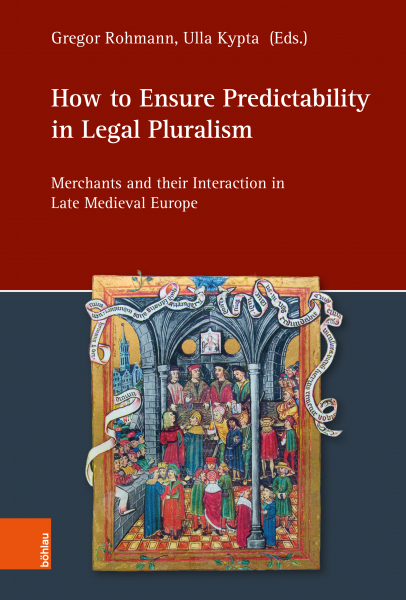
BOOK: Gregor ROGHMANN & Ulla KYPTA (eds.), How to Ensure Predictability in Legal Pluralism. Merchants and their Interaction in Late Medieval Europe [Einheit & Vielfalt im Recht/Legal Unity & Pluralism, eds. Ulrike LUDWIG & Peter OESTMANN; 5] (Wien: Böhlau, 2025), 298 p. ISBN 978-3-412-53376-2, € 60


(image source: uni Münster)

On the editors:

Gregor Rohmann is Professor of Regional Cultural History of Mecklenburg at the University of Rostock; Ulla Kypta works as a junior professor of late medieval and early modern history at the University of Hamburg.

Table of contents:

How did pre-modern merchants provide for predictability in situations of legal pluralism? What kind of practices did merchants use to make other parties act according to their expectations? In spheres of legal pluralism, different normative framings always overlapped and had to be negotiated in order to manage expectations. How did the actors in premodern trade decide on the framing they would act upon? The contributors discuss various means to cope with legal pluralism in place in Northern Europe, from trust and diplomacy to violence and normative orders. Taken together, the contributions show that merchants and their communities did not strive for a unification and harmonization of laws according to modern statehood, but for an enhancement of their particular group’s position in a pluralist normative field.

(Source: Uni Münster) 


07 January 2026

JOURNAL: The Journal of Legal History XLV (2024), No. 3

 The Origin and Effect of the Nisi Prius Reports (Paul Newman) (OPEN ACCESS)

DOI 10.1080/01440365.2024.2324395
Abstract:

For some seventy years, rulings made by judges sitting at nisi prius were regularly reported, despite those reports being held in low esteem by the legal profession and such rulings being regarded as of little value as precedents. This article considers why those rulings, at least on matters of substantive law, were rejected as authorities, and sets out the reasons why they were nevertheless reported and cited. The article explains that the principal purposes of these reports were to introduce new members of the profession to the practicalities of preparing cases for trial, and to provide some authority, however slight, to cite in court. The article also explains that, while nisi prius rulings on substantive law were cited by nineteenth century judges, they were used differently to decisions of courts in banc. The greater authority of such rulings on points of evidence, at least up to the mid-nineteenth century, is also explored. The article concludes by examining the tendency of more recent judges to ascribe greater weight to nisi prius rulings than their nineteenth century counterparts, due to the modern profession’s ignorance of the former difference in the treatment of nisi prius rulings and the decisions of courts in banc.

On the Origins of Invalidation of British Colonial Legislation by Colonial Courts – the Van Diemen’s Land Dog Act Controversy of the 1840s – Part Two (Ian Loveland) (OPEN ACCESS)

DOI 10.1080/01440365.2024.2414535
Abstract:

The first part of this paper examined the background to and conduct of a case called Symons v Morgan before the Supreme Court of Van Diemen’s Land. Symons appears to be the first case in which a colonial court asserted jurisdiction to invalidate a colonial ‘statute’ on the basis that the legislation concerned contravened the colony’s constitution. The Supreme Court claimed the jurisdiction as a matter of inference. There was no imperial or colonial legislation expressly granting such a power, nor any judicial authority – whether colonial or imperial in origin – supporting the Supreme Court’s conclusion. The second part of this paper analyses the responses of the colonial government to the Symons judgment, and consequently the responses of the imperial government and Parliament to those colonial initiatives. The actions of the imperial government and Parliament show acceptance of the principle that colonial courts could review the validity of colonial legislation.

‘And Along Came DNA’: The Introduction of DNA Evidence in Australian Courts in the Applebee case (Laura L. Dawes) (OPEN ACCESS)

DOI 10.1080/01440365.2024.2414536
Abstract:

In 1989, serial offender Desmond Applebee was tried in the Australian Capital Territory for the rape of a young woman. A first for Australian courts, the prosecution tendered DNA evidence to counter Applebee’s alibi that he had been unconscious in his car at the time. However, despite the handling of novel scientific evidence being hotly debated at the time, the trial failed to engage with the legal issues this new evidence raised. The defence was unprepared and under-resourced to put into issue evidentiary principles; there was no systemic means for addressing the issues raised by novel scientific evidence if the defence did not do so. This paper argues that the Applebee case is a dissatisfying case of first impression, graphically illustrating the struggles legal systems can have interrogating novel scientific evidence. The case helped smooth adoption of this new form of evidence. How courts receive and respond to scientific evidence is today again in mind owing to the recent quashing of Kathleen Folbigg’s murder conviction following genetic discoveries; Applebee shows why relying on a particular defendant and particular defence counsel to carry out a gate-keeping function for admissibility of novel evidence collides with practical realities of the court system.

Scottish Legal History Group Report 2022 (Andrew Simpson)

Migrations of Manuscripts 2022 (John Baker)

Book reviews:

  • Women, Their Lives, and the Law: Essays in Honour of Rosemary Auchmuty edited by Victoria Barnes, Nora Honkala and Sally Wheeler, Great Britain, Bloomsbury Publishing, 2023, 320 pp., £81 (hardback) £64 (ebook) ISBN: 9781509962082 (Erika Rackley)
  • Landmark Cases in the law of punitive damages edited by James Goudkamp and Eleni Katsampouka, Oxford, Hart Publishing, 2023, xxiii + 379, £108.00 (hardback), ISBN 978-1-50996-700-1 (Nicholas Sinanis)
  • Copyright and Cartography: History, Law, and the Circulation of Geographical Knowledge by Isabella Alexander, Oxford, Hart Publishing, 2023, 8 + 297 pp. 307, £75.50 (hardback), £38.69 (paperback, free open access e-book), ISBN 978-1-50995-833-7 (Elena Cooper)
Read all articles here.

JOURNAL: Fundamental rights. Rivista di studi giuridici, storici e antropologici - 2025/2 [open access]


Abstract: This contribution means to focus on some fundamental points of the modern international law’s formation, considering the elaboration made by both the catholic based (with particular attention to the Escuela de Salamanca) and the protestant based (Hugo Grotius and Alberico Gentili) juridical science of the modern age. In particular it will note the historical and conceptual dynamics that led: 1) to the admissibility of a just war for both warring parties; 2) to the crucial historical and juridical passage from ius ad bello to ius in bello; 3) to the doctrinal prefiguration of a “humanitarian war” in order to defend the innocentes. Therefore, it will be possible to outline some fundamental concepts of the classical law of peoples of the modern age that constitute part of the “grammar” used to write the ius inter nationes by XVI and XVII century’s european jurists. 
Abstract: This article aims to examine how Gaetano Filangieri, in the Science of Legislation, conceived of the body as the primary normative space in which law takes form. Physical education becomes the first act of citizenship, shaping habits, discipline and civic virtue. By linking corporeal formation to moral and political order, Filangieri anticipates modern biopolitical reflections and highlights the central role of education in sustaining a just and cohesive society. 
Abstract: This article offers a critical perspective on the ethical, philosophical, and legal implications of the development and use of emerging technologies such as generative artificial intelligence, AI agents, and quantum computing. Drawing on an analogy with the biblical narrative of Genesis, it argues that humanity may be repeating, in digital form, the ancient temptation to pursue absolute knowledge without considering its consequences. The article challenges the redemptive narratives that legitimize the unquestioned use of these tools, while obscuring their biases, limitations, and sociocultural constraints. Particular attention is devoted to the phenomenon of algorithmic justice, whose implementation without critical oversight may erode fundamental principles of law. It ultimately asserts that this phenomenon is not merely an innocuous technological innovation, but an alarming epistemic mutation of judicial decision-making and of the public justice service. From a legal and philosophical standpoint, the article advocates recovering doubt as an essential faculty of human thought—not to halt technological progress, but to guide it toward the common good, thereby avoiding a new form of “fall”: the dehumanization of our decisions in the name of technical perfection. Finally, it follows the guidance of the former rector of USAL, Jorge Bergoglio - Pope Francis - in his call for an ethical AI, encapsulated in his teaching: «Not everything that is technically possible is morally acceptable». 
Abstract: This essay examines the evolution of constitutional review in Italy from the late nineteenth century to the establishment of the Constitutional Court under the 1948 Constitution. Contrary to the widespread assumption that constitutional justice emerged only with the Republican Constitution, the study shows that reflections and practices relating to judicial scrutiny of legislation existed well before 1948, particularly during periods of political crisis and extensive use of emergency decree-laws. Through an analysis grounded in the theories of democracy developed by Robert Dahl and Luigi Ferrajoli, the essay highlights the relationship between constitutional review, the democratization process, and the transformation from a flexible constitutional system under the Albertine Statute to the rigid constitutional order of the post-war Republic. The paper explores key debates among Italian jurists on the limits of legislative power, the role of the Court of Cassation in reviewing decree-laws, and the tensions between formal and substantive legality. It also retraces the constitutional reflections during Fascism, the crisis of the liberal state, and the eventual choice to establish a Constitutional Court as a guarantee of rights and of the supremacy of the Constitution. The essay concludes by showing how constitutional review became central to consolidating Italy’s modern constitutional democracy and ensuring the effectiveness of fundamental rights. 

CALL: Positions on the Editorial Board (Comparative Legal History; DEADLINE 15 JAN 2026) [REMINDER]


Journal Comparative Legal History


Call for Positions on the Editorial Board


Deadline: 15 January 2026


The European Society for Comparative Legal History (ESCLH) is seeking applications for positions on the editorial board of its flagship journal, Comparative Legal History, including at least an articles editor and a reviews editor.


Evidence of scholarly ability, experience in editing or a willingness to learn quickly, willingness to contribute to journal projects beyond the narrow scope of the job title, and membership (or a commitment to become a member if appointed) of the ESCLH are requirements. Full training in the journal’s processes will be provided as needed.


You would contribute to the advancement of comparative legal history as part of a warm, supportive, and dedicated team.


The journal is an official academic forum of the ESCLH. It was first published in 2013 and aims to offer a space for the development of comparative legal history. The journal welcomes contributions that explore law in different times and jurisdictions from across the globe.


Applications, indicating to which position/s is being applied, with a brief cover letter and short CV (no more than 4 pages) should be sent to Luisa Brunori (Vice-President of the ESCLH), at luisa.brunori@ens.psl.eu, by 15 January 2026.


The ESCLH particularly welcomes applications from people underrepresented in academia generally, and in the ESCLH and the journal particularly.


These positions are not paid.


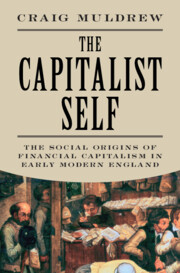
BOOK: Craig MULDREW, The Capitalist Self. The Social Origins of Financial Capitalism in Early Modern England (Cambridge: Cambridge University Press, 2025), ISBN 9781009644488, €40,85


(image source: CUP)

Abstract:

In this radical reinterpretation of the Financial Revolution, Craig Muldrew redefines our understanding of capitalism as a socially constructed set of institutions and beliefs. Financial institutions, including the Bank of England and the stock market, were just one piece of the puzzle. Alongside institutional developments, changes in local credit networks involving better accounting, paper notes and increased mortgaging were even more important. Muldrew argues that, before a society can become capitalist, most of its members have to have some engagement with 'capital' as a thing – a form of stored intangible financial value. He shows how previous oral interpersonal credit was transformed into capital through the use of accounting and circulating paper currency, socially supported by changing ideas about the self which stressed individual savings and responsibility. It was only through changes throughout society that the framework for a concept like capitalism could exist and make sense.

Read more here: DOI  10.1017/9781009644488.