Search

Showing posts with label scandinavia. Show all posts

02 July 2025

BOOK: Helle VOGT, Mia KORPIOLA, Else MUNDAL & Miriam JENSEN TVEIT (eds.), Gendered Punishments in Medieval Nordic Law, ca. 1100–1300 (York: ARC Humanities Press, 2025), 156 p. ISBN 9781802701845, € 119


(image source: ARC Humanities Press)

Abstract:

This book examines gendered punishments in medieval Nordic laws, ca. 1100–1300. By exploring legislation on violence, sorcery, sexual morality, and theft, it considers whether women were seen as independent legal subjects or as extensions of their families. It identifies various gendered punishments and discriminatory treatments, revealing regional differences and the influence of European legal ideologies. It also uncovers an emphasis on individual culpability for crimes, reflecting a shift from collective to individual responsibility and women’s increasing property rights. This comparative analysis offers a nuanced view of medieval Nordic law, highlighting the complex relationship between gender, law, and society during this transformative period. It explains how criminal law was influenced by canon law and German town law and offers new insights into the legal history of the Nordic region.

 Table of contents:

List of Illustrations

Abbreviations

Introduction. Gender in the Medieval Nordic Laws

Chapter 1. The Nordic Medieval Laws

Chapter 2. Violence and Homicide

Chapter 3. Sorcery and Magic

Chapter 4. Violations of the Norms of Sexual Morality

Chapter 5. Theft

Chapter 6. Comparative Observations and Main Conclusions

Bibliography

Index

 On the editors:

Helle Vogt is Professor in Legal History at University of Copenhagen, Denmark. Mia Korpiola (PhD 2004) is professor of legal history of the University of Turku. She has published extensively on Swedish and Finnish legal history. Else Mundal is professor emerita in Old Norse philology at the University of Bergen. She has published extensively on gender in medieval Norway and Iceland. In 2017, she was appointed a knight of the Icelandic Order of the Falcon. Miriam Jensen Tveit (PhD 2017) is assistant professor of medieval history at Nord University, and has published extensively on Norwegian medieval legal history.

Read more  here. 

26 June 2025

ARTICLE: Mia KORPIOLA & Jørn ØYREHAGEN SUNDE, "The Influence of the Principle "Necessitas Non Habet Legem" on Nordic Medieval Laws on Theft" (Journal of the History of Ideas LXXXV (2024), nr. 4 (Oct), 681-711


(image source: UPenn Press)

First paragraph:

The chapter on theft in the Norwegian Code of the Realm, compiled through the initiative of King Magnus VI Lawmender (r. 1263–80) and promulgated by him in 1274, opens by declaring theft unlawful.1 However, the Code goes on to stipulate that larceny would not merit punishment in the case of a starving man who steals food after unsuccessfully seeking gainful [End Page 681] employment.2 The Code of 1274 then prescribes the penalties for petit larceny for first-time offenders who do work to support themselves. Thus, the Code explicitly distinguishes between starving unemployed persons who steal food out of necessity and those who steal despite having access to a livelihood. It was a longstanding and widespread norm, as the Code was drafted for the whole of rural Norway and remained in force well into the seventeenth century. In this article, we consider whether this norm could have been inspired by the canonical maxim necessitas non habet legem (necessity knows no law).

Read the article here: DOI  10.1353/jhi.2024.a944582.

19 November 2020

BOOK: Tore IVERSEN, John Ragnar MYKING & Stefan SONDEREGGER, Peasants, Lords, and State: Comparing Peasant Conditions in Scandinavia and the Eastern Alpine Region , 1000-1750 (Leiden: Brill, 2020). ISBN: 978-90-04-42970-3, pp. 375, €119.00

(Source: Brill)

ABOUT THE BOOK

Peasants, Lords and State: Comparing Peasant Conditions in Scandinavia and the Eastern Alpine Region, 1000-1750 challenges the once widespread view, rooted in the historical thinking of the nineteenth century, that Scandinavian and especially Norwegian peasants enjoyed a particular “peasant freedom” compared to their Continental counterparts. Markers of this supposed freedom were believed to be peasants’ widespread ownership of land, extensive control over land and resources, and comprehensive judicial influence through the institution of the thing. The existence of slaves and unfree people was furthermore considered a marginal phenomenon. The contributors compare Scandinavia with the eastern Alpine region, two regions comprising fertile plains as well as rugged mountainous areas. This offers an opportunity to analyse the effect of topographical factors without neglecting the influence of manorial and territorial power structures over the long time-span of c.1000 to 1750. 

With contributions by Markus Cerman, Tore Iversen, Michael Mitterauer, John Ragnar Myking, Josef Riedmann, Werner Rösener, Helge Salvesen, and Stefan Sonderegger.

ABOUT THE EDITORS

Tore Iversen, Dr. Art (1994), Professor emeritus in medieval history at the Norwegian University of Science and Technology. He has published monographs and articles on medieval slavery, property and land tenancy in a Scandinavian and European context. 

John Ragnar Myking, Dr. Art (2003), Professor emeritus in medieval and early modern history at Western Norwegian University of Applied Sciences. He has published monographs and articles on land tenancy in a European context and local and regional history. 

Stefan Sonderegger, Dr. (1994), Professor in medieval history at the University of Zurich and Head of the City Archive of St.Gallen, Switzerland. His research focuses on economic history and the editing of documents.

TABLE OF CONTENTS

Preface 

  Acknowledgements 

  List of Figures 

  Notes on Contributors 

Part 1: Introduction

1 Historiographical and Methodological Reflections 

    Tore Iversen and John Ragnar Myking 

Part 2: Comparing Scandinavia and the Eastern Alpine Region

2 Slavery and Unfreedom from the Middle Ages to the Beginning of the Early Modern Period 

    Tore Iversen 

3 Leasehold and Freehold c. 1200–1750 

    John Ragnar Myking 

4 Peasant Participation in Thing and Local Assemblies c. 1000–1750 

    Tore Iversen and John Ragnar Myking 

5 Summary and Conclusion 

    Tore Iversen and John Ragnar Myking 

Part 3: The Portrayal of Peasants in National Historiography

6 The Historian as Architect of Nations: A Historiographical Analysis of the Norwegian Peasantry as Carrier of National Ideology and Identity in the Medieval and Early Modern Period 

    Helge Salvesen 

7 The Participation of the Tyrolean Peasantry in the Government of the Country: Theory – Reality – Ideology 

    Josef Riedmann 

8 Peasant Ideology in German Historiography 

    Werner Rösener 

9 Switzerland – A ‘Peasant State’? 

    Stefan Sonderegger 

Part 4: Appendix

The Sub-peasant Strata in the Late Medieval and Early Modern Eastern Alpine Region 

    Markus Cerman and Michael Mitterauer 

Active Manorial Lords and Peasant Farmers in the Economic Life of the Late Middle Ages: Results from New Swiss and German Research 

    Stefan Sonderegger 

  Glossary 

  Bibliography 

  Index 


More information with the publisher.

17 April 2019

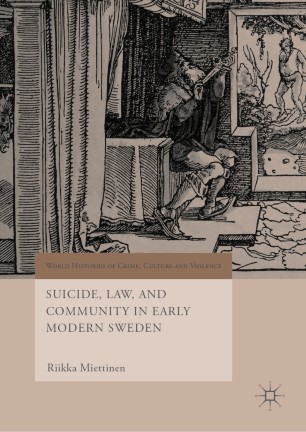
BOOK: Riikka MIETTINEN, Suicide, Law, and Community in Early Modern Sweden (Cham: Springer, 2019). ISBN 978-3-030-11844-0, EUR 67.82


(Source: Springer)

Springer is publishing a book on the judicial treatment of suicides in early modern Sweden.

ABOUT THE BOOK

This book explores the judicial treatment of suicides in early modern Sweden, with a focus on the criminal investigation and selective treatment of suicides in the lower courts in the seventeenth and early eighteenth centuries. Riikka Miettinen shows that reactions and attitudes towards suicides varied considerably despite harsh condemnation by officials. The indictment, investigation, and classification of suspected suicides and the mental state of a person already deceased were challenging, and depended on local co-operation and lay testimonies. Not all suicides were considered alike; a widespread view on the heinousness of suicide was not the same as agreement about specific cases, and did not result in uniform handling of them. The social status and local ties of the deceased influenced the interpretations and responses at the local lower courts and communities. Esteemed local community members had a better defence and greater chance to escape the shameful penalties.

ABOUT THE AUTHOR

Riikka Miettinen - 1.Tampere University Tampere Finland

TABLE OF CONTENTS

Front Matter
Pages i-xi
Introduction
Pages 1-44
Attitudes and Reactions to Suicides in Early Modern Sweden
Pages 45-105
Prosecuting Suspected Suicides: Processes and Obstacles
Pages 107-172
Investigation of Suicides in the Lower Courts
Pages 173-255
Selectivity by the Court: The Influence of Social Standing, Reputation and Piety
Pages 257-326
Conclusion
Pages 327-337
Back Matter
Pages 339-346

More information here