Search

Showing posts with label Swedish legal history. Show all posts

29 March 2022

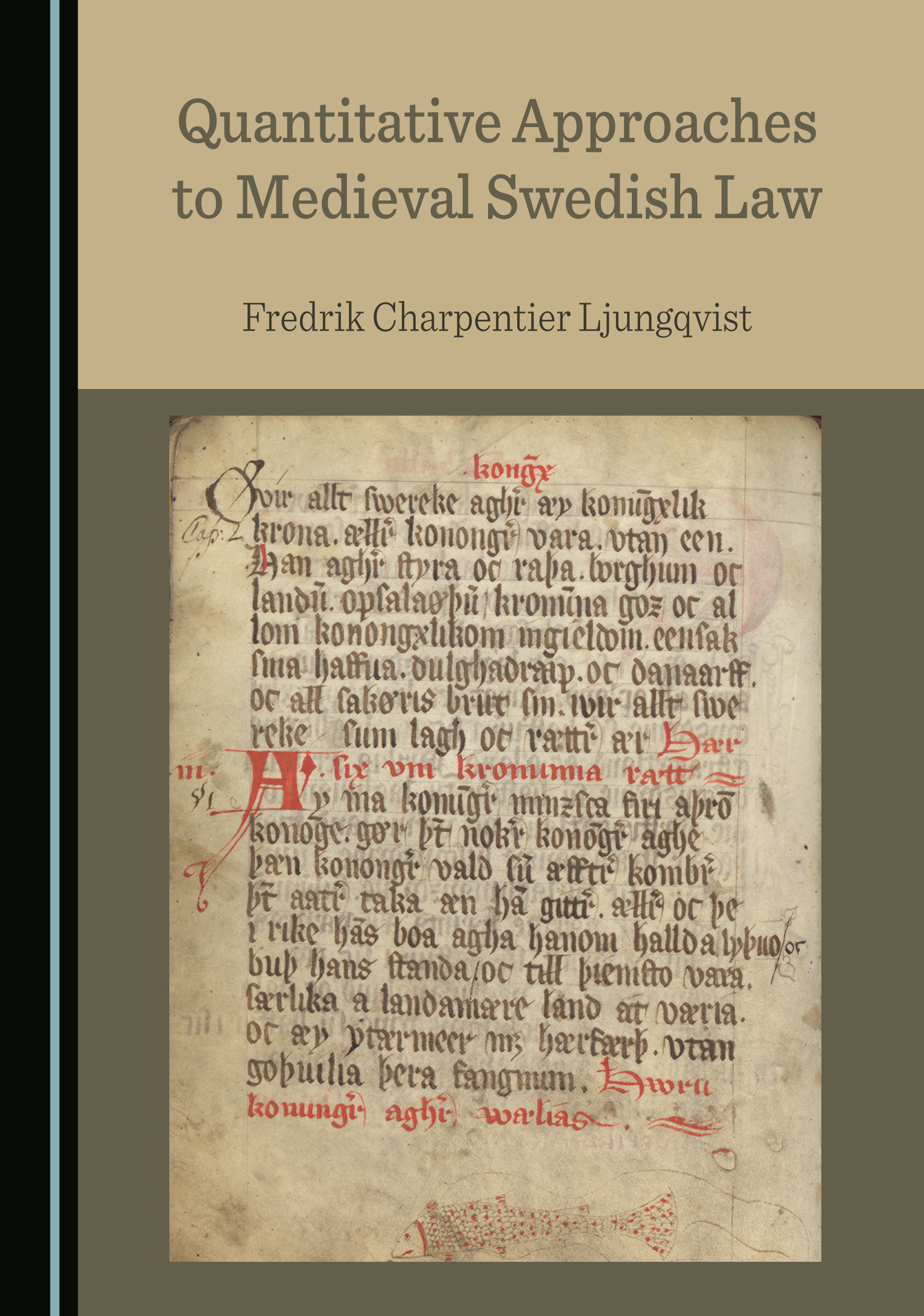
BOOK: Fredrik CHARPENTIER LJUNGQVIST, Quantitative Approaches to Medieval Swedish Law (Newcastle upon Tyne, Cambridge Scholars Publishing, 2002), ISBN: 978-1-5275-8056-5


ABOUT THE BOOK

This book presents a novel framework for studying historical legalisation using quantitative methods, with 10 fully-preserved laws from medieval Sweden, written between c. 1225 and 1350, serving as a case study. By applying a systematic classification scheme to each legal provision, it is possible to investigate the major differences and similarities in structure and content between the 10 laws. This, in turn, allows for the re-assessment of many long-standing problems in Swedish and European medieval legal history that have been challenging to address with traditional methods based on text analyses. Over the course of the thirteenth and fourteenth centuries, major changes in the proportion of legal provisions devoted to different fields of law, and to prescribed consequences, are found. The book shows how the proportions of civil law and public law expanded at the expense of criminal law. Furthermore, a clear transition from casuistic to more abstract law provisions can also be witnessed.


ABOUT THE AUTHOR

Fredrik Charpentier Ljungqvist is Associate Professor of both History and Physical Geography at Stockholm University, Sweden. His current research interests range from medieval Scandinavian law to the link between past climate variability and historical harvest yields, the effect of plague outbreaks on the history of European building activity, and socio-political aspects of historical food (in)security. He is the author and co-author of more than 80 peer-reviewed articles and the author of four popular science books, and an experienced university teacher and popular science lecturer. As a Pro Futura Scientia Fellow at the Swedish Collegium for Advanced Study, he leads the interdisciplinary project “Disentangling socio-political and climatic factors for food insecurity in early modern Europe (c. 1500–1800)”.


More information can be found here.

04 September 2020

BOOK: Bonnie CLEMENTSSON, Incest in Sweden, 1680–1940 A History of Forbidden Relations (Manchester: Manchester University Press, 2020). ISBN 978-9-1984-6992-9, 25.00 GBP


Manchester University Press is publishing a book on the legal history of incest in Sweden.

ABOUT THE BOOK

In early modern Sweden, if a man and his deceased wife´s sister were found guilty of engaging in sexual intercourse they would be sentenced to death by beheading. Today the same relationship is not even illegal. Covering the period 1680-1940, this book analyses both incest crimes and applications for dispensation to marry, revealing the norms underpinning Swedish society's shifting attitudes to incestuous relations and comparing them with developments in other European countries. It demonstrates that, even though the debate on incest has been dominated by religious, moral, and - in due course - medical notions, the values that actually determined the outcome of incest cases were frequently of quite a different character.

ABOUT THE AUTHOR

Bonnie Clementsson is a researcher at Lund University

TABLE OF CONTENTS

Introduction
1 Background and context
2 Incest: a religious crime, 1680-1750
3 Incest: a moral crime, 1750-1840
4 Incest: a crime of violence, 1840-1940
The phenomenon of incest in Sweden over 250 years: a summary discussion
Index

More info here

17 April 2019

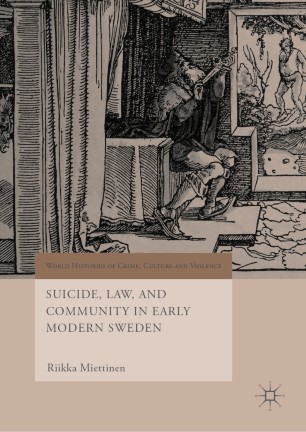
BOOK: Riikka MIETTINEN, Suicide, Law, and Community in Early Modern Sweden (Cham: Springer, 2019). ISBN 978-3-030-11844-0, EUR 67.82


(Source: Springer)

Springer is publishing a book on the judicial treatment of suicides in early modern Sweden.

ABOUT THE BOOK

This book explores the judicial treatment of suicides in early modern Sweden, with a focus on the criminal investigation and selective treatment of suicides in the lower courts in the seventeenth and early eighteenth centuries. Riikka Miettinen shows that reactions and attitudes towards suicides varied considerably despite harsh condemnation by officials. The indictment, investigation, and classification of suspected suicides and the mental state of a person already deceased were challenging, and depended on local co-operation and lay testimonies. Not all suicides were considered alike; a widespread view on the heinousness of suicide was not the same as agreement about specific cases, and did not result in uniform handling of them. The social status and local ties of the deceased influenced the interpretations and responses at the local lower courts and communities. Esteemed local community members had a better defence and greater chance to escape the shameful penalties.

ABOUT THE AUTHOR

Riikka Miettinen - 1.Tampere University Tampere Finland

TABLE OF CONTENTS

Front Matter
Pages i-xi
Introduction
Pages 1-44
Attitudes and Reactions to Suicides in Early Modern Sweden
Pages 45-105
Prosecuting Suspected Suicides: Processes and Obstacles
Pages 107-172
Investigation of Suicides in the Lower Courts
Pages 173-255
Selectivity by the Court: The Influence of Social Standing, Reputation and Piety
Pages 257-326
Conclusion
Pages 327-337
Back Matter
Pages 339-346

More information here