Search

Showing posts with label equity. Show all posts

19 May 2025

BOOK: Johann Benedikt STEIGER, Einzelfall und Norm. Zur Rolle der Billigkeit in der Rechtsphilosophie der Frühen Neuzeit [Recht und Philosophie; 17] (Berlin: Duncker & Humblot, 2025), 414 p., ISBN 978-3-428-19406-3

Cover: Einzelfall und Norm

ABOUT THE BOOK:

Das Verhältnis von Einzelfall und Norm stellt seit der griechischen Antike eine zentrale Problemfrage der Rechtsphilosophie dar. Der Begriff der Billigkeit (gr. ›epieíkeia‹, lat. ›aequitas‹) verkörpert den Versuch der rechtsmethodischen Beantwortung dieser Problemfrage. Die heterogenen billigkeitsphilosophischen und -theologischen Traditionslinien aus Antike und Mittelalter kulminieren in den verschiedenartig ausdifferenzierten Billigkeitsverständnissen der Frühen Neuzeit. Die mit dieser Schrift erstmals vorgelegte epochenübergreifende billigkeitsphilosophische Analyse zeigt – bei allen bestehenden teils deutlichen Differenzen zwischen den untersuchten Autoren – eine übergreifende hermeneutische Prägung sowie eine theologische Legitimationskontinuität der frühneuzeitlichen Billigkeitsverständnisse. Deren Bedeutung erschöpft sich dabei nicht in einer historischen Relevanz, sondern erstreckt sich auf rechtsethische Impulse für den rechtsphilosophischen Diskurs der Gegenwart. 

Ausgezeichnet mit dem Dr. Feldbausch-Preis 2024 der Juristenfakultät der Universität Leipzig.

TABLE OF CONTENTS:

A. Einleitung
Verortung des rechtsphilosophischen Problems der Billigkeit – Terminologie

B. Grundlagen des Billigkeitsverständnisses der Frühen Neuzeit
Antike Philosophie – Mittelalterliche Theologie und Kirchenrecht – Conclusio

C. Das hermeneutische Billigkeitsverständnis der Frühen Neuzeit unter den Vorzeichen von Reformation und sog. Älterem Naturrecht
Begriff und Bedeutung der Billigkeit im Deutschen – Erster Hauptteil: Die Billigkeit als theologisches Regulativ in der Reformationszeit (Erste Hälfte des 16. Jahrhunderts) – Zweiter Hauptteil: Kontinuität und Wandlung der Billigkeitsverständnisse im 17. Jahrhundert

D. Die Billigkeit: Renaissance einer verlorenen Kategorie? – Die Relevanz der frühneuzeitlichen Billigkeitsphilosophie für das Recht im 21. Jahrhundert
Bestandsaufnahme: Die Billigkeit im (deutschen) Recht des 21. Jahrhunderts – Perspektiven der frühneuzeitlichen Billigkeit in der Gegenwart – Exemplifizierung der Billigkeitsanwendung – veranschaulicht an Fallkonstellationen der Gegenwart

E. Conclusio

Find more here.

22 November 2023

BOOK: Dario MANTOVANI (dir.), L'équité hors du droit (Paris: Collège de France, 2023), 248 p. ISBN 978-2722606326, € 28


(image source: livres de philosophie)


Abstract:
Comment définir l'équité ? Comment l'appliquer en période de pandémie, lorsque l'on façonne une politique climatique ou que l'on s'interroge sur le plurilinguisme ? Sans cesse évoquée mais toujours équivoque, depuis des siècles, l'équité suscite à la fois la question de sa définition et de sa mise en pratique. En partant des sens antiques de l'équité, cet ouvrage a pour vocation d'étudier la diffraction de cette notion originellement juridique, rhétorique et éthique dans d'autres disciplines à l'époque contemporaine. Il propose donc une comparaison de son acception dans l'Antiquité avec l'usage qu'en font les sciences actuelles, sous le prisme d'un regard et d'une pensée modernes. Ainsi, dans une perspective diachronique, le droit antique, la rhétorique, les sciences religieuses, l'histoire et l'archéologie rencontrent-ils la philosophie contemporaine, l'économie, l'éthique, ou encore le droit de l'environnement, la sociologie, la linguistique et le droit comparé.


Table of contents:

Sommaire

Dario Mantovani – Introduction. De l’aequitas à l’équité

Première partie. Généalogies : l’équité en Grèce et à Rome

Philippe Hoffmann – L’épieikeia aristotélicienne et la littérature grecque ancienne

John Scheid – L’aequitas est-elle une déesse ? Le culte d’Aequitas

Charles Guérin – L’aequitas dans la rhétorique cicéronienne : émergence, stabilisation et expansion d’une catégorie argumentative

Deuxième partie. Diffractions modernes

Claudine Tiercelin – L’équité : que peut donc bien avoir à en dire le philosophe ?

Bruno Karsenti – L’équité, œuvre de justice : aux sources de la politique de la sociologie

Innovation et inégalités – Philippe Aghion

Jean-François Delfraissy et Pierre-Henri Duée – L’équité à l’épreuve de la Covid-19

Troisième partie. L’équité hors et dans le droit

Jean-Luc Egger – L’équité linguistique

Laurent Fonbaustier – Équité intergénérationnelle et environnement

Jean-Louis Halpérin – L’équité à l’épreuve du comparatisme

Alain Supiot – L’équité hors du droit : remarques marginales

(source: Collège de France


06 May 2020

BOOK: Dennis KLIMCHUK, Irit SAMET, and Henry E. SMITH, eds., Philosophical Foundations of the Law of Equity (Oxford: Oxford University Press, 2020). ISBN 9780198817659, £80.00


(Source: OUP

OUP is publishing a new book on the philosophical foundations of the law of equity.

ABOUT THE BOOK

The law of Equity, a latecomer to the field of private law theory, raises fundamental questions about the relationships between law and morality, the nature of rights, and the extent to which we are willing to compromise on the rule of law ideal to achieve social goals. In this volume, leading scholars come together to address these and other questions about underlying principles of Equity and its relationship to the common law: What relationships, if any, are there between the legal, philosophical, and moral senses of 'equity'? Does Equity form a second-order constraint on law? If so, is its operation at odds with the rule of law? Do the various theories of Equity require some kind of separation of law and equity-and, if they do, what kind of separation? The volume further sheds light on some of the most topical questions of jurisprudence that are embedded in the debate around 'fusion'.

A noteworthy addition to the Philosophical Foundations series, this volume is an important contribution to an ongoing debate, and will be of value to students and scholars across the discipline.

ABOUT THE EDITORS
Edited by Dennis Klimchuk, Associate Professor of Philosophy and Law, University of Western Ontario, Irit Samet, Professor, The Dickson Poon School of Law, and Henry E. Smith, Fessenden Professor of Law, Harvard Law School
Dennis Klimchuk is Associate Professor of Philosophy and Law at the University of Western Ontario. His main research interests are in philosophy of law, especially private law theory, and the history of political philosophy, especially the early modern period. He was a contributor to two earlier volumes in OUP's Philosophical Foundations of law series (on unjust enrichment and on property) and is co-editor, with Lisa Austin, of Private Law and the Rule of Law (OUP 2014).
Irit Samet is a Professor in The Dickson Poon School of Law, which she joined in 2008 after teaching in Oxford and Essex. Irit's main research interests lie in the areas of equity, property law, theory of private law, and ethics. Her monograph on the normative foundations of the law of equity was published by OUP in 2018. Irit has published numerous papers in peer-reviewed journals (such as the MLR, Jurisprudence, Kantian Review, and OJLS), as well as in edited collections published by OUP (such as Philosophical Foundations of Fiduciary Law and Philosophical Foundations of Property Law).
Henry E. Smith is Fessenden Professor of Law and the Director of the Project on the Foundations of Private Law at Harvard Law School. Previously, he taught at the Northwestern University School of Law and was the Fred A. Johnston Professor of Property and Environmental Law at Yale Law School. He has written extensively on property, equity, remedies, and private law theory.

TABLE OF CONTENTS
Introduction
1: Discretionary Justice, Charlie Webb
2: Aristotle at the Foundations of the Law of Equity, Dennis Klimchuk
3: Equity, Justice and Conscience: Suitors behaving badly?, J E Penner
4: Equity and the Right to Do Wrong, Andrew S. Gold
5: Equity as Supplemental Law, Paul B. Miller
6: The Constitution of Equity, Evan Fox-Decent
7: Equity is Not a Single Thing, Lionel Smith
8: Pathways to Legal Rights: The Function of Equity, Larissa Katz
9: What's Special About Equity? Rights about Rights, Ben McFarlane and Robert Stevens
10: Fusion of Law and Confusion of Equity, Henry E. Smith
11: Form and Substance in the Fusion of Law and Equity, Samuel L. Bray
12: Equitable Correction of Law, Emily Sherwin
13: What Can 'Equity's Darling' Tell Us About Equity?, Aruna Nair and Irit Samet
14: From Riggs v. Palmer to Shelley v. Kraemer: The Continuing Significance of the Law-Equity Distinction, John C. P. Goldberg and Benjamin C. Zipursky
15: Some Varieties of Consent in Equity: Enhancing and Protecting Autonomy?, Simone Degeling
16: Equity and Institutions, Matthew Harding
17: The Equity of the Statute, James Edelman

More info here

09 September 2019

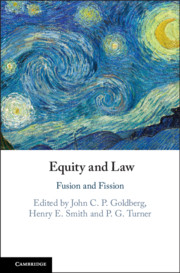
BOOK: John C. P. GOLDBERG, Henry E. SMITH, and P. G. TURNER, eds., Equity and Law : Fusion and Fission (Cambridge: Cambridge University Press, 2019). ISBN 9781108421317, $ 140.00


(Source: CUP)

Cambridge University Press has published a new edited collection containing several legal-historical contributions on the relationship between equity and law in common law systems.

ABOUT THE BOOK

The fusion of law and equity in common law systems was a crucial moment in the development of the modern law. Common law and equity were historically the two principal sources of rules and remedies in the judge-made law of England, and this bifurcated system travelled to other countries whose legal systems were derived from the English legal system. The division of law and equity - their fission - was a pivotal legal development and is a feature of most common law systems. The fusion of the common law and equity has brought about major structural, institutional and juridical changes within the common law tradition. In this volume, leading scholars undertake historical, comparative, doctrinal and theoretical analysis that aims to shed light on the ways in which law and equity have fused, and the ways in which they have remained distinct even in a 'post-fusion' world.

ABOUT THE EDITORS

John C. P. GoldbergHarvard Law School, Massachusetts
John C. P. Goldberg is the Carter Professor of General Jurisprudence at the Harvard Law School, Harvard University.

Henry E. SmithHarvard Law School, Massachusetts
Henry E. Smith is the Fessenden Professor of Law and Director of the Project on the Foundations of Private Law at the Harvard Law School, Harvard University.

P. G. TurnerUniversity of Cambridge
P. G. Turner is a University Senior Lecturer and a Fellow of St Catharine's College in the University of Cambridge.

TABLE OF CONTENTS

List of figures
List of tables
List of contributors
Acknowledgements
Table of cases
Table of legislation
List of abbreviations
1. Fusion and theories of equity in common law systems P. G. Turner
Part I. Jurisdictions and Their Institutions:
2. Equity: notes on the American reception Samuel L. Bray
3. The union of law and equity: the United States, 1800–1938 Kellen Funk
4. What did the makers of the judicature acts understand by 'fusion'? Michael Lobban
5. At the crossroads of fusion: British North America/Canada, 1750–2000 Philip Girard
6. Fusion – fission – fusion: pre-judicature equity jurisdiction in New South Wales, 1824–1972 Mark Leeming
7. Fusion without fission: equity and the judicature acts in colonial Victoria James Mccomish
8. Are equity and law in Scotland fused, separate or intertwined? Daniel J. Carr
Part II. Fusion and Fission in Doctrine and Practice:
9. Equity and the common counts: the development of the action for money had and received Ben Kremer
10. Mistake and unfairness in contract law Stephen Waddams
11. Lex Sequitur Equitatem: fusion and the penalty doctrine P. G. Turner
12. Rediscovering the equitable origins of discovery: the 'blending' of law and equity prior to fusion Patricia I. Mcmahon
Part III. Functional, Analytical and Theoretical Views:
13. Wrongful fusion: equity and tort John C. P. Goldberg and Henry E. Smith
14. Avoiding anarchy? Common law vs. equity and Maitland vs. Hohfeld Ben Mcfarlane
15. Equity and the modern mind Emily Sherwin
16. An argument for limited fission Matthew Harding
Conclusion
17. 'Single nature's double name': the unity of law and equity? Dennis Klinck
Index.

More information here

21 January 2014

ARTICLE: Carr on "English Influences on the Historical Development of Fiduciary Duties in Scottish Law"


Daniel J Carr on 
"English influences on the historical development of fiduciary 
duties in scottish law"
  
Edinburgh Law Review, Vol. 18, No. 1: 29-58. 

Article available in fulltext here