Search

Showing posts with label trusts. Show all posts

03 March 2025

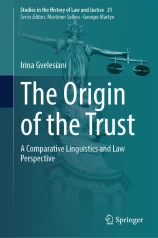
BOOK: Irina GVELESIANI, The Origin of the Trust. A Comparative Linguistics and Law Perspective [Studies in the History of Law and Justice, 31, eds. Mortimer SELLERS & Georges MARTYN] (Heidelberg: Springer, 2024), X + 116 p., € 137,79


(image source: Springer)

Abstract:
This book offers an interdisciplinary approach that covers linguistics and jurisprudence, shows the interconnectedness of law and language, singles out major theories related to the emergence of the concept of trust and discusses them from the perspective of legal linguistics. Contemporary globalizing processes change the contours of different spheres of life. Against the backdrop of ongoing changes, an overall tendency emerges of the unifying and harmonizing legal systems. The dominance of American and English law firms fuels a broader worldwide circulation of Anglo-American legal concepts and instruments. Increasing contacts of non-trust jurisdictions with trustees and trust assets promote the use of trusts and trust-like devices in civil law jurisdictions. As a result, the interest towards the entrusting relationships increases. The research in this book is based on the methods of descriptive and structural-semantic analyses. Emphasis is put on the interinfluence of the West Germanic languages and the laws of the Germanic tribes, the Salian Franks and the Anglo-Saxons. The book consults selected Franconian manuscripts, lex salica and lex ripuaria, and dictionaries for the study and interpretation of the trust-related lexical units. The results of the research shed a new light on the origin of the common law trust and its predecessor use. The book is intended for legal linguists, lawyers, legal practitioners, legal historians and for researchers and students in the fields of trust law, legal linguistics, and legal history.

On the author:

Prof. Irina Gvelesiani is an Associate Professor at Ivane Javakhishvili Tbilisi State University. She researches legal terminology, trust law, problematics of translation and educational issues. She was awarded "Tytus Filipowicz Award" in Poland in 2020, where she carried out research in the field of legal terminology. 

 Read more here: DOI 10.1007/978-3-031-69027-3.


04 October 2018

BOOK: Jean-François CHAUVARD, Lier et délier la propriété : tutelle publique et administration des fidéicommis à venise aux derniers siècles de la république (Rome: École française de Rome, 2018). ISBN 978-2-7283-1222-1, € 42


Publications de l’École française de Rome published a new book on the fideicommis in the law of the Venetian Republic during the Early Modern Era.  

ABOUT THE BOOK

Les fidéicommis étaient consubstantiels aux sociétés d’Ancien Régime. En rendant les biens indisponibles et en fixant la ligne de succession, ces fondations testamentaires visaient la conservation de l’assise matérielle des familles. Au nom de la libre circulation des biens et d’une conception absolue de la propriété, ils furent au XVIIIe siècle l’objet de critiques qui débouchèrent sur des réformes dans certains États italiens. Rien de tel dans la République de Venise où le patriciat n’envisagea jamais de réformes systémiques qui risquaient de remettre en cause les équilibres politiques et sociaux. Néanmoins, dès la fin du XVe siècle, l’État vénitien légiféra à mesure que les fidéicommis entraient en contradiction avec d’autres systèmes normatifs : le recouvrement des créances et des impôts et le remboursement des dots. L’État définit également les conditions de levée de l’inaliénabilité des biens et mit en place, sous l’égide des Juges du Procurator, une procédure pour garantir le réinvestissement des capitaux assujettis à fidéicommis (emprunts publics et prêts) au prix d’un travail administratif considérable. L’exploitation des archives de cette cour de justice permet d’éclairer le rôle de l’autorité judiciaire dans la cogestion des fidéicommis et celui des ayants droit qui pouvaient se comporter en administrateurs actifs, capables de remodeler le contenu du fidéicommis sans changer sa valeur. En scrutant les modalités du passage de l’indisponible au disponible, ce livre interroge l’élasticité d’un dispositif réputé pour sa rigidité ; il démontre aussi que les fidéicommis étaient une institution totalisante dont le gouvernement était autant une affaire de famille que l'affaire de l'État.

ABOUT THE AUTHOR

Ancien directeur des études modernes et contemporaines à l’École française de Rome, Jean-François Chauvard est professeur d’histoire moderne à l’Université Lumière Lyon 2 - LARHRA. Ses travaux portent sur l’histoire des sociétés urbaines de l’Italie moderne, en particulier sur le monde vénitien.

TABLE OF CONTENTS

The table of contents can be found here

More information here

21 January 2014

ARTICLE: Carr on "English Influences on the Historical Development of Fiduciary Duties in Scottish Law"


Daniel J Carr on 
"English influences on the historical development of fiduciary 
duties in scottish law"
  
Edinburgh Law Review, Vol. 18, No. 1: 29-58. 

Article available in fulltext here