Search

Showing posts with label Transnational Law. Show all posts

06 December 2023

SEMINAR SERIES: Max Planck Institute & Tel Aviv University, Transnational Legal History Workshop (2023-2024)


TRANSNATIONAL LEGAL HISTORY WORKSHOP


6 December: Assaf Likhovski (TAU)

Studying Ancient Constitutional Law in Colonial India and Mandatory Palestine


13 December: Jan-Henrik Meyer (MPILHLT)

European Community Environmental Law in the 1970s: Combatting Water Pollution


20 December: Noga Morag-Levine (Michigan State University)

England’s Missing Boards of Health: The Medieval Beginnings of an Anglo-Continental Divergence


10 January: Alon Jasper (TAU)

Transforming a Polity into an Economy: The Five Nations and the Railroads, 1855-1894


17 January: Raquel Sirotti (MPILHLT)

State-like powers? Charter Companies and the production of knowledge of normativity in Mozambique (1891-1942)


24 January: Egas Moniz Bandeira (FAU)

Changing Legal Professions in China, Japan, and the Ottoman Empire in the long 19th century: Towards a Historical Comparison


31 January: Aparna Balachandran (Delhi University)

Religion, Law and Urban Governance: Subaltern Christians as Legal Subjects in Early Colonial South India


7 February: Cristiano Paixão (University of Brasília)

Transnational legal mobilization: repressive structures and networks of resistance in S. American dictatorships (1964-1988)


14 February: Julia Moses (University of Sheffield)

Harmonizing the Family? International Law, Cultural Norms and Marriage at the Turn of the Twentieth Century


21 February: Sarina Kuersteiner (Union College)

Whatever God Gives: Arabic and Judaeo-Arabic Rizq and Latin Resicum in Commercial Vocabulary, 1154-1164 CE


For more information or to register, please email mpitauwkshp@gmail.com.

08 June 2020

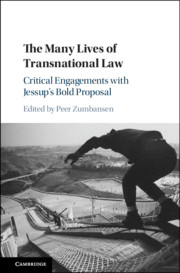
BOOK: Peer ZUMBANSEN, The Many Lives of Transnational Law Critical Engagements with Jessup’s Bold Proposal (Cambridge: Cambridge University Press, 2020). ISBN 9781108490269, $ 140.00


(Source: CUP)

Cambridge University Press is publishing a new book on former ICJ Judge Jessup and transnational law.

ABOUT THE BOOK

In 1956, ICJ judge Philip Jessup highlighted the gaps between private and public international law and the need to adapt the law to border-crossing problems. Today, sixty years later, we still ask what role transnational law can play in a deeply divided, post-colonial world, where multinationals hold more power and more assets than many nation states. In searching for suitable answers to pressing legal problems such as climate change law, security, poverty and inequality, questions of representation, enforcement, accountability and legitimacy become newly entangled. As public and private, domestic and international actors compete for regulatory authority, spaces for political legitimacy have become fragmented and the state's exclusivist claim to be law's harbinger and place of origin under attack. Against this background, transnational law emerges as a conceptual framework and method laboratory for a critical reflection on the forms, fora and processes of law making and law contestation today.

ABOUT THE AUTHOR

Peer ZumbansenKing's College London
Peer Zumbansen is the founding Director of the Transnational Law Institute at King's College London and teaches at King's and Osgoode Hall Law School, Toronto. He is the series editor of Cambridge Studies in Transnational Law and co-editor-in-chief of Transnational Legal Theory.

TABLE OF CONTENTS

Introduction: transnational law, with and beyond Jessup Peer Zumbansen
Part I. Transnational Law: The Public and the Private:
1. Jessup at the United Nations: international legacy, transnational possibilities Stephen Minas
2. The concept of a global legal system Christopher A. Whytock
3. How comity makes transnationalism work Thomas Schultz and Niccolò Ridi
Part II. Transnational Law as Regulatory Governance:
4. Aiding and abetting in theorising the increasing softification of the international normative order – a darker legacy of Jessup's transnational law? Karsten Nowrot
5. From international law to transnational law, from transnational law to transnational legal orders Gregory Shaffer and Carlos Coye
6. Transnational law in the Pacific Century: mapping pesticide regulation in China Francis Snyder, Zhouke Hu and Lili Ni
7. Transnational law in context: the relevance of Jessup's analysis for the study of 'international' arbitration Florian Grisel
8. Transnational Law and Adjudication – Domestic, International and Foreign Intersections Bryan Horrigan
9. Transnational Law and Global Dispute Resolution Shahla Ali
10. Conflicts of law and the challenge of transnational data flows Paul Schiff Berman
11. What lex sportiva tells you about transnational law Antoine Duval
12. Family law: a blindspot Ivana Isailovic
Part III. Transnational Law: The Field's Normative Stakes:
13. Locating private transnational authority in the global political economy A. Claire Cutler
14. Transnational law as drama Jothie Rajah
15. Transnational law as unseen law Natasha Affolder
16. The Cri De Jessup sixty years later: transnational law's intangible objects and abstracted frameworks Larry Catá Backer
17. The private life of transnational law: reading Jessup from the postcolony Prabhakar Singh
18. After the backlash: a new pride for transnational law? Ralf Michaels
Part IV. Conclusion: Epilogue – difficulties for every solution: defining transnational law at the edge of transdisciplinarity Vik Kanwar.

More info here

14 August 2014

ARTICLE: Thomas Duve on "National Traditions and Transnational Perspectives"

Thomas Duve on "National Traditions and Transnational Perspectives", now available on SSRN.  
The article will be published in the upcoming issue of our journal Rechtsgeschichte-Legal History

click here to read the abstract and download the article