Search

Showing posts with label Constitution. Show all posts

18 February 2025

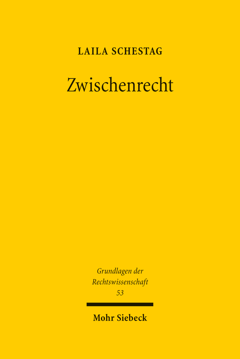
BOOK: Laila SCHESTAG, Zwischenrecht. Die allgemeinen Regeln des Völkerrechts in der frühen Bundesrepublik [Grundlagen der Rechtswissenschaft; 53] (Tübingen: Mohr Siebeck, 2024), 287 p., ISBN 978-3-16-163841-1

 Cover von 'undefined'

ABOUT THE BOOK:

»Das Völkerrecht geht unter allen Umständen dem Bundesrecht und auch dem Bundesverfassungsrecht vor«. Mit diesem Satz des späteren Außenministers Heinrich von Brentano nahm der Parlamentarische Rat die bis heute gültige Fassung von Artikel 25 GG einstimmig an. Noch in der ersten Hälfte der 1950er Jahre stieß der Vorrang des Völkerrechts auf breite Zustimmung. Heute weist die Verfassungsauslegung den allgemeinen Regeln des Völkerrechts nur noch einen 'Zwischenrang' zu: Sie stehen über dem einfachen Recht, aber unter dem Verfassungsrecht. Wie lässt sich die radikale Offenheit des Grundgesetzes gegenüber dem Völkerrecht im Moment der Verfassungsgebung erklären? Warum war sie nicht von Dauer? Diesen Fragen geht Laila Schestag in ihrer ideengeschichtlichen Studie nach. Entlang der Genese zentraler verfassungsrechtlicher Begriffe wie 'Völkerrechtsfreundlichkeit' und 'offene Staatlichkeit' zeigt sie, wie Deutungs- und Bedeutungswandel von Artikel 25 GG den politischen Selbstfindungsprozess der frühen Bundesrepublik spiegeln.
Die Arbeit wurde mit dem Promotionspreis der Juristischen Fakultät der Humboldt-Universität zu Berlin 2024 ausgezeichnet.

TABLE OF CONTENTS:

Recht einer Zwischenzeit. Einleitung
Erster Teil: Vor der Verfassung - Die Entstehung von Artikel 25 des Grundgesetzes

Kapitel 1. Motive
Kapitel 2. Entwürfe
Kapitel 3. Diskurse

Zweiter Teil: Unter dem Grundgesetz - Vom internationalen Provisorium zur nationalen Verfassung
Kapitel 1. Revolutionäre Popularität? Die Rangfrage zwischen 1949 und 1957
Kapitel 2. Vom besetzten Provisorium zum europäischen Staat
Kapitel 3. Saturierter Staat? Die Rangfrage zwischen 1958 und 1976

Ein vergessenes Potential? Schluss

ABOUT THE AUTHOR:

Laila Schestag: Geboren 1993; Studium der Rechtswissenschaft an der Humboldt-Universität zu Berlin; 2018 Erstes Juristisches Staatsexamen; 2021-22 Forschungsaufenthalte am European University Institute in Florenz und am Hans Kelsen-Institut in Wien; 2024 Promotion (HU Berlin); Rechtsreferendariat am Kammergericht Berlin.
https://orcid.org/0000-0003-0150-1635

Find more here


15 January 2025

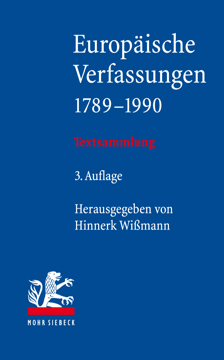
BOOK: Hinnerk WISSMANN (ed.), Europäische Verfassungen 1789-1990 (Tübingen: Mohr Siebeck, 2024), 585 p., ISBN 978-3-16-164214-2

 Cover von 'undefined'
ABOUT THE BOOK:
 
Die neue Auflage der Textsammlung erscheint als Beitrag zum Verfassungsjahr 2024. Nach 75 Jahren Grundgesetz, das hier in seiner Ursprungsfassung abgedruckt wird, lässt sich erkennen: Freiheit, Demokratie und Rechtsstaat müssen immer wieder neu errungen, verteidigt und bewahrt werden, nach außen wie nach innen. Die hier versammelten historischen Verfassungstexte bezeugen das gemeinsame »Projekt Verfassungsstaat«, das Europa seit Beginn der staatsrechtlichen Moderne geprägt hat. Einen Schwerpunkt bilden deutsche (Reichs- und Landes-)Verfassungen des 19. und 20. Jahrhunderts, die typischerweise für einschlägige Lehrveranstaltungen herangezogen werden. Hinzu kommen (in deutscher Übersetzung) besonders wichtige Verfassungen europäischer Staaten ebenso wie zwischenstaatliche Vertragswerke im Zeitraum bis 1990. Ergänzt wird die Sammlung im Anhang durch die Verfassung der USA und wichtige Texte der vormodernen englischen Rechtstradition. Neu abgedruckt wird die Bill of Rights (Amendments 1-10), mit der die amerikanische Bundesverfassung 1789/1791 grundlegende Bürgerrechte aufnahm.
 
Find more here.

24 April 2024

BOOK: Xavier GIL (ed.), Constitutional Moments - Founding Myths, Charters and Constitutions through History [History of European Political and Constitutional Thought; 11] (Brill, 2024), 542 p., ISBN 978-90-04-54913-5


Book-Abstract: 
      
 “Constitution” is a rich term in Western political culture, encompassing political and juridical doctrine as well as government practices through the ages. This volume examines “constitutional moments” in history, those occasions or episodes when significant steps were taken in the definition or redefinition of polities. Their actors were writers or politicians, rulers or ruled, who found inspiration in a distant past or instead looked towards a future to be drawn anew. This book sheds light on such moments from Ancient Greece to the present day, mostly in Europe but also in the Ottoman world and the Americas, thereby uncovering a revealing variety of constitutional thinking and action throughout history. 

Contributors:

Contributors are: Jon Arrieta, Niall Bond, Luc Brisson, Peter Cholakov, Nora Chonowski, Angela De Benedictis, F. Sinem Eryilmaz, Hakon Evju, Pablo Fernández Albaladejo, Javier Fernández Sebastián, Merieke Gebhardt, Xavier Gil, Mark J. Hill, Ferenc Hörcher, Jaska Kainulainen, Thomas Lorman, Adriana Luna-Fabritius, Ere Nokkala, Brian Kjaer Olesen, András Pap, Nikola Regent, Alberto Mariano Rodríguez Martínez, Pablo Sánchez León, José Reis Santos, and Ersin Yildiz.  

Find more here

08 September 2023

CALL FOR PAPERS: International conference on Constitutional Communities (KU Leuven, 8-9 February 2024) (DEADLINE: 25 October 2023).


(Source: KU Leuven)

We received notice of a call for papers for a conference on constitutional communities at KU Leuven in February 2024.

Call for Papers

International conference on

Constitutional Communities

       When: 8-9 February 2024

       Where: KU Leuven (Institute of Philosophy and Faculty of Law), Belgium

       Deadline for abstract submissions: 25 October 2023 

Theme:

Today almost all countries are “constitutional communities” in a broad sense: their constitution provides the basic framework for their common life. This link between community and constitution is increasingly recognized and there is a growing awareness of the potential of constitutions for societal integration. Jürgen Habermas, with his notion of constitutional patriotism, made the case for a collective identity that does not rely on ethnic nationalism. At the same time, the belief that a constitutional document can be the source of a liberal collective identity has been criticized from various angles. A constitution is typically anchored at the national level, while in a globalized world social integration happens at many different levels. Moreover, courts have used the concept of “constitutional identity” to justify divergent interpretations of the rule of law and human rights and to uphold populist claims. Indigenous people sometimes see constitutional recognition as a new form of assimilation. And some critics have claimed that the concept is empty and abstract: constitutional principles are mostly the same across borders so how can they inspire a sense of community?

These developments raise important questions. How do constitutions create communities? Can they really do so? And should they? These questions can be answered from different disciplinary perspectives. Scholars in constitutional law and in the history of law have studied the working of constitutions since long. But legal and political philosophy should also weigh in, as philosophers from the past and the present have amply studied the relation between written laws and community. The issue of constitutional identity can also be approached from an empirical sociological perspective or even from a literary perspective, as it is ultimately the agency of a text that is at stake here. 

By engaging in an interdisciplinary dialogue about constitutions and community, this conference aims to explore the impact that constitutions have and can have in the functioning of communities, and to contribute to our understanding of the concept of constitutional identity.

Possible paper topics: 

- Constitutions and community building

- National and/or constitutional identity as legal instruments 

- The relation between constitutional identity and affiliated notions (sovereignty, constituent power, representation, …) 

- Constitutional recognition (of minorities, historically oppressed groups, rights of nature, …)

- Constitutional change 

- Specific philosophers on the role of constitutions 

- Constitutions as a literary genre

Submitting your abstract:

If you are interested in presenting your work at this conference, please submit an anonymized abstract (max. 400 words, in .doc, .docx or .pdf format) along with your name, title, and affiliation via e-mail to Ana Van Liedekerke (ana.vanliedekerke@kuleuven.be). The actual presentations can be 15 to 20 minutes long. Abstract should be submitted on 25 October 2023 (CET) at the latest. If accepted, you will be invited to develop your abstract into a full paper of around 5000 words; papers will be precirculated to all conference participants. We welcome submissions both from junior and from senior scholars. We especially encourage scholars from underrepresented groups to apply.

Conference Fee: There will be a registration fee of 75 euro to participate in the conference (40 euro for those attending just one day and reduced prices for KU Leuven students) and an additional fee of 75 euro for those wanting to attend the conference dinner.

Organizers: Raf Geenens, Stefan Sottiaux, Christophe Maes, Roger Ventura Cossin, Ana Van Liedekerke.

This conference is organized by RIPPLE (Research in Political Philosophy and Ethics Leuven) and the Leuven Centre for Public Law. It is part of an interdisciplinary research project on constitutional identity, jointly hosted by KU Leuven's Institute of Philosophy and KU Leuven's Faculty of Law and funded by FWO, the Research Foundation Flanders.


All info here

09 April 2020

BOOK: La Costituzione italiana alla prova della politica e della storia 1948-2018 (Soveria Mannelli: Rubbettino Editore, 2019). ISBN: 9788849859072, pp. 246, € 16,00

Foto

ABOUT THE BOOK

Collana: Fondazione Giacomo Matteotti

Il presente volume espone, in una dimensione interdisciplinare, i contributi di autorevoli studiosi di diversa formazione – storici, giuristi, filosofi ed economisti – sui principi fondativi della Carta costituzionale italiana nell’intento di verificarne, in alcuni settori specifici, il grado di attuazione a settanta anni dalla sua entrata in vigore. La pubblicazione è stata realizzata con il contributo del Ministero per i Beni e le attività culturali, Direzione generale per le Biblioteche, gli istituti culturali ed il diritto d’autore.


More information with the publisher.