Search

Showing posts with label Call for articles. Show all posts

11 May 2026

CALL FOR ARTICLES: Rechtskultur. Zeitschrift für Europäische Rechtsgeschichte - European Journal of Legal History - Journal européen d'histoire du droit (2025-2026 and 2026-2027)

(image source: Rechtskultur)


Rechtskultur is open to authors of all recognized areas of study irrespective of their university status. All that matters is that an article be of very high quality and in tune with the theme of the respective journal. 

Future topics of the annual journal will be:

Read more here.


20 October 2025

CALL FOR ARTICLES: Innovation (Rechtskultur 2026-2027)


(image source: Rechtskultur)

Abstract:

Laws can promote, delay or prevent innovation. With regard to digitalisation and the development of artificial intelligence, fundamental legal policy questions are currently being raised as to whether legislation should set the course for future development at an early stage or whether it is better to allow development to run its course as freely as possible and then intervene with legislation in a targeted manner where undesirable effects occur that need to be corrected. This current challenge is not new. We also encounter it in legal history. Consider issues of economic and environmental law. Where legislation imposes high barriers on new technologies, the willingness to innovate is limited due to costs and risks. The expansion of transport routes in Europe took place at very different speeds, not least because of different legal frameworks. The same applies to the use of hydropower and canal construction. Where economic cooperation was prohibited for protectionist reasons and detailed production regulations applied, guild-based trade was limited to pure reproduction for many decades. Legal systems that did not recognize joint-stock companies hindered the growth of private companies because they lacked the equity financing function of joint-stock companies. Adherence to antiquated border regimes and customs regulations hampered foreign trade in many countries. The introduction of causal liability led to greater security for the population, but at the same time created higher risks for the introduction of new technologies. Price fixing and control of supply (monopoly rights) were intended to serve the supply of goods to the population, but hampered trade. There are many other examples relating to human rights, labour law, contract law (e.g. iustum pretium), copyright and patent law, etc. This issue aims to highlight the advantages and disadvantages of legal regulation for economic and technological innovations of all kinds in a legal-historical context. The editors welcome contributions from all relevant fields of science with a maximum length of 200,000 characters. Contributions should be submitted by using rechtskultur@ur.de within 31. August 2027. All contributions will be peer-reviewed, and admittance for publications rests on the merits of the contribution alone.

Read more here. 

10 June 2024

CALL FOR ARTICLES: CLIO@THEMIS, No 30/2026 -- Time and Justice, Timing Justice (early modern period to contemporary history, Europe and the Americas)[DEADLINE 1 SEPT 2024]

(Source: Clio@Themis)


Coordination:

Alice Bonzom, Université Lumière Lyon 2, Triangle UMR 5206

Simon Castanié, Centre Roland Mousnier UMR 8596

Nicolas Picard, Centre d’histoire du xixe siècle UR 3550

Benoît Saint-Cast, LARHRA UMR 5190

Verónica Vallejo Flores, Mondes Américains UMR 8168


Argument

The temporality of justice is a topic that has not been explored much by social and law historians. Paradoxically, legal archives have more often been used to grasp the rhythms of ancient societies and the temporality of social practices [Voth, 2000] than to understand the relationship between justice and time. Yet the temporality of justice is no ordinary social and political time [Garapon, 1997]. Beyond the symbols and rituals that give majesty and authority to judgements, justice as a social activity has its own temporalities regulated by the law and the organisation of judicial work. The temporality of these actions is regulated by law and proceedings, which impose an order, deadlines and variable durations depending on the type of case or the status of the parties [Cerutti, 2020]. The practical dimension of this temporality can be observed in all the operations carried out daily in the courts: opening, investigating, adjourning, reassigning and closing cases. While the law imposes a timeframe on the resolution of disputes, judicial institutions remain permeable to external pressures and attentive to the needs of litigants. Far from being fixed, procedural rules are put into practice and used by the actors (judges, auxiliaries, litigants), who do not have the same interests and the same type of leeway. Judicial time is thus at the heart of a dialogue between institutions, society and the State. While the shortening of court proceedings and judgments has become a leitmotif of judicial reforms, little is known about what constitutes the time of justice.

In the wake of a conference organised in Lyon in October 2023, this Clio@Themis special issue aims to examine, from a historical perspective, the ways in which justice constructs its temporalities and how these relate to other forms of social times. The aim is not only to examine the legal and procedural dimensions of judicial time, but also to grasp its social, economic, political and even sensitive dimensions. In addition to the diversity of jurisdictions (civil, criminal, commercial, military, ecclesiastical, etc.), the chronological (early modern period to contemporary era) and geographical (Europe and the Americas) framework makes it possible to consider the varied spatial, temporal and cultural contexts on both sides of the Atlantic, to put the colonial phenomenon into perspective and to compare countries with common law and civil law traditions.

Proposals for articles may fall into one or more of the following (and non exhaustive) areas. Particular attention will be paid to proposals that emphasise both the social and legal dimensions of their subject, as wells as the actors, the practices and the spatial dimensions involved.


1. Justice and its temporalities, discourses and measurements

This first axis aims to examine the different ways in which historians and contemporaries have sought to evaluate and measure judicial time. How does the institution measure the temporality of its own actions? What are the effects of discourse on social representations, political reforms and institutional practices? Such questions also invite researchers to compare these measures with their own analyses. Reflecting on the timescale of justice requires not only the construction of empirical data but also a methodological reflection on the way in which these temporalities are apprehended. How can we count the time taken for proceedings? What tools can be used to understand the multiplicity of timeframes (those of litigants, of the procedure, of the institution)? What methods should be used to qualify these durations (compared with the average, the median, the parties’ expectations)?

2. Diversity of judicial times and uses of proceedings

Understanding judicial time means getting to the heart of the judicial proceeding mechanisms. While the civil or criminal jurisdiction, the nature of the disputes and the status of the litigants (body, class, gender, race) determine the form of the procedure and, as a result, the time limits associated with it, litigants, legal professionals and court officers nevertheless have some leeway when it comes to modulating time to suit their interests. What role do spoken words, writing, the cost of justice and legal professionals play in the construction of legal timeframes? What place does time occupy in the practices and strategies implemented by different actors? What weight does judicial time have in the reluctance to seek justice and the preference for extra-legal approaches?

3. Deciding, punishing, enforcing judgments

Judicial decisions take time and often include time provisions, whether in commercial, family or criminal matters. Is the speed or slowness of a decision correlated with its quality and effectiveness? Particularly in modern times, the question of the length of sentence has become the main instrument for responding to offences, both in the codes and in the verdicts actually pronounced. To what extent is time at the heart of the penal and/or prison experience? Into what spaces and in what ways is the sentence divided? What temporal arrangements and adjustments affect the execution of judicial decisions?

4. Reforms and crises: justice in ordinary and extra-ordinary time periods

The last axis aims to question the political dimension of judicial temporalities. To what extent does the codification of law and the unification of proceedings reduce the slowness of the judicial system? How does the modulation of the judicial network make it possible to regulate the time taken for proceedings and appeals? How does the justice system adapt its functioning to emergencies or extraordinary situations? In turn, can the inability of justice to adapt to ordinary social temporalities be seen as the symptom of a justice crisis? Or, on the contrary, is the discordance of social and judicial time an inherent contradiction in the exercise of justice?


How to submit

Proposals for articles (in French, English or Spanish) should be sent before1 September 2024 to the following address: temps.justice.2023@gmail.com.

Proposals should be approximately 500 words in length (excluding the bibliography) and should set out in detail the arguments of the proposed article, emphasising the angle of approach, the historiographical contribution, the method and the sources used. Particular attention will be paid to the way in which contributors’ proposals fit into the themes of this special issue and the spirit of the journal. A short bio-bibliography and bibliography should be included in proposals.


Publication schedule

Submission of article proposals: 1st September 2024.

Selection of proposals and coordinators’ feedbacks: 1st November 2024.

Submission of final articles on 1st April 2025 (instructions to authors are available here: https: //journals.openedition.org/cliothemis/2104).

First review of articles by the editorial board: June 2025.

Amended articles submission: 1st December 2025.

Second reviews of articles by the editorial board: 1st January 2026.

Final submission of articles: 15th April 2026.

Publication: June 2026 in Clio@Themis n°30/2026.

07 June 2024

CALL FOR CONTRIBUTIONS 2024: Journal for Digital Legal History


Call for contributions

The Journal for Digital Legal History (DLH) is a diamond Open-Access, peer-reviewed international journal hosted by the Open UGent platform. For our second issue, which will be published in November 2024, we are pleased to invite contributions from researchers working on legal history with digital, empirical and computational approaches. The journal welcomes all research questions and outputs at the intersection of legal history, digital humanities and empirical legal studies, broadly defined.


In the field of legal history, digital methods are hardly ever the centrepiece of a publication itself, if not downplayed. In 1997, Richard Evans claimed that: 'How we know about the past, what historical causation is, how we define a historical fact, whether there is such a thing as historical truth or objectivity - these are questions that most historians have happily left to one side as unnecessary distractions from their essential work in the archives' (R. Evans, In Defence of History, 1997, p. 9). Nevertheless, in the 21st century, the work of a historian or legal scholar does not stop in the archives. Often, digital or computational techniques are applied in seemingly pedestrian ways, such as "searching" full texts, or they are applied in more elaborate methods to transform the historical facts embedded in our precious archival material or legal documents to answer novel research questions or to explore well-trodden paths from an innovative perspective. 


The application of digital techniques to legal history research is often overlooked or omitted from discussions on methodology. We encourage you to highlight the technical tools or methods that proved effective in your research projects without neglecting all the trials and errors that helped structure your final choice of any particular technique. You are welcome to illustrate your work with all forms of outputs, from notebooks to graphs, networks, maps, diagrams, etc.. If you have developed software, a database or a dataset that others could reuse, feel welcome to publish it with us. 


2024 Call for Contributions: continuous call for submissions


Submissions that address legal sources from any historical period and any part of the world are welcome. We actively encourage collaborative and multi-authored pieces by authors from different countries working across disciplines. 

We accept publications in English; we can also support German, French, Spanish, Italian and Portuguese, but do contact the editorial board in advance. If you wish to publish in another language than mentioned here, please consult us beforehand.

Beyond the following suggestions, feel free to contact us through the DLH website if you have any original ideas that you want to discuss.


Topic suggestions 

  • Original research articles (up to 10,000 words). 

  • Reproduction pieces: Can the results of classic studies be replicated through DLH techniques?

  • A dedicated section for your Digital Legal History events: If you are organising a panel, conference, or webinar series that prominently features Digital Humanities performed on legal sources, contact us for a dedicated focus section that will allow you to publish the papers or conclusions of your meeting.

  • Shorter focus pieces or provocations (around 5,000 words with fewer footnotes).

    • Conference and seminar reports.

    • Spotlight articles: inspiration from other social sciences fields on the promising benefits of specific Digital Humanities techniques that could be successfully applied to Digital Legal History.

  • Presentations or Reviews of software, databases, datasets, websites, and platforms.

    • Tutorials: general presentation, application through a specific study angle (legal linguistics, marginalia analysis).

  • Trials & errors: reflections on the productive role of wandering and errors in abandoned, rejected or substantially modified past projects that could help improve the current methodology (inspired by the Journal of Trial & Error). 

Formats

We are open to submissions in traditional and non-traditional formats: from traditional articles to blog posts, from plain text to linked data or hyperlinked texts, from posters to Notebooks, etc.. Illustrations could be included in the form of notebooks, graphs, diagrams, maps, networks, and images.


Timeline

Upon receiving your contribution, we aim to publish it within 2-4 months, depending on a positive peer-review. Please send us a short abstract of 150 words, including a provisional title, suggested format and up to five keywords. You can find the detailed guidelines for authors on the journal's website. Please include a short biographical statement for the proposed contributor(s), including the area of expertise, interests, affiliation (if applicable), and any other relevant information. We will respond to all abstract submissions within 14 days (in July and August, this may take a bit longer).


16 June 2023

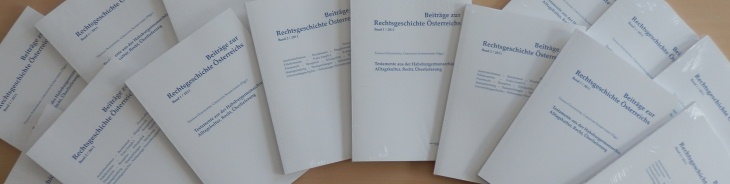
CALL FOR ARTICLES: Beiträge zur Rechtsgeschichte Österreichs - BRGÖ (Deadline: 1 SEPT 2023)


 (Image source: https://www.oeaw.ac.at/rechtsgeschichte/brgoe)


Die "Beiträge zur Rechtsgeschichte Österreichs - BRGÖ" sind eine peer reviewte Zeitschrift, die zweimal jährlich sowohl open access im Internet als auch im Druck im Verlag der Österreichischen Akademie der Wissenschaften erscheint. Sie bringt Beiträge zur allen Bereichen der Rechtsgeschichte (Verfassungsgeschichte, Privatrechtsgeschichte, Strafrechtsgeschichte, Geschichte der Rechtswissenschaften,...) vom Mittelalter bis ins 21. Jahrhundert. Der Begriff "Österreich" ist weit zu verstehen; auch Beiträge zu ehemals habsburgischen Ländern wie Böhmen, Ungarn, Galizien, Mailand oder Belgien, sowie zur Einbindung Österreichs in größere Einheiten, vom Heiligen Römischen Reich bis zur EU, sind herzlich willkommen! Angenommen können nur Originalbeiträge, die noch an keiner anderen Stelle publiziert oder zum Druck angenommen worden sind. Nähere Informationen zur Zeitschrift finden Sie hier:

https://www.oeaw.ac.at/rechtsgeschichte/brgoe

Besonders weisen wir Sie auf unsere ethischen Richtlinien und die Informationen zur peer review hin: https://www.oeaw.ac.at/fileadmin/kommissionen/rechtsgeschichte/pdf/publication_ethics_dt.pdf

Die Beiträge können in deutscher oder englischer Sprache eingereicht werden und sollten in der Regel 45.000 Zeichen (einschließlich Fußnoten und Leerzeichen) nicht übersteigen; nur in besonderen Fällen ist ein Abdruck auch längerer Beiträge möglich. Der Beitrag sollte eine Zusammenfassung in englischer Sprache (max. 1.000 Zeichen), sowie ca. 3-5 keywords in englischer Sprache umfassen. Die Autorinnen und Autoren werden gebeten, eine e-mail-Adresse, eine Postanschrift sowie ihre ORCID-Nummer (https://orcid.org) hinzuzufügen. Die Verwendung von Graphiken und Bildern in Farbe ist möglich und dort wünschenswert, wo dies der Unterstützung des Textes dient, sollte aber nicht für bloß illustrative Zwecke geschehen. Es wird in solchen Fällen gebeten, diese Graphiken/Bilder in einer separaten Datei mitzuschicken und im Manuskript die Stelle zu bezeichnen, an der die Graphik platziert werden soll.

Hinweise zur Manuskriptgestaltung und zu den Zitierrichtlinien finden Sie hier: https://www.oeaw.ac.at/fileadmin/kommissionen/rechtsgeschichte/pdf/zitierrichtlinien_dt.pdf

 
Beiträge für das kommende Heft mögen bis 1. September 2023 als Word-Dokument per e-mail an thomas.olechowski@oeaw.ac.at oder christoph.schmetterer@univie.ac.at geschickt werden.


28 July 2021

CALL FOR ARTICLES: Rechtskultur (DEADLINE: 30 October 2022)


(Source: Rechtskultur)

We learned of a call for contributions to the 2022 issue of Rechtskultur.

Law and Reconstruction after crisis will be the theme for the 2022 volume of Rechtskultur. The editors want to focus on law as a tool for social engineering and how it has been applied to reconstruct society after very different crises like the 30-years war, the cholera pandemics or the fall of the Berlin Wall. The editors welcome contributions from all relevant fields of science with a maximum length of 100 000 characters. Contributions should be submitted by using rechtskultur@ur.de within 30. October 2022. All contributions will be peer reviewed, and admittance for publications rests on the merits of the contribution alone. For further information please visit our wegpage www.rechtskultur.org

02 April 2020

CALL FOR ARTICLES: Adam Mickiewicz University Law Review (DEADLINE: 15 May 2020)


We learned of a call for articles from the Adam Kickiewizc University Law Review. Here the call:

The editorial board of the Adam Mickiewicz University Law Review welcomes new proposals for articles until May 15th 2020. Adam Mickiewicz University Law Review is a general peer-refereed journal designed to contribute original papers on theoretical, interdisciplinary, comparative and doctrinal oriented inquiries into the legal sciences. The journal seeks to take a broad approach to legal scholarship, publishing articles which cover issues from all branches of law. The Editorial Board of the journal welcomes original contributions in international and domestic law, with a special emphasis on the domestic legal systems of the European states, the theory and philosophy of law, and legal history.

ppuam@amu.edu.pl
ppuam.amu.edu.pl

21 November 2019

CALL FOR ARTICLES: Comparative Legal History (Routledge/ESCLH)


(image source: ESCLH)

Comparative Legal History is an international and comparative review of law and history. It was established in 2013, and it is the official journal of the European Society for Comparative Legal History.

The Journal welcomes articles, which explore 'internal' legal history (doctrinal and disciplinary developments in the law) or 'external' legal history (legal ideas and institutions in wider contexts). Rooted in the complexity of the various Western legal traditions worldwide, the articles can also investigate other laws and customs from around the globe. Comparisons may be either temporal or geographical, and both legal and other law-like normative traditions will be considered.
Scholarship on comparative and trans-national historiography, including trans-disciplinary approaches, is particularly welcome.

For further information on how to submit, see https://www.tandfonline.com/action/journalInformation?show=aimsScope&journalCode=rclh2

06 November 2018

CALL FOR ARTICLES: Widerstand gegen Rechtsvereinheitlichung / Against Unification of law / Contre Unification du droit (European Journal of Legal History - Journal européene d'histoire du droit) VIII (2019); DEADLINE 31 OCT 2019

(image source: Rechtskultur)

Call:
2019 wird der achte Band der Zeitschrift "Rechtskultur - European Journal of Legal History - Journal européene d'histoire du droit" erscheinen. Themenschwerpunkt ist "Widerstand gegen Rechtsvereinheitlichung / Against Unification of law / Contre Unification du droit". Die Herausgeber laden Wissenschaftlerinnen und Wissenschaftler aller einschlägigen Fachdisziplinen zur Einreichung von Beiträgen für Rechtskultur 8 (2019) ein.
Die Beiträge sollen sich mit Bestrebungen zur Vereinheitlichung von Recht in Geschichte und Gegenwart aus der Perspektive von Gegenkräften befassen. Sie sollen einen Umfang von 100.000 Zeichen nicht überschreiten und bis zum 31. Oktober 2019 bei der Redaktion eingehen, die unter rechtskultur@ur.de erreichbar ist.
"Rechtskultur" steht Autoren aller einschlägigen Wissenschaftsdisziplinen ohne Ansehen des universitären Status offen. Kriterien sind allein Themenbezug und Qualität eines Aufsatzes. Alle Manuskripte werden einer beiderseits anonymen Begutachtung unterzogen (double-blind peer review). 
Board:
Prof. Dr. Ignacio Czeguhn (FU Berlin); Prof. Dr. Lukas Gschwend (St. Gallen/Zürich); Prof. Dr. Dirk Heirbaut (Gent); Prof. Dr. Martin Löhnig (Regensburg); Prof. Dr. Antonio Sánchez Aranda (Granada)
More information:
Weiter Informationen: http://www.edition-rechtskultur.de/ ISSN: 2568-4469

(source HSozKult)
(see also journal website)

14 August 2018

CALL FOR CONTRIBUTIONS: Towards a History of Files – Vol. 4 of Administory (DEADLINE: 31 August 2018)


(Source: Administory)

We learned of a Call for Contributions from Administory – Zeitschrift für Verwaltungsgeschichte. Here the call: 

Call For Contributions: Towards a History of Files – vol. 4 of Administory
Towards a History of Files

Max Weber famously observed that the modern office is based upon »files«. In his characterization of the »bureau« he went as far as to say that it was composed of the »body of officials actively engaged in a ›public‹ office, along with the respective apparatus of material implements and the files« (Gerth/Wright Mills 1946: 197). In recent years, anthropologists, historians, literary critics and media historians as well as sociologists, have moved beyond reading documents just »as evidence of any kind of historical reality«, but rather as »testimonies of the practices and cultural techniques embodied by them«. (Siegert 2003: 25) Drawing from the study of discourse, materiality, cultural techniques as well as of science and technology, scholarship on bureaucracy increasingly examines the role of documentation processes in the life of institutions.

With respect to processes of administration this body of scholarship revealed that »bureaucracies don’t so much employ documents as they are partly constructed by and out of them« (Gitelman 2014: 5, referring to Hull 2012). Files are connecting administrative acts: »Every file note indirectly contains a command. Reporting the execution of an order triggers the next one. […] An executed command, then, has a double orientation: it generates the next command and notes its own execution.« (Vismann 2008: 8) In other words, records generate files and build a papery organism that embodies and at the same time realizes the logics of law, state, and government.

Based on this observation, we would like to develop the analytical viewpoint by strengthening the historical perspective. This opens several important questions. The first asks what actually is considered to be a file under specific historical circumstances? Some studies understand files chiefly as those administrative objects referred to as »files« in particular bureaucratic settings. More commonly, scholars follow Weber in identifying files as »written documents«. However, we want to attend to files as a particular documentary type, which was and is subject to change both as an integrative written record and as material artefact. Therefore, files belong to a particular genre of documentation and are defined by their relation to other records. Understanding files as artefacts, therefore, allows for an analysis of the historically specific ways through which documents are physically and discursively interrelated.

Related to this is the second questions which focuses on the role of political, medial, or material transformation for the ways in which files gather, organize, articulate, store, and circulate individual documents. Unlike other kinds of documents, whose completeness and temporal finality is essential to their function, files grow and expand unlimitedly. What effects have for example political transformations for this process? Are filing routines interrupted, efforts made to restore a continuity of documentation, to destroy or to hide files? Changes in mediality (e.g. the use typescripts instead of manuscripts, or more ephemeral notes as post-its instead of forms) will affect equally the potential of files for organizing and synthesizing the various kinds of paperwork. Do these changes affect the way in which people, places, things, and processes are transformed into cases and issues.

We invite contributions that explore files that shape or emerging during moments of political, medial, or material transformation. Situations of turbulence highlight specific qualities of files and therefore allow for observing particular qualities. We are looking for contributions dealing with cases outside Europe or North America as well as papers engaging with pre-modern times.

Issues/questions:
·       discourses dealing with files
·       structures of participation
·       laws, norms, procedures, techniques of production, access, circulation, storage
·       materiality, material media, including electronic media and their impact on files and vice versa
·       interaction of files and administrations, including human and non-human actors
·       material and reality effects of files
·       historical emergence of files
·       the file as a genre and its boundaries (ephemeral notes)
·       speech and writing (catastrophes for administrative writing e.g. destruction of files, telephone, type writer, post-its, email et cetera)

ADMINISTORY aims to foster debate on the history of states and administrations. With its innovative articles and broad methodological and theoretical spectrum, the yearbook is a key interface between historical and cultural science research, and discussions on the state and administration in the social, legal and political sciences. The yearbook publishes original contributions in English and German. On average, our articles contain 9000 words including footnotes.

If you intend to contribute to this volume, please submit a title and a short abstract (max. 2500 characters) by August 31 2018 to stefan.nellen@bar.admin.ch. We expect an outline sketch (around 10’000 characters) by end of September 2018 and the submission of the final article by end of January 2019.

For more information on the yearbook: https://adhi.univie.ac.at

Cited Literature
·       Hans Heinrich Gerth/Charles Wright Mills (eds.), From Max Weber. Essays in Sociology, New York 1946
·       Lisa Gitelman, Paper Knowledge. Toward a Media History of Documents, Durham/London 2014
·       Matthew S. Hull, Government of Paper. The Materiality of Bureaucracy in Urban Pakistan, Berkeley/Los Angeles/London 2012
·       Bernhard Siegert, Passage des Digitalen. Zeichenpraktiken der neuzeitlichen Wissenschaften 1500-1900, Berlin 2003
·       Cornelia Visman, Files. Law and Media Theory, Stanford 2008

09 July 2018

CALL FOR BLOGPOSTS: Online Symposium "Cultural Heritage in a Post-Colonial World - New Framings of a Global Legal Problem" - Völkerrechtsblog (DEADLINE 31 JUL 2018)

(image source: Völkerrechtsblog)
The Voelkerrechtsblog is happy to announce an interdisciplinary online symposium on “Cultural Heritage in a Post-colonial World – New Framings of a Global Legal Problem”. Cultural and anthropological objects from colonized or de-facto colonized territories have arrived in Europe in great amounts since the 18th century. Many European metropoles established large collections of those artefacts and human remains to display this shared “heritage” to their people – all projects closely tied to the upcoming political nationalism of that time. Last year, the stepback of professor Bénédicte Savoy from the committee advising the founding process of the new Humboldt Forum in Berlin and the promise of French president Emanuel Macron in Ouagadougou to restitute anthropological and cultural objects taken during French colonial rule caused a wide societal debate about the colonial provenance of collections and artworks in museums. In Germany, the complaint of the Ovaherero and Nama Peoples against the German state currently pending before a US court (see for a recent post on this topic on this blog here), illustrates that the colonial histories keep on haunting the old continent and reaches public opinion. This increased public debate can be considered a significant opportunity to think about the relationship with museums’ collections and cultural property of unclear provenance in general. The advancing globalization and the rising self-confidence of the former “colonized territories” will make these issues even more pressing in the future.
The aim of this symposium is to discuss the different challenges related to this ambivalent past. Up to now, the appropriation of cultural artefacts are mostly discussed in the context of Nazi-looted art. Seizures in asymmetrical and colonial contexts are just seldom a topic among international lawyers. That is why we want to ask: Which role can and should (international) law and its institutions play when dealing with such questions? We would like to encourage contributors to follow Savoy’s claim raised in her inaugural lecture at the Collège de France to reflect on legal constructions and concepts of private, public, and international law unthought of until today to address these issues. In addition, we are happy to welcome blogposts from other disciplines that open different perspectives on the topic.
Therefore, we invite contributions on any of these or further questions relevant to the symposium’s theme. Contributions should be around 1000-1500 words long, and are welcome in English, French, or German. The symposium will take place in the period of August and September 2018, contributions will be received till 31 July 2018. Please send us your texts or inquiries at ajv.kontakt@gmail.com.

29 November 2017

CALL FOR ARTICLES: Rechtskultur - European Journal of Legal History 2018 (Bankruptcy - Debts - Credit)

(image source: Edition Rechtskultur)

The 2018 issue of the review Rechtskultur- European Journal of Legal History has as theme: Bankruptcy - Debts - Credit. Authors who want to submit a text to the journal, should send it to martin.loehnig@jura.uni-regensburg-de, before 15 October 2018. 

Rechtskultur is open to authors of all recognized areas of study irrespective of their university status. All that matters is that an article be of very high quality and in tune with the theme of the issue. The 2019 issue will be on Resistance against legal unification. For more information, see

14 April 2017

CFA: Interpretatio Prudentium. Roman law and Roman legal tradition in review (deadline June 15, 2017)


WHAT Interpretatio Prudentium. Roman law and Roman legal tradition in review, Call for articles

WHEN deadline for submissions June 15, 2017

Interpretatio Prudentium is a biannual scientific journal with double-blind peer review published by Legal Theory and History – Research Center of the University of Lisbon (THD-ULisboa) promoting scholarly excellence research and a profound knowledge of Roman Jurisprudence and the Roman Legal Tradition while aiming at a critical understanding of contemporary legal phenomena.
The Executive Committee of Interpretatio Prudentium invites the academic community to submit papers (monographs or reviews of recent publications) to be included in the third issue.
The Journal publishes in any neolatine language, english or german. Articles, under 70.000 characters (spaces included), should be submitted for publication along with a summary (c.550 characters) and keywords (3-5), written in the original language of the article and in an additional language. Reviews should be up to 15.000 characters.
The submitted articles should be sent in Word format to the e-mail interpretatio@fd.ulisboa.ptwith carbon copy to the editorial secretary (claudiaeliasduarte@fd.ulisboa.pt). The deadline for the submission of papers is June 15, 2017.
The submitted articles are reviewed by members of the Scientific Committee of Interpretatio Prudentium, the identities of both reviewer and author remaining anonymous throughout the review process.