Search

13 February 2012

NOTICE: MUSSON & STEBBINGS ON MAKING LEGAL HISTORY

Cambridge University Press has just published Anthony Musson and Chantal Stebblings (eds), Making legal history: approaches and methodologies (2012).


The book is largely drawn from the British Legal History Conference held in Exeter in 2009. It also includes, however, David Ibbetson's 'Comparative legal history: a methodology', originally delivered at the European Society of Comparative Legal History (ESCLH)'s inaugural conference held in Valencia in 2010. It also includes several other ESCLH members.

The volume is described as:

Drawing together leading legal historians from a range of jurisdictions and cultures, this collection of essays addresses the fundamental methodological underpinning of legal history research. Via a broad chronological span and a wide range of topics, the contributors explore the approaches, methods and sources that together form the basis of their research and shed light on the complexities of researching into the history of the law. By exploring the challenges posed by visual, unwritten and quasi-legal sources, the difficulties posed by traditional archival material and the novelty of exploring the development of legal culture and comparative perspectives, the book reveals the richness and dynamism of legal history research.

Contents

  • Introduction Anthony Musson and Chantal Stebbings
  • Reflections on 'doing' legal history - Sir John Baker
  • Editing law reports and doing legal history: compatible or incompatible projects - Paul Brand
  • The indispensability of manuscript case notes to eighteenth-century barristers and judges - James Oldham
  • Judging the judges: the reputations of nineteenth century judges and their sources - Patrick Polden
  • Benefits and barriers: the making of Victorian legal history - Chantal Stebbings
  • The historical turn in late nineteenth-century American legal thought - David M. Rabban
  • The methodological debates in German speaking Europe (1960–1990) - Marcel Senn
  • Exploring the minds of lawyers: the duty of the legal historian to write the books of non-written law - Dirk Heirbaut
  • Comparative legal history: a methodology - David Ibbetson
  • 'They put to the torture all the ancient monuments': reflections on making eighteenth-century Irish legal history - Sean Donlan
  • The politics of historiography and the taxonomies of the colonial past: law, history and the tribes - Paul McHugh
  • Lay legal history - Wilf Prest
  • Antiquarianism and legal history - Michael Stuckey
  • Re-examining King John and Magna Carta: reflections on reasons, methodology and methods - Jane Frecknall-Hughes
  • Visual sources: mirror of justice or 'through a glass darkly'? - Anthony Musson
  • Sanctity, superstition and the death of Sarah Jacob - Richard Ireland.

NOTICE: New Issue of SOLON: Promoting Interdisciplinary Studies in Law, Crime and History

The latest edition of SOLON: Promoting Interdisciplinary Studies in Law, Crime and History is now live at:


The articles include:
  • Tom Smith, Zealous Advocates: The Historical Foundations of the Adversarial Criminal Defence Lawyer
  • Vicky Holmes, Absent Fireguards and Burnt Children: Coroners and the Development of Clause 15 of the Children Act 1908
  • Stefan Slater, Street Disorder in the Metropolis, 1905-39
Contact: solon@plymouth.ac.uk

08 February 2012

CALL FOR PAPERS: Australia New Zealand Law & History Society

The following Call for Papers was lifted straight from the Legal History Blog:

CFP: Australia New Zealand Law & History Society

Posted by Dan Ernst 

[Here's a call for papers for what appears to be a particularly well-crafted annual meeting of Antipodean legal historians, to be held at the University of Technology, Sydney (UTS). The organizers tell me that they are keen to have "many of our North American colleagues" attend. Here is the link to the conference website; here a link to another conference at UTS, on the "historical connections" between the legal profession and defense forces; here a link to yet another, on feminism and the law that will include "revisiting the past."]

The 31st Annual Conference of the Australia New Zealand Law and History Society will be held at the University of Technology, Sydney (UTS), 10-12 December 2012. UTS is the most centrally located law school in Sydney, situated next to Central Station, on the edge of China Town, three minutes by monorail from Sydney’s central shopping district and a short trip to the harbour by direct train or bus.

The conference theme is “Receiving Laws/Giving Laws”. It is orientated towards the movement, transmission and transformation of laws and their histories – across Empire, through time, in and between genres and disciplines. The receiving and giving of laws could be addressed in a broad range of ways. How do laws and histories translocate? By what means (doctrinal, processual, cultural) are laws transmitted and received in new places? What transformations happen as a result of this movement? Whose histories, cultures and laws appear and disappear through these transformations? What kinds of interventions can bring about ways of transforming, perceiving and transmitting the law and its histories/cultures?

The keynote speaker is Professor Philip Girard, University Research Professor and Professor of Law, History & Canadian Studies, Schulich School of Law, Dalhousie University. There will also be a plenary panel in which three scholars will address the theme of the conference, each through a different genre of legal history: Professor Anne Orford, Melbourne Law School; Dr Katherine Biber, School of Law, UTS; Dr Damen Ward, Crown Law Office, Wellington.

The organising committee would welcome interest from historians from any jurisdiction. The call for papers will be open until late June. Inquiries or paper proposals - including a title, brief abstract and brief biography - should be sent to shaunnagh.dorsett@uts.edu.au

07 February 2012

NOTICE: Ando on Law, Language, and Empire in the Roman Tradition

The Legal History Blog recently posted a notice on Clifford Ando's Law, Language, and Empire in the Roman Tradition (2011). It will be of interest to many of you. They wrote:

Clifford Ando, Professor of Classics, History, and Law at the University of Chicago, discusses his new book Law, Language, and Empire in the Roman Tradition (University of Pennsylvania Press) in a recent issue of Rorotoko.

On the book "in a nutshell":

For complicated reasons, Roman law as an academic discipline long remained fixated on describing its rules. How did one write a will at Rome? What was the age of marriage? Books had titles like “The Roman law of slavery.”

My book attempts to side-step questions about what Romans lawyers thought—in order to ask about how they thought. Why did they think law changed? How did they think change in the law could or should be justified? And how did they think legal institutions could or should adapt to social change?

For the fact of the matter was, Roman society was in constant flux. . . .

On how he came to the project:

Despite popular visions of Rome as a society of empire and of laws, this was not how professional historians saw the matter. For a generation at least, the dominant picture had instead been of ancient government as minimalist in its achievements and even its intents.

I therefore embarked on a large-scale history of the role of government in social and cultural change. To do that, I had to take Roman law more seriously than I had in the past.

Ando concludes with some thoughts about the book's broader significance. He hopes it will "draw attention to the astonishing creativity of Roman lawyers," as well as to "an understudied problem in the history of the Roman law, namely, the historical priority of private law at Rome, in contrast to all other forms of legal thought."

Read on here.

CALL FOR PAPERS: British Crime Historians Symposium

Call for papers
British Crime Historians Symposium 3
6-7 September, 2012, The Open University, Milton Keynes

[My apologies for the late posting. The Call for Papers has, unfortunately, now passed.]

Following on from the success of the British Crime Historians Symposia at Leeds Metropolitan University in 2008 and Sheffield University in 2010, the Open University is pleased to host the next in Milton Keynes on September 6th and 7th, 2012.

We would like this to be an opportunity for all those who work on the criminal justice history of the British Isles, or on other topics illuminated through criminal justice archives, to participate. We would like therefore to invite papers on any aspect of the history of criminal justice in the British Isles.

We are also especially keen to accept papers which:

• survey the historiography of this field,
• discuss methodological questions with a broader applicability,
• analyse historiographical developments in other countries with a view to informing the research agenda in the British Isles, or
• assess the public history of criminal justice.

Given the gratifyingly large number of historians studying this topic and the need to keep the meeting as affordable as possible while not fragmenting it into an excessive number of parallel sessions, it is unlikely that we will be able to give a verbal presentation slot to everyone who has something interesting to say. Thus we are also keen to receive proposals for poster presentations: we would particularly like to give space to posters from graduate students at any stage in their research. We will make sure that there is a critical mass of posters and that they are a central feature of the conference. We are also open to being approached with proposals for panels of papers on a linked theme.

The deadline for (200-word) abstracts for (15-20 minute) papers, panels (of 3-5 speakers) and (A1) posters is January 31st 2011. Please submit to BCHS2012@open.ac.uk. For further information, contact Paul Lawrence (p.m.lawrence@open.ac.uk) or Chris Williams (chris.williams@open.ac.uk). We will distribute a preliminary version of the programme by February 29th 2012.

06 February 2012

NOTICE: Law and the French Atlantic Symposium

2012-13 Symposium on Comparative Early Modern Legal History  

Friday, October 5, 2012 

9:00 a.m.-5:00 p.m. 

Law and the French Atlantic 

 Organized by Allan Greer, McGill University, and Richard J. Ross, University of Illinois at Urbana-Champaign.

HomeThe French Atlantic has not yet received the sustained attention given to the British and Spanish Atlantic, particularly where the topic of law is concerned.  This conference will explore the legal dimension (broadly conceived) of the French Atlantic empire in the early modern period.  The variegated and rapidly evolving juridical order of ancien régime France was deeply implicated in the expansion of overseas commerce, the founding of colonies, and the creation of imperial administrations.

Participants may explore topics such as: legal discourse and imperial ideologies; the establishment of colonial jurisdictions in Canada, Louisiana, and the French West Indies; the regulation of slavery; indigenous peoples and the law; the emergence of colonial land tenures; and the legal framework for trade and business enterprise.  The organizers wish particularly to encourage comparative approaches that consider more than one French colony and that examine contrasts and convergences with the British, Spanish and Portuguese empires.  In according due attention to the distinctive features of French law and the French New World empire, we hope to enrich understandings of Atlantic history generally.

04 February 2012

CALL FOR PAPERS: New Perspectives on locatio conductio in Roman law

New Perspectives on locatio conductio in Roman law
6 – 8 June 2012, Edinburgh


In the nearly 100 years since the publication of Emilio Costa’s La locazione di cose nel diritto romano (1915), the first monograph of the twentieth-century on letting and hiring in Roman law, modern understanding of this contract has changed significantly. The reasons for this are mainly twofold. First, scholars of Roman law, while still largely engaged in purely dogmatic investigations of the origins and development of legal rules and of the contributions of individual Roman jurists to this process, are slowly becoming more aware of the contexts in which these rules operated and their relation to Roman society such as, for example, in the work of Bruce Frier (Landlords and Tenants in Imperial Rome (1980)) and Dennis Kehoe (Investment, Profit and Tenancy: the Jurists and the Roman Agrarian Economy (1998)), to name but a few. In second place, the publication in 1999 of Roberto Fiori’s La definizione della ‘locatio conductio’ (1999) comprehensively transformed modern understanding of the conceptual structure of this contract and finally laid to rest the much debated issue of the “trichotomy”. The aim of this conference is to bring together scholars with an interest in locatio conductio in Roman law (whether in Roman private or public law) to explore new insights (dogmatic, social, economic) into the origin and growth of this contract.

Deadline for submission of proposals: Friday 30 March 2012

For more information or to submit and abstract, please email Dr. Paul J. du Plessis (p.duplessis@ed.ac.uk)

03 February 2012

CALL FOR PARTICIPANTS: Jurisdictional Complexity Workshop

Jurisdictional Complexity Workshop

Ghent University (Belgium) - 6-7 July 2012

As part of a project on ‘jurisdictional complexity’ in Western legal history (c1600-1900), led by Dr Seán Patrick Donlan (Limerick) and Dirk Heirbaut (Ghent), a workshop will be held in Ghent from 6-7 July 2012.


Participants in the workshop need not be part of the project and are free to discuss other periods and places. 

The workshop will focus on the historiographical methods necessary for the study of jurisdictional complexity, the attempt to capture a sense of the legal-normative whole in context studied. As described in the project statement, to do this:

[t]hose working on the project will be encouraged to utilise a number of interdisciplinary methods—comparative, contemporary theories of interpretation, as well as historical anthropology, geography, and sociology …. [The project] is, in effect, an analysis of the both the ‘law in action’ (per Roscoe Pound) and the ‘living law’ (per Eugen Ehrlich) of the past. Concentrating on limited geographical areas, its case studies will investigate, in a form akin to modern comparative ‘country reports’, both the legal and normative complexity of the past. It will do so, however, in light of the realities of the past, avoiding the imposition of modern national and juridical boundaries [and will] serve as instantiations of wider intellectual and institutional developments….

For additional information, contact Dr Seán Patrick Donlan (sean.donlan@ul.ie) or Dirk Heirbaut (Dirk.Heirbaut@UGent.be). Those interested in participating should contact Dr Donlan with a short abstract (approximately 250 words) and a curriculum vitae, ideally before 1 May 2012. Depending on the number of participants, presentations are likely to be approximately 15-20 minutes and should be in English.

There is no fee for participation, but participants will be expected to cover their own travel, accomodation, and meal costs.

Finally, note that this gathering immediately precedes the European Society for Comparative Legal History Conference to be held in Amsterdam (9-10 July 2012). Participants in that conference might consider visiting us in advance of that event.

02 February 2012

NOTICE: ESCLH Conference Registration

REGISTRATION

Second Biennial Conference of the

The Second Biennial Conference of the ESCLH will take place on 9 and 10 July 2012 in Amsterdam. The venue is the campus of the VU University. 

The Conference theme is “Comparative Legal History - Definitions and Challenges”: how do we delineate the landmarks which fruitful legal historical comparison requires and which are the specific problems that a comparative-historical approach of the various branches of law may encounter? 

Subthemes are Fascist Criminal Law (coordinator Stephen Skinner) and Corporate Law (coordinator Dave De ruysscher).

Enrolment/Registration is possible through the conference website until June 11: http://www.rechten.vu.nl/comparativelegalhistory

The fee (including coffee/tea during the breaks, drinks on Monday afternoon, the lunch and canal round trip on Tuesday) is €100 for non-members and €50 for students and PhD-students. ESCLH-members enroll free of charge. For the Buffet-Diner on Monday night an additional fee of €40 per head will be required for all participants (members, non-members and companions).

For additional information, please see the original notice.

NOTICE: Radding on Justinian


THE VOLTERRA LECTURE

PROFESSOR CHARLES RADDING (Michigan State University)
The Recovery and Use of Justinian’s Code In Eleventh-Century Italy 

Wednesday, 29th February 2012, 5.30pm 
Chancellor’s Hall, 
First Floor, South Block, SENATE HOUSE, 
Malet Street, London, WC1E 7HU 

All Welcome 

To be followed by a reception
Any enquiries please to Dr Simon Corcoran.
Tel: 02076793614. Email: s.corcoran@ucl.ac.uk 
Website: http://www.ucl.ac.uk/history2/volterra

31 January 2012

This interesting request recently appeared in H-Net:

Dear legal historian:

The American Society for Legal History's Graduate Student Outreach Committee seeks your legal history syllabi. If you have taught a legal history course, please send me a copy of your syllabus. All fields (U.S., non-U.S., ancient, modern) and all levels (graduate, undergraduate, law school, advanced seminar, introductory survey) accepted. Please send syllabi as e-mail attachments to: John Wertheimer, Davidson College, jowertheimer@davidson.edu

20 January 2012

NOTICE: The William Nelson Cromwell Foundation Prize for American Legal History

H-Net has circulated the following notice:

The William Nelson Cromwell Foundation has generously funded a prize of $2,500 for an excellent article in American legal history published by an early career scholar in 2011. Articles published in 2011 in the field of American legal history, broadly conceived, will be considered. There is a preference for articles in the colonial and early National periods. Articles published in the Law and History Review are eligible for the Surrency Prize and will not be considered for the Cromwell Article Prize.

The Cromwell Foundation makes the final award, in consultation with a subcommittee from the American Society for Legal History. This subcommittee invites nominations for the article prize; authors are invited to nominate themselves or others may nominate works meeting the criteria that they have read and enjoyed. Please send a brief letter of nomination no longer than a page, along with an electronic or hard copy of the article, by May 31, 2012, to the subcommittee's chair, Alfred Brophy, University of North Carolina School of Law, Campus Box #3380, Chapel Hill, NC 27599-3380 or via email abrophy@email.unc.edu

14 January 2012

NOTICE: Law and History Review Editorship


After seven years of exceptional service, David Tanenhaus has decided to step down as editor of the Law and History Review, which is sponsored by the American Society for Legal History and published by the Cambridge University Press. The ASLH Publications Committee invites applications for the position. Applicants should be members of the Society who are accomplished legal historians, have the intellectual range to work with manuscripts from different periods and regions in legal history, and are conversant with both law and history. The departmental or institutional support required for the position is usually modest.

The editor's responsibilities include soliciting manuscripts in all fields of legal history, shepherding submitted manuscripts through the peer review and editorial processes, working with the journal's print and electronic publisher Cambridge University Press, and maintaining collaborative relationships with the journal's Editorial Board and the Board ASLH Board of Directors. Production management is the responsibility of the Cambridge University Press. Appointment is for an initial five-year term.

Call for Nominations - Honorary Fellows of the American Society for Legal History

The following Call for Nominations for Honorary Fellows of the American Society for Legal History was recently circulated:

In 2011 the American Society for Legal History made some important changes to its processes for electing Honorary Fellows of the Society. First, it abandoned the distinction it had formerly drawn between Honorary Fellows (limited to residents of the U.S. and Canada) and Corresponding Fellows (the rest of the world). Recognizing that we live in an increasingly globalized world, from now on there will be only one category of Honorary Fellows for all legal historians wherever they may be. (Existing Corresponding Fellows may maintain that title or choose to become Honorary Fellows.) Second, recognizing that the number of legal historians both in the United States and world-wide has greatly expanded in recent years, the society has abandoned any upper limit on the total number of Honorary Fellows that may be recognized at any given time. The only limitation is that no more than three Honorary Fellows may be elected in any given year.

05 January 2012

NOTICE: Raoul Berger-Mark DeWolfe Howe Legal History Fellowship

Image DetailRaoul Berger-Mark DeWolfe Howe Legal History Fellowship

Harvard Law School is seeking fellows who have a J.D. degree, who have completed the required coursework for their doctorate degree, or who have recently been awarded the doctorate degree. A J.D. is preferred, but not required. We will also consider applicants who are beginning a teaching career in either law or history. The purpose of the fellowship is to enable the fellow to complete a major piece of writing in the field of legal history, broadly defined. There are no limitations as to geographical area or time period.

Fellows are expected to spend the majority of their time on their own research. They are also asked to help coordinate the Harvard Law School Legal History Colloquium, which meets five or six times each semester. Fellows are invited to present their own work. Fellows will be required to be in residence at law school during the academic year (September through May).

Applicants for the fellowship for 2012-13 should address a letter to Professor Bruce H. Mann at the Harvard Law School, Cambridge, MA 02318.

29 December 2011

FINAL CALL FOR PAPERS: ESCLH Conference

The ESCLH Conference will be held in Amsterdam from 9-10 July 2012. The theme is 'Comparative Legal History - Definitions and Challenges' and the deadline for proposals is this Sunday, 1 January 2012.

For additional information, see the original conference notice and the conference website.

19 December 2011

REMINDER: European Society for Comparative Legal History Conference (9-10 July 2012)

The Second ESCLH Conference will be held in Amsterdam from 9-10 July 2012. The deadline for proposals is fast approaching (1 January 2012).

The theme is:

COMPARATIVE LEGAL HISTORY
Definitions and Challenges

The conference:

will try to delineate the landmarks which fruitful legal historical comparison requires and to trace the specific problems that a comparative-historical approach of the various branches of law may encounter. The keynote address will be delivered by David Ibbetson, Regius Professor of Civil Law at the University of Cambridge.

The deadline for proposals is 1 January 2012. For additional information, see the original conference notice and the conference website.

18 December 2011

CALL FOR PAPERS: The Irish Constitution: Past, Present and Future

The Constitutional Studies Group at University College Dublin invites submissions for a conference on “The Irish Constitution: Past, Present and Future”. The conference is being organised to mark the 75th anniversary of the enactment of the current Irish Constitution and will take place in Dublin between June 28th and 30th, 2012.


The conference line-up will feature a range of distinguished speakers from Ireland and other jurisdictions. Confirmed participants so far include:
• The Chief Justice of Ireland, the Hon. Mrs. Justice Susan Denham
• The Hon. Mr. Justice Donal O'Donnell of the Supreme Court
• Prof. Philip Pettit (Princeton)

• Prof. Mark Tushnet (Harvard)

• Prof. Cheryl Saunders (Melbourne)

• Prof. Deirdre Curtin (Amsterdam)

• Prof Gerry Whyte (TCD)

• Prof. Martin Loughlin (LSE)

• Dr. Aileen Kavanagh (Oxford)

• Dr. Colm O’Cinneide (UCL)

The conference organisers welcome proposals from all disciplines on any topic relevant to Irish constitutionalism. Proposed papers are not required to focus on Irish law alone. The organisers particularly welcome submissions from a comparative, conceptual or inter-disciplinary perspective.

NOTICE: Rivista di Diritto Ellenico

The Rechtsgeschiedenis Blog just announced the following:

A few days ago the French legal history blog Nomôdos, the twin sister of the e-journal Clio@Themis, announced the first issue of the Rivista di Diritto Ellenico, a journal devoted to the study of ancient Greek law.

This new journal is edited by scholars at Torino, Isernia and Verona. The Rivista di Diritto Ellenico is published in open access, but there is a connection with the publishing firm Edizioni dell’Orso in Alessandria. The first issue of the Rivista di Diritto Ellenico contains eleven articles and seven book reviews. The translation in Italian of an article from 1963 by Hans-Julius Wolff, ‘Verjährung von Ansprüchen nach Attischen Recht’, is a service which could very well be inspired by the translation into French of classic articles in each issue of Clio@Themis. All contributions in the first issue are in Italian. However, the editors invite authors to submit articles in Italian, English, French, German, Dutch, Spanish and modern Greek. 

15 December 2011

NOTICE: 66th Session of the Société Internationale ‘Fernand de Visscher’ pour l’Histoire des Droits de l’Antiquité (SIHDA)

The following notice on 66th Session of the Société Internationale ‘Fernand de Visscher’ pour l’Histoire des Droits de l’Antiquité (SIHDA) will take place from 18-21 September 2012 in Oxford.


The notice reads:

First circular
Oxford
14 December 2011

Dear colleages,

I am very pleased to invite you to the 66th Session of the Société Internationale ‘Fernand de Visscher’ pour l’Histoire des Droits de l’Antiquité (SIHDA), which will take place from 18 to 21 September 2012 in Oxford. In accordance with the decision taken by the last General Assembly, the theme of the congress will be Reception of Law.

In this First Circular I shall provide you with general information regarding the congress. In the course of January you will receive a Second Circular with information on how to registration.

The congress will start in the afternoon of Tuesday 18 September and end on Friday 21 September with the General Assembly. A Banquet dinner is foreseen for that Friday night, and excursions are planned for Saturday 22 September.

The theme is ‘Reception of Law’. It is a wide theme, which covers, e.g., the reception of Assyrian law by the Mesopotamians, Greek law by Egyptians, Roman law by the Greeks in the 4th and 5th century, by the Gallic population in the 6th century, but also, as the name of our association implies (‘Histoire des droits de l’Antiquité’), the reception of Roman law after 1100, and I welcome particularly contributions concerning the reception of Roman law after 1100 in Europe, the ‘Civil Law’. Yet, as is the custom of our association, papers on other themes than the proposed are of course always welcome and appreciated, in one of the five accepted languages (French, English, German, Italian and Spanish).

11 December 2011

NOTICE: Griffith Law School’s Legal History Seminar Series

Information on the Griffith Law School (Australia) Legal History Seminar Series. The Series:

is a gesture to the interdisciplinary turns in legal history, and a contribution to the innovation at the heart of much contemporary legal history scholarship.

The Griffith Law School Legal History Seminar Series

The LHSS aims to showcase legal history’s international and comparative flavour; it welcomes all who are interested in legal history’s present and future significance. Its aim is to participate in reinvigorating, and enlivening, an interest in the critically reflective directions of legal history, both in Queensland and elsewhere.

26 November 2011

CALL FOR PAPERS: New Historia et Ius Journal

Historia et Ius is an on-line International journal dedicated to medieval, modern and contemporary historical legal studies. Founded after the initiative of a group Italian legal historians, the journal is supported by an editorial board composed by European legal historians of high scientific profile.


The journal’s main purpose is to provide an agile and easy to use tool aimed at disseminating the results of legal-historical researches at the international level, as well as facilitating the exchange of ideas and methods.

Historia et Ius, International journal of medieval and modern legal history, invites interested scholars to send articles and texts for publication in the No. 1 of the journal, which will be posted on the web on the 1st of July, 2012. Articles and texts for publication should be sent to the editorial board by the 29th of February, 2012.

REMINDER: ESCLH Conference (9-10 July 2012)

The Second ESCLH Conference will be held in Amsterdam from 9-10 July 2012. The theme is:

COMPARATIVE LEGAL HISTORY
Definitions and Challenges


Under the heading “Definitions and Challenges” the confernce will try to delineate the landmarks which fruitful legal historical comparison requires and to trace the specific problems that a comparative-historical approach of the various branches of law may encounter. The keynote address will be delivered by David Ibbetson, Regius Professor of Civil Law at the University of Cambridge.

The deadline for proposals is 1 January 2012. For additional information, see the original conference notice and the conference website.

25 November 2011

NOTICE: The Irish Legal History Bursary

The Irish Legal History Bursary

The Irish Legal History Society administers the Irish Legal History Bursary which was established to subvent the travelling expenses of postgraduate students undertaking research into any aspect to Irish legal history.

There is a fund of up to €1,000 available annually. The closing date for applications for the new round is 30 January 2012. Further details may be obtained from one of the Joint Secretaries of the Society (Dr. Níamh Howlin: n.howlin@qub.ac.uk or Dr. Thomas Mohr: thomas.mohr@ucd.ie):

1. Eligibility:

1.1 Applicants for the Bursary should normally hold at least a second class degree in law or history.

1.2 The Bursary is restricted to student members of the Irish Legal History Society; student membership costs €20 / £15 per annum. Details and membership forms are available at: http://www.ilhs.eu/become_a_member.asp

1.3 The award may be made to any postgraduate student undertaking research into any aspect of Irish legal history. Preference will be shown to postgraduate research students, but others are eligible to apply, including those pursuing taught postgraduate degree programmes provided that such programmes have a substantial research component.

1.4 ‘Legal history’ includes the development or history of legal rules, legal institutions, legal procedures or the legal profession; biographical sketches of legal personalities; the development of legal theories or ideas; comparative legal history.

23 November 2011

Call for Papers: 2012 Meeting of the American Society for Legal History

The 2012 meeting of the American Society for Legal History will take place in St. Louis, Missouri, November 8-11, 2012. The ASLH invites proposals on any facet or period of legal history, anywhere in the world. In selecting presenters, the Program Committee will give preference to those who did not present at last year’s meeting. Among the people selected to present, limited financial assistance will be available for those in need—with special priority given to graduate students and post-docs, as well as scholars traveling from abroad.

14 November 2011

CALL FOR PAPERS: British Crime Historians Symposium 3

Call for papers: British Crime Historians Symposium 3
6-7 September, 2012, The Open University, Milton Keynes


Following on from the success of the British Crime Historians Symposia at Leeds Metropolitan University in 2008 and Sheffield University in 2010, the Open University is pleased to host the next in Milton Keynes on September 6th and 7th, 2012.

We would like this to be an opportunity for all those who work on the criminal justice history of the British Isles, or on other topics illuminated through criminal justice archives, to participate. We would like therefore to invite papers on any aspect of the history of criminal justice in the British Isles.

We are also especially keen to accept papers which:

* survey the historiography of this field,
* discuss methodological questions with a broader applicability,* analyse historiographical developments in other countries with a view to informing the research agenda in the British Isles, or
* assess the public history of criminal justice.

11 November 2011

New Issue: Journal of the History of International Law - Revue d'histoire du droit international XIII (2011), nr. 2


The latest issue of the Journal of the History of International Law / Revue d'histoire du droit international (Vol. XIII (2011), nr. 2) appeared earlier this week:

Contents:
  • John Quigley, Britain's Secret Re-Assessment of the Balfour Declaration. The Perfidy of Albion
  • Yang Zewei, Western International Law and China's Confucianism in the 19th Century. Collision and Integration
  • Awalou Ouedraogo, La neutralité et l'émergence du concept de due diligence en droit international. L'affaire de l'Alabama revisitée
  • Frederik Dhondt, From Contract to Treaty. The Legal Transformation of the Spanish Succession 1659-1713
  • William E. Butler, David Bailie Warden and the Development of American Consular Law

03 November 2011

CALLS FOR APPLICATIONS: IMéRA and IEA

Dear colleagues,

Are you looking for a new job or challenge? Good news! I can draw your attention to the following calls for application in France:

- l'Institut Méditerranéen de Recherches Avancées (IMéRA)
- l'Institut d'Etudes avancées (IEA) Paris

Follow the links for more information.

02 November 2011

CALL FOR PAPERS: Violence Studies Conference 2012

I've been asked to post the following:

Violence Studies Conference 2012
Call for Papers


The Humanities Research Institute at the University of Newcastle invites academics from a wide a variety of disciplines — including anthropology, art, criminology, history, international relations, law, literature, psychology, philosophy, political science and sociology — to submit proposals for panels and individual papers at its conference, Histories of Violence, to be held in the city of Newcastle from 21-23 August 2012.

Plenary speakers:

Arjun Appadurai, New York University
Rosemary Gartner, University of Toronto
Gyanendra Pandey, Emory University

01 November 2011

CALL FOR PAPERS: Entanglements in Legal History: Conceptual Approaches to Global Legal History

I've been asked to post the following exciting conference:

Entanglements in Legal History:
Conceptual Approaches to Global Legal History
Conference of Legal Historian, Lucerne – 2-6 September 2012
Conference MPI, Frankfurt -

Global History, World History, Imperial History, Atlantic or Pacific History: the variety of transnational historiography is growing ever larger. Hitherto, legal historians have rarely participated in these discourses. On a favourable interpretation, one could argue that legal historians have always thought, researched and worked transnationally – yet this might have different reasons.

It is certain that, in legal history, the exchange and overlapping of different normative spheres beyond territorially-constrained statehood has been the norm: the tiered territorial and legal spheres of influence of antique empires, stratified societies with their regulations tied to civil status, the coexistence of secular normativity and clerical normativity intersecting the secular realm, and finally the complex processes of the period of the ‘Reception’ belong to the classic objects of legal historical research. It has also become clear that the encounter of two hitherto co-existing normative orders, through the intensified exchange and communication since the 16th and particularly during the 19th century in two waves of globalisation, has attracted the interest of legal history.

29 October 2011

NOTICE: Becker on Medicine, Law, and the State in Imperial Russia

Elisa M Becker (George Washington University)'s Medicine, Law, and the State in Imperial Russia, from the Central European University (CEU) Press might be of interest:

Examines the theoretical and practical outlook of forensic physicians in Imperial Russia, from the 18th to the early 20th centuries, arguing that the interaction between state and these professionals shaped processes of reform in contemporary Russia. It demonstrates the ways in which the professional evolution of forensic psychiatry in Russia took a different turn from Western models, and how the process of professionalization in late imperial Russia became associated with liberal legal reform and led to the transformation of the autocratic state system.

19 October 2011

Call for Papers: XVIIIth Annual Forum of Young Legal Historians (30 May-2 June 2012)

The XVIIIth Annual Forum of Young Legal Historians of the Association of Young Legal Historians (AYLH) will be held in Vienna from 30 May-2 June 2012. The theme is “Making things legal”: Law-making and procedural reality in the European legal traditions:


The secular tradition of modern European jurisprudence agrees on the basic assumption that law is actually ‘made’ in one way or another. The conditions and procedures of law-making are subject to constant change and, accordingly, the creation of legal norms is one of the major areas of research for legal historians. The questions they ask relate to the legitimacy of normative acts, their economic, political and social impetus or even the media of their representation. Scholars direct their attention at all stages of the legislative process, i.e. from the very first considerations to the publication of a legal act.

14 October 2011

NOTICE: Brown and Donlan on The Laws and Other Legalities of Ireland, 1689–1850

Michael Brown (Aberdeen) and Seán Patrick Donlan (Limerick) have published, with Ashgate, The Laws and Other Legalities of Ireland, 1689–1850:

The Laws and Other Legalities of Ireland, 1689-1850This collection is the first to concentrate attention on the actual relationship that existed between the Irish population and the state under which they lived from the War of the Two Kings (1689–1691) and the Great Famine (1845–1849). Particular attention is paid to an understanding of the legal character of the state and the reach of the rule of law, addressing such themes as how law was made and put into effect; how ordinary people experienced the law and social regulations; and how Catholics related to the legal institutions of the Protestant confessional state. These themes will help to situate the study of Irish society into the mainstream of English and European social history.

The contents include:
  • The laws in Ireland, 1689–1850: a brief introduction, Michael Brown and Seán Patrick Donlan

07 October 2011

NOTICE: Rockwell on Spanish and Mexican Law (Lawbook Exchange)

As part of its extraordinary and ongoing mission to republish valuable legal texts of the past, the Lawbook Exchange has announced the publication of

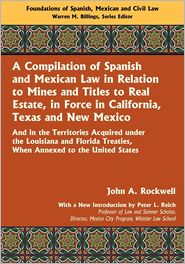
John A Rockwell, A Compilation of Spanish and Mexican Law in Relation to Mines and Titles to Real Estate, in Force in California, Texas and New Mexico; and in the Territories Acquired Under the Louisiana and Florida Treaties When Annexed to the United States (1851), with a new introduction by Peter L Reich

This is the latest text from the Foundations of Spanish, Mexican and Civil Law series (Warren M Billings, series editor). Other titles in the series include:
  • Laws and Decrees of the State of Coahuila and Texas in Spanish and English (1839), JP Kimball, trs., with a new introduction by Joseph W McKnight.
  • Joseph M White, A New Collection of Laws, Charters and Local Ordinances of the Governments of Great Britain, France and Spain: Relating to the Concessions of Land in their Respective Colonies, Together with the Laws of Mexico and Texas on the Same Subject, to Which is Prefixed Judge Johnson's Translation of Azo and Manuel's Institutes of the Civil Law of Spain (1839), with a new introduction by Agustin Parise.

06 October 2011

NOTICE: Morigiwa, Stolleis, and Halperin on the Interpretation of Law in the Age of Enlightenment

I’ve just become aware of the release (by Springer) of a very interesting text by Yasutomo Morigiwa, Michael Stolleis, and Jean-Louis Halperin (eds), Interpretation of Law in the Age of Enlightenment: From the Rule of the King to the Rule of Law (2011):

This book examines the actual practice of the interpretation of law in the Age of Enlightenment versus the ideology of the Age and explains the reason for and difference between the two. The ideology of the Age of Enlightenment was that law, i.e., the will of the sovereign, can be explicitly and appropriately stated, thus making interpretation redundant. However, the reality was that in the 18th century, there was no one leading source of national law that would be the object of interpretation. Instead, there was a plurality of sources of law: the Roman Law, local customary law, and the royal ordinance. Yet, in deciding a case in a court of law, the law must speak with one voice, making interpretation to unify the norms inevitable. This book discusses the process involved and the role played by justification in terms of reason - the hallmark of Enlightenment.

The table of contents includes:

Editors’ Preface; Morigiwa Yasutomo, Michael Stolleis, Jean-Louis Halpérin.- Foreword from the Herstec Project; Sato Shoichi.- About the Contributors.- I. Introduction.- Judicial Interpretation in Transition from the Ancien Régime to Constitutionalism; Michael Stolleis.- II. The case of France.- Legal Interpretation in France under the Reign of Louis XVI through the Gazette des Tribunaux; Jean-Louis Halpérin.- Legal Interpretation through the Case Law Book of the Parlement de Flandre; Serge Dauchy.- II. The case of Germany.- The Object of Interpretation: Legislation and Competing Normative Sources of Law in Europe during the 16th to 18th Centuries; Heinz Mohnhaupt.- The Concept and Means of Legal Interpretation in the 18th Century; Jan Schröder.- Necessity: Pandectists between Norm and Reality (1780-1870); Hans-Peter Haferkamp.- IV. The Nature of Legal Interpretation.- Interpretation by Another Name; Morigiwa Yasutomo.- What is Interpretation of the Law for the French Judge? Michel Troper.- The Craft of Interpretation ; Bradley Wendel.- Concluding Remarks.- Legal Interpretation in 18th Century Europe: Doctrinal Debates versus Political Change ; Jean-Louis Halpérin.- Index.