Search

Showing posts with label litigation. Show all posts

12 May 2026

BOOK: Niels FIEREMANS, Law, Leverage, and Litigation in Late Medieval Bruges. Foreign Merchants in a City of Justice (Edinburgh: Edinburgh University Press, 2025), 248 p. ISBN 9781399545860, 90 GBP [OPEN ACCESS]


(image source: Edinburgh UP)

Abstract:

Explores the interaction between law and commerce in late medieval Bruges and its impact on the concept of justice Takes an interdisciplinary approach and engages in the debates of commercial history and legal history Draws on extensive archival material from across Europe Challenges the notion that a commercial city tailored its system to merchants Contributes to the field of customary law where scholars diverge from the previous theoretical law treaties and look to what happened in the more practical sources e.g. Litigation records Illustrated with examples to demonstrate key concepts and ideas Late medieval Bruges was a commercial hub that connected Hanseatic, English, Scottish, Portuguese, Spanish, Aragonese, and Italian traders. This book focuses on the conflict resolution of the aldermen and how merchants operated within this legal framework. The key question being whether Bruges was a city of justice. Although this was sometimes claimed by travellers, a lot of merchants confronted with the practicalities of conflict resolution in Bruges, disagreed. Fieremans analyses how customary law, institutional frameworks, and commerce intersected and were challenged by the aldermen's pursuit of justice. By clarifying the working of the aldermen, it advances our knowledge of the basic mechanisms of a late medieval law court and the evolution of the law courts of late medieval Flanders. Taking an interdisciplinary approach, the book focuses on the interplay between commerce and justice, explores the diverse merchant communities, and considers the potential lessons it offers for understanding both historical and modern markets. It sheds light on the pragmatic legal culture of Bruges and the legal mechanisms that partially regulate commerce.

Table of contents: 

Introduction: Historiography and Contribution

Part I. Law. The legal framework of late medieval Bruges

  1. The procedures of the aldermen
  2. The usage of procedures
  3. The goal of these procedures

Part 2. Leverage. The group strategies to adapt the framework

  1. The strategy of economic leverage: the Hanseatic, English and Scottish community
  2. The strategy of political leverage: the Iberian communities
  3. Strategies without privileges: the Italian communities

Part 3. Litigation. The individual strategies adapting the framework

  1. The Council of Flanders and Bruges.
  2. Supralocal courts. The Great Council and the Parliament of Paris
  3. The end of Bruges legal dominance

Conclusion

Read the book in open access here. 

13 May 2025

CALL FOR PAPERS: Conference: 'Strategien und Justiz: Geschichte strategischer Prozessführung in Deutschland', 27. Jahrestagung des Forums Justizgeschichte (Wustrau, 26-28 September 2025) (DEADLINE: 31 May 2025)

27. Jahrestagung, Strategien und Justiz: Geschichte strategischer Prozessführung in Deutschland

Geschichte strategischer Prozessführung in Deutschland

In Rechtsstaaten mobilisieren Personen und Gruppen das Recht zur Veränderung von Politik und Gesellschaft. So klagt vor dem Oberlandesgericht Hamm der Landwirt und Bergführer Saúl Luciano Lliuya gegen den Energiekonzern RWE: Er will erreichen, dass sich der Konzern anteilig an Kosten für Schutzmaßnahmen gegen eine Flutwelle durch den Gletschersee Palcacocha beteiligt. In Karlsruhe gehen Pflegekräfte gerichtlich gegen die Zustände in deutschen Heimen vor; in Straßburg wehren sich Flüchtlinge aus Mali juristisch gegen Rückschiebungen an der spanischen EU-Außengrenze; Opfer eines Fabrikbrandes in Pakistan verlangen Schadenersatz von einem deutschen Discounter; Jemeniten verklagen die Bundesregierung wegen der Beteiligung an tödlichen Drohneneinsätzen.

Strategische Prozessführung ist ein schillernder Begriff, Definitionen gibt es viele. Von traditioneller Prozessführung unterscheidet sich „strategic litigation“ (auch: „impact litigation“ oder „public interest litigation“) jedenfalls darin, dass sie jenseits des Prozesserfolgs der vertretenen Partei im jeweiligen Einzelfall auch gesellschaftliche Veränderung anstrebt. Mit strategischen Klagen in ausgewählten Fällen sollen Präzedenzentscheidungen mit Breitenwirkung erstritten werden, mit massenhaften Verfahren wird (politischer) Druck erzeugt, mit Selbstanzeigen oder Aktionen des zivilen Ungehorsams werden Prozesse zur öffentlichen Skandalisierung ungerechter Straftatbestände initiiert. Verteidigung oder Nebenklage können die Bühne eines politischen Strafprozesses nutzen, um gesellschaftliche Zustände und staatliche Praktiken zu kritisieren.

Es geht also um Aktivismus mit Mitteln des Rechts (Christian Helmrich). Zwischen dem Kaiserreich, der Weimarer Republik und der Bundesrepublik haben unterschiedliche Akteur:innen auf verschiedenen Rechtsgebieten strategische Prozesse geführt: Für Arbeits- und soziale Rechte, für die Gleichberechtigung der Geschlechter, gegen Diskriminierung und Antisemitismus, für den Mieter- oder Umweltschutz.

Für Gerichte ist strategische Prozessführung eine Herausforderung: Wie gehen deutsche Richter:innen damit um, wie reagieren die Prozessordnungen und -kulturen auf Verfahren, in denen Beteiligte übergeordnete Ziele jenseits des konkreten rechtlichen Erfolgs verfolgen? Und welche Seite der – vermeintlich so unpolitischen – Justiz zeigt sich dabei? Interdisziplinär ließe sich diskutieren, inwiefern strategische Prozessführung justizielle Expert:innen weiter ermächtigt und wie insgesamt ihre (möglichen) gesellschaftlichen Wirkungen einzuschätzen sind. Die gegenwärtige politische Entwicklung drängt schließlich zur Frage, welche strukturellen verfassungsstaatlichen Voraussetzungen gegeben sein müssen, damit strategische Prozessführung überhaupt Erfolge erzielen kann.

Wir suchen Beiträge auch junger Wissenschaftler:innen, die sich mit diesen oder benachbarten justizhistorischen Fragen beschäftigen. Eine Darstellung des vorgeschlagenen Beitrags (max. 500 Wörter) und ein kurzer Lebenslauf sind erwünscht. Einsendungen bitte bis zum 31. Mai 2025 an: info@forum-justizgeschichte.de.

Kontakt

info@forum-justizgeschichte.de

Find more here.


04 September 2019

BOOK: Peter Charles HOFFER, Litigation Nation: A Cultural History of Lawsuits in America (Lanham: Rowman & Littlefield, 2019). ISBN 978-1-5381-1657-9, $35.00


Rowman & Littlefield has published a new book on the history of litigation in the US.

ABOUT THE BOOK

Americans have long been identified as a people of law and lawyers with an addiction to lawsuits. In Litigation Nation, Peter Charles Hoffer, one of America’s most preeminent legal historians, charts the history of civil litigation from the seventeenth century to the present, using key cases pursued by ordinary people to illustrate how the civil courts have been a battlefront to contest the boundaries of permissible personal conduct in times of social and political change. Using representative case studies from each period—from defamation suits in seventeenth-century America to recent civil rights and gender discrimination lawsuits, Hoffer’s concise and accessible history shows how litigation reflects the lives and values of ordinary Americans. 

ABOUT THE AUTHOR

Peter Charles Hoffer is Distinguished Research Professor of History at the University of Georgia and coeditor of the prizewinning series Landmark Law Cases and American Society. His nearly dozen books include The Supreme Court: An Essential History, The Historians' Paradox: The Study of History in Our Time, Brave New World: A History of Early America, Seven Fires: The Urban Infernos That Reshaped America, The Salem Witchcraft Trials: A Legal History, Roe v. Wade: The Abortion Rights Controversy in American History, and The Treason Trials of Aaron Burr.

More information here

10 July 2019

ARTICLE: Philip LOFT, "Litigation, the Anglo-Scottish Union, and the House of Lords as High Court, 1660-1875" (Historical Journal LXI (2018), nr. 4, pp. 943-967 (OPEN ACCESS)

(image source: Cambridge)

Abstract:

This article examines the role of the House of Lords as the high court from the Restoration of 1660 to the passage of the Appellate Jurisdiction Act in 1876. Throughout this period, lay peers and bishops judged appeals on civil law from the central courts of England and Wales, Ireland (aside from between 1783 and 1800), and Scotland after the Union of 1707. It has long been known that the revolution of 1688–9 transformed the ability of parliament to pass legislation, but the increased length and predictability of parliamentary sessions was of equal significance to the judicial functions performed by peers. Unlike the English-dominated profile of eighteenth-century legislation, Scots constituted the largest proportion of appellants between 1740 and 1875. The lack of interaction between Westminster and Scotland is often seen as essential to ensuring the longevity of the Union, but through comparing the subject matter of appeals and mapping the distribution of cases within Scotland, this article demonstrates the extent of Scottish engagement. Echoing the tendency of Scottish interests to pursue local, private, and specific legislation in order to insulate Scottish institutions from English intervention, Scottish litigants primarily sought to maintain and challenge local privileges, legal particularisms, and the power of dominant landowners.
Read the article in full on Cambridge Core.

23 July 2018

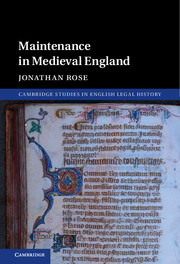
BOOK: Jonathan ROSE, Maintenance in Medieval England (Cambridge: Cambridge University Press, 2017), xviii + 410 p. ISBN 9781107358324, 85 GBP

(image source: Cambridge)

Book abstract:
This is the first book covering those who abused and misused the legal system in medieval England and the initial attempts of the Anglo-American legal system to deal with these forms of legal corruption. Maintenance, in the sense of intermeddling in another person's litigation, was a source of repeated complaint in medieval England. This book reveals for the first time what actually transpired in the resultant litigation. Extensive study of the primary sources shows that the statutes prohibiting maintenance did not achieve their objectives because legal proceedings were rarely brought against those targeted by the statutes: the great and the powerful. Illegal maintenance was less extensive than frequently asserted because medieval judges recognized a number of valid justifications for intermeddling in litigation. Further, the book casts doubt on the effectiveness of the statutory regulation of livery. This is a treasure trove for legal historians, literature scholars, lawyers, and academic libraries.
Table of contents:
1. Introduction
2. Social norms relating to the assistance of others
3. Legal responses to the corruption of justice
4. The early litigation 1272–1327
5. Efforts to deal with corruption of justice in the reign of Edward III
6. Criminal and civil litigation during the reign of Edward III
7. Maintenance and medieval literature
8. Changes in the late medieval period
9. The development of the law of maintenance: permissible justifications for meddling
10. The development of the law of maintenance: illegal maintenance
11. Livery
12. Achieving the legislative objectives of the maintenance statutes
13. Conclusion.
On the author:
Jonathan Rose is Professor of Law and Willard H. Pedrick Distinguished Research Scholar Emeritus, Sandra Day O'Connor College of Law, Arizona State University; Faculty Affiliate, Arizona Center for Medieval and Renaissance Studies, Arizona State University; and Affiliated Faculty Member, Department of History, Arizona State University. He has taught legal history, contracts, professional responsibility, and antitrust. He has also received several awards for outstanding teaching. Professor Rose is the author of numerous articles and other works on legal history, antitrust, economic regulation, and legal ethics.

More information with the publisher.