Search

Showing posts with label history of religion. Show all posts

20 May 2025

BOOK: Adrien ARACIL, Histoire d'une liberté dans la France moderne. Protestants, politique et monarchie (vers 1598-vers 1629) [Bibliothèque d'histoire de la Renaissance, dir. Denis CROUZET & Nicolas LE ROUX; 32] (Paris: Classiques Garnier, 2025), 919 p. ISBN 978-2-406-17854-5, € 49


(image source: Classiques Garnier)

Abstract:
Parler de liberté pour comprendre la politique d’Ancien Régime est inattendu. Comprise comme une capacité à l’action libre, la notion structure pourtant la façon dont les huguenots se sont glissés dans le cadre contraint où la monarchie française se réélabore après les guerres de Religion.

Read more here: DOI 10.48611/isbn.978-2-406-17856-9.

05 March 2025

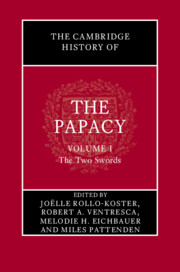
BOOK: Joëlle ROLLO-KOSTER, Robert A. VENTRESCA, Melodie H. EICHBAUER & Miles PATTENDEN (eds.), The Cambridge History of the Papacy, Vol. 1: The Two Swords (Cambridge: Cambridge University Press, 2025), ISBN 9781108485234


(image source: CUP)

Abstract:
Throughout its history, the papacy has engaged with the world. Volume 1 addresses how the papacy became an institution, and how it distinguished itself from other powers, both secular and religious. Aptly titled 'The Two Swords,' it explores the papacy's navigation, negotiation, and re-negotiation, initially of its place and its role amid changing socio-political ideas and practices. Surviving and thriving in such environment naturally had an impact on the power dynamics between the papacy and the secular realm, as well internal dissents and with non-Catholics. The volume explores how changing ideas, beliefs, and practices in the broader world engaged the papacy and lead it to define its own conceptualizations of power. This dynamic has enabled the papacy to shift and be reshaped according to circumstances often well beyond its control or influence.

Table of contents:

General Introduction Joëlle Rollo-Koster, Robert A. Ventresca, Melodie Eichbauer and Miles Pattenden
Part I. Christendom and Empire:
1. Inventing Peter in late antiquity George E. Demacopoulos
2. From Constantine to Justinian Hartmut Leppin
3. The Popes and the papacy in the Carolingian world Thomas F. X. Noble
4. The papal monarchy and the empire in the thirteenth century Brett Edward Whalen
5. Papal primacy and the holy Roman emperors (IV–XII centuries) Uta-Renate Blumenthal
Part II. Crises, Schisms, and Dissent:
6. Gregory VII and the reform movement John Howe
7. The schism of 1054 Eugene Webb
8. The papacy, heresy, and religious dissent Irene Bueno
9. The papacy and crusaders: from the Saracens to Stalin Rebecca Rist
10. The Avignon papacy and the Great Western Schism Blake Beattie
11. The Great Western Schism in history and memory Bénédicte Sère
Part III. Reformations and Revolutions:
12. The papacy and the Protestants (1517–63) Nelson Minnich
13. The Reformation Popes Tadhg Ó hAnnracháin
14. The Popes and The Enlightenment Shaun Blanchard
15. The papacy in revolution 1775–1823: the Cesena Popes, Pius VI and Pius VII Ambrogio Caiani
16. Enlightenment and its aftermath: liberalism, materialism, and nationalism Daniele Menozzi
17. Pope Leo XIII and the Catholic response to modernity Robert P. Kraynak
Part IV. Theopolitics and Religious Diplomacy:
18. Papal elections and renunciations Miles Pattenden
19. The military papacy David Alvarez
20. Benedict XV (1914–22) and the legacy of a wartime papacy John Pollard
21. The papacy and slavery Justine Walden
22. The papacy and the decolonization of Africa Elizabeth Foster
23. The rise of liberation theology Michael E. Lee
24. Papal diplomacy during and since the Ancien Régime Toby Osborne
Part V. Inter-Faith Relations: Confrontation and Dialogue:
25. The papacy and the Christian East: the theological issues Edward Siecienski
26. The Popes and the Protestant churches Joshua Bennett
27. The Popes and Islam John Tolan
28. The Islamic world and the papacy Alexander Mallett
29. The medieval papacy and the Jews Kenneth Stow
30. The papacy and the Jews since the French Revolution Adrian Ciani

Bibliography.

On the editors:

Joëlle Rollo-Koster, University of Rhode Island Joëlle Rollo-Koster has published widely on the social, cultural, religious, and political history of the late Middle Ages. She is a specialist of the Avignon Papacy and of the Great Western Schism and is a Fellow of the Medieval Academy of America. Her most recent publications are Avignon and its Papacy, 1309-1417: Popes, Institutions, and Society (Rowman & Littlefield, 2015); The Great Western Schism, 1378-1417: Performing Legitimacy, Performing Unity (Cambridge University Press, 2022); and, as editor, Death in Medieval Europe: Death Scripted and Death Choreographed (Routledge, 2016). She was knighted Chevalier de l'Ordre des Palmes Académiques in 2016. Robert A. Ventresca, King’s University College at Western University Robert A. Ventresca has published widely on a diverse range of topics including the papacy in the era of the two world wars and the Holocaust. His book Soldier of Christ: The Life of Pope Pius XII (Harvard University Press, 2013) was awarded the 2014 Harry C. Koenig Prize by the American Catholic Historical Association.  He is a member of the Committee on Ethics, Religion, and the Holocaust at the US Holocaust Memorial Museum in Washington, DC. Melodie H. Eichbauer, Florida Gulf Coast University Melodie H. Eichbauer is Professor of Medieval History at Florida Gulf Coast University. Her research focuses on the dissemination of legal knowledge and the interpretation of law, and the ways in which social, political, and intellectual developments and trends shaped both between c.1000 and c.1500. She is the author of Medieval Canon Law, 2nd ed. (an expanded and revised version of the 1st edition by James A. Brundage) (Routledge, 2022); editor of A Cultural History of Genocide, vol. 2, The Middle Ages (Bloomsbury Academic Publishers, 2021); the co-editor, with Danica Summerlin, of The Use of Canon Law in Ecclesiastical Administration, 1000–1250 (Brill, 2018); and the co-editor, with Kenneth Pennington, of Law as Profession and Practice in Medieval Europe: Essays in Honor of James A. Brundage (Ashgate, 2011). Miles Pattenden, University of Oxford Miles Pattenden has published widely on the papacy and the Catholic Church in the Counter-Reformation and Enlightenment. He is the author of Pius IV and the Fall of the Carafa: Nepotism and Papal Authority in Counter-Reformation Rome (Oxford University Press, 2013) and Electing the Pope in Early Modern Italy, 1450–1700 (Oxford University Press, 2017), and is writing a general history of the Catholic Church for Princeton University Press. 

Read more here: DOI 10.1017/9781108750608. 


15 December 2023

FELLOWSHIPS: IEG Fellowships for Doctoral Students (m/f/div) (Mainz: IEG, deadline 15 FEB 2024)

(Image source: Wikimedia Commons)


 IEG Fellowships for Doctoral Students (m/f/div)

The Leibniz Institute of European History (IEG) awards 8–10 fellowships for doctoral students in European history, the history of religion and other historical disciplines.

The IEG funds PhD projects in European history from early modern to contemporary history. We are particularly interested in projects

  • with a comparative or cross-border approach
  • on European history in its relation to the wider world
  • on topics of intellectual and religious history
  • that make use of digital tools and methods.

What we offer
IEG Fellowships provide a unique opportunity to pursue and finalise individual PhD projects while living and working at the Institute in Mainz for 6–12 months. The monthly stipend is € 1,350. Additionally, it is possible to apply for family or child allowance.

Requirements
Successful candidates are required to reside at the Institute in Mainz throughout the duration of their fellowship. They are expected to be active members on the IEG’s research community and to participate in the weekly colloquia and scholarly activities. Moreover, they will present their work in progress at least once during their stay. The IEG supports the writing up of dissertations and does not provide funding for preliminary research, language courses or the revision of book manuscripts. At the time of the application deadline, candidates should have pursued their PhD for a maximum of three years. PhD theses continue to be supervised under the auspices of the fellows' home universities. We expect proficiency in English. The IEG encourages applications from women.

Application 
Please combine all application materials, except for the application form, into a single PDF and send it to: application@ieg-mainz.de

Applications may be submitted in either English or German; we recommend that candidates use the language in which they are most proficient.

Application forms can be downloaded here: https://buff.ly/3Tl47ZG

The IEG has two deadlines each year for IEG Fellowships: February 15 and August 15.

The next deadline for applications is February 15, 2024.

Please direct any questions concerning the IEG Fellowship Programme to Ms. Joke Kabbert: fellowship@ieg-mainz.de

Contact Information

Leibniz Institute of European History (IEG)
Head of Research Fellowship Programme
Joke Kabbert, M. A.
Alte Universitaetsstrasse 19
55116 Mainz
Germany