Search

Showing posts with label copyright law. Show all posts

05 November 2024

BOOK: Stephan MEDER (ed.), Geschichte und Zukunft des Urheberrechts IV [Beiträge zu Grundfragen des Rechts; 43] (Göttingen: V&R unipress, 2024), 310 p., ISBN 978-3-8471-1714-8


ABOUT THE BOOK:

The contributions in this volume deal with the broad spectrum of historical and current problems of copyright law. They range from text adaptations in works by the humanist Conrad Lagus to the censorship policy in Gerhart Hauptmann's social drama “The Weavers” (“Die Weber”) and to the question of whether a patron can force an artist to create a work. In addition, insights are provided into the early history of IT law as well as findings on the licensing of platform software and the copyright law for press publishers. The volume makes it clear that the conflict of interests between creator, exploiter and user, which has always existed, cannot be resolved with ready-made templates.

ABOUT THE EDITOR:

Prof. Dr. Stephan Meder has been teaching civil law and legal history at the Faculty of Law at the University of Hanover since 1998.

Read more here.


20 April 2022

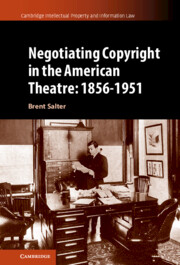
ONLINE BOOK PRESENTATION: Discussion on the book Brent SALTER, Negotiating Copyright in the American Theatre: 1856-1951 (5 May, Stanford-ONLINE)


(Image source: Cambridge University Press)


Please join us for   The Stanford Center for Law and History and the Department of Theater and Performance Studies, Stanford will co-host a book talk with author and Stanford Center for Law and History Fellow Brent Salter: “Negotiating Copyright in the American Theatre: 1856-1951". Commentators for the event include Derek Miller (Harvard), Kara Swanson (Northeastern Law), Marlis Schweitzer (York Theatre), Jose Bellido (Kent Law), and Ann Folino White (MSU Law). The event will be chaired by Amalia Kessler (SCLH Director and Stanford Law) and Kathy Bowrey (UNSW Law).

The book talk will be in-person (Room 320D, Stanford Law School) and live streamed at the HowlRound website here, on Thursday, May 5, 12:40 – 2:00 PM (Pacific).

To RSVP, click here. Those who confirm their attendance will receive a separate email containing the link to the event.


ABSTRACT

The book is a historical account of how creation is negotiated in the American theatre. It is also about how the American theatre has structured its industry relationships and how industry stakeholders, and in particular dramatists, have responded to these structures through industry customs and collective organization. The research seeks to explain how stakeholders who controlled the transformation of the dramatic work from the playwright’s manuscript to the theatrical stage asserted expansive power over theatrical creation between the mid nineteenth and mid twentieth centuries. These stakeholders (mediators of the American theatre) evolved in different forms: for-profit, nonprofit, and governmental. They included theatrical agents, transnational publishers, producers and managers that emerged and formed combination businesses, and government programs established during the New Deal. Instead of situating copyright law at the center of legal authority structures in the American theatre, the book explores how labor relationships, administrative structures and processes, control over material resources, informal guild expectations and minimum contracts, and other professional norms, all shape how theatre-makers relate cultural production to the more nebulous space of a realized theatrical performance on a stage.


More information can be found here.

22 October 2020

BOOK: Stephan MEDER (Ed.), Geschichte und Zukunft des Urheberrechts II (Göttingen: Vandenhoeck & Ruprecht, 2020). ISBN 978-3-8471-1176-4, 45.00 EUR


Vandenhoeck & Ruprecht is publishing a new book on past and future of copyright law.

ABOUT THE BOOK

Warum hat es ein römisches Urheberrecht nicht gegeben? Hat der Humanist Konrad Lagus die Aequitas-Lehre bei seinem Kollegen Budé einfach abgekupfert? Worum ging es bei dem Kampf zwischen Richard Strauss und Luigi Denza? Wer streitet sich um die »Original-Sachertorte«, und was hat das Foto des toten Bismarcks mit der DSGVO zu tun? Die Beiträgerinnen und Beiträger aus Wissenschaft und Praxis erörtern das breite Spektrum urheberrechtlicher Sachverhalte und Entscheidungen. Inhaltlich behandeln die Beiträge die Geschichte des Urheberrechts in verschiedensten Werkarten. Dabei wird deutlich, dass der in allen Zeiten bestehende Interessenkonflikt zwischen Werkschöpfer, Verwerter und Nutzer mit vorgefertigten Schablonen nicht zu lösen ist. Mit einem Blick »zurück nach vorn« liefern sie Anstöße zum Nachdenken über ein künftiges Urheberrecht.

ABOUT THE EDITOR

Prof. Dr. Stephan Meder lehrt seit 1998 Zivilrecht und Rechtsgeschichte an der Juristischen Fakultät der Universität Hannover.


More info here

26 March 2019

BOOK: Monika DOMMANN (transl. Sarah Pybus), Authors and Apparatus : A Media History of Copyright (Ithaca: Cornell University Press, 2019). ISBN 9781501709920, $41.95


Cornell University Press has published a new book on media changes and the history of copyright law.

ABOUT THE BOOK

Copyright is under siege. From file sharing to vast library scanning projects, new technologies, actors, and attitudes toward intellectual property threaten the value of creative work. However, while digital media and the Internet have made making and sharing perfect copies of original works almost effortless, debates about protecting authors' rights are nothing new. In this sweeping account of the evolution of copyright law since the mid-nineteenth century, Monika Dommann explores how radical media changes—from sheet music and phonographs to photocopiers and networked information systems—have challenged and transformed legal and cultural concept of authors' rights.

Dommann provides a critical transatlantic perspective on developments in copyright law and mechanical reproduction of words and music, charting how artists, media companies, and lawmakers in the United States and western Europe approached the complex tangle of technological innovation, intellectual property, and consumer interests. From the seemingly innocuous music box, invented around 1800, to BASF's magnetic tapes and Xerox machines, she demonstrates how copyright has been continuously destabilized by emerging technologies, requiring new legal norms to regulate commercial and private copying practices. Without minimizing digital media's radical disruption to notions of intellectual property, Dommann uncovers the deep historical roots of the conflict between copyright and media—a story that can inform present-day debates over the legal protection of authorship.

TABLE OF CONTENTS

List of Illustrations
Acknowledgments
List of Abbreviations
Introduction: A Media History of Legal Norms
Part I: Writing and Recording
1. Sheet Music
2. Images of Books
3. Voice Recorders
4. Canned Music
Part II: Collecting Agencies and Research Materials
5. Collecting Collectives
6. Celluloid Circulations
7. Performing Artists
Part III: Private Copies and Universal Standards
8. Fees for Devices
9. Flow of Information
10. Authors of Tradition
Conclusion: Legal Histories of Media Transformation
Further ReadingBibliographic Essay
Notes
Bibliography
Index

More information here